Well, here I am in Maynooth for the first time in 2018. I flew over from Cardiff yesterday. The flight was rather bumpy owing to the strong winds following Storm Eleanor, and it was rather chilly waiting for the bus to Maynooth from Dublin Airport; nevertheless I got to my flat safely and on time and found everything in order after the Christmas break.
This morning I had to make a trip by train to Dublin city to keep an appointment at the Intreo Centre in Parnell Street, which is about 15 minutes walk from Dublin Connolly train station. I bought an Adult Day Return which costs the princely sum of €8.80. Trains, stations and track in Ireland are maintained and operated by Irish Rail (Iarnród Éireann), which is publicly owned. Just saying.
The distance between Maynooth and Dublin about 25 km, which takes about 40 minutes on the local stopping train or about 25 minutes on the longer distance trains which run nonstop from Maynooth to Dublin. As it happens I took one of the fast trains this morning, which arrived on schedule, as did the return journey on a commuter train. My first experience of the Irish railway system was therefore rather positive.
I had thought of having a bit of a wander around the city on my way to Parnell Street but it was raining and very cold so I headed straight there. I arrived about 20 minutes ahead of my scheduled appointment, but was seen straight away.
The reason for the interview was to acquire a Personal Public Services Number (PPSN), which is the equivalent of the National Insurance Number we have in the United Kingdom. This number is needed to be registered properly on the tax and benefit system in Ireland and is the key to access a host of public services, the electoral roll, and so on. You have to present yourself in person to get a PPSN, presumably to reduce the opportunity for fraud, and I was told the interview would take 15 minutes. In fact, it only took about 5 minutes and at the end a photograph was taken to go on the ID card that is issued with the number on it.
So there I was, all finished before I was even due to start. The staff were very friendly and it all seems rather easy. Fingers crossed that the letter informing me of my number will arrive soon. It should take a week or so, so I’m told. After that I should be able to access as many personal services as I want whenever I want them. (Are you sure you have the right idea? Ed.)
For the return trip to Maynooth I got one of the slower commuter trains, stopping at intermediate stations and running right next to the Royal Canal, which runs from Dublin for 90 miles through Counties Dublin, Kildare, Meath and Westmeath before entering County Longford, where it joins the River Shannon. One of the intermediate stations along the route next to the canal is Broombridge, the name of which stirred a distant memory.
A quick application of Google reminded me that the town of Broombridge is the site of the bridge (Broom Bridge) beside which William Rowan Hamilton first wrote down the fundamental result of quaternions (on 16th October 1843). Apparently he was walking from Dunsink Observatory into town when he had a sudden flash of inspiration and wrote the result down on the spot, now marked by a plaque:
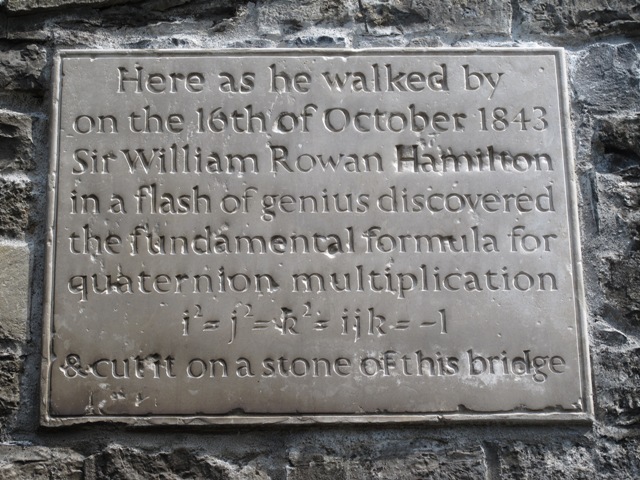
Picture Credit: Brian Dolan
This episode is commemorated on 16th October each year by an annual Hamilton Walk. I look forward to reporting from the 2018 walk in due course!
P.S. Maynooth is home to the Hamilton Institute which promotes and facilitates research links between mathematics and other fields.