Archive for the History Category

The Centenary of the First Dáil

Posted in History with tags , , , , , , , , , on January 21, 2019 by telescoper

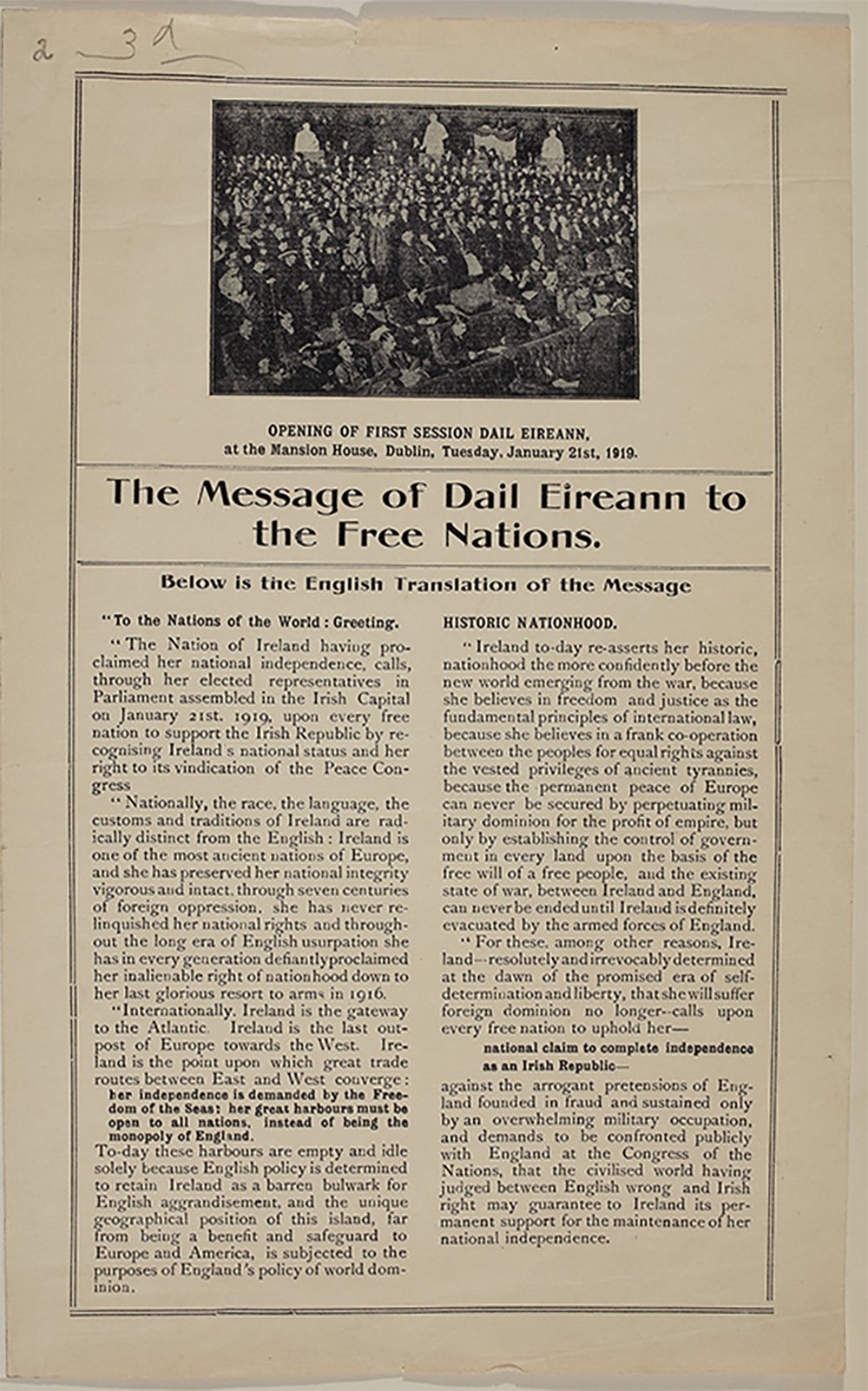
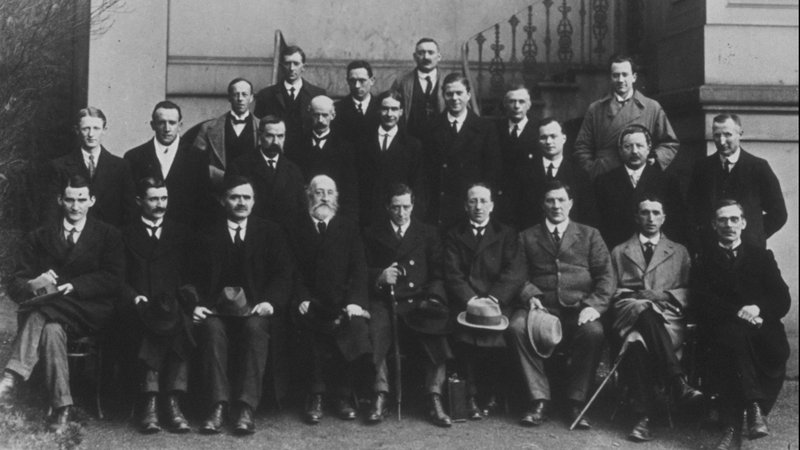
As I mentioned at the weekend, today marks the centenary of the historic first meeting of the Dáil Éireann, at the Mansion House in Dublin on (Tuesday) 21st January 1919. The picture above shows the 27 Teachtaí Dála (TDs) present. The event is being commemorated this afternoon.

I’m summarizing the events surrounding the First Dáil largely because I didn’t learn anything about this at School. Despite Ireland being such a close neighbour, Ireland’s history is only covered in cursory fashion in the British education system.

The background to the First Dáil is provided by the General Election which took place in November 1918 and which led to a landslide victory for Sinn Féin who won 73 seats, and turned the electoral map of Ireland very green, though Unionists held 22 seats in Ulster.

In accordance with its policy of abstentionism, the Sinn Féin MPs refused to take their seats in Westminster and instead decided to form a provisional government in Ireland. In fact 35 of the successful candidates for the General Election were actually in prison, mostly because of their roles in the 1916 Easter Rising and the Ulster Unionists refused to participate, so the First Dáil comprised only 27 members as seen in the picture. It was chaired by Sean T. O’Kelly; Cathal Brugha was elected Speaker (Ceann Comhairle).

As part of this meeting, the adoption and the ritual of ‘the Turning of the Seal’ establishing the Sovereignty of the Irish Republic was begun. The First Dáil published The Declaration of Irish Independence.

It also approved a Democratic Programme, based on the 1916 Proclamation of the Irish Republic, and read and adopted a Message to the Free Nations of the World in Irish, English and French:

On the same day as the first meeting of the Dáil (though the timing appears not to have been deliberate), two members of Royal Irish Constabulary were shot dead by volunteers of the Irish Republication Army in an ambush at Soloheadbeg, Co Tipperary. The IRA squad made off with explosives and detonators intended for use in mining. This is generally regarded as the first incident in the Irish War of Independence. The war largely consisted of a guerrilla campaign by the IRA countered by increasingly vicious reprisals by British forces, especially the infamous Black and Tans who quickly became notorious for their brutality and indiscipline.

Following the outbreak of the War of Independence, the British Government decided to suppress the Dáil, and in September 1919 it was prohibited. The Dáil continued to meet in secret, however, and Ministers carried out their duties as best they could.

The War of Independence lasted until the summer of 1921, when it was ended by a truce and the negotiation of the Anglo-Irish Treaty. That, in turn, triggered another cycle of violence with the breakout of the Irish Civil War in 1922 between pro-Treaty and anti-Treaty forces and the eventual partition of Ireland into the independent Republic and Northern Ireland which remained part of the United Kingdom.

Domhnall Ua Buachalla and the First Dáil

Posted in History, Maynooth on January 19, 2019 by telescoper

This Monday, 21st January 2019, is the centenary of a momentous day in Irish history. On 21st January 1919 the first Dáil Éireann met and issued a Declaration of Irish Independence and so the War of Irish Independence began..

This post from Maynooth Library describes fascinating archived material relating to Domhnall Ua Bramhall, who was elected to the First Dáil for Kildare North (which includes Maynooth).

I’ll probably do a brief post on Monday to mark the centenary.

Special Collections's avatarMU Library Treasures

Ciara Joyce, Archivist

May God send in every generation men who
live only for the Ideal of Ireland A Nation’ James Mallon B. Co. III Batt.
I.R.A. Hairdresser “To the boy of
Frongoch” with E. D’Valera Easter Week 22/12/16 Frongoch’.

                                                            MU/PP26/2/1/7 Autograph by James Mallon

Members of the first Dáil 1919

On the 21st of January 1919, the first meeting of Dáil Éireann took place in the Mansion House, Dublin. Elected in the 1918 General Election, the members of parliament refused to take up their seats in Westminster, and instead established the Dáil as a first step in achieving the Irish Republic.

Prominent elected members included Michael Collins,Constance Markievicz, Éamon de Valera, Cathal Brugha, W.T. Cosgrave, Eoin MacNeill and Arthur Griffith. A number of T.Ds, including de Valera and Markievicz, were serving sentences in British prisons at the time and…

View original post 893 more words

Turning a Blind Eye

Posted in History, Politics with tags , , on January 2, 2019 by telescoper

As my little festive sojourn in Wales draws to a close, there’s no sign of the Brexit Pantomime season doing likewise. The latest episode of this tragicomedy saw Transport Secretary Chris Grayling dishing out £14 million of taxpayers’ money to a ‘company’ called Seaborne Freight to operate ferries between Ramsgate and Ostend when, in less than 90 days, the UK leaves the EU.

As his name suggests, there’s something very fishy about Grayling’s decision to hand out a lucrative contract, without any proper procurement process, to a company that has only existed for a few months, has never operated a ferry, has no trained staff and, above all, has no ships!

Is this lawful? I doubt it. Is it ethical? Certainly not. Will Grayling get away with it? Almost certainly. Recent events have shown that illegality, fraud and corruption are all part of the job description for a Brexiter.

Perhaps Grayling is trying to channel Lord Nelson who, in legend anyway, at the Battle of Copenhagen in 1801, held a telescope to his blind eye when ordered to retreat, saying “I see no ships”. The difference here is of course that the ships can’t be seen because they don’t exist.

“I see no ships” is actually a misquote: what Nelson said was something like “I have a right to be blind sometimes. I really do not see the signal”. This event is not the origin of the phrase ‘to turn a blind eye’, either: the OED gives an example of its usage from 1698..

Anyway I think we can all see what the signal is in this case, a desperate government throwing public money down the drain without a shred of accountability. Get used to it. There will be a lot more of that in Brexit Britain. It’s what you voted for, isn’t it?

Fourier, Hamilton and Ptolemy

Posted in History, Poetry, The Universe and Stuff with tags , , , , , , , on December 17, 2018 by telescoper

As we stagger into the last week of term I find myself with just two lectures to give in my second-year module on Vector Calculus and Fourier Series. I didn’t want to present the two topics mentioned in the title as disconnected, so I linked them in a lecture in which I used the divergence theorem of vector calculus to derive the heat equation, the solution of which led Joseph Fourier to devise his series in Mémoire sur la propagation de la chaleur dans les corps solides (1807), a truly remarkable work for its time that inspired so many subsequent developments.

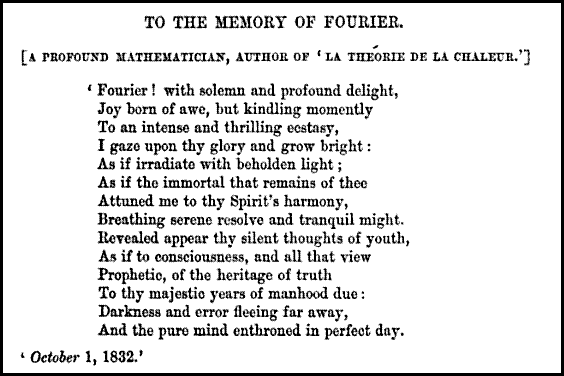
Fourier’s work was so influential and widely admired that it inspired a famous Irish mathematician William Rowan Hamilton to write the following poem:

Hamilton-for Fourier

The serious thing that strikes me is not the quality of the verse, but how many scientists of the 19th Century, Hamilton included, saw their scientific interrogation of Nature as a manifestation of the human condition just as the romantic poets saw their artistic contemplation and how many poets of the time were also interested in science.

Anyway I was looking for nice demonstrations of Fourier series to help my class get to grips with them when I remembered this little video recommended to me some time ago by esteemed Professor George Ellis. It’s a nice illustration of the principles of Fourier series, by which any periodic function can be decomposed into a series of sine and cosine functions.

This reminds me of a point I’ve made a few times in popular talks about Astronomy. It’s a common view that Kepler’s laws of planetary motion according to which which the planets move in elliptical motion around the Sun, is a completely different formulation from the previous Ptolemaic system which involved epicycles and deferents and which is generally held to have been much more complicated.

The video demonstrates however that epicycles and deferents can be viewed as the elements used in the construction of a Fourier series. Since elliptical orbits are periodic, it is perfectly valid to present them in the form a Fourier series. Therefore, in a sense, there’s nothing so very wrong with epicycles. I admit, however, that a closed-form expression for such an orbit is considerably more compact and elegant than a Fourier representation, and also encapsulates a deeper level of physical understanding.

The Irish Accent

Posted in History, Maynooth with tags , , , , , , , , on December 11, 2018 by telescoper

It’s been a very busy day, as Tuesdays tend to be this term, so I thought I’d wind down with a little blog post.

Some time ago I got an email from Maynooth University about Irish language classes. Still feeling a bit ashamed about not having learned Welsh in all my time in Cardiff, I thought I’d sign up for the Beginners class and fill in a Doodle Poll to help the organizers schedule it. Unfortunately, when the result was announced it was at a time that I couldn’t make owing to teaching, so sadly I’m not learning Irish properly yet.

I have picked up a few things about the language, however, which it might be worth passing on here. Although Irish and Welsh are both Celtic languages they are from two distinct groups: the Goidelic group that comprises Irish, Manx and Scottish Gaelic; and the Brythonic group that comprises Welsh, Cornish and Breton. These are sometimes referred to as q-Celtic and p-Celtic, respectively, although not everyone agrees that is a useful categorization. Incidentally, Scottish Gaelic is not the language spoken by the Celtic people who lived in Scotland at the time of the Romans, the Picts, which is lost. Scottish Gaelic is actually descended from Middle Irish. Also incidentally, Breton was taken to Brittany by a mass migration of people from South-West Britain which peaked somewhere around 500 AD. I guess that was the first Brexodus.

Welsh and Irish don’t sound at all similar to me, which is not surprising really. It is thought that the Brythonic languages evolved from a language  brought to Britain by people from somewhere in Gaul (probably Northern France), whereas the people whose language led to the Goidelic tongues were probably from somewhere in the Iberia (modern-day Spain or Portugal). There are nevertheless some similarities. For example, `Merry Christmas’ is Nadolig Llawen in Welsh and Nollaig Shona in Irish..

Anyway, back to the topic of this post, there is only one accent in Irish (in the sense of a diacritic mark), which is the síneadh fada (`long accent’), sometimes called the fada for short, which looks the same as the acute accent in, e.g., French. There’s actually one in síneadh if you look hard enough. It just means the vowel is pronounced long (i.e. the first syllable of síneadh is pronounced SHEEN).

One does find quite a few texts (especially online) where the fada is carelessly omitted, but it really is quite important. For example Cáca is the Irish word for `cake’, while the unaccented Caca means `excrement’…

I took the above text in Irish and English from the front cover of an old examination paper. You can see the accents as well as another feature of Irish which is slightly similar to Welsh, the mysterious lower-case h in front of Éireann. This is a consequence of an initial mutation, in which the initial character of word changes in various situations according to syntax or morphology (i.e. following certain words changing the case of a noun or following certain sounds). This specific case is an an example of h-prothesis (of an initial vowel).

In Welsh, mutations involve the substitution of one character for another. For example, `Wales’ is Cymru but if you cross the border into Wales you may see a sign saying Croeso i Gymru, the `C’ having mutated. The Irish language is a bit friendlier to the learner than Welsh, however, as the mutated character (h in the example above) is inserted in front of the unmutated character. Seeing both the mutated and unmutated character helps a person with limited vocabulary (such as myself) figure out what’s going on.

Mutations of consonants also occur in Irish. These can involve lenition (literally `weakening’, also known as aspiration) or eclipsis (nasalisation). In the case of eclipsis the unmutated consonant is preceded by another denoting the actual sound, e.g. b becomes m in terms of pronunciation, but what is written is mb. On the other hand, lenition is denoted by an following the unmutated consonant.

In older forms of Irish the overdot (ponc séimhithe) -another diacritic – was used to denote lenition. Had this practice continued into the modern era there would be two Irish accents, but nowadays there is only one.

There are many ways to go mad…

Posted in Music, History with tags , , , on December 8, 2018 by telescoper

The clip below is of a live performance by Irish folk artist Lisa O’Neill (who is from Cavan) of her own song, `Violet Gibson’. I heard the studio version from her CD on the radio the other day and the first line really caught my attention. The Youtube version is preceded by a lengthy spoken by Lisa O’Neill which is worth listening to but if you want to jump to the point where the song starts, that’s about 5:27.

The story of Violet Gibson is both bizarre and tragic. She was in 1876 into a well-to-do family living in Merrion Square in Dublin. Her father, Edward Gibson, was made Baron Ashbourne in 1886. To cut a long story short, at 11am on 26th April 1926, Violet Gibson turned up in Rome where she attempted to shoot Fascist Leader Benito Mussolini with a pistol. She only failed in this task because Mussolini moved his head at the instant she pulled the trigger, and the bullet just grazed his nose. She tried to fire again, but her gun jammed. She was then seized by the angry mob of fascist supporters with whom she had mingled to get close enough to shoot. She was almost lynched but saved by the police. Eventually, the authorities came to the conclusion that she was insane and she was sent back to England. She spent the rest of her life in a psychiatric institution in Northampton. She died in 1956, at the age of 79.

P.S. If you want to find out more about Violet Gibson, I recommend a book about her life called The Woman Who Shot Mussolini by Frances Stonor Saunders.

P.P.S. Cavan is the county town of County Cavan, which is in the Irish Border Region. Although part of the province of Ulster, it is in the Republic of Ireland.

The Dublin Castle Scandal (1884) and “The Unspeakable Crime”

Posted in History, LGBTQ+ with tags , on November 16, 2018 by telescoper

This is quite a lengthy blog post but it gives an absolutely fascinating insight in a story of the underground gay subculture of Dublin in the 1880s…

Sam's avatarCome Here To Me!

The Dublin Castle homosexual scandal of 1884 is a complex story. It involves more than a dozen characters that were introduced over a series of separate criminal trials. All sections of society were involved. The upper echelons of serving police detectives, eminent civil servants and British Army captains. Aspirational middle-class bank clerks and Trinity college graduates. Right down to the semi-blind brothel-keepers and young male prostitutes who were described as “persons of the lowest class of life”. All of these men were accused in newspapers and in court of having same-sex physical relationships. Irish society was shocked.

My main interest is in one specific aspect of the scandal – the backgrounds and post-prison lives of three men who were convicted of running homosexual brothels in the city in 1884.

But before that, a very brief background.

Tim Healy (Irish Nationalist MP) accused two high-ranking British establishment figures, of being homosexual in the United…

View original post 1,599 more words

Private Arnold Ridley

Posted in History, Television with tags , , , on November 11, 2018 by telescoper

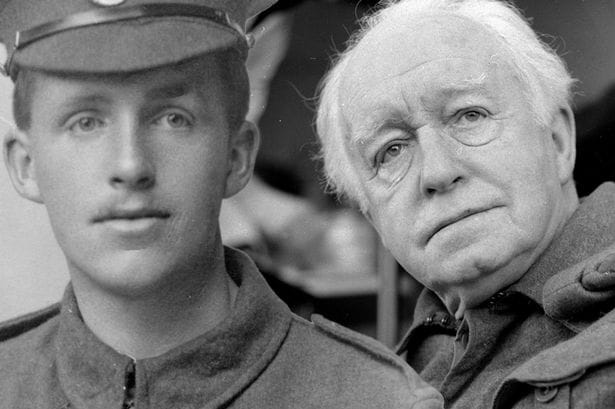
You probably recognize the elderly gentleman in the photograph on the right as Arnold Ridley who played Private Godfrey in the TV comedy series Dad’s Army. You might not have realized that the person on the left is also Arnold Ridley, photographed shortly after he enlisted in the Somerset Light Infantry in 1915. You also may not know that Ridley fought with great courage in the Battle of the Somme in 1916, during which he was very badly injured.

After being ordered to go `over the top’ near Gueudecourt as part of the Somme offensive, many of Ridley’s battalion were killed by machine gun fire as they advanced towards the enemy lines, but Ridley was among those who survived long enough to reach the German trenches.

In the desperate hand-to-hand struggle that ensued as he and the rest of unit fought their way along a trench, Ridley was knocked out by a blow from a rifle butt that turned out to have cracked his skull, and was bayonetted in the groin. His legs were riddled with shrapnel and he received a further bayonet wound to the hand, which left him permanently disabled. Somehow he survived, though for the rest of his life he suffered from blackouts and recurrent nightmares. He was discharged from the army on medical grounds in 1916, at the rank of Lance Corporal.

He never told anyone – not even his family – how he sustained his wartime injuries, and the facts only became known long after his death (in 1984, at the age of 88).

A Suspension of Hostilities

Posted in History, Politics with tags , , , , on November 11, 2018 by telescoper

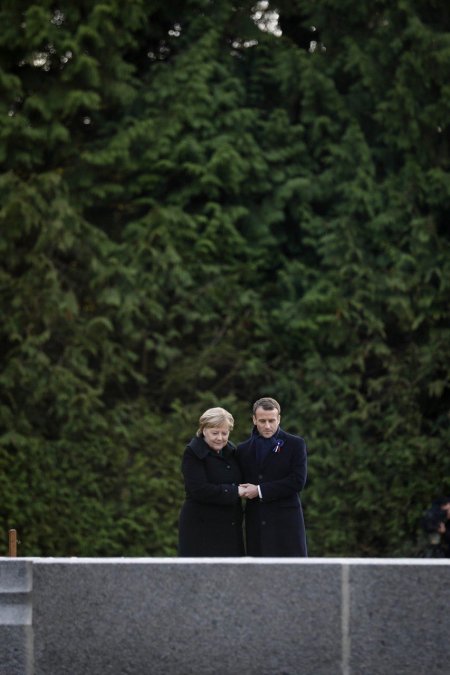
Among all the images produced during this weekend’s commemorations of the centenary of Armistice Day, this image of Angela Merkel and Emmanuel Macron struck me as particularly moving.

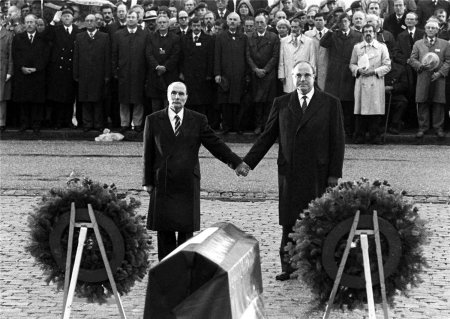
Part of the reasons is that it reminded me of this photograph, of President Mitterand and Chancellor Kohl, taken in 1984:

Exactly one hundred years after the truce that effectively ended the First World War, these images remind us how much suffering took place before Europe reached a point at which war between France and Germany became unthinkable. That peace now looks increasingly fragile as the forces of nationalism, spurred on by populist demagogues, and funded by greedy disaster capitalists, threaten to tear apart the institutions that have brought Europe together in a spirit of mutual cooperation for so long. All that has been achieved could so easily be lost.

As Fintan O’Toole has written in a long article in this weekend’s Irish Times, the First World War is, in many ways, still being fought. The Second World War was certainly very much a continuation of the First, after a break of just over twenty years, to which the short-sightedness of Western governments in their treatment of Germany was a contributing factor. The end of the First World War saw not only the disintegration of the German Empire (and the abdication of the Kaiser), but also the collapse of Tsarist Russia, and the end of the Austro-Hungarian and Ottoman Empires to boot. We are still living with the consequences of that upheaval.

All this reminds us – or should remind us – that the word `armistice’ means `a truce’ or `a suspension of hostilities’ rather than a lasting peace, and it is by no means impossible we could be sleepwalking to disaster once more. As President Macron put it in his speech today

Les démons anciens resurgissent : des idéologies nouvelles manipulent des religions, l’Histoire menace de reprendre son cours tragique. Faisons une fois de plus ce serment des Nations de placer la paix plus haut que tout, car nous en connaissons le prix.

Frankly, I fear very much for the future and take solace only in the fact that I am no longer young.

I have found the pomp and ceremony of this year’s official Armistice commemorations very difficult to endure. Perhaps there are some people, including some in high places, who have learned the lessons of history, but it is also clear that there are very many who have not.

Which brings me to the poppy. I have written quite a few pieces on this blog, around the time of Remembrance Sunday, about the wearing of a poppy, the last being in 2016. I have worn a poppy at this time of year for most of my adult life, but I decided last year to stop.

For one thing, there is no pressure to wear a poppy here in Ireland. Indeed, many Irish people see the poppy mainly as a symbol of British militarism and colonial oppression. Even at Friday’s concert to mark the Armistice I saw only a few audience members wearing a poppy, and most of them were the shamrock version commemorating the sacrifice of Irish soldiers during the Great War.

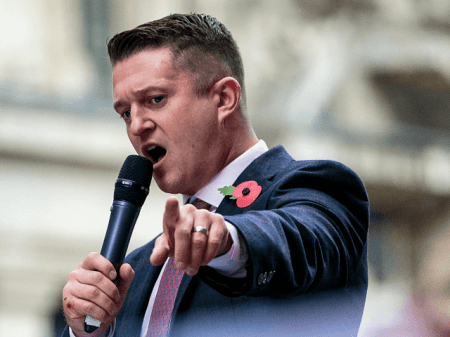
But I don’t think I’ve ever really been that susceptible to peer pressure, so that’s not the main reason for my not wearing a poppy. The main reason is that over the past couple of years the poppy has been appropriated by the likes of racist thug, career criminal and founder-member of the EDL, Stephen Yaxley-Lennon (also known as Tommy Robinson):

I simply cannot bring myself to wear the same badge as this creature, nor can I stand the hypocrisy of those politicians who make a show of wearing it while happily encouraging the rise of nationalism. Enough is enough. The message of the poppy is supposed to be `Lest We Forget’. I’m afraid far too many have already forgotten.

On The Alteration Of Time

Posted in History with tags , , , , on October 28, 2018 by telescoper

So here we are again, having put our clocks back an hour. Summer Time is over, but at least I had extra time to do this morning’s crosswords. Or so it seems. It’s really only the clocks that changed, not the time. But then what is time, other than what clocks measure?

Anyway, before I get too philosophical let me mention that I found the marvellous poster above on Twitter. It’s from 1916, when British Summer Time was introduced. I was surprised that the practice of changing clocks backwards and forwards began so recently in the United Kingdom. To be honest I’m also surprised that the practice persists to this day, as I can’t see any real advantage in it.

It would be better in my view to stick with Greenwich Mean Time throughout the year. Any institution or organisation that wants to change its working hours in summer can easily do so, but the world of work is far more flexible nowadays than it was a hundred years ago and I think few would feel the need.

Anyway, while I am on about Mean Time, here is a another poster from 1916.

Until October 1916, clocks in Ireland were set to Dublin Mean Time, as defined at Dunsink Observatory rather than at Greenwich. The adoption of GMT in Ireland was driven largely by the fact that the British authorities found that the time difference between Dublin and London had confused telegraphic communications during the Easter Rising earlier in 1916. Its imposition was therefore, at least in part, intended to bring Ireland under closer control and this did not go down well with Irish nationalists.

Ireland had not moved to Summer Time with Britain in May 1916 because of the Easter Rising. Dublin Mean Time was 25 minutes 21 seconds behind GMT but the change was introduced at the same time as BST ended in the UK, hence the alteration by one hour minus 25 minutes 21 seconds, ie 34 minutes and 39 seconds as in the poster.