Archive for the History Category

George’s Marvellous Medicine

Posted in History, Literature with tags , , , on September 13, 2016 by telescoper

Today is the 100th anniversary of the birth of author Roald Dahl, who was born in Llandaff, Cardiff, on 13th September 1916.  To celebrate this occasion, Cardiff University’s School of Chemistry has tried to recreate some of the phenomena described in one of Dahl’s children’s books, George’s Marvellous Medicine. Enjoy!


250 Years of Dalton

Posted in History, The Universe and Stuff with tags , on September 6, 2016 by telescoper

Having a quick look at Twitter this morning as I drank my coffee I discovered that today is the 250th anniversary of the eminent English scientist John Dalton, who was born on 6th September 1766. Dalton is most famous in the United Kingdom for his work on chemistry and physics, and somewhat less so for his pioneering studies of colour blindness. I didn’t know until quite recently, in fact, that the birthday of John Dalton, who was himself colour blind, is also  Colour Blindness Awareness Day so I thought I’d do a quick post to mark the occasion. You might also be interested in this old guest post on the subject of colour and colour perception.

Here’s a test for some of the main types of colour blindness – can you read the numbers?

Colour_Blind

Colour blindness comes in different forms and affects a significant fraction of the population, with a much higher rate of occurence in males (up to 1 in 10 in some groups) than in females (about 1 in 200). It also varies significantly across different populations, with particularly low rates for, e.g., Fijian males (0.8 %) and much higher frequencies among, e.g. Russian males (9.2%). I am not colour-blind myself, but I know several colleagues who are. In fact at the meeting I was at last week, when one speaker decided to show two different sets of results on a graph by plotting one in red and the other in green, there were howls from several in the audience who couldn’t tell them apart. It’s very easy to make careless mistakes like this in preparing lecture materials when it takes only a small effort to make them suitable for all. I urge colleagues who teach to remember that if they are 100 men in the audience the likelihood is that there will be around 8 to 10 who are colour blind.

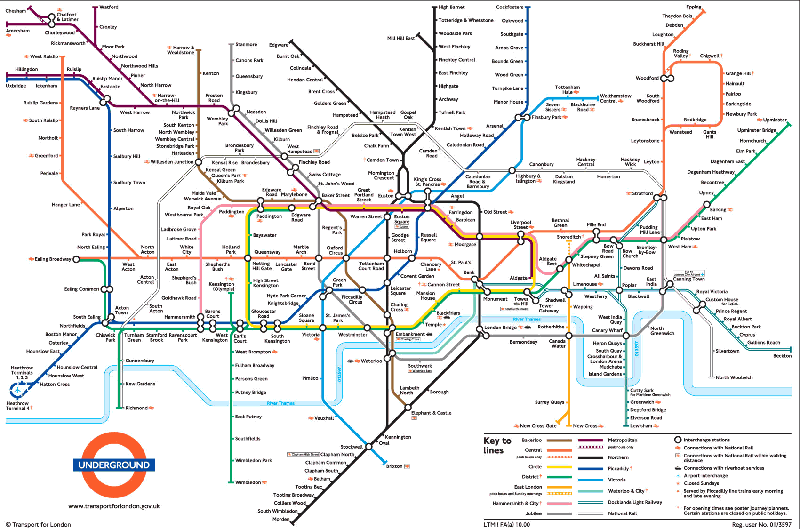
Thinking about this makes you realise how many maps and other designs rely on full colour perception for their effect. I’ve previously celebrated the London Underground map as an excellent example of graphic design, but it must be a nightmare to a person who is colour blind!

tube_map


It’s also worth mentioning that standard instructions at many institutions for marking examination papers is that the first marker should do  them in red ink and the second marker in green….

This all reminds me of the late Professor Francesco Lucchin, who first invited to Italy to work with the  astronomy group in Padova back in the early 1990s. Francesco and I ended up writing a book together and during the course of working on that he told me that he was “daltonic”. I later found out that this word does exist in English, but it is not in common usage as a word meaning “colour blind”. The standard word in Italian for “colour blind” is “daltonico” and there are many other variants in other European languages, such as the French “daltonien”. It’s very curious that Dalton’s name is so strongly associated with colour blindness across the European continent but not in the country of his birth. I wonder why this is?

By the way, if I understand correctly, the English word “daltonic” refers to a specific form of red/green colour blindness called deuteranopia, whereas the foreign variants can refer to any form of colour blindness.

P.S. You would have thought that the 25oth anniversary of Dalton’s birth would at least have warranted a Google doodle, but apparently not.

Henry Draper’s Photograph of M42

Posted in History, The Universe and Stuff with tags , , , , on July 29, 2016 by telescoper

I just remembered that last night I happened across an interesting episode of The Essay on Radio 3. It was about the first ever photograph of an astronomical nebula, which happened to be of the Orion Nebula (M42). The programme features Omar Nasim, a lecturer in History at Kent University, and is available on iPlayer or as a download here. It’s only 15 minutes long, but absolutely fascinating.

Here is the photograph concerned, taken by Henry Draper in 1880:

Henry_Drape_Orion_nebula_1880_inverted

The stars of the constellation Orion are clearly over-exposed in order to reveal the much fainter light from the nebula, and the resolution is poor compared to, e.g., this glorious Hubble Space Telescope image:

Hubble's sharpest view of the Orion Nebula

The Orion Nebula seen by Hubble. Credit: ESA/NASA/Hubble Space Telscope

Nevertheless the Draper photograph is of great historical importance, as it changed the way astronomers made images of such objects (by photography rather than by drawing) and ushered in a new era of scientific research.

Hat’s off to Henry Draper!

Vesti La Giubba

Posted in History, Opera with tags , on July 19, 2016 by telescoper

On what looks set to be the hottest day of the year I’m getting ready to head off to the Brighton Dome for this afternoon’s graduation ceremony for the School of Mathematical and Physical Sciences. This requires the wearing of ridiculously heavy robes on top of a suit which means that I’ll probably melt even before I start reading the names out. Anyway, the need to wear silly clothes for this performance reminded me of the famous aria Vesti La Giubba, which I translate roughtly as “Put on the costume”, from the  Opera Pagliacci. Here is a collection of recordings of this by the great Enrico Caruso, whose 1907 version of Vesti La Giubba was the world’s first million-selling record.


Jacob van Artevelde

Posted in History with tags , , , on July 17, 2016 by telescoper

image

This statue stands in the Vrijdagsmarkt (“Friday Market”) in Ghent just round the corner from the hotel I stayed in last week. It is of
Jacob van Artevelde , a merchant turned statesman who brokered an alliance with Edward III during the early stages of the Hundred Years War. Flanders had close commercial ties with England at the time and Artevelde thought it would be very bad for business to be on the wrong side of the conflict.

The statue is supposed to show Artevelde pointing in the direction of England, but it isn’t aligned correctly.

Artevelde was very close to the Plantagenet royal family. His son, Philip, being the godson of the Queen, Philippa of Hainault, and named in her honour.

Incidentally, among the actual sons of Philippa of Hainault was John,  who happened to be born in Ghent, which for some reason was rendered in the English of the time as “Gaunt”. John of Gaunt was the first Duke of Lancaster, and founded the House of Lancaster, which gave us Henry IV to Henry VI (inclusive).  In fact (or at least in Shakespeare) it was the eldest son of John of Gaunt, Bolingbroke, who deposed Edward III’s successor Richard II and thus became Henry IV..

Last Day of MaxEnt2016

Posted in Biographical, History, The Universe and Stuff with tags , , on July 15, 2016 by telescoper

This week has gone very quickly. It is already the last day of MaxEnt2016. Tomorrow I’m returning by train to the UK. Last night was a very nice conference dinner at a place called Parnassus (which is actually a deconsecrated church). That was after a very enjoyable afternoon of sightseeing through two guided tours, one on foot and the other by boat.

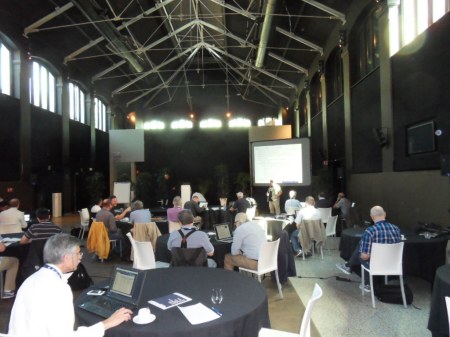
This morning is the last session in the conference venue Oude Vismijn. Here is a snap taken in between talks this morning:

SAMSUNG DIGITAL CAMERA

MaxEnt2016

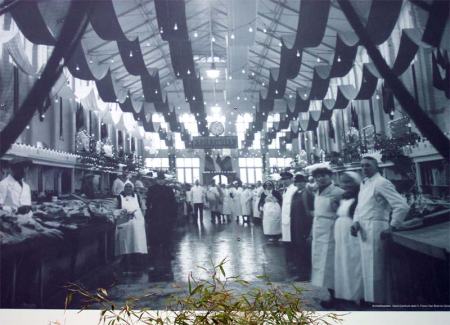
In olden days this hall looked more like this:

vismijn3

Given the location it’s a pity I didn’t think to put a joke in my talk about the Poisson distribution. Geddit?

Over the last few days the City of Ghent has been preparing for the annual Ghent Festival (Gentse Feesten) which has involved the construction of dozens of temporary structures including stages for the bands to play on, and many tents of various sizes for beer consumption). The Festival goes on for 10 days and the first night is tonight. I’m told it’s very noisy in the city centre, which is where my hotel is, so I’m not sure I’ll get much sleep tonight as the festivities go on round the clock!


Emily Dickinson’s Desk

Posted in History, Poetry with tags , on July 15, 2016 by telescoper

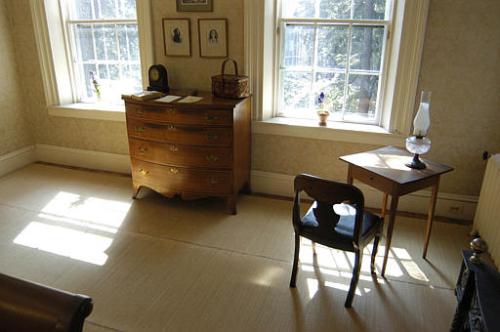
Here’s a fascinating post about the poet Emily Dickinson. Apparently she wrote all her poems sitting at that little square table!

malcolmguite's avatarMalcolm Guite

Emily's desk Emily’s Desk

Whilst I was speaking at a CS Lewis conference in Amherst I had the opportunity to visit Emily Dickinson’s house, now beautifully preserved as the Emily Dickinson Museum. And so I came to stand in that ‘mighty room’ where all the poems were written, and there, plain and simple and strangely, paradoxically, small was her little desk: a small square writing table.  I was filled with wonder at how much had flowed from so small a space, but then I thought about Dickinson’s characteristically concentrated and terse verse forms; those compact and concentrated little quatrains with the emphatic dashes linking and yet binding in the energy of her phrases, and it seemed to me the smallness of the desk was itself part of the form of the poetry, part of her gift.

Anyway the whole experience stirred me on to this: (as always you can hear…

View original post 88 more words

Egmont

Posted in History, Music with tags , , , on July 12, 2016 by telescoper

It was just brought to my attention that one of the historical landmarks of Ghent, the location of the conference I am currently at, is the home of Lamoral, Count of Egmont whose execution in 1568 sparked an uprising against Spanish occupation that eventually led to the independence of the Netherlands. The house itself is extremely old, being built in 1200 from roman bricks.

Egmont was also the inspiration behind Beethoven’s  famous overture played here in suitably dramatic style by the Berlin Philharmonic under the direction of Herbert von Karajan.


Chilcot Reactions

Posted in History, Politics with tags , , , on July 6, 2016 by telescoper

At long last, the Chilcot Report on the UK’s involvement in the 2003 Iraq War has now been published. It’s a mammoth document which can obtain in full here. Even the Executive Summary is 150 pages long.

I’m going to put my cards on the table straight away. I opposed the invasion of Iraq in 2003 and have never wavered from that opposition. I would feel vindicated were I not so saddened by the agony the invasion unleashed.

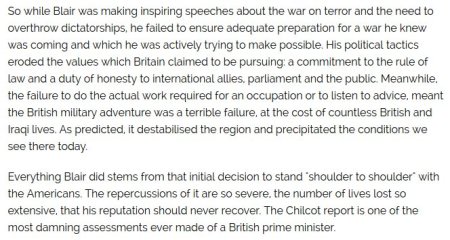
I’m not going to pretend to have read the whole document, or even all of the Executive Summary, but all the reaction I’ve seen suggest that it is unequivocal in its condemnation of the (then) Prime Minister, Tony Blair. Here is an example:

Chilcot

I sincerely hope that Blair’s reputation will not recover, and indeed hope that some form of legal redress can be sought against him. Attention in this country is focussing on the 179 service personnel who lost their lives in Iraq either during, or as a direct result of, the invasion of Iraq. However, let’s not lose sight of the fact that it was the Iraqi people who suffered most – over 150,000 are thought to have been killed, though such is the chaos of a country ruined by invasion and its aftermath that the true figure will never be known.

A few days ago we remembered the thousands who died on the Somme with the words “Lest we forget”. We shouldn’t forget Blair either…


The Day Sussex Died

Posted in History with tags , , , on June 30, 2016 by telescoper

In advance of tomorrow’s sombre commemorations of the centenary of the start of the Battle of the Somme, I thought I’d write a short preliminary piece about a related centenary to be marked today, 30th June 2016.

On this day in 1916 there took place the Battle of the Boar’s Head, the name given to a German salient near Richebourg-l’Avoué in the Pas de Calais region. This battle is remembered locally here in Brighton as The Day Sussex Died. The following brief account is based on the wikipedia article.

The attack on the Boar’s Head was launched on 30 June 1916, as an attempt to divert German attention from the Battle of the Somme which was to begin on the following day, 1 July. The attack was conducted by the 11th, 12th and 13th (Southdowns) Battalions of the Royal Sussex Regiment, part of the 116th Southdowns Brigade of the 39th Division.

A preliminary bombardment and wire-cutting by the artillery commenced on the afternoon of 29 June and was reported to be very effective. The final bombardment commenced shortly before 3:00 a.m. and the 12th and 13th battalions went over the top (most for the first time) shortly afterwards, the 11th Battalion providing carrying parties. The guns lifted their fire off the German front trench and put down an intense barrage in support. The infantry reached the German trenches, bombing and bayoneting their way into the German front line trench and held it for about four hours.

The second trench was captured and held for only half an hour, during which several counter-attacks were repulsed and then the raiders withdrew, because of a shortage of ammunition and mounting casualties. The German support position was not reached by the infantry, because the German defensive tactics included shelling trenches where the British had gained a foothold.

In fewer than five hours the three Southdowns Battalions of the Royal Sussex lost 17 officers and 349 men killed, including 12 sets of brothers, three from one family. A further 1,000 men were wounded or taken prisoner.

The corps commander looked upon the attack as a raid and considered it to be successful.

Here is a photograph of A Company of the 13th Battalion of the Royal Sussex Regiment, taken shortly before the battle; by its end, over 80% of these men were dead.

BoarsHead

The losses at the Boar’s Head were shortly to be dwarfed by the horrendous scale of the slaughter on the Somme, but their impact  on families and indeed whole villages in rural Sussex was devastating.  Those who lost their lives in armed conflict should never been forgotten, nor should their sacrifices be appropriated for political ends.

Lest we forget.