Archive for the History Category

Campaigners warn on Guy Fawkes night pogonophobia

Posted in Beards, History on November 5, 2015 by telescoper

No beards on your bonfire please!!

kmflett's avatarKmflett's Blog

Beard Liberation Front

PRESS RELEASE           2nd November

Contact Keith Flett     07803 167266

CAMPAIGNERS WARN ON GUY FAWKES BONFIRE NIGHT POGONOPHOBIA

guy

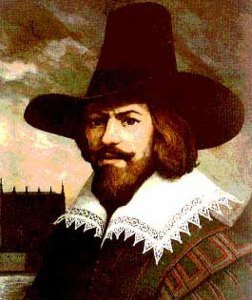
The Beard Liberation Front, the informal network of beard wearers, has warned of Guy Fawkes pogonophobia as bonfires around the country burn effigies of a hirsute man on Thursday evening and the following weekend.

Pogonophobia is the ancient Greek for an irrational fear or hatred of facial hair, known as beardism in modern English.

The BLF says that November 5th is the traditional highlight of the pogonophobes year as they burn an effigy of what they assume to be a dangerous radical figure with a beard, although few will openly discuss their often deep seated concerns about beard wearers

BLF Organiser Keith Flett said the irony is that Guy Fawkes was a deeply reactionary character who, had he lived now, would almost certainly not have had a beard under any…

View original post 32 more words

Why I wear a poppy

Posted in Biographical, History with tags , , on November 3, 2015 by telescoper

Once again we’re coming up to Remembrance Sunday, an occasion to remember those who have given their lives in conflicts past and present. This is always held on the second Sunday in November in the United Kingdom, so that it is close to the date of anniversary of the armistice that formally ended the First World War, on 11th November 1918. Another way to commemorate this  is the observance of two minutes’ silence at 11am on 11th November itself. I plan to do that, next Wednesday (which is the 11th November). I’ve kept my calendar free at 11am precisely for that purpose.

Then there  is the wearing of a poppy. The poppy appeal raises money for veterans and their families, but the wearing of these little red paper flowers is something that not everyone feels comfortable with. Some people think that to wear a poppy is to celebrate militarism or even Britain’s imperialist past. I don’t see it that way at all. In fact, if someone asked me to wear a badge to support Britain’s participation in the invasion of Iraq, I’d certainly refuse.

I wrote about my reaction to the horror and futility of war some time ago, so I’ll try not to repeat myself except to say that, to me, the poppy is not about celebrating war or military prowess or imperialism, it’s simply about remembering those who died. In fact, one of the main reasons the paraphernalia of  Remembrance Day observances (the Poppy, the Cenotaph, the Tomb of the Unknown Soldier, etc) were set up in the first place was to remind not just people but also governments of the devastation caused by World War One. That’s why the Remembrance Day ceremonial laying of wreaths takes place in Whitehall, right at the heart of government. The ritual  was specifically intended to be a warning to the politicians who had brought the conflict about not to allow it to happen again.

As a young lefty student I grappled with the implications of the poppy appeal. The Peace Pledge Union produces white poppies, as an overtly anti-war symbol of remembrance. For a time I wore a white poppy but, although I am against war, I don’t think a policy of non-violence would have helped much against Hitler’s Nazi regime and therefore can’t really call myself an out-and-out  pacifist. One year I wore both white and red poppies, but since then I’ve decided to stick with a red one.

Of course many in the Establishment would like the poppy to turn into a symbol of obedience, a kind of alternative national flag. Some people choose not to wear it precisely because it has that implication. The sight of some hypocritical warmongerers wearing the poppy at the Cenotaph on these occasions sickens me, but their betrayal does not make me want to stop wearing it myself. Neither does the fact that our politicians seem content to give away the freedoms that so many died to protect.

People have  a wide range of views about the poppy and its meaning. There is no “right” answer – every person’s attitude is shaped by a number of factors, not least by whether or not they have lost a loved one in any form of armed conflict.  Some of us wear wear a poppy, some don’t. It’s a matter of choice. The fact that we have a choice is important in itself. I would probably refuse to wear a poppy myself if someone tried to make it compulsory.

Some poppy sellers use the slogan  Wear Your Poppy With Pride, but the original meaning  is much better expressed by the original, Lest We Forget. I’m not sure I wear mine with pride at all, in fact. What I feel is really more like shame, at the wastefulness and stupidity of armed conflict. I count myself incredibly lucky that I have never had to live through anything like that, not only because I’ve had a relatively peaceful and comfortable life, but also because I have never been tested in the way previous generations were. I wear the poppy to acknowledge their bravery and to recognize my own good fortune.  When I stand for the two minutes silence I remember those all who fell fighting on all sides of all wars, and  fallen civilians too.

When the newsreader Jon Snow decided not to wear a poppy on TV a few years ago, there were angry complaints. I’m sure he didn’t mean disrespect to the cause but disliked the pressure being put on him to conform. I can see his point. It has to be voluntary if it is to mean anything at all. . But in the end I agree with Euan Ferguson’s piece in the Observer a few years ago:

I don’t like pressure being put on people to conform. Orthodoxy and fear are always to be regretted and today’s society is over-condemnatory, swift to its manufactured outrage. But this change seems to have come from below, not been ordered by bullies: the daily reports of life and death in the forces, of the danger other 20-year-olds daily find themselves facing. And is the symbolism of the poppy being degraded as it is customised? No. You can’t do much to the fabulous simplicity of this symbol. And the poppy doesn’t preach: it’s not about “right” or “wrong” wars, but about brave dead soldiers. And the message was, never, Remember in the way we tell you to remember. It is, simply, Lest We Forget.

So, yes. I am wearing a poppy again this year. Lest we forget.

GEORDIE LAMP

Posted in History with tags , , on November 2, 2015 by telescoper

This reminds me of one of the two plausible explanations for the origin of the word “Geordie” – that miners from the Newcastle area favoured lamps of the type invented by George Stephenson described in this article, while those in the rest of the country (including the Midlands) used the Davy Lamp, invented around the same time in 1815.

The other explanation of the origin of Geordie relates to the 1715 Jacobite rebellion, when the city of Newcastle upon Tyne closed its gates to the rebel army from Scotland and declared its loyalty to King George I. The rebels were eventually defeated at the Battle of Preston.

The word “Geordie” is thus either 200 or 300 years old depending on which account you believe…

imechearchive's avatarIMechE Archive and Library

This year marks 200 years since the invention of the Geordie Lamp – a revolutionary invention by George Stephenson – which is on view off our reception until Christmas.

Committee for the Renumeration of George Stephenson for hi Committee for the Remuneration of George Stephenson for his Safety Lamp Invention

In 1812, Stephenson was an engine-wright at Killingworth High Pit. In this role, he was in charge of all of the colliery machine of the Grand Allies. Because this machinery was not only above ground, but also below, Stephenson spent a lot of time actually down in the mines carrying out maintenance and repairs. He was all too well aware of the poor working conditions that the miners had to deal with, and the casualties that took place due to firedamp explosions. Indeed, in a previous role, he had been working at the West Moor pit in when a firedamp explosion killed 10 miners.

Firedamp is the combination of…

View original post 520 more words

R.I.P. Lisa Jardine

Posted in History with tags , on October 26, 2015 by telescoper


Lisa Jardine

As soon as I got home from Oxford yesterday I heard the very sad news of the death of writer, scholar and broadcaster Lisa Jardine, who has passed away at the age of 71.

Today’s newspapers are filled with tributes from people who are fair better qualified than me to discuss her career as a historian (e.g. here and here). I can’t leave her death unmarked, but I’ll restrict myself to some personal recollections. Lisa Jardine worked at Queen Mary College when I was employed there (from 1990-1998) . I won’t claim to have known her well but I did meet her quite a few times, usually in the Senior Common Room bar.  She seemed to me to be a rarity:  a historian who was genuinely interested in, and knowledgeable about,  science. In fact she knew an enormous amount about a huge range of different subjects, but was also extremely engaging and approachable, though she didn’t suffer fools gladly (if at all). She was a delight to talk to; conversations with Lisa were always both entertaining and educational.  What I’ll remember most, however, is her deliciously cheeky sense of humour and the  marvellous twinkle in her eye. It’s hard to believe that she has gone.

Rest in Peace, Lisa Jardine (1944-2015).

P.S. In case you weren’t aware, Lisa Jardine was the daughter of famous polymath Jacob Bronowski who was of Polish-Jewish origin. I mention that not to detract from Lisa’s own achievements as an academic, but to draw attention to yet another family of “migrants” that has enriched our nation’s culture.


Battle of Britain Day

Posted in Film, History with tags , , , on September 15, 2015 by telescoper

Today is the 75th Anniversary of the day that historians regard as the climax of the Battle of Britain. To commemorate this, a huge flypast will take place across the South of England. Unfortunately, the weather isn’t too great today, and I don’t think it will be quite the spectacle that was intended, although Purple, Brown and Black sections are due to fly over Brighton from RAF Goodwood and perhaps the clouds will have broken up by the time they get here. Normally Battle of Britain Day is commemorated on a Sunday, as 15th September 1940 lay on a Sunday.

I had a friend – now long dead – who served as a fighter pilot in the RAF during the Battle of Britain and I once asked him about the tactics they used. He explained that they didn’t really have any tactics. When scrambled they were usually lucky if they managed to get to the right altitude before the enemy were on them. And if they did, they just flew head on at the incoming planes and tried to shoot them down. There was little point in attacking a big formation from behind with a handful of planes, which was the usual situation: you might pick off one or two but the bombers would carry on to their target. You had to attack from the front in order to scatter them. He added that on a good day, if you were feeling exceptionally brave, you might even keep your eyes open as you screamed straight into the enemy at getting on for 400 mph.

Another event of 15th September 1940 exemplifies the almost insane courage of the RAF pilots. A formation of Dornier bombers penetrated the British air defencesa as central London, where it was engaged by planes from a number of RAF squadrons, including the Hurricane of Flight Sergeant Ray Holmes. Holmes got into position to shoot down one Dornier, but when attempted to fire he discovered he had run out of ammunition. In an act of amazing bravery he decided to ram the Dornier. He succeeded ins slicing off the plane’s tail and it came down on Victoria Station. Somewhat improbably, Holmes managed to bale out and, though injured, survived to fight again. He died in 2005.

The other thing that this event reminded me of was the film Battle of Britain. The movie is a bit dated now, largely because some of the special effects don’t really stand up to modern comparisons: no cgi when it was made, for example. The best thing about it for me, though, is the wonderful music written for the film by William Walton, especially in the following sequence where the dogfights are shown with only the music as soundtrack. This turns the shots of terrifying close-range combat into a something a lot more than an action movie. It’s a work of art.

The context of this sequence is, as far as I know, historically accurate. Over the summer of 1940 the Luftwaffe had sent raid after raid over to attack Britain, these raids increasing in size as time went on. Hugh Dowding, Head of Fighter Command at that time, refused to let his planes be drawn into a huge battle against numerically superior forces and instead kept most of his planes in reserve, sending up only a squadron or half a squadron to meet the incoming planes. Thanks to the breaking of the German Air Force Enigma code, Dowding knew that the Luftwaffe pilots had been handing in grossly exaggerated reports of how many planes they had been shooting down. Convinced that the RAF was on the brink of collapse, the Germans launched an enormous air raid on September 15th 1940 intended to deliver the knockout blow and prepare the way for invasion.

Dowding knew that they were coming, and put every available plane at the RAFs disposal into the air. The survival of this country was at stake during this battle. There were no reserves. When the Luftwaffe arrived over Britain their pilots were aghast to find the air filled with Spitfires and Hurricanes whose pilots, having been consistently outnumbered in the battles so far, relished the chance to fight for once with something close to numerical equality with the enemy. The RAF scored a decisive victory, convincing Hitler to abandon his plans for an invasion in 1940.

Fish, Chips and Immigration

Posted in History, Politics with tags , , , , , , on September 10, 2015 by telescoper

I’m not the biggest fan of Simon Jenkins, especially when he goes off on one of his childish anti-science rants, but there’s a powerful piece by him in today’s Guardian  with which I agree totally. Reading the article on the bus, and especially the passage about the arrival of Huguenot refugees from France in the 18th Century, I decided to repost the content of an item from about 5 years ago, to demonstrate the importance of immigration to Britain’s culture and traditions, sometimes in very surprising ways.

Have you ever wondered where and when the traditional “British” dish of fish and chips originated? The answer is fascinating, and a little bit controversial too.

The practice of eating fried fish in batter started to appear in England during the fifteenth century; it was derived from the  Pescado Frito cooked by Portuguese Sephardic Jews – Marranos – who had moved to Britain to escape persecution in their homeland. By the Victorian era “Fish Fried in the Jewish Fashion” was extremely popular in the working class districts of London, particularly in the East End. Dickens refers to a “fried fish warehouse” in Oliver Twist, which was first published in 1837. It seems to have become available in large quantities with the rapid development of trawler fishing in the mid 19th century.

Incidentally, there is a prominent relic  of the Spanish and Portuguese Jews who settled in the East End right next to Queen Mary, University of London in Mile End (see left). The burial ground has, I think, recently been moved but it neverthless provides a timely reminder that immigration is by no means a new phenomenon as far as the East End is concerned.

The traditional way of frying the fish involved oil and I don’t know precisely when the practice of using lard – which is what is used in many modern shops – came on the scene, but it clearly would not have met with Jewish approval and must have been a more recent development.

The origin of chips is more controversial. The first occurence of this usage of the word chip according to the Oxford English Dictionary appears in Dickens’ novel A Tale of Two Cities, dated 1859, in the phrase

Husky chips of potatoes, fried with some reluctant drops of oil

Some say the practice of frying potatoes like this originated in Belgium or France, and that chips are a British version of pommes frites or french fries. This style of cooking potatoes could have been brought to London by the Huguenots (French Protestants who settled in the East End of London after being forced out of their homeland). However, there is some controversy about how and why chips became so popular throughout Britain. Some claim the practice of eating fried potatoes was already established in the North of England before 1859. It also seems that fried chipped potatoes were served in working class eating establishments throughout Victorian London. Many working people – especially single men living in lodging houses – lacked the facilities or the ability to cook anything substantial at home, so preferred to buy their food ready made. At an Irish Ordinary you could get a filling meal of beer, meat and fried potatoes for about tuppence (in old money). Such establishments proliferated all over London during the 19th Century as the number of navvies and other itinerant Irish labourers  grew in response to the demand for manual workers across the country.

I think it was most likely the presence of a nearby Irish Ordinary that led a Jewish londoner called Joseph Malin to hit upon the idea of combining fried fish with chipped potatoes. At any rate it’s reasonably well established that the very first commercial Fish-and-Chip Shop was opened by him in 1860 in Cleveland Street and business was so good that it was followed by many others across the East End of London and beyond.

There’s something rather inspiring about rediscovering that Britain is nation whose traditions and institutions have always been so reliant on foreign immigrants. Even Fish and Chips turns out to be from somewhere else. This is actually what makes me proud to be British.

The Day of Daltonism

Posted in History with tags , on September 6, 2015 by telescoper

Having a quick look at Twitter this morning as I drank my coffee I discovered that it is the birthday of the English scientist John Dalton, who was born on 6th September 1766. Dalton is most famous in the United Kingdom for his work on chemistry and physics, but somewhat less so for his pioneering studies of colour blindness. I didn’t know until today, in fact, that the birthday of John Dalton, who was himself colour blind, is Colour Blindness Awareness Day so I thought I’d do a quick post to mark the occasion. You might also be interested in this guest post on the subject of colour and colour perception.

Here’s a test for some of the main types of colour blindness – can you read the numbers?

Colour_Blind

Colour blindness comes in different forms and affects a significant fraction of the population, with a much higher rate of occurrence in males (up to 1 in 10 in some groups) than in females (about 1 in 200). It also varies significantly across different populations, with particularly low rates for, e.g., Fijian males (0.8 %) and much higher frequencies among, e.g. Russian males (9.2%). I am not colour-blind myself, but I know several colleagues who are. In fact at the meeting I was at last week, when one speaker decided to show two different sets of results on a graph by plotting one in red and the other in green, there were howls from several in the audience who couldn’t tell them apart. It’s very easy to make careless mistakes like this in preparing lecture materials when it takes only a small effort to make them suitable for all. I urge colleagues who teach to remember that if they are 100 men in the audience the likelihood is that there will be around 8 to 10 who are colour blind.

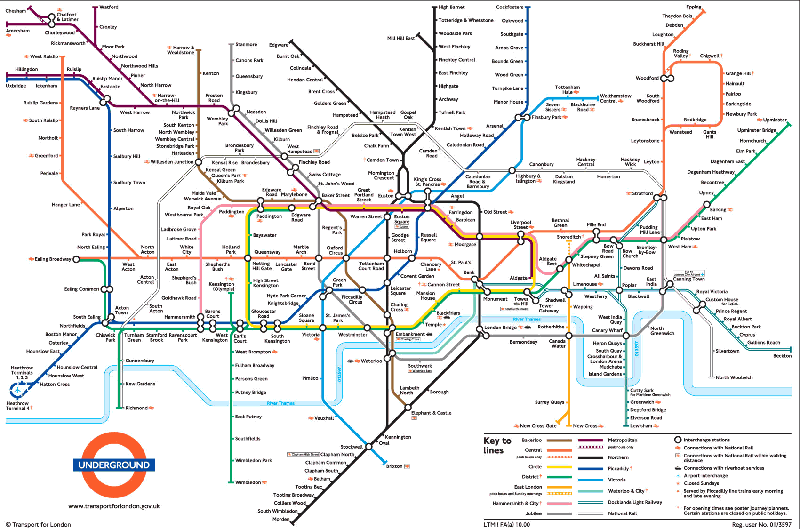
Thinking about this makes you realise how many maps and other designs rely on full colour perception for their effect. I’ve previously celebrated the London Underground map as an excellent example of graphic design, but it must be a nightmare to a person who is colour blind!

tube_map

Last week I gave a short speech at the workshop to celebrate Sabino Matarrese’s 60th birthday, in the course of which I mentioned the late Francesco Lucchin, who first invited to Italy to work with the Padova group (of which Sabino was a member) back in the early 90s. Francesco and I ended up writing a book together and during the course of working on that he told me that he was “daltonic”. I later found out that this word does exist in English, but it is not in common usage as a word meaning “colour blind”. In fact the standard word in Italian for “colour blind” is “daltonico” and there are many other variants in other European languages, such as the French “daltonien”. It’s very curious that Dalton’s name is so strongly associated with colour blindness across the European continent but not in the country of his birth. I wonder why?

By the way, if I understand correctly, the English word “daltonic” refers to a specific form of red/green colour blindness called deuteranopia, whereas the foreign variants can refer to any form of colour blindness.

Anyway, must wrap it up there. I have to mark some resit examinations which, according to the instructions, should be done in red ink by the first marker and in green ink by the second marker…

From here to Astragalo

Posted in Biographical, History with tags , , , , on September 5, 2015 by telescoper

Now that I’m back to the relatively autumnal setting of Brighton, I can’t help reflecting on last week’s meeting. On Monday evening I attended a cocktail party in a very pleasant bar in Castiglioncello overlooking the sea. Sunset views are something of a speciality from this location:

image

Anyway, the name of the place we were in was Astragalo. I checked and, as I suspected, this the Italian word for astragalus, which has an approximately tetrahedral shape. Astragalus is also a kind of plant, which is perhaps more likely to be associated with the name of a seaside bar, but that spoils the connection I wish to make with probability theory, a topic that came up regularly during the conference I was attending, so I’ll ignore it.

Nowadays gambling is generally looked down on as something shady and disreputable, not to be discussed in polite company, or even to be banned altogether. However, the formulation of the basic laws of probability was almost exclusively inspired by their potential application to games of chance. Once established, these laws found a much wide range of applications in scientific contexts, including my own field of astronomy. The astragalus provides a very early example.

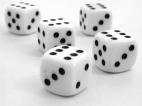
Gambling in various forms has been around for millennia. Sumerian and Assyrian archaeological sites are littered with examples the astragalus (or talus bone). This is found just above the heel and its roughly tetrahedral shape (in sheep and deer at any rate) is such that when it is tossed in the air it can land in any one of four possible orientations; it’s fairly similar in fact to the four-sided dice used in some role-playing games. The astragalus can be used to generate “random” outcomes and is in many ways the forerunner of modern six-sided dice. The astragalus is known to have been used for gambling games as early as 3600 BC.

images

Unlike modern dice, which began to appear around 2000BC, the astragalus is not quite symmetrical, giving a different probability of it landing in each orientation. It is not thought that there was a mathematical understanding of how to calculate odds in games involving this object or its more symmetrical successors (right).

The Last Match

Posted in Cricket, History with tags , , , , , on August 23, 2015 by telescoper

Yesterday (Saturday 22nd August) I took the day off to go to Sussex County Cricket Club‘s ground at Hove watch some cricket and also to watch a play called The Last Match. Here’s a snap I took in the direction of the scoreboard as play commenced, at 11am.

Hove_cricket

As you can see from the picture, it was very sunny yesterday – the high cloud had vanished by the afternoon to leave a perfectly cloudless blue sky. I arrived at the ground already rather hot, having walked from Kemptown (which lies well to the East of Hove) along the seafront and through Brighton city centre to get there. Fortunately, cricket grounds are not short of options for liquid refreshment!

The match going on was between Sussex and Yorkshire in the County Championship. I haven’t seen much County cricket in recent years, but it was good to see a reasonably big crowd there. Many of them were Yorkshire supporters who had presumably made the short trip South from the Midlands to watch the game. Saturday was the second day of a four-day game. Yorkshire had batted first on day 1 and reached 346-6 by close of play, with Gary Ballance not out on 98 and Tim Bresnan not out on 44 (both former England players). No sooner had I settled into my seat than Ballance got his century, but Bresnan took about 35 minutes to get to his fifty. Thereafter the Yorkshire batsman progressed steadily, adding a hundred to their overnight score without losing a wicket but soon after that Ballance was out for 165, clean bowled by Liddle. A few runs later Bresnan was run out in controversial fashion: the batsmen went for a quick single, fielder Chris Nash threw at the bowler’s end whereupon the bowler caught it and fell on the stumps, knocking them all over with Bresnan short of his ground. The umpire’s finger went up, but it should have been not out, because the ball is supposed to hit the stumps at some point. Anyway, the umpire’s decision is final – no reviews in County cricket – so Bresnan was out for 78 with the score on 458-8. Had I been Yorkshire captain I would probably have declared then to let my bowlers have a go at Sussex before lunch. But that didn’t happen.

Six overs later the ninth wicket fell, at about 12.59 (with lunch scheduled for 1pm). Then a rule was invoked with which I was unfamiliar. Apparently in County cricket if a wicket falls just before lunch, so that the batting side is nine down, play continues for up to 30 minutes (or 8 overs) or until the final wicket falls. Thus it came to pass that, possibly for the first time ever in the history of cricket, play stopped Play…

The Play concerned was due to start at 1.15 in one of the function rooms at the boundary of the ground, but the organizers decided to hold back the start until the session of play (in the cricketing sense) had actually finished. As it happened, the last wicket pair for Yorkshire batted about 7 overs and added 35 runs until Plunkett was run out. Yorkshire’s innings closed at 494 all out. Now the Play could start.

The subject of The Last Match was legendary Yorkshire spin bowler Hedley Verity. I posted about him not long ago so I won’t repeat his life story here, but the point was that the last match he ever played in for Yorkshire (and indeed the last competitive match he ever played in) was the County Championship fixture against Sussex at Hove which took place from August 30th to September 1st 1939. Hence the poem I posted yesterday, which is actually quoted during the play.

The significance of the date September 1st 1939 is that was when German forces began the invasion of Poland, which commenced at 5am UK time. Although Britain did not formally declare war on Germany until 3rd September, the invasion of Poland did lead to various emergency measures being immediately adopted in Britain. One of these was that a plan to evacuate all children of school age from major cities was implemented on that day. On the morning of 1st September the Yorkshire players were told that they should abandon the final day and return home. Verity must have been especially keen to rejoin his family, as he had two young children to think about. Yorkshire had by then already won the County Championship so there wasn’t really that much to play for. However, the players on both sides discussed what to do and decided to play out the match, the main reason being that it was a benefit match for Jim Parks. I’d also suggest that the players probably knew they wouldn’t be playing cricket again for a long time, and wanted to savour the last monents of peaceful normality, much as a condemned man might savour his last cigarette.

It’s probable that the cricketers’ minds were not entirely on the match that day, but what happened was remarkable nevertheless. Sussex had batted first and score 387 all out; Yorkshire managed 392 all out in their first innings. Verity had taken only 2 for 108 off 18 overs in the first innings, which makes the second innings all the more remarkable. Sussex were bowled out for a paltry 33, with Verity the destroyer (6-1-9-7). Yorkshire then knocked off the 30 required to win for the loss of one wicket, and won the match. The Yorkshire players bundled onto their coach and travelled home.

Verity subsequently enlisted in the British Army and, as a Captain in the Green Howards, took part in the invasion of Sicily in 1943. During the Battle for Catania, Verity was ordered to lead his unit in a night attack on a farmhouse occupied by German soldiers. He did so, but he had walked into a trap and they were quickly surrounded. Half his men were killed and he received a bullet in the chest. He died of his wounds in a prisoner of war camp at Caserta, near Naples on July 31st 1943, at the age of 38, but the official telegram informing his family that he had been killed was not sent until some time later; it was dated 1st September 1943..

Apart a brief preamble and some film footage projected at the rear of the stage, most of The Last Match is set in the hospital in which Verity spent his last days and revolves around a conversation between himself (played by Al Barclay) and a fictional character, Francis Watson (played by Daniel Abelson) whose role is to hold a mirror up to Verity. Francis is younger, more cynical and from a wealthier background than Verity who comes across as rather old-fashioned but with a strong sense of personal duty. It only lasts about 35 minutes, but in that short time it touches on a wide range of issues, especially the conflict between freedom and responsibility. It’s a poignant story, well written and acted, although its brevity means that there’s no time to develop the characters fully. It did occur to me watching it that it would work very well as a radio play, and I hear that there has been some discussion of that possibility.

Congratulations to writers Colin Philpott and Kit Monkman for such a thought-provoking piece. It certainly added an interestingly different dimension to a day’s cricket. The production now moves to Yorkshire – it will be at Yorkshire County Cricket Ground, Headingly on 1st September and again on 24th September, and a couple of other venues in between. Do go and see it if you get a chance.

So then it was back to the cricket, sunshine and (I must admit) some beers – Harvey’s mainly! On what seemed to be a good batting wicket, the Sussex batsmen struggled early on against an impressive Yorkshire pace attack (Sidebottom, Bresnan, Plunkett and Patterson; the first three of whom are former England bowlers). Despite numerous appeals, a lot of playing and missing, and more oohs and aahs than you will hear in a Frankie Howerd monologue, openers Ed Joyce and Luke Wells put on 110 for the first wicket before Wells fell to Adil Rashid for 43. A couple of balls later Rashid also dismissed the hapless Machan for a duck. Plunkett trapped Nash lbw for 18 to make it 139-3. Ed Joyce brought up his century with a six off Rashid, and almost immediately departed off the same bowler to make it 175-4, whereupon Sussex sent on a nightwatchman, Oliver Robinson, who was almost out first ball to Rashid but clung on until close of play.

Honours pretty even I’d say at the end of day 2, and this (Sunday) morning’s session having been lost to rain with more bad weather forecast for tomorrow, I suspect this one will be a draw.

So there you have it. War and peace. Life and death. Sussex and Yorkshire. Beer and lovely weather. What more could you want from a day off?

UPDATE: Monday 24th August. Sussex ended day 3 on 493-7 with centuries for Michael Yardy and Ben Brown. No play was possible this morning, the final day, because of heavy rain, so the match does indeed look set to be a draw.

UPDATE to the UPDATE: No play was possible on Monday at all due to rain, so the game did indeed end as a draw.

Six Spitfires

Posted in History with tags , , , on August 18, 2015 by telescoper

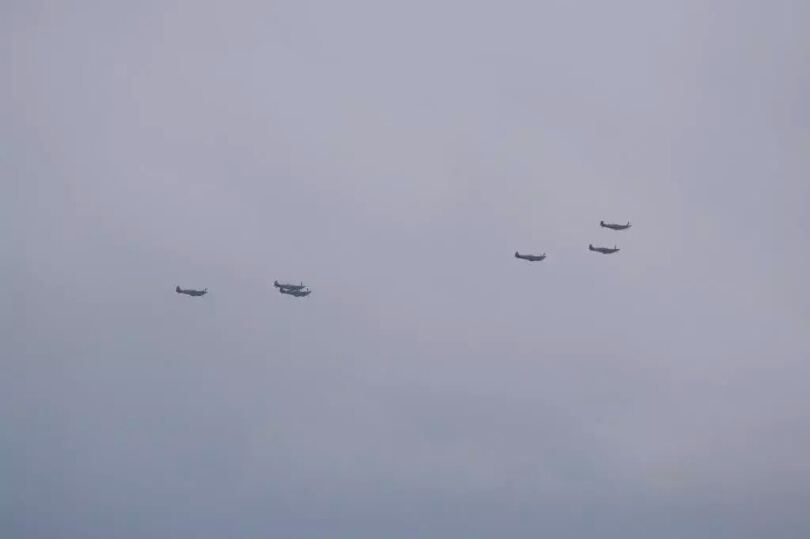
I am indebted to James West for sharing this picture of no fewer than six Supermarine Spitfires seen earlier today over the Solent..

image

Six planes is half a Squadron. Seventy-five summers ago, during the Battle of Britain, such a tiny force would frequently have been scrambled to take on over 100 incoming enemy planes. And not only over the South of England. This day in 1940, August 18th, was a particularly tough one for the RAF and has come to be known as the Hardest Day, with heavy losses on both sides.

I can’t help reflecting upon the fact that the pilots involved in that momentous conflict were not only so few in number, but also so very young. Nineteen or twenty was typical, the same age as the undergraduate students I teach at work.

So few and so young, but without their courage and skill the world would have slipped into unimaginable darkness.

Lest we forget.