Archive for the History Category

The Origin of CERN

Posted in History, The Universe and Stuff with tags , , , , on September 30, 2014 by telescoper

Since  CERN, the Geneva home of the Large Hadron Collider, is currently celebrating its 60th Anniversary, I thought I would use this organ to correct a widespread misapprehension concerning the the true historical origin of that organization. I have to say the general misunderstanding of the background to CERN is not helped by the information produced locally which insists that CERN is an acronym for Conseil Européen pour la Recherche Nucléaire and that it came into being in 1954. This may be the date at which the Geneva operation commenced, but the organization has a far older origin than that.

CERN is in fact named after the Dorset village of Cerne Abbas, most famous for a prehistoric hill figure called the Cerne Abbas Giant. The following aerial photograph of this outstanding local landmark proves that the inhabitants of Dorset had the idea of erecting a large hardon facility hundreds of years ago…

Market Garden

Posted in Biographical, History with tags , , , on September 17, 2014 by telescoper

I’m just back to Brighton after a meeting in London so I hope you will excuse me for my brevity on this occasion. On the other hand I feel obliged to note an important anniversary.

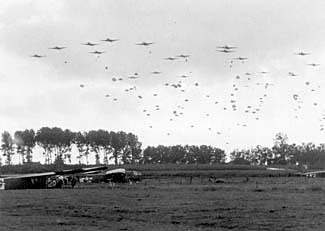
Seventy years ago today, on 17th September 1944, the largest airborne operation in military history began. Operation Market Garden (as it was called) saw about 35,000 Allied troops dropped by parachute or landed in gliders behind German lines in Holland, with the aim of seizing key bridges in order to allow infantry and armoured divisions to advance, eventually into Germany. Of more immediate tactical importance was that capture of the Northernmost bridges over the Rhine at Arnhem would prevent German reinforcements from moving South to confront the advancing troops and armoured vehicles of XXX Corps whose job was to punch a hole in the German defences and link up with the airborne troops.


Operation_MARKET-GARDEN_-_82.Airborne_near_Grave

Motivated by the belief that German armies in the West were exhausted and on the brink of collapse as well as the desire if possible to finish the war before Christmas, Operation Market Garden was daring and imaginative, but began to unravel right from the outset and ended as a disastrous failure, with the loss of many lives.

I’m not a military historian, so am not competent to add anything significant to the huge amount that has been written about what went wrong, but I will add a personal note. A cousin of my Grandfather flew to Arnhem with the 1st British Airborne division whose job was to take and hold the bridges over the Rhine that would open the door to an invasion of Germany. Sadly, he was one of those many troops who never even made it to their objective. In fact he was dead before he even hit the ground; his unit was dropped virtually on top of heavily armed German forces and had no chance of defending themselves. I had always been told that he had been dropped by parachute, but the records at the cemetery revealed that was wrong; he was on a glider which was badly shot up during its approach.

In fact the action at Arnhem involved two bridges, one a railway bridge at Oosterbeek and the other a road bridge in Arnhem itself. British paratroopers did manage to capture one end of the road bridge, but never succeeded in securing both ends of the structure. Cut off from the much larger force pinned down near their landing zones they were eventually forced to surrender simply because they had run out of ammunition. The other units that landed near Arnhem never made their objectives and had to dig in and hope for reinforcements that never came. They fought a brave but desperate defensive action until 25th September when some were successfully evacuated across the Rhine. The original battle orders had specified they were to hold their ground for 48 hours until relieved by armour and infantry advancing from the South.

Some years ago, after attending a conference in Leiden, I took time out to visit Oosterbeek cemetery, where  1437 soldiers lie buried. Such was the chaos at Arnhem that bodies of fallen soldiers are still being discovered in gardens and woods; as there were so many dead that there was only time to bury them in shallow graves where they had fallen. As remains are discovered they are removed and reburied in Oosterbeek. When I visited the cemetery about 20 years ago, there were several brand new graves.

The local people looked on in horror as their potential liberators were cut down. It must have been deeply traumatizing for them. I think it is telling that when, in 1969, the British Army proposed bringing to an end the annual ceremonies in commemoration of these events, local Dutch civilians insisted that they continue.

As I stood by the grave I couldn’t help thinking of how lucky members of my generation are that we have not been called on to make such a sacrifice. The failure of Operation Market Garden had other terrible consequences. The winter of 1944/45 was a bitter one for Dutch civilians in the part of their country that had not been liberated, with many thousands dying from hunger and cold.

And of course had the Allies succeeded in penetrating into Germany in 1944 the post-war map of Europe would probably have been very different. Had Market Garden been successful would there have been 45 years of Cold War?


Doodlebug Summer

Posted in History with tags , , , , , , , , , , , on August 10, 2014 by telescoper

Yesterday’s post reminded me of another aspect of World War 2 that is worth mentioning. There’s a general impression that the defeat of Nazi Germany was more-or-less inevitable after the Normandy invasion of June 1944. However, as I mentioned yesterday, the Allied advance was much slower than expected and it was not until mid-August that the British, Canadian and American divisions really broke through. Morale back home wasn’t helped by this slow progress, but the most significant factor for the civilian population, especially in London, for the period June to August 1944 was the arrival of a new form of weapon; for many, the summer 1944 was “Doodlebug Summer”.

First came the V1 “Flying Bomb” (or “doodlebug”). The first of these to fall on London hit the railway bridge at Grove Road in Bow, East London, on 13th June 1944. This is just a few hundred yards North of Mile End tube station, and close to where I used to work at Queen Mary College, University of London. I don’t think people realize the scale of the threat these terror weapons posed. For a start they were launched in considerable numbers, usually over a hundred a day and over 8000 in total during the course of the summer. These weapons caused 22,892 (mainly civilian) casualties and causing widespread damage to the city’s infrastructure. Looking through the War Office minutes for the week corresponding to this one, seventy years ago, yields a typical statistic: 768 Flying Bombs were launched, 158 landed over London, 462 were destroyed.

These numbers however, convey only part of the picture. The doodlebug was primarily a terror weapon; it struck fear into the hearts of the population though the distinctive sound of its primitive jet engine – fear would immediately transform into alarm when the engine cut out, for that was when the device would fall to Earth and detonate. On the one hand, this did at least give some warning to those in its path but, on the other, it made it impossible for the authorities to disguise the nature of the threat. The V1 was relatively slow (640 km/h, i.e. about 400 mph) and flew at quite a low altitude, which meant that many were downed by ground-based anti-aircraft guns or fighter aircraft fast enough to intercept them, but sufficient numbers still got through to cause considerable panic. The onslaught was only halted in September 1944 when the advancing Allies overran the launch sites in France. Although attacks resumed in due course from other launch sites, the scale of the threat was greatly diminished.

Later on, from September 1944 onwards, the V2 rocket was introduced; this travelled on a ballistic trajectory and gave no warning whatsoever; no gun or aircraft could possibly shoot it down. To begin with the authorities attempted to explain the succession of mysterious explosions as being due to fault gas mains, etc. There never was an effective defence against the V2, but fortunately they were rather unreliable and the number of casualties they caused, though considerable, was not on the same scale as the V1.

Another interesting aspect of the doodlebug attacks was the deception campaign run by British Intelligence, which involved a famous double-agent code-named Garbo. This was the agent behind the audacious deception plan that led the Nazi High Command to believe that the Normandy landings were a decoy to draw attention away from the main landings which would happen in the Pas de Calais. As part of this ruse, Garbo (whom the Germans believed was working for them) actually sent news of the Normandy landings to his handlers by radio. This staggeringly risky gambit could have ended in disaster, but the Germans swallowed the bait: an entire division was kept away from Normandy, waiting for the expected assault in Pas de Calais, which of course never came.

In mid-June 1944 Garbo was asked by his handlers to report on the locations of V1 impacts. The guidance system on the doodlebug was very crude and the Germans had no real idea whether they were systematically overshooting or falling short of London. Could some form of deception plan be concocted that could work in this case? The obvious strategy would be to report that V1s falling on London were falling too far North; if the Germans believed this then they would adjust the settings so they fell further South, and would then miss London. However, some doodlebugs hit high-profile targets so there was little point lying about them – Garbo would immediately be exposed. Moreover, some V1s were fitted with radio transmitters and the Germans knew exactly where they were landing. In the end it was decided that Garbo would simply report (accurately) only those V1 impacts that happened to the North West of London, hoping that the selection bias in these reports would be misinterpreted as a systematic error in the aiming of the V1s. From Ultra decrypts from the code-breakers at Bletchley Park, the Allies knew what was believed by the Germans and what was not and adjusted the flow of information accordingly.

If 1944 seems sufficiently remote for this all just to be a fascinating piece of history, it is worth remembering that the V1 “Terror Weapon” was the forerunner of the modern US combat drones that have killed many hundreds of civilians in Pakistan, Yemen and Somalia in covert attacks as part of the so-called “War on Terror”. Think about the irony of that for a moment.

Solly’s Story

Posted in Biographical, Brighton, History, LGBTQ+ with tags , , , on August 9, 2014 by telescoper

I don’t know why I suddenly remembered a long-forgotten character I knew when I was in Brighton as a research student, but I thought I’d write a blog post so I don’t forget him again.

I moved to Brighton in late September 1985 to start my DPhil. I’d left it quite late looking for accommodation because I’d been working in Newcastle through the summer after my graduation. In the end I had to settle for a bedsit in Hove, quite a long way from central Brighton in a road called Goldstone Villas, not far from Brighton & Hove Albion’s old stadium, the Goldstone Ground.

Round the corner from my place was a pub – I’ve forgotten the name – which became my local. After a few visits there I became friendly with one of the regulars there, a man in his sixties who was known to everyone as Solly, short for Solomon. He was, as I soon came to realise, something of a local celebrity.

Solly was a tall man, always immaculately dressed, and (I would say) handsome for his years. He was also (quite obviously) gay and (also quite obviously) Jewish. He had a great sense of humour and was a wonderful raconteur, but at the same time very kindly and self-effacing; he was liked by everyone in the pub (which wasn’t a gay pub, by the way).

Like everyone else I took an immediate liking to Solly; I greatly enjoyed his company and we had dinner together quite a few times in addition to conversations in the pub. On one of these occasions he told me his life story, or at least some of it. It turns out he was of Anglo-Austrian extraction, with an English mother and an Austrian father, although he had no trace of an accent. He was born in Austria, but his parents sent him to live with relatives in England during the 1930s because they could see what was going to happen there as the power of Nazi Germany grew; he never saw either of them again.

Solly arrived in Brighton when he was about 11 and he was 17 when World War 2 broke out. He immediately tried to join up, but was refused because he was too young. When he reached 18 he tried again but was still refused. He went to London (at the height of the Blitz) to try enlisting there, but was also refused, possibly because of his German-sounding name (and also possibly because of his sexuality).

Having failed to join up he returned to Brighton in late summer 1940 and joined the Local Defence Volunteers (the “Home Guard”). Given his appearance in later life I imagine he would have looked at this time rather a lot like Private Pike from Dad’s Army.

I remember many of his hilarious stories of how shambolic the Home Guard actually was, as well as how they were largely engaged in helping the Police deal with crimes such as racketeering and looting, but there was one particular striking incident that has stuck in my memory.

On 7th September 1940 the War Office issued the following communique:

Message to all UK units: codeword CROMWELL. Home Defence forces to highest degree of readiness. Invasion of mainland UK expected at any time.

After being informed of this signal Solly and his comrades turned up to be issued with the equipment with which they were expected to stop the invasion. In his case it was an ancient pre-WW1 vintage rifle, three rounds of ammunition, and two improvised grenades. With these meagre supplies, they were supposed to hold their positions until reinforced, possibly for up to 7 days.

As they walked to their posts all the volunteers were certain that they had no chance and that none of them would survive the night. The talk was exclusively of the need to make all their shots count. If each man could kill at least one German before he himself was killed then the invasion might be thwarted. Solly certainly had no intention of allowing himself to be taken prisoner, as he knew all too well how he would be treated by the Nazis.
After an agonizing wait, and several false alarms, dawn broke. The Germans never came.

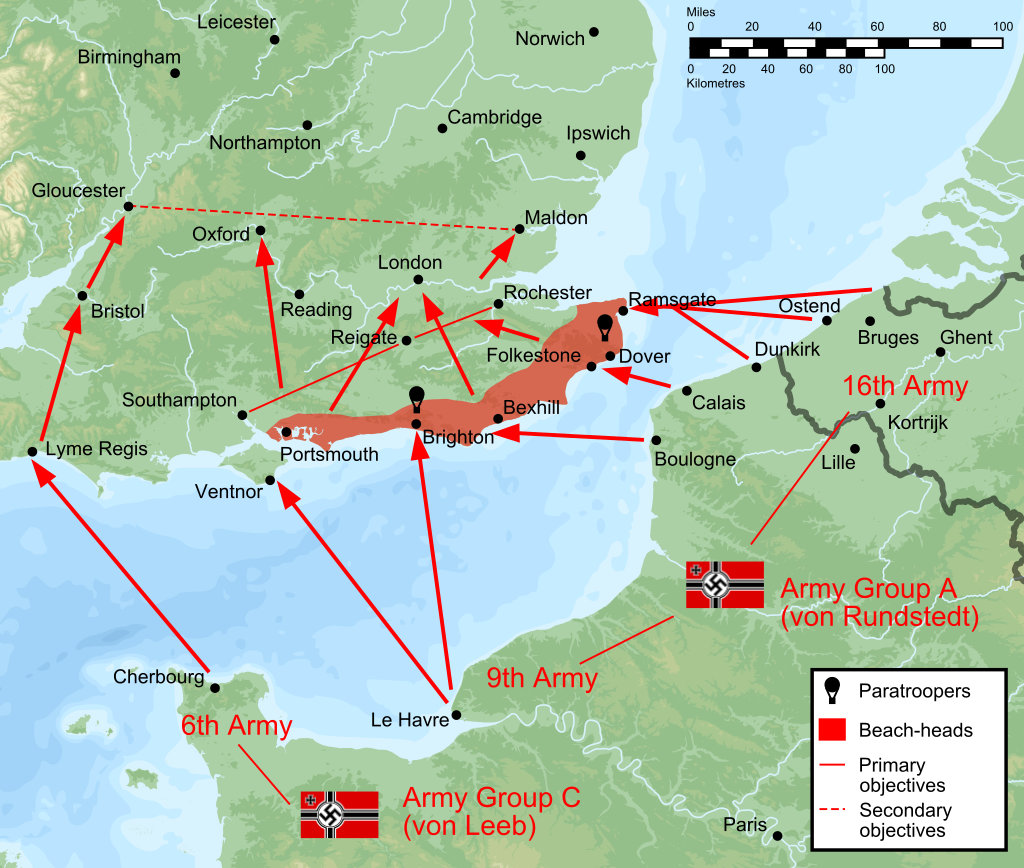
As it turns out, if they had come, Solly’s platoon would have been right in the front line: Operation Sealion (the planned invasion of England) involved the landing of paratroopers on the Downs just behind Brighton with the intention of securing the high ground behind the landings and the main road to London ahead of the invasion:

1024px-OperationSealion.svg

Solly did finally succeed in enlisting, but his good knowledge of the German language meant that he was given a desk job, translating documents and such, until the Normandy invasion when he finally got to fire a weapon in action, although he landed some weeks after the initial assault, when his unit was attacked south of Caen. He didn’t hit anyone.

Incidentally, the 70th anniversary of the D-Day landings passed in June 1944 but it’s worth noting that the German defensive lines were not really broken until August. In fact, on this day in 1944, British and Canadian forces were engaged in heavy fighting about 6 miles from Falaise, while the Americans were executing a wide encircling manoeuvre designed to surround and trap the German army.

Anyway, back to the 1980s. I didn’t stay long in the Hove bedsit and moved out early in 1986. About six months later I happened to be in the area so popped into the pub to see Solly. He wasn’t there; he had passed away suddenly of a heart attack in the Spring.

JULY 1914, by Anna Akhmatova

Posted in History, Poetry with tags , , , on August 5, 2014 by telescoper

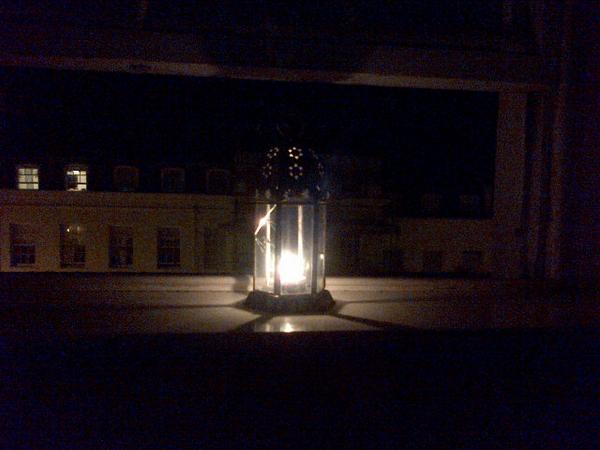
I heard a great poem on Radio 3 last night. It was part of a programme that preceded a late night promenade concert during which, at 10pm, people across the country were invited to turn their lights out and place a candle in their window as an act of remembrance. From what I could see, not many in my street bothered, but I did…

LightsOut


The poem I heard was written by Russian poet Anna Akhmatova on the eve of her country’s entry into World War 1. It’s actually just the first part of a poem called JULY 1914 (the capitalization is deliberate). It perfectly captures that sense of foreboding she felt as the clouds gathered, and the hot weather we’ve been having made it all the more effective:

It smells of burning. For four weeks
The dry peat bog has been burning.
The birds have not even sung today,
And the aspen has stopped quaking.

The sun has become God’s displeasure,
Rain has not sprinkled the fields since Easter.
A one-legged stranger came along
And all alone in the courtyard he said:

“Fearful times are drawing near. Soon
Fresh graves will be everywhere.
There will be famine, earthquakes, widespread death,
And the eclipse of the sun and the moon.

But the enemy will not divide
Our land at will, for himself;
The Mother of God will spread her white mantle
Over this enormous grief.”

by Anna Akhmatova (1889-1966).


This Land is Mine

Posted in Art, History, Politics with tags , , on July 11, 2014 by telescoper

Brilliant video by Nina Paley on the tragedy and absurdity of armed conflict…


Commemorations

Posted in Biographical, Football, History with tags , , , , , , on July 9, 2014 by telescoper

This is a busy week in many ways and for many reasons, but the main activity revolves around Graduation at the University of Sussex. There are 7 ceremonies this week altogether; my School (Mathematical and Physical Sciences) is No. 4, which takes place tomorrow morning (Thursday).

Things are going to be a bit different this year. The Chancellor of the University, Sanjeev Bhaskar, is unable to preside owing to prior commitments (filming episodes of Doctor Who in Cardiff). This is sad because his informality and sense of humour usually brings an enormous amount to such occasions. After much discussion and debate it was eventually decided (on Monday) that the normal order of ceremonies would be changed so that the Head of the graduating School would stand in the centre of the platform, where the Chancellor would normally be situated, in order to shake hands with (and generally congratulate) the graduands as their names are read out and they cross the stage. Normally the Head of School simply reads out the list of names from a podium at one side, so it will be nice to be a bit more involved, although doubt that there will be as many students wanting to take selfies with me as there would have been had Sanjeev been there!

I also have the honour to present an honorary graduate at the ceremony, but I’ll probably say more about that in a future post.

This is a special graduation week for another reason too. It’s now fifty years since the first University of Sussex graduation ceremony in 1964. The University only received its Royal Charter in 1961 and there were only 38 graduates at the first ceremony. This week about 3000 will cross the stage.

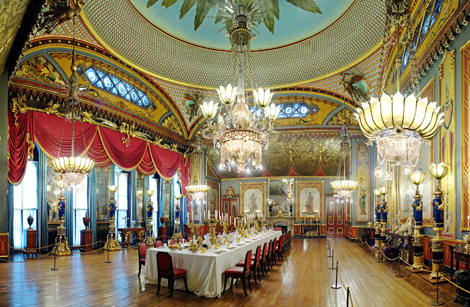
Anyway, last night there was a special Commemoration Dinner to mark the 50th Anniversary in the Dining Room of Brighton Pavilion:

Brighton_Pavilion_Dining_room

The decor is a little understated for my tastes, but apart from that it was a splendid occasion. We didn’t sit at the central table, which is covered with period crockery and cutlery, and was roped off; we sat at smaller tables situated in the space around it. Owing to some sort of administrative error I was accidentally seated at a Table 1, along with a host of important people and the Vice-Chancellor. This turned out well for me as I was seated near Asa Briggs (now Lord Briggs) a famous historian who was the second Vice-Chancellor of the University. He’s now 93 years young and a bit frail but wonderfully interesting conversation ensued. The opportunity to talk to a true Sussex legend added to the fine food and wine to make for a wonderful evening.

There’s another point worth commemorating in the light of the forthcoming centenary of the start of the First World War. One thing I didn’t know before this week was that during World War 1, Brighton Pavilion was commandeered for use as a hospital for wounded soldiers, many of them from India. In fact, the first ever recipient of the Victoria Cross from the British Indian Army, Khudadad Khan, recovered there from wounds sustained in action in Belgium in 1914:

In October 1914, the Germans launched a major offensive in northern Belgium, in order to capture the vital ports of Boulogne in France and Nieuport in Belgium. In what came to be known as the First Battle of Ypres, the newly arrived 129th Baluchis were rushed to the frontline to support the hard-pressed British troops. On 31 October, two companies of the Baluchis bore the brunt of the main German attack near the village of Gheluvelt in Hollebeke Sector. The out-numbered Baluchis fought gallantly but were overwhelmed after suffering heavy casualties. Sepoy Khudadad Khan’s machine-gun team, along with one other, kept their guns in action throughout the day; preventing the Germans from making the final breakthrough. The other gun was disabled by a shell and eventually Khudadad Khan’s own team was overrun. All the men were killed by bullets or bayonets except Khudadad Khan, who despite being badly wounded, had continued working his gun. He was left for dead by the enemy but despite his wounds, he managed to crawl back to his regiment during the night. Thanks to his bravery, and that of his fellow Baluchis, the Germans were held up just long enough for Indian and British reinforcements to arrive. They strengthened the line, and prevented the German Army from reaching the vital ports. For his matchless feat of courage and gallantry, Sepoy Khudadad Khan was awarded the Victoria Cross.

We were honoured last night by the presence at dinner of Sergeant Johnson Beharry who, in 2005, became the first recipient of the Victoria Cross for over thirty years for acts of extreme courage when serving as Lance Corporal in Iraq.

On 1 May 2004, Beharry was driving a Warrior tracked armoured vehicle that had been called to the assistance of a foot patrol caught in a series of ambushes. The Warrior was hit by multiple rocket propelled grenades, causing damage and resulting in the loss of radio communications. The platoon commander, the vehicle’s gunner and a number of other soldiers in the vehicle were injured. Due to damage to his periscope optics, Pte. Beharry was forced to open his hatch to steer his vehicle, exposing his face and head to withering small arms fire. Beharry drove the crippled Warrior through the ambush, taking his own crew and leading five other Warriors to safety. He then extracted his wounded comrades from the vehicle, all the time exposed to further enemy fire. He was cited on this occasion for “valour of the highest order”.

While back on duty on 11 June 2004, Beharry was again driving the lead Warrior of his platoon through Al Amarah when his vehicle was ambushed. A rocket propelled grenade hit the vehicle six inches from Beharry’s head, and he received serious shrapnel injuries to his face and brain. Other rockets then hit the vehicle, incapacitating his commander and injuring several of the crew. Despite his life-threatening injuries, Beharry retained control of his vehicle and drove it out of the ambush area before losing consciousness. He required brain surgery for his head injuries, and he was still recovering in March 2005 when he was awarded the Victoria Cross.

It’s humbling to be in the presence of such a courageous fellow. I only wish our mendacious politicians hadn’t engineered the conflict that made his actions necessary in the first place.  Resplendent in his dress uniform, I’m glad to say that Sergeant Beharry seems fully recovered from his injuries.

I had forgotten to take my Blackberry with me when I left my flat to walk to the dinner so was unable to keep up with the World Cup semi-final. This came up in the conversation at the table. Lord Briggs concurred with my prediction that Germany would win comfortably. It was only when I left the Pavilion and walked past a pub on the way to the bus-stop that I saw the scale of the thrashing that Germany had administered. It was 7-0 when I stopped to look at the screen just in time to see Brazil score. I wouldn’t even describe it as a consolation goal. This amazing result will now be forever linked in my mind with the other events of the evening.

Anyway, must finish now. I have to write my speech for tomorrow’s ceremony!


Remembering the 7th of July

Posted in Biographical, History with tags , , on July 7, 2014 by telescoper

I was saddened and dismayed to read that the memorial for the victims of the terrorist attacks in London on 7th July 2005 has been defaced. We all know that Blair lied about the Iraq war but insulting the memories of the 52 innocent people who perished on that day doesn’t help one little bit to bring him to justice. Two wrongs don’t make a right. This is just sick.

I have my own reasons for remembering the 7th July. One summer morning in 2005 I rose early and left my house – I was living in Nottingham then – and took a train to London. I was quite excited. I was going to be interviewed later that day for a programme in the BBC TV series Horizon called The Hawking Paradox. The filming was to take place inside the Café de Paris near Piccadilly Circus, for the simple reason that it wasn’t used during the daytime, and would therefore be both quiet and cheap to hire. I was keen not to be late so I got a train that was due to arrive at St Pancras Station in London at about 9.30am.

On the train I dealt with a few bits of correspondence, filling in forms and writing out cheques to pay bills, so had a couple of  items of mail to post when I got to London. The train was on time, and it was a fine morning, so I decided to walk from the station down through Soho to the location of the shoot.

I crossed Euston Road and walked down towards Bloomsbury. Spying  a bright red Royal Mail postbox across the road  in Tavistock Square, I waited for a bus to go past, crossed the road and popped my letters into the box. I looked at my watch to see if I had time for coffee on the way to Piccadilly. It was exactly 9.45am, on July 6th 2005.

I enjoyed the filming, although it took quite a long time – as these things do. Breaking for lunch in a local pizzeria, we were surrounded by a hubbub of excitement when news broke that London had been awarded the right to stage the 2012 Olympics. We finished the filming and I headed back to Nottingham on the train. All in all it had been a very pleasant day.

The terrible events of 7th July 2005 took place the day after my trip. Here is a picture of the postbox in Tavistock Square taken on 7/7/2005. The bomb that tore the roof off the bus and killed 13 people went off at 9.47am, almost exactly 24 hours after I had been in precisely the same spot. What a difference a day makes.

The Zel’dovich Universe – Days 5 & 6 Summary

Posted in History, The Universe and Stuff with tags , , , , , on June 29, 2014 by telescoper

Well, it’s Sunday morning and it’s raining in Tallinn. I’ve got a few hours to kill but fortunately don’t have to check out of the hotel until noon so I thought I’d briefly summarize Days Five and Six of IAU Symposium No. 308, The Zel’dovich Universe just to complete the story.

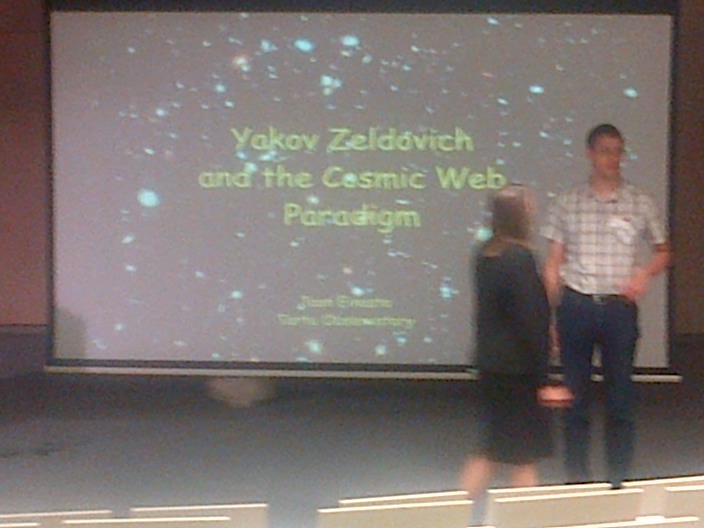
Day Five (Friday) began with a talk by Jaan Einasto, recent winner of the Gruber Prize for Cosmology. As you can see from this picture I took before his talk commenced,  the topic was Yakov Zel’dovich and the Comic Sans Cosmic Web Paradigm:

IMG-20140627-00354

The following talk was by the ebullient Rashid Sunyaev, whose name is associated with Zel’dovich in so many contexts, including the Sunyaev-Zeld’ovich effect. Sunyaev is such a big personality that he is unconstrained by the banal notions of time, and his talk set the schedule back for the rest of the morning. Among the things I remember from his contribution was a discussion of the Berkeley-Nagoya distortion. This was a hot topic during the time I was a graduate student, as it was a measurement that suggested the spectrum of the cosmic microwave background departed significantly from a black-body (Planck) curve in the Wien part of the spectrum; this is now usually known as a y-distortion. Anyway, lots of theorists wrote papers explaining the measured excess in terms of this that and the other and then it was shown to be an error; the excess emission came not from the Big Bang but from the exhaust of the rocket carrying the measurement. The thing I remember most strongly about this was that as soon as the error was identified it ceased to be the Berkeley-Nagoya distortion and became instead the Nagoya-Berkeley distortion…

Rashid Sunyaev was himself a winner of the Gruber prize some years ago, as indeed were Dick Bond and Brent Tully who spoke erlier in the conference, so the organizers decided to form a Gruber-panel to discuss various topics suggested by the audience. Here is Sunyaev, hogging the microphone:

IMG-20140627-00355

Carlos Frenk is also a Gruber prize winner, but he only arrived after lunch so wasn’t part of this discussion. The afternoon was all about cosmological simulations of various aspects of the Cosmic Web. This gives me an opportunity to repeat how the Oxford English Dictionary defines “simulation”:

1. a. The action or practice of simulating, with intent to deceive; false pretence, deceitful profession.

b. Tendency to assume a form resembling that of something else; unconscious imitation.

In the World Cup players can even get sent off for simulation, although regrettably they seldom are.

Anyway, Friday evening found us at the famous House of Blackheads (aptly on Pikk Street) for an evening of very long speeches punctuated by small amounts of food and wine (and of course some very lovely music as I described yesterday). When the party was over a group of us adjourned to a local bar, from which I returned to my hotel at about 2am.

Day Six was a half-day, with some very interesting talks about gravitational len-sing in the first session and “superstructures” in the cosmic web. Then we were into the final furlong as it were. Nick Kaiser was put in Session (No. 21) all of his own. As usual, given how annoyingly brilliant he is, Nick gave  fabulously interesting talk full of insights and ideas. The organizers had definitely saved the best for second-to-last.

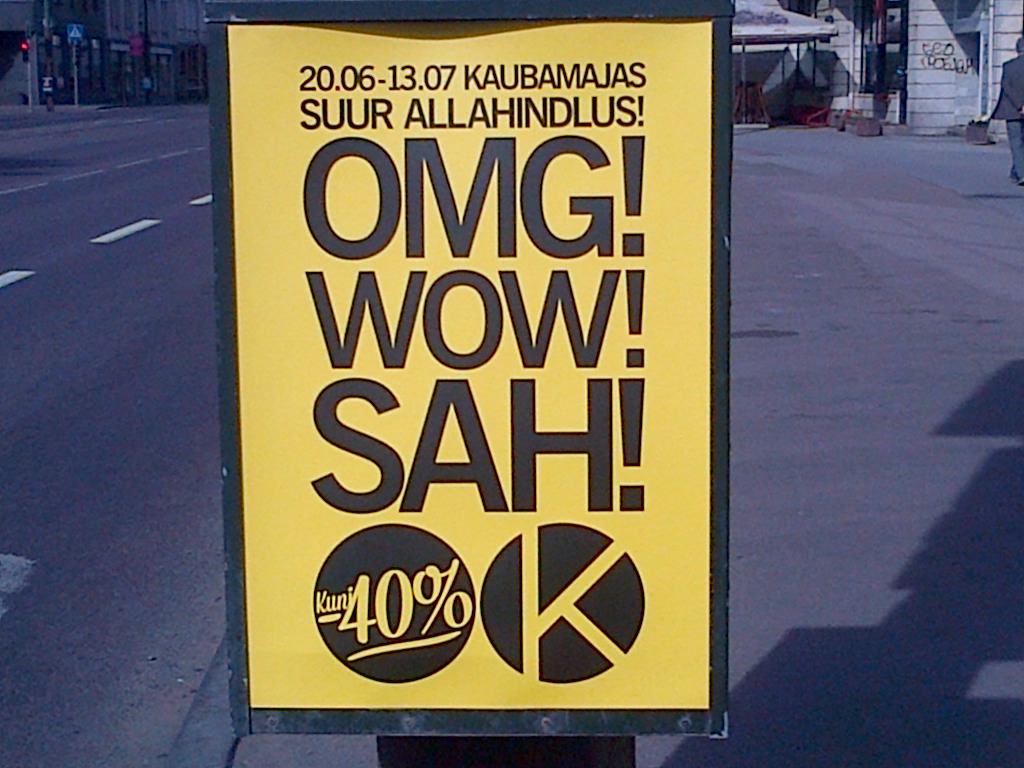
Then, after five-and-a-half days and almost 100 talks, it was down to me to give the conference summary. Obviously I couldn’t really summarize all that such I just picked up a few things that occurred to me during the course of the conference (some of which I’ve written about over the last week or so on this blog) and made a few jokes, primarily at the expense of Carlos Frenk. I was interested to see that signs like this had been put up around Tallinn advertising my talk:

IMG-20140628-00356

The OMG and WOW are self-explanatory, but I was a bit confused about the SAH so I googled it and found that it means the Society of Architectural Historians. I’ve never heard it put quite like that before, but I guess that’s what we cosmologists are: trying to understanding the origins and time evolution of the architecture of the Universe.

A number of speakers at this conference referred to a conference in Hungary in 1987 at which they had met Zel’dovich (who died later that year). I was a graduate student (at Sussex) at that time and owing the shortage of travel funds I wasn’t able to go; I went to a meeting in Cambridge called The Post-Recombination Universe instead. If memory serves that’s when I gave my first conference talk. Anyway, Carlos Frenk gave a talk at that meeting in Hungary which he decribed in his talk at this conference on Friday afternoon. Somebody back in 1987 had written a series of limericks to describe that meeting, so I was challenged to come up with one to conclude this one. Here’s my effort, which is admittedly pretty feeble, but at least the sentiments behind it are genuine..

In Tallinn (IAU 308)
The sessions invariably ran late
But despite being tired
We still much inspired
By Yakov Zel’dovich (the Great).

Mu süda, ärka üles

Posted in History, Music with tags , , , on June 28, 2014 by telescoper

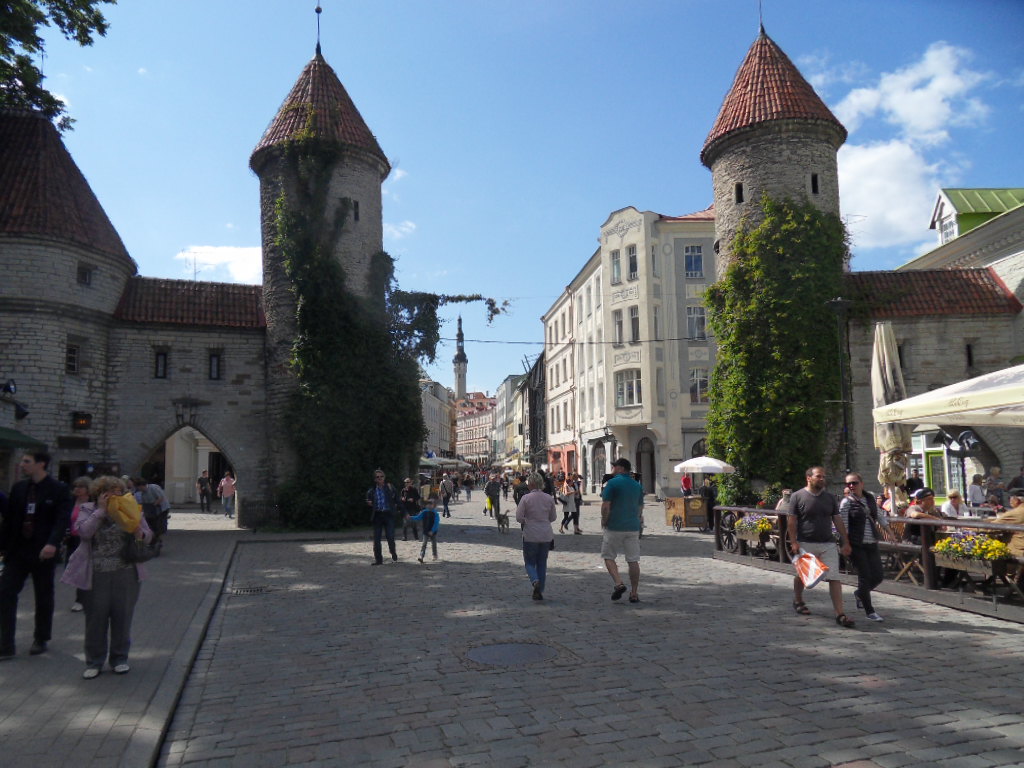
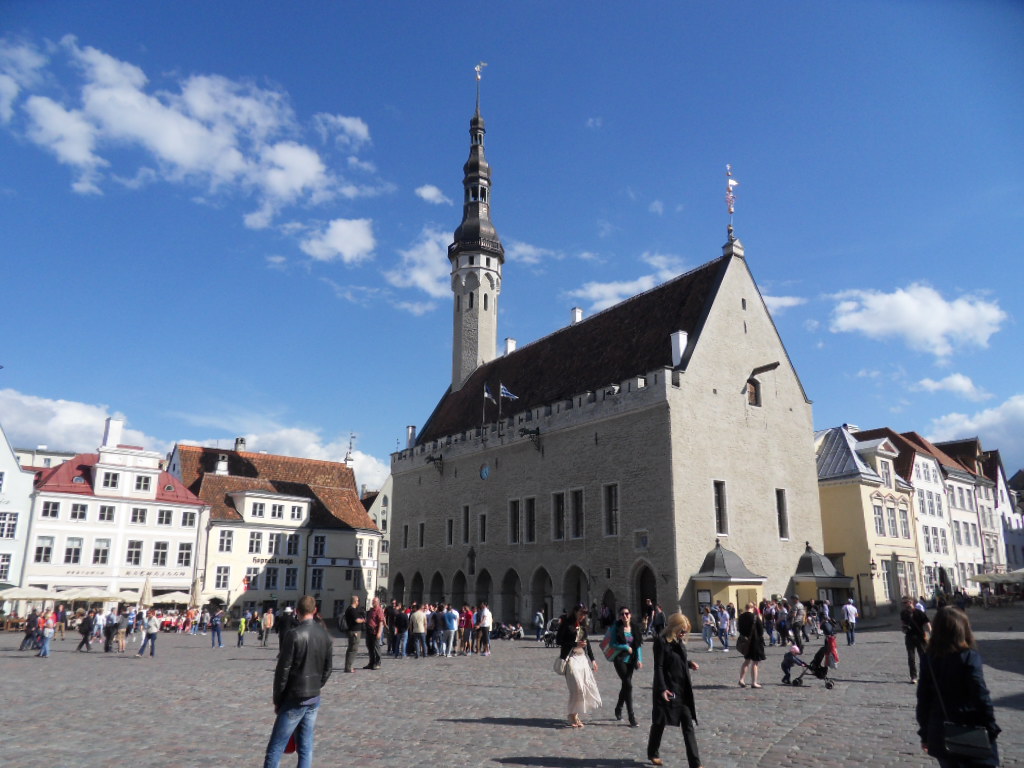
Well, the conference is over. I did my summary talk this afternoon and most of the conference attendees have already begun their journey home. I’m coming back to England tomorrow so I spent the early evening doing a bit of exploration. The conference schedule has been so packed that this is the first time I’ve been able to act like a tourist. I have to say the old town of Tallinn really is exceptionally beautiful, especially in the bright summer sunshine. Here’s a couple of pictures I took on my stroll.

SAMSUNG DIGITAL CAMERASAMSUNG DIGITAL CAMERASAMSUNG DIGITAL CAMERA

On Friday we had the conference dinner at the House of the Blackheads, which doesn’t sound so promising in English but is in fact a spending old building in the centre of Tallinn. To my delight we were serenaded by a choir (The Estonian Girls’ TV Choir). Estonia is a small country, with a population of only 1.3 Million, but it has an exceptionally strong musical tradition especially in choral music. Estonia has more choirs per unit population than any other country in the world, or so I’m told. Even more than Wales!

Anyway, this is the folk hymn they started with last night; the lights were dimmed in the ancient hall and the girls stood around the dining hall holding candles as they sang. The effect was stunning. Mu süda, ärka üles which means Awake, my heart is a traditional song, but the wonderful arrangement is by a composer who is quite new to me, Cyrillus Kreek.

I’ll complete my series of summaries of the conference tomorrow morning.