Archive for the History Category

Sinfonia Antarctica

Posted in History, Music with tags , , , , , , , , on February 8, 2012 by telescoper

Just time for a quick post while I eat my breakfast this morning about last night’s Scott Centenary Concert at St David’s Hall Cardiff. The concert was given by the City of London Sinfonia (conducted by Stephen Layton) and last night’s performance was actually the third date in a tour which takes them next to Cheltenham and then to the Cadogan Hall in London. I mentioned this concert in a post last week.

The main music for the evening was written by Vaughan Williams. The concert started with excerpts from his score for the 1948 film Scott of the Antarctic, interspersed with dramatic readings from Scott’s own diaries and letters, by actor Hugh Bonneville. Apparently Vaughan Williams found the subject matter of the film so compelling that he wrote a huge amount of music, most of it before even seeing the screenplay, and only a small part was actually used in the movie soundtrack. He later re-worked much of this material into a full symphony, The Sinfonia Antarctica, his 7th, which was performed in full after the interval. Musically speaking, therefore, the opening piece was really a taster for the full work, but the readings were deeply moving.

Scott kept full diaries all the way from the beginning to the end of the expedition so they describe the journey in remarkable detail, and with no little poignancy. The initial optimism gradually tempered turned to crushing disappointment when they discovered that Amundsen had beaten them to the South Pole. When they turned  home to try to reach safety before the Antarctic winter closed in around them, Scott’s diary asks for the first time “I wonder if we’ll make it.”  Passages describing the awful death of Petty Officer Evans and Captain Oates’ noble sell-sacrifice were included, and the last terrible days when, without food or fuel, the three remaining companions were entombed in their tent by a raging blizzard, were depicted by Scott’s increasingly fragmentary and heartbreaking notes. One can’t really imagine the depth of their suffering, of course, but the desolation of their last hours is obvious. Their bodies were not found until 8 months later.

Before the interval we heard a new commission, Seventy Degrees Below Zero, by Cecilia McDowell, featuring tenor Robert Murray. This was an orchestral setting of various parts of the scientific record of Scott’s Last Expedition. I have to say I didn’t really like the piece: the vocal lines lacked interest and the orchestral music lacked any real sense of variation or development. Robert Murray struggled to project, his rather thin tenor voice not really suited to the music.

After the interval we had a complete performance of the Sinfonia Antarctica. Although I enjoyed it very much, I’m still not sure how well this hangs together as a symphony. There’s no doubt, however,  that it contains a number of strokes of genius. The opening theme, heard at various points later on in the piece, manages to conjure up  the Antarctic landscape – not only the snow and ice but also its singular desert-like aridity – as well as a deep sense of tragedy. The second movement featuring soprano Katherine Watson and women’s voices from the Bath Camerata and Wells Cathedral School Chamber Choir in wordless singing produced a wonderful unearthly atmosphere. Later on, there’s a passage featuring an organ which gave me the chance to  hear he magnificent organ at St David’s Hall for the first time.

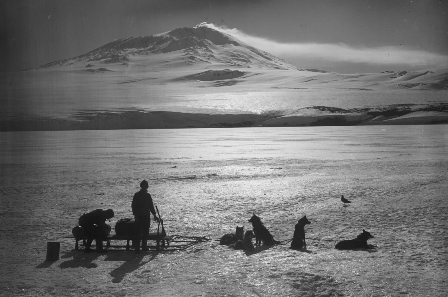
Projected above the orchestra throughout the performance were still photographs actually taken during the expedition. Some of these – like the one shown above – were stunning, but after a while I found them a bit of a distraction from the music.

Overall, an interesting concert rather than a brilliant one, which was well received by the (relatively small) audience at St David’s.

Terra Nova

Posted in Art, History, The Universe and Stuff with tags , , , , , , , on February 3, 2012 by telescoper

We’re currently enduring a spell of cold weather here in Cardiff, although I think it might be rather milder here then elsewhere in the UK. My garden thermometer showed a mere -5 C when I looked at it at 7.15 this morning. The other day we had a meeting of half-a-dozen people in one of our large teaching rooms and it was absolutely freezing. I don’t know what was wrong with the heating. Yesterday I actually did a lecture in the same room, but with 80-odd “warm bodies” (or “students” as they are sometimes known) in there, it was bearable.

The cold here of course is nothing compared with that endured by Captain Scott‘s ill-fated expedition to the South Pole, but I mention it here for a number of reasons. First, the centenary of the death of Scott and his companions is coming up next month; the tragedy unfolded in March 1912. There’s actually a very special concert coming up next week, featuring Vaughan Williams’ wonderful music written for the classic film Scott of the Antarctic (which, incidentally, you can actually watch in full on Youtube). I’m definitely going along, and will probably review the performance next week, but quite a number of my colleagues are also going, for reasons which will become obvious..

The concert is special because of the very strong connections between the Scott Expedition and the City of Cardiff. Much of the financial support needed to fund the trek to the South Pole was raised from Cardiff businessmen and Scott’s ship, the Terra Nova, actually set sail from Cardiff (in June 1910) on its journey, first to New Zealand and thence to Antarctica.

Incidentally, an article in this morning’s Western Mail relates to a historic painting of the departure of the Terra Nova which is about to be auctioned:

Cardiff Bay has certainly changed a great deal since 1910, but quite a lot is recognizable, especially the Pierhead Building, which can be seen to the right. The actual docks, the locations of which are revealed by the lines of masts of tall ships, are now mainly filled in. But there is at least one other reminder of this occasion to be found at Cardiff Bay, a large waterfront bar itself called Terra Nova

There’s also a deep connection with the South Pole, and the Antarctic generally, for many members of the Astronomy Instrumentation Group here in the School of Physics & Astronomy at Cardiff University, quite a few of whom have actually been to the South Pole in connection with various experiments, including Quad,  Boomerang and BLAST, because of the unique observing conditions there.

A Potted Prehistory of Cosmology

Posted in History, The Universe and Stuff with tags , , , , , , , , , , , , , , , , , , , , , on January 26, 2012 by telescoper

A few years ago I was asked to provide a short description of the history of cosmology, from the dawn of civilisation up to the establishment of the Big Bang model, in less than 1200 words. This is what I came up with. Who and what have I left out that you would have included?

–0–

 Is the Universe infinite? What is it made of? Has it been around forever?  Will it all come to an end? Since prehistoric times, humans have sought to build some kind of conceptual framework for answering questions such as these. The first such theories were myths. But however naïve or meaningless they may seem to us now, these speculations demonstrate the importance that we as a species have always attached to thinking about life, the Universe and everything.

Cosmology began to emerge as a recognisable scientific discipline with the Greeks, notably Thales (625-547 BC) and Anaximander (610-540 BC). The word itself is derived from the Greek “cosmos”, meaning the world as an ordered system or whole. In Greek, the opposite of “cosmos” is “chaos”. The Pythagoreans of the 6th century BC regarded numbers and geometry as the basis of all natural things. The advent of mathematical reasoning, and the idea that one can learn about the physical world using logic and reason marked the beginning of the scientific era. Plato (427-348 BC) expounded a complete account of the creation of the Universe, in which a divine Demiurge creates, in the physical world, imperfect representations of the structures of pure being that exist only in the world of ideas. The physical world is subject to change, whereas the world of ideas is eternal and immutable. Aristotle (384-322 BC), a pupil of Plato, built on these ideas to present a picture of the world in which the distant stars and planets execute perfect circular motions, circles being a manifestation of “divine” geometry. Aristotle’s Universe is a sphere centred on the Earth. The part of this sphere that extends as far as the Moon is the domain of change, the imperfect reality of Plato, but beyond this the heavenly bodies execute their idealised circular motions. This view of the Universe was to dominate western European thought throughout the Middle Ages, but its perfect circular motions did not match the growing quantities of astronomical data being gathered by the Greeks from the astronomical archives made by the Babylonians and Egyptians. Although Aristotle had emphasised the possibility of learning about the Universe by observation as well as pure thought, it was not until Ptolemy’s Almagest, compiled in the 2nd Century AD, that a complete mathematical model for the Universe was assembled that agreed with all the data available.

Much of the knowledge acquired by the Greeks was lost to Christian culture during the dark ages, but it survived in the Islamic world. As a result, cosmological thinking during the Middle Ages of Europe was rather backward. Thomas Aquinas (1225-74) seized on Aristotle’s ideas, which were available in Latin translation at the time while the Almagest was not, to forge a synthesis of pagan cosmology with Christian theology which was to dominated Western thought until the 16th and 17th centuries.

The dismantling of the Aristotelian world view is usually credited to Nicolaus Copernicus (1473-1543).  Ptolemy’s Almagest  was a complete theory, but it involved applying a different mathematical formula for the motion of each planet and therefore did not really represent an overall unifying system. In a sense, it described the phenomena of heavenly motion but did not explain them. Copernicus wanted to derive a single universal theory that treated everything on the same footing. He achieved this only partially, but did succeed in displacing the Earth from the centre of the scheme of things. It was not until Johannes Kepler (1571-1630) that a completely successful demolition of the Aristotelian system was achieved. Driven by the need to explain the highly accurate observations of planetary motion made by Tycho Brahe (1546-1601), Kepler replaced Aristotle’s divine circular orbits with more mundane ellipses.

The next great development on the road to modern cosmological thinking was the arrival on the scene of Isaac Newton (1642-1727). Newton was able to show, in his monumental Principia (1687), that the elliptical motions devised by Kepler were the natural outcome of a universal law of gravitation. Newton therefore re-established a kind of Platonic level on reality, the idealised world of universal laws of motion. The Universe, in Newton’s picture, behaves as a giant machine, enacting the regular motions demanded by the divine Creator and both time and space are absolute manifestations of an internal and omnipresent God.

Newton’s ideas dominated scientific thinking until the beginning of the 20th century, but by the 19th century the cosmic machine had developed imperfections. The mechanistic world-view had emerged alongside the first stirrings of technology. During the subsequent Industrial Revolution scientists had become preoccupied with the theory of engines and heat. These laws of thermodynamics had shown that no engine could work perfectly forever without running down. In this time there arose a widespread belief in the “Heat Death of the Universe”, the idea that the cosmos as a whole would eventually fizzle out just as a bouncing ball gradually dissipates its energy and comes to rest.

Another spanner was thrown into the works of Newton’s cosmic engine by Heinrich Olbers (1758-1840), who formulated in 1826 a paradox that still bears his name, although it was discussed by many before him, including Kepler. Olbers’ Paradox emerges from considering why the night sky is dark. In an infinite and unchanging Universe, every line of sight from an observer should hit a star, in much the same way as a line of sight through an infinite forest will eventually hit a tree. The consequence of this is that the night sky should be as bright as a typical star. The observed darkness at night is sufficient to prove the Universe cannot both infinite and eternal.

Whether the Universe is infinite or not, the part of it accessible to rational explanation has steadily increased. For Aristotle, the Moon’s orbit (a mere 400,000 km) marked a fundamental barrier, to Copernicus and Kepler the limit was the edge of the Solar System (billions of kilometres away). In the 18th and 19th centuries, it was being suggested that the Milky Way (a structure now known to be at least a billion times larger than the Solar System) to be was the entire Universe. Now it is known, thanks largely to Edwin Hubble (1889-1953), that the Milky Way is only one among hundreds of billions of similar galaxies.

The modern era of cosmology began in the early years of the 20th century, with a complete re-write of the laws of Nature. Albert Einstein (1879-1955) introduced the principle of relativity in 1905 and thus demolished Newton’s conception of space and time. Later, his general theory of relativity, also supplanted Newton’s law of universal gravitation. The first great works on relativistic cosmology by Alexander Friedmann (1888-1925), George Lemaître (1894-1966) and Wilhem de Sitter (1872-1934) formulated a new and complex language for the mathematical description of the Universe.

But while these conceptual developments paved the way, the final steps towards the modern era were taken by observers, not theorists. In 1929, Edwin Hubble, who had only recently shown that the Universe contained many galaxies like the Milky way, published the observations that led to the realisation that our Universe is expanding. That left the field open for two rival theories, one (“The Steady State”, with no beginning and no end)  in which matter is continuously created to fill in the gaps caused by the cosmic expansion and the other in which the whole shebang was created, in one go, in a primordial fireball we now call the Big Bang.

Eventually, in 1965, Arno Penzias and Robert  Wilson discovered the cosmic microwave background radiation, proof (or as near to proof as you’re likely to see) that our Universe began in a  Big Bang…
Backwater Blues

Posted in History, Jazz with tags , , , , on January 5, 2012 by telescoper

Although the risk of flooding has abated somewhat in these parts, the various alerts reminded me that I should post this classic piece of music. It’s not only a definitive example of the art of the blues, sung by the incomparable Bessie Smith with James P. Johnson on piano, but also an important piece of American social history, as it documents the Mississippi River flood of 1927, which brought death and devastation to seven southern states, including Tennessee and Arkansas as well as  Mississippi. It’s mistitled “Black Water” on the clip – it should be “Backwater”, but whatever its name it’s definitely the Blues.


Hylas and Philonous

Posted in History, The Universe and Stuff with tags , , , , , , , on December 21, 2011 by telescoper

I’ve just finished reading (and writing a review of) a funny little book about quantum mechanics called Quantum Enigma: Physics Encounters Consciousness by Bruce Rosenblum and Fred Kuttner. I won’t repeat the review here for fear of copyright infringement, but I will say that, somewhat to my surprise, I actually liked some of the book although it does go off the rails a bit now and then. Don’t we all, though?

Anyway, one thing did strike me that I didn’t really have time to write about in my piece concerns the philospher George Berkeley (1685-1753). In case you weren’t aware, the town of Berkeley (near San Francisco, in California) is actually named after him.

Berkeley was one of a number of philosophers responsible for the emergence in the 17th and 18th centuries of a movement now known as empiricism. The most striking of Berkeley’s arguments is that matter (or substance) cannot be said to exist in a manner that’s independent of the mind, butHis work has turned out to be nowhere near as durable as some of his contemporaries, notably David Hume,  but he’s actually a much more interesting thinker  than most people seem to give him credit for. Indeed, many writers – including the authors of the book I mentioned above – dismiss his views as a preposterously naive form of solipsism. Although I’m no empiricist myself, I think this Berkeley-bashing is a bit unfair.

I think Berkeley’s ideas are best understood in relation to the others that were being suggested around the time he was writing, particularly René Descartes whose method was to try to understand what could be known with certainty when all possible scepticism was argued away. In Berkeley’s most important work The Dialogues of Hylas and Philonous (1710)  he developed this approach into an argument that only ideas, perceived and created by the mind, could be known with any certainty, doing so through a dialogue between two characters. Hylas represents the view of “normal” scientific common sense (as one imagines would be exemplified by, say, Isaac Newton); Philonous represents Berkeley’s own views.

Time and time again Philonous comes up with ingenious counters to the “obvious” arguments presented by Hylas. Our understanding of what we consider to be actually existing objects to which we attribute certain qualities (such as white clouds or hot water) is essentially a mental affair. Sensations such as taste and pain have no basis in existence outside the mind, but what about trickier concepts like colour? Can it be said that when  an object looks red that it must contain in itself the quality of redness? Berkeley says no, because “red” is merely a category and cannot therefore exist in the colour. Of course we now know a lot more about how colour comes about than Berkeley did, but it remains an interesting point.

He suggested quite generally that impressions we get from our senses are not necessarily based on an innate qualities of the objects or substances with which our senses come into contact. For example, our sense of distance is not caused by the actual distance between objects themselves.

I have to re-iterate that I’m not an empiricist and I don’t agree with Berkeley’s position, just that his position is a great deal subtler and more interesting than usually represented. I mis-spent a large part of my youth struggling with  impenetrable works of philsophy, but Hylas and Philonous is one I definitely don’t regret reading. Not quite up to the standard of David Hume, mind you, but who is?

So give George Berkeley a break! Karl Popper, on the other hand…

Remembered Heroes

Posted in Books, Talks and Reviews, Cricket, History with tags , on November 13, 2011 by telescoper

Two things have come up recently that I’d like to mention here. They’re both, in their different ways, about heroes, but the remembrance that’s called for is different to that normally observed on this day.

First, I couldn’t resist passing on a link to a short but intensely moving piece by Alan Garner in yesterday’s Guardian about Alan Turing, in the My Hero series.

I suppose most readers of this blog will know of Turing’s pioneering work on computer science and his crucial contribution to the war effort in cracking the German Enigma codes. I also suppose most know about the circumstances of his death; he took is own life in 1954 after being forced to endure a form of chemical castration after being found guilty of homosexuality, in case you didn’t already know. Many of you will also have read some (or in my case many) of the various books about his life and work. (If not I recommend Andrew Hodges’ excellent The Enigma of Intelligence, which I read when I was an undergraduate, over 25 years ago.)

But what those of us who never met Alan Turing will never know is what he was really like as a man, and that is why pieces like the one by Alan Garner are so moving. Turing comes across as eccentric (I think we all know what was the case), but also as a very amusing character who was excellent company and a bit of a chatterbox, despite suffering from a stammer. The circumstances of his arrest and subsequent conviction for the “crime” of being gay also confirm the impression that he had an almost childlike innocence about the world outside academe. In other words, he was a very easy target. We like to think we live in more enlightened times nowadays – and I suppose in many ways we do – but I think Alan Turing would be as much, or even more of, a misfit in today’s world than he was in the 1950s. Although he was undoubtedly a genius, he rarely bothered to publish academic papers so I dread to think how he would fare in the present university system!

Anyway, I’d just like to say thank you to Alan Garner (who knew Turing well as a friend) for sharing his thoughts and experiences. I may have never met Alan Turing, but he’s my hero too…

And that brings me to another sad story. I only learned this morning that former cricketer Peter Roebuck died yesterday, at the age of 55, having taken his own life in a hotel room in Cape Town. Peter Roebuck always seemed to me an unlikely figure for a sportsman, with his spectacles, cerebral air, and rather stooped gait he looked more like an academic than an athlete, but he was a fine cricketer. I remember him very well from the time I was a schoolboy mad keen about cricket, and I liked him particularly because he wasn’t – or didn’t seem to be – someone blessed with prodigious natural skill. He made it in the professional game because he worked hard. People like that are always heroes to those, like me, who love sport but don’t have any innate talent for it.

After retiring from cricket Roebuck went to live in Australia and took up a career as writer and commentator on the sport, a role at which he excelled, as much for his lucid prose as for his deep technical knowledge. Although he mainly covered Australian cricket, I often read his articles and admired his writing enormously. I have no idea what caused him to commit suicide, and I wouldn’t wish to speculate about that, let alone presume to judge. All I can say is that it’s the saddest thing when someone takes their own life, whatever the circumstances.

UPDTATE: 14/11/2011 There’s a lot of traffic coming to this post via Google searches of “Was Peter Roebuck gay” or suchlike. I have no idea whether he was or wasn’t and I’m not going to indulge in gossip, so I’m afraid that if that’s the reason you’re here you’re going to be disappointed.

Rest in peace, Peter Roebuck.


How to reply to a libel threat…

Posted in History, Literature with tags , , , on October 19, 2011 by telescoper

A couple of days ago I bought a copy of Private Eye: The First 50 Years by Adam MacQueen, which I’ve been dipping into from time to time. This is in an  A-Z format that encourages one to sample rather than read straight through  like a history book. I think it’s excellent: not only great fun, with several “laugh-out-loud” passages, but also a very interesting piece of social history.

Last night I came across the book’s account of the famous episode of Arkell versus Pressdram , one of the Eye‘s many brushes with libel law, Pressdram being the name of the company that publishes said organ. I thought I’d post it here for those who haven’t heard of it because I find it quite inspirational. It’s actually been a while since anyone threatened me with a libel action but when that did happen, many moons ago, my response was similar in spirit (though not in form) to the memorable reply given by the Eye in the correspondence below (with, I might add, the same result):

Solicitor’s Letter to Private Eye:

We act for Mr Arkell who is Retail Credit Manager of Granada TV Rental Ltd.

His attention has been drawn to an article appearing in the issue of Private Eye dated 9th April 1971 on page 4. The statements made about Mr Arkell are entirely untrue and clearly highly defamatory.

We are therefore instructed to require from you immediately your proposals for dealing with the matter. Mr Arkell’s first concern is that there should be a full retraction at the earliest possible date in Private Eye and he will also want his costs paid. His attitude to damages will be governed by the nature of your reply.

Response from Private Eye:

We acknowledge your letter of 29th April referring to Mr J. Arkell.

We note that Mr Arkell’s attitude to damages will be governed by the nature of our reply and would therefore be grateful if you would inform us what his attitude to damages would be, were he to learn that the nature of our reply is as follows: fuck off.

No further letters were received from Mr Arkell’s solicitors. This legendary exchange of letters has now become a well-known in-joke for solicitors. So if you ever get a letter from a solicitor trying to frighten you with threats of libel, or simply want someone to fuck off for some other reason, I suggest you refer them to the Reply Given in Arkell versus Pressdram.

Einstein and your Gas Bill

Posted in History, Television, The Universe and Stuff with tags , , , , , on October 11, 2011 by telescoper

Taking refuge in my office this lunchtime for a sandwich and a cup of coffee I turned to the latest edition of Physics World and came across an funny little story about a physicist (who is completely new to me) with the splendid name of Fritz Hasenöhrl.

The news story relates to a paper on the arXiv, part of the abstract of which I’ve copied below:

In 1904 Austrian physicist Fritz Hasenohrl (1874-1915) examined blackbody radiation in a reflecting cavity. By calculating the work necessary to keep the cavity moving at a constant velocity against the radiation pressure he concluded that to a moving observer the energy of the radiation would appear to increase by an amount E=(3/8)mc^2, which in early 1905 he corrected to E=(3/4)mc^2

Since I’ve been doing a bit of dimensional analysis with first-year students, I’m a bit surprised that the authors of this paper read so much into the fact that Hasenöhrl’s formula bears a superficial resemblance to Einstein’s most famous formula E=mc^2, probably the best known and at the same time worst understood equation in physics. In fact any physicist worth his or her salt no matter how incorrect their reasoning would have to get something like E =\alpha mc^2, with \alpha some dimensionless number, simply because the answer has to have the correct dimensions to be an energy.

Expressing energy in terms of the basic dimensions mass M, length L and time T is probability easiest to do when you think of mechanical work (force×distance). Since Newton’s laws give a force equal to mass×acceleration, a force has dimensions MLT^{-2}, so work (a form of energy) has dimensions ML^{2}T^{-2}. Now try to make this out of a combination of a mass (M) and a velocity (LT^{-1}) and you’ll find that it has to be mass×velocity2. You can’t get the dimensionless constant this way, but the combination of m and c must be the way it is in Einstein’s formula.

Anyway, all this suddenly reminded me of a day long ago when I appeared on peak-time television in the consumer affairs programme Watchdog, explaining – or, rather, attempting to explain – the physics behind the way gas bills are calculated. Apparently someone had written in to the programme asking why it was that they weren’t just being charged for the volume of gas that had flowed through their meter, but that the cost involved a complicated calculation involving something called the calorific value of the gas.

The answer is fairly obvious, actually. The idea is that to make competition fairer between different forms of energy (particularly gas and electricity) the bills should be for the amount of energy you have used rather than the amount of gas. Since the source of fuel varies from day to day so does its chemical composition and hence the amount of energy that can be extracted from it when it is burned. Gas companies therefore monitor the calorific value, using it to convert the amount of gas you have used into an amount of energy.

On the programme I was confronted by the curmudgeonly Edward Enfield (father of comedian Harry Enfield) who took the line that it was all unnecessarily complicated and that the bill should just be for the amount of gas used, rather in the same way that petrol is sold. When I tried to explain that the way it was done was really fairer, because  it was really the energy that mattered, it quickly became obvious that he didn’t really understand what energy was or how it was defined.  He didn’t even get the difference between energy and power. I suspect that goes for many members of the general public.

It was all a bit tongue-in-cheek, but I enjoyed the sparring. Eventually he came out with a question about why energy was given by E=mc^2 rather than mc^3 or something else. So I launched into an explanation of dimensional analysis and why mc^3 couldn’t be an energy because it has the wrong dimensions. His eyes glazed over. The shoot ended. My splendidly erudite and logically rigorous exposition of dimensional analysis never made it into the broadcast programme.
My brief career on BBC1 was over.

University Physics Examinations, Vintage 1892

Posted in Education, History with tags , , on September 7, 2011 by telescoper

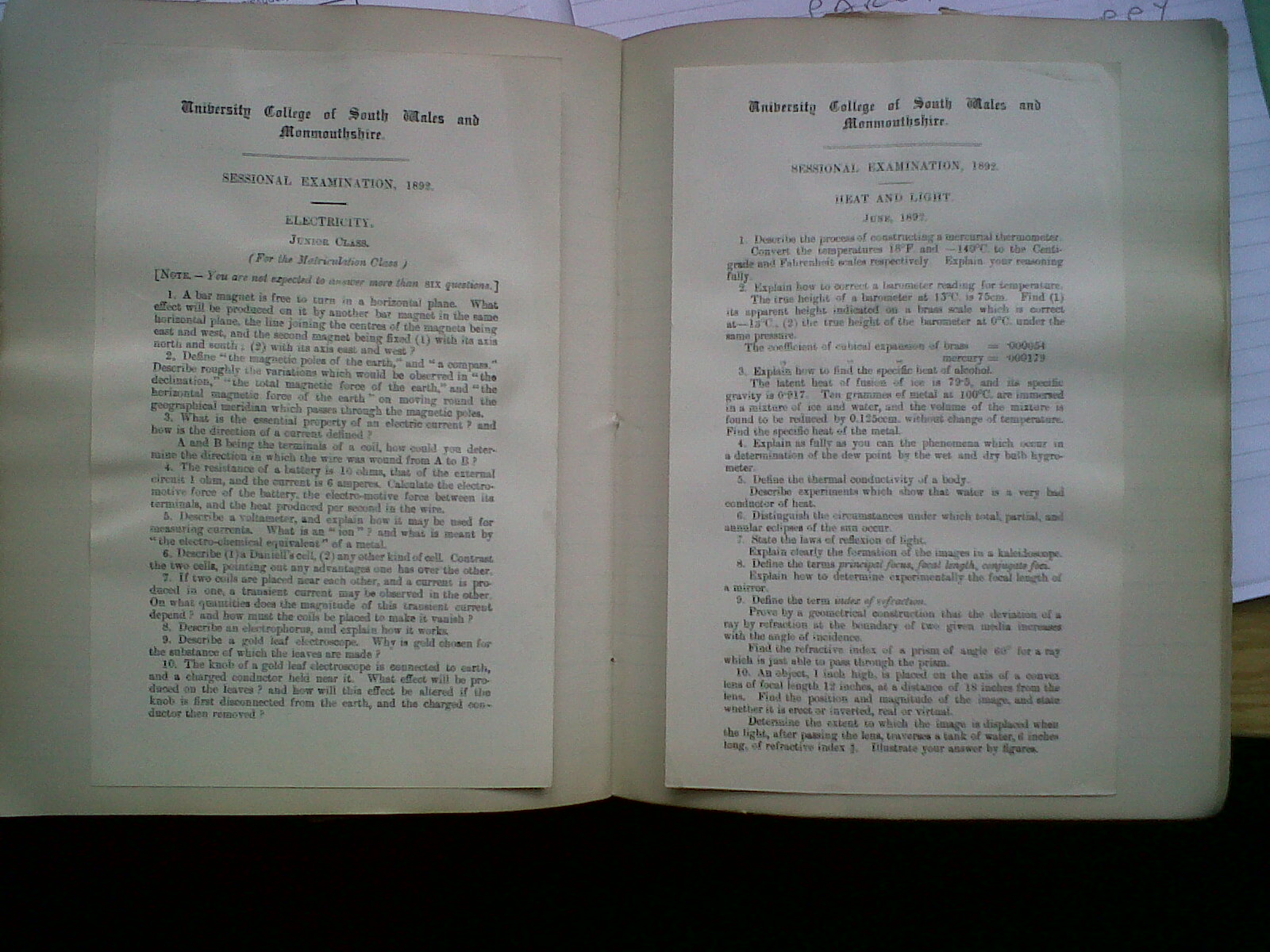
There recently came into my possession a book of very old school and university physics examinations, which are of interest because I’ve been posting slightly less ancient examples in recent weeks. These examinations were set by the University College of South Wales and Monmouthshire, which was founded in 1883,  an institution which eventually became Cardiff University. I find them absolutely fascinating.

The papers are rather fragile, as is the book containing them, so I daren’t risk trying to scan them systematically in case flattening them out causes damage. Here instead are a few random examples that I photographed on my desk, in the manner of an old-fashioned secret agent. Sorry they’re not all that clear, but you can see them blown up if you click on them.

The collection is fairly complete, covering most of classical physics, at all examination levels from university entry to final honours. For some reason, however, the papers on relativity and quantum physics appear to be missing….

No Pasaran

Posted in Biographical, History, Music, Politics with tags , , , on September 4, 2011 by telescoper

Yesterday’s attempt by the so-called English Defence League (a group of violent Neo-Nazi thugs) to stir up trouble in the East End of London was the cue for thousands of anti-fascists to stage a counter-demonstration. Many were worried that this would lead to a repeat of the Battle of Cable Street, but thankfully that didn’t happen. While it’s reassuring that the number of of EDL supporters amounted to just a few hundred – many fewer than those who protested against them – it still fills me with sadness that there are even that many people who are prepared to follow such an organization. The lessons of history make it clear that the journey they want to take will lead to an England that isn’t worth defending, so they must be stopped at the outset with every peaceful means possible.

I wasn’t able to get to London for the demonstration, but if I had it would no doubt filled me with nostalgia because the anti-EDL protestors were chanting “¡No pasarán!” (“They Shall Not Pass“), a slogan redolent with nostalgia for me, from my time as a student leftie, and which dates from the heroic defence of Madrid against Franco’s fascists during the Spanish Civil War. In those days (when I was student, I mean, not during the Spanish Civil War!) I was  a member of the Nicaragua Solidarity Campaign and remember hearing the band, Zinica, singing a song with that title (which I’ve put below). I even bought their album, Bluefields Express, which I still have.

The members of Zinica hailed from the caribbean cost of Nicaragua which was extensively settled by English people, so a number of the towns in that area have English names, such as Bluefields. Many of their songs were based on traditional English folk songs, especially sea shanties, but with a definite  flavour of calypso and reggae.

Anyway, now in my complacent middle age, I thank the EDL for one thing only – reminding me of the sad fact that fascism remains a threat to which we all must be alert. Next time the EDL try to incite violence again, I’ll definitely be among those protesting against them.

No pasarán.