Archive for the LGBTQ+ Category

Stonewall and After – in Praise of Drag Queens

Posted in Biographical, History, LGBTQ+ with tags , , , , on June 28, 2015 by telescoper

Despite not being able to go to the big event in London yesterday, it’s been a very memorable Pride Weekend, preceded as it was by the ruling of the Supreme Court of the United States of America that the right for same sex couples to get married was protected under the constitution. The White House responded to the judgement in appropriate style:

white-house-rainbow-3

I’m tempted to quote Genesis 9:16, but I won’t.

My facebook and twitter feeds have been filled with rainbows all weekend, as is my wordpress editor page as I write this piece. It’s been great to see so many people, straight and gay, celebrating diversity and equality. Even a Dalek joined in.

Gay Dalek

I’m a bit more cynical about the number of businesses that have tried to cash in on  Pride but even that is acceptance of a sort. It’s all very different from the first Pride March I went on, way back in 1986. That was a much smaller scale event than yesterday’s, and politicians were – with very few exceptions – notable by their absence.

In fact today is the anniversary of the event commemorated by Pride. It was in the early hours of the morning of Saturday June 28th 1969 that the Stonewall Riots took place in the Greenwich Village area of New York City. There are few photographs and no film footage of what happened which, together with some conflicting eyewitness accounts, has contrbuted to the almost mythical status of these demonstations, which were centred on the Stonewall Inn (which, incidentally, still exists).  What is, I think, clear is that they were the spontaneous manifestation of the anger of a community that had simply had enough of the way it was being treated by the police. Although it wasn’t the first such protest in the USA, I still think it is also the case that Stonewall was a defining moment in the history of the movement for LGBT equality.

One of the myths that has grown up around Stonewall is that the Stonewall Inn was a place primarily frequented by drag queens and it was the drag queens who began the fight back against intolerable  police harassment. That was the standard version, but the truth is much more complicated and uncertain that that. Nevertheless, it is clear that it was the attempted arrest of four people – three male (cross-dressers) and one female – that ignited the protest. Whether they led it or not, there’s no doubt that drag queens played a major role in the birth of the gay liberation movement. Indeed, to this day, it remains the case that the “T” part of the LGBT spectrum (which I interpret to include Transgender and Transvestite) is often neglected by the rest of the rainbow.

I have my own reasons for being grateful for drag queens. When I was a youngster (still at School) I occasionally visited a gay bar in Newcastle called the Courtyard. I was under age for drinking alcohol let alone anything else – the age of consent was 21 in those days – but I got a kick out of the attention I received and flirted outrageously without ever taking things any further. I never had to buy my own drinks, let’s put it that way.

Anyway, one evening I left the pub to get the bus home – the bus station was adjacent to the pub – but was immediately confronted by a young bloke who grabbed hold of me and asked if I was a “poof”. Before I could answer, a figure loomed up behind him and shouted “Leave him alone!”. My assailant let go of me and turned round to face my guardian angel, or rather guardian drag queen. No ordinary drag queen either. This one, at least in my memory, was enormous: about six foot six and built like a docker, but looking even taller because of the big hair and high heels. The yob laughed sneeringly whereupon he received the immediate response of a powerful right jab to the point of the chin, like something out of boxing manual. His head snapped back and hit the glass wall of a bus shelter. Blood spurted from his mouth as he slumped to the ground.

I honestly thought he was dead, and so apparently did my rescuer who told me in no uncertain terms to get the hell away. Apart from everything else, the pub would have got into trouble if they’d known I had even been in there. I ran to the next stop where I got a bus straightaway. I was frightened there would be something on the news about a violent death in the town centre, but that never happened. It turns out the “gentleman” concerned had bitten his tongue when the back of his head hit the bus shelter. Must have been painful, but not life-threatening. My sympathy remains limited.

I think there’s a moral to this story, but I’ll leave it up to you to decide what it is.

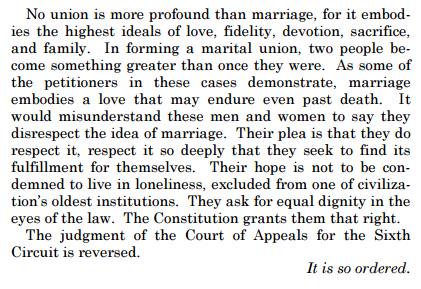
It is so ordered..

Posted in LGBTQ+, Politics on June 26, 2015 by telescoper

image

I never expected to be moved to tears by the eloquence of a court judgement, even if the margin was as narrow as it could have been (5-4).

Network Launch

Posted in Biographical, LGBTQ+ with tags , on June 19, 2015 by telescoper

As promised, last night saw the launch of the new Sussex University staff LGBT network. I was quite nervous ahead of the event, unsure of how it would go.

LGBT_staff

In the end most of the people who said they would come did so,  25 people or thereabouts. The mailing list is over 50, but this is a busy time of year so there were quite a few who couldn’t come last night. In fact if there had been many more people it might have made it more difficult for people to have their opinions heard.

At least most of the food and drink was consumed…

nibbles

Anyway, we had a nice discussion of the things we might do and a few people stepped up to volunteer their time to help organize various events. Now for some serious work over the summer to get things really moving and plan a programme for next academic year…


An “Enfys” for Sussex…

Posted in Biographical, LGBTQ+ with tags , , , on June 9, 2015 by telescoper

As Head of School for Mathematical and Physical Sciences I get to do all kinds of jobs across the University to do with all kinds of matters, academic and non-academic alike. In the course of one of these – chairing the University’s Human Resources Committee – it occurred to me that it was very strange that it was a bit strange that a University (Sussex) so close to a famously gay-friendly city (Brighton) didn’t have any real forum for LGBT staff to share information, to support each other, and to run social, cultural or other events. It also seemed strange to me that the University of Sussex was not part of the Stonewall Diversity Champions scheme. Even worse, there is no official University staff representation at Brighton’s annual Pride celebrations, though the Student LGBTQ society has

My former institution, Cardiff University, not only has a thriving staff network (called Enfys, the Welsh word for “Rainbow”) and belongs to the Stonewall scheme, it also ranks 24th in the top 100 Equality Index of all UK employers.

Anyway, it was definitely with Enfys in mind that I suggested setting up a similar network here on the Sussex campus, open to all staff (not just academics). I wasn’t sure whether there would be any enthusiasm for it, but the senior management of the University gave me their backing to try.

And so it came to pass that we announced that a network was being set up, and there would be a kind of “launch party” on 18th June to plan what sort of things we would do. I had no idea how many people would be interested and was quite prepared for the idea to bomb completely. However, just a couple of weeks after the initial announcement we have more than 50 people on the mailing list, and I’m expecting good turnout for the launch which I hope will be a fun occasion in itself but also the start of something very interesting to be part of. I also hope people bring plenty of ideas for the sorts of events and activities we can organize and the energy and enthusiasm to work at actually bringing these ideas into being.

One of the most important things we have to do, though, is to come up with a name. Although I nicked the idea from them I don’t think we can really use Enfys. And “Sussex University LGBT Staff Network” sounds a bit dull. Any suggestions?

Gay Astronomers – At Last Some Data!

Posted in Biographical, LGBTQ+, Science Politics with tags , , , , , , on June 1, 2015 by telescoper

Some time ago I wrote a blog post entitled Where are all the LGBT Astrophysicists. I wrote that piece when I accidentally discovered that somebody had recently written a blog post (about Einstein’s Blackboard) which mentions me. I used to look after this famous relic when I was in Nottingham many years ago, you see.

There’s a sentence in that post that says

Professor Coles is one of the few out gay astrophysicists in the UK.

Well, it all depends by what you mean by “few” but at the time I wrote that  I thought there are more gay (or lesbian or bisexual or transgendered) astrophysicists out there than most people probably think. I know quite a large number personally- dozens in fact- most of whom are “out”. It’s a safe bet that there are many more who aren’t open about their sexuality too. However, it is probably the case that LGBT scientists are much less visible as such through their work than colleagues in the arts or humanities. Read two research papers, one written by a straight astrophysicist and one by an LGBT astrophysicist, and I very much doubt you could tell which is which. Read two pieces of literary criticism, however, and it’s much more likely you could determine the sexual orientation of the writer.

You might ask why it matters if an astrophysicist or astronomer is straight or gay? Surely what is important is whether they are good at their job? I agree with that, actually. When it comes to career development, sexual orientation should be as irrelevant as race or gender. The problem is that the lack of visibility of LGBT scientists – and this doesn’t just apply to astrophysics, but across all science disciplines – could deter young people from choosing science as a career in the first place.

Anyway, at last we have some evidence as to whether this might be the case. In 2014 the Royal Astronomical Society (of which I am a Fellow) carried out a demographic survey of its membership. This happens from time to time but this one was the first to include a question about sexual orientation. The Institute of Physics did a similar survey about Physics about a decade ago, but did not include sexual orientation among its question, so this is the first time I’ve seen any data about this from a systematic survey. The results are quite interesting. About 7% of UK respondents (from a total of around a thousand) refused to answer the sexual orientation question but, among those who did, 3% identified themselves as bisexual and 4% as gay men. Both these proportions are significantly higher than the figures for the general UK population reported by the Office of National Statistics. The fraction of respondents in the RAS Survey declaring themselves to be heterosexual was 84%, whereas the corresponding figure from the ONS Survey was 93.5%. The number of UK respondents in the RAS Survey identifying as lesbian was only 0.2%; the proportion of respondents identifying themselves as male was 77.5% versus 21.3% female, which accounts for only some of the difference between gay and lesbian proportions.

So, according to the survey, gay men are actually significantly over-represented in the Royal Astronomical Society compared to the general population. That confirms the statement I made earlier that there are more gay astronomers than you probably think.  It also shows that there is no evidence that gay men are deterred from becoming astronomers. In fact, it seems to be quite the opposite. It’s a different story when it comes to other demographics, however. The RAS membership is older, less ethnically diverse, and more male-dominated than the the general population, so there’s a lot of work to be done redressing the balance there.

On the other hand, next time the Royal Astronomical Society is looking to elect a President it will naturally want to find someone who is representative of its membership, which means an ageing white gay male. I rest my case.


Round the Horn Antenna

Posted in LGBTQ+, The Universe and Stuff with tags , , , , , on August 28, 2014 by telescoper

The other day I was looking through my copy of Monthly Notices of the Royal Astronomical Society (which I buy for the dirty pictures).  Turning my attention to the personal columns, I discovered an advertisement for the Science & Technology Facilities Council which is, apparently, considering investing in new space missions related to astronomy and cosmology. Always eager to push back the frontiers of science, I hurried down to their address in Swindon to find out what was going on.


ME: (Knocks on door) Hello. Is there anyone there?

JULIAN: Oh hello! My name’s Julian, and this is my friend Sandy.

SANDY: Oooh hello! What can we do for you?

ME: Hello to you both. Is this Polaris House?

JULIAN: Not quite. Since we took over we changed the name…

ME: To?

SANDY: It’s now called Polari House…

JULIAN: ..on account of that’s the only language spoken around here.

ME: So you’re in charge of the British Space Programme then?

JULIAN:  Yes, owing to the budget, the national handbag isn’t as full as it used to be so now it’s just me and her.

SANDY: But never fear we’re both dab hands with thrusters.

JULIAN: Our motto is “You can vada about in any band, with a satellite run  by Jules and…

SANDY: …Sand.

ME: I heard that you’re looking for some input.

SANDY: Ooooh. He’s bold, in’e?

ME: I mean for your consultation exercise…

JULIAN: Oh yes. I forgot about that. Well I’m sure we’d welcome your contribution any time, ducky.

ME: Well I was wondering what you could tell me about Moonlite?

SANDY: You’ve come to the right place. She had an experience by Moonlight, didn’t you Jules?

JULIAN: Yes. Up the Acropolis…

ME: I mean the Space Mission “Moonlite”

SANDY: Oh, of course. Well, it’s only small but it’s very stimulating.

JULIAN: Hmmm.

SANDY: Yes. It gets blasted off into space and whooshes off to the Moon…

JULIAN: …the backside thereof…

SANDY: ..and when it gets there it shoves these probes in to see what happens.

ME: Why?

SANDY: Why not?

ME: Seems a bit pointless to me.

JULIAN: There’s no pleasing some people is there?

ME: Haven’t you got anything more impressive?

SANDY: Like what?

ME:  Maybe something that goes a bit further out? Mars, perhaps?

JULIAN: Well the French have this plan to send some great butch omi to troll around on Mars but we haven’t got the metzas so we have to satisfy ourselves with something a bit more bijou…

SANDY: Hmm…You can say that again.

JULIAN: You don’t have to be big to be bona.

SANDY: Anyway, we had our shot at Mars and it went willets up.

ME: Oh yes, I remember that thing named after a dog.

JULIAN: That’s right. Poodle.

ME: Do you think a man will ever get as far as Uranus?

JULIAN&SANDY: Oooh! Bold!

SANDY: Well I’ll tell you what. I’ll show you something that can vada out to the very edge of the Universe!

ME: That sounds exciting.

JULIAN: I’ll try to get it up right now.

ME: Well…er…

JULIAN: I mean on the computer

ME: I say, that’s an impressive piece of equipment

JULIAN: Thank you

SANDY: Oh don’t encourage her…

ME: I meant the computer.

JULIAN: Yes, it’s a 14″ console.

SANDY:  And, believe me, 14 inches will console anyone!

JULIAN; There you are. Look at that.

ME: It looks very impressive. What is it?

SANDY: This is an experiment designed to charper for the heat of the Big Bang.

JULIAN. Ooer.

SANDY: The Americans launched WMAP and the Europeans had PLANCK. We’ve merged the two ideas and have called it ….PLMAP.

ME: Wouldn’t it have been better if you’d made the name the other way around? I mean with the first bit of WMAP and the second bit of Planck. On second thoughts maybe not..

JULIAN: It’s a little down-market but we have high hopes.

SANDY: Yes, Planck had two instruments called HFI and LFI. We couldn’t afford two so we made do with one.

JULIAN: It’s called MFI. That’s why it’s a bit naff.

ME: I see. What are these two round things either side?

SANDY: They’re the bolometers…

ME: What is this this long thing in between pointing up? And why is it leaning to one side?

SANDY: Well that’s not unusual in my experience …

JULIAN:  Shush. It’s an off-axis Gregorian telescope if you must know.

ME: And what about this round the back?

SANDY: That’s your actual dish. It’s very receptive, if you know what I mean.

ME: What’s that inside?

JULIAN: That’s a horn antenna. We didn’t make that ourselves. We had to get it from elsewhere.

ME: So who gave you the horn?

SANDY: That’s for us to know and you to find out!

ME: So what does it all do?

JULIAN: It’s designed to make a map of what George Smoot called “The Eek of God”.

ME: Can it do polarization?

JULIAN: But of course! We polari-ize everything!

ME: Like BICEP?

JULIAN: Cheeky!

SANDY: Of course. We’re partial to a nice lally too!

JULIAN: But seriously, it’s fabulosa…

SANDY: …Or it would be if someone hadn’t neglected to read the small print.

ME: Why? Is there a problem?

JULIAN: Well, frankly, yes. We ran out of money.

SANDY: It was only when we got it out the box we realised.

ME: What?

JULIAN & SANDY: Batteries Not Included!

With apologies to Barry Took and Marty Feldman, who wrote the original Julian and Sandy sketches performed by Hugh Paddick (Julian) and Kenneth Williams (Sandy) for the radio show Round the Horne. Here’s an example of the real thing:


Solly’s Story

Posted in Biographical, Brighton, History, LGBTQ+ with tags , , , on August 9, 2014 by telescoper

I don’t know why I suddenly remembered a long-forgotten character I knew when I was in Brighton as a research student, but I thought I’d write a blog post so I don’t forget him again.

I moved to Brighton in late September 1985 to start my DPhil. I’d left it quite late looking for accommodation because I’d been working in Newcastle through the summer after my graduation. In the end I had to settle for a bedsit in Hove, quite a long way from central Brighton in a road called Goldstone Villas, not far from Brighton & Hove Albion’s old stadium, the Goldstone Ground.

Round the corner from my place was a pub – I’ve forgotten the name – which became my local. After a few visits there I became friendly with one of the regulars there, a man in his sixties who was known to everyone as Solly, short for Solomon. He was, as I soon came to realise, something of a local celebrity.

Solly was a tall man, always immaculately dressed, and (I would say) handsome for his years. He was also (quite obviously) gay and (also quite obviously) Jewish. He had a great sense of humour and was a wonderful raconteur, but at the same time very kindly and self-effacing; he was liked by everyone in the pub (which wasn’t a gay pub, by the way).

Like everyone else I took an immediate liking to Solly; I greatly enjoyed his company and we had dinner together quite a few times in addition to conversations in the pub. On one of these occasions he told me his life story, or at least some of it. It turns out he was of Anglo-Austrian extraction, with an English mother and an Austrian father, although he had no trace of an accent. He was born in Austria, but his parents sent him to live with relatives in England during the 1930s because they could see what was going to happen there as the power of Nazi Germany grew; he never saw either of them again.

Solly arrived in Brighton when he was about 11 and he was 17 when World War 2 broke out. He immediately tried to join up, but was refused because he was too young. When he reached 18 he tried again but was still refused. He went to London (at the height of the Blitz) to try enlisting there, but was also refused, possibly because of his German-sounding name (and also possibly because of his sexuality).

Having failed to join up he returned to Brighton in late summer 1940 and joined the Local Defence Volunteers (the “Home Guard”). Given his appearance in later life I imagine he would have looked at this time rather a lot like Private Pike from Dad’s Army.

I remember many of his hilarious stories of how shambolic the Home Guard actually was, as well as how they were largely engaged in helping the Police deal with crimes such as racketeering and looting, but there was one particular striking incident that has stuck in my memory.

On 7th September 1940 the War Office issued the following communique:

Message to all UK units: codeword CROMWELL. Home Defence forces to highest degree of readiness. Invasion of mainland UK expected at any time.

After being informed of this signal Solly and his comrades turned up to be issued with the equipment with which they were expected to stop the invasion. In his case it was an ancient pre-WW1 vintage rifle, three rounds of ammunition, and two improvised grenades. With these meagre supplies, they were supposed to hold their positions until reinforced, possibly for up to 7 days.

As they walked to their posts all the volunteers were certain that they had no chance and that none of them would survive the night. The talk was exclusively of the need to make all their shots count. If each man could kill at least one German before he himself was killed then the invasion might be thwarted. Solly certainly had no intention of allowing himself to be taken prisoner, as he knew all too well how he would be treated by the Nazis.
After an agonizing wait, and several false alarms, dawn broke. The Germans never came.

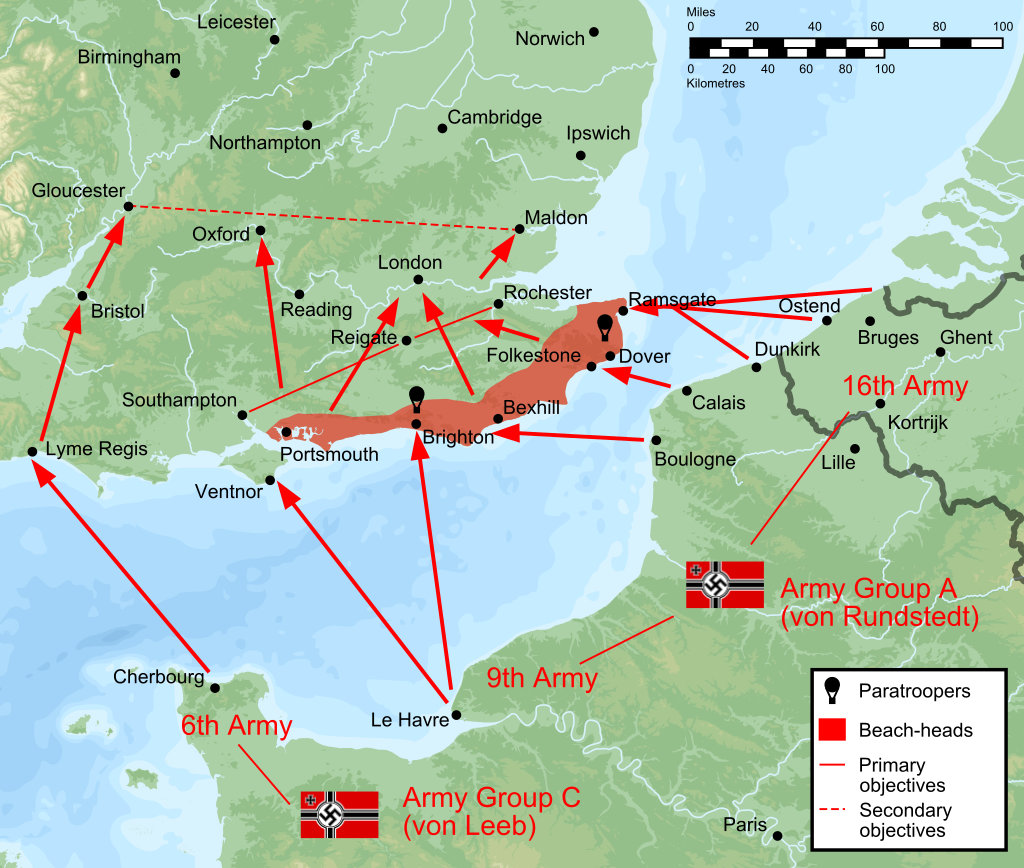
As it turns out, if they had come, Solly’s platoon would have been right in the front line: Operation Sealion (the planned invasion of England) involved the landing of paratroopers on the Downs just behind Brighton with the intention of securing the high ground behind the landings and the main road to London ahead of the invasion:

1024px-OperationSealion.svg

Solly did finally succeed in enlisting, but his good knowledge of the German language meant that he was given a desk job, translating documents and such, until the Normandy invasion when he finally got to fire a weapon in action, although he landed some weeks after the initial assault, when his unit was attacked south of Caen. He didn’t hit anyone.

Incidentally, the 70th anniversary of the D-Day landings passed in June 1944 but it’s worth noting that the German defensive lines were not really broken until August. In fact, on this day in 1944, British and Canadian forces were engaged in heavy fighting about 6 miles from Falaise, while the Americans were executing a wide encircling manoeuvre designed to surround and trap the German army.

Anyway, back to the 1980s. I didn’t stay long in the Hove bedsit and moved out early in 1986. About six months later I happened to be in the area so popped into the pub to see Solly. He wasn’t there; he had passed away suddenly of a heart attack in the Spring.

From Brighton Pride to Sussex Pride

Posted in Biographical, Brighton, LGBTQ+ with tags , , , , , , , , on July 31, 2014 by telescoper

Brighton Pride is coming up this weekend. I heard some people on the train the other day saying that they didn’t think such events were needed any more because “gays have everything they need, especially in Brighton”. Although I was tempted, I didn’t interrupt, though I did disagree. Things have indeed changed a lot over the last twenty years, but they could easily change back if we get complacent and Brighton has its fair share of intolerance and bigotry still.

I was myself beaten up on Brighton’s seafront many years ago, during my previous existence at the University of Sussex as a PhD student and a postdoctoral researcher. There was no doubt why I was attacked: the four young men who surrounded me and punched and kicked me to the ground were shouting just one word over and over again, “faggot”. It’s still a word I hate to hear used, even if purportedly in jest. That event left me with deep psychological scars that contributed to a breakdown I had as recently as two years ago.

Thirty or so years after my encounter with the queerbashers, attitudes have definitely changed, and so has the law. Certain types of criminal offence are now officially recognized as hate crimes: the list treats sexual orientation as equivalent to race, gender, religious belief and disability in such matters. The Police are now obliged to treat these with due seriousness, and penalties for those found guilty of crimes exacerbated by homophobia are consequently more severe. All Police forces now have special units for dealing with them; here is an example.

These changes are mirrored in other aspects of life too. For example, employment law relating to discrimination or harassment in the workplace now puts sexual orientation on the same footing as race, gender, disability and religious belief. In many universities in the UK, staff have been required to attend training in Equality and Diversity matters not only to raise awareness of the legal framework under which we all have to work, but also to promote a sensitivity to these issues in order to improve the working environment for both staff and students. Now we have equal marriage too.

This training isn’t about over-zealous busybodies. Under the law, employers have a vicarious liability for the conduct of their staff with regard to harassment and discrimination. This means that a University can be sued if, for example, one of its employees commits harassment, and it can be shown that it did not make appropriate efforts to ensure its staff did not engage in such activities.

Of course not everyone approves of these changes. Some staff  have refused point-blank to attend Equality and Diversity training, even though it’s compulsory. Others attend grudgingly, muttering about “political correctness gone mad”. You may think all this is a bit heavy handed, but I can tell you it makes a real difference to the lives of people who, without this legal protection, would be victimised, harassed or discriminated against.  It is, also, the law.

I think the efforts that have been made to improve the legal situation have been (at least partly) responsible for the changes in society’s attitudes over the last twenty years, which have been extremely positive. I’m old enough to remember very different times. That’s not to say that there’s no bigotry any more. Even in this day and age, violent crimes against gay men are still disturbingly common and police attitudes not always helpful even though many police forces do now have Lesbian and Gay teams, something that was just unthinkable 25 years ago.

Although relatively few universities appear in the list of gay-friendly employers compiled by the campaigning organisation Stonewall,  my experience generally, having worked in a number of UK universities (Sussex, Queen Mary, Nottingham and Cardiff), is that they are  generally friendly and comfortable places for an openly gay person to work. So much so, in fact, that there’s no real need to make a big deal of one’s sexual identity. It doesn’t really have much to do with the way you do your work – certainly not if it’s astrophysics – and work-related social events are, as a rule, very inclusive.

However, even in the supposedly enlightened environment of a University there do remain islands of bigotry, and not just about gay or lesbian or bisexual or transgender staff.  Sexism is a major problem, at least in science subjects, and will probably remain so until the gender balance improves, which it slowly doing, despite the actions of certain professors who actively block attempts to encourage more female applicants to permanent positions. Universities still do not seem to me to treat sexual orientation with the same seriousness as, say, race or gender discrimination. I’ve had plenty of experiences to back that up.

I recently took part in an interesting meeting involving various staff from the University of Sussex with a representative of Stonewall. The topic was how we could work with Stonewall to make it more gay-friendly. If I remember correctly, there are 78 UK Universities currently taking part in Stonewall’s programmes. It is a matter of some  embarrassment to me that the University of Sussex is not among them. Perhaps the attitude is that because there is such a large and visible gay population in Brighton it’s not necessary for the University of Sussex to take any steps in this direction. I disagree, and am absolutely convinced that there are many Lesbian, Gay, Bisexual or Transgender members of the University of Sussex staff who would love to see some action taken to make their workplace just a little bit friendlier and more inclusive, even if that just amounts to acknowledging their existence.  There is a visible and active LBGT student society on campus, but no such entity exists for staff – an absence that is truly glaring. I don’t even think the University has any idea what fraction of its staff identify themselves as LGBT.

No doubt there’ll be many members of the University of Sussex staff on the Pride Parade on Saturday and at the various parties being held around Brighton afterwards. Perhaps it’s time to start some sort of network so that for staff at the University of Sussex, Pride doesn’t just come once a year…?

If you’re interested in this idea please let me know, either through the comments box or by email.

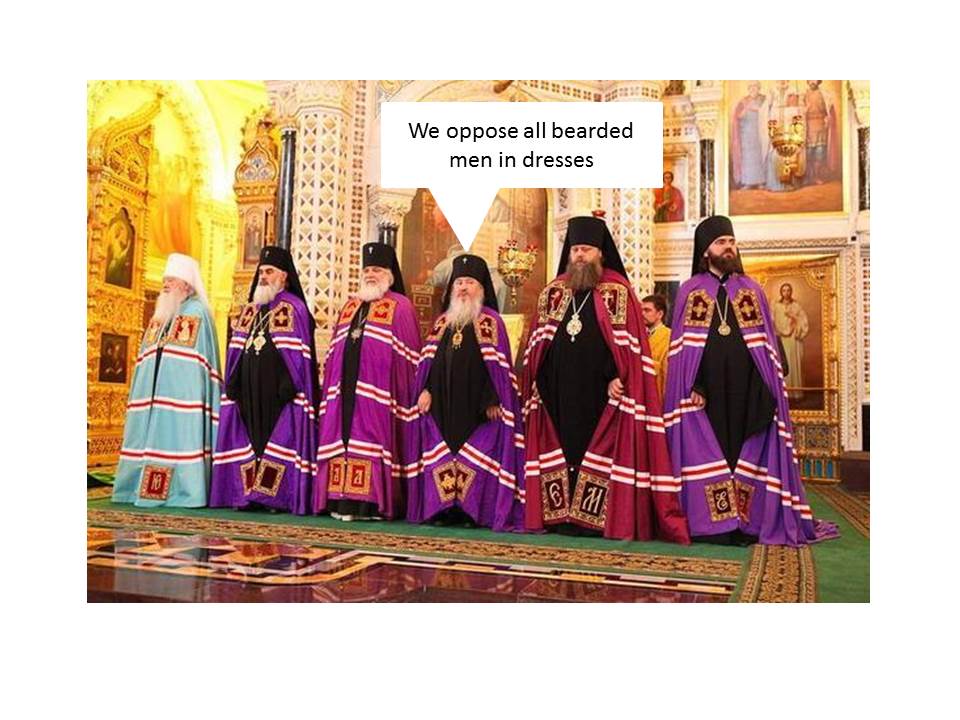
The Russian Orthodox Church Condemns Eurovision

Posted in LGBTQ+ with tags , , on May 15, 2014 by telescoper

Eurovision_1

A Victory for Diversity

Posted in Beards, LGBTQ+ with tags , , , , , on May 11, 2014 by telescoper

I didn’t watch the 2014 Eurovision Song Contest last night, but my Twitter feed was full of comments by people who did. That’s how I found out who won!

Conchita

Conchita Wurst, Winner of the 2014 Eurovision Song Contest

I don’t know what the song was like, but that doesn’t matter at all; the Eurovision Song Contest isn’t about the songs at all. What is important is that Conchita Wurst‘s victory sends out a clear message that there is a world out there that is happy to embrace diversity. Interviewed after the voting, Conchita said “I’m just a singer in a fabulous dress, with great hair and a beard”. That sums it all up, really.

I agree wholeheartedly with the official statement of the Beard Liberation Front:

The Beard Liberation Front the informal network of beard wearers has welcomed the win for Austria’s Conchita Wurst in the Eurovision Song Contest as a victory for a diverse Europe over transphobia and pogonophobia.

The BLF has long campaigned for the right of people to be able to dress and appear as they want.

There will no doubt be those who mock Conchita Wurst (original name Thomas Neuwirth), even within the gay community. But it’s important to remember that the Stonewall Riots of 1969 that galvanised the gay rights movement in the United States into action, paving the way for example to Equal Marriage, began as a  fightback against heavy-handed policing that was predominantly led by drag queens. It takes courage to stand up for the right to be different, and in that respect Conchita is an example to inspire us all.

UPDATE: Here’s the official video made in advance of the contest

P.S. I’m pretty sure that this means that Beard of the Year 2014 is now a foregone conclusion….