Archive for the Literature Category

Grave Thoughts Again

Posted in Biographical, History, Literature with tags , , , , on August 13, 2017 by telescoper

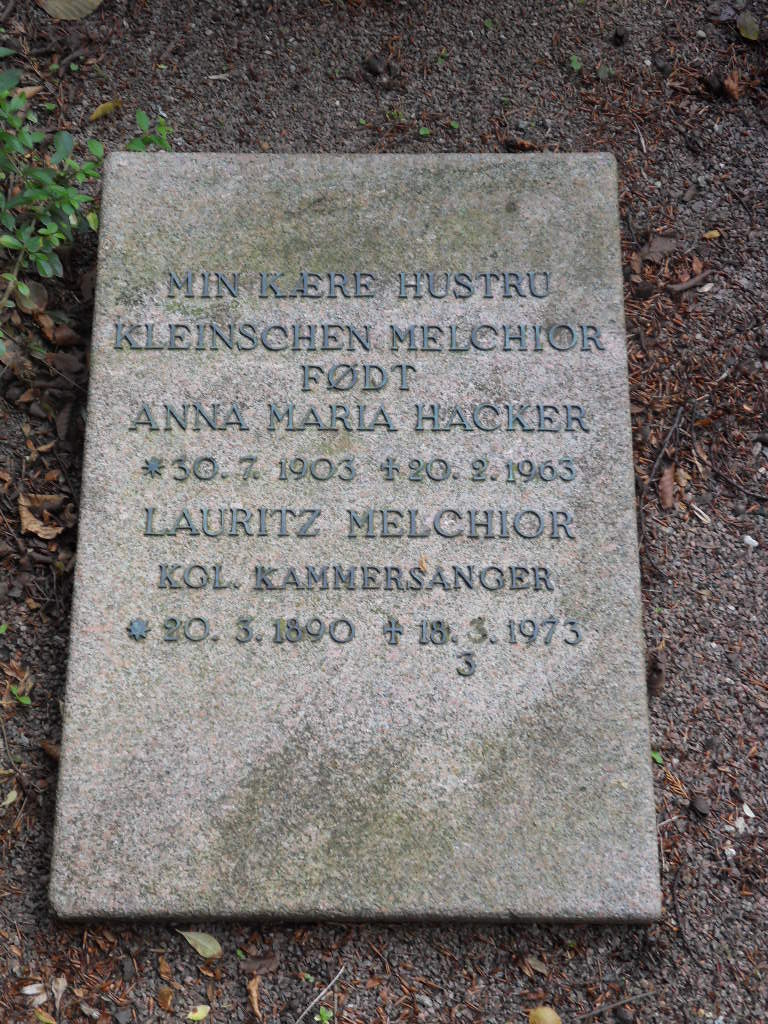
This is my last full day in Copenhagen before flying back tomorrow evening, so I decided to take care of some unfinished business by visiting the famous Assistens Kirkegård  in the Nørrebro district of the city. I went there five years ago (almost to the day) but on that occasion I didn’t find the memorial I was looking for, that of the great Heldentenor Lauritz Melchior.

I was surprised to find at the time that his name was absent from the main index, and still doesn’t appear on the maps displayed at the cemetery. Its location is however now on a guide you can find online so I had little difficulty locating it this time round. In case anyone is interested it is in section F, near the western end of the park. Lauritz Melchior was cremated, and his remains interred in a small family plot:

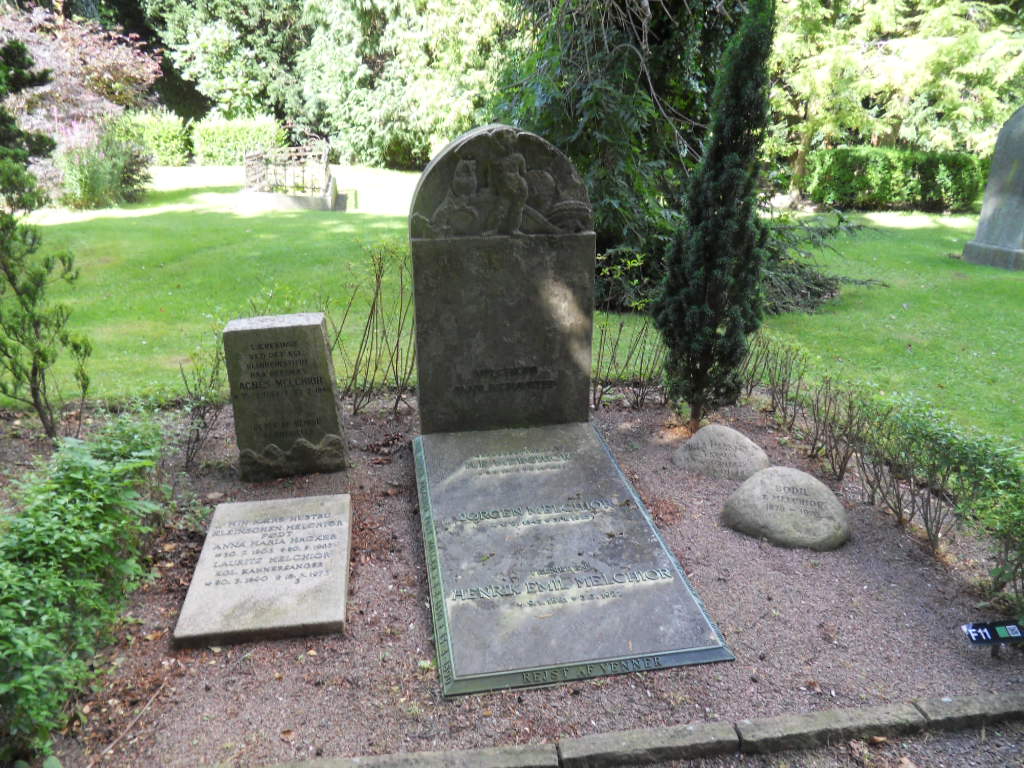
The small slab to the left marks the burial of Lauritz Melchior:

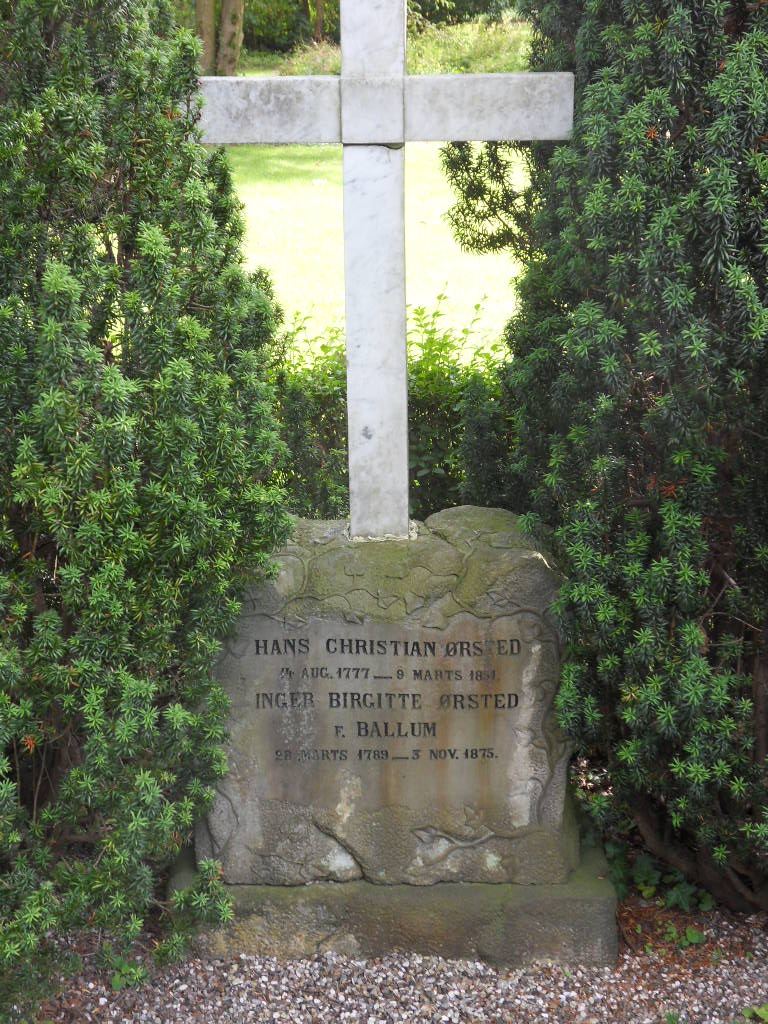
In fact this memorial is not far from that of another famous Dane I missed last time, pioneering physicist Hans Christian Ørsted:

The Hans Christian Ørsted Institute, part of the University of Copenhagen, is a short walk from the main buildings of the Niels Bpohr Institute. It houses Chemistry and Mathematical Sciences and some physicists of the Niels Bohr Institute.

You might think that a cemetery was a rather morbid choice of place to go for a stroll in the sunshine, but actually it’s not that way at all. It’s actually a rather beautiful place, a very large green space criss-crossed by pleasant tree-lined paths. These are poplars:

We British have a much more reserved attitude to cemeteries than the Danes seem to have, at least judging by  their behaviour in this place; joggers and cyclists pass through Assistens Cemetery at regular intervals, and many people were having picnics or just sitting and reading between the gravestones.  I find this matter-of-fact attitude to the dead rather refreshing, actually.

Part of the attraction of Assistens Kirkegård – the name derives from the fact that it was originally an auxiliary burial place, outside the main city, designed to take some of the pressure off the smaller cemeteries in the inner areas – is the large number of famous people buried there, many of whose graves I found last time. I didn’t however notice the large area devoted to common graves nor did I realise that there was a memorial to French and Belgian soldiers of World War 1. Most of these died in 1919, which puzzled me. It turns out that they had been prisoners of war and many of them were ill or injured and had been sent to Copenhagen to recuperate only to be struck down by the Spanish ‘flu epidemic of 1919.

It’s noticeable that some of the smaller graves are extremely well-tended whereas many of the more opulent memorials are in a state of considerable disrepair. I think there’s a moral in there somewhere. My ambition is to be forgotten as quickly as possible after my death so the idea of anyone erecting some grandiose marble monument on my behalf fills me with horror, but I have to say I do find graveyards are strangely comforting places. Rich and poor, clever and stupid, ugly and beautiful; death comes to us all in the end. At least it’s very democratic.

August, a poem by Viggo Stuckenberg

Posted in Poetry with tags , , , on August 1, 2017 by telescoper

Hr. Preben pusler i Skovens Bryn,
fæster Doner, binder Bær, Bær saa rosenrøde,
bryder et Blad og bøjer en Kvist,
at liflig de Bær kunne gløde.

‘Kramsfugl! Kramsfugl! nu er det Tid!
Falder Havren, synger Segl over alle Agre,
bliver ej større en eneste Blomst,
ej Lundene mere fagre!

Gunild! Gunild! nu gulnes goldt
alle Løfter, al Lokken, al Leg fra Skærsommer!
Viger den Haand, som ikke jeg greb,
og aldrig vi sammen kommer!

Thi længst er leden den lyse Vaar,
levnet Nætter i Mulm, levnet flygtende Fugle!
Den, som ved det, maa sidde kvær
og skogre som gammel Ugle!’

Hr. Preben pusler i Skovens Bryn,
fæster Doner, binder Bær, Bær saa lifligt røde:
‘Kramsfugl! Dig sender jeg hende kvalt
og ler stor Elskov til Døde!’

by Viggo Stuckenberg (1863-1905)


They called it Passchendaele

Posted in History, Poetry with tags , , , , on July 31, 2017 by telescoper

Pass

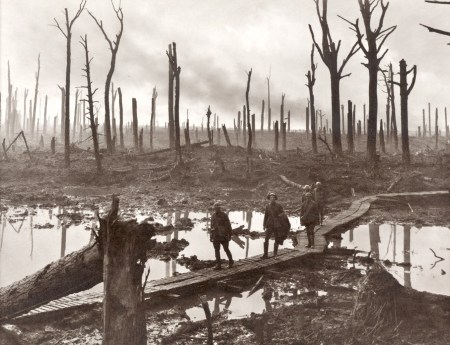
One hundred years ago today, on 31st July 1917, the Third Battle of Ypres began. The battle, often called the Battle of Passchendaele, staggered on until November with hundreds of thousands of troops killed. The Allied assault on Ypres was ultimately intended to break through the German lines and capture submarine bases on the Belgian coast. That objective was not reached, and territorial gains were limited to just a few miles at terrible cost in suffering and death.

David Lloyd George, Prime Minster at the time, wrote in his memoirs:

Passchendaele was indeed one of the greatest disasters of the war … No soldier of any intelligence now defends this senseless campaign …

Others have argued that the Battle of Passchendaele had the important strategic role of taking pressure of the French army further South, which was so close to breaking point that mutinies were breaking out. Although the casualties on both sides were unsustainable, the German High Command knew that American reinforcements would soon enter the fray, and that if they were to win the War it would have to be with a knockout blow the following year. The German offensive of 1918 made substantial inroads through the Allied lines, even threatening Paris, until it was eventually halted and turned into a full-scale retreat.

Whatever the military outcome of the Battle, there is no question about the scale of the suffering of the troops (many of whom, at this stage of the War, were conscripts). The area in which the action took place was mainly low-lying, with a water table just a couple of feet below the surface. The myriad of small streams ditches, and drainage channels that had been developed over centuries to turn it into farmland, were destroyed by heavy shelling so the soldiers had to contend with heavy mud, often strewn with body parts and deep enough to drown in, as described by Siegfried Sassoon in his poem Memorial Tablet:

Squire nagged and bullied till I went to fight,
(Under Lord Derby’s Scheme). I died in hell—
(They called it Passchendaele). My wound was slight,
And I was hobbling back; and then a shell
Burst slick upon the duck-boards: so I fell
Into the bottomless mud, and lost the light.

At sermon-time, while Squire is in his pew,
He gives my gilded name a thoughtful stare:
For, though low down upon the list, I’m there;
‘In proud and glorious memory’ … that’s my due.
Two bleeding years I fought in France, for Squire:
I suffered anguish that he’s never guessed.
Once I came home on leave: and then went west…
What greater glory could a man desire?

Whenever I read about the terrible events of past wars, the important thing (to me) is not strategy or objectives but the suffering  that had to be endured by ordinary soldiers. It’s important to remember things like Passchendaele to remind ourselves how lucky we are to be living in a time of relative peace. The way the world is heading, however, I worry that may soon be coming to an end. Lest we forget? Far too many people have already forgotten.

P.S. Among those killed in action on the first day of Passchendaele was Welsh poet Hedd Wyn, whom I wrote about here.

P.P.S. The troops shown in the picture above are in fact Australian gunners: the picture was taken in October 1917.


The Dead Statesman

Posted in Poetry, Politics with tags , , on July 21, 2017 by telescoper

I could not dig; I dared not rob:
Therefore I lied to please the mob.
Now all my lies are proved untrue
And I must face the men I slew.
What tale shall serve me here among
Mine angry and defrauded young?

by Rudyard Kipling (1865-1936)

Film Noir, Physics, and the Futility of Existence

Posted in Biographical, Literature, The Universe and Stuff with tags , , , , , on July 5, 2017 by telescoper

Last night I decided to treat myself to the umpteenth viewing of a DVD of the  classical film  Double Indemnity. It’s a great movie that repays repeated viewing and is historically important for many reasons, not least because when it was released in 1944 it immediately established much of the language and iconography of the genre that has come to be known as Film Noir , which I’ve written about on a number of occasions on this blog; see here, for example.

After watching the film I had a look on Twitter to see if I had any messages and saw a thread about how modern physics inspires, in some people, an all-pervading sense of existential angst.  In the light of that discussion I decided to use my morning off to rehash that old post and add a few embellishments.

It’s difficult to define exactly what turns a film noir, but there are some common characteristics. First the male lead protagonist is far from the dashing romantic character portrayed in mainstream Hollywood fare. Often a troubled and dysfunctional character, cynical and hard-bitten, distrustful and alienated, the classic noir anti-hero is often a private investigator or in any case a loner who lives in a kind of moral vacuum. To counterpoint this, the female lead is usually a femme fatale, glamorous but duplicitous, sexy and dangerous, manipulative and assertive. There are definitely shades of Macbeth in that the female lead is usually a more compelling and impressive personality than the supposed hero. The inversion of stereotypical roles also serves to hold a “dark mirror” up to society, an effect which other elements of these films also strive to achieve.

The plots usually deal with the seedy side of human life: crime, betrayal, jealousy and revenge, much of it sexually motivated. Narrative strategies involve repeated use of flashbacks, first-person voiceovers, dream-like sequences, and unresolved episodes that emphasize the overall lack of moral direction. The photography is dominated by high contrast lights surrounding the protagonists with dark, threatening shadows while odd angles and unbalanced framing produce unstable, disorienting images. The chiaroscuro lighting makes even mundane encounters seem charged with danger or erotic suspense.
di6

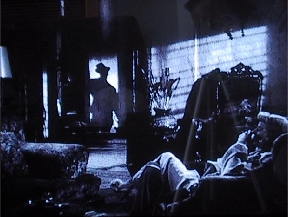
This is a still from Double Indemnity which shows a number of trademark features. The shadows cast by Venetian blinds on the wall, the cigarette being smoked by Barbara Stanwyck and the curious construction of the mise en scene are all very characteristic of the style. What is even more wonderful about this particular shot however is the way the shadow of Fred McMurray’s character enters the scene before he does. The Barbara Stanwyck character is just about to shoot him with a pearl-handled revolver; this image seems to be hinting that he is already on his way to the underworld even before he arrives in the room.

Noir settings are almost exclusively urban: the resulting iconography consists of images of dark night-time cities with rain-soaked streets reflecting dazzling neon lights that intrude into the picture and fracture the composition. Interiors are almost always cramped and claustrophobic: dingy hotel rooms, night clubs or even the backs of taxi cabs. The dark outside world presses in on the characters and is full of danger. Soundtracks often include jazz in the bebop style from the late 1940s or early 1950s, with its jagged melodic lines and stuttering rythms, emphasizing the psychological instability displayed by the characters and settings.

The protagonists are trapped, perhaps just by mischance, in an alienating lonely world, usually a night-time city, where they are constantly in danger for their lives. The chaotic, random violence of this world gives rise to feelings of persecution and paranoia and a sense that life is absurd, meaningless, without order or purpose, and governed by contingency rather than design.

Much has been written about the origins of Film Noir, but it does seem clear to me that, although it is essentially an American style, it owes many of its roots to European existentialism, a point further reinforced by the fact that many great movie directors of the noir period (including the great Billy Wilder, who directed Double Indemnity) were in fact European emigres.

Anyway, I digress. What I wanted to say really was that during the course of watching all these wonderful films from a bygone age it struck me how much the language and iconography of modern cosmology shares this existentialist heritage. Our new standard cosmological model is full of references to the “dark” sector (dark matter and dark energy) which dominates the energy budget of the Universe, but which not just invisible but also unfathomable. The cosmos is lit by garish starlight from small islands of luminosity embedded in this sea of darkness. Long chains of bright galaxies stretch across space like rows of streetlights whose glare fractures and disturbs the celestial dark. We cling to a precarious existence on a tiny rock that is surrounded by danger. Even the stuff from which our atoms are made is completely overshadowed by alien matter. The universe is oblivious to us and we are irrelevant to it.

But it’s not only the surface imagery of cosmology that resembles that of a noir movie. The existentialist trend runs deep. Cosmology seems to be abandoning the idea that there is a design behind it all. The idea that there is a single explanatory principle “a theory of everything” that accounts for why our Universe is the way it is and why life is possible within it, is losing ground to the idea that there is a multiverse in which all possible laws of nature are realised; we just live in a place where life happens to be possible. I’m not at all convinced that it is a good route for science to follow, but many cosmologists seem to be accepting this kind of thing as the best we will ever do to explain the Universe.

The physicist Steven Weinberg summed up the way this view of the Universe challenges us:

It is almost irresistible for humans to believe that we have some special relation to the universe, that human life is not just a more-or-less farcical outcome of a chain of accidents reaching back to the first three minutes, but that we were somehow built in from the beginning. … It is very hard to realise that this is all just a tiny part of an overwhelmingly hostile universe. It is even harder to realise that this present universe has evolved from an unspeakably unfamiliar early condition, and faces a future extinction of endless cold or intolerable heat. The more the universe seems comprehensible, the more it also seems pointless.

In an interview he put it thus:

I believe that there is no point in the universe that can be discovered by the methods of science. I believe that what we have found so far, an impersonal universe in which it is not particularly directed toward human beings is what we are going to continue to find. And that when we find the ultimate laws of nature they will have a chilling, cold impersonal quality about them.

The influential American horror writer Howard Phillips Lovecraft (known to his friends as “H.P.”), wrote a letter in 1919 that argued much the same:

As you are aware, I have never been able to soothe myself with the sugary delusions of religion; for these things stand convicted of the utmost absurdity in light of modern scientific knowledge. With Nietzsche, I have been forced to confess that mankind as a whole has no goal or purpose whatsoever, but is a mere superfluous speck in the unfathomable vortices of infinity and eternity. Accordingly, I have hardly been able to experience anything which one could call real happiness; or to take as vital an interest in human affairs as can one who still retains the hallucination of a “great purpose” in the general plan of terrestrial life. … However, I have never permitted these circumstances to react upon my daily life; for it is obvious that although I have “nothing to live for”, I certainly have just as much as any other of the insignificant bacteria called human beings. I have thus been content to observe the phenomena about me with something like objective interest, and to feel a certain tranquillity which comes from perfect acceptance of my place as an inconsequential atom. In ceasing to care about most things, I have likewise ceased to suffer in many ways. There is a real restfulness in the scientific conviction that nothing matters very much; that the only legitimate aim of humanity is to minimise acute suffering for the majority, and to derive whatever satisfaction is derivable from the exercise of the mind in the pursuit of truth (from Letter to Reinhardt Kleiner  (14 September 1919), in Selected Letters I, 1911-1924 edited by August Derleth and Donald Wandrei, pp. 86-87).

I’ve thought about this quite a lot over the last few years and am gradually finding myself more and more in agreement with Lovecraft. I would say further that that one of the few things that make life bearable is the futility of existence. Futility is very reassuring. If all the shit that happens in this world were designed to serve some higher purpose then that really would be terrifying. And even more reassuring than its futility is the knowledge that we will soon return to dust and be quickly forgotten.

Here’s  Weinberg again, from the same interview quoted above:

…if there is no point in the universe that we discover by the methods of science, there is a point that we can give the universe by the way we live, by loving each other, by discovering things about nature, by creating works of art. And that — in a way, although we are not the stars in a cosmic drama, if the only drama we’re starring in is one that we are making up as we go along, it is not entirely ignoble that faced with this unloving, impersonal universe we make a little island of warmth and love and science and art for ourselves. That’s not an entirely despicable role for us to play.

Inspired by this, I’m going to make a point of existence not by doing science nor creating a work of art, but by making a nice cup of tea.
Please look after this bear…

Posted in Literature, Television with tags , on June 28, 2017 by telescoper

R.I.P. Michael Bond (13 January 1926 to 27 June 2017)

It isn’t Time that’s passing

Posted in Poetry with tags , , on June 23, 2017 by telescoper

Remember the long ago when we lay together
In a pain of tenderness and counted
Our dreams: long summer afternoons
When the whistling-thrush released
A deep sweet secret on the trembling air;
Blackbird on the wing, bird of the forest shadows,
Black rose in the long ago summer,
This was your song:
It isn’t time that’s passing by,
It is you and I.

by Ruskin Bond (b. 1934)


June 1915, by Charlotte Mew

Posted in Poetry with tags , , on June 16, 2017 by telescoper

Who thinks of June’s first rose today?
Only some child, perhaps, with shining eyes and
rough bright hair will reach it down.
In a green sunny lane, to us almost as far away
As are the fearless stars from these veiled lamps of town.
What’s little June to a great broken world with eyes gone dim
From too much looking on the face of grief, the face of dread?
Or what’s the broken world to June and him
Of the small eager hand, the shining eyes, the rough bright head?

by Charlotte Mew (1869-1928)


The Bright Field, by R.S. Thomas

Posted in Poetry with tags , , , on May 31, 2017 by telescoper

I heard this recording of R.S. Thomas reading one of his most famous poems on Private Passions on BBC Radio 3 this Sunday. It was only later that I realised that although I’ve posted quite a few poems by R.S. Thomas over the years, I’ve never posted this one so I’m correcting that omission now. The poem is called The Bright Field:

I have seen the sun break through
to illuminate a small field
for a while, and gone my way
and forgotten it. But that was the pearl
of great price, the one field that had
treasure in it. I realize now
that I must give all that I have
to possess it. Life is not hurrying

on to a receding future, nor hankering after
an imagined past. It is the turning
aside like Moses to the miracle
of the lit bush, to a brightness
that seemed as transitory as your youth
once, but is the eternity that awaits you.

Here is R.S. Thomas himself reading it. The comments made about this reading on the radio programme weren’t entirely complimentary, but I rather like it. Notice, however, that in the spoken version he adds a `the’ between `had’ and `treasure’, which isn’t there in my printed copy of the poem.

http://www.dailymotion.com/video/xuohy0_r-s-thomas-the-bright-field_creation

The Beautiful Sun, by William McGonagall

Posted in Poetry with tags , , , on May 24, 2017 by telescoper

Beautiful Sun! with thy golden rays,
To God, the wise Creator, be all praise;
For thou nourisheth all the creation,
Wherever there is found to be animation.

Without thy heat we could not live,
Then praise to God we ought to give;
For thou makest the fruits and provisions to grow,
To nourish all creatures on earth below.

Thou makest the hearts of the old feel glad,
Likewise the young child and the lad,
And the face of Nature to look green and gay,
And the little children to sport and play.

Thou also givest light unto the Moon,
Which certainly is a very great boon
To all God’s creatures here below,
Throughout the world where’er they go.

How beautiful thou look’st on a summer morn,
When thou sheddest thy effulgence among the yellow corn,
Also upon lake, and river, and the mountain tops,
Whilst thou leavest behind the most lovely dewdrops!

How beautiful thou seem’st in the firmament above,
As I gaze upon thee, my heart fills with love
To God, the great Creator, Who has placed thee there,
Who watches all His creatures with an eye of care!

Thou makest the birds to sing on the tree,
Also by meadow, mountain, and lea;
And the lark high poised up in air,
Carolling its little song with its heart free from care.

Thou makest the heart of the shepherd feel gay
As he watches the little lambkins at their innocent play;
While he tends them on the hillside all day,
Taking care that none of them shall go astray.

Thou cheerest the weary traveller while on his way
During the livelong summer day,
As he admires the beautiful scenery while passing along,
And singing to himself a stave of a song.

Thou cheerest the tourist while amongst the Highland hills,
As he views their beautiful sparkling rills
Glittering like diamonds by the golden rays,
While the hills seem to offer up to God their praise.

While the bee from flower to flower does roam
To gather honey, and carry it home;
While it hums its little song in the beautiful sunshine,
And seemingly to thank the Creator divine —

For the honey it hath gathered during the day,
In the merry month of May,
When the flowers are in full bloom,
Also the sweet honeysuckle and the broom.

How beautiful thy appearance while setting in the west,
Whilst encircled with red and azure, ’tis then thou look’st best!
Then let us all thank God for thy golden light
In our prayers every morning and night!

by Wiliam Topaz McGonagall (1825-1902)