Archive for the Literature Category

Fourier, Hamilton and Ptolemy

Posted in History, Poetry, The Universe and Stuff with tags , , , , , , , on December 17, 2018 by telescoper

As we stagger into the last week of term I find myself with just two lectures to give in my second-year module on Vector Calculus and Fourier Series. I didn’t want to present the two topics mentioned in the title as disconnected, so I linked them in a lecture in which I used the divergence theorem of vector calculus to derive the heat equation, the solution of which led Joseph Fourier to devise his series in Mémoire sur la propagation de la chaleur dans les corps solides (1807), a truly remarkable work for its time that inspired so many subsequent developments.

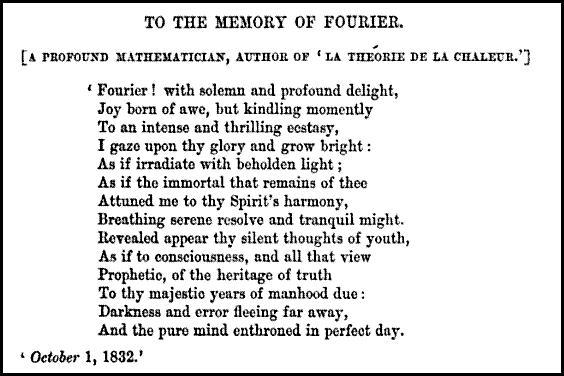
Fourier’s work was so influential and widely admired that it inspired a famous Irish mathematician William Rowan Hamilton to write the following poem:

Hamilton-for Fourier

The serious thing that strikes me is not the quality of the verse, but how many scientists of the 19th Century, Hamilton included, saw their scientific interrogation of Nature as a manifestation of the human condition just as the romantic poets saw their artistic contemplation and how many poets of the time were also interested in science.

Anyway I was looking for nice demonstrations of Fourier series to help my class get to grips with them when I remembered this little video recommended to me some time ago by esteemed Professor George Ellis. It’s a nice illustration of the principles of Fourier series, by which any periodic function can be decomposed into a series of sine and cosine functions.

This reminds me of a point I’ve made a few times in popular talks about Astronomy. It’s a common view that Kepler’s laws of planetary motion according to which which the planets move in elliptical motion around the Sun, is a completely different formulation from the previous Ptolemaic system which involved epicycles and deferents and which is generally held to have been much more complicated.

The video demonstrates however that epicycles and deferents can be viewed as the elements used in the construction of a Fourier series. Since elliptical orbits are periodic, it is perfectly valid to present them in the form a Fourier series. Therefore, in a sense, there’s nothing so very wrong with epicycles. I admit, however, that a closed-form expression for such an orbit is considerably more compact and elegant than a Fourier representation, and also encapsulates a deeper level of physical understanding.

Winter Garden, by Patrick Kavanagh

Posted in Poetry with tags , , , on December 11, 2018 by telescoper

No flowers are here
No middle-class vanities –
Only the decapitated shanks
Of cabbages
And prostrate
On a miserable ridge
Bean-stalks.

by Patrick Kavanagh (1904-1967)


Fintan O’Toole on “Heroic Failure: Brexit and the Politics of Pain”

Posted in Literature, Maynooth, Politics with tags , , , on December 6, 2018 by telescoper

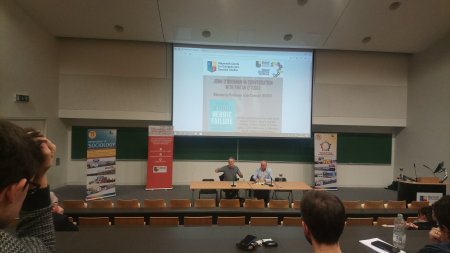
Time for a tea break and a quick post about a very interesting event this afternoon at Maynooth featuring renowned Irish journalist and author Fintan O’Toole (whose regular columns in the Irish Times I read with great interest).

This event saw John O’Brennan, Director of the Centre for European and Eurasian Studies in Maynooth in conversation with Fintan on his new book, Heroic Failure: Brexit and the Politics of Pain. The book deals with the Brexit referendum, the chaos it unleashed in British politics and the challenges posed to the island of Ireland by a ‘No Deal Brexit’. In particular the book examines how a country that once had colonies is redefining itself as an oppressed nation requiring liberation; the dreams of revolutionary deregulation and privatization that drive Arron Banks, Nigel Farage and Jacob Rees-Mogg; and the silent rise of English nationalism, the force that dare not speak its name. He also discusses the fatal attraction of heroic failure, once a self-deprecating cult in a hugely successful empire that could well afford the occasional disaster: the Charge of the Light Brigade, or Franklin lost in the Arctic. Now failure is no longer heroic – it is just failure, and its terrible costs will be paid by the most vulnerable of Brexit’s supporters, and by those who may suffer the consequences of a hard border in Ireland and the breakdown of a fragile peace.

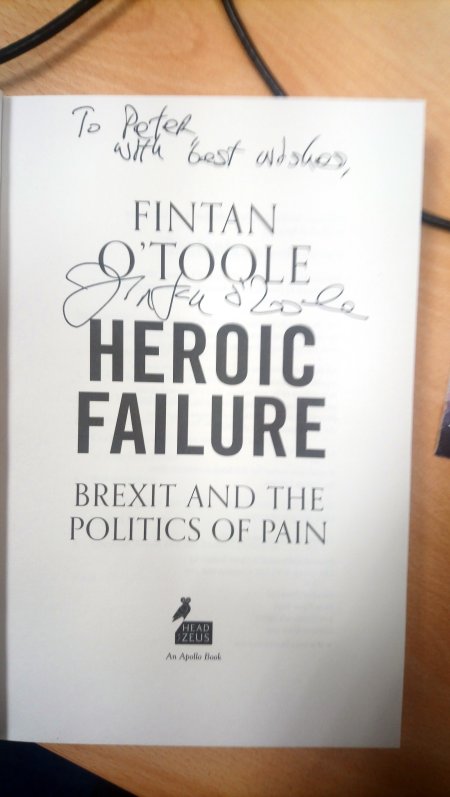
The discussion was so interesting – and Fintan O’Toole was so eloquent and amusing –  that I bought the book. The author was kind enough to sign it for me too!

There’s an extract printed on the cover that will give you a taste, but if you want more you’ll have to buy the book:

Of all the pleasurable emotions, self-pity is the one that most makes us want to be on our own…Only alone can we surrender completely to it and immerse ourselves in the steaming bath of hurt, outrage and tender regard for our terribly wronged selves. Brexit therefore makes sense of a nation that feels sorry for itself. The mystery, though, is how Britain, or more precisely England, came not to just experience this delightful sentiment but to define itself through it.

I only bought the book today so haven’t read it yet, but I will endeavour to write a review when I have.

Now back to the writing of lecture notes…

A Book of Note

Posted in Literature with tags , on November 28, 2018 by telescoper

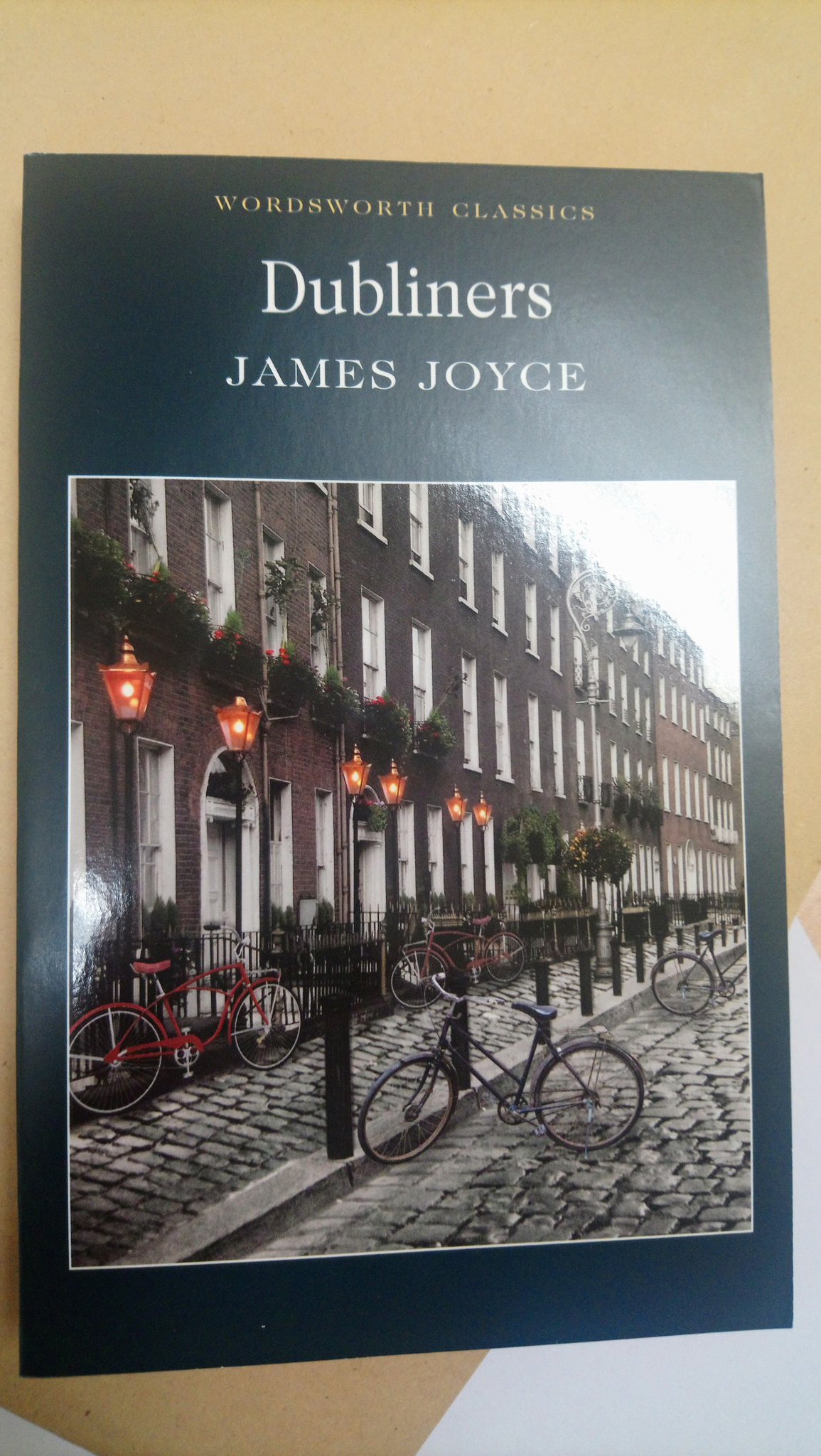
I’ve been too busy today to do a proper blog, but I did pop out at lunchtime to buy the above book (for the princely sum of €3). I can’t believe I haven’t read it before now, but I am definitely looking forward to it and will be making a start at the weekend!


We and They

Posted in Biographical, Literature, Politics with tags , , , , , , on November 25, 2018 by telescoper

All good people agree,
And all good people say,
All nice people, like Us, are We
And every one else is They.

(from `We and They‘, by Rudyard Kipling.)

A few days ago one of my colleagues here in Maynooth mentioned that he found it amusing that, although I’ve been living and working here in Ireland for less than a year, I have already taken to referring to the British as `They’ rather than `We’. He went on to point out that he noticed this transformation from First Person to Third Person some months ago.

I hadn’t realised that I was doing this, but I suppose it is a reflection of the fact that I have accepted that I will almost certainly be spending the rest of my working life in Ireland, and will probably end my days here too. It has taken relatively little time of observing Britain from the other side of the Irish Sea to recognize that it is changing into something grotesque and horrible. I want no part of what it is becoming, a squalid xenophobic rathole run by crooks, liars, and narrow-minded bigots. My new home is far from perfect, but it’s a damn sight better than Brexit Britain.

About a year ago I wrote (from Cardiff) about my reasons for moving to Maynooth. Here is a quote:

Because I’ve lived here all my life I thought I would find it difficult to leave Britain. I was quite traumatised by the Brexit referendum, as one would be by the death of a close relative, but it made me re-examine my life. There is a time when you have to move on, and that’s what I’m doing. I’m done here.

I haven’t changed my mind.

Not that I now consider myself fully Irish. Passport and citizenship notwithstanding, I still feel like a foreigner here and probably always will. I lived for over fifty years in Britain and do not have sufficient experience of Ireland to feel really part of it. Yet. That may come. But to appropriate the phrase Theresa May used in her Lancaster House speech last year I am proud to be for the time being, and perhaps forever, a `Citizen of Nowhere’. I don’t mind that, and a little bit of autobiography that might explain why I see things the way I do.

I was born in Wallsend (on Tyneside) in the North East of England. My parents were both born just before World War II started, also in the area where I was born. Of my four grandparents, one was born in England, one in Northern Ireland, one in Scotland, and one in Wales. I always smile when I had to put my nationality on a form, because I always put `United Kingdom’. Of course being born in England makes me English too, but I find that less defining than `UK’ or `British’ or even `Geordie’, and now of course there’s the Irish dimension. To be honest, my ancestry means that I generally find the whole concept of nationality fundamentally silly. I find nationalism silly too, except for those occasions – regrettably frequent nowadays – when nationalism takes on the guise of xenophobia. Then it is truly sinister. Nationalism is a tool by which unscrupulous individuals whip up hatred for political gain, regardless of the economic or social consequences. This is what lies behind Brexit.

Anyway, talking about Theresa May, it appears that the Prime Minister has written a letter to the British public asking for them to support her `deal’. I find it very curious that she has done this when, without another referendum or a General Election, the British public is denied any way of either expressing or withholding such support. Is this an admission that there will have to be another vote?

It appears from her letter that the PM is particularly happy about one aspect of the deal:

We will take back control of our borders, by putting an end to the free movement of people once and for all.

Apart from the fact that the UK always had control of its borders anyway, I find it absolutely astonishing that any politician could brag about removing from its own citizens the right to free movement across 27 countries. Freedom of movement was and is one of the great benefits of the European Union. Outside the EU, Theresa May’s `hostile environment’ in which all foreigners are viewed with suspicion and contempt will become even more hostile. It is just a matter of time before the unlawful deportations that the Home Office have inflicted on members of the Windrush generation will begin happening to Europeans currently living in the United Kingdom.

Towards the end of her awful letter, there is this:

We will then begin a new chapter in our national life. I want that to be a moment of renewal and reconciliation for our whole country. It must mark the point when we put aside the labels of ‘Leave’ and ‘Remain’ for good and we come together again as one people.

Excuse me, but the time for reconciliation was in the immediate aftermath of the 2016 Referendum result. Instead, Mrs May went out of her way to insult, denigrate and marginalize everyone who voted Remain; she never apologized for the `Citizens of Nowhere’ jibe and her pals in the right-wing added other pejoratives like ‘saboteur’ and ‘enemy of the people’. Like so many other things she says and does, Mrs May’s letter is so phony it is painful.

Worse, the Prime Minister has continued to insult European citizens working in the UK by accusing them of `jumping the queue’. It seems that the Prime Minister just can’t stop her deep-seated xenophobia showing itself from time to time. It’s her defining characteristic, and it is sure to be the defining characteristic of post-Brexit Britain.

Sonnet No. 87

Posted in Poetry with tags , on November 21, 2018 by telescoper

Farewell! thou art too dear for my possessing,
And like enough thou knowst thy estimate.
The Charter of thy worth gives thee releasing;
My bonds in thee are all determinate.
For how do I hold thee but by thy granting,
And for that riches where is my deserving?
The cause of this fair gift in me is wanting,
And so my patent back again is swerving.
Thy self thou gav’st, thy own worth then not knowing,
Or me, to whom thou gav’st it, else mistaking,
So thy great gift, upon misprision growing,
Comes home again, on better judgement making.
Thus have I had thee as a dream doth flatter:
In sleep a king, but waking no such matter.


Britten: War Requiem

Posted in Music, Poetry with tags , , , , , , , , , , , on November 10, 2018 by telescoper

Last night I was back at the National Concert Hall in Dublin for an immensely powerful and moving performance of Benjamin Britten’s War Requiem. This vast work is composed for two orchestras (a standard symphony orchestra and a smaller chamber orchestra), two choirs (a chorus of adult voices and a boy’s choir) and three solo vocalists. Last night the soloists were Ailish Tynan (soprano), Gavan Ring (baritone) and Robin Tritschler (tenor), who performed with the combined forces of the RTÉ National Symphony Orchestra, the RTÉ National Concert Orchestra, the RTÉ Philharmonic Choir and the boy Choristers of St Patrick’s Cathedral in Dublin, all conducted by David Brophy.

You can see the members of the Philharmonia Choir in position in the above photograph, which I took about ten minutes before the performance began; the choristers were out of sight in the gallery above and behind me, near where the President of Ireland, Michael D Higgins, was sitting.

The War Requiem was commissioned for the consecration in 1962 of the new Coventry Cathedral built to replace the 14th century cathedral that was destroyed along with most of the city in a devastating air raid ion 1940. It’s a remarkable work that juxtaposes settings of traditional liturgical Latin texts against poems by Wilfred Owen. The idea of doing this may have originated with the first poem Britten uses, Anthem for Doomed Youth, which itself deploys words associated with religious services to emphasize the soulless brutality of warfare:

What passing-bells for these who die as cattle?
-Only the monstrous anger of the guns.
Only the stuttering rifles’ rapid rattle
Can patter out their hasty orisons.
No mockeries now for them; no prayers nor bells;
Nor any voice of mourning save the choirs,-
The shrill, demented choirs of wailing shells;
And bugles calling for them from sad shires.

What candles may be held to speed them all?
Not in the hands of boys but in their eyes
Shall shine the holy glimmers of good-byes.
The pallor of girls’ brows shall be their pall;
Their flowers the tenderness of patient minds,
And each slow dusk a drawing-down of blinds.

These settings are sung by soloists accompanied by the smaller chamber orchestra (positioned at the front of the stage) while the more traditional liturgical elements involve the larger forces arrayed behind.

I’ve known this work for many years largely through the classic 1963 recording conducted by Britten himself, with Galina Vishnevskaya, Peter Pears and Dietrich Fischer-Dieskau as soprano, tenor and baritone soloists respectively. I’m so familiar with that version that it was at first a little disconcerting to hear very different voices, but that very soon gave way into an appreciation of three very fine artists in their own right. All three were excellent last night, but I have to give extra special plaudits to Ailish Tynan, who sang with extraordinary passion in the Sanctus and Libera Me. The Latin text of the latter section includes:

Tremens factus sum ego, et timeo
dum discussio venerit, atque ventura ira.
Libera me, Domine, de morte aeterna.
Quando coeli movendi sunt i terra.
Dies illa, dies irae, calamitatis
et miseriae, dies magna et amara valde.
Libera me, Domine.

Ailish Tynan performed this not just as an evocation of the horrors of wars past but also with a sense of anguished foreboding about wars yet to come. It was deeply moving and clearly heartfelt. I found this from her on Twitter this morning:

The first few bars of the War Requiem are enough to tell you right from the start this is music is coming from the same imagination that gave us Peter Grimes and a host of other masterpieces, and the quality of the music is sustained throughout the 85 minutes or so of its duration. There are some wonderful touches in the orchestration, such as the Dies Irae (with a definite nod in the direction of Verdi, but with tricky 7/8 rhythms). The Boys Choir was also used extremely effectively, the fact that they could not be seen (at least by me) adding to the ethereal quality of their voices. In all, it added up to an intense experience, I think for the musicians as well as the audience.

At the end of the music, David Brophy kept his arms (and baton) extended for a considerable time before gradually lowering them to signal the end of the performance. I really appreciated that several seconds of silence, which was immaculately observed by the audience. It’s good to have a time to reflect on what you’ve just heard before the applause begins. When the ovation had died down, the elderly lady sitting next to me (whom I’d never met before) turned to me and said `Wasn’t that wonderful?’. It was only then that I realised how powerfully I’d been affected. I tried to answer, but found I was a bit choked, and all I could get out was “Yes, it was”. I hope that didn’t come across as rude. It’s just that sometimes music expresses things that words can’t convey. Actually, come to think of it, that’s what it’s for.

Anyway, you don’t need to take my word for how good a concert it was, because you can watch the whole thing here:

(Please note that there are quite a few minutes of blank screen before it starts, but it is there!)

Congratulations to all the musicians involved last night for a tremendous performance, and thank you for a wonderful experience. It was a privilege to be there.

Arms and the Boy, by Wilfred Owen (who died on 4th November 1918)

Posted in Poetry with tags , , , on November 4, 2018 by telescoper

Wilfred Owen, probably the greatest poet of the First World War, died precisely 100 years ago today, on 4th November 1918, aged 25, just one week before the Armistice that brought the war to an end. I am posting this poem in his memory.

Let the boy try along this bayonet-blade
How cold steel is, and keen with hunger of blood;
Blue with all malice, like a madman’s flash;
And thinly drawn with famishing for flesh.

Lend him to stroke these blind, blunt bullet-leads,
Which long to nuzzle in the hearts of lads,
Or give him cartridges of fine zinc teeth
Sharp with the sharpness of grief and death.

For his teeth seem for laughing round an apple.
There lurk no claws behind his fingers supple;
And God will grow no talons at his heels,
Nor antlers through the thickness of his curls.

by Wilfred Owen (1893-1918).

Especially when the October Wind

Posted in Poetry with tags , , on October 15, 2018 by telescoper

Especially when the October wind
With frosty fingers punishes my hair,
Caught by the crabbing sun I walk on fire
And cast a shadow crab upon the land,
By the sea’s side, hearing the noise of birds,
Hearing the raven cough in winter sticks,
My busy heart who shudders as she talks
Sheds the syllabic blood and drains her words.

Shut, too, in a tower of words, I mark
On the horizon walking like the trees
The wordy shapes of women, and the rows
Of the star-gestured children in the park.
Some let me make you of the vowelled beeches,
Some of the oaken voices, from the roots
Of many a thorny shire tell you notes,
Some let me make you of the water’s speeches.

Behind a pot of ferns the wagging clock
Tells me the hour’s word, the neural meaning
Flies on the shafted disk, declaims the morning
And tells the windy weather in the cock.
Some let me make you of the meadow’s signs;
The signal grass that tells me all I know
Breaks with the wormy winter through the eye.
Some let me tell you of the raven’s sins.

Especially when the October wind
(Some let me make you of autumnal spells,
The spider-tongued, and the loud hill of Wales)
With fists of turnips punishes the land,
Some let me make you of the heartless words.
The heart is drained that, spelling in the scurry
Of chemic blood, warned of the coming fury.
By the sea’s side hear the dark-vowelled birds.

by Dylan Thomas (1914-1953)


Lines composed upon Hearing News of the Retirement of Mr Alastair Cook from International Cricket

Posted in Cricket, Poetry on September 3, 2018 by telescoper

So.
Farewell then,
Alastair
Cook.

I hear that
You are going
To retire from
Test Match
Cricket.

Does that mean
You will go
Back
To doing
Letter from
America?

by Peter Coles (aged 55 ¼)