Archive for the Literature Category

From Sappho to Babbage

Posted in Astrohype, Poetry, The Universe and Stuff with tags , , , on May 24, 2016 by telescoper

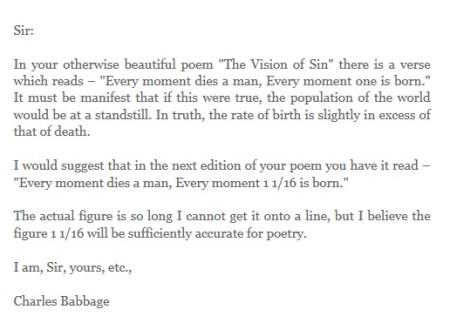
The English mathematician Charles Babbage, who designed and built the first programmable calculating machine, wrote to the (then) young poet Tennyson, whose poem The Vision of Sin he had recently read:

BabbageToTennyson

I like to think Babbage was having a laugh with Tennyson here, rather than expressing a view that poetry should be taken so literally, but you never know..

Anyway, I was reminded of the above letter by the much-hyped recent story of the alleged astronomical “dating” of this ancient poem (actually just a fragment) by Sappho:

Tonight I’ve watched
the moon and then
the Pleiades
go down

The night is now
half-gone; youth
goes; I am

in bed alone

It is a trivial piece of astronomical work to decuded that if the “Pleiades” does indeed refer to the constellation and “the night is now half-gone” means sometime around midnight, then the scene described in the fragment happened, if it happened at all, between January and March. However, as an excellent rebuttal piece by Darin Hayton points out, the assumptions needed to arrive at a specific date are all questionable.

More important, poetry is not and never has been intended for such superficial interpretation.  That goes for modern works, but is even more true for ancient verse. Who knows what the imagery and allusions in the text would have meant to an audience when it was composed, over 2500 years ago, but which are lost on a modern reader?

I’m not so much saddened that someone thought to study the possible astronomical interpretation an ancient text, even if they didn’t do a very thorough job of it. At least that means they are interested in poetry, although I doubt they were joking as Babbage may have been.

What does sadden me, however, is the ludicrous hype generated by the University of Texas publicity machine. There’s far too much of that about, and it’s getting worse.


The Moon is Distant from the Sea

Posted in Poetry, Uncategorized with tags , , on May 19, 2016 by telescoper

The moon is distant from the sea,
And yet with amber hands
She leads him, docile as a boy,
Along appointed sands.

He never misses a degree;
Obedient to her eye,
He comes just so far toward the town,
Just so far goes away.

Oh, Signor, thine the amber hand,
And mine the distant sea, —
Obedient to the least command
Thine eyes impose on me.

by Emily Dickinson (1830-1886)


Academic Cruciverbalism

Posted in Biographical, Crosswords, Literature with tags , , , , , , , , , on May 10, 2016 by telescoper

The other day I came across something I’ve never seen before: an academic paper about cryptic crosswords. It’s in an open access journal so feel free to clock – it’s not behind a paywall. Anyway, the abstract reads:

This paper presents a relatively unexplored area of expertise research which focuses on the solving of British-style cryptic crossword puzzles. Unlike its American “straight-definition” counterparts, which are primarily semantically-cued retrieval tasks, the British cryptic crossword is an exercise in code-cracking detection work. Solvers learn to ignore the superficial “surface reading” of the clue, which is phrased to be deliberately misleading, and look instead for a grammatical set of coded instructions which, if executed precisely, will lead to the correct (and only) answer. Sample clues are set out to illustrate the task requirements and demands. Hypothesized aptitudes for the field might include high fluid intelligence, skill at quasi-algebraic puzzles, pattern matching, visuospatial manipulation, divergent thinking and breaking frame abilities. These skills are additional to the crystallized knowledge and word-retrieval demands which are also a feature of American crossword puzzles. The authors present results from an exploratory survey intended to identify the characteristics of the cryptic crossword solving population, and outline the impact of these results on the direction of their subsequent research. Survey results were strongly supportive of a number of hypothesized skill-sets and guided the selection of appropriate test content and research paradigms which formed the basis of an extensive research program to be reported elsewhere. The paper concludes by arguing the case for a more grounded approach to expertise studies, termed the Grounded Expertise Components Approach. In this, the design and scope of the empirical program flows from a detailed and objectively-based characterization of the research population at the very onset of the program.

I still spend quite a lot of my spare time solving these “British-style” cryptic crossword puzzles. In fact I simply can’t put a crossword down until I’ve solved all the clues, behaviour which I admit is bordering on the pathological. Still, I think of it as a kind of mental jogging, forcing your brain to work in unaccustomed ways is probably good to develop mental fitness for other more useful things. I won’t claim to have a “high fluid intelligence” or any other of the attributes described in the abstract, however. As a matter of fact I think in many ways cryptic crosswords are easier than the straight “American-style” definition puzzle. I’ll explain why shortly. I can’t remember when I first started doing cyptic crossword puzzles, or even how I learned to do them. But then people can learn languages simply by picking them up as they go along so that’s probably how I learned to do crosswords. Most people I know who don’t do cryptic crosswords tend to think of them like some sort of occult practice, although I’ve never actually been thrown off a plane for doing one!

If you’ve never done one of these puzzles before, you probably won’t understand the clues at all even if you know the answer and I can’t possibly explain them in a single post. In a nutshell, however, they involve clues that usually give two routes to the word to be entered in the crossword grid. One is a definition of the solution word and the other is a subsidiary cryptic allusion to it. Usually the main problem to be solved involves the identification of the primary definition and secondary cryptic part, which are usually heavily disguised. The reason why I think cryptic puzzles are in some ways easier than the “straight-definition” variety is that they provide two different routes to the solution rather than one definition. The difficulty is just learning to parse the clue and decide what each component means.

The secondary clue can be of many different types. The most straightforward just exploits multiple meanings. For example, take

Fleeces, things often ordered by men of rank [6]

The answer to this is RIFLES which is defined by “fleeces” in one sense, but “men of rank” (soldiers) also order their arms hence giving a different meaning. Other types include puns, riddles, anagrams, hidden words, and so on. Many of these involve an operative word or phrase instructing the solver to do something with the letters in the clue, e.g.

Port’s apt to make you steer it erratically [7]

has the solution TRIESTE, which is an anagram of STEER+IT, port being the definition.

Most compilers agree however that the very best type of clue is of the style known as “&lit” (short for “and literally what it says”). Such clues are very difficult to construct and are really beautiful when they work because both the definition and cryptic parts comprise the same words read in different ways. Here’s a simple example

The ultimate of turpitide in Lent [5]

which is FEAST. Here we have “e” as the last letter of turpitude in “fast” (lent) giving “feast” but a feast is exactly what the clue says too. Nice.

Some clues involve more than one element of this type and some defy further explanation altogether, but I hope this at least gives you a clue as to what is involved.

Cryptic crosswords like the ones you find in British newspapers were definitely invented in the United Kingdom, although the crossword itself was probably born in the USA. The first great compiler of the cryptic type used the pseudonym Torquemada in the Observer. During the 1930s such puzzles became increasingly popular with many newspapers, including famously The Times, developing their own distinctive style. People tend to assume that The Times crossword is the most difficult, but I’m not sure. I don’t actually buy that paper but whenever I’ve found one lying around I’ve never found the crossword particularly hard or, more importantly, particularly interesting.

With the demise of the Independent, source of many prize dictionaries, I have now returned to the Guardian and Observer puzzles at the weekend as well as the interesting mixture of cryptic and literary clues of the puzzle in the weekly Times Literary Supplement and the “Genius” puzzle in The Oldie. I’ve won both of these a few times, actually, including the TLS prize just last week (£40 cash).

I also like to do the bi-weekly crossword set by Cyclops in Private Eye which has clues which are not only clever but also laced with a liberal helping of lavatorial humour and topical commentary which is right up my street. Many of the answers (“lights” in crossword parlance) are quite rude, such as

Local energy source of stress for Bush [5]

which is PUBES (“pub” from “local”+ E for energy +S for “source of stress”; Bush is the definition).

I send off the answers to the Eye crossword every time but have never won it yet. That one has a cash prize of £100.

Anyway, Torquemada, who I mentioned above, was eventually followed as the Observer’s crossword compiler by the great Ximenes (real name D.S. Macnutt) who wrote a brilliant book called the Art of the Crossword which I heartily recommend if you want to learn more about the subject. One of the nice stories in his book concerns the fact that crossword puzzles of the cryptic type were actually used to select recruits for British Intelligence during the Second World War, but this had a flip side. In late May 1944 the chief crossword setter for the Daily Telegraph was paid a visit by some heavies from MI5. It turned out that in a recent puzzle he had used the words MULBERRY, PLUTO, NEPTUNE and OVERLORD all of which were highly confidential code words to be used for the forthcoming D-Day invasion. The full background to this curious story is given here.


Afterwards, by Thomas Hardy

Posted in Poetry with tags , , , on May 3, 2016 by telescoper

When the Present has latched its postern behind my tremulous stay,
And the May month flaps its glad green leaves like wings,
Delicate-filmed as new-spun silk, will the neighbours say,
“He was a man who used to notice such things”?

If it be in the dusk when, like an eyelid’s soundless blink,
The dewfall-hawk comes crossing the shades to alight
Upon the wind-warped upland thorn, a gazer may think,
“To him this must have been a familiar sight.”

If I pass during some nocturnal blackness, mothy and warm,
When the hedgehog travels furtively over the lawn,
One may say, “He strove that such innocent creatures should come to no harm,
But he could do little for them; and now he is gone.”

If, when hearing that I have been stilled at last, they stand at the door,
Watching the full-starred heavens that winter sees,
Will this thought rise on those who will meet my face no more,
“He was one who had an eye for such mysteries”?

And will any say when my bell of quittance is heard in the gloom,
And a crossing breeze cuts a pause in its outrollings,
Till they rise again, as they were a new bell’s boom,
“He hears it not now, but used to notice such things”?

by Thomas Hardy (1840-1928).


Sonnet No. 121

Posted in Literature with tags , on April 23, 2016 by telescoper

Oh, go on then. Here’s another post for the 400th anniversary of the death of William Shakespeare. I’ve posted quite a few of Shakespeare’s sonnets over the years, and my book of them goes with me whenever I travel, so it seems appropriate to post another as a personal way of marking the quatercentenary. This is Sonnet 121, another in the “fair youth” sequence, although to some extent it stands apart from the verses preceding and following it.  It was apparently written about the time a mysterious scandal was circulating about the poet and it’s presumably a specific reaction to that. The message is basically that having a bad reputation  is even worse than actually being bad. The poet does not claim to be blameless, be argues that he is being insulted by those whose sins are far worse than his and who therefore have no right to criticise him. So he decides to reject hypocrisy and be himself no matter what people say. It’s a poem that will resonate for anyone who has been falsely, perhaps maliciously, accused of something they did not do.

‘Tis better to be vile, than vile esteemed,
When not to be, receives reproach of being,
And the just pleasure lost which is so deemed
Not by our feeling, but by others’ seeing:
For why should others’ false adulterate eyes
Give salutation to my sportive blood?
Or on my frailties why are frailer spies,
Which in their wills count bad what I think good?
No; — I am that I am, and they that level
At my abuses reckon up their own:
I may be straight, though they themselves be bevel;
By their rank thoughts my deeds must not be shown;
Unless this general evil they maintain,
All men are bad, and in their badness reign.


Next! – The Complete Animated Shakespeare

Posted in Literature, Television with tags , , , on April 23, 2016 by telescoper

I’m sure most readers are aware that today is the 23rd April 2016, which is the 400th anniversary of the death of William Shakespeare. Despite the fact that most modern scholars agree that many of Shakespeare’s plays were not actually written by Shakespeare, but by someone else who had the same name, it’s still a good excuse to celebrate the life and work of a towering figure in the world of literature and drama. I was trying to think I suddenly remembered this marvellous animated film I saw when it was first released over 20 years ago. I couldn’t remember the name so it took me a bit of time to find it, but I got there in the end. It’s by Aardman Animations (best known for the later Wallace and Gromit films) and it was part of a splendid series of animated shorts called Lip-synch commissioned by Channel 4 and broadcast in 1990. It’s hard to imagine Channel 4 doing anything this good nowadays.  This film, called Next,  is only 5 minutes long yet it manages to refer to every single one of Shakespeare’s plays by having the immortal bard himself do them all as an audition. It’s not only clever and visually appealing but also a lot of fun…


Child of Europe

Posted in Poetry with tags , , on April 14, 2016 by telescoper

The poet Czeslaw Milosz was the winner of the Nobel Prize for Literature in 1980. He was born in Lithuania, in 1911, to a family of Polish origin.  He experienced at first hand the suffering caused by the Nazi terror and genocide, the war, and later, Stalinist tyranny.  His Nobel Prize citation states that he ” with uncompromising clear-sightedness voices man’s exposed condition in a world of severe conflicts”. This example of his poetry, written (I believe) in Poland in 1945, is a particularly powerful example.

1

We, whose lungs fill with the sweetness of day,

Who in May admire trees flowering,
Are better than those who perished.

We, who taste of exotic dishes,
And enjoy fully the delights of love,
Are better than those who were buried.

We, from the fiery furnaces, from behind barbed wires
On which the winds of endless Autumns howled,
We, who remember battles where the wounded air roared in paroxysms of pain,
We, saved by our own cunning and knowledge.

By sending others to the more exposed positions,
Urging them loudly to fight on,
Ourselves withdrawing in certainty of the cause lost.

Having the choice of our own death and that of a friend,
We chose his, coldly thinking: let it be done quickly.

We sealed gas chamber doors, stole bread,
Knowing the next day would be harder to bear than the day before.

As befits human beings, we explored good and evil.
Our malignant wisdom has no like on this planet.

Accept it as proven that we are better than they,
The gullible, hot-blooded weaklings, careless with their lives.

2

Treasure your legacy of skills, child of Europe,
Inheritor of gothic cathedrals, of baroque churches,
Of synagogues filled with the wailing of a wronged people.
Successor of Descartes, Spinoza, inheritor of the word “honor,”
posthumous child of Leonidas,
Treasure the skills acquired in the hour of terror.

You have a clever mind which sees instantly
The good and bad of any situation.
You have an elegant, skeptical mind which enjoys pleasures
Quite unknown to primitive races.

Guided by this mind you cannot fail to see
The soundness of the advice we give you:
Let the sweetness of day fill your lungs.
For this we have strict but wise rules.

3

There can be no question of force triumphant.
We live in the age of victorious justice.

Do not mention force, or you will be accused
Of upholding fallen doctrines in secret.

He who has power, has it by historical logic.
Respectfully bow to that logic.

Let your lips, proposing a hypothesis,
Not know about the hand faking the experiment.

Let your hand, faking the experiment,
Not know about the lips proposing a hypothesis.

Learn to predict a fire with unerring precision.

Then burn the house down to fulfill the prediction.

4

Grow your tree of falsehood from a small grain of truth.
Do not follow those who lie in contempt of reality.

Let your lie be even more logical than the truth itself,
So the weary travelers may find repose in the lie.

After the Day of the Lie gather in select circles,
Shaking with laughter when our real deeds are mentioned.

Dispensing flattery called: perspicacious thinking.
Dispensing flattery called: a great talent.

We, the last who can still draw joy from cynicism.
We, whose cunning is not unlike despair.

A new, humorless generation is now arising,
It takes in deadly earnest all we received with laughter.

5

Let your words speak not through their meanings,
But through them against whom they are used.

Fashion your weapon from ambiguous words.
Consign clear words to lexical limbo.

Judge no words before the clerks have checked
In their card index by whom they were spoken.

The voice of passion is better that the voice of reason.
The passionless cannot change history.

6

Love no country: countries soon disappear.
Love no city: cities are soon rubble.

Throw away keepsakes, or from your desk
A choking, poisonous fume will exude.

Do not love people: people soon perish.
Or they are wronged and call for your help.

Do not gaze into the pools of the past.
Their corroded surface will mirror
A face different from the one you expected.

7

He who invokes history is always secure.
The dead will not rise to witness against him.

You can accuse them of any deed you like.
Their reply will always be silence.

Their empty faces swim out of the deep dark.
You can fill them with any features desired.

Proud of dominion over people long vanished,
Change the past into your own, better likeness.

8

The laughter born of the love of truth
Is now the laughter of the enemies of the people.

Gone is the age of satire. We no longer need mock
The senile tyrant with false courtly phrases.

Stern as befits the servants of a cause,
We will permit ourselves only sycophantic humor.

Tight-lipped, guided by reasons only,
Cautiously let us step into the era of the unchained fire.

by Czeslaw Milosz (1911-2004).

Sonnet No. 98

Posted in History, Poetry with tags , , , on April 5, 2016 by telescoper

It’s been a while since I posted any of Shakespeare’s sonnets. A brief mention on the radio this morning that William Shakespeare died 400 years ago this month convinced me to rectify that omission and, since it is April, I thought I’d put up this one, No. 98. As with the rest of the first 126 of these poems, it is addressed by the poet to a “fair youth”, i.e. from an older man to a younger one. These sonnets deal with such themes as love, beauty, mortality, absence and longing, framed by the affectionate relationship between two men of very different ages:

From you have I been absent in the spring,
When proud-pied April, dressed in all his trim,
Hath put a spirit of youth in every thing,
That heavy Saturn laughed and leaped with him.
Yet nor the lays of birds, nor the sweet smell
Of different flowers in odour and in hue
Could make me any summer’s story tell,
Or from their proud lap pluck them where they grew.
Nor did I wonder at the lily’s white,
Nor praise the deep vermilion in the rose;
They were but sweet, but figures of delight
Drawn after you, you pattern of all those.
Yet seemed it winter still, and you away,
As with your shadow I with these did play.


Far Out

Posted in Poetry with tags , , on March 14, 2016 by telescoper

Beyond the dark cartoons
Are darker spaces where
Small cloudy nests of stars
Seem to float on air.

These have no proper names:
Men out alone at night
Never look up at them
For guidance or delight,

For such evasive dust
Can make so little clear:
Much less is known than not,
More far than near.

by Philip Larkin (1922-85)


The Ways We Touch

Posted in Mental Health, Poetry on March 8, 2016 by telescoper

Have compassion for everyone you meet,
even if they don’t want it.
What appears bad manners, an ill temper or cynicism
is always a sign of things no ears have heard,
no eyes have seen.
You do not know what wars are going on down there where the spirit meets
the bone.

by Miller Williams (1930-2015)