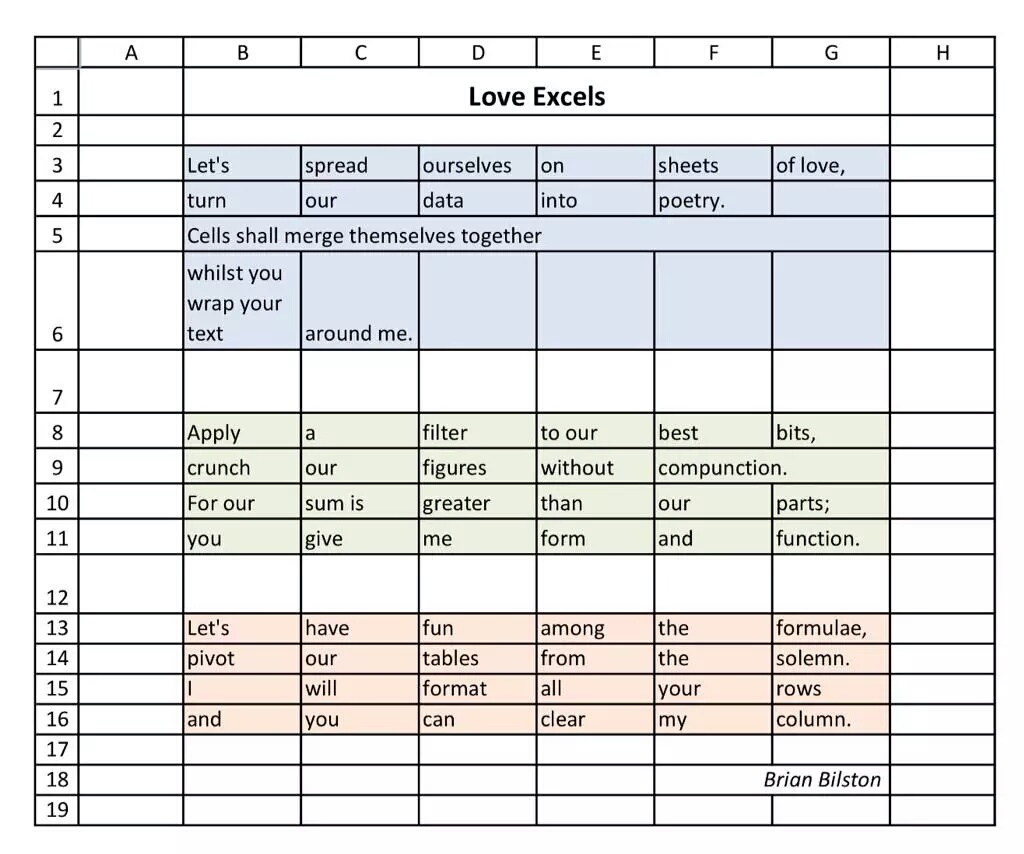
The fog comes
on little cat feet.
It sits looking
over harbor and city
on silent haunches
and then moves on.
by Carl Sandburg (1878-1967)
Follow @telescoper
The fog comes
on little cat feet.
It sits looking
over harbor and city
on silent haunches
and then moves on.
by Carl Sandburg (1878-1967)
Follow @telescoper
First, are you our sort of a person?
Do you wear
A glass eye, false teeth or a crutch,
A brace or a hook,
Rubber breasts or a rubber crotch,
Stitches to show something’s missing? No, no? Then
How can we give you a thing?
Stop crying.
Open your hand.
Empty? Empty. Here is a hand
To fill it and willing
To bring teacups and roll away headaches
And do whatever you tell it.
Will you marry it?
It is guaranteed
To thumb shut your eyes at the end
And dissolve of sorrow.
We make new stock from the salt.
I notice you are stark naked.
How about this suit——
Black and stiff, but not a bad fit.
Will you marry it?
It is waterproof, shatterproof, proof
Against fire and bombs through the roof.
Believe me, they’ll bury you in it.
Now your head, excuse me, is empty.
I have the ticket for that.
Come here, sweetie, out of the closet.
Well, what do you think of that?
Naked as paper to start
But in twenty-five years she’ll be silver,
In fifty, gold.
A living doll, everywhere you look.
It can sew, it can cook,
It can talk, talk, talk.
It works, there is nothing wrong with it.
You have a hole, it’s a poultice.
You have an eye, it’s an image.
My boy, it’s your last resort.
Will you marry it, marry it, marry it.
pity this busy monster, manunkind,
not. Progress is a comfortable disease:
your victim (death and life safely beyond)
plays with the bigness of his littleness
— electrons deify one razorblade
into a mountainrange; lenses extend
unwish through curving wherewhen till unwish
returns on its unself.
A world of made
is not a world of born — pity poor flesh
and trees, poor stars and stones, but never this
fine specimen of hypermagical
ultraomnipotence. We doctors know
a hopeless case if — listen: there’s a hell
of a good universe next door; let’s go
by e e cummings (1895-1962).
Follow @telescoper
I passed through Worthing on the train on the way to Brighton on Monday – the line is immaterial. Today, Friday 16th October 2015, is the 161st anniversary of the birth of Oscar Wilde. From that tenuous connection I offer you this glorious clip from the 1952 film of The Importance of Being Earnest. The principals are Michael Redgrave as Mr Ernest Worthing, Joan Greenwood as Gwendolyn and the wondrous Edith Evans as the formidable Lady Bracknell. It’s an absolutely brilliant scene, but if I had to choose one particular excerpt from the script it would be this:
Follow @telescoper“I do not approve of anything that tampers with natural ignorance. Ignorance is like a delicate exotic fruit; touch it and the bloom is gone. The whole theory of modern education is radically unsound. Fortunately in England, at any rate, education produces no effect whatsoever.”
September’s Baccalaureate
A combination is
Of Crickets – Crows – and Retrospects
And a dissembling Breeze
That hints without assuming –
An Innuendo sear
That makes the Heart put up its Fun
And turn Philosopher.
by Emily Dickinson (1830-1886)
Follow @telescoper
A Life
Lived long; much fear, less
courage. Bottom in love’s school
of his class; time’s reasons
too far back to be known.
Good on his knees, yielding,
vertical, to petty temptations.
A mouth thoughts escaped
from unfledged. Where two
were company, he the unwanted
third. A Narcissus tortured
by the whisperers behind
the mirror. Visionary only
in his perception of an horizon
beyond the horizon. Doubtful
of God, too pusillanimous
to deny him. Saving his face
in verse from the humiliations prose
inflicted on him. One of life’s
conscientious objectors, conceding
nothing to the propaganda of death
but a compulsion to volunteer.
An obituary of his own hand.
posted on the 15th anniversary of the death of R.S. Thomas (1913-2000).
Follow @telescoper
I’ve been reading, with rapidly growing delight and astonishment, an amazing poem called The Botanic Garden , which was written by Erasmus Darwin in 1789. It is a truly wonderful work which depicts the Universe as a vast laboratory set up by a Divine Creator through verses that generate a thrilling sense of momentum and vitality. Take this example, a passage from the First Canto, dealing with the creation of the stars and planets:
‘Let there be Light!’, proclaimed the Almighty Lord,
Astonish’d Chaos heard the potent word: –
Through all his realms the kindly Ether runs,
And the mass starts into a million suns;
Earths round each sun with quick explosions burst,
And second planets issue from the first;
Bend, as they journey with projectile force,
In bright ellipses bend their reluctant course;
Orbs wheel in orbs, round centres centres roll,
And form, self-balanced, one revolving Whole.
It doesn’t quite fit with modern theories of star and planet formation, but it’s certainly beautifully expressed!
Follow @telescoperWell, I made it to Pisa Airport in time to sample the Club Europe lounge, which offers free wifi access (as well as other luxuries). It seems I have a bit of time before my flight so thought I’d do a quick post about this morning’s events. I had the honour to be asked, along with Rocky Kolb, to deliver the concluding remarks for the meeting I’ve been at since Monday. Rocky and I had a quick discussion yesterday about what we should do and we agreed that we shouldn’t try to do a conventional “summary” of the workshop, but instead try something different. In the end we turned to Charles Dickens for inspiration and based the closing remarks on the following text:
IT WAS the best of times, it was the worst of times, it was the age of wisdom, it was the age of foolishness, it was the epoch of belief, it was the epoch of incredulity, it was the season of Light, it was the season of Darkness, it was the spring of hope, it was the winter of despair, we had everything before us, we had nothing before us, we were all going direct to Heaven, we were all going direct the other way…
This is of course part of the famous opening paragraph of Book 1 of A Tale of Two Cities.
The idea was to use the text to discuss different perspectives on the state of the Universe, or at least of cosmology. For example, the fact that we now have huge amounts of cosmological data might lead you to view that this is the “the best of times” for cosmology. On the other hand, this has made life much harder for theorists as everything is now so heavily constrained that it is much more difficult to generate viable alternative models than it was thirty years ago. We also now have a standard cosmological model which some physicists believe in very strongly, whereas others are much more skeptical. This the “epoch of belief” for some but the “epoch of incredulity” for others. Now that the field is dominated by large collaborations in which it is hard for younger researchers to establish themselves, is this a “winter of despair” or do the opportunities presented by the new era of cosmology offer a “spring of hope”.
I haven’t got time to summarize all the points that came up, but it was fun acting as a “feed” for Rocky who had a stream of amusing and insightful comments. There aren’t any “right” or “wrong” answers of course, but it seemed to be an interesting way to get people thinking about where on the “best of times/worst of times” axis they would position themselves.
My own opinion is that cosmology has changed since I started (thirty years ago) and the challenges by the current generation are different from, and in many ways tougher than, those faced by my generation, who were lucky to have been able to learn quite a lot using relatively simple ideas and techniques. Now most of the “easy” stuff has been done, but solving difficult puzzles is immensely rewarding not only for the scientific insights the answers reveal, but also for their own sake. The time to despair about a field is not when it gets tough, but when it stops being fun. I’m glad to say we’re a long way from that situation in cosmology.
Follow @telescoper
I have been out all day at an event that commemorates something that happened on September 1st 1939. No time to write about it tonight, but until I do it seems apt to post this poem By W.H. auden..
I sit in one of the dives
On Fifty-second Street
Uncertain and afraid
As the clever hopes expire
Of a low dishonest decade:
Waves of anger and fear
Circulate over the bright
And darkened lands of the earth,
Obsessing our private lives;
The unmentionable odour of death
Offends the September night.
Accurate scholarship can
Unearth the whole offence
From Luther until now
That has driven a culture mad,
Find what occurred at Linz,
What huge imago made
A psychopathic god:
I and the public know
What all schoolchildren learn,
Those to whom evil is done
Do evil in return.
Exiled Thucydides knew
All that a speech can say
About Democracy,
And what dictators do,
The elderly rubbish they talk
To an apathetic grave;
Analysed all in his book,
The enlightenment driven away,
The habit-forming pain,
Mismanagement and grief:
We must suffer them all again.
Into this neutral air
Where blind skyscrapers use
Their full height to proclaim
The strength of Collective Man,
Each language pours its vain
Competitive excuse:
But who can live for long
In an euphoric dream;
Out of the mirror they stare,
Imperialism’s face
And the international wrong.
Faces along the bar
Cling to their average day:
The lights must never go out,
The music must always play,
All the conventions conspire
To make this fort assume
The furniture of home;
Lest we should see where we are,
Lost in a haunted wood,
Children afraid of the night
Who have never been happy or good.
The windiest militant trash
Important Persons shout
Is not so crude as our wish:
What mad Nijinsky wrote
About Diaghilev
Is true of the normal heart;
For the error bred in the bone
Of each woman and each man
Craves what it cannot have,
Not universal love
But to be loved alone.
From the conservative dark
Into the ethical life
The dense commuters come,
Repeating their morning vow;
‘I will be true to the wife,
I’ll concentrate more on my work,’
And helpless governors wake
To resume their compulsory game:
Who can release them now,
Who can reach the dead,
Who can speak for the dumb?
All I have is a voice
To undo the folded lie,
The romantic lie in the brain
Of the sensual man-in-the-street
And the lie of Authority
Whose buildings grope the sky:
There is no such thing as the State
And no one exists alone;
Hunger allows no choice
To the citizen or the police;
We must love one another or die.
Defenseless under the night
Our world in stupor lies;
Yet, dotted everywhere,
Ironic points of light
Flash out wherever the Just
Exchange their messages:
May I, composed like them
Of Eros and of dust,
Beleaguered by the same
Negation and despair,
Show an affirming flame.