Archive for the Literature Category

The Year

Posted in Poetry with tags , , , on January 1, 2015 by telescoper

What can be said in New Year rhymes,
That’s not been said a thousand times?

The new years come, the old years go,
We know we dream, we dream we know.

We rise up laughing with the light,
We lie down weeping with the night.

We hug the world until it stings,
We curse it then and sigh for wings.

We live, we love, we woo, we wed,
We wreathe our brides, we sheet our dead.

We laugh, we weep, we hope, we fear,
And that’s the burden of the year.

by Ella Wheeler Wilcox (1850-1919)

The Definition of Love

Posted in Poetry with tags , , on December 19, 2014 by telescoper

My love is of a birth as rare
As ’tis for object strange and high;
It was begotten by Despair
Upon Impossibility.

Magnanimous Despair alone
Could show me so divine a thing
Where feeble Hope could ne’er have flown,
But vainly flapp’d its tinsel wing.

And yet I quickly might arrive
Where my extended soul is fixt,
But Fate does iron wedges drive,
And always crowds itself betwixt.

For Fate with jealous eye does see
Two perfect loves, nor lets them close;
Their union would her ruin be,
And her tyrannic pow’r depose.

And therefore her decrees of steel
Us as the distant poles have plac’d,
(Though love’s whole world on us doth wheel)
Not by themselves to be embrac’d;

Unless the giddy heaven fall,
And earth some new convulsion tear;
And, us to join, the world should all
Be cramp’d into a planisphere.

As lines, so loves oblique may well
Themselves in every angle greet;
But ours so truly parallel,
Though infinite, can never meet.

Therefore the love which us doth bind,
But Fate so enviously debars,
Is the conjunction of the mind,
And opposition of the stars.

by Andrew Marvell (1621-1678)


Anthem for Doomed Academics

Posted in Poetry, Science Politics with tags , , on December 17, 2014 by telescoper

Well, not long now until the announcement of the results of the 2014 Research Excellence Framework are known publicly. I’ll post something in the way of a personal reflection tomorrow, as long as I haven’t thrown myself off Brighton Pier by then. In the meantime, I couldn’t resist sharing this brilliant parody of Wilfred Owen I found via Twitter…

Paul Kleiman's avatarStumbling with Confidence

(This has been written as the momentous results of the Research Excellence Framework, known to all and sundry as the dreaded REF, are about to be announced, and as careers hang in the balance depending on who are the winners and losers.)

Anthem for Doomed Academics

(with apologies to Wilfred Owen)

What lasting hell for these who try as authors?
Only the monstrous anger of the dons.
Only the stuttering academic’s crippled cursor
Can patter out career horizons.
No metrics now for them; no citations nor reviews;
Nor any voice of warning save the choirs, –
The shrill, demented choirs of wailing peers;
And lost opportunities calling them from sad HEIs.
What meetings may be held to speed them all?
Not in the hand of managers but in their eyes
Shall shine the unholy glimmers of goodbyes.
The cost of student fees shall be their pall;
Their inheritance the frustrations…

View original post 11 more words

Lying is an Occupation

Posted in Poetry, Politics with tags , , on December 10, 2014 by telescoper
Lying is an occupation,
     Used by all who mean to rise;
Politicians owe their station,
     But to well concerted lies.
These to lovers give assistance,
     To ensnare the fair-one’s heart;
And the virgin’s best resistance
     Yields to this commanding art.
Study this superior science,
     Would you rise in Church or State;
Bid to Truth a bold defiance,
     ‘Tis the practice of the great.

by Laetitia Pilkington (1709-1750)


The Other Ozymandias

Posted in Poetry with tags , , , on December 4, 2014 by telescoper

The sonnet Ozymandias by Percy Bysshe Shelley is so famous that it really needs no introduction here. What you may not know, however, is that Shelley’s poem was one of a pair with the same title on the same theme and submitted to the literary magazine The Examiner. Shelley’s poem was published on January 11th  1818; the other Ozymandias, composed by Shelley’s friend Horace Smith, appeared about three weeks later on February 1st. I can see why Shelley’s is the more famous of the two!

In Egypt’s sandy silence, all alone,
Stands a gigantic Leg, which far off throws
The only shadow that the Desert knows.
“I am great Ozymandias,” saith the stone,
“The King of kings: this mighty city shows
The wonders of my hand.” The city’s gone!
Naught but the leg remaining to disclose
The sight of that forgotten Babylon.
We wonder, and some hunter may express
Wonder like ours, when through the wilderness
Where London stood, holding the wolf in chase,
He meets some fragment huge, and stops to guess
What wonderful, but unrecorded, race
Once dwelt in that annihilated place.


Rest in Peace, P.D. James

Posted in Literature with tags , , on November 28, 2014 by telescoper

I was saddened yesterday to hear of the death, at the age of 94, of the great crime novelist P.D. James so decided to take a few minutes out of my lunch break to post this little tribute. I’ve long been a fan of detective fiction in general but there was something very special about the writing of P.D. James; the initials stand for Phyllis Dorothy, by the way. I think she was one of the few crime novelists who managed to transcend the whodunnit genre  to produce work of authentic literary merit in its own right; Ruth Rendell is the only other that springs to mind among contemporary writers of detective fiction. Her style was as polished and the subject matter as meticulously researched was you would expect from a direct descendant of Dorothy L. Sayers, one of the leading exponents of the “Golden Age” of detective fiction.

P.D. James is most famous for her series of fourteen books featuring the poetry-loving detective Adam Dalgleish, the first of which, Cover Her Face, was published in 1962. That series contained many superb stories, such as Shroud for a Nightingale, Devices and Desires, and Death of an Expert Witness. She also wrote two novels about the female private detective Cordelia Gray, including An Unsuitable Job for a Woman. More recently she wrote a murder mystery  sequel to Jane Austen’s Pride and Prejudice called Death Comes to Pemberley. I bought this last year, but somehow never got around to reading it but will definitely do so now, as I now know it her last; I have read all her other books.

As well as numerous awards for her writing, P.D. James was honoured by the Establishment with an OBE in 1983 and a Life Peerage in 1999. It’s says most however that so many other authors, even those whose style is markedly different have offered heartfelt tributes to her (including these in the Guardian). The main reason why she was held in such high regard by fellow authors was simply that she was bloody good at being a writer; she cared about her craft and was proud of what she did.

There’s something distinctively English about the detective novels of P.D. James, although that something is a something that clearly tends to polarize people. Some find her approach a bit too detached and genteel, some find it, “cosy”, snobbish and class-ridden, and some think that she was just an anachronism, harking back too much to the era of Agatha Christie and Dorothy L. Sayers. Yet others can’t understand the attraction of the genre at all. People are welcome to their opinions of course, but I think that the best detective fiction is not just about setting a puzzle for the reader to solve, but also posing questions about the nature of a society in which such crimes can happen. Far from being “cosy”, great crime writing actually unsettles bourgeois attitudes. The solution of the mystery may offer us a form of comfort, but the questions exposed by the investigation do not go away. As Val McDermid
wrote in the Guardian
, “People who know no better sometimes describe her work as cosy. If a scalpel is cosy, then so was Phyllis”.

Rest in Peace, P.D. James (1920-2014).

At a Lecture

Posted in Education, Poetry with tags , , , on November 27, 2014 by telescoper

Since mistakes are inevitable, I can easily be taken
for a man standing before you in this room filled
with yourselves. Yet in about an hour
this will be corrected, at your and at my expense,
and the place will be reclaimed by elemental particles
free from the rigidity of a particular human shape
or type of assembly. Some particles are still free. It’s not all dust.

So my unwillingness to admit it’s I
facing you now, or the other way around,
has less to do with my modesty or solipsism
than with my respect for the premises’ instant future,
for those afore-mentioned free-floating particles
settling upon the shining surface
of my brain. Inaccessible to a wet cloth eager to wipe them off.

The most interesting thing about emptiness
is that it is preceded by fullness.
The first to understand this were, I believe, the Greek
gods, whose forte indeed was absence.
Regard, then, yourselves as rehearsing perhaps for the divine encore,
with me playing obviously to the gallery.
We all act out of vanity. But I am in a hurry.

Once you know the future, you can make it come
earlier. The way it’s done by statues or by one’s furniture.
Self-effacement is not a virtue
but a necessity, recognised most often
toward evening. Though numerically it is easier
not to be me than not to be you. As the swan confessed
to the lake: I don’t like myself. But you are welcome to my reflection.

by Joseph Brodsky (1940-1996)


Autumn: A Dirge

Posted in Poetry with tags , on November 24, 2014 by telescoper

I.

The warm sun is failing, the bleak wind is wailing,
The bare boughs are sighing, the pale flowers are dying,
And the Year
On the earth her death-bed, in a shroud of leaves dead,
Is lying.
Come, Months, come away,
From November to May,
In your saddest array;
Follow the bier
Of the dead cold Year,
And like dim shadows watch by her sepulchre.

II.

The chill rain is falling, the nipped worm is crawling,
The rivers are swelling, the thunder is knelling
For the Year;
The blithe swallows are flown, and the lizards each gone
To his dwelling;
Come, Months, come away;
Put on white, black, and gray;
Let your light sisters play —
Ye, follow the bier
Of the dead cold Year,
And make her grave green with tear on tear.


by Percy Bysshe Shelley (1792-1822)


The New Mariner

Posted in Poetry, The Universe and Stuff, Uncategorized with tags , , , , on November 16, 2014 by telescoper

In the silence
that is his chosen medium
of communication and telling
others about it
in words. Is there no way
not to be the sport
of reason? For me now
there is only the God-space
into which I send out
my probes. I had looked forward
to old age as a time
of quietness, a time to draw
my horizons about me,
to watch memories ripening
in the sunlight of a walled garden.
But there is the void
over my head and the distance
within that the tireless signals
come from. An astronaut
on impossible journeys
to the far side of the self
I return with the messages
I cannot decipher, garrulous
about them, worrying the ear
of the passer-by, hot on his way
to the marriage of plain fact with plain fact.

by Ronald Stuart Thomas (1913-2000)


Science, Poetry and Romanticism

Posted in Poetry, The Universe and Stuff with tags , , , , , , on November 4, 2014 by telescoper

I listened to a very interesting programme on BBC Radio 3 on Sunday evening, part of which was a documentary about science and poetry presented by Gregory Tate. Given that both these subjects feature heavily on this blog I couldn’t resist a quick post about it.

The feature explored why so many scientists have been inspired to write poetry, and the nature of the relationship between their artistic work and their science.

Among the famous scientists included in the programme was chemist and inventor Humphry Davy who, inspired by his friendship with the poets Wordsworth and Coleridge, wrote poems throughout his life. Others to do likewise were: physician Eramus Darwin; mathematician William Rowan Hamilton; astronomer William Herschel (who was also a noted musician and composer); J. Robert Oppenheimer; and Erwin Schrödinger.

Doing a quick google about after the programme I came across this example by Hamilton, which I searched for because he is the scientist from the list above with whose mathematical work I am most familiar because of its huge influence on physics, and because he seems to have been a very colourful character as well as a superb mathematician. Interestingly, he too was a very close friend of Wordsworth, to whom he often sent poems with requests for comments and feedback. In the subsequent correspondence, Wordsworth was usually not very complimentary even to the extent of telling Hamilton to stick to his day job (or words to that effect). What I didn’t know was that Hamilton regarded himself as a poet first and a mathematician second. That just goes to show you shouldn’t necessarily trust a man’s judgement when he applies it to himself.

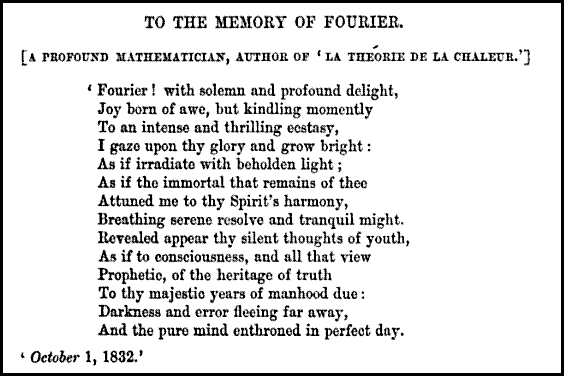
Here’s an example of Hamilton’s verse – a poem written to honour Joseph Fourier:

Hamilton-for Fourier

If that’s one of his better poems, then I think Wordsworth may have had a point!

The serious thing that struck me about this programme though was how many scientists of the 19th Century, Hamilton included, saw their scientific interrogation of Nature as a manifestation of the human condition just as the romantic poets saw their artistic contemplation. It is often argued that romanticism is responsible for the rise of antiscience. I’m not really qualified to comment on that but I don’t see any conflict at all between science and romanticism. I certainly don’t see Wordsworth’s poetry as antiscientific. I just find it inspirational:

I HAVE seen
A curious child, who dwelt upon a tract
Of inland ground, applying to his ear
The convolutions of a smooth-lipped shell;
To which, in silence hushed, his very soul
Listened intensely; and his countenance soon
Brightened with joy; for from within were heard
Murmurings, whereby the monitor expressed
Mysterious union with its native sea.
Even such a shell the universe itself
Is to the ear of Faith; and there are times,
I doubt not, when to you it doth impart
Authentic tidings of invisible things;
Of ebb and flow, and ever-during power;
And central peace, subsisting at the heart
Of endless agitation.