Rest in Peace, Rik Mayall (1958-2014).
Follow @telescoperArchive for the Literature Category
The Theatre – by Rik Mayall
Posted in Poetry with tags Poetry, Rik Mayall, The Theatre on June 10, 2014 by telescoperWindows is shutting down
Posted in Poetry with tags Clive James, Poem, Windows is shutting down on June 7, 2014 by telescoperWindows is shutting down, and grammar are
On their last leg. So what am we to do?
A letter of complaint go just so far,
Proving the only one in step are you.
Better, perhaps, to simply let it goes.
A sentence have to be screwed pretty bad
Before they gets to where you doesnt knows
The meaning what it must of meant to had.
The meteor have hit. Extinction spread,
But evolution do not stop for that.
A mutant languages rise from the dead
And all them rules is suddenly old hat.
Too bad for we, us what has had so long
The best seat from the only game in town.
But there it am, and whom can say its wrong?
Those are the break. Windows is shutting down.
by Clive James (b 1939)
Follow @telescoperOn the Pulse of Morning
Posted in Poetry with tags Maya Angelou, On the pulse of morning, Poetry on May 30, 2014 by telescoperA Rock, A River, A Tree
Hosts to species long since departed,
Marked the mastodon.
The dinosaur, who left dry tokens
Of their sojourn here
On our planet floor,
Any broad alarm of their hastening doom
Is lost in the gloom of dust and ages.
But today, the Rock cries out to us, clearly, forcefully,
Come, you may stand upon my
Back and face your distant destiny,
But seek no haven in my shadow.
I will give you no more hiding place down here.
You, created only a little lower than
The angels, have crouched too long in
The bruising darkness,
Have lain too long
Face down in ignorance.
Your mouths spilling words
Armed for slaughter.
The Rock cries out today, you may stand on me,
But do not hide your face.
Across the wall of the world,
A River sings a beautiful song,
Come rest here by my side.
Each of you a bordered country,
Delicate and strangely made proud,
Yet thrusting perpetually under siege.
Your armed struggles for profit
Have left collars of waste upon
My shore, currents of debris upon my breast.
Yet, today I call you to my riverside,
If you will study war no more. Come,
Clad in peace and I will sing the songs
The Creator gave to me when I and the
Tree and the stone were one.
Before cynicism was a bloody sear across your
Brow and when you yet knew you still
Knew nothing.
The River sings and sings on.
There is a true yearning to respond to
The singing River and the wise Rock.
So say the Asian, the Hispanic, the Jew
The African and Native American, the Sioux,
The Catholic, the Muslim, the French, the Greek
The Irish, the Rabbi, the Priest, the Sheikh,
The Gay, the Straight, the Preacher,
The privileged, the homeless, the Teacher.
They hear. They all hear
The speaking of the Tree.
Today, the first and last of every Tree
Speaks to humankind. Come to me, here beside the River.
Plant yourself beside me, here beside the River.
Each of you, descendant of some passed
On traveller, has been paid for.
You, who gave me my first name, you
Pawnee, Apache and Seneca, you
Cherokee Nation, who rested with me, then
Forced on bloody feet, left me to the employment of
Other seekers- desperate for gain,
Starving for gold.
You, the Turk, the Swede, the German, the Scot…
You the Ashanti, the Yoruba, the Kru, bought
Sold, stolen, arriving on a nightmare
Praying for a dream.
Here, root yourselves beside me.
I am the Tree planted by the River,
Which will not be moved.
I, the Rock, I the River, I the Tree
I am yours- your Passages have been paid.
Lift up your faces, you have a piercing need
For this bright morning dawning for you.
History, despite its wrenching pain,
Cannot be unlived, and if faced
With courage, need not be lived again.
Lift up your eyes upon
The day breaking for you.
Give birth again
To the dream.
Women, children, men,
Take it into the palms of your hands.
Mold it into the shape of your most
Private need. Sculpt it into
The image of your most public self.
Lift up your hearts
Each new hour holds new chances
For new beginnings.
Do not be wedded forever
To fear, yoked eternally
To brutishness.
The horizon leans forward,
Offering you space to place new steps of change.
Here, on the pulse of this fine day
You may have the courage
To look up and out upon me, the
Rock, the River, the Tree, your country.
No less to Midas than the mendicant.
No less to you now than the mastodon then.
Here on the pulse of this new day
You may have the grace to look up and out
And into your sister’s eyes, into
Your brother’s face, your country
And say simply
Very simply
With hope
Good morning.
by Maya Angelou (4th April 1928-28th May 2014; Rest in Peace)
Follow @telescoper
The Rainy Day
Posted in Poetry on May 24, 2014 by telescoperThe day is cold, and dark, and dreary;
It rains, and the wind is never weary;
The vine still clings to the mouldering wall,
But at every gust the dead leaves fall,
And the day is dark and dreary.
My life is cold, and dark, and dreary;
It rains, and the wind is never weary;
My thoughts still cling to the mouldering Past,
But the hopes of youth fall thick in the blast,
And the days are dark and dreary.
Be still, sad heart! and cease repining;
Behind the clouds is the sun still shining;
Thy fate is the common fate of all,
Into each life some rain must fall,
Some days must be dark and dreary.
by Henry Wadsworth Longfellow (1807-1882)
Follow @telescoperThe Tempest in Musick
Posted in Brighton, Literature, Music with tags Brighton Dome, Brighton Festival, John Dryden, New London Consort, The Tempest, The Tempest in Musick, William Shakespeare, Willian Davenant on May 17, 2014 by telescoperI haven’t done a music review type of thing on this blog for some time, for the simple reason that I haven’t had the time to go to many live music events recently. However, this being Festival time in Brighton I felt I should make an extra-special effort to take a bit of time out to take in a bit of culture. All work and no play and all that.
Anyway, yesterday evening found me in the Concert Hall of the Brighton Dome for a performance entitled The Tempest in Musick by the New London Consort. The programme for the show featured all the music written for the 17th and early 18th century revivals of William Shakespeare’s play, The Tempest. That in itself tells an interesting story. In 1667, after the Restoration of the Monarchy, John Dryden and Willian Davenant put together an enlarged and adapted version of Shakespeare’s play with a host of new characters and numerous musical interludes and additions. This piece was later revised further aa number of times, each including even more music, a process which culminated in a semi-operatic version compiled by Thomas Shadwell in 1674. As if Shakespeare’s original tale were not exotic enough, these new versions had extra devils, Tritons, and Nereids along with spectacular stage effects and costumes. London audiences clearly wanted to let their hair down after the severe restrictions on popular entertainment imposed by Puritans during the Protectorate. The Shadwell version was the top show in London for over fifty years: it ran from 1674 until 1728, until it was eventually replaced in popularity by The Beggar’s Opera.
In the concert we heard most if not all of the music that survives from the multiple revivals and revisions of the Tempest, written by various composers over the period 1667 to 1712, including a setting of “Dear pretty youth” by Henry Purcell dated to 1695. There were two different versions of the most famous song from the original play, Full Fathom Five, sung by Ariel:
Full fathom five thy father lies;
Of his bones are coral made;
Those are pearls that were his eyes;
Nothing of him that doth fade,
But doth suffer a sea-change
Into something rich and strange.
Sea-nymphs hourly ring his knell:
Ding-dong.
Hark! now I hear them — Ding-dong, bell
Of course the New London Consort play using period instruments, which gives me an excuse to post this again:
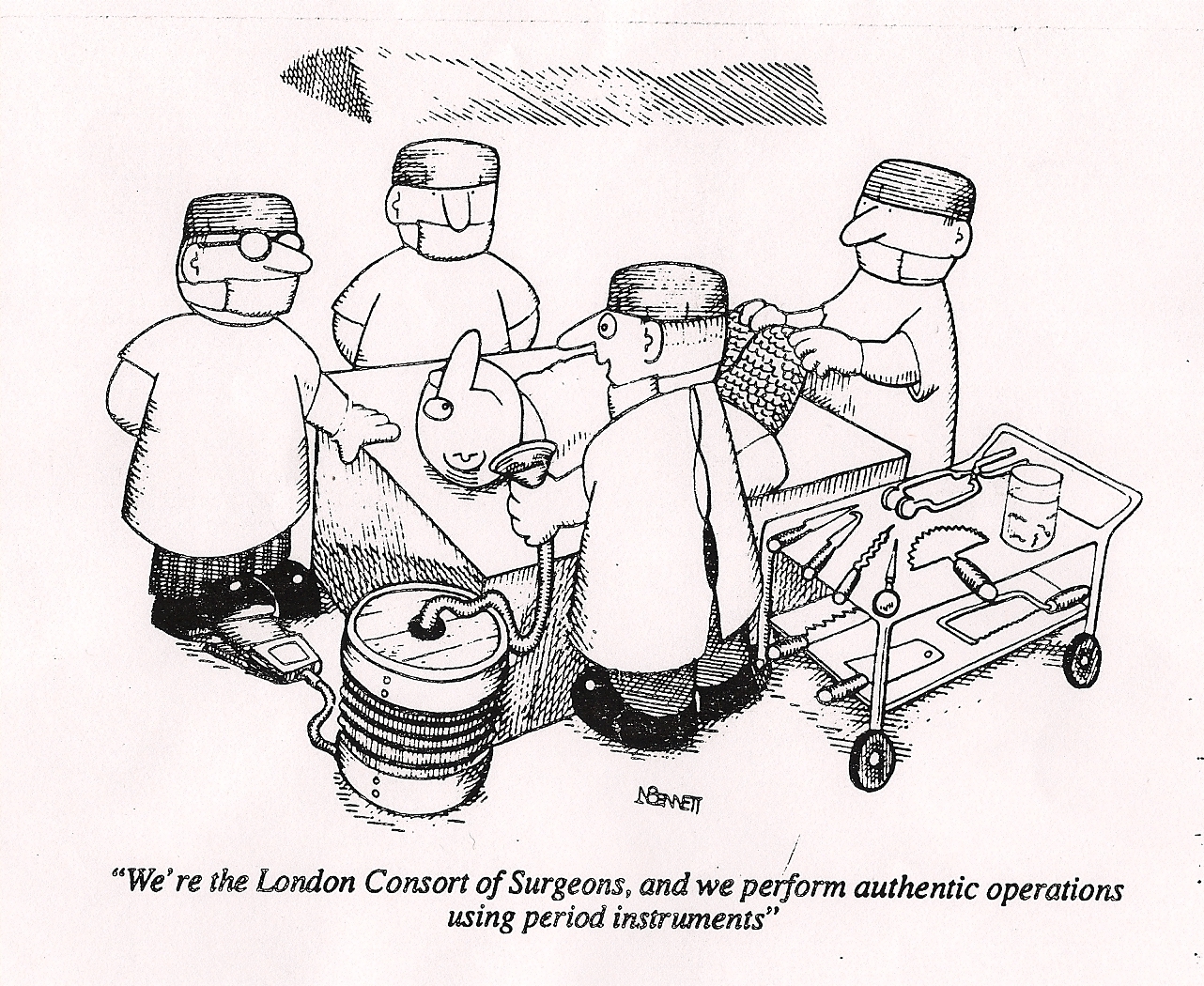
I’m not a fan of period instruments generally, but because of the historical interest in the music I thought I’d give it a go. I had grave misgivings when I saw that the musicians were to be directed by David Roblou from a harpsichord, but decided to grit my teeth and perservere instead of fleeing to the nearest pub.
As it happened, although it was good in parts, the concert basically just confirmed my prejudices. To start with, much of the music is very ordinary and the musicians for the most part failed to bring it to life. The strings, played without vibrato throughout and occasionally rather ragged to boot, didn’t produce much in the way of colour or dynamics; this way of playing also exposed their uncertain pitching. The recorders, a long way from the audience right at the back of the stage, found it difficult to project. They would have been much better off in a smaller venue, I think, especially because of the large gap between audience and stage left for standing customers (of whom there were very few). The dreaded harpsichord was barely audible too. Not that I’m complaining about that.
On the other hand there was some brilliant trumpet playing by Simon Munday on a period instrument. Also I think this is the first time I’ve ever heard a Serpent played and I really enjoyed hearing it. Apart from these highlights though I found the music rather undistinguished and the performance curiously flat.
The singing was much better: the three lovely female voices (Anna Dennis, Faye Newton and Penelope Appleyard) are worth mentioning and tenor Jorge Navarro-Colorado sang well and was a striking presence on stage during the occasional semi-staged pieces. I wasn’t that keen on any of the bass-baritones though.
I realise that there will probably be early music fans out there who would have loved last night’s performance. That’s fine of course. Les gouts et les couleurs ne se discutent pas.
Follow @telescoper
On a Forenoon of Spring
Posted in Poetry with tags On a Forenoon of Spring, Poem, Poetry, William Allingham on May 16, 2014 by telescoperI’m glad I am alive, to see and feel
The full deliciousness of this bright day,
That’s like a heart with nothing to conceal;
The young leaves scarcely trembling; the blue-grey
Rimming the cloudless ether far away;
Briars, hedges, shadows; mountains that reveal
Soft sapphire; this great floor of polished steel
Spread out amidst the landmarks of the bay.
I stoop in sunshine to our circling net
From the black gunwale; tend these milky kine
Up their rough path; sit by yon cottage-door
Plying the diligent thread; take wings and soar–
O hark how with the season’s laureate
Joy culminates in song! If such a song were mine!
by William Allingham (1824-1889)
Follow @telescoper
Silence
Posted in Poetry with tags Poem, Poetry, Silence, Thomas Hood on May 7, 2014 by telescoperThere is a silence where hath been no sound,
There is a silence where no sound may be,
In the cold grave–under the deep, deep, sea,
Or in wide desert where no life is found,
Which hath been mute, and still must sleep profound;
No voice is hushed–no life treads silently,
But clouds and cloudy shadows wander free,
That never spoke, over the idle ground:
But in green ruins, in the desolate walls
Of antique palaces, where Man hath been,
Though the dun fox, or wild hyena, calls,
And owls, that flit continually between,
Shriek to the echo, and the low winds moan,
There the true Silence is, self-conscious and alone.
by Thomas Hood (1799-1845).
Follow @telescoper
The Rev. Eli Jenkins’ Prayer
Posted in Poetry with tags Dunvant Male Voice Choir, Dylan Thomas, Dylan Thomas Day, Eli Jenkins' Prayer, Under Milk Wood on May 5, 2014 by telescoperWell, this Bank Holiday Monday is drawing to a close. I’ve spent a lot of it working, actually, but also occasionally listening to the wonderful celebration of Dylan Thomas Day on BBC Radio 3. Among other things, this actually made me feel a bit nostalgic for Wales (where I lived until last year)…
This is the Reverend Eli Jenkins’ Prayer from Under Milk Wood, by Dylan Thomas which is also sometimes known as The Sunset Poem. It’s a different choir, though. This is the Dunvant Male Voice Choir and they’re filmed on the breezy clifftops overlooking the beautiful Rhossili Bay on the Gower Peninsula.
Dylan Thomas and a Male Voice Choir; what could be more Welsh than that?
Every morning when I wake,
Dear Lord, a little prayer I make,
O please do keep Thy lovely eye
On all poor creatures born to die
And every evening at sun-down
I ask a blessing on the town,
For whether we last the night or no
I’m sure is always touch-and-go.
We are not wholly bad or good
Who live our lives under Milk Wood,
And Thou, I know, wilt be the first
To see our best side, not our worst.
O let us see another day!
Bless us all this night, I pray,
And to the sun we all will bow
And say, good-bye – but just for now!
A Poem for Dylan Thomas Day
Posted in Poetry with tags Dylan Thomas, Fern Hill on May 3, 2014 by telescoperIn honour of the poet Dylan Thomas, BBC Radio 3 has designated this forthcoming Bank Holiday Monday (5th May) Dylan Thomas Day and will broadcasting a number of programmes about him and his work on that day and in fact also on the Sunday preceding it. This is because Dylan Thomas was born in 1914 so this year marks the centenary of his birth, although his actual birthday is 27th October.
Anyway, I thought I’d use this event as an excuse to post a poem by Dylan Thomas. I’ve loved this particular one since I first heard it when I was a student many years ago. I say “heard it” rather than “read it” because it was through buying a tape of the man himself reading his poems that got me hooked. Fern Hill reflects about the passage of time, the loss of childhood happiness and the inevitability of death but its mood is defiant rather than gloomy. It’s full of vibrant imagery, but it’s also written with a wonderful feeling for the natural rhythms and cadences of the English language. You can listen to Dylan Thomas reading this exactly as you would if it were music.
I remember once getting very drunk at a conference, standing on a table in a pub and reciting this loudly to a largely foreign (German) audience. To my astonishment they gave me a standing ovation, but my rendition wasn’t a patch on the original. My voice has nothing like that resonance!
Fern Hill
Now as I was young and easy under the apple boughs
About the lilting house and happy as the grass was green,
The night above the dingle starry,
Time let me hail and climb
Golden in the heydays of his eyes,
And honoured among wagons I was prince of the apple towns
And once below a time I lordly had the trees and leaves
Trail with daisies and barley
Down the rivers of the windfall light.
And as I was green and carefree, famous among the barns
About the happy yard and singing as the farm was home,
In the sun that is young once only,
Time let me play and be
Golden in the mercy of his means,
And green and golden I was huntsman and herdsman, the calves
Sang to my horn, the foxes on the hills barked clear and cold,
And the sabbath rang slowly
In the pebbles of the holy streams.
All the sun long it was running, it was lovely, the hay
Fields high as the house, the tunes from the chimneys, it was air
And playing, lovely and watery
And fire green as grass.
And nightly under the simple stars
As I rode to sleep the owls were bearing the farm away,
All the moon long I heard, blessed among stables, the nightjars
Flying with the ricks, and the horses
Flashing into the dark.
And then to awake, and the farm, like a wanderer white
With the dew, come back, the cock on his shoulder: it was all
Shining, it was Adam and maiden,
The sky gathered again
And the sun grew round that very day.
So it must have been after the birth of the simple light
In the first, spinning place, the spellbound horses walking warm
Out of the whinnying green stable
On to the fields of praise.
And honoured among foxes and pheasants by the gay house
Under the new made clouds and happy as the heart was long,
In the sun born over and over,
I ran my heedless ways,
My wishes raced through the house high hay
And nothing I cared, at my sky blue trades, that time allows
In all his tuneful turning so few and such morning songs
Before the children green and golden
Follow him out of grace.
Nothing I cared, in the lamb white days, that time would take me
Up to the swallow thronged loft by the shadow of my hand,
In the moon that is always rising,
Nor that riding to sleep
I should hear him fly with the high fields
And wake to the farm forever fled from the childless land.
Oh as I was young and easy in the mercy of his means,
Time held me green and dying
Though I sang in my chains like the sea.
On the Birth of his Son
Posted in Poetry, Politics with tags Su Dong-po, Su Shi, Sung Dynasty on May 2, 2014 by telescoperFamilies, when a child is born
Want it to be intelligent.
I, through intelligence,
Having wrecked my whole life,
Only hope the baby will prove
Ignorant and stupid.
Then he will crown a tranquil life
By becoming a Cabinet Minister.
by Su Shi (1037-1101); he is generally viewed as the greatest poet of the Sung dynasty in China and was also known as Su Dong-po or Si Tung-p’0.
Follow @telescoper

 In the Dark