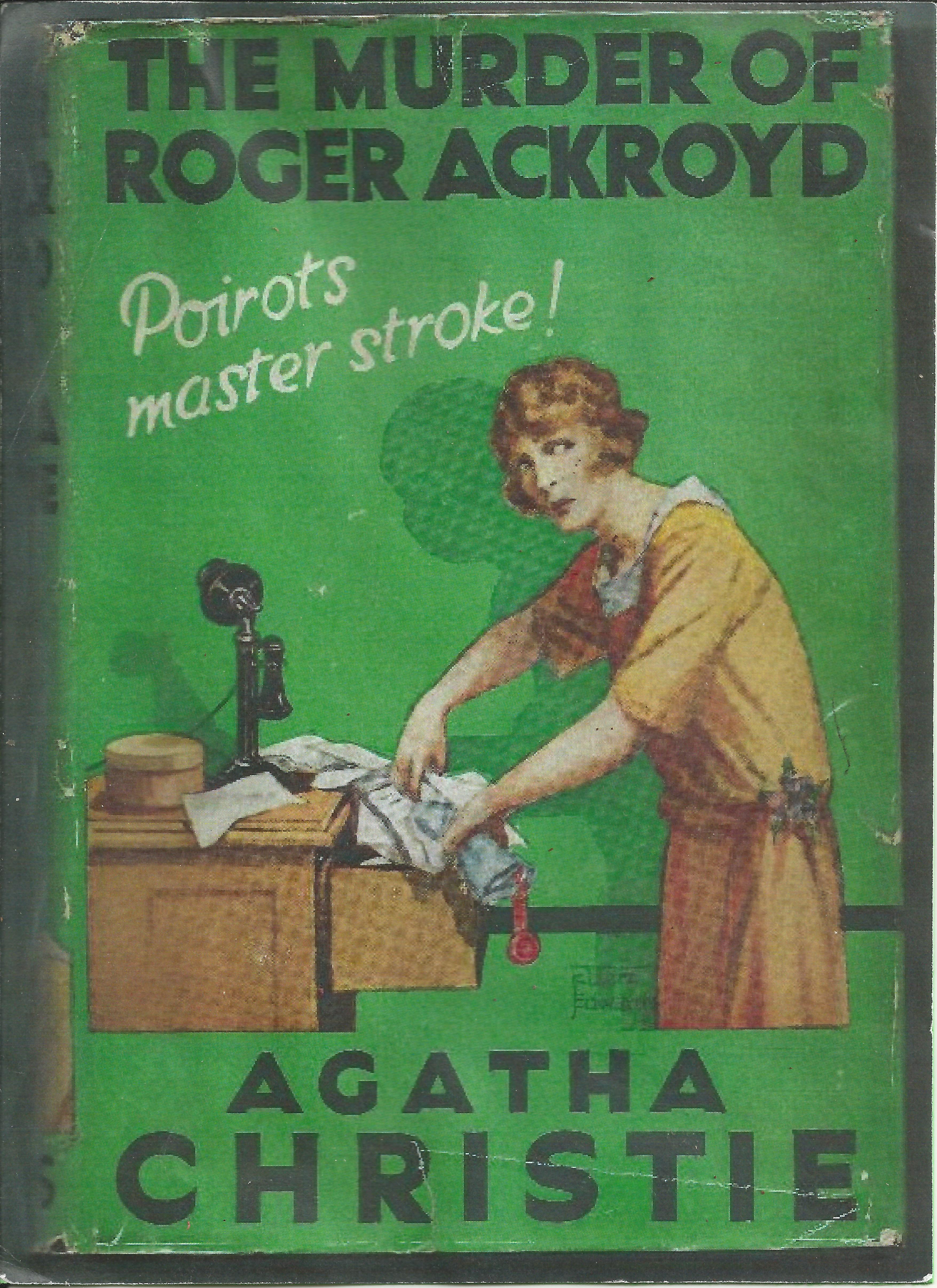
..and a First Edition too!
In April, in April,
My one love came along,
And I ran the slope of my high hill
To follow a thread of song.
His eyes were hard as porphyry
With looking on cruel lands;
His voice went slipping over me
Like terrible silver hands.
Together we trod the secret lane
And walked the muttering town;
I wore my heart like a wet, red stain
On the breast of a velvet gown.
In April, in April,
My love went whistling by,
And I stumbled here to my high hill
Along the way of a lie.
Now what should I do in this place
But sit and count the chimes,
And splash cold water on my face,
And spoil a page with rhymes?
by Dorothy Parker (1893-1967)
Follow @telescoper
I marvel how Nature could ever find space
For so many strange contrasts in one human face:
There’s thought and no thought, and there’s paleness and bloom
And bustle and sluggishness, pleasure and gloom.
There’s weakness, and strength both redundant and vain;
Such strength as, if ever affliction and pain
Could pierce through a temper that’s soft to disease,
Would be rational peace–a philosopher’s ease.
There’s indifference, alike when he fails or succeeds,
And attention full ten times as much as there needs;
Pride where there’s no envy, there’s so much of joy;
And mildness, and spirit both forward and coy.
There’s freedom, and sometimes a diffident stare
Of shame scarcely seeming to know that she’s there,
There’s virtue, the title it surely may claim,
Yet wants heaven knows what to be worthy the name.
This picture from nature may seem to depart,
Yet the Man would at once run away with your heart;
And I for five centuries right gladly would be
Such an odd such a kind happy creature as he.
by William Wordsworth (1770-1850)
Follow @telescoperI thought I had forgotten,
But it all came back again
To-night with the first spring thunder
In a rush of rain.
I remembered a darkened doorway
Where we stood while the storm swept by,
Thunder gripping the earth
And lightning scrawled on the sky.
The passing motor busses swayed,
For the street was a river of rain,
Lashed into little golden waves
In the lamp light’s stain.
With the wild spring rain and thunder
My heart was wild and gay;
Your eyes said more to me that night
Than your lips would ever say. . . .
I thought I had forgotten,
But it all came back again
To-night with the first spring thunder
In a rush of rain.
by Sara Teasdale (1884-1933)
Follow @telescoperHappy the man, whose wish and care
A few paternal acres bound,
Content to breathe his native air,
In his own ground.
Whose herds with milk, whose fields with bread,
Whose flocks supply him with attire,
Whose trees in summer yield him shade,
In winter fire.
Blest! who can unconcern’dly find
Hours, days, and years slide soft away,
In health of body, peace of mind,
Quiet by day,
Sound sleep by night; study and ease
Together mix’d; sweet recreation,
And innocence, which most does please,
With meditation.
Thus let me live, unseen, unknown;
Thus unlamented let me die;
Steal from the world, and not a stone
Tell where I lie.
by Alexander Pope (1688-1744; he wrote this poem when he was 12 years old)
Follow @telescoper Spring Song, Meirionydd
A white combustion rules these fields,
and testifies to men, and rams;
the mind of winter thaws, and yields–
Great God, the world is drunk with lambs.
The high grey stone is clean of snows,
the streams come tumbling, far from dams;
the wind is green, the day’s eye grows–
Great God, the world is drunk with lambs.
The heart, gone light as all the ewes,
redounds with milk, and epigrams
that make no sense; except their news–
Great God, the world is drunk with lambs.
In gold October, grown to size,
they’ll know the hook, and hang with hams,
but March is all their enterprise–
Great God, the world is drunk with lambs.
by John Dressel.
Follow @telescoperIt’s St David’s Day today so Dydd Gŵyl Dewi Hapus! I’m in Cardiff and shortly heading to St David’s Hall for a gala concert being held to mark the occasion. As has become traditional on this blog, I thought I’d post a poem by the great Welsh poet R.S. Thomas. This is called Welsh History:
We were a people taut for war; the hills
Were no harder, the thin grass
Clothed them more warmly than the coarse
Shirts our small bones.
We fought, and were always in retreat,
Like snow thawing upon the slopes
Of Mynydd Mawr; and yet the stranger
Never found our ultimate stand
In the thick woods, declaiming verse
To the sharp prompting of the harp.
Our kings died, or they were slain
By the old treachery at the ford.
Our bards perished, driven from the halls
Of nobles by the thorn and bramble.
We were a people bred on legends,
Warming our hands at the red past.
The great were ashamed of our loose rags
Clinging stubbornly to the proud tree
Of blood and birth, our lean bellies
And mud houses were a proof
Of our ineptitude for life.
We were a people wasting ourselves
In fruitless battles for our masters,
In lands to which we had no claim,
With men for whom we felt no hatred.
We were a people, and are so yet.
When we have finished quarrelling for crumbs
Under the table, or gnawing the bones
Of a dead culture, we will arise
And greet each other in a new dawn.
Spring is like a perhaps hand
(which comes carefully
out of Nowhere) arranging
a window,into which people look (while
people stare
arranging and changing placing
carefully there a strange
thing and a known thing here) and
changing everything carefully
spring is like a perhaps
Hand in a window
(carefully to
and from moving New and
Old things, while
people stare carefully
moving a perhaps
fraction of flower here placing
an inch of air there) and
without breaking anything.
by e e cummings (1894-1962).
Follow @telescoperI missed the anniversary by a day but I thought I’d pass on a fascinating but very sad little bit of history. One hundred and twenty years ago yesterday, on February 15th 1894, a 26-year old Frenchman by the name of Martial Bourdin blew himself up near the Royal Observatory in Greenwich. His death seems to have been an accident caused by the bomb he was carrying going off prematurely. It is not really known either whether the bomb was meant for the Royal Observatory or somewhere else. Anarchist attacks involving bombs were not uncommon in the 1890s and the range of targets was very wide.
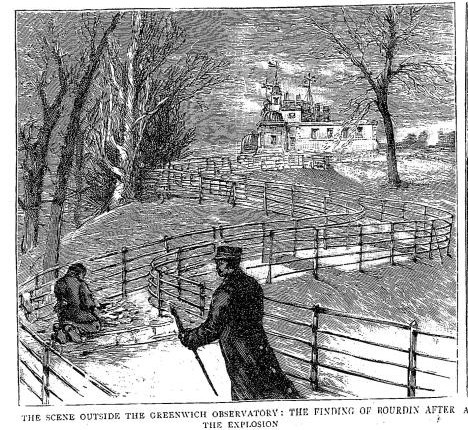
Bourdin was found alive, though very seriously injured, by people who heard the blast. Though able to speak he did not offer any explanation for what had happened. He died about half an hour later.
This sad and perplexing story inspired Joseph Conrad‘s famous novel The Secret Agent. Conrad added an “Author’s Note” to the manuscript of his book:
The attempt to blow up the Greenwich Observatory: a blood-stained inanity of so fatuous a kind that is is impossible to fathom its origin by any reasonable or even unreasonable process of thought. For perverse unreason has its own logical processes. But that outrage could not be laid hold of mentally in any sort of way, so that one remained faced by the fact of a man blown to pieces for nothing even most remotely resembling an idea, anarchistic or other. As to the outer wall of the Observatory, it did not show as much as the faintest crack.
We’ll never know what Bourdin’s motivations were; perhaps he didn’t really know himself. He is usually described as an “anarchist” although that term describes such a wide spectrum of political beliefs that it doesn’t really explain Bourdin’s actions; not all anarchists embrace violence and aggression, for example, although some – such as the members of Class War – clearly do. At one end of the anarchist spectrum there are the violent thugs who are nothing more than the mirror image of fascism and at the other there are reasonable intelligent people who simply don’t believe in hierarchical structures.
Brighton has its share of anarchists and the thing that’s most noticeable about them to an outsider like me is their conformity; the dress code is apparently very strictly enforced. The obvious irony aside, this suggests to me that much of the attraction of being an anarchist is not really the existence of a compelling political philosophy, but simply to fulfill the need to belong to something.
The main thing that occurred to me yesterday while I was reading about the Greenwich Observatory bomb plot concerns the implications of the location. If the Royal Observatory was the intended target then why was it so? The simple answer is that a core belief for most varieties of anarchist is their opposition to “the State”. A powerful symbol of the British state in 1894 was the Royal Navy; it was Britain’s maritime traditions that led to the founding of the Royal Observatory in the first place and most of the work carried out there involved accurate positional measurements designed to help with navigation. Or maybe it was to do with the role of the Observatory in defining the time? Insofar as acts like this make any sense at all, these seem reasonable interpretations.
I’m tempted to suggest that the adoption of Greenwich as the Prime Meridian in 1884 may have given a young Frenchman additional grounds for resentment..
A different answer from the suggestion that it was an anti-establishment gesture stems from the conflict between anarchism and the nature of scientific knowledge. Anarchists usually express their beliefs in terms of the desire to make society more “equal” and “democratic”, so that decisions should be made collectively for the common good. I’m happy with that line of argument, and agree that we should all enjoy equal rights versus the government and other institutions, and in relation to one another. However, having equal rights does not mean having equal knowledge and it doesn’t mean that any person’s opinion about anything is as good as anyone else’s. What I mean is that there are scientific experts, and the knowledge they possess has demonstrable value.
The approach of some to this challenge is simply to deny the value of scientific knowledge, and assert instead that it’s just a social construct like anything else. I am aware of a number of so-called social scientists at the University of Sussex and elsewhere who hold this view; my usual response is to ask them whether they regard witchcraft or crystal healing as equal to orthodox medicine.
CLARIFICATION: Please note I do not mean to imply that all social scientists hold the opinions described above. I’m fully aware that they are fringe views. The phrase “so-called social scientists” does not refer to all social scientists, just the fringe in much the same way I’d use “so-called geographers” to describe the Flat Earth Society.
I’m not trying to suggest that members of the Department of Sociology are plotting to blow up the Astronomy Centre! What I do think that while we should always strive to be as democratic as possible there are always limits, not just because of what is practically possible but also what is socially desirable. Any organization in which everyone votes about every decision that has to be made would struggle to function at all. We have to find ways of working that make best use of the different skills and knowledge we all possess.
A constructive approach is to argue that if we are to build a more democratic society it is first necessary to greatly increase the level of scientific literacy in the population, so that more people can make informed decisions about the big issues facing the future, such as how we fulfill our energy requirements for the next 30 years and how we cope with global warming. That will not be an easy thing to do given the dearth of scientists in Parliament and in the media, but that’s not an argument for not trying.
Symptomatic of the widespread rejection of science among the politically disaffected is the lamentable state of Green politics in the United Kingdom. In my opinion there is huge potential for a scientifically-informed political movement focussed on environmental issues. Unfortunately the current Green Party is anti-science to the core, which would doom it to perpetual marginalization even without the loss of credibility stemming from the childish antics of the only Green MP, Caroline Lucas. I know that many will argue with me about whether the Green Party should be included in “The Left”, but since both Labour and Conservative parties now belong to the Centre-Right it seems a sensible classification to me.
It hasn’t always been like this. As Alice Rose Bell pointed out in a Guardian piece some time ago, there have been examples of constructive engagement between science and left-wing politics. This seems to me to have largely evaporated. I don’t think that’s so much because scientists have rejected the left. It’s more that the left has rejected science.
Follow @telescoper
The rain it rains without a stay
In the hills above us, in the hills;
And presently the floods break way
Whose strength is in the hills.
The trees they suck from every cloud,
The valley brooks they roar aloud—
Bank-high for the lowlands, lowlands,
Lowlands under the hills!
The first wood down is sere and small,
From the hills—the brishings off the hills;
And then come by the bats and all
We cut last year in the hills;
And then the roots we tried to cleave
But found too tough and had to leave—
Polting through the lowlands, lowlands,
Lowlands under the hills!
The eye shall look, the ear shall hark
To the hills, the doings in the hills,
And rivers mating in the dark
With tokens from the hills.
Now what is weak will surely go,
And what is strong must prove it so—
Stand fast in the lowlands, lowlands,
Lowlands under the hills!
The floods they shall not be afraid—
Nor the hills above ’em, nor the hills—
Of any fence which man has made
Betwixt him and the hills.
The waters shall not reckon twice
For any work of man’s device,
But bid it down to the lowlands, lowlands,
Lowlands under the hills!
The floods shall sweep corruption clean—
By the hills, the blessing of the hills—
That more the meadows may be green
New-mended from the hills.
The crops and cattle shall increase,
Nor little children shall not cease.
Go—plough the lowlands, lowlands,
Lowlands under the hills!
by Rudyard Kipling 19865-1936).
Follow @telescoper


