Archive for the Literature Category

Final Goodbyes

Posted in Biographical, Education, Literature with tags , , on June 1, 2013 by telescoper

Yesterday, as the week drew to a close, along with the month of May itself, I found myself in a visitor’s office in the School of Physics & Astronomy at Cardiff University, nursing a hangover, and finishing off a few final matters arising from my time as a member of staff here. I took part in a couple of viva voce examinations for 4th year project students. Now the reports are written up, marks agreed, and paperwork handed in. When I’ve handed in my keys and ID card that will be that. I’ll be back at the University of Sussex next week, having fulfilled my obligations (as best I could) to the students whose interest in their projects outweighed the virtually complete absence of their supervisor for half the year.

The project assessments and the examination period in general at Cardiff  now being over, it’s time for final-year undergraduate students to think about packing up their things and heading out into the big wide world, to return only briefly in July (perhaps) for their graduation ceremony. It seems that no sooner do students’ faces become familiar than they disappear, most of them never to be seen again, and sometimes without so much as a word of goodbye…

I don’t really know why but this reminded me of Brutus’ famous goodbye to Cassius on the plains of Philippi  in Scene V of Julius Caesar:

And whether we shall meet again I know not.
Therefore our everlasting farewell take:
For ever, and for ever, farewell, Cassius!
If we do meet again, why, we shall smile;
If not, why then, this parting was well made.

The More Loving One

Posted in Poetry with tags , , , on May 31, 2013 by telescoper

Looking up at the stars, I know quite well
That, for all they care, I can go to hell,
But on earth indifference is the least
We have to dread from man or beast.

How should we like it were stars to burn
With a passion for us we could not return?
If equal affection cannot be,
Let the more loving one be me.

Admirer as I think I am
Of stars that do not give a damn,
I cannot, now I see them, say
I missed one terribly all day.

Were all stars to disappear or die,
I should learn to look at an empty sky
And feel its total dark sublime,
Though this might take me a little time.


by W.H. Auden (1907-1973).

The Thought Fox

Posted in Poetry with tags , , on May 25, 2013 by telescoper

I imagine this midnight moment’s forest:
Something else is alive
Besides the clock’s loneliness
And this blank page where my fingers move.

Through the window I see no star:
Something more near
Though deeper within darkness
Is entering the loneliness:

Cold, delicately as the dark snow,
A fox’s nose touches twig, leaf;
Two eyes serve a movement, that now
And again now, and now, and now

Sets neat prints into the snow
Between trees, and warily a lame
Shadow lags by stump and in hollow
Of a body that is bold to come

Across clearings, an eye,
A widening deepening greenness,
Brilliantly, concentratedly,
Coming about its own business

Till, with sudden sharp hot stink of fox
It enters the dark hole of the head.
The window is starless still; the clock ticks,
The page is printed.


by Ted Hughes (1930-1998)

The Moral Activity which Disentangles

Posted in Literature, The Universe and Stuff with tags , , , , , , , on May 22, 2013 by telescoper

I came across this last night and thought I would share it with you. It’s the preamble to Edgar Allan Poe‘s famous short story The Murders in the Rue Morgue, which is arguably the first-ever work in the genre of detective fiction. The piece is a bit dated (especially by the reference to the (now) discredited pseudoscience of phrenology, but Poe nevertheless says some very interesting things about a topic that I have returned to a number of times on this blog: the interplay between analysis and synthesis (and between deductive and inductive reasoning) involved not only in detective stories but also in card games and – I would contend – in the scientific method generally. I  agree with Poe when he says that the most fascinating part of such endeavours is the poorly understood yet vital element of intuition, that creative spark of ingenuity that sets apart a true genius, but am not sure about his contention that it is closely related to the analytic aspect. Anyway, see what you think…

–o–

IT is not improbable that a few farther steps in phrenological science will lead to a belief in the existence, if not to the actual discovery and location, of an organ of analysis. If this power (which may be described, although not defined, as the capacity for resolving thought into its elements) is not, in fact, an essential portion of what late philosophers term ideality, then there are, indeed, many good reasons for supposing it a primitive faculty. That it may be a constituent of ideality is here suggested in opposition to the vulgar dictum (founded, however, upon the assumptions of grave authority) that the calculating and discriminating powers (causality and comparison) are at variance with the imaginative — that the three, in short, can hardly co-exist. But, although thus opposed to received opinion, the idea will not appear ill-founded when we observe that the processes of invention or creation are strictly akin with the processes of resolution — the former being nearly, if not absolutely, the latter conversed.

It cannot be doubted that the mental features discoursed of as the analytical, are, in themselves, but little susceptible of analysis. We appreciate them only in their effects. We know of them, among other things, that they are always to their possessor, when inordinately possessed, a source of the liveliest enjoyment. As the strong man exults in his physical ability, delighting in such exercises as call his muscles into action, so glories the analyst in that moral activity which disentangles.  He derives pleasure from even the most trivial occupations bringing his talent into play. He is fond of enigmas, of conundrums, of hieroglyphics; exhibiting in his solutions of each a degree of acumen which appears to the ordinary apprehension præternatural. His results, brought about by the very soul ­and essence of method, have, in truth, the whole air of intuition.

The faculty in question is possibly much invigorated by mathematical study, and especially by that highest branch of it which, unjustly, and merely on account of its retrograde operations, has been called, as if par excellence, analysis.  Yet to calculate is not in itself to analyse. A chess-player, for example, does the one without effort at the other.  It follows that the game of chess, in its effects upon mental character, is greatly misunderstood. I am not now writing a treatise, but simply prefacing a somewhat peculiar narrative by observations very much at random; I will, therefore, take occasion to assert that the higher powers of the reflective intellect are more decidedly and more usefully tasked by the unostentatious game of draughts than by all the elaborate frivolity of chess. In this latter, where the pieces have different and bizarre motions, with various and variable values, that which is only complex is mistaken (a not unusual error) for that which is profound. The attention is here called powerfully into play. If it flag for an instant, an oversight is committed, resulting in injury or defeat. The possible moves being not only manifold but involute, the chances of such oversights are multiplied; and in nine cases out of ten it is the more concentrative rather than the more acute player who conquers. In draughts, on the contrary, where the moves are unique and have but little variation, the probabilities of inadvertence are diminished, and the mere attention being left comparatively unemployed, what advantages are obtained by either party are obtained by superior acumen. To be less abstract — Let us suppose a game of draughts, where the pieces are reduced to four kings, and where, of course, no oversight is to be expected. It is obvious that here the victory can be decided (the players being at all equal) only by some recherché movement, the result of some strong exertion of the intellect. Deprived of ordinary resources, the analyst throws himself into the spirit of his opponent, identifies himself therewith, and not unfrequently sees thus, at a glance, the sole methods (sometimes indeed absurdly simple ones) by which he may seduce into miscalculation or hurry into error.

Whist has long been noted for its influence upon what is termed the calculating power; and men of the highest order of intellect have been known to take an apparently unaccountable delight in it, while eschewing chess as frivolous. Beyond doubt there is nothing of a similar nature so greatly tasking the faculty of analysis. The best chess-player in Christendom may be little more than the best player of chess; but proficiency ­ in whist implies capacity for success in all those more important undertakings where mind struggles with mind. When I say proficiency, I mean that perfection in the game which includes a comprehension of all the sources (whatever be their character) whence legitimate advantage may be derived. These are not only manifold but multiform, and lie frequently among recesses of thought altogether inaccessible to the ordinary understanding. To observe attentively is to remember distinctly; and, so far, the concentrative chess-player will do very well at whist; while the rules of Hoyle (themselves based upon the mere mechanism of the game) are sufficiently and generally comprehensible. Thus to have a retentive memory, and to proceed by “the book,” are points commonly regarded as the sum total of good playing. But it is in matters beyond the limits of mere rule that the skill of the analyst is evinced. He makes, in silence, a host of observations and inferences. So, perhaps, do his companions; and the difference in the extent of the information obtained, lies not so much in the falsity of the inference as in the quality of the observation. The necessary knowledge is that of what to observe. Our player confines himself not at all; nor, because the game is the object, does he reject deductions from things external to the game. He examines the countenance of his partner, comparing it carefully with that of each of his opponents. He considers the mode of assorting the cards in each hand; often counting trump by trump, and honor by honor, through the glances bestowed by their holders upon each. He notes every variation of face as the play progresses, gathering a fund of thought from the differences in the expression of certainty, of surprise, of triumph or of chagrin. From the manner of gathering up a trick he judges whether the person taking it can make another in the suit. He recognises what is played through feint, by the air with which it is thrown upon the table. A casual or inadvertent word; the accidental dropping or turning of a card, with the accompanying anxiety or carelessness in regard to its concealment; the counting of the tricks, with the order of their arrangement; embarrassment, hesitation, eagerness or trepidation — all afford, to his apparently intuitive perception, indications of the true state of affairs. The first two or three rounds having been played, he is in full possession of the contents of each hand, and thenceforward puts down his cards with as absolute a precision of purpose as if the rest of the party had turned outward the faces of their own.

The analytical power should not be confounded with simple ingenuity; for while the analyst is necessarily ingenious, the  ingenious man is often remarkably incapable of analysis. I have spoken of this latter faculty as that of resolving thought into its elements, and it is only necessary to glance upon this idea to perceive the necessity of the distinction just mentioned. The constructive or combining power, by which ingenuity is usually manifested, and to which the phrenologists (I believe erroneously) have assigned a separate organ, supposing it a primitive faculty, has been so frequently seen in those whose intellect bordered otherwise upon idiocy, as to have attracted general observation among writers on morals. Between ingenuity and the analytic ability there exists a difference far greater indeed than that between the fancy and the imagination, but of a character very strictly analogous. It will be found, in fact, that the ingenious are always fanciful, and the truly imaginative never otherwise than profoundly analytic.

Heiliger Dankgesang

Posted in Music, Poetry with tags , , , , , on May 20, 2013 by telescoper

Not much time to post these days, what with one thing and another, but music is always a good standby. In fact I’ve had this at the back of my mind for some time; hearing it on the radio last week gave me the nudge I needed to post it. I always feel a but uncomfortable about posting just a movement from a classical piece, but I think it is justifiable in this case. This is the 3rd Movement of String Quartet No. 15 (in A minor) by Ludwig van Beethoven (Opus 132).

The third movement is headed with the words

Heiliger Dankgesang eines Genesenen an die Gottheit, in der lydischen Tonart

I take the liberty of translating the first two words, using my schoolboy German, as “A Holy Song of Thanksgiving”; Beethoven wrote the piece after recovering from a very serious illness which he had feared might prove fatal. The movement begins in a mood of quiet humility but slowly develops into a sense of hope and deeply felt joy. The most remarkable  thing about this movement to me, though,  is that the music possesses the same restorative powers that it was written to celebrate. This music has a therapeutic value all of its own.

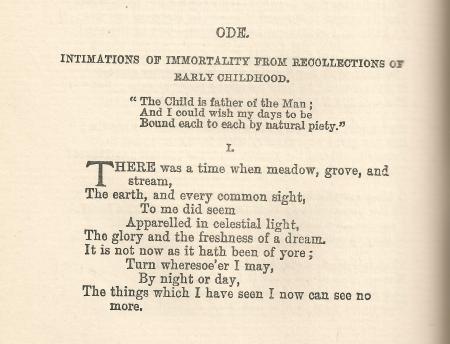
I don’t know if William Wordsworth (of whose poetry I am also extremely fond) ever had the chance to hear Beethoven’s Quartet No. 15 , and in Tintern Abbey he was writing about the therapeutic power of nature rather than music, but surely the  “tranquil restoration” described in that poem is exactly the feeling  Beethoven achieves in his music:

These beauteous forms,
Through a long absence, have not been to me
As is a landscape to a blind man’s eye:
But oft, in lonely rooms, and ‘mid the din
Of towns and cities, I have owed to them
In hours of weariness, sensations sweet,
Felt in the blood, and felt along the heart;
And passing even into my purer mind,
With tranquil restoration: — feelings too

Of unremembered pleasure: such, perhaps,
As have no slight or trivial influence
On that best portion of a good man’s life,
His little, nameless, unremembered, acts
Of kindness and of love. Nor less, I trust,
To them I may have owed another gift,
Of aspect more sublime; that blessed mood,
In which the burthen of the mystery,
In which the heavy and the weary weight
Of all this unintelligible world,

Is lightened: — that serene and blessed mood,
In which the affections gently lead us on, —
Until, the breath of this corporeal frame
And even the motion of our human blood
Almost suspended, we are laid asleep
In body, and become a living soul:
While with an eye made quiet by the power
Of harmony, and the deep power of joy,
We see into the life of things.

Lines Composed upon the Relegation of Wigan Athletic from the Premiership

Posted in Football, Poetry with tags , , on May 15, 2013 by telescoper

So farewell, then,
Wigan Athletic.
You weren’t
Athletic enough,
Apparently.

Keith’s mum says
Wigan is not
In the Midlands.
But she’s wrong.
Obviously.

by Peter Coles (aged nearly 50).

On His Blindness

Posted in Poetry with tags , , , , on May 11, 2013 by telescoper

As I often do when I’m at a bit of a loose end, I just picked up a book of poems and dived in at random, which took me straight to the following sonnet by John Milton. I therefore stumbled upon a phrase “(“they also serve who only stand and wait”) which is is such common usage that I had never really thought about where it might have come from. Anyway, this is as nearly perfect an example of a Petrarchean (or Italian) sonnet as you could wish for, although the meaning is often been misinterpreted simply as an encouragement to be passive. Seen in its proper context, it seems to me that what Milton is saying is more like “Don’t be frustrated by what you can’t do, because God also knows your limitations, just do whatever you can – even if it’s not much”. As far as I know the poem is undated, but was presumably written after 1644 when Milton began to lose his eyesight. It could even be as late as 1655 by which time he was completely blind.

When I consider how my light is spent
Ere half my days in this dark world and wide,
And that one talent which is death to hide
Lodged with me useless, though my soul more bent
To serve therewith my Maker, and present
My true account, lest he returning chide,
“Doth God exact day-labour, light denied?”
I fondly ask. But Patience, to prevent
That murmur, soon replies: “God doth not need
Either man’s work or his own gifts: who best
Bear his mild yoke, they serve him best. His state
Is kingly; thousands at his bidding speed
And post o’er land and ocean without rest:
They also serve who only stand and wait.”

by John Milton (1608-1674)

Lines on the Death of Herschel

Posted in Poetry, The Universe and Stuff with tags on April 30, 2013 by telescoper

So farewell, then,
Herschel
Space
Observatory.

You were named after
William Herschel,
Who lived
During the reign of
George III.
The mad King
Who went blind,
Then died.

You went blind
Then died.
But there the
Similarity
Ends.

You ran out
Of Helium;
He had no
Need of He.

And he was neither
In Space
Nor an
Observatory,
So forget
It.

by Peter Coles (aged 49 11/12).

Hosts, Guests, and Parasites

Posted in Literature with tags , , , , , on April 26, 2013 by telescoper

I just returned from my first experience of Court, at least in the sense of that word that applies to the University of Sussex. It was quite different to what I had imagined, especially because it included three research talks. One of them, by Dr Sara Crangle of the School of English was about the Engagement Diaries of Virginia Woolf (many of which have been acquired by the University). This talk began with a fascinating preamble focussed on a short quote from The Critic as Host by J. Hillis Miller. This revolved around the curious shared etymology of “host” and “guest” and their common relationship to “hostia” the latin word meaning a sacrifice or a victim. Being fascinated by the origin and evolution of words I thought I’d have a look for a bit more of the context so here is an extended discussion.

“Parasite” is one of those words which calls up its apparent “opposite.” It has no meaning without that counterpart. There is no parasite without its host. At the same time both word and counterword subdivide and reveal themselves each to be fissured already within themselves and to be, like Unheimlich, unheimlich, an example of a double antithetical word. Words in “para,” like words in “ana” have this as an intrinsic property, capability, or tendency. “Para” as a prefix in English (sometimes “par”) indicates alongside, near or beside, to the side of, alongside, beyond, wrongfully, harmfully, unfavorably, and among. The words in “para” form one branch of the tangled labyrinth of words using some form of the Indo-European root per, which is the “base of prepositions and pre-verbs with the basic meaning of ‘forward,’ ‘through,’ and a wide range of extended senses such as ‘in front of ,’ ‘before,’ ‘early,’ ‘first,’ ‘chief,’ ‘toward,’ ‘against,’ ‘near,’ ‘at,’ ‘around.’”

I said words in “para” are one branch of the labyrinth of “pers,” but it is easy to see that the branch is itself a miniature labyrinth. “Para” is an “uncanny” double antithetical prefix signifying at once proximity and distance, similarity and difference, interiority and exteriority, something at once inside a domestic economy and outside it, something simultaneously this side of the boundary line, threshold, or margin, and at the same time beyond it, equivalent in status and at the same time secondary or subsidiary, submissive, as of guest to host, slave to master. A thing in “para” is, moreover, not only simultaneously on both sides of the boundary line between inside and outside. It is also the boundary itself, the screen which is at once a permeable membrane connecting inside and outside, confusing them with one another, allowing the outside in, making the inside out, dividing them but also forming an ambiguous transition between one and the other. Though any given word in “para” may seem to choose unequivocally or univocally one of these possibilities, the other meanings are always there as a shimmering or wavering in the word which makes it refuse to stay still in a sentence, like a slightly alien guest within the syntactical closure where all the words are family friends together. Words in “para” include: parachute, paradigm, parasol, the French paravent (screen protecting against the wind), and parapluie (umbrella), paragon, paradox, parapet, parataxis, parapraxis, parabasis, paraphrase, paragraph, paraph, paralysis, paranoia, paraphernalia, parallel, parallax, parameter, parable, paresthesia, paramnesia, paregoric, parergon, paramorph, paramecium, Paraclete, paramedical, paralegal–and parasite.

“Parasite” comes from the Greek, parasitos, etymologically: “beside the grain,” para, beside (in this case) plus sitos, grain, food. “Sitology” is the science of foods, nutrition, and diet. “Parasite” was originally something positive, a fellow guest, someone sharing the food with you, there with you beside the grain. Later on, “parasite” came to mean a professional dinner guest, someone expert at cadging invitations without ever giving dinners in return. From this developed the two main modern meanings in English, the biological and the social. A parasite is (1) “Any organism that grows, feeds, and is sheltered on or in a different organism while contributing nothing to the survival of its host”; (2) “A person who habitually takes advantage of the generosity of others without making any useful return.” To call a kind of criticism “parasitical” is, in either case, strong language.

A curious system of thought, or of language, or of social organization (in fact all three at once) is implicit in the word parasite. There is no parasite without a host. The host and the somewhat sinister or subversive parasite are fellow guests beside the food, sharing it. On the other hand, the host is himself the food, his substance consumed without recompense, as when one says, “He is eating me out of house and home.” The host may then become the host in another sense, not etymologically connected. The word “Host” is of course the name for the consecrated bread or wafer of the Eucharist, from Middle English oste, from Old French oiste, from Latin hostia, sacrifice, victim.

If the host is both eater and eaten, he also contains in himself the double antithetical relation of host and guest, guest in the bifold sense of friendly presence and alien invader. The words “host” and “guest” go back in fact to the same etymological root: ghos-ti, stranger, guest, host, properly “someone with whom one has reciprocal duties of hospitality.” The modern English word “host” in this alternative sense comes from the Middle English (h)oste, from Old French, host, guest, from Latin hospes (stem hospit-), guest, host, stranger. The “pes” or “pit” in the Latin words and in such modern English words as “hospital” and “hospitality” is from another root, pot, meaning “master.” The compound or bifurcated root ghos-pot meant “master of guests,” “ one who symbolizes the relationship of reciprocal hospitality,” as in the Slavic gospodic, Lord, sir, master. “Guest,” on the other hand, is from Middle English gest, from Old Norse gestr, from ghos-ti, the same root for “host.” A host is a host. The relation of household master offering hospitality to a guest and the guest receiving it, of host and parasite in the original sense of “fellow guest,” is inclosed within the word “host” itself. A host in the sense of a guest, moreover, is both a friendly visitor in the house and at the same time an alien presence who turns the home into a hotel, a neutral territory. Perhaps he is the first emissary of a host of enemies (from Latin hostis [stranger, enemy]), the first foot in the door, to be followed by a swarm of hostile strangers, to be met only by our own host, as the Christian deity is the Lord God of Hosts. The uncanny antithetical relation exists not only between pairs of words in this system, host and parasite, host and guest, but within each word in itself. It reforms itself in each polar opposite when that opposite is separated out, and it subverts or nullifies the apparently unequivocal relation of polarity which seems the conceptual scheme appropriate for thinking through the system. Each word in itself becomes separated by the strange logic of the “para,” membrane which divides inside from outside and yet joins them in a hymeneal bond, or allows an osmotic mixing, making the strangers friends, the distant near, the dissimilar similar, the Unheimlich heimlich, the homely homey, without, for all its closeness and similarity, ceasing to be strange, distant, dissimilar.


Interesting!

Down with Fanatics!

Posted in Poetry with tags , , on April 22, 2013 by telescoper

If I had my way with violent men
I’d simmer them in oil,
I’d fill a pot with bitumen
And bring them to the boil.
I execrate the terrorist
And those who harbour him,
And if I weren’t a moralist
I’d tear them limb from limb.

Fanatics are an evil breed
Whom decent men should shun;
I’d like to flog them till they bleed,
Yes, every mother’s son,
I’d like to tie them to a board
And let them taste the cat,
While giving praise, oh thank the Lord,
That I am not like that.

For we should love the human kind,
As Jesus taught us to,
And those who don’t should be struck blind
And beaten black and blue;
I’d like to roast them in a grill
And listen to them shriek,
Then break them on the wheel until
They turned the other cheek.

by Roger Woddis (1917-1993)