Archive for the Literature Category

The Return of the Inductive Detective

Posted in Bad Statistics, Literature, The Universe and Stuff with tags , , , , , , , , on August 23, 2012 by telescoper

A few days ago an article appeared on the BBC website that discussed the enduring appeal of Sherlock Holmes and related this to the processes involved in solving puzzles. That piece makes a number of points I’ve made before, so I thought I’d update and recycle my previous post on that theme. The main reason for doing so is that it gives me yet another chance to pay homage to the brilliant Jeremy Brett who, in my opinion, is unsurpassed in the role of Sherlock Holmes. It also allows me to return to a philosophical theme I visited earlier this week.

One of the  things that fascinates me about detective stories (of which I am an avid reader) is how often they use the word “deduction” to describe the logical methods involved in solving a crime. As a matter of fact, what Holmes generally uses is not really deduction at all, but inference (a process which is predominantly inductive).

In deductive reasoning, one tries to tease out the logical consequences of a premise; the resulting conclusions are, generally speaking, more specific than the premise. “If these are the general rules, what are the consequences for this particular situation?” is the kind of question one can answer using deduction.

The kind of reasoning of reasoning Holmes employs, however, is essentially opposite to this. The  question being answered is of the form: “From a particular set of observations, what can we infer about the more general circumstances that relating to them?”.

And for a dramatic illustration of the process of inference, you can see it acted out by the great Jeremy Brett in the first four minutes or so of this clip from the classic Granada TV adaptation of The Hound of the Baskervilles:

I think it’s pretty clear in this case that what’s going on here is a process of inference (i.e. inductive rather than deductive reasoning). It’s also pretty clear, at least to me, that Jeremy Brett’s acting in that scene is utterly superb.

I’m probably labouring the distinction between induction and deduction, but the main purpose doing so is that a great deal of science is fundamentally inferential and, as a consequence, it entails dealing with inferences (or guesses or conjectures) that are inherently uncertain as to their application to real facts. Dealing with these uncertain aspects requires a more general kind of logic than the  simple Boolean form employed in deductive reasoning. This side of the scientific method is sadly neglected in most approaches to science education.

In physics, the attitude is usually to establish the rules (“the laws of physics”) as axioms (though perhaps giving some experimental justification). Students are then taught to solve problems which generally involve working out particular consequences of these laws. This is all deductive. I’ve got nothing against this as it is what a great deal of theoretical research in physics is actually like, it forms an essential part of the training of an physicist.

However, one of the aims of physics – especially fundamental physics – is to try to establish what the laws of nature actually are from observations of particular outcomes. It would be simplistic to say that this was entirely inductive in character. Sometimes deduction plays an important role in scientific discoveries. For example,  Albert Einstein deduced his Special Theory of Relativity from a postulate that the speed of light was constant for all observers in uniform relative motion. However, the motivation for this entire chain of reasoning arose from previous studies of eletromagnetism which involved a complicated interplay between experiment and theory that eventually led to Maxwell’s equations. Deduction and induction are both involved at some level in a kind of dialectical relationship.

The synthesis of the two approaches requires an evaluation of the evidence the data provides concerning the different theories. This evidence is rarely conclusive, so  a wider range of logical possibilities than “true” or “false” needs to be accommodated. Fortunately, there is a quantitative and logically rigorous way of doing this. It is called Bayesian probability. In this way of reasoning,  the probability (a number between 0 and 1 attached to a hypothesis, model, or anything that can be described as a logical proposition of some sort) represents the extent to which a given set of data supports the given hypothesis.  The calculus of probabilities only reduces to Boolean algebra when the probabilities of all hypothesese involved are either unity (certainly true) or zero (certainly false). In between “true” and “false” there are varying degrees of “uncertain” represented by a number between 0 and 1, i.e. the probability.

Overlooking the importance of inductive reasoning has led to numerous pathological developments that have hindered the growth of science. One example is the widespread and remarkably naive devotion that many scientists have towards the philosophy of the anti-inductivist Karl Popper; his doctrine of falsifiability has led to an unhealthy neglect of  an essential fact of probabilistic reasoning, namely that data can make theories more probable. More generally, the rise of the empiricist philosophical tradition that stems from David Hume (another anti-inductivist) spawned the frequentist conception of probability, with its regrettable legacy of confusion and irrationality.

In fact Sherlock Holmes himself explicitly recognizes the importance of inference and rejects the one-sided doctrine of falsification. Here he is in The Adventure of the Cardboard Box (the emphasis is mine):

Let me run over the principal steps. We approached the case, you remember, with an absolutely blank mind, which is always an advantage. We had formed no theories. We were simply there to observe and to draw inferences from our observations. What did we see first? A very placid and respectable lady, who seemed quite innocent of any secret, and a portrait which showed me that she had two younger sisters. It instantly flashed across my mind that the box might have been meant for one of these. I set the idea aside as one which could be disproved or confirmed at our leisure.

My own field of cosmology provides the largest-scale illustration of this process in action. Theorists make postulates about the contents of the Universe and the laws that describe it and try to calculate what measurable consequences their ideas might have. Observers make measurements as best they can, but these are inevitably restricted in number and accuracy by technical considerations. Over the years, theoretical cosmologists deductively explored the possible ways Einstein’s General Theory of Relativity could be applied to the cosmos at large. Eventually a family of theoretical models was constructed, each of which could, in principle, describe a universe with the same basic properties as ours. But determining which, if any, of these models applied to the real thing required more detailed data.  For example, observations of the properties of individual galaxies led to the inferred presence of cosmologically important quantities of  dark matter. Inference also played a key role in establishing the existence of dark energy as a major part of the overall energy budget of the Universe. The result is now that we have now arrived at a standard model of cosmology which accounts pretty well for most relevant data.

Nothing is certain, of course, and this model may well turn out to be flawed in important ways. All the best detective stories have twists in which the favoured theory turns out to be wrong. But although the puzzle isn’t exactly solved, we’ve got good reasons for thinking we’re nearer to at least some of the answers than we were 20 years ago.

I think Sherlock Holmes would have approved.

Sonnet No. 33

Posted in Poetry with tags , , on August 18, 2012 by telescoper


Full many a glorious morning have I seen
Flatter the mountain-tops with sovereign eye,
Kissing with golden face the meadows green,
Gilding pale streams with heavenly alchemy;
Anon permit the basest clouds to ride
With ugly rack on his celestial face,
And from the forlorn world his visage hide,
Stealing unseen to west with this disgrace:
Even so my sun one early morn did shine
With all triumphant splendor on my brow;
But out, alack! he was but one hour mine;
The region cloud hath mask’d him from me now.
Yet him for this my love no whit disdaineth;
Suns of the world may stain when heaven’s sun staineth.


Sonnet No.33 , by William Shakespeare (1564-1616)

The Racism of H.P. Lovecraft

Posted in Poetry with tags , , , on August 17, 2012 by telescoper

From time to time I’ve posted bits of poetry on this blog by H.P. Lovecraft, an author of fantasy, horror and science fiction stories that I discovered as a teenager and which made a big and lasting impression on me.

I never thought Lovecraft was a great writer, actually. At times his prose style is truly excruciating. But he was clearly a person with a remarkable imagination and he did write some genuinely frightening stories. He also had a big influence on many subsequent horror writers and film-makers.

It was only in later life that I started to read collections of his poetry, which is also uneven in quality but among which there are many gems. They’ve proved quite popular when I’ve posted them on here too, perhaps because quite a few of the followers of this blog also know Lovecraft’s stories.

But last night I came across this revolting poem, which reveals a side of H.P. Lovecraft’s character of which I was previously unaware.  Its charming title is On the Creation of Niggers:

When, long ago, the gods created Earth
In Jove’s fair image Man was shaped at birth.
The beasts for lesser parts were next designed;
Yet were they too remote from humankind.
To fill the gap, and join the rest to Man,
Th’Olympian host conceiv’d a clever plan.
A beast they wrought, in semi-human figure,
Filled it with vice, and called the thing a Nigger.

I don’t think any further comment is necessary.

A Martian Sends A Postcard Home

Posted in Poetry with tags , , on August 15, 2012 by telescoper

Caxtons are mechanical birds with many wings
and some are treasured for their markings –

they cause the eyes to melt
or the body to shriek without pain.

I have never seen one fly, but
sometimes they perch on the hand.

Mist is when the sky is tired of flight
and rests its soft machine on ground:

then the world is dim and bookish
like engravings under tissue paper.

Rain is when the earth is television.
It has the property of making colours darker.

Model T is a room with the lock inside –
a key is turned to free the world

for movement, so quick there is a film
to watch for anything missed.

But time is tied to the wrist
or kept in a box, ticking with impatience.

In homes, a haunted apparatus sleeps,
that snores when you pick it up.

If the ghost cries, they carry it
to their lips and soothe it to sleep

with sounds. And yet they wake it up
deliberately, by tickling with a finger.

Only the young are allowed to suffer
openly. Adults go to a punishment room

with water but nothing to eat.
They lock the door and suffer the noises

alone. No one is exempt
and everyone’s pain has a different smell.

At night when all the colours die,
they hide in pairs

and read about themselves –
in colour, with their eyelids shut.

by Craig Raine (b. 1944).

Grave Thoughts

Posted in Biographical, History, Jazz, Literature with tags , , , , , on August 12, 2012 by telescoper

It being a lovely day in Copenhagen yesterday I decided to go for a long walk. My destination was the famous Assistens Kirkegård which is in the Nørrebro district of the city. You might think that was a rather morbid choice of place to go for a stroll in the sunshine, but actually it’s not that way at all. It’s actually a rather beautiful place, a very large green space criss-crossed by tree-lined paths. We British have a much more reserved attitude to cemeteries than the Danes seem to have, at least judging by yesterday; joggers and cyclists pass through Assistens Cemetery at regular intervals, and many people were having picnics or just sunbathing between the gravestones.  And of course there were many tourists wandering around, myself included. I found this matter-of-fact attitude to the dead rather refreshing, actually.

Incidentally, I was also surprised to see a number of Jewish burials among the Christian ones. I don’t know if this happens in British graveyards.

Part of the attraction of Assistens Kirkegård – the name derives from the fact that it was originally an auxiliary burial place, outside the main city, designed to take some of the pressure off the smaller cemeteries in the inner areas – is the large number of famous people buried there.  The cemetery is extremely large (about 25 hectares), and the maps don’t show the locations of all the famous people laid to rest there, but I did find quite a few.

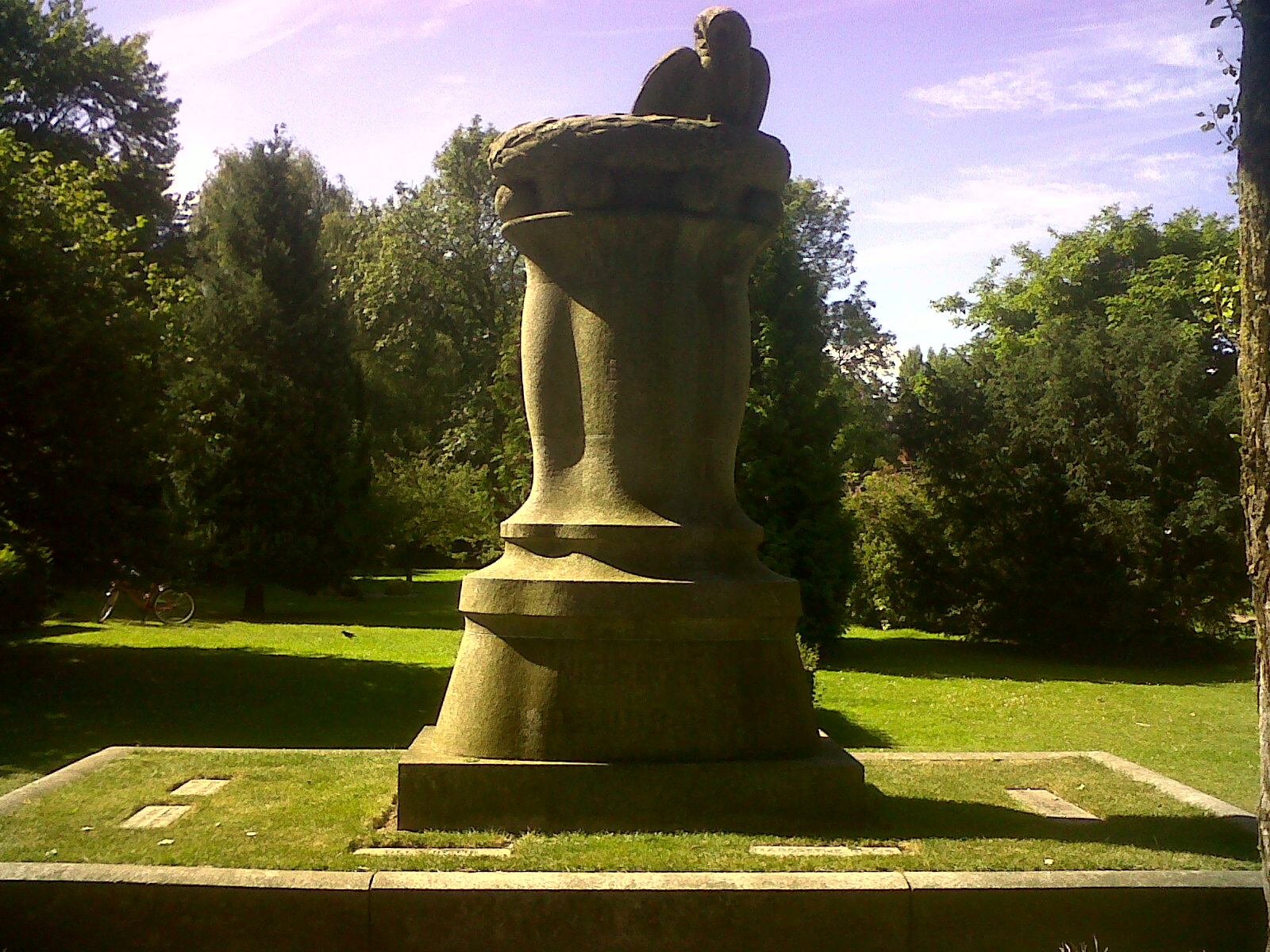
Here for example is the memorial to one of the most famous Danes of all, Hans Christian Andersen

Going by the number of signposts pointing to it, this must be one of the most popular sites for visitors to the cemetery, along with the grave of the philosopher Søren Kierkegaard. One can also quite easily locate the memorial which marks the last resting place of Niels Bohr and various other members of his family:

But it’s not only Danes that are buried here. There’s a corner of one plot occupied by a number of famous American Jazz musicians, including pianist Kenny Drew and, most famously of all, tenor saxophonist Ben Webster whose gravestone is rather small, but clearly very well tended, no doubt by a Danish jazz lover:

Unfortunately, I was unable to locate one of the graves I wanted to find, that of the great Heldentenor Lauritz Melchior. I was surprised to find his name was absent from the main index. I know he was cremated and his ashes buried there, and I even found a picture of his memorial on the net, but the cemetery is so large that without further clues I couldn’t find it. I’ll have to go back on a subsequent visit after doing a bit more research.

It’s very interesting that some of the smaller graves are extremely well-tended whereas many of the more opulent memorials are in a state of disrepair. My ambition is to be forgotten as quickly as possible after my death so the idea of anyone erecting some grandiose marble monument on my behalf fills me with horror, but I have to say I do find graveyards are strangely comforting places. Rich and poor, clever and stupid, ugly and beautiful; death comes to us all in the end. At least it’s very democratic.

And after about three hours strolling around in the cool shade of the trees in Assistens Kirkegård the thought did cross my mind there still seems to be plenty of room…

The Cool Web

Posted in Poetry with tags , , on August 9, 2012 by telescoper

Children are dumb to say how hot the day is,
How hot the scent is of the summer rose,
How dreadful the black wastes of evening sky,
How dreadful the tall soldiers drumming by,

But we have speech, to chill the angry day,
And speech, to dull the roses’s cruel scent,
We spell away the overhanging night,
We spell away the soldiers and the fright.

There’s a cool web of language winds us in,
Retreat from too much joy or too much fear:
We grow sea-green at last and coldly die
In brininess and volubility.

But if we let our tongues lose self-possession,
Throwing off language and its watery clasp
Before our death, instead of when death comes,
Facing the wide glare of the children’s day,
Facing the rose, the dark sky and the drums,
We shall go mad, no doubt, and die that way.

by Robert Graves (1895-1985)

Against Entropy

Posted in Poetry with tags , , on July 30, 2012 by telescoper

The worm drives helically through the wood
And does not know the dust left in the bore
Once made the table integral and good;
And suddenly the crystal hits the floor.
Electrons find their paths in subtle ways,
A massless eddy in a trail of smoke;
The names of lovers, light of other days
Perhaps you will not miss them. That’s the joke.
The universe winds down. That’s how it’s made.
But memory is everything to lose;
Although some of the colors have to fade,
Do not believe you’ll get the chance to choose.
Regret, by definition, comes too late;
Say what you mean. Bear witness. Iterate.

by John M. Ford (1957-2006)

There’s a shoulder where death comes to cry

Posted in Music, Poetry with tags , , , on July 26, 2012 by telescoper

I heard this song Take this Waltz by Leonard Cohen a long time ago, and found it very mysterious as I didn’t know what it was about. Lately I found this youtube clip with a preface by Mr Cohen himself that explains that it is a tribute to the Spanish Poet Federico Garcia Lorca. I can’t say I know much about Lorca’s poetry, even in English translation, but I wish I did.

Lorca was born in 1898, and was murdered in 1936 by fascists during the Spanish Civil War. His body was never found.

In darkness let me dwell

Posted in Music, Poetry with tags , , on July 25, 2012 by telescoper

In darkness let me dwell; the ground shall sorrow be,
The roof despair, to bar all cheerful light from me;
The walls of marble black, that moist’ned still shall weep;
My music, hellish jarring sounds, to banish friendly sleep.
Thus, wedded to my woes, and bedded in my tomb,
O let me dying live, till death doth come, till death doth come.

My dainties grief shall be, and tears my poison’d wine,
My sighs the air, through which my panting heart shall pine:
My robes my mind shall suit exceeding blackest night,
My study shall be tragic thoughts, sad fancy to delight.
Pale ghosts and frightful shades shall my acquaintance be:
O thus, my hapless joy, I haste to thee, I haste to thee.

by John Dowland (1563-1620). Here sung by the wonderful counter-tenor Andreas Scholl…

A Walk after Dark

Posted in Poetry with tags , , on July 23, 2012 by telescoper

A cloudless night like this
Can set the spirit soaring:
After a tiring day
The clockwork spectacle is
Impressive in a slightly boring
Eighteenth-century way.

It soothed adolescence a lot
To meet so shameless a stare;
The things I did could not
Be so shocking as they said
If that would still be there
After the shocked were dead.

Now, unready to die
But already at the stage
When one starts to resent the young,
I am glad those points in the sky
May also be counted among
The creatures of Middle-age.

It’s cosier thinking of night
As more an Old People’s Home
Than a shed for a faultless machine,
That the red pre-Cambrian light
Is gone like Imperial Rome
Or myself at seventeen.

Yet however much we may like
The stoic manner in which
The classical authors wrote,
Only the young and the rich
Have the nerve or the figure to strike
The lacrimae rerum note.

For the present stalks abroad
Like the past and its wronged again
Whimper and are ignored,
And the truth cannot be hid;
Somebody chose their pain,
What needn’t have happened did.

Occurring this very night
By no established rule,
Some event may already have hurled
Its first little No at the right
Of the laws we accept to school
Our post-diluvian world:

But the stars burn on overhead,
Unconscious of final ends,
As I walk home to bed,
Asking what judgement waits
My person, all my friends,
And these United States.

Written in 1948 by by W. H. Auden (1907-1973)