Archive for the Literature Category

To the Warmongers – Siegfried Sassoon

Posted in History, Poetry, Politics with tags , , on November 6, 2023 by telescoper

As we approach Remembrance Sunday in a time of rising conflict, it seems apt to post the following poem written by Siegfried Sassoon, called the To the Warmongers:

I’m back again from hell
With loathsome thoughts to sell;
Secrets of death to tell;
And horrors from the abyss.
Young faces bleared with blood,
Sucked down into the mud,
You shall hear things like this,
Till the tormented slain
Crawl round and once again,
With limbs that twist awry
Moan out their brutish pain,
As for the fighters pass them by.
For you our battles shine
With triumph half-divine;
And the glory of the dead
Kindles in each proud eye.
But a curse is on my head,
That shall not be unsaid,
And the wounds in my heart are red,
For I have watched them die.

Modern Ireland 1600-1972 by R. F. Foster

Posted in History, Literature with tags , , , , on October 30, 2023 by telescoper

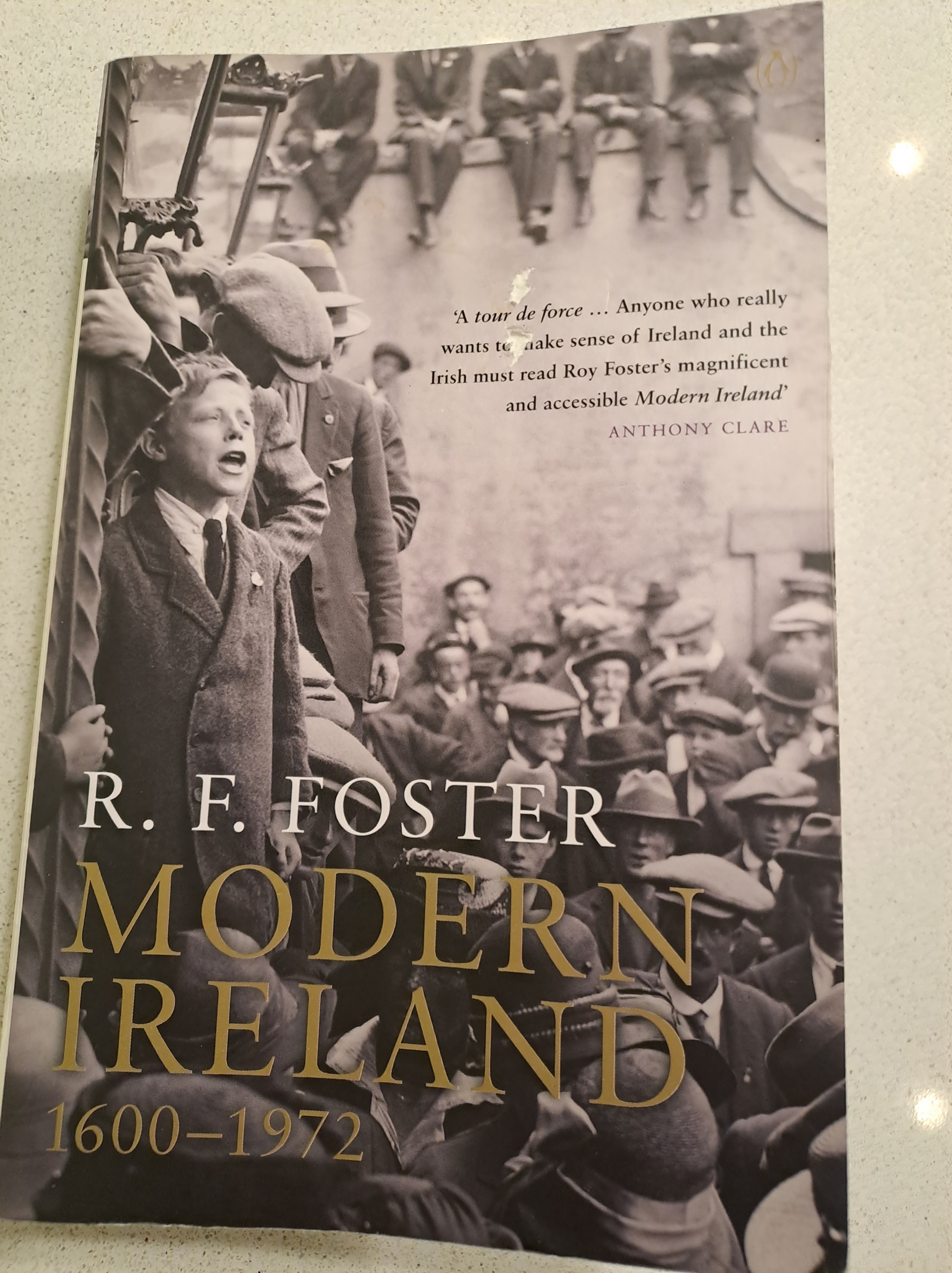
My attempt to catch up with a backlog of reading while on sabbatical has now brought me to Modern Ireland, by R.F. Foster, the paperback version of which, shown above, I bought way back in 2018 but have only just finished reading. In the following I’ll describe the scope of the book and make a few observations.

The book was first published in 1988 so it obviously can’t deal with more recent events such as the Good Friday Agreement. The narrative stops almost 50 years ago in 1972, the year of Bloody Sunday and just before Ireland joined the European Economic Community in 1973, but since it starts way back in 1600 one can forgive Roy Foster for not covering such recent events. The start is in what is usually termed the early modern period, but if truth be told much of Irish society at that point was still organized on mediaeval lines.

To set the scene, Foster starts with a description of the three main sections of the population of Ireland in 1600. These were the (Gaelic and Catholic) Irish, the “Old English”, descendants of the 12th Century conquest of part of the country, who were also Catholic, and the Protestant “New English” who arrived with the Tudor plantations. There were tensions between all three of these groups.

The rest of the book is divided into four parts, roughly one per century: Part I covers the continued Elizabethan plantation of Ireland, rebellions against it, the devastation caused by Cromwell’s so-called “pacification”, and the Penal Laws that basically outlawed the Catholic faith. In Part II Foster discusses a period often called The Ascendancy which showed the consolidation of power in the hands of a Protestant – specifically Anglican – ruling class, though there was a sizeable community of non-conformist Protestants, chiefly Presbyterians, who were regarded by Anglicans with almost as much suspicion as the Catholics. This Part ends with yet another failed rebellion, involving Wolfe Tone and the United Irishmen, against the backdrop of the French revolution. Up until the Act of Union of 1800, Ireland had its own Parliament; after that Irish MPs were sent to the House of Commons in Westminster. The century covered by Part III includes the Irish Famine, rising levels of rural violence, and issues of land reform, and various attempts to deliver some form of Home Rule; it ends with Charles Stewart Parnell. Part IV covers the Easter Rising, War of Independence, Civil War, Partition, the creation of the Irish Free State, and the eventual formation of the Irish Republic. A running theme through all four Parts is a recognition of how historical forces – and not only religion – shaped Ulster in a different way from the rest of Ireland.

As I’ve said before on this blog, it disturbs me quite how little of this history I was taught at school in England so I found it valuable to read a detailed scholarly work whose main message is that everything is much more complex than simple narratives – those peddled by politicians, for example – would have you believe. This is primarily a revisionist history, calling much of received wisdom into question. That said, it’s probably not the best book for a newcomer to Irish history. Foster does assume knowledge of quite a few of the major events and, while reading it, I did have to look quite a few things up. Much is said in the jacket reviews of the author’s writing style. To be honest, I found it sometimes rather mannered and self-conscious, though with some enjoyably arch humour thrown in for good measure. It’s thoroughly researched, as far as that is possible when primary sources are sketchy and contemporary records usually written by someone with an axe to grind. It does seem to rely mainly on documents written in English, however, so one might argue that introduces quite a bias. I gather that there is much greater emphasis among contemporary Irish historians on records written in Irish (Gaelic).

The book is rather heavy on footnotes, too. Usually I dislike these, but in this case they are mostly little biographical sketches of important figures which would have disrupted the flow if included in the main text, and I found many of them valuable. Just to be perverse, I have to say I liked his liberal use of semicolons. Though dense, the books is as accessible as I think a scholarly work can be and although I am not so much a scholar of history as an interested bystander, I learnt a lot. It also made me want to learn more, especially about the period between the death of Parnell in 1891 and the Easter Rising of 1916.

It seems apt to finish with an excerpt that illustrates a theme that crops up repeatedly during the 23 chapters of the book:

Irish history in the long period since the completion of the Elizabethan conquest concerned a great deal more than the definition of Irishness against Britishness; this survey has attempted to indicate as much. But that sense of difference comes strongly through, though its expression was conditioned by altering circumstances, and adapted for different interest-groups, as the years passed. If the claims of cultural maturity and a new European identity advanced by the 1970s can be substantiated, it may be by the hope of a more relaxed and inclusive definition of Irishness, and a less constricted view of Irish history.

Modern Ireland, R. F. Foster, p596

I hope that too. It may even be happening.

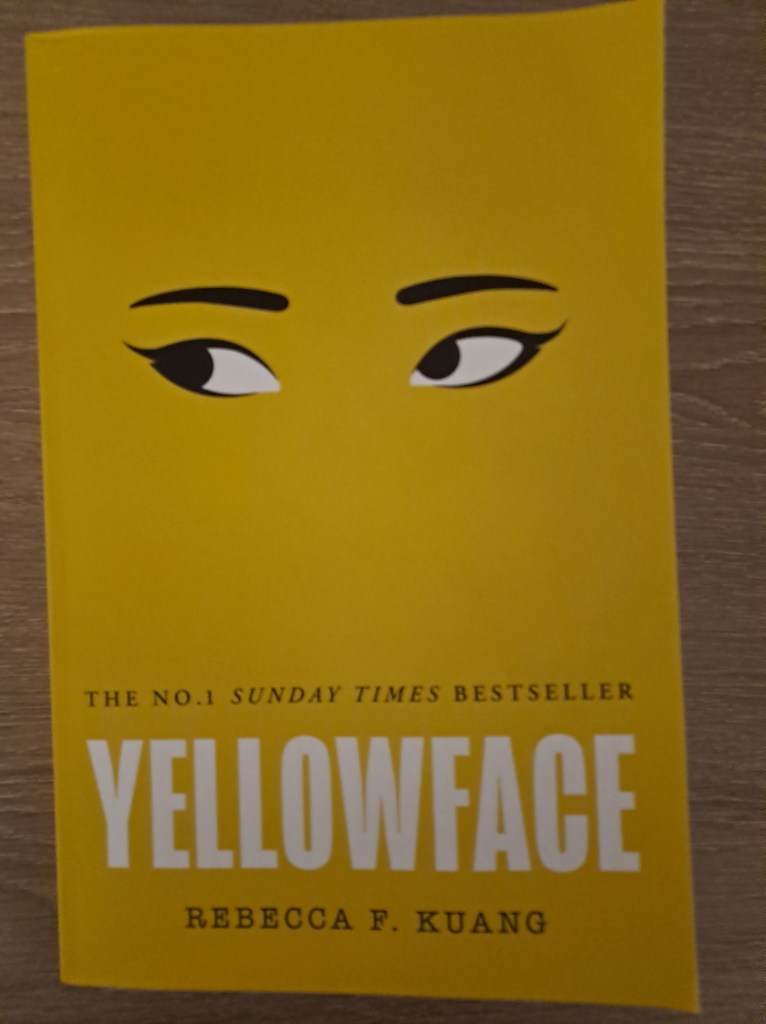
Yellowface, by Rebecca F. Kuang

Posted in Literature with tags , on October 17, 2023 by telescoper

Continuing with my aim of reading more books while on sabbatical, I’ve just finished Yellowface by Rebecca F. Kuang. The story, told in the first person, revolves around June Hayward, an unsuccessful young white author, who is present at the accidental death of Athena Liu, a Chinese-American author, a hit in literary circles, who chokes on a pancake. Athena has just finished a complete draft of a novel about Chinese laborers in World War I and while waiting for emergency services to arrive, June purloins the manuscript and passes it off as her own. She is immediately welcomed by publishers and offered a large advance, but that’s only the start as she has to then contend with accusations of plagiarism and racism as well as being haunted by what appears to be Athena’s ghost. I won’t spoil the read by telling you how it ends, but it did remind me a little bit of Dostoevsky’s Crime and Punishment.

The author describes this as a “horror story about loneliness” in the highly competitive world of publishing, I found much of it resonates with academia too, but it’s really more of a satire about plagiarism and marketing hype than a horror story per se. I found it very readable, and interesting for someone who has recently quit Twitter to see how social media play such an important – and negative – role in the story. I was gripped by the story and read it in just two evenings, which is quick for me. Recommended.

Telescope – Louise Glück

Posted in Poetry, R.I.P. with tags , , , on October 16, 2023 by telescoper

I posted a poem by American poet Louise Glück when she won the 2020 Nobel Prize for Literature (“for her unmistakable poetic voice that with austere beauty makes individual existence universal”). I was sad to read that she passed away just a few days ago at the age of 80. By way of a small tribute here is another poem of hers I like very much. It is called Telescope.

There is a moment after you move your eye away
when you forget where you are
because you’ve been living, it seems,
somewhere else, in the silence of the night sky.

You’ve stopped being here in the world.
You’re in a different place,
a place where human life has no meaning.

You’re not a creature in a body.
You exist as the stars exist,
participating in their stillness, their immensity.

Then you’re in the world again.
At night, on a cold hill,
taking the telescope apart.

You realize afterward
not that the image is false
but the relation is false.

You see again how far away
each thing is from every other thing.

R.I.P. Louise Glück (1943-2023)

The Dream of the Celt

Posted in History, LGBTQ+, Literature with tags , , , on October 8, 2023 by telescoper

Knowing that I would be spending even less time watching TV while in Barcelona than I would back in Maynooth, I packed a number of books from the substantial pile that I haven’t yet got around to. The first I’ve finished is The Dream of the Celt by Peruvian author Mario Vargos Llosa which tells the fascinating but ultimately tragic story of Roger Casement using a mixture of thoroughly researched journalistic reportage and fictionalized extrapolations that try to bring this enigmatic character to life.

Roger Casement was born in Sandycove, Dublin, but spent some of his childhood in England. He served with great distinction as a diplomat, and a fierce advocated of human rights, first in the Congo, where he compiled a devastating report of the brutal exploitation of indigenous people, and then in Peru where he exposed even worse cruelty being exacted on native men women and children who were used as forced labour in the rubber plantations. He was knighted in 1911 for his humanitarian efforts.

When he first started out in the diplomatic service, Casement apparently believed that colonization would be a civilizing influence, bringing free trade, the rule of law, and Christianity instead of repression and violence. His bitter experience changed his view entirely, and he became increasingly associated with the cause of England’s first colony, and became a fervent advocate of Irish nationalism. He found himself travelling to Germany during the First World War to procure arms for an Irish rebellion and to raise an Irish Regiment from Irish prisoners of war captured fighting for the British. In the latter he was not successful – he persuaded only about 50 POWs to join the cause. He did succeed in obtaining weapons but the ship smuggling them to Ireland was intercepted and scuttled to avoid the weapons falling into British hands.

Incidentally, Casement was against the Easter Rising of 1916. He thought it would be futile unless it could be combined with a German attack on England. Ireland was not sufficiently important geopolitically for the Kaiser to mount such an operation. The other leaders of the Rising wanted Casement to stay in Germany as it proceeded but he travelled to Ireland in a submarine, was captured, tried for high treason, found guilty, and hanged at Pentonville Prison on 3rd August 1916. He was 51. His executioner later remarked that he was ‘‘the bravest man it fell to my unhappy lot to execute.’

W.B. Yeats wrote a poem about Roger Casement, the last verse of which is:

Come speak your bit in public
That some amends be made
To this most gallant gentleman
That is in quicklime laid.

Leading up to Casement’s execution there was a concerted campaign for clemency, i.e. the commutation of his death sentence, as had happened with some involved directly in the rebellion. But then came the Black Diaries. Parts of these, describing in Casement’s own words his many sexual adventures with men and boys, were leaked to the press by British intelligence services. At a time when homosexuality was still a crime, that effectively ended any hope of avoiding the gallows. The Black Diaries are of questionable authenticity, and many who believe they were genuine think Casement was merely writing about fantasies rather than reality. Maybe writing about things he couldn’t do was a way for him to relieve sexual tension? We’ll never know for sure.

After his execution Casement’s body was subject to a rectal examination to ascertain whether he had had anal sex as described in the books. He was buried in an unmarked grave and it wasn’t until 1965 that his remains were returned to Ireland to be interred at Glasnevin cemetery.

The author tells this story by interspersing Casement’s last weeks and months in Pentonville with flashbacks to his time in the Congo, the Peru, Germany and Ireland. The protagonist did write extensive notes on his travels but they are somewhat disorganized, so he had to make reasonable guesses to fill in the gaps. The conversations with other characters are imagined to make it seem more like a novel than a straight historical biography. This approach makes for a fascinating read, although I did find it somewhat repetitive in places.

Sir Roger Casement, as reconstructed in this book, is a fascinating character, but how close the account is to how he really was as a person is something we’ll never know. In a strange way, that mystery is part of the appeal.

No Second Troy, by W.B. Yeats

Posted in Poetry with tags , , on July 27, 2023 by telescoper

Why should I blame her that she filled my days
With misery, or that she would of late
Have taught to ignorant men most violent ways,
Or hurled the little streets upon the great,
Had they but courage equal to desire?
What could have made her peaceful with a mind
That nobleness made simple as a fire,
With beauty like a tightened bow, a kind
That is not natural in an age like this,
Being high and solitary and most stern?
Why, what could she have done, being what she is?
Was there another Troy for her to burn?


by William Butler Yeats (1865-1939)

Something more than Night…

Posted in Literature with tags on July 24, 2023 by telescoper

Yesterday (23rd July) was the birthday of the late great American crime novelist Raymond Chandler, who was born on that day in 1888. A reminder of this factoid appeared on one of my social media feeds last night, along with this memorable quote:

The streets were dark with something more than night.

I assumed this came from one of his novels, perhaps The Big Sleep or Farewell My Lovely, but it is actually from an essay which serves as an introduction to a collection of four short novels, Trouble Is My Business, Finger Man, Goldfish, and Red Wind when they were published in a single volume in 1950. Since this is now in the public domain, as indeed are all his novels and stories, I thought I’d share the essay here, as it is a good description of the rise of the “hard-boiled” style of American crime fiction, exemplified by Chandler himself, Dashiell Hammett and others, as it compares with the more “refined” murder mysteries of, say, Agatha Christie. It’s a very perceptive piece, enhanced by Chandlers sharp wit and tight prose.

–o–

Some literary antiquarian of a rather special type may one day think it worth while to run through the files of the pulp detective magazines which flourished during the late twenties and early thirties, and determine just how and when and by what steps the popular mystery story shed its refined good manners and went native. He will need sharp eyes and an open mind. Pulp paper never dreamed of posterity and most of it must be a dirty brown color by now. And it takes a very open mind indeed to look beyond the unnecessarily gaudy covers, trashy titles and barely acceptable advertisements and recognize the authentic power of a kind of writing that, even at its most mannered and artificial, made most of the fiction of the time taste like a cup of lukewarm consommé at a spinsterish tearoom.

I don’t think this power was entirely a matter of violence, although far too many people got killed in these stories and their passing was celebrated with a rather too loving attention to detail. It certainly was not a matter of fine writing, since any attempt at that would have been ruthlessly blue-penciled by the editorial staff. Nor was it because of any great originality of plot or character. Most of the plots were rather ordinary and most of the characters rather primitive types of people. Possibly it was the smell of fear which these stories managed to generate. Their characters lived in a world gone wrong, a world in which, long before the atom bomb, civilization had created the machinery for its own destruction, and was learning to use it with all the moronic delight of a gangster trying out his first machine gun. The law was something to be manipulated for profit and power. The streets were dark with something more than night. The mystery story grew hard and cynical about motive and character, but it was not cynical about the effects it tried to produce nor about its technique of producing them. A few unusual critics recognized this at the time, which was all one had any right to expect. The average critic never recognizes an achievement when it happens. He explains it after it has become respectable.

The emotional basis of the standard detective story was and had always been that murder will out and justice will be done. Its technical basis was the relative insignificance of everything except the final denouement. What led up to that was more or less passagework. The denouement would justify everything. The technical basis of the Black Mask type of story on the other hand was that the scene outranked the plot, in the sense that a good plot was one which made good scenes. The ideal mystery was one you would read if the end was missing. We who tried to write it had the same point of view as the film makers. When I first went to work in Hollywood a very intelligent producer told me that you couldn’t make a successful motion picture from a mystery story, because the whole point was a disclosure that took a few seconds of screen time while the audience was reaching for its hat. He was wrong, but only because he was thinking of the wrong kind of mystery.

As to the emotional basis of the hard-boiled story, obviously it does not believe that murder will out and justice will be done—unless some very determined individual makes it his business to see that justice is done. The stories were about the men who made that happen. They were apt to be hard men, and what they did, whether they were called police officers, private detectives or newspaper men, was hard, dangerous work. It was work they could always get. There was plenty of it lying around. There still is. Undoubtedly the stories about them had a fantastic element. Such things happened, but not so rapidly, nor to so close-knit a group of people, nor within so narrow a frame of logic. This was inevitable because the demand was for constant action; if you stopped to think you were lost. When in doubt have a man come through a door with a gun in his hand. This could get to be pretty silly, but somehow it didn’t seem to matter. A writer who is afraid to overreach himself is as useless as a general who is afraid to be wrong.

As I look back on my stories it would be absurd if I did not wish they had been better. But if they had been much better they would not have been published. If the formula had been a little less rigid, more of the writing of that time might have survived. Some of us tried pretty hard to break out of the formula, but we usually got caught and sent back. To exceed the limits of a formula without destroying it is the dream of every magazine writer who is not a hopeless hack. There are things in my stories which I might like to change or leave out altogether. To do this may look simple, but if you try, you find you cannot do it at all. You will only destroy what is good without having any noticeable effect on what is bad. You cannot recapture the mood, the state of innocence, much less the animal gusto you had when you had very little else. Everything a writer learns about the art or craft of fiction takes just a little away from his need or desire to write at all. In the end he knows all the tricks and has nothing to say.

As for the literary quality of these exhibits, I am entitled to assume from the imprint of a distinguished publisher that I need not be sickeningly humble. As a writer I have never been able to take myself with that enormous earnestness which is one of the trying characteristics of the craft. And I have been fortunate to escape what has been called “that form of snobbery which can accept the Literature of Entertainment in the Past, but only the Literature of Enlightenment in the Present.” Between the one-syllable humors of the comic strip and the anemic subtleties of the litterateurs there is a wide stretch of country, in which the mystery story may or may not be an important landmark. There are those who hate it in all its forms. There are those who like it when it is about nice people (“that charming Mrs. Jones, whoever would have thought she would cut off her husband’s head with a meat saw? Such a handsome man, too!”). There are those who think violence and sadism interchangeable terms, and those who regard detective fiction as subliterary on no better grounds than that it does not habitually get itself jammed up with subordinate clauses, tricky punctuation and hypothetical subjunctives. There are those who read it only when they are tired or sick, and, from the number of mystery novels they consume, they must be tired and sick most of the time. There are the aficionados of deduction and the aficionados of sex who can’t get it into their hot little heads that the fictional detective is a catalyst, not a Casanova. The former demand a ground plan of Greythorpe Manor, showing the study, the gun room, the main hall and staircase and the passage to that grim little room where the butler polishes the Georgian silver, thin-lipped and silent, hearing the murmur of doom. The latter think the shortest distance between two points is from a blonde to a bed.

No writer can please them all, no writer should try. The stories in this book certainly had no thought of being able to please anyone ten or fifteen years after they were written. The mystery story is a kind of writing that need not dwell in the shadow of the past and owes little if any allegiance to the cult of the classics. It is a good deal more than unlikely that any writer now living will produce a better historical novel than Henry Esmond, a better tale of children than The Golden Age, a sharper social vignette than Madame Bovary, a more graceful and elegant evocation than The Spoils of Poynton, a wider and richer canvas than War and Peace or The Brothers Karamazov. But to devise a more plausible mystery than The Hound of the Baskervilles or The Purloined Letter should not be too difficult. Nowadays it would be rather more difficult not to. There are no “classics” of crime and detection. Not one. Within its frame of reference, which is the only way it should be judged, a classic is a piece of writing which exhausts the possibilities of its form and can hardly be surpassed. No story or novel of mystery has done that yet. Few have come close. Which is one of the principal reasons why otherwise reasonable people continue to assault the citadel.

Machiavelli on Mercenaries

Posted in History, Literature, Politics with tags , , on June 24, 2023 by telescoper

I thought I’d post this, from Il Principe (The Prince) by Niccolò Machiavelli for reasons of topicality. It’s from Chapter XII, entitled How Many Kinds of Soldiery There are, and Concerning Mercenaries:

Mercenaries and auxiliaries are useless and dangerous; and if one holds his state based on these arms, he will stand neither firm nor safe; for they are disunited, ambitious, and without discipline, unfaithful, valiant before friends, cowardly before enemies; they have neither the fear of God nor fidelity to men, and destruction is deferred only so long as the attack is; for in peace one is robbed by them, and in war by the enemy. The fact is, they have no other attraction or reason for keeping the field than a trifle of stipend, which is not sufficient to make them willing to die for you…

I wish to demonstrate further the infelicity of these arms. The mercenary captains are either capable men or they are not; if they are, you cannot trust them, because they always aspire to their own greatness, either by oppressing you, who are their master, or others contrary to your intentions; but if the captain is not skilful, you are ruined in the usual way.

Niccolò di Bernardo dei Machiavelli, The Prince (1513), Chapter XII

This Englishwoman – Stevie Smith

Posted in Art, Poetry with tags , on June 17, 2023 by telescoper

Thinking about Stevie Smith after yesterday’s post I thought I’d post something by her. She liked to put funny little sketches or doodles with some of her more whimsical poems, some of which are very short like this one, which brought a smile to my face so I thought I’d share it.

R.I.P. Glenda Jackson (1936-2023)

Posted in Film, Poetry, Politics, R.I.P. with tags , , , , on June 16, 2023 by telescoper

I’ve been writing far too many R.I.P. posts recently, but I had to say something to mark the passing of Glenda Jackson who has died at the age of 87. Glenda Jackson had an illustrious acting career during which she won many awards (including two Oscars) and then turned her hand to politics; she was a Labour Member of Parliament from 1992 to 2015.

Glenda Jackson in Stevie (1978)

The role in which I remember Glenda Jackson best was in the film Stevie (1978) in which she played the poet Stevie Smith, whose poetry I have admired greatly for its dark yet whimsical tone since I was introduced to it while at school. The originality of her voice is the reason I’ve posted some of her poems on this blog from time to time.

Stevie Smith, who died in 1971, made a number of radio broadcasts and, without really trying to impersonate her, I think Glenda Jackson captured perfectly her quirky mixture of wit and melancholia. It was a marvelous performance in what I think is a neglected film masterpiece.

Rest in peace, Glenda Jackson (1936-2023)