Archive for the Poetry Category

They called it Passchendaele

Posted in History, Poetry with tags , , , , on July 31, 2017 by telescoper

Pass

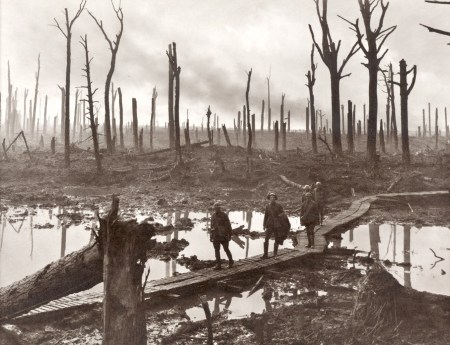
One hundred years ago today, on 31st July 1917, the Third Battle of Ypres began. The battle, often called the Battle of Passchendaele, staggered on until November with hundreds of thousands of troops killed. The Allied assault on Ypres was ultimately intended to break through the German lines and capture submarine bases on the Belgian coast. That objective was not reached, and territorial gains were limited to just a few miles at terrible cost in suffering and death.

David Lloyd George, Prime Minster at the time, wrote in his memoirs:

Passchendaele was indeed one of the greatest disasters of the war … No soldier of any intelligence now defends this senseless campaign …

Others have argued that the Battle of Passchendaele had the important strategic role of taking pressure of the French army further South, which was so close to breaking point that mutinies were breaking out. Although the casualties on both sides were unsustainable, the German High Command knew that American reinforcements would soon enter the fray, and that if they were to win the War it would have to be with a knockout blow the following year. The German offensive of 1918 made substantial inroads through the Allied lines, even threatening Paris, until it was eventually halted and turned into a full-scale retreat.

Whatever the military outcome of the Battle, there is no question about the scale of the suffering of the troops (many of whom, at this stage of the War, were conscripts). The area in which the action took place was mainly low-lying, with a water table just a couple of feet below the surface. The myriad of small streams ditches, and drainage channels that had been developed over centuries to turn it into farmland, were destroyed by heavy shelling so the soldiers had to contend with heavy mud, often strewn with body parts and deep enough to drown in, as described by Siegfried Sassoon in his poem Memorial Tablet:

Squire nagged and bullied till I went to fight,
(Under Lord Derby’s Scheme). I died in hell—
(They called it Passchendaele). My wound was slight,
And I was hobbling back; and then a shell
Burst slick upon the duck-boards: so I fell
Into the bottomless mud, and lost the light.

At sermon-time, while Squire is in his pew,
He gives my gilded name a thoughtful stare:
For, though low down upon the list, I’m there;
‘In proud and glorious memory’ … that’s my due.
Two bleeding years I fought in France, for Squire:
I suffered anguish that he’s never guessed.
Once I came home on leave: and then went west…
What greater glory could a man desire?

Whenever I read about the terrible events of past wars, the important thing (to me) is not strategy or objectives but the suffering  that had to be endured by ordinary soldiers. It’s important to remember things like Passchendaele to remind ourselves how lucky we are to be living in a time of relative peace. The way the world is heading, however, I worry that may soon be coming to an end. Lest we forget? Far too many people have already forgotten.

P.S. Among those killed in action on the first day of Passchendaele was Welsh poet Hedd Wyn, whom I wrote about here.

P.P.S. The troops shown in the picture above are in fact Australian gunners: the picture was taken in October 1917.


The Dead Statesman

Posted in Poetry, Politics with tags , , on July 21, 2017 by telescoper

I could not dig; I dared not rob:
Therefore I lied to please the mob.
Now all my lies are proved untrue
And I must face the men I slew.
What tale shall serve me here among
Mine angry and defrauded young?

by Rudyard Kipling (1865-1936)

It isn’t Time that’s passing

Posted in Poetry with tags , , on June 23, 2017 by telescoper

Remember the long ago when we lay together
In a pain of tenderness and counted
Our dreams: long summer afternoons
When the whistling-thrush released
A deep sweet secret on the trembling air;
Blackbird on the wing, bird of the forest shadows,
Black rose in the long ago summer,
This was your song:
It isn’t time that’s passing by,
It is you and I.

by Ruskin Bond (b. 1934)


June 1915, by Charlotte Mew

Posted in Poetry with tags , , on June 16, 2017 by telescoper

Who thinks of June’s first rose today?
Only some child, perhaps, with shining eyes and
rough bright hair will reach it down.
In a green sunny lane, to us almost as far away
As are the fearless stars from these veiled lamps of town.
What’s little June to a great broken world with eyes gone dim
From too much looking on the face of grief, the face of dread?
Or what’s the broken world to June and him
Of the small eager hand, the shining eyes, the rough bright head?

by Charlotte Mew (1869-1928)


The Bright Field, by R.S. Thomas

Posted in Poetry with tags , , , on May 31, 2017 by telescoper

I heard this recording of R.S. Thomas reading one of his most famous poems on Private Passions on BBC Radio 3 this Sunday. It was only later that I realised that although I’ve posted quite a few poems by R.S. Thomas over the years, I’ve never posted this one so I’m correcting that omission now. The poem is called The Bright Field:

I have seen the sun break through
to illuminate a small field
for a while, and gone my way
and forgotten it. But that was the pearl
of great price, the one field that had
treasure in it. I realize now
that I must give all that I have
to possess it. Life is not hurrying

on to a receding future, nor hankering after
an imagined past. It is the turning
aside like Moses to the miracle
of the lit bush, to a brightness
that seemed as transitory as your youth
once, but is the eternity that awaits you.

Here is R.S. Thomas himself reading it. The comments made about this reading on the radio programme weren’t entirely complimentary, but I rather like it. Notice, however, that in the spoken version he adds a `the’ between `had’ and `treasure’, which isn’t there in my printed copy of the poem.

http://www.dailymotion.com/video/xuohy0_r-s-thomas-the-bright-field_creation

The Beautiful Sun, by William McGonagall

Posted in Poetry with tags , , , on May 24, 2017 by telescoper

Beautiful Sun! with thy golden rays,
To God, the wise Creator, be all praise;
For thou nourisheth all the creation,
Wherever there is found to be animation.

Without thy heat we could not live,
Then praise to God we ought to give;
For thou makest the fruits and provisions to grow,
To nourish all creatures on earth below.

Thou makest the hearts of the old feel glad,
Likewise the young child and the lad,
And the face of Nature to look green and gay,
And the little children to sport and play.

Thou also givest light unto the Moon,
Which certainly is a very great boon
To all God’s creatures here below,
Throughout the world where’er they go.

How beautiful thou look’st on a summer morn,
When thou sheddest thy effulgence among the yellow corn,
Also upon lake, and river, and the mountain tops,
Whilst thou leavest behind the most lovely dewdrops!

How beautiful thou seem’st in the firmament above,
As I gaze upon thee, my heart fills with love
To God, the great Creator, Who has placed thee there,
Who watches all His creatures with an eye of care!

Thou makest the birds to sing on the tree,
Also by meadow, mountain, and lea;
And the lark high poised up in air,
Carolling its little song with its heart free from care.

Thou makest the heart of the shepherd feel gay
As he watches the little lambkins at their innocent play;
While he tends them on the hillside all day,
Taking care that none of them shall go astray.

Thou cheerest the weary traveller while on his way
During the livelong summer day,
As he admires the beautiful scenery while passing along,
And singing to himself a stave of a song.

Thou cheerest the tourist while amongst the Highland hills,
As he views their beautiful sparkling rills
Glittering like diamonds by the golden rays,
While the hills seem to offer up to God their praise.

While the bee from flower to flower does roam
To gather honey, and carry it home;
While it hums its little song in the beautiful sunshine,
And seemingly to thank the Creator divine —

For the honey it hath gathered during the day,
In the merry month of May,
When the flowers are in full bloom,
Also the sweet honeysuckle and the broom.

How beautiful thy appearance while setting in the west,
Whilst encircled with red and azure, ’tis then thou look’st best!
Then let us all thank God for thy golden light
In our prayers every morning and night!

by Wiliam Topaz McGonagall (1825-1902)


Manchester Thoughts

Posted in Poetry with tags , , on May 23, 2017 by telescoper

I went to bed early last night after a long day, so I only found out about the terrible events in Manchester when I woke up this morning. The lives of 22 people ended last night, and many of those who survived will never be the same again because of their physical injuries or because of the awful things they witnessed.

I know it’s a feeble response, but I send my deepest condolences to the bereaved and wish a speedy recovery to all those injured or in any other way affected.

Words fail in situations like this. Comprehension fails too. How someone purportedly of the same species as me can sit down and systematically plan to murder children and teenagers is quite beyond my ability to fathom. The choice of target was as callous as it was deliberate: an audience of young girls. The murderer blew himself up in the course of this attack, which means he has evaded justice. I just hope the police will identify the remains and wrap up whatever network helped him plan and execute this attack.

There’s enough information in the news to make a reasonably informed guess as to what kind of explosive device was used. It’s not difficult to make a bomb of that type, but it’s a step up in sophistication from the event on Westminster Bridge. Let’s hope it’s not the start of a new wave of terror attacks, but even if it is they will not win.

It’s difficult to concentrate on work when something like this happens, but I think it’s important to force oneself to do so. If we allow ourselves to become distracted, then the bastards have won. I won’t write much more, but I will refer you to a poem by Dylan Thomas, arguably his greatest, which came into my mind this morning as it has done (sadly) many times before.

A Refusal to Mourn the Death by Fire of a Child in London was first published just after the end of the Second World War and was written after Thomas heard news of a young girl who had burned to death when the house she was in was set on fire during an air raid.

The idea behind the poem is complex, and its message double-edged, but Thomas finds a perfect balance between horror and sadness, and between indignation and heartbreak. Children shouldn’t have to die, and neither should anyone else whose life is cut short by another’s hand, but we have to live with the fact that they can and do. There’s no consolation to be found in mourning and in any case it’s hypocritical to favour one death with elegies, when suffering is so widespread. The best we can do is allow the dead some dignity and the bereaved some time to heal.

Here is a short extract from the poem, which sums up my thoughts.

I shall not murder
The mankind of her going with a grave truth
Nor blaspheme down the stations of the breath
With any further
Elegy of innocence and youth.

I won’t post the full poem here, but you can find it elsewhere on this blog.


Spring Rain

Posted in Biographical, Poetry on May 12, 2017 by telescoper

This poem accurately describes what happened to me walking home yesterday evening…

The storm came up so very quick
It couldn’t have been quicker.
I should have brought my hat along,
I should have brought my slicker.

My hair is wet, my feet are wet,
I couldn’t be much wetter.
I fell into a river once
But this is even better!

by Marchette Chute (1909-1994)

The Word, by R.S. Thomas

Posted in Poetry with tags , , , on April 5, 2017 by telescoper

A pen appeared, and the god said:
‘Write what it is to be
man.’ And my hand hovered
long over the bare page.

until there, like footprints
of the lost traveller, letters
took shape on the page’s
blankness, and I spelled out
the word ‘lonely’.

And my hand moved
to erase it; but the voices
of all those waiting at life’s
window cried out loud: ‘It is true.’

by R.S. Thomas (1913-2000)


Composed upon Westminster Bridge, September 3 1802, by William Wordsworth

Posted in Poetry with tags on March 23, 2017 by telescoper

Earth has not anything to show more fair:
Dull would he be of soul who could pass by
A sight so touching in its majesty:
This City now doth, like a garment, wear
The beauty of the morning; silent, bare,
Ships, towers, domes, theatres, and temples lie
Open unto the fields, and to the sky;
All bright and glittering in the smokeless air.
Never did sun more beautifully steep
In his first splendour, valley, rock, or hill;
Ne’er saw I, never felt, a calm so deep!
The river glideth at his own sweet will:
Dear God! the very houses seem asleep;
And all that mighty heart is lying still!

by William Wordsworth (1770-1850)