Archive for the Poetry Category

November, a poem by William Morris

Posted in Poetry with tags , on November 2, 2013 by telescoper

Are thine eyes weary? is thy heart too sick
To struggle any more with doubt and thought,
Whose formless veil draws darkening now and thick
Across thee, e’en as smoke-tinged mist-wreaths brought
Down a fair dale to make it blind and nought?
Art thou so weary that no world there seems
Beyond these four walls, hung with pain and dreams?

Look out upon the real world, where the moon,
Half-way ‘twixt root and crown of these high trees,
Turns the dread midnight into dreamy noon,
Silent and full of wonders, for the breeze
Died at the sunset, and no images,
No hopes of day, are left in sky or earth –
Is it not fair, and of most wondrous worth?

Yea, I have looked and seen November there;
The changeless seal of change it seemed to be,
Fair death of things that, living once, were fair;
Bright sign of loneliness too great for me,
Strange image of the dread eternity,
In whose void patience how can these have part,
These outstretched feverish hands, this restless heart?

by William Morris (1834-1896).

Did I Miss Anything?

Posted in Education, Poetry with tags , , , on October 17, 2013 by telescoper

Question frequently asked by
students after missing a class

Nothing. When we realized you weren’t here
we sat with our hands folded on our desks
in silence, for the full two hours

Everything. I gave an exam worth
40 per cent of the grade for this term
and assigned some reading due today
on which I’m about to hand out a quiz
worth 50 per cent

Nothing. None of the content of this course
has value or meaning
Take as many days off as you like:
any activities we undertake as a class
I assure you will not matter either to you or me
and are without purpose

Everything. A few minutes after we began last time
a shaft of light descended and an angel
or other heavenly being appeared
and revealed to us what each woman or man must do
to attain divine wisdom in this life and
the hereafter
This is the last time the class will meet
before we disperse to bring this good news to all people on earth

Nothing. When you are not present
how could something significant occur?

Everything. Contained in this classroom
is a microcosm of human existence
assembled for you to query and examine and ponder
This is not the only place such an opportunity has been gathered

but it was one place

And you weren’t here

by Tom Wayman (b. 1945)

Ode to a Small Lump of Green Putty I Found in my Armpit One Midsummer Morning

Posted in Poetry on October 12, 2013 by telescoper

Putty. Putty. Putty.
Green Putty – Grutty Peen.
Grarmpitutty – Morning!
Pridsummer – Grorning Utty!
Discovery….. Oh.
Putty?….. Armpit?
Armpit….. Putty.
Not even a particularly
Nice shade of green.
As I lick my armpit and shall agree,
That this putty is very well green.

(Excerpt) by Grunthos the Flatulent (translated by Douglas Adams)

A Cranefly in September

Posted in Poetry with tags , , on September 29, 2013 by telescoper

She is struggling through grass-mesh – not flying,
Her wide-winged, stiff, weightless basket-work of limbs
Rocking, like an antique wain, a top-heavy ceremonial cart
Across mountain summits
(Not planing over water, dipping her tail)
But blundering with long strides, long reachings, reelings
And ginger-glistening wings
From collision to collision.
Aimless in no particular direction,
Just exerting her last to escape out of the overwhelming
Of whatever it is, legs, grass,
The garden, the county, the country, the world –

Sometimes she rests long minutes in the grass forest
Like a fairytale hero, only a marvel can help her.
She cannot fathom the mystery of this forest
In which, for instance, this giant watches –
The giant who knows she cannot be helped in any way.

Her jointed bamboo fuselage,
Her lobster shoulders, and her face
Like a pinhead dragon, with its tender moustache,
And the simple colourless church windows of her wings
Will come to an end, in mid-search, quite soon.
Everything about her, every perfected vestment
Is already superfluous.
The monstrous excess of her legs and curly feet
Are a problem beyond her.
The calculus of glucose and chitin inadequate
To plot her through the infinities of the stems.

The frayed apple leaves, the grunting raven, the defunct tractor
Sunk in nettles, wait with their multiplications
Like other galaxies.
The sky’s Northward September procession, the vast
soft armistice,
Like an Empire on the move,
Abandons her, tinily embattled
With her cumbering limbs and cumbered brain.

by Ted Hughes (1930-1998)

When’s a Sonnet not a Sonnet? When it’s No. 126..

Posted in Poetry with tags , , on September 22, 2013 by telescoper

Every now and then I like to post one of Shakespeare’s Sonnets. Of the entire collection of 154 this one, No. 126, is undoubtedly the strangest. It marks the end of the series of poems addressed to an unknown young man and is thought to have been given to the fair youth on his 27th birthday, marking the end of a relationship that lasted nine years. The following sonnets are addressed to another unknown person, but of the opposite Experts generally regard it as a kind of envoi, which is normally a short stanza at the end of a long poem, but in this case it is a poem in itself occurring at the end of a sequence. What’s strange about it is that it isn’t actually a sonnet at all. It consists of twelve lines rather than the usual fourteen, but the missing two lines are presented in most editions as two pairs of parentheses as shown below. Moreover, the rhyme scheme (consisting of six couplets) doesn’t fit with the pattern of the rest of the Sonnets, so even if he had filled in the two blanks at the end it would still have been an oddity.

So what was the reason for this curious verse? Perhaps Shakespeare deleted the final couplet because he felt the lines were somehow inappropriate? Perhaps he meant the fair youth to finish it himself, or issue an invitation to others to do likewise? Perhaps the poem is simply unfinished? Perhaps the poet wanted to demonstrate that the relationship with his beloved ended prematurely.

More likely than any of these interpretations, in my opinion, is that furnished by looking at the typical structure of a Shakespearean Sonnet. The last two lines usually express the poet’s consolation in the face of what has come before. Here there is none. It’s over. Read it in this light and I think it becomes even more moving to anyone who has experienced any kind of love and has had to face the fact that it is finally over.

O thou, my lovely boy, who in thy power
Dost hold Time’s fickle glass, his sickle, hour;
Who hast by waning grown, and therein show’st
Thy lovers withering, as thy sweet self grow’st.
If Nature, sovereign mistress over wrack,
As thou goest onwards, still will pluck thee back,
She keeps thee to this purpose, that her skill
May time disgrace and wretched minutes kill.
Yet fear her, O thou minion of her pleasure!
She may detain, but not still keep, her treasure:
Her audit (though delayed) answered must be,
And her quietus is to render thee.
(        )
(        )

Of the Terrible Doubt of Appearances

Posted in Poetry with tags , , on September 20, 2013 by telescoper

Of the terrible doubt of appearances,
Of the uncertainty after all, that we may be deluded,
That may-be reliance and hope are but speculations after all,
That may-be identity beyond the grave is a beautiful fable only,
May-be the things I perceive, the animals, plants, men, hills,
shining and flowing waters,
The skies of day and night, colors, densities, forms, may-be these
are (as doubtless they are) only apparitions, and the real
something has yet to be known,
(How often they dart out of themselves as if to confound me and mock me!
How often I think neither I know, nor any man knows, aught of them,)
May-be seeming to me what they are (as doubtless they indeed but seem)
as from my present point of view, and might prove (as of course they
would) nought of what they appear, or nought anyhow, from entirely
changed points of view;
To me these and the like of these are curiously answer’d by my
lovers, my dear friends,
When he whom I love travels with me or sits a long while holding me
by the hand,
When the subtle air, the impalpable, the sense that words and reason
hold not, surround us and pervade us,
Then I am charged with untold and untellable wisdom, I am silent, I
require nothing further,
I cannot answer the question of appearances or that of identity
beyond the grave,
But I walk or sit indifferent, I am satisfied,
He ahold of my hand has completely satisfied me.

by Walt Whitman (1819-92)

The Little Red Book Revisited

Posted in Biographical, Poetry with tags , , , , on September 15, 2013 by telescoper

I can hardly believe it, but tomorrow this blog will be five years old; my first ever post was on September 16th 2008. I’ve decided to use this occasion as an excuse to wallow in self-indulgence by reposting some vintage items, with appropriate updates. This one was originally posted on 27th September 2008, but I’ve updated it with a picture of the eponymous little red book and a scan from one of its pages.

–0–


It’s now late September and there’s no sign that the Indian summer we’ve been having is going to fade. Once again, I’m sitting outside in the sunshine while Columbo daydreams. In the newspapers there’s yet more panic about the global financial crisis and the US Government’s attempts to persuade Congress to bail out the profligate bankers. The Republicans don’t want to play along, apparently because they don’t like the idea of government getting involved in the markets. I’m opposed to it for the opposite reason, which is I think those who have caused the problem should be the ones that pay for it. If the UK government decides to bail out any banks, I hope it will be at the price of public representation on their boards or even nationalisation.

Not long ago there was talk about energy companies having a windfall tax levied upon them owing to the sudden leap in their profits arising from high oil and gas prices. This seemed like a good idea to me. A retrospective windfall tax on city bonuses to pay for any packages cobbled together to pay the financial sector’s debts appears at least as justifiable as that proposed for the energy sector.

It’s now about a year since my father died. He hadn’t left a will so I had to travel to Weymouth to tidy up his things and organise a funeral. I hadn’t seen him much in recent years and was never particularly close, since my parents split up when I was about 12 and I went to live with my mother when that happened.

My dad never really came to terms with life after the break up of the family. His business eventually went down the tubes and he left Newcastle to live in Weymouth near his sister, my Auntie Ann, who had lived there for quite a while. He had a history of heart problems so his death wasn’t really a shock, but it did bring feelings of guilt to me, for not having kept in touch very well, as well sudden and unpredictable pangs of nostalgia which I’m still a bit prone to.

Among the memories that popped uncontrollably into my mind last year was a visit we made as a family to the house of my late Auntie Vi, who I don’t think I ever met. I don’t remember when this was but it was just after she died, when I guess I was probably about seven or eight which would make it around 1970 or so. My dad was among those invited to the house to help clear it by taking away anything they wanted.

I don’t remember the house very well except that it was rather dark, decorated with Victorian designs, and cluttered with heavy old-fashioned furniture. I imagined Auntie Vi (or “Violetta”, which was her real name) to be quite scary, perhaps like a governess in some gothic novel. I don’t know much about her except that she wasn’t well liked by the rest of the family. There was talk of some scandal, but I never found out what it was. I was just intrigued how she got the name Violetta. Perhaps her parents liked opera.
Wordsworth

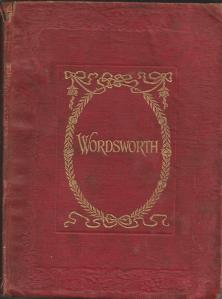
The only relic from that visit that I still know about was a little red book that we took home with us. It was a book of Poems by Wordsworth which my mum kept when she split up with my dad and moved out. I asked her about it last year, after my dad’s funeral, and was quite surprised to find she still had it. She gave it to me to keep, and it is on the table beside me now as I write this.

Out of curiosity last year I looked for the date the little book was published, but couldn’t find one anywhere inside. I don’t know why, but the lack of that little bit of information bothered me. I looked on the web to see if there was information about this or similar books was to be found. No luck.

I turned instead to the task of finding out whatever I could about the publisher. The book is in a series called “Canterbury Poets” which was published by the Walter Scott Publishing company (London, New York and Felling). That made be laugh. As if anyone could ever have imagined Felling to be on a par with New York or London!

I had assumed that Sir Walter Scott was the famous novelist of Ivanhoe and the Waverley novels, but digging about a little I found out that it was named for someone else entirely. This particular Sir Walter Scott was born in 1826. He had very little formal education, but became a highly successful businessman. By the 1880s he owned a large network of business interests in the North East, primarily involving engineering and construction companies. In 1882 Scott expanded his empire by buying a publishing company “The Tyne Publishing Company”, which had just gone bust. Scott built a new factory (at Felling) and established a new office in London for his new publishing house, and the Walter Scott Publishing Company was born.

I think Scott must have been a very shrewd entrepreneur because the printing business grew rapidly, primarily through its list of editions of classic works of literature that were out of copyright. The Canterbury Poets series was first published in 1884, which is also the date of their first edition of the Wordsworth. These books were extremely well made, with hard covers, fine quality paper and good stitching . They sold for a shilling, which is an astonishingly low price for books of this quality. I can’t be sure, but have a feeling that a lot of them were given as “rewards” , for good behaviour at sunday schools and the like. That market accounted for a lot of the book trade in those days.Sir Walter Scott died in 1910 and the company ceased trading in 1931. At its peak it did indeed have offices in New York, and also sold large quantities of books in Australia.

I found this all out quite easily, because the Walter Scott Company turned out to be quite famous for the role it played in the story of working class literacy, but it didn’t tell me about the specific edition I had. However, I did discover that a scholarly work had been published in 1997 that contained a complete biliography of all the works it published until the company finally went down the tubes. Quite apart from the connection with my peculiar Aunt, I found the whole story quite fascinating. I sent off for the bibliography, which is basically a kind of catalogue that painstakingly records the size, typeface, cover design, and printers colophons for all known editions. (It’s quite boring to read, as you can imagine). I searched through it to find references to William Wordsworth. Number 99c is the entry for the “Poems” of William Wordsworth.

With a bit of work I established that the specific edition I have was first published in 1892 but reprinted many times after that. Details of the book, however, indicate that my version was actually printed in 1902. Among the clues is the fact that the colophon states “The Walter Scott Publishing Co, Ltd.” and it didn’t become a limited company until 1902. The company also moved its London and New York offices a couple of times which helps pin down the date, as these changes are noted on the imprint.

So there you have it. The little red book was printed in Felling in 1902, which happens to be the same year that my little house in Pontcanna was built, just after the death of Queen Victoria. I don’t know how old Auntie Vi was when she died, but she must have been a young girl when she got it and had obviously kept it all the rest of her life. That fits with the way her name is written in pencil, in what looks like a child’s hand, inside the front cover.

The book isn’t particularly valuable. A lot were printed and it’s not particularly rare. I’m not sure Wordsworth is very collectible nowadays either. I am still amazed, though, how well it had withstood the passage of time. Today’s books are cheaply bound and printed on chatty paper. Most modern paperbacks are in bad condition only a few years after you buy them. They made things to last in those days.

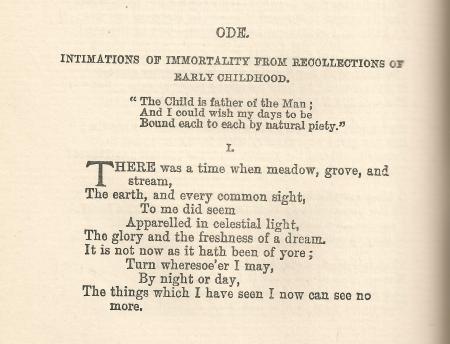
It seems appropriate to end with one of Wordsworth’s poems, of which (I forgot to mention) I’m very fond indeed. I’ve picked the start of the Ode “Intimations of Immortality from Recollections of Early Childhood”, partly because there’s a wonderful setting of this work to music by Gerald Finzi which was performed at this years Proms.

I think it’s apt enough. Here is the first verse as it appears in the Little Red Book:
wordsworth_intiminations


Lines on the Death of David Frost

Posted in Poetry with tags , , on September 1, 2013 by telescoper

So farewell, then,
Sir David Frost.

Now that you have
Died, I thought
I would write
A silly poem about
You.

And, no doubt, soon
There’ll also be
One in the Eye.

Keith’s Mum says
She used to like
Breakfast with Frost.

But I’ve never been
All that keen
On Frosties.

by Peter Coles (aged 50 ¼).

Mid-term Break

Posted in Poetry with tags , on August 31, 2013 by telescoper

I sat all morning in the college sick bay
Counting bells knelling classes to a close.
At two o’clock our neighbors drove me home.

In the porch I met my father crying–
He had always taken funerals in his stride–
And Big Jim Evans saying it was a hard blow.

The baby cooed and laughed and rocked the pram
When I came in, and I was embarrassed
By old men standing up to shake my hand

And tell me they were ‘sorry for my trouble,’
Whispers informed strangers I was the eldest,
Away at school, as my mother held my hand

In hers and coughed out angry tearless sighs.
At ten o’clock the ambulance arrived
With the corpse, stanched and bandaged by the nurses.

Next morning I went up into the room. Snowdrops
And candles soothed the bedside; I saw him
For the first time in six weeks. Paler now,

Wearing a poppy bruise on his left temple,
He lay in the four foot box as in his cot.
No gaudy scars, the bumper knocked him clear.

A four foot box, a foot for every year.

by Seamus Heaney (1939–2013)

Marsh Flowers

Posted in Music, Poetry with tags , , , on August 21, 2013 by telescoper

I heard a reading of this poem on BBC Radio 3 last night and couldn’t resist posting it here. It’s by Suffolk poet George Crabbe and it came up in the context of a programme about poetry and the music of Benjamin Britten. That gives me the opportunity to plug an anthology of the poems Britten set to music, which is available from the excellent Carcanet Press. Last time I plugged one of their books on here they sent me a free copy. Fingers crossed.

Crabbe is probably most famous for his lengthy work The Borough, part of which features a character called Peter Grimes. It was that work that inspired Britten to write the opera of that name, a true masterpiece if ever there was one.

I didn’t know until yesterday evening that Britten had written other pieces based on Crabbe’s poetry, so it was a pleasant surprise to hear this one, which became one of the Five Flower Songs (Op. 47). It stands on its own, however, as a wonderfully dry piece of comic verse, the plodding meter perfectly conveying the uninspiring nature of the fenland flora described by the text. It’s also full of clever touches, such as the alliteration in Line 4 “sickly scent is seen”.

Here the strong mallow strikes her slimy root,
Here the dull nightshade hangs her deadly fruit:

On hills of dust the henbane’s faded green,
And pencil’d flower of sickly scent is seen.

Here on its wiry stem, in rigid bloom,
Grows the salt lavender that lacks perfume.

At the wall’s base the fiery nettle springs
With fruit globose and fierce with poison’d stings;

In every chink delights the fern to grow,
With glossy leaf and tawny bloom below;

The few dull flowers that o’er the place are spread
Partake the nature of their fenny bed.

These, with our sea-weeds rolling up and down,
Form the contracted Flora of our town.

by George Crabbe (1754-1832).