Archive for the mathematics Category

Everything is a Simple Harmonic Oscillator

Posted in mathematics, The Universe and Stuff with tags , , , on December 13, 2025 by telescoper

Anyone who has studied theoretical physics for any time will be familiar with the simple harmonic oscillator, which I will call the SHO for short. This is a system that can be solved exactly and its solutions can be applied in a wide range of situations where it holds approximately, e.g. when looking at small oscillations around equilibrium. I’ve often remarked in lectures that we spend much of our lives solving the SHO problem in various guises, often pretending that the difficult system we have in front of us can, if looked at in the right way, and with sufficient optimism, be approximated by the much simpler SHO. Cue the old joke that if all you have is a hammer, everything looks like nail…

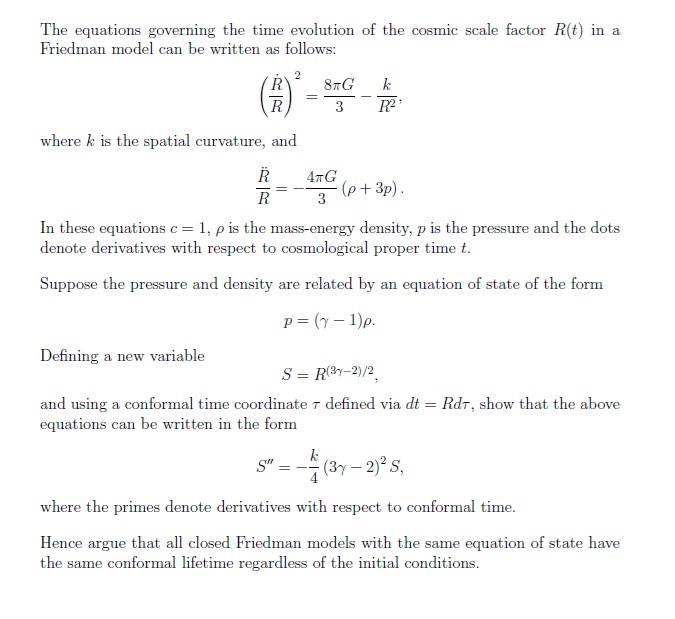
That rambling prelude occurred to me when I found this little problem in some old notes. It is a cute mathematical result that shows that the Friedman equations that underpin our standard cosmological model can in fact be written in the same form as those describing a Simple Harmonic Oscillator. In what follows we take the cosmological constant term to be zero.

The resulting equation is the SHO equation if k>0. I’m not sure whether this result is very useful for anything, but it is cute. It also goes to to show that, if looked at in the right way, the whole Universe is a Simple Harmonic Oscillator!

Nine Teaching Days to Christmas

Posted in Biographical, mathematics, Maynooth, Television with tags , , , on December 8, 2025 by telescoper

This week is the penultimate week of teaching term at Maynooth and, as usual at this stage of the Semester, we’re getting busier and busier. The examinations for January have been sent off for printing and are (presumably) ready to go, and I’m up to date with all my coursework gradin so I am, miraculously, on schedule as far as teaching is concerned. I should finish covering the respective syllabuses by Tuesday 16th, with the remaining teaching sessions devoted to revision. I don’t have any lectures on Fridays this term, so my teaching ends, a day before the end of term, on Thursday 18th December. To celebrate the end of term I’ll be presenting the students in the last session of my Engineering Mathematics module the gift of a final Class Test. I’m not sure when I’ll get to correct it. Oh, and our Department Christmas Dinner is on Wednesday 17th.

I’ll soon have to decide when to pause the publication of new papers at the Open Journal of Astrophysics and prepared for next year’s Volume 9. A certain person is insisting that I take a complete break for at least a week, so I think we’ll probably stop on Christmas Eve and begin again in the New Year.

In the meantime, term goes on. I have three lectures to get ready for tomorrow. Incidentally, my mid-Semester feedback suggested that I start each lecture with an introduction to say what I’m going to be covering. Here are some examples of what I’ve been doing in response:

A month to go

Posted in Artificial Intelligence, Biographical, Education, mathematics, Maynooth with tags , , , , , on November 25, 2025 by telescoper

I’ve been a bit preoccupied these recent weeks so it was with a shock that I realised that we’re into Week 9, which means just four weeks (including this one) until the end of term and just a month before Christmas. Teaching finishes here in Maynooth on Friday 19th December, but I don’t have any lectures on Fridays so in my case it will finish the day before (with a tutorial). I don’t know how many students will be there, but the module concerned is my 4th year Mathematical Physics module and the students are very hard-working, so I think most will attend. After such a busy term I’m sure that they will need a break as much as I will.

I had to rejig the schedule for both modules I am teaching this semester to accommodate the introduction of in-class tests to replace take-home assignments (for reasons I outlined here). I’ve also been handing out voluntary exercises for practice, not counting towards the module mark but for formative reasons. Both modules are mathematical in nature, and I think the best way to learn mathematics is by doing it…

Despite the changes with respect to last year, I am still roughly on track. In my Engineering Mathematics module I’ve just finished Laplace transforms, and will start Fourier methods tomorrow. With the mathematical physicists, I am in the middle of complex analysis, having done complex differentiation and conformal mappings and starting complex integration next week.

I still have a couple more class tests to get through. On the positive side, the students are turning up for them and have expressed approval for the fact that they don’t have compulsory homework to do off-campus. This form of assessment is undoubtedly harder work for the students, it’s also better preparation for the examination that take-home assignments.

We’ve just received the draft examination timetable for January, and I’m pleased that both of the examinations for which I am responsible will take place quite early in the examination period (on 12th and 15th January, respectively) so I should be able to get them corrected in time to have a break for some research before teaching resumes at the start of February.

Testing Times

Posted in Artificial Intelligence, Education, mathematics, Maynooth with tags , , , , on October 17, 2025 by telescoper

As it was foretold, I conducted my first set of my new-style in-class tests this week. These tests, as I mentioned a while ago,  were introduced because of concerns about the integrity of the coursework element of my modules in the light of improvements in Generative AI.

The main events – one for each of my modules – were both yesterday, but one student couldn’t make it at the scheduled time (for good reasons) so I set a special test this morning, which is now over. Because access to the internet is not allowed these tests are invigilated.

It’s been quite a while since I was last required to invigilate a full examination. I think it was back in Nottingham days, actually. I never enjoyed this task even though I took work to do it wasn’t really possible to do much as one had to keep one’s eyes on the students. Crosswords could be done; these are good in this situation because you can solve a few clues at a time. It was disappointing if I happened to take one that was easy enough to do quickly, as there was little to stave off the boredom after completing it. Other things I used to do included counting the number of right-handed and left-handed students, though I never did any detailed statistical analysis of the results.

Anyway, my recent class tests were a bit different. Designed to fit in a lecture slot of 50 minutes duration, they were much shorter than traditional end-of-year exams. They were also “open-book” style, so students could bring anything on paper that they wanted. Phones and laptops were, however, forbidden. During these tests I just sat quietly with my laptop getting some work done, with an occasional glance at the students. It was actually nice to be locked away like this with no disturbance. Time passed very quickly, actually, though perhaps not as quickly as it did for the students taking the tests.

When I first told the students that the tests would be “open-book”, I think they all assumed that would make them easy. I don’t think that was the case, however, as the questions are designed so that the answers can’t be obtained immediately by looking them up in a textbook. Also, having things on paper rather than in your head does slow you down. I’ve never seen much point in examinations as speed tests. I designed this week’s tests so that the questions could be done in about 30 minutes, but the formal duration was 50 minutes. I encouraged students who finished early to use the remaining time to check their work, but some did leave early.

This new regime also meant I had number of teaching sessions without the exertion of having to do any actual teaching, which was nice. The downside is, of course, that I now have stacks of class tests to correct. That will be payback time.

I won’t know how well the students have coped until I have got their grades, but informal feedback was that they seemed reasonably content with the new method of assessment. I’ll be doing the next ones in about three weeks.

Quarter-Term – Testing Time

Posted in Education, mathematics, Maynooth with tags , , , on October 13, 2025 by telescoper

I’ve just noticed that three teaching weeks have passed and we’re already into the fourth. Tempus fugit. Both the modules I am lecturing this semester are divided into four chunks of approximately equal size. For example, MP469 Differential Equations and Complex Analysis splits into: Ordinary Differential Equations; Partial Differential Equations; Complex Functions and Derivatives; and Complex Integration. Though technically not on the syllabus, I also do couple of lectures on Conformal Mappings because I think they’re cool.

As I mentioned a while ago,  I am concerned about the integrity of the coursework element of these modules in the light of improvements in Generative AI. Only a couple of years ago GenAI could not solve the sort of problems I set for homework, but now it generally can. I don’t altogether object to people applying artificial intelligence to solve mathematical problems, but the main issue is that it does make mistakes. Moreover, instead of saying “sorry I can’t solve that problem” it will generally present a superficially plausible but incorrect solution. Although students will probably use GenAI for problem-solving, I think it is important that they learn to do such problems themselves, otherwise they won’t know whether the solution coughed up by the algorithm is correct or not.

The only way to learn mathematics is by doing it. If students get GenAI to do the mathematics for them, then they won’t learn it. In the past we have given marks for coursework (usually 20% of the module mark) mainly to encourage students to do them. Students who don’t bother to do these exercises generally do badly in the final exam (80%).

For these reasons I am moving the assessment from weekly homework sheets – which could be tackled with AI – to supervised in-class tests for which students can use notes on paper, but not laptops or phones. I will of course give examples for the students to have a go at themselves, and I will give feedback on their attempts, but they will not contribute to the module score. Another advantage of this approach is that students won’t have to do so much work against deadlines outside of class.

What I’ve decided to do is have one class test for each of the four sections of each module. Given that we’re about a quarter of the way through the term, it’s time for the first ones. This week there will be a class test on Ordinary Differential Equations. I’ve never been enthusiastic about examinations being speed tests, so I’ve decided to set problems to be done in a 50-minute session which would be expected to take about 30 minutes in a formal end-of-term examination.

I have to make a short work-related trip that will keep me away on Wednesday, but I’ve already written the test questions, and will make arrangements for someone to supervise the tests if for some reason I don’t make it back to Maynooth on time…

Anyway, although we’ve been teaching for three weeks I still have to check my calendar to remember which room I’m supposed to go to before every lecture. Perhaps by Christmas I will have learned them off by heart…

When will the AI Bubble burst?

Posted in Artificial Intelligence, Finance, mathematics with tags , , , , on October 12, 2025 by telescoper

I’m not a financial expert, but I have noticed a significant number of articles in the media suggesting that the Generative AI industry is a bubble waiting to burst. There are recent pieces here on the BBC website, here in the Financial Times (from which I stole the cartoon), and here in the Irish Times, to name but a few.

These stories are based on reports by the Bank of England and the International Monetary Fund, warning of a stock market crash far worse than the dotcom boom-and-bust of 2000 and even the banking crisis of 2008. Over 30% of the valuation of the US stock market, for example, lies in five big technology companies that are investing heavily in the enormous infrastructure required for AI. Their extravagant capital expenditure is underpinned by a complex series of financial arrangements which could unravel very quickly if the investors get cold feet and consider it unlikely they will see a return on their money. It does look very much like a bubble to me.

My own view is that the claims made about the capabilities of AI by tech gurus are grossly overstated. Only the irredeemably gullible could think otherwise. I think a correction is inevitable. It’s not a question of “if” but “when” and “how much”. I am not competent to answer those questions.

P.S. Now there’s an RTÉ Brainstorm piece along the same lines…

How to Fight Fraudulent Publishing

Posted in mathematics, Open Access with tags , , , , , , , on September 23, 2025 by telescoper

There’s a short article on arXiv with the title How to Fight Fraudulent Publishing in the Mathematical Sciences: Joint Recommendations of the IMU and the ICIAM which is well worth reading. The abstract is not useful but the prelude reads:

PreludeIn November 2023, Clarivate announced that it had excluded the entire field of mathematics from the latest edition of its influential list of ‘highly cited researchers’. This prompted the IMU and the ICIAM to conduct a more thorough investigation into the problem of fraudulent publishing in the mathematical sciences (see [1]). Understanding the problem is one thing; finding a way out and regaining control is another. With the recommendations given below, we would like to start the discussion on how, as a global community, we can achieve this. We are all concerned. It affects the very core of the science we love so much. I.A.

arXiv:2509.09877

The paper correctly identifies predatory journals and citation cartels as two consequences of the effort to quantify and rank the quality of research through scientific ‘performance indicators’, in the form of bibliometric measures and suggests some possible remedies.

Many of the recommendations are already included in the San Francisco Declaration on Research Assessment (SFDORA). Many also apply beyond the mathematical sciences (which is why I dropped the Mathematical Sciences bit in the title of the paper from the title of this blog post) and it’s not a long paper so I suggest you read it.

In my view one of the most important steps to take is to ditch the reliance on such companies as Scopus and Clarivate, who have deliberately constructed a system that is so easy to game. All higher education institutes should follow the examples of the Sorbonne University in Paris and, more recently, Utrecht University in the Netherlands. The academic publishing racket is inherently fraudulent. Too many universities, and indeed researchers employed by them, are willing participants in the system.

Back to Teaching and Coping with GenAI

Posted in Artificial Intelligence, Education, mathematics, Maynooth with tags , , , , on September 21, 2025 by telescoper

Summer is well and truly over: it’s a chilly day in Maynooth; the Autumnal Equinox takes place tomorrow; and tomorrow I return to teaching at Maynooth University. So begins my antepenultimate academic year as a university teacher.

I’ve often remarked how the academic year at Maynooth is largely defined by the astronomical phenomena of the equinoxes and solstices. This year demonstrates this perfectly: Semester 1 lectures for undergraduates begin tomorrow (22nd September), the day of the Autumnal equinox; they end on Friday 19th December with the Winter Solstice on 21st. The half-term study break coincides with Samhain, a cross-quarter day. It’s all refreshingly pagan.

This time last year, having been away on sabbatical the year before, I was preparing to teach two new modules. I have those two again this year so this year should be a bit easiest than last year. I still have to get everything sorted out, though, including setting up my Moodle pages and preparing the materials, which is what I’ve been doing today.

The timetable for my Engineering Mathematics (EE206 Differential Equations and Transform Methods) module has not changed, so my first lectures on that (a double session) are not until Tuesday. I’m also doing MP469 Differential Equations and Complex Analysis for 4th Year Mathematical Physics students again, but the lecture times for that have changed. That is because, as a consequence of the merger of the Departments of Theoretical Physics and Experimental Physics to form a single Department of Physics, times have been coordinated as far as possible to ensure that Physics students can have flexibility in their choice of theoretical or experimental-based modules. The Engineering Mathematics module has not changed because the times for those lectures are such as to fit with the needs of the Department of Engineering, rather than Physics.

The upshot of all this is that my first lecture of the new term is for MP469, tomorrow afternoon at 2pm and my second is also MP469, at 11am on Tuesday. This means that I have three hours of lectures on Tuesdays this term, but at least that makes it possible to have a day without teaching (Wednesday).

You will notice that both the modules I am teaching this term are mathematical in nature. I have been concerned about the integrity of the coursework element of these modules in the light of improvements in Generative AI. Only a couple of years ago GenAI could not solve the sort of problems I set for homework, but now it generally can – especially for EE206. I don’t altogether object to people applying artificial intelligence to solve mathematical problems, but the issue is that it does make mistakes. Moreover, instead of saying “sorry I can’t solve that problem” it will generally present a superficially plausible but incorrect solution. Although students will probably use GenAI for problem-solving, I think it is important that they learn to do such problems themselves, otherwise they won’t know whether the solution coughed up by the algorithm is correct or not. That way lies disaster.

The only way to learn mathematics is by doing it. If students get GenAI to do the mathematics for them, then they won’t learn it. In the past we have given marks for coursework (usually 20% of the module mark) mainly to encourage students to do them. Students who don’t bother to do these exercises generally do badly in the final exam (80%).

For these reasons I am moving the assessment from weekly homework sheets – which could be tackled with AI – to supervised in-class tests for which students can use notes on paper, but not laptops or phones, just like they would in the final examination. I will of course give examples for the students to have a go at themselves, and I will give feedback on their attempts, but they will not contribute to the module score. Another advantage of this approach is that students won’t have to do so much work against deadlines outside of class.

Anyway, that’s the approach I am going to try. I’d be interested to hear what others are doing to deal with GenAI. The Comments Box is at your disposal.

P.S. There is a rumour circulating that The Rapture will occur on Tuesday 23rd September, but it is as yet unclear whether this will happen before, during, or after the lectures I am due to give on that day.

De Valera Connections

Posted in History, mathematics, Maynooth, Television with tags , , , , on September 11, 2025 by telescoper

On September 4th, when I posted a piece about the forthcoming Presidential Election in Ireland, I forgot to mention that just two days earlier was the 50th anniversary of the funeral of Éamon de Valera, founder of Fianna Fáil (one of the two largest political parties in Ireland) and architect of the Irish constitution, who died on 29th August 1975 at the age of 92. Here’s some coverage at the time by (British) Movietone News, the commentary is rather generous to him:

De Valera (nickname `Dev’) is an enigmatic figure, who was a Commandant in the Irish Republican Army during the 1916 Easter Rising, but despite being captured he somehow evaded execution by the British. There’s no evidence, incidentally, that he escaped the firing squad because he was born in America. Dev subsequently became Taoiseach (Prime Minister) and then President (Head of State) of the Irish Republic.

Eamon de Valera, photographed sometime during the 1920s.

There’s no question in my mind that de Valera is the most significant Irish politician of the 20th Century, which is not to say I fid him an agreeable figure at all and his legacy isn’t particularly positive. Nevertheless, his funeral was perhaps as significant event for the Irish as that of Winston Churchill had been for the British just a decade earlier.

Over the past couple of weeks RTÉ television broadcast a two-part documentary called Dev: Rise and Rule; the second part was on last night. It is quite nicely made, but disappointingly superficial and lacking in any real historical insight. The suggestion that it would “decode” Dev was unfulfilled. This is a pity because RTÉ often does good documentaries.

Anyway, this gives me an excuse to mention again, Dev’s connection with Maynooth. De Valera was a mathematics graduate, and for a short time (1912-13) he was Head of the Department of Mathematics and Mathematical Physics at St Patrick’s College, Maynooth, which was then a recognised college of the National University of Ireland. The Department became incorporated in Maynooth University when it was created in 1997. Mathematical Physics is no longer a part of the Mathematics Department at Maynooth, having first become a Department in its own right, then changing its name to the Department of Theoretical Physics and then, just last year, being subsumed within a new Department of Physics.

De Valera missed out on a Professorship in Mathematical Physics at University College Cork in 1913. He joined the the Irish Volunteers, when it was established the same year. And the rest is history. I wonder how differently things would have turned out had he got the job in Cork?

Presentation Day

Posted in Education, mathematics, Maynooth with tags , , , on August 15, 2025 by telescoper

Today was the day of the last component of our MSc in Theoretical Physics and Mathematics here in Maynooth. The students handed in their dissertations on Monday and today they all gave presentations about their work. Listening to them all was very enjoyable, actually, as they were on a range of different topics, some purely mathematical, some statistical, and some more obviously physics. Moreover, they were all very good.

I often worry that assessing presentations is much more subjective than written work in physics and mathematics. In the event, however, we usually find good consistency in the scores awarded by staff in attendance. 

It also occurred to me during today’s presentations that we may make more use of such assessments to deal with the encroaching use of AI in project dissertations. One can get a good idea if someone has actually done and understood the work if they can present it in person and answer questions. That is, after all, the main reason we do viva voce examinations at PhD level.

Listening to talk after talk in a long session can be quite wearying – conferences are usually set up like that and they’re not often useful or interesting – but today’s session was fun. Not so much for the students I suppose, as there were a few signs of nerves. When all the talks were over the students trouped off en masse (presumably to the pub) as that was the end of their course. The staff remained behind to agree a set of marks and combine them with the other components of assessment, i.e. the marks for the dissertation. The examination board meets early next week, after which the final results will go forward to the University.

It was great to see the students all completing their course successfully, especially because it is (I think) such a demanding one. My only sadness is that we won’t see them until the conferring ceremonies in October. The Masters students have been regularly present in the Department throughout the whole year and I’ve had quite a lot of interest chats with them. I saw my own project student even more frequently, once a week for almost a year. We have to banish such thoughts now, though, as our thoughts turn to next year’s intake.

I don’t think any of the MSc students will read this – for all I know they’re still in the pub! – but in any case I’d like to say congratulations to them all and wish them all the very best for the future. They’ve earned it!