Archive for the Maynooth Category

Weather Conditions

Posted in Biographical, LGBTQ+, Maynooth with tags , , , , on March 2, 2024 by telescoper

This is my last full day in Sydney and – by sheer coincidence – it happens to be Sydney Gay & Lesbian Mardi Gras! I will probably go out later to watch some of the fun, although it seems it’s very likely to rain on the Parade; it’s very overcast this morning, although the temperature is still 24°C.

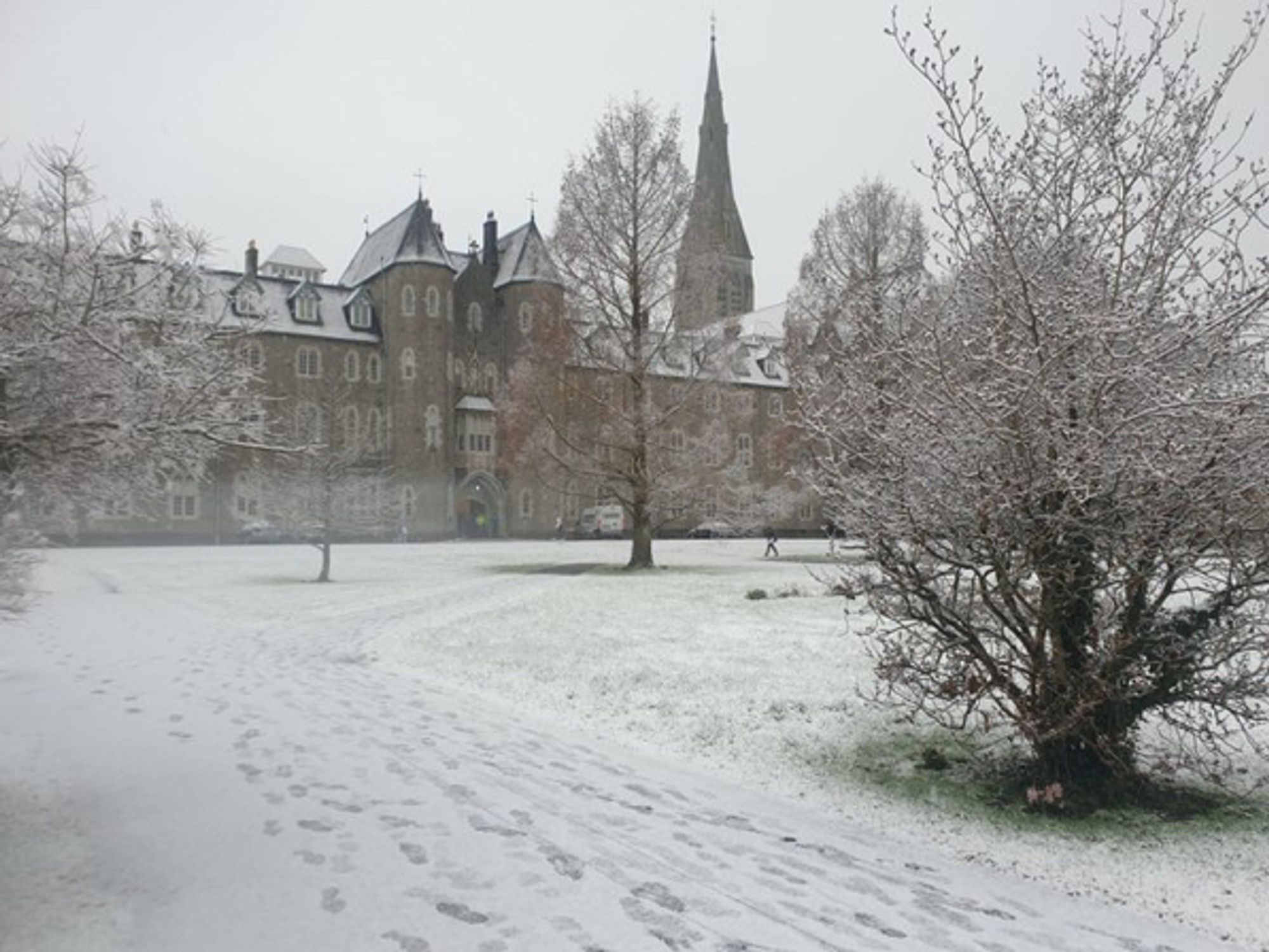
Talking of the weather, I noticed on social media that yesterday it snowed in Maynooth (and elsewhere in Ireland). The contrast with what I’ve been experiencing in Sydney will be rather extreme:

I was a bit concerned that the snow might cause problems with my return flight and/or onward transport, but I’m told that it was soon washed away by rain.

I’ll only be making a brief stop in Maynooth before travelling to (different) warmer climes, of which more in due course.

Masters in Theoretical Physics & Mathematics at Maynooth

Posted in Education, Maynooth, The Universe and Stuff with tags , , on February 6, 2024 by telescoper

Yesterday was a holiday in Ireland but now, with the January examinations over, it’s back to teaching. I am not in Maynooth to enjoy the fun but I can use the medium of this blog to advertise the fact that the MSc in Theoretical Physics & Mathematics is now open to applications for entry in September.

This postgraduate course is run jointly between the Departments of Theoretical Physics and Mathematics & Statistics, with each contributing about half the material. The duration is one calendar year (full-time) or two years (part-time) and consists of 90 credits in the European Credit Transfer System (ECTS). This is split into 60 credits of taught material (split roughly 50-50 between Theoretical Physics and Mathematics) and a research project of 30 credits, supervised by a member of staff in a relevant area from either Department.

This course is a kind of follow-up to the existing undergraduate BSc Theoretical Physics & Mathematics at Maynooth, also run jointly. We think the postgraduate course will appeal to many of the students on that programme who wish to continue their education to postgraduate level, though applications are very welcome from suitably qualified candidates who did their first degree elsewhere.

Postgraduate admissions in Ireland operate differently from the UK, in that there is a central system in Ireland (called PAC) that is similar to the undergraduate admissions system; in the UK PG courses are dealt with by individual institutions. You will need to apply online via PAC after the following the instructions here. The requisite PAC code for the full-time version of the course is MHQ56.

The closing date for applications is 30th June 2024.

Reformscape – the Video!

Posted in Education, Maynooth with tags , , , on February 2, 2024 by telescoper

Not long ago, I posted an item about the San Francisco Declaration on Research Assessment (DORA). I was interested this week to see the latest initiative from DORA which is called Reformscape. You can read much more about here. Here are some excerpts from the introduction:

  • The old ways of assessing the quality of research and progressing the careers of researchers are no longer fit for purpose. These dated approaches are neither fair nor responsible and often leave talented people overlooked, holding back progress in diversity, equity and inclusion. Institutions are increasingly expected to move with the times and update their assessment practices, but making meaningful change isn’t easy. 
  • Luckily, many have gone before you. Institutions around the world have been busy figuring out how to overcome the challenges of reforming academic career assessment, and we are here to help you learn from their experiences.
  • DORA Reformscape is an online tool where you can explore examples of how to bring responsible assessment for hiring, promotion and tenure into your institution, and to share your approach with others.
  • DORA Reformscape is an online tool where you can explore examples of how to bring responsible assessment for hiring, promotion and tenure into your institution, and to share your approach with others.

There’s also an introductory video:

Since my own institution, Maynooth University, is a signatory of DORA I am sure that it will already be working to implement the Reformscape recommendations into its own processes…

The Little Book of Irish Research

Posted in Euclid, Maynooth, The Universe and Stuff with tags , on January 30, 2024 by telescoper

A few months ago, I blogged on the occasion of the launch by Simon Harris TD, Minister for Further and Higher Education, Research, Innovation and Science, of the Little Book of Irish Research. This book, which is aimed at school students, so is written at an elementary level, gives quick summaries of areas of research that the general public said that they were interested in, grouped into sixteen themes, and it will be distributed to schools all round Ireland.

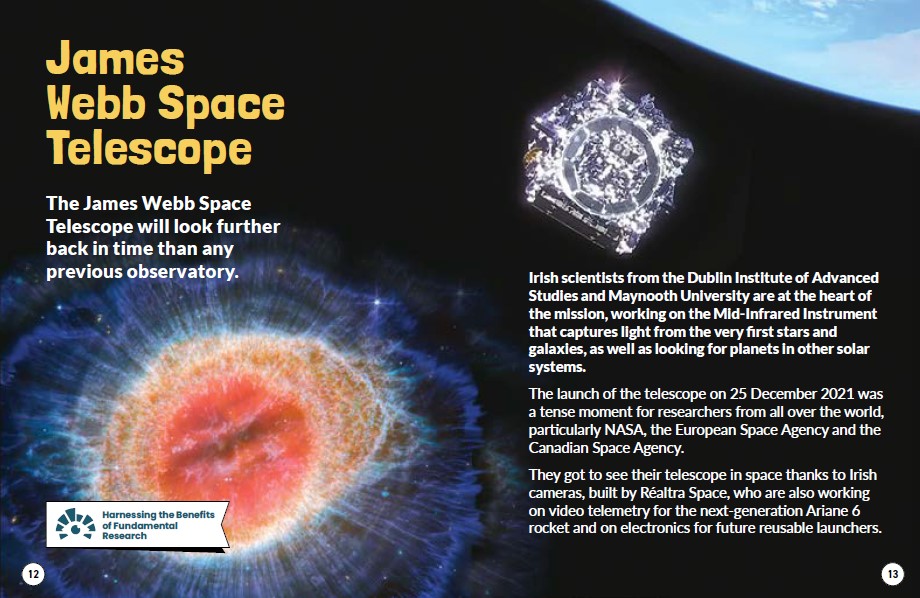
if you want to read it here is a PDF file of the whole thing for you to download at your leisure. When I posted about it last time I hadn’t actually seen a hard copy, but I finally got my hands on one:

I can now confirm that it is indeed a little book. I think we’ll find it useful for our own outreach events, open days, etc, in the Department of Theoretical Physics, and so will the many colleagues in other Departments in other universities and research institutes whose work is also featured.

I was very gratified to see myself get a mention (on page 41), though it’s not really about me but about Euclid which has generated considerable interest in the general public already and is set to continue doing that for many years. As you can see, there’s also a double-page spread of JWST, though unfortunately it does not name the scientists involved; Paddy Kavanagh is the main man at Maynooth for matters JWST.

Mathematical Mystics at Maynooth

Posted in History, mathematics, Maynooth with tags , , , on January 25, 2024 by telescoper

I’m indebted to my colleague David Malone for sending me this small excerpt from an old issue of the Kalendarium of St Patrick’s College, Maynooth, dating back to the 1960s, which deals with the appointments of new members of staff

Halfway down you will see a reference to Mathematical Mystics!

This is obviously a mistake. It should of course be Mathematical Psychics Physics. I also think the name of the Mathematical Mystics lecturer should be Tigran Tchrakian. I think these are both transcription errors from somebody’s very bad handwriting! The current Department of Theoretical Physics at Maynooth was formerly known by the title Mathematical Physics.

There are some other points of interest. in Experimental Physics you will find mention of a young Susan Lawlor who is now better known as Susan McKenna-Lawlor, a very eminent astrophysicist who specialized in space instrumentation, now in her eighties.

I’m also amused by the existence of a lecturer in Elocution

The historical background of St Patrick’s College is that it was primarily a Catholic theological institution (founded in 1795) although it taught secular courses and was a recognized college of the National University of Ireland from 1910. It was only in the mid-1960s that it was opened to lay students, which expanded the numbers considerably. In 1997 that the secular part separated and formed NUI Maynooth (now known by the marketing people as Maynooth University). The remaining theological institution is known as St Patrick’s Pontifical University (or St Patrick’s College or just Maynooth College).

A major role for St Patrick’s College was the training of priests and I suppose it was important that priests should be well spoken, hence the lectures on elocution…

Near the top in connection with Sociology you can see the title An tAth which is the Irish language way of writing the abbreviation “Fr” for “Father”, indicating a priest; “father” is athair and the an is a definite article. Note the lower case t in front of Ath which is an example of prothesis.

Finally, right at the top of the page you can see the name Donal Linehan, which will be familiar to Irish rugby fans but I don’t know if there’s a family connection between the former Ireland intentional who is now a TV commentator and the lecturer in Roman and Civil Law.

Prophet Song by Paul Lynch

Posted in Literature, Maynooth with tags , , , on January 23, 2024 by telescoper

My ongoing quest to keep up with the literature brings me to the winner of the 2023 Booker Prize, Prophet Song by Paul Lynch. Before writing a few comments on this extraordinary work I should mention the Maynooth connection: the book was written during the writer’s tenure as Writer-in-Residence at Maynooth University which involves teaching creativity and novel-writing, on the MA in Creative Writing, which is now in its second year.

So to the book, which is a grimly compelling novel set in an alternative Ireland after a far-right takeover revolving around Eilish Stack and her family. Her husband, Larry, a trade unionist, is detained by the state police and her efforts to find him get tangled up in the disintegration of society into civil war during which she tries desperately to keep herself and her family together as anarchy descends. We learn little of what goes on in the wider world, except what Eilish herself sees and rumours she picks up from others, but eventually, her home engulfed by the fighting, she is forced to attempt to flee with what remains of her family and cruelly exploited by human traffickers.

I won’t give away any details, but the story is bleak and at times is truly harrowing. I had to stop reading at one point – when Eilish visits a military hospital in the penultimate chapter, for those of you who have read it.

I have to admit that it took me a while to get the hang of Lynch’s writing style, with no conventional division into paragraphs and minimal punctuation. For example, speech is not included in quotation marks but embedded into the often very long sentences that blur the distinction between Eilish’s inner thoughts and the outer reality. Once I got used to it, however, I found it gripping despite the relentless horror of Eilish’s situation: Lynch conjures up an atmosphere of dread and hopelessness as effectively as George Orwell does in Nineteen Eighty-Four, with which this book has been rightly compared, but the prose also seems to me to be heavily influenced by James Joyce.

This is not an easy read, but is an important novel that should be read. I don’t think it will be long before it is on the syllabus for Leaving Certificate English.

I’ll just make further comment. Many of the reviews I have read of this book describe it as an “alternative future” and a warning about the rise of the fascism, but that’s only a part of the story. To me, it’s not really an alternative future, but an alternative present. The point is all the horrors described in this book – the murders, the abductions, the torture, the indiscriminate slaughter of innocent civilians, the people trafficking are actually happening right now elsewhere in the world, but those of us living in safer places can view them from a safe distance or, more likely, just ignore them. The novel’s power is that it makes such things happen on the familiar streets of Dublin, making the unthinkable an alternative reality.

You have to wait until near the very end of the book for Paul Lynch to explain the title, which he says far more eloquently, essentially what I said in the preceding paragraph.

…and the prophet sings not of the end of the world but of what has been done and what will be done and what is being done to some but not others, that the world is always ending over and over again in one place but not another and that the end of the world is always a local event, it comes to your country and visits your town and knocks on the door of your house and becomes to others but some distant warning, a brief report on the news, an echo of events that has passed into folklore…

Paul Lynch, Prophet Song

The tale ends with a crowd of refugees – Eilish and her young children among them – getting into small boats to attempt to reach safety across the sea. Frail as it is, that’s their only hope of survival and a better life…
Spring School on Topological Aspects of Low-dimensional Quantum Physics at Maynooth!

Posted in Maynooth, The Universe and Stuff with tags , , on January 23, 2024 by telescoper

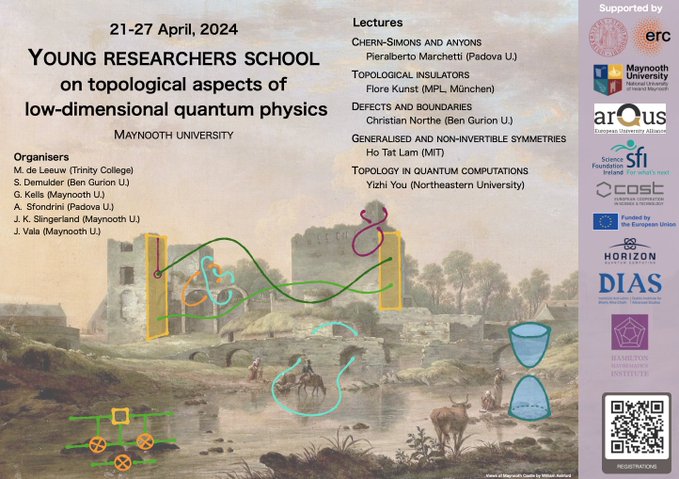
I’ve been asked by colleagues not in Barcelona to use the medium of this blog to advertise the fact that Maynooth University is hosting an exciting spring school for Early Career Researchers this April:

Registration is now open!

For further information and to register see here. Please forward to anyone who might be interested!

Among the Travellers

Posted in Biographical, Cardiff, Education, Maynooth with tags , , , , , , on January 7, 2024 by telescoper

With Nollaig na mBan yesterday that’s the festive season over for me, and time to resume my sabbatical. Joining the crowd of post-Christmas travellers at the airport, today I took my first flight of 2024, complete with last-minute change of gate, apart from which all went perfectly to plan. I won’t be returning to Barcelona immediately, however, as I have a things to do in various different parts of not-Barcelona.

I’m in Cardiff now, where it is fine and dry but very cold, and spending a few days in Cardiff to start with. After that I’ll be taking a train to London to attend a meeting at the Royal Astronomical Society, followed by dinner at the R.A.S Club on Friday 12th January.

Coincidentally, Friday’s dinner is rather appropriately at the Travellers Club, rather than the usual Athenaeum (which is unavailable for some reason). I couldn’t attend any of these occasions between October and December as I was in Barcelona, and for a couple of years. In fact I haven’t been able to attend much at all since the bicentennial dinner in 2020 because of the pandemic and subsequent workload issues. I’m not sure if I’ll be able to go to any others this year either, so I’m looking forward to Friday (despite having to pay the arrears on my subscription) because it is the Parish Dinner, when new members are elected. Owing to the arcane complexity of the rules, and the fact that it all happens after the consumption of a great deal of wine, this usually makes for an amusing occasion.

Meanwhile, in Maynooth, preceded by a few days of revision lectures and tutorials, the January examinations start on Friday 12th January too. Students will therefore be returning from their breaks, swapping the Christmas decorations for the austerity of the examination halls. Although I’m not involved in examinations this year, I’d like to take this opportunity to wish all students at Maynooth and elsewhere all the best for the forthcoming ordeals, and the same for all academic staff whose ordeal by marking will come in due course…

A Test for Presidential Plagiarism

Posted in Education, Maynooth with tags , , , , on January 3, 2024 by telescoper

I was shocked today to hear the news that Claudine Gay has resigned from her post as President of Harvard University amid allegations of plagiarism.

I think we can all agree that plagiarism is a serious form of misconduct that constitutes a breach of academic integrity and, as such, should be punished wherever it is found. But just how widespread is this kind of unethical behaviour among the leaders of public universities?

Fortunately, I have thought of a simple test to identify Presidential plagiarism, which I encourage academics everywhere to carry out.

One of the documents for which a University President (or Vice Chancellor, or equivalent) is responsible is their institution’s Strategic Plan, which normally carries their Leader’s signature on the front page.

If you work in a University, therefore, all you need to do is run this document through the plagiarism detector Turnitin. This will compare the document with others available on the internet and produce a similarity report indicating how much of it has been copied from elsewhere. If the document is found to have been significantly plagiarized, then your President (or Vice Chancellor, or equivalent) should be forced to resign.

This simple test will probably lead to many so-called leaders being removed from office so, as well as improving academic integrity, it will also save institutions a great deal of money in salary costs. It’s a win-win situation for all (except perhaps for the ex-Presidents).

P.S. Please feel free to copy this idea.

Euclid: a Year of Diversities

Posted in Biographical, Euclid, Maynooth with tags , , , , on December 28, 2023 by telescoper

I have now entered that strange twilight zone between Christmas and New Year during which it is difficult to remember which day is which, so I thought I’d just do a quick retrospective about the thing that has the biggest effect on my professional life in 2023, namely the Euclid satellite.

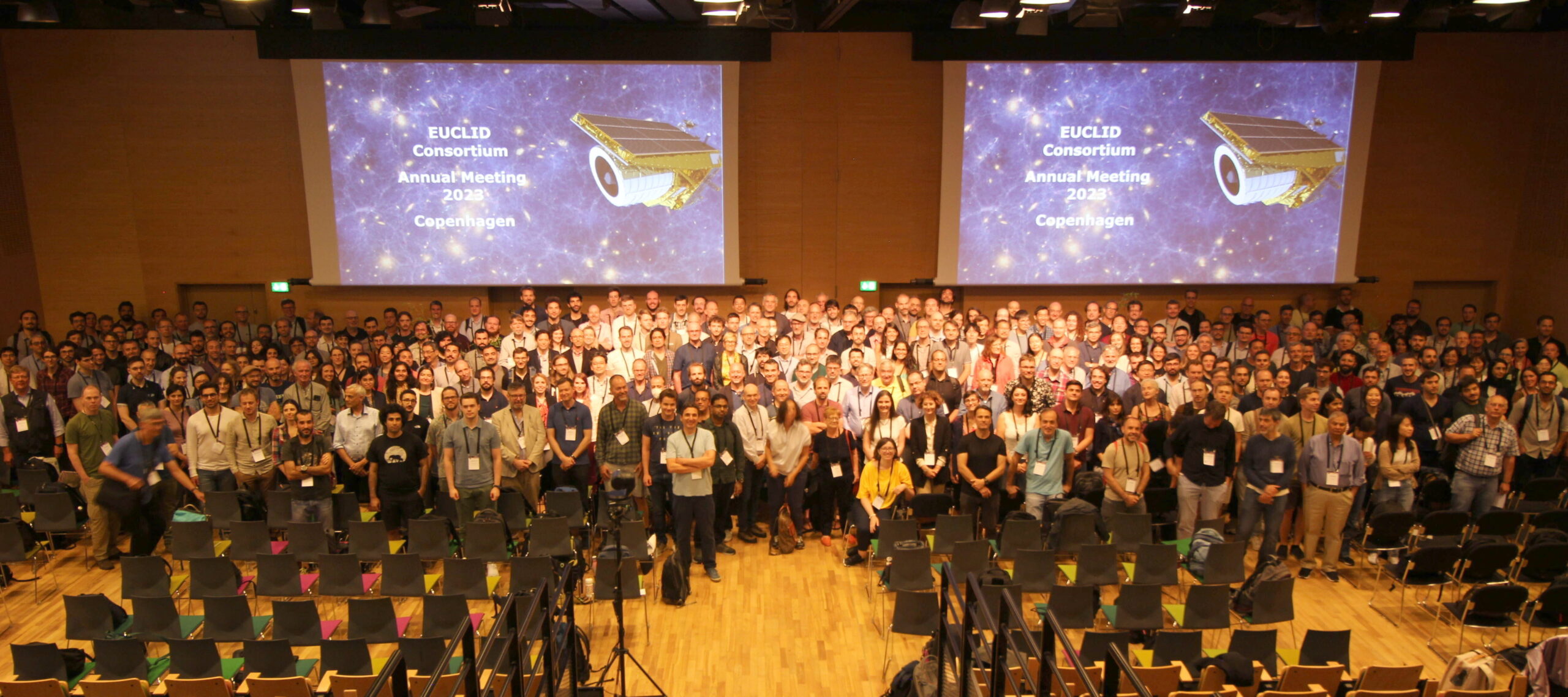
Euclid Consortium Meeting 2023 Conference Photograph

Euclid was launched halfway through the year, on July 1st, an event that took place just a week after or so after the annual Euclid Consortium Meeting in Copenhagen when I took over as Chair of the Euclid Consortium Diversity Committee. The latter led to a huge increase in the number of telecons I had to attend, not only the ECDC’s own bi-weekly Zoom meetings but also various other committees that the ECDC Chair attends ex officio. Much of the Chair’s work is confidential, which means there is no-one to consult with about the difficult matters. Had I not been on sabbatical since September I don’t think I would have had either the time or the energy to carry out these duties. It has taken me quite a while to get the hang of this role, but I do feel that it’s important and that I have contributed in a small way to the Euclid Consortium.

As for the scientific side of Euclid, after a few technical issues the commissioning of Euclid’s instruments is now more-or-less over and the final preparations are being made for the survey proper, which will take commence in the New Year. What is going on now is called a phase diversity analysis, which is being used to verify and improve the performance of the optical system.

In November, a set of Early Release Observations were published. Early in the New Year a number of scientific papers about these will be published, along with other papers about Euclid in general, including an overview paper that provides a high-level description of the mission. Data relating to the Early Release Observations will also be released to the general public.

After that the survey will begin in earnest. The full exercise will take six years to complete – I’ll have retired before it finishes – but there will be a first data release (DR1) using one year’s worth of survey data. That should give a good idea of how well it’s all going to work out for the full survey. That data will be made available to the public.

If all goes to plan, after the annual EC meeting (which next year will be in Rome, from 17th to 21st June), I’ll be stepping down as ECDC Chair and indeed from the ECDC altogether. That is just as well because my sabbatical will be over at the end of August and I’ll be back to a full teaching and admin load at Maynooth, assuming there’s still a Department to return to!