Archive for the Maynooth Category

Announcing the Maynooth MSc in Theoretical Physics & Mathematics!

Posted in Education, Maynooth on May 9, 2023 by telescoper

About a month ago I used the medium of this blog to give a sneak preview of our new MSc course in Theoretical Physics & Mathematics which had just been approved. Well, the course details are now public and now it is open for applications. For further details see here.

The new postgraduate course will be run jointly between the Departments of Theoretical Physics and Mathematics & Statistics, with each contributing about half the material. The duration is one calendar year (full-time) or two years (part-time) and consists of 90 credits in the European Credit Transfer System (ECTS). This will be split into 60 credits of taught material (split roughly 50-50 between Theoretical Physics and Mathematics) and a research project of 30 credits, supervised by a member of staff in a relevant area from either Department.

This new course is a kind of follow-up to the existing undergraduate BSc Theoretical Physics & Mathematics at Maynooth, also run jointly. We think the postgraduate course will appeal to many of the students on that programme who wish to continue their education to postgraduate level, though applications are very welcome from suitably qualified candidates who did their first degree elsewhere.

Postgraduate admissions in Ireland operate differently from the UK, in that there is a central system in Ireland (called PAC) that is similar to the undergraduate admissions system; in the UK PG courses are dealt with by individual institutions. You will need to apply online via PAC after the following the instructions here. The requisite PAC code for the full-time version of the course is MHQ56.

Please note also that Maynooth University offers Taught Masters Scholarships for high-flying applicants. If you apply by 30th June you may be eligible for one of these!

Changes in the Calendar

Posted in Biographical, Cardiff, Education, Maynooth on May 7, 2023 by telescoper

As I often do on a Sunday morning, I just sat down to look at my timetable for the forthcoming week. Until Friday 12th this is “Study Week” and my Outlook calendar is noticeably less cluttered than recently because teaching ended on Friday 5th May. Although I had a lecture and a tutorial on Friday morning I did find Campus was already much quieter than usual. Many students at Maynooth University rent rooms here for only part of the week and Fridays are generally quiet because some students leave on Thursday evening if they don’t have classes on Fridays, and I suppose some that do usually have Friday classes will have had them cancelled as the lecturer had finished the syllabus. My two classes on Friday were actually for revision, actually.

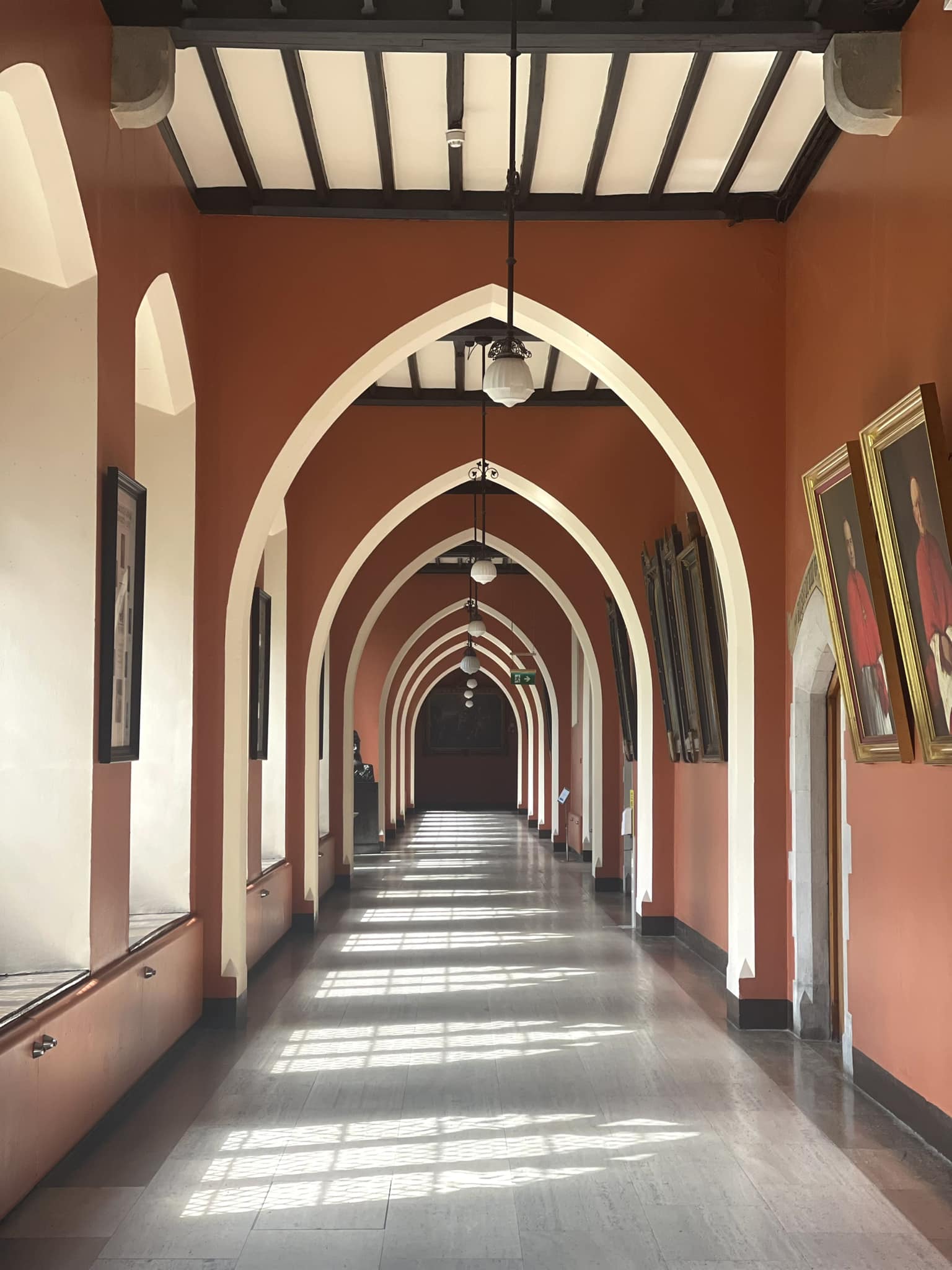
At any rate the cloisters of St Patrick’s House looked rather empty on Friday as I headed for a quick lunch in Pugin Hall before the final-year project presentations in the afternoon.

Incidentally, colleagues in other departments have reported a drastic decline in lecture attendance over the last few weeks. I can’t say I’ve noticed that myself but my classes are by no means statistically representative.

I will be doing two more revision classes next week, one for Advanced Electromagnetism and one for Computational Physics. don’t know how many will attend these but it’s the students’ last chance to ask me questions before the examinations, which are on Thursday 18th May and Saturday 20th May respectively. Friday 12th May marks the start of the Examination Period – for some reason this always starts on a Friday – during which many teaching rooms are unavailable so we don’t usually do revision classes beyond Study Week.

I won’t be teaching either of these modules next academic year. In fact I won’t be teaching anything next year, as I’ll be off on sabbatical. I’ll miss the teaching and am particularly sad that I won’t see the class in my 3rd year module again, unless some of them remain for Masters or PhD studies, as they will complete their studies next year while I am away. Since I am officially on leave from 1st September 2023, my final teaching-related responsibility for this year will be marking the repeat examinations in August.

In case anyone asks, I don’t know who’ll be delivering the modules I did this year, but the handover shouldn’t be too hard as there are complete sets of notes for all of them (and plenty of problem sets).

I don’t know which modules I’ll be giving when I return either, but I hope there’s an opportunity for a bit of a reshuffle. In particular, I’ve been doing Computational Physics for six years now and maybe it’s time for a fresh pair of hands on that one. It’s not that I dislike it at all – in fact I like it – but I think there are good arguments for a refresh every now and again. I’ve always taken the view that anyone employed in a physics department should be able to teach any subject up to the 3rd year so I don’t particularly mind what happens next. At any rate it would be nice to have a go at a few different things before I retire. Who knows, I might even get to teach some astrophysics or cosmology at some point?

It’s not just about undergraduate teaching, of course. Study Week or not I still have the regular meetings with my research students, a cosmology discussion group and a Euclid telecon. But my main objective between now and the arrival of my examination scripts to mark is to finish two manuscripts that are very late. I’ve no excuse for that other than poor time management by myself.

Looking further ahead, the launch of Euclid is scheduled for the first half of July and I hope to find time to organize some sort of public event related to this. I’m also attending the Euclid Consortium annual meeting in Copenhagen at the end of June. I’ve also been invited to contribute to the UK National Astronomy Meeting, which is in early July this year, in Cardiff…

Assessment in the Age of AI

Posted in Education, Maynooth with tags , , , , on May 5, 2023 by telescoper

The arrival of AI bots such as ChatGPT continues to cast a shadow over student assessment in the third-level institutions, as academics are realizing that these algorithms are getting better and better at the tasks asked of students, especially straightforward writing tasks (perhaps including simple calculations) as well as the traditional student essay.

Before going further I have to admit that I’ve never really understood the obsession in some parts of academia with “the Essay” as a form of assessment. I agree that writing skills are extremely important but they’re not the only skills it is important for students to acquire during the course of a degree. Learning how to do things seems to me to be more important than writing about things other people have done. While forms of assessment in science subjects have evolved considerably over the last 50 years, some other domains still seem to concentrate almost exclusively on “The Essay”.

Systems such as ChatGPT can produce text on demand (with a variable degree of success) using sources on the internet. This is not great at dealing with technically complex specialist topics but can produce plausible if somewhat superficial offerings in many circumstances where something less demanding is required. I know that staff in some science departments find that these systems can score essentially 100% on their first-year coursework assignments. Urgent meetings are being called and working groups being set up about this. Panic is in the air.

My immediate response to the situation is very twofold:

  1. Don’t panic!
  2. If an assessment can be aced by a bot then it should not contribute towards credit unless the students do it in a supervised environment, e.g. as an in-class test rather than a take-home assignment.
  3. More importantly, if a student with only a superficial knowledge can score a high mark on an assessment, what is the value of the assessment anyway?

It seems to me that the intervention of ChatGPT should cause academics to reflect much more deeply on what it is that they are trying to assess, and that should lead to new forms of assessment that can’t be performed by AI bots as well as the scrapping of many existing assessment activities, many of which (in my opinion) are pointless. There is so much inertia in academia, however, that such a radical rethink will be forthcoming on the timescale required.

All of which waffly nonsense reminded me of a joke I heard many years ago.

Q: How many academics does it take to change a lightbulb?

A: What do you mean, change?

Sisters, Lovers & Traitors: INO in Maynooth

Posted in Maynooth, Opera with tags , , , , , , , on May 4, 2023 by telescoper

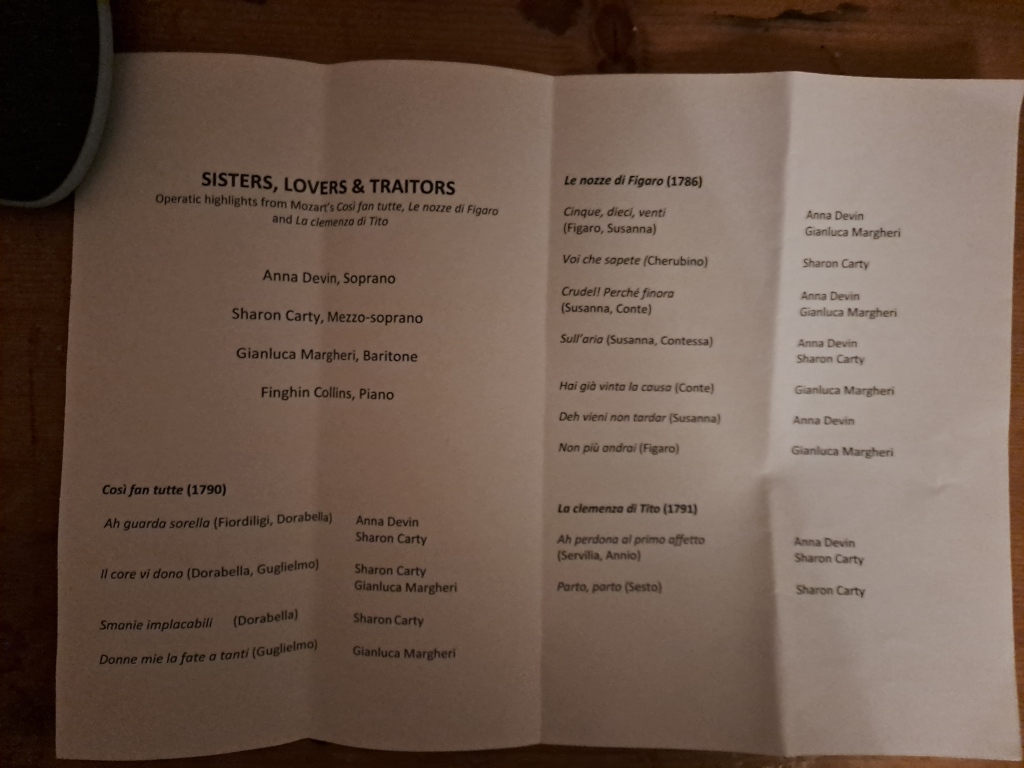
I don’t often get the chance to attend a concert in Maynooth, but I did this evening when I went to the Aula Maxima on Maynooth University South Campus for a performance of arias and duets from Mozart operas by singers from Irish National Opera.

The artists involved were Anna Devin (Soprano), Sharon Carty (Mezzo), and Gianluca Margheri (Baritone) . All were excellent, but I particularly loved Italian Gianluca Margheri’s richly sonorous voice. Fine accompaniment was provided on the piano by Finghin Collins (who, incidentally, last featured on this blog in an item about a very different type of music).

INO are currently rehearsing their forthcoming production of Cosi fan tutte which provided the first four pieces; it features two sisters of course, Fiordiligi and Dorabella. These were followed by a selection from Le nozzle di Figaro, including the lovely duet Sull’aria. The final two pieces were from La clemenza di Tito, a much less familiar work, which was composed at roughly the same time as The Magic Flute and is arguably Mozart’s final opera.

The encore was a trio performance of Là ci darem la mano from Don Giovanni, usually a duet but in this case with the part of Zerlina shared between Anna Devin and Sharon Carty.

It was a very enjoyable programme, very well received by the audience, and an ideal break from a busy end-of-term schedule, especially on a rainy night like tonight. Now, I must remember to get tickets for Cosi fan tutte to give me a break from examination marking!

Swan Update

Posted in Maynooth with tags , , on May 4, 2023 by telescoper

Not long ago I posted an item about the swans of Maynooth, expressing anticipation of the forthcoming cygnets. Well, they have arrived at last; seven in total. Here’s a picture I took this morning near the harbour and one a couple of days ago further along the Royal Canal.

The family probably won’t go far from their nest while the cygnets are very small, and the adults will stay very close to their little ones for quite a while, but soon they’ll be taking longer journeys and the youngsters will roam a little on their own. I spoke to two guys who work by the canal who have a little shed next to the harbour on the Royal Canal. They told me that when they’ve grown up a bit the cygnets regularly knock on the door of the shed to ask for food. They also warned me not to make any sudden movements near the Swan family, as Mr Swan can be very aggressive. All of them were very relaxed when I saw them, however.

P.S. It is interesting that the word “swan” is Germanic (cf. Schwann) while the word “cygnet” is via French cygne (cf. Latin cygnus, Greek κύκνος); the Irish word for “swan” is “eala”.

Lá Bealtaine shona daoibh go leir!

Posted in Biographical, Education, Maynooth on May 1, 2023 by telescoper

Spring on Campus

As well as being International Workers Day, today, 1st May, is Beltane (Bealtaine in Irish) is an old Celtic festival. The month of May is called Bealtaine in Irish and May Day is called Lá Bealtaine, which is one of the so-called Cross-Quarter Days that lie (roughly) halfway between the equinoxes and solstices, in this case the Spring Equinox and the Summer Solstice. The upshot of all this is that today is a Bank Holiday, so I have the day off.

If the weather holds I shall spend a bit of time in the garden. Yesterday was quite warm but very showery. I tried three times to hang out my washing to dry in broad sunshine only to have to bring it in again when a torrential downpour arrived. Eventually I gave up.

On the corresponding days last year, the year before and the year before that I was wondering about how the pandemic would pan out. Back on May 1st 2020 I didn’t think it would last until May 2021 and back in 2021 I did not forecast that we would still have over a thousand new infections every day in May 2022.  Fortunately the pandemic seems to be dying down, though the consequences will be with us for some time.

After toady’s holiday we have four days left of teaching term at Maynooth University, then there’s a study week for the students and then the exams begin. I’ve more-or-less managed to keep on track so my remaining classes will be mainly revision. It will be quite a busy week though. Friday 5th May is the deadline for this year’s Computational Physics projects, so I’m anticipating last-minute queries all week. As well as this, and revision lectures and tutorials, I will be attending the annual Dean’s Lecture on Wednesday and attending a concert performance by members of Irish National Opera in the Aula Maxima on campus on Thursday as part of the Arts and Minds Festival.

No Tension at Redshift Ten

Posted in Maynooth, The Universe and Stuff with tags , , , , , on April 29, 2023 by telescoper

I know it’s the Bank Holiday weekend but I could resist a quick post about a new paper that hit the arXiv yesterday (where all new astrophysics papers worth reading can be found). It is led by Joe McCaffrey who is a PhD student in the Department of Theoretical Physics at Maynooth University. The paper has been submitted to the Open Journal of Astrophysics, but obviously I am conflicted so have assigned it to another editor.

UPDATE: the paper is now published here.

As many of you will be aware, there’s been a considerable to-do not to mention a hoo-hah about the detections by JWST of some galaxies at high redshift. Some of these have been shown not to be galaxies at high redshift after all, but some around z=10 seem to be genuine.

Anyway, the abstract of Joe’s paper is this:

Recent observations by JWST have uncovered galaxies in the very early universe via the JADES and CEERS surveys. These galaxies have been measured to have very high stellar masses with substantial star formation rates. There are concerns that these observations are in tension with the ΛCDM model of the universe, as the stellar masses of the galaxies are relatively high for their respective redshifts. Recent studies have compared the JWST observations with large-scale cosmological simulations. While they were successful in reproducing the galaxies seen in JADES and CEERS, the mass and spatial resolution of these simulations were insufficient to fully capture the early assembly history of the simulated galaxies. In this study, we use results from the Renaissance simulations, which are a suite of high resolution simulations designed to model galaxy formation in the early universe. We find that the most massive galaxies in Renaissance have stellar masses and star formation rates that are entirely consistent with the observations from the JADES and CEERS surveys. The exquisite resolution afforded by Renaissance allows us to model the build-up of early galaxies from stellar masses as low as 104 M⊙ up to a maximum stellar mass of a few times 107 M⊙. Within this galaxy formation paradigm, we find excellent agreement with JADES and CEERS. We find no tension between the ΛCDM model and current JWST measurements. As JWST continues to explore the high redshift universe, high resolution simulations, such as Renaissance, will continue to be crucial in understanding the formation history of early embryonic galaxies.

arXiv:2304.13755

The key figure is this one:

The solid curves show the number of galaxies of a given mass one would expect to see as a function of redshift in fields comparable to those observed with estimated values from observations (star-shaped symbols). As you can see the observed points are consistent with the predictions. There’s no tension, so you can all relax.

Maynooth University Library Cat Update

Posted in Maynooth with tags on April 28, 2023 by telescoper

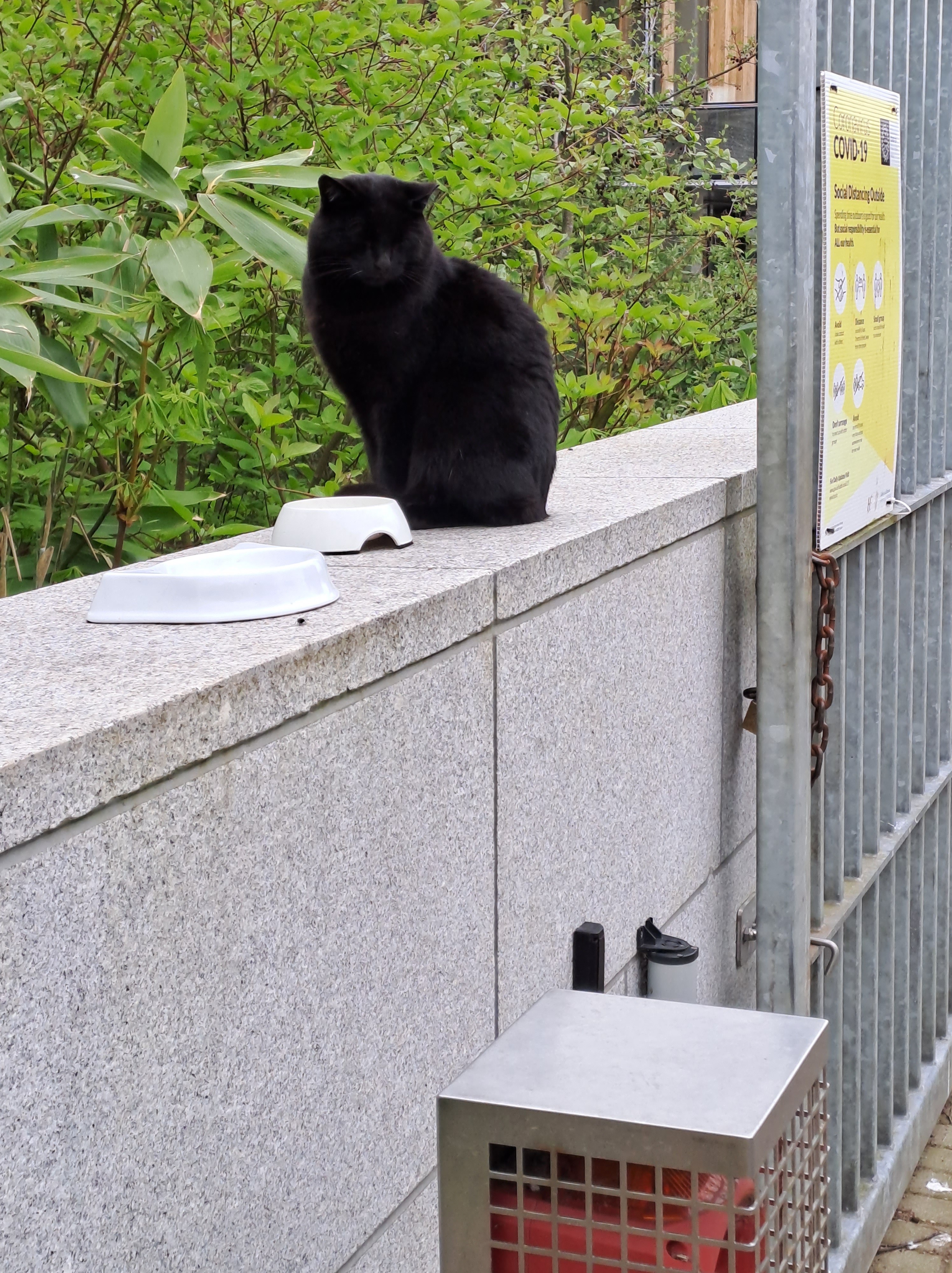
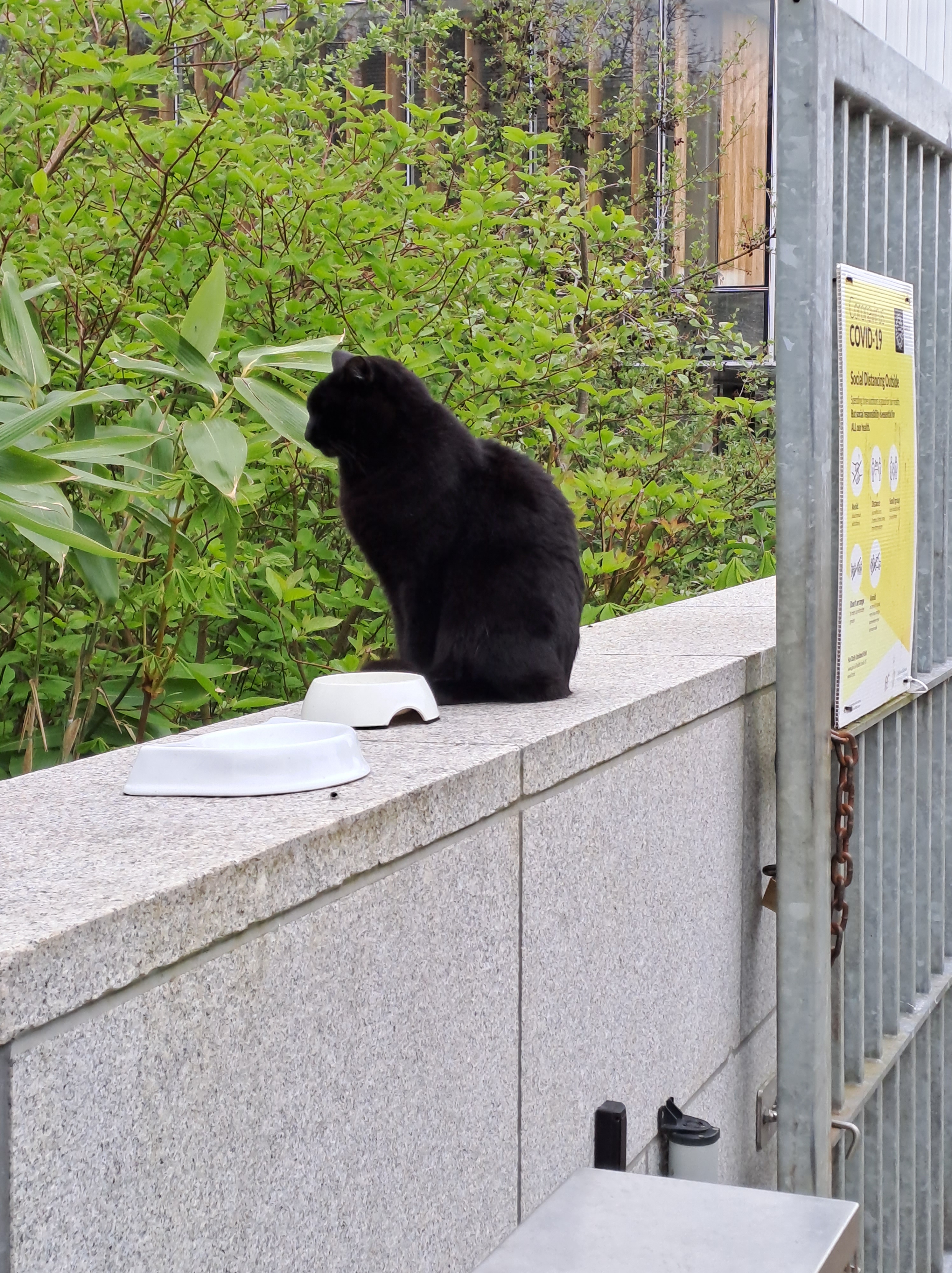
It’s the Friday of the penultimate week of teaching term at Maynooth University, and it’s also a long weekend with the May Bank Holiday on Monday. I thought I would just give an update on our resident feline before I go to a seminar and then head into Dublin for a concert. I passed by Maynooth University Library Cat yesterday on my way back to the Department after lunch, and although he seemed well he wasn’t very sociable. I think he generally gets a bit sleepy after lunch. At any rate he seemed reluctant to open his eyes!

The Swans of Maynooth

Posted in Maynooth with tags , on April 25, 2023 by telescoper
The Royal Canal near Maynooth, with Maynooth railway station in the background to the left.

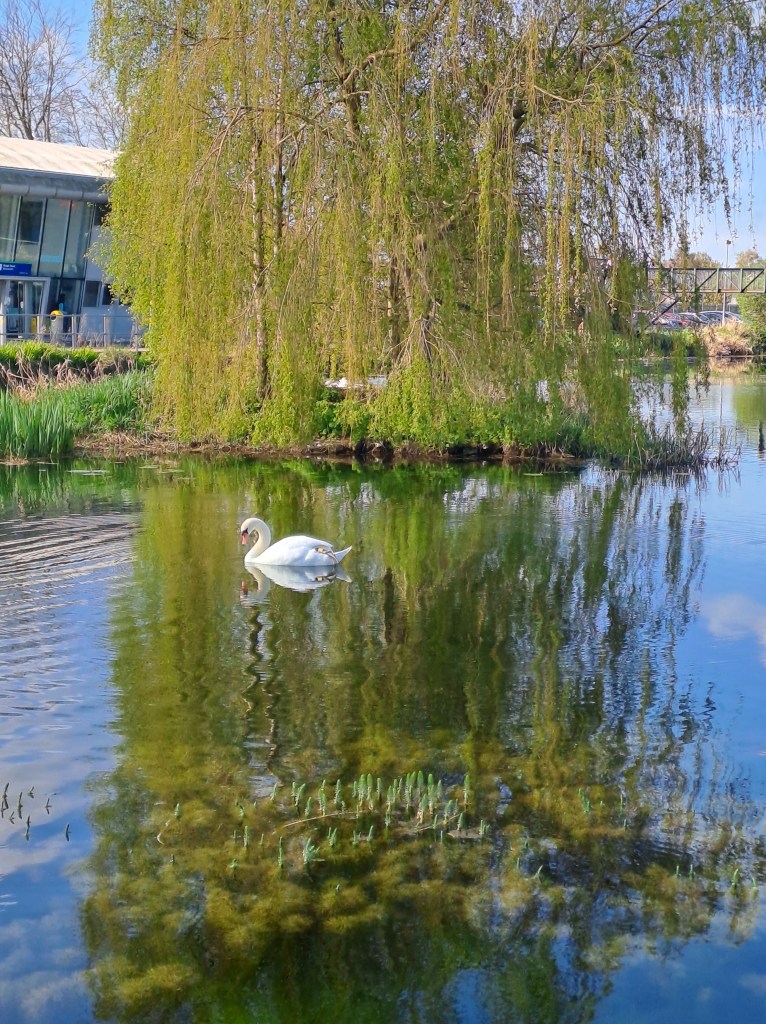
Most mornings I walk to work at Maynooth University along a route that includes a short section of the towpath of the Royal Canal, roughly from the Mullen Bridge to Maynooth Harbour. There is a small island there which plays home to a pair of mute swans who have been nesting there at least as long as I’ve lived in Maynooth (more than five years). Swans mate for life and they’ve found a great spot there on the little island and have no reason to move.

I took the above picture as I walked in this morning. In the foreground, you can see the male swan (the cob) who is on patrol. If you look carefully you can see a splash of white on the island which is his partner, the pen, sitting on their nest. As you can see, the water in the canal is very clear, which made for an interesting combination of reflection and transmission. I don’t know the name of the plants that grow on the bottom of the canal, and would be grateful if anyone could enlighten me.

This time of year is particularly interesting on the canal because it is about now that the annual brood of cygnets will appear. The young will stay with their parents for the best part of a year then, suddenly, around March, they’re off to find their own way in the world and make room for the next generation.

Swans are bad-tempered at the best of times but when the eggs hatch and the chicks appear, the pen will become extremely aggressive. For most of the year, the swans tolerate other birds on their island, but when they have very young cygnets they are very protective, and regularly have a go at the other birds. Crows, herons and seagulls are a particular danger.

Anyway, they should hatch very soon now, and there’s always an overload of cuteness when they go for their first trip on the water on their mother’s back, like passengers on a stately galleon.

On SciPost…

Posted in Maynooth, Open Access with tags , , , on April 24, 2023 by telescoper

On of my colleagues this morning passed on details of a recent publication to put on the Twitter feed of the Department of Theoretical Physics at Maynooth. As far as I’m aware this is the first paper authored by a member of the Department to be published on SciPost, a Diamond Open Access journal.

I’ve known about SciPost for quite a while, but have been preoccupied with the Open Journal of Astrophysics (OJAp) and have not tracked its progress very closely, but I’m glad to see it going well. Its business model is very different from the Open Journal of Astrophysics but its commitment to publishing high-quality scientific papers free of charge for authors and readers alike is most commendable. Looking at the physics section I see that there are quite a few highly-cited papers among them, over a wide spread of topics, including high-energy physics. There are only a few papers in Astronomy, however- only three when I looked.

I’ve heard it said that one of the advantages of SciPost is that, because it allows authors to keep the copyright on their publications, they can post articles freely on arXiv for wider distribution without embargo or other restriction. That is true and laudable. The logic of the Open Journal of Astrophysics, however, is that most astrophysicists use arXiv as their primary source of research literature, so if you’re going to read it on arXiv why not dispense with the separate journal and just use an overlay?

Not all research areas are so wedded to the arXiv, however, and it is great that there’s a free alternative. I’m a little surprised that nobody has set up a particle physics overlay journal (yet), as the HEP community seems to use arXiv a lot. When I asked a particle physicist about this they said it had been discussed, but they decided that they were happy enough with SciPost as an OA platform. Fair enough. The important thing to me is to avoid the excessive Article Processing Charges (APCs) imposed by mainstream journals for OA publishing.

I note that the HEP community has SCOAP3, which pays for articles to appear in Open Access form in traditional journals. In other words it hides the cost from the scientists and effectively subsidizes the academic publishing industry. It is important that there are alternatives to traditional journals so that authors to have a choice whether to adopt the SCOAP3 route.

One final comment. On the Finance page for SciPost it states that the estimated average cost per paper published is €400. That’s at 2019 rates. It’s probably higher now. That cost is a lot less than a typical APC but is still about a factor of ten higher than the cost per paper for OJAp. SciPost has a large network of sponsors so it can cover this cost. The overlay model used by arXiv is much cheaper to run.