Archive for the Maynooth Category

Offering Refuge

Posted in Biographical, LGBTQ+, Maynooth, Politics with tags , , on March 6, 2022 by telescoper

As the humanitarian consequences of Russia’s invasion of Ukraine unfold, Ireland expects something like 20,000 refugees to arrive many of whom will require accommodation. Around 1300 have arrived in Ireland so far, but these have mainly been taken in by Ukrainian family members and friends already in Ireland.

(The number of Ukrainian refugees so far accepted into the UK is just 50.)

We had a Department Meeting on Friday which began with a minute’s silence for the dead, the bereaved and all those suffering in ways we can’t even begin to imagine as a result of Russia’s heinous crimes in Ukraine. As I stood in silence I felt frustration at the smallness of the gesture; that feeling wasn’t at all assuaged by making a donation to the Irish Red Cross appeal later that evening.

When I learnt that the Irish Red Cross has launched an appeal for emergency accommodation I saw the chance to do something practical. I have a spare room, which I decided to register as potential accommodation for a refugee. It’s quite a small bedroom but can be made available very quickly once I’ve moved a few things out and given it a clean. At least the bed is quite comfortable: I know because I slept in it for several weeks before my new bed arrived. Of course if anyone comes they can have the run of the rest of the house.

Pledging accommodation in this way is not a trivial process. The property and the host have to be vetted to check that nothing nefarious is going on. I expect I’ll be contacted next week for this purpose and if my pledge is accepted and an appropriate individual found, a case officer will be assigned to ensure everything is going OK. There’s no guarantee my offer will be accepted, though. I’ll just have to wait and see.

As a single adult it would obviously be more appropriate to host another single adult. It crossed my mind that an offer of accommodation in a university town such as Maynooth might enable a student or academic from Ukraine to continue their studies in some way, but I’m not going to limit the range of possible people to that. I can offer an LGBT+ friendly environment too if that is important to anyone.

I’ve lived alone for quite a long time now so it is not without apprehension that I registered this pledge. I can see that there may be many difficulties, but they would be as nothing compared to the difficulties facing the Ukrainian people right now. I feel it’s the least I could do.

I am glad that, within the European Union, Ireland is playing its part in the response to the Ukraine crisis. When I look across the Irish Sea at the United Kingdom’s callous indifference to refugees alongside its half-hearted implementation of sanctions on Putin’s evil regime, I am once more glad I no longer live in a country with such a corrupt and mean-spirited Government.

Beard of Ireland 2022 Poll sees competition bristling

Posted in Beards, Biographical, Maynooth on March 5, 2022 by telescoper

Yes, I know there are far more important things to think about these days but if you want to take a break from doom scrolling then you might want to cast your vote in the St Patrick’s Day Beard of Ireland 2022 poll.

Owing no doubt to some form of administrative error, I actually won this in 2020 but sank without trace last year. I’m in the first round group this year and will no doubt be eliminated but I’d be happy if I could cling on to the fourth place (out of four) that I managed last year.

kmflett's avatarKmflett's Blog

Beard Liberation Front

Press release 5th March

Contact Keith Flett 07803 167266

BEARD OF IRELAND 2022 POLL SEES COMPETITION BRISTLING

The Beard Liberation Front, the informal network of beard wearers, has said that competition for the Irish Beard of the Year 2022 is officially open

The 2017 winner was politician Colum Eastwood who bearded broadcaster William Crawley for the annual Award.

In 2018 the DUP’s Lee Reynolds shaved writer Dominic O’Reilly for the honour with Colum Eastwood in a steady third place.

In 2019 Lee Reynolds retained the title

The 2020 winner was Maynooth academic Peter Coles

In 2021 Aodhan Connolly shaved opponents to win the coveted title

The BLF says that while traditionally a land of predominantly clean-shaven cultures, Ireland has in recent times become something of a centre for stylish and trendy beards.

Contenders for the title in 2022 include a diverse range of the hirsute- a golfer…

View original post 161 more words

Making a Statement about Ukraine

Posted in Maynooth, Politics with tags , , , , , , on March 2, 2022 by telescoper

A Ukrainian student here in Maynooth gave out some ribbons for staff and students to show support by making a visible statement of solidarity. I’m proud to be wearing one:

Public statements made by institutions such as universities and research organizations aren’t going to end the war in Ukraine, but they can at least offer solidarity with the victims of war and sometimes even offer practical support.

I was very pleased to see on Friday, dust a day after the Russian invasion of Ukraine, that my own University, Maynooth, issued a statement on the conflict:

Maynooth University condemns the invasion of Ukraine and we extend our deepest sympathy at this dark hour to all our Ukrainian colleagues, students and graduates as they anxiously await word from friends and family fleeing their homes.

Also in our thoughts are members of the MU community from the entire region, whose families, lives and livelihoods are affected by the escalating tension and violence.

Maynooth University stands in solidarity with those who cherish democracy and peace, and we will undertake a process of engagement with colleagues from this region to discuss and explore ways to activate our support.  

It doesn’t say much, but it was at least timely and thoughtful. Far better than remaining silent.

The Royal Irish Academy issued a statement on Monday:

The Royal Irish Academy, as Ireland’s national academy for science, the humanities, and social sciences, is shocked and deeply concerned at the military invasion by Russia of Ukraine. The Academy notes with grave concern the damage this represents to educational and scientific institutions, academics, and international research collaboration, and to the social, economic and cultural foundations of Ukraine. The Academy expresses support and solidarity with the National Academy of Sciences of Ukraine. The Academy also wishes to salute the courageous position taken by many members of the Russian Academy of Sciences, who associated their signature with that of several hundred researchers and scientific journalists from their country in an open letter denouncing the aggression against Ukraine by the Russian Federation and calling for its immediate end.

In my own field, I saw a statement issued by various learned societies and organizations in the field of astronomy. It’s not as strong but at least does offer some practical supports for Ukrainian academics fleeing the war:

The European Astronomical Society (EAS), the International Astronomical Union (IAU), the American Astronomical Society (AAS), and African Astronomical Society (AfAS), the Astronomical Society of Australia (ASA), and the Korean Astronomical Society (KAS) have been observing with great concern the events unfolding in Ukraine and fear the adverse consequences for the scientific community, our colleagues, and their families. We have been receiving reports of the dire circumstances they are experiencing: their freedom, safety and even their lives are under threat.

The mission of our societies is to promote and safeguard the science of astronomy in all its aspects, including research, communication, education and development through international cooperation. We believe in free expression and free exchange of scientific ideas and in peaceful collaboration at a global level. The current events jeopardise the scientific cooperation within our European community and with the rest of the world.

We are deeply concerned for the Ukrainian community as well as for the entire region. Triggered by the life-threatening situation in which our Ukrainian colleagues find themselves, we wish to encourage members to help wherever possible in this difficult time for Ukraine. Ukrainian astronomers seeking support should contact the Institute of International Education (IIE) scholar rescue fund, which supports refugee scholars and is activating an Ukraine-specific student emergency fund.

Notice that the Royal Astronomical Society is absent from the list of signatories. Indeed it has not made any public statement whatsoever about the invasion of Ukraine. Their silence is deafening. From where I sit, as a Fellow, their policy of ignoring the conflict just looks spineless and contemptible.

UPDATE: The Royal Astronomical Society has now posted a statement (dated 2nd March):

The Royal Astronomical Society deeply regrets the illegal military invasion of Ukraine, a sovereign democratic nation, by Russia. Our thoughts and hopes go out to our fellow scientists and all the citizens of Ukraine for their safety and well-being. We will be exploring avenues for supporting our fellow scientists who are fleeing the war zone with government agencies and our sister societies.

There are a number of non-governmental organisations working to provide humanitarian relief in Ukraine itself and in neighbouring countries, including the following, who welcome donations:

British Red Cross

United Help Ukraine

Sunflower of Peace

Voices of Children

As far I know the Institute of Physics has so far refused to address the Ukraine crisis.

The Institute of Physics has also now issued a (brief) statement (dated 3rd March):

The Institute of Physics condemns Russia’s actions against Ukraine which are a violation of one of the most fundamental norms of international law that prohibits the use or threat of force by one state against another. As a member of the European Physical Society we support the statement of the Executive Committee.

Physics is a global endeavour, and we continue to support academic freedom of scientists everywhere.

We hope for a quick resolution of the crisis to bring an end to its devastating impacts on the people of Ukraine.

My regard for both these organizations has fallen considerably in the last week, to the point that I now seriously doubt whether I wish to remain a Fellow of either. If there are good reason why I should change my mind, or if either organization has made public statements that I’ve missed, I’d love to hear them, either through the comments box or privately.

P.S. The Royal Society of London is also yet to make a statement on Ukraine. I find this regrettable. Obviously, though, I am not a Fellow of that organization so am not able to resign.

UPDATE: The Royal Society has now joined with the National Academies of all the G7 Nations in making a strong statement against the Russian invasion of Ukraine:

I don’t know why it took a full week to get there, but I am pleased at last that the RAS, IOP and Royal Society have now at least said something. Every little helps.

Two Years of Covid in Ireland

Posted in Biographical, Covid-19, Maynooth with tags , , on February 28, 2022 by telescoper

Trying to find something other than the conflict in Ukraine to write about, I thought I’d do a quick post to mark that we have reached the two year mark since the first “official” case of Covid-19 in Ireland was detected. It seems so long ago that I had forgotten that 2020 was a leap year and the date was 29th February, and the case was reported a day later on 1st March 2020.

It was to be another couple of weeks before we went into the first lockdown and I didn’t start keeping a log of all the cases and deaths until 27th March 2020, but you will find a complete record here (backdated to the date of the first case).

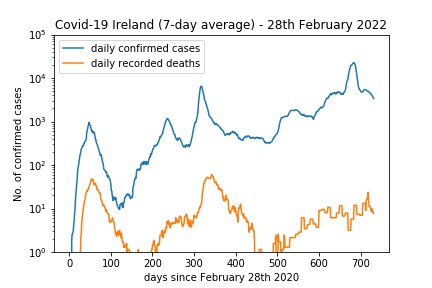
Here is the latest plot, with data complete up to today:

Today is the day that most Covid related restrictions are lifted. There is no longer a legal requirement to wear masks anywhere other than in healthcare settings, though at my University there is a recommendation to do so. I dropped into Dunnes this morning to buy a sandwich to have for lunch and I’d say a slight majority of shoppers (including myself) were still wearing masks, though all the staff I saw were unmasked (a fact which I found very disappointing).

I intend to carry on wearing a face covering in shops and, of course, in classrooms (and especially in labs) for the foreseeable future. I didn’t have any teaching this morning so I don’t know what the students are doing. We are told that if a student refuses to wear a mask then lecturers can’t make them, but peer pressure may do the job for us. We do have a significant number of students off and teaching staff unavailable due to Covid-19 infection but we just have to manage this as best we can.

The requirement to have a PCR test if you are symptomatic has also lapsed for most people in Ireland, but not for me. As I’m over the age of 55 I am still required to take a test if I have symptoms.

The drastic reduction in testing implied by the change in regulations will undoubtedly lead to a steep reduction in PCR-confirmed cases (currently running at a seven-day average of around 3500 per day) and in the light of this I’m not sure it’s worth carrying on plotting the data for much longer. I will persevere for the mean time though.

Job Opportunity in Computer Science, Statistics or Applied Mathematics at Maynooth

Posted in mathematics, Maynooth with tags on February 21, 2022 by telescoper
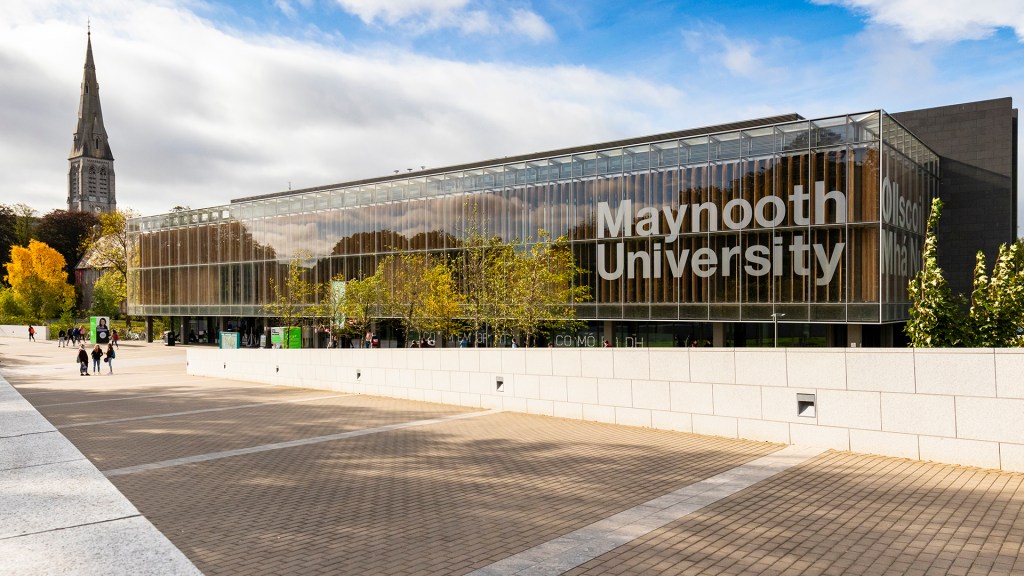
This is the Library not the Hamilton Institute but you get the idea..

Just a quick post to pass on the news that my colleagues in the Hamilton Institute at Maynooth University have a vacancy for a permanent position at Professorial level.

You can find the full advert here. Please feel free to pass it on to anyone you think might be interested.

P. S. I’m looking forward to mentioning further announcements about a number of other permanent job opportunities at Maynooth in the not-too-distant future!

They think it’s all over…

Posted in Biographical, Covid-19, Education, Maynooth on February 18, 2022 by telescoper

This afternoon it was announced that the Government of Ireland would be accepting the latest advice from the National Public Health Emergency Team (NPHET) to wind down most of the remaining Covid-19 restrictions from 28th February 2002. The first officially recognized Covid-19 case in Ireland was reported on March 1st 2020, so that will be two years after the arrival of the pandemic here.

The decision means that face masks will no longer be required on public transport or in shops or in schools, though they will be mandatory in hospitals and other health-care settings. I assume this extends to universities too. Likewise limits on social distancing. The Chief Medical Officer has also announced that PCR testing will no longer be performed for anyone under the age of 55. It seems that even NPHET itself is to be phased out.

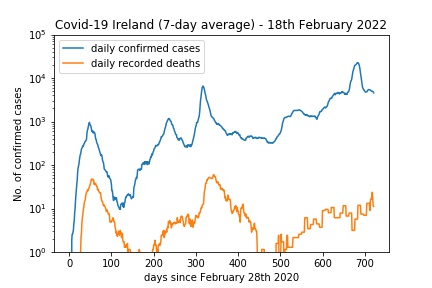
I know many people will be celebrating the end of these restrictions, but in case you need reminding here are the latest figures for Covid-19 in Ireland:

PCR-confirmed new cases are still running at 4500+ per day (almost double that if you include self-reported antigen tests). That means medically vulnerable people would be at risk of infection if those around them are not wearing masks. Masks protect others more than they protect the wearer so allowing the wearing of face masks to be discretionary puts such people in danger. For this reason I for one will be continuing to wear a face covering in shops, on buses, etc for the foreseeable future.

I don’t mind this – it was widespread practice in Asia long before the Coronavirus pandemic – and just can’t understand the extreme anti-maskers who liken the wearing of a face covering to being put in a concentration camp. I just hope we don’t get situations in which those who choose to wear a mask on, say, a bus get picked on by those who don’t.

At the moment in the Department of Theoretical Physics at Maynooth the situation is that a significant fraction of our students are staying away from lectures because of illness or self-isolation and one lecturer is having to do his teaching remotely. That’s not too bad; I feared much worse. I think other Departments have worse problems, missing demonstrators and tutors who are unable to come on campus.

The logic behind scrapping these restrictions is that despite the high case numbers the vaccination programme (helped, perhaps by the ‘milder’ omicron variant) does seem to have succeeded in keeping hospitalizations and deaths at a much lower level than in previous waves. Implicitly the strategy is to let Covid-19 wash over the population without worrying that the Health Service will be overwhelmed. My main worry now is what if another variant emerges after we have let our guard down?

Attack of the Rooks

Posted in Biographical, Maynooth on February 15, 2022 by telescoper

In this recent spell of rather cold weather I’ve been especially careful to keep the garden birds well nourished by deploying various feeders around the place. My fat balls are proving particular popular with the birds, but I won’t dwell on that here.

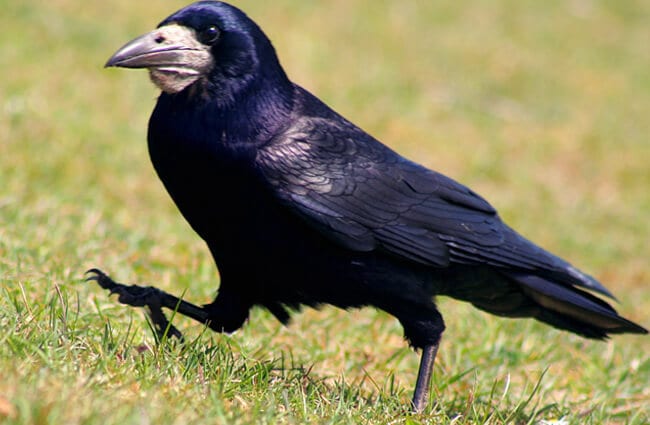
A few weeks ago a solitary rook started visiting my garden. I felt a bit sorry for this bird as it seemed to be on its own and was too big and clumsy to feed off the seed and peanut dispensers. Rooks always look a big glum to me. Eventually this figured one out how to dislodge one of the feeders from its usual place so it crashed to the floor and spilled seed all over the lawn, some of which it ate.

There then followed a sort of arms race. First I attached the feeder more securely to its existing site. The rook again managed after some time to knock it down. Then I moved it somewhere else, only for it to appear on the ground once more. Then I found a place where I could hang it between two branches of a tree in such a way it would be impossible to dislodge. This clearly frustrated the rook and again I felt sorry for it, but only for a short time.

A few days later I looked out in the garden and saw not just one rook but a whole crowd of them five or six in number, no doubt the local gang had been pressed into service. They proceeded to jump up and down on the branches of the tree until both snapped off completely, again dislodging the feeder.

I know I should admire the quality of the teamwork – a characteristic of the Corvid family – but at this rate the trees in my garden are going to be reduced to stumps. I’m not sure what I can do next.

There’s no doubt that rooks are hooligans, but at least they’re not taking all the food. I have two other dispensers that are positioned in such a way that only the little critters can get at them. So far. I’ve had all kinds of tits and finches as well as sparrows and starlings and pigeons as well as the rooks’ slightly less troublesome cousins, jackdaws and magpies.

Third Level Ireland – The Core Problem

Posted in Biographical, Education, Maynooth, Politics with tags , on February 13, 2022 by telescoper

One of the things I noticed straight away when I moved from the UK to my current job in Ireland is how under-resourced the Irish higher education system is. That realization was driven home still further by the Covid-19 pandemic during which those of us working in Irish universities had to switch to online teaching with precious little support.

Academic staff worked very hard to keep going during the various lockdown periods, but I’m sure I’m not the only person to feel deep regret that we were unable to do things better and that many students have a right to feel they have been let down by the system.

Now that we’re back teaching on campus the problems have not gone away. With a significant number of students prevented from attending lectures by the need to self-isolate we should be making recordings or live streams available, but we lack the equipment to do so properly. I have to carry a webcam and a tripod around campus to record my classes in improvised and not very satisfactory fashion. Contrast with the UK, where proper lecture capture facilities were commonplace in universities long before the pandemic. We are at least a decade behind.

This is one example of a deep crisis in the Irish third level system. Sadly it is by no means clear that the current Government is interested in solving it. There is talk of reducing the “student contribution” (currently €3000, the highest in the EU) because of the cost-of-living crisis but cutting this tuition fee (which is effectively what it is) would reduce the money coming into higher education unless offset by an increase in Government funding. According to this report (from November 2019), core state funding per student in third level institutions fell from about €9K in 2009 to under €5K in 2019.

A sizeable fraction of the income of a university is spent on its staff. In Ireland academic staff are treated as public sector employees which means that salary levels are set centrally. After being cut after the financial crisis they are now fairly generous and increase in line with overall pay settlements. Academic staff get annual increments and can get promoted, which adds to costs on top of the cost-of-living increases.

And that’s the crunch.

If the resource per student is decreasing but the salary bill is increasing, universities have to find other ways of generating income (which has been particularly difficult during the pandemic) or to increase the number of students. Keeping staff and student numbers constant means sliding into deficit. The way out of this many have found is to freeze permanent academic hires and instead take on casual teaching staff that can be paid lower wages than full-time staff. With no disrespect at all to people employed on such contracts, who generally do an excellent job, I feel we are short-changing students if they are not taught by academics who are active in research.

Take my current Department of Theoretical Physics at Maynooth University as an example. This has a student-staff ratio of about 15. That would be considered quite high for a physics department in the United Kingdom, but lower ratios are financially viable there because the fee income per student is much higher and physics departments bring in significant research income that makes a contribution to both direct and indirect costs. The latter is very difficult in Ireland because of the lack of research funding, especially in basic sciences; fortunately we have been relatively successful in generating research income and have recently increased student numbers, so we’re keeping our head above water. For now.

The price is that all academic staff in the Department have very heavy teaching loads – about five modules a year. That is way higher than physics departments in the UK, where most staff teach at most a couple. That makes it very difficult to stay competitive in research.

The problem is that science subjects are (a) more expensive to teach and (b) have limited capacity to grow because of constraints on, e.g., laboratory space (and the fact that there is a limited pool of suitably qualified school-leavers). As a consequence there is a strong incentive for universities to expand in subjects that are cheaper to teach. Something has to be done to ensure that Ireland’s universities can continue to provide education in a broad range of subjects.

Given the funding situation and the charges currently levied on students, it amazes me that more don’t seek their tertiary education elsewhere in the EU where fees are much lower (and in some places non-existent) especially since there is such a terrible shortage of student housing In Ireland. Does the Government really want to continue giving its young people such strong incentives to emigrate?

I was going to end this post there, having stated that the mismatch between between income and salary costs is the core problem facing Irish universities. As I went along though I came to think that the really basic problem is at a deeper level than that. Irish universities are public institutions but the political parties that have dominated Irish government for decades are of a neoliberal hue and are at best ambivalent towards the public sector. There are many in the current Government who would privatize everything if they could get away with it. They are pragmatic, though, and realize that these institutions are actually popular, just like the NHS in England. It is however very difficult for public institutions to function when the Government in charge doesn’t really believe in them.

Particle Physics Masterclass at Maynooth

Posted in Covid-19, Maynooth, The Universe and Stuff on February 9, 2022 by telescoper

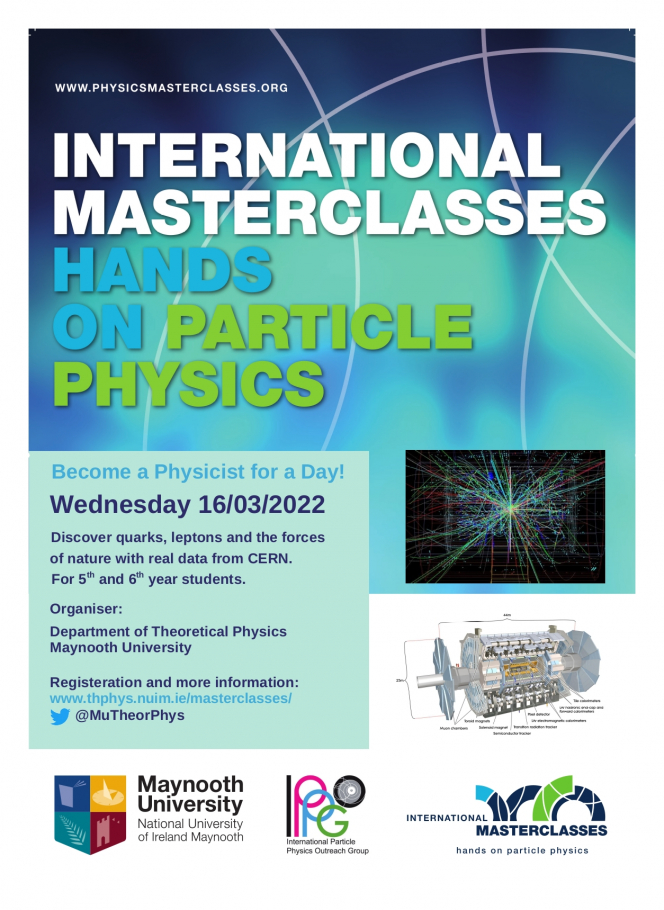
You may remember that we ran a very successful virtual Astrophysics & Cosmology Masterclass at Maynooth University last November. Now it’s time to announce the forthcoming International Masterclass on Particle Physics. This will take place on campus at Maynooth during the half-term break:


You can find more information, including instructions on how to book a place, here. The first such Masterclass at Maynooth took place in March 2012, so this year we will be celebrating the 10th anniversary.

These Masterclasses give secondary school students the opportunity to discover the world of quarks and leptons for themselves, by performing measurements on real data from CERN, meeting active particle physics researchers and linking up with like-minded students from other countries.  We will join thousands of other secondary school students at more than 100 universities and laboratories around Europe and worldwide in a programme stretching over four weeks.

Physics at the most fundamental level – the smallest and most basic building blocks of matter – is an exotic world.  But a few introductory talks and working with data from CERN will give the students insight into the fundamental particles of matter and the forces between them, as well as what went on during the Big Bang.

On Sunday afternoon, the students are introduced to particle physics, experiments and detectors in lectures given by active particle physics researchers.  On Monday, after a virtual visit to the ALICE detector at CERN, they work on their own with data from ALICE Afterwards they participate in a video conference with students from other countries and moderators at CERN, where they discuss and compare their results.

For more information on the Particle Physics Masterclasses, see the International Masterclasses web site.

Leaving Certificate Matters

Posted in Covid-19, Education, Maynooth with tags on February 4, 2022 by telescoper

On the last day of a very busy first week of the new term I’ve finally cleared a backlog of things and thought I’d take a break for a quick comment about the arrangements for this year’s Leaving Certificate which has implications for this year’s University admissions (amongst many other things).

It has been decided that this year’s Leaving Certificate will revert to the pre-pandemic style of written examinations, but with the important proviso that the overall distribution of marks will be scaled to be no lower than the results last year (when accredited grades were taken into account). In addition the examinations will offer students more choice, so that they have to answer a smaller subset of the questions than in the good old days before Covid.

Last year’s Leaving Certificate results revealed a big increase in scores and consequent changes in offers for many courses. For example, the points required for our Theoretical Physics and Mathematics course (MH206) at Maynooth University went up by about 50 to around 550. Perhaps surprisingly this resulted in the admissions to this course going up by about a factor three. I won’t speculate on the reasons for this here.

The reason for scaling this year’s results is to ensure that students entering third-level education this year are not disadvantaged relative to those who left school last year and took a year out. Also, there is much less information on which to base accredited grades, because of pandemic interruptions.

My concern about the announcement is not so much about the return to formal examinations but on the matter of choice. Take Mathematics for instance. Instead of answering questions in each of 10 sections, students this year will only have to answer questions from six. That means that students can get very high grades despite knowing nothing about 40% of the syllabus. That matters most for subjects that require students to have certain skills and knowledge for entry into University.

In my own discipline (physics) we already have to get new students rapidly up to speed in, e.g., calculus – a difficulty exacerbated this year by the fact that the first Semester was shortened as a knock-on effect of delays in Leaving Certificate process – this is likely also to be a problem for next year’s entry. I can see we’re going to have to do a lot of thinking over the summer about how to deal with this.

Overall I prefer the Leaving Certificate over the UK system of A-levels, as the former gives the students a broader range of subjects than the latter (as does the International Baccalaureate), but I still have doubts about using a simple points count for determining entry into third-level education. Changing a system so deeply embedded is likely to prove difficult, though, so we for the foreseeable future we just have to make the best of what we’ve got.