Archive for the Maynooth Category

A Day of Computing

Posted in Biographical, Education, Maynooth, The Universe and Stuff with tags , , , , , , on February 3, 2022 by telescoper

Last Semester, Thursday was what I optimistically called a “Research Day” (on the basis that I had no teaching on it). This Semester it’s one of my busiest teaching days, with lecturing in the morning and a lab session in the afternoon, both for Computational Physics.

For most of the last two years I’ve been delivering the lectures and running the lab remotely, but now that we’re back teaching face-to-face I gave the lecture in person and was in the lab with the class for this afternoon’s session. I’ve got about twice as many students this year as last year swill be running two lab sessions (one next Tuesday repeating the material from the Thursday one, and so on throughout the term).

Running the lab remotely worked reasonably well because Python is available to download for free and works on a standard Windows-based PC. In the lab however we use a Linux (Ubuntu) system, which gives the students the chance to try a different operating system (and one which is for many purposes better than Windows).

It’s good to be back running the computing laboratory class in person but I was a bit nervous this morning because since I last did it that way the machines we have in our laboratory have all been upgraded to a new operating system and have a new (and very different) version of Python (3.9 versus the now obsolete 2.7). I’ve been around long enough to realize that things can go wrong in such situations, so I warned the class during this morning’s lecture that there might be teething troubles. Sure enough we had quite a few technical glitches but, to be honest, it it could have been a lot worse. Next Tuesday’s lab should be a bit less stressful as we’ve fixed a few of the things that went wrong.

So, by no means a disaster, but a busy and quite stressful day. Time to go home and relax.

Back to Electromagnetism

Posted in Biographical, Education, Maynooth, The Universe and Stuff with tags , , , on February 1, 2022 by telescoper

So today I gave my first lecture of the new Semester, it being a gentle reintroduction to Maxwell’s equations for a 4th-year class on Advanced Electromagnetism. They have seen these equations before but it doesn’t do any harm to spend a bit of time refreshing the memory. In what follows I do some potential theory, applications to electrostatics (method of images, multipole expansions, use of the complex potential, etc), dielectric materials and polarization, magnetostatics, relativistic formalism of electromagnetism, gauge invariance, electromagnetic radiation and energy transport, and (if time) plasma physics (if time).

When I taught this module last year I did it all remotely from home – using the blackboard shown above – but this year until further notice I’ll be doing it in person in an actual lecture theatre, though I will be recording the lectures in case any students wish to look at them again for revision, etc, and webcasting them for any students unable to attend on campus. I know there are differences of opinion on this, but I think recording of lectures should become routine practice – as it is in all UK universities I’m aware of – but that is difficult here in Maynooth because the equipment available is inadequate (by which I mean virtually non-existent). Let’s hope the necessary investment will be made at some point.

All Change for Semester Two!

Posted in Covid-19, Education, Maynooth with tags , , , on January 31, 2022 by telescoper

So here we are, then, at the start of Semester Two at Maynooth University. When I arrived in the Department of Theoretical Physics I noticed a few differences:

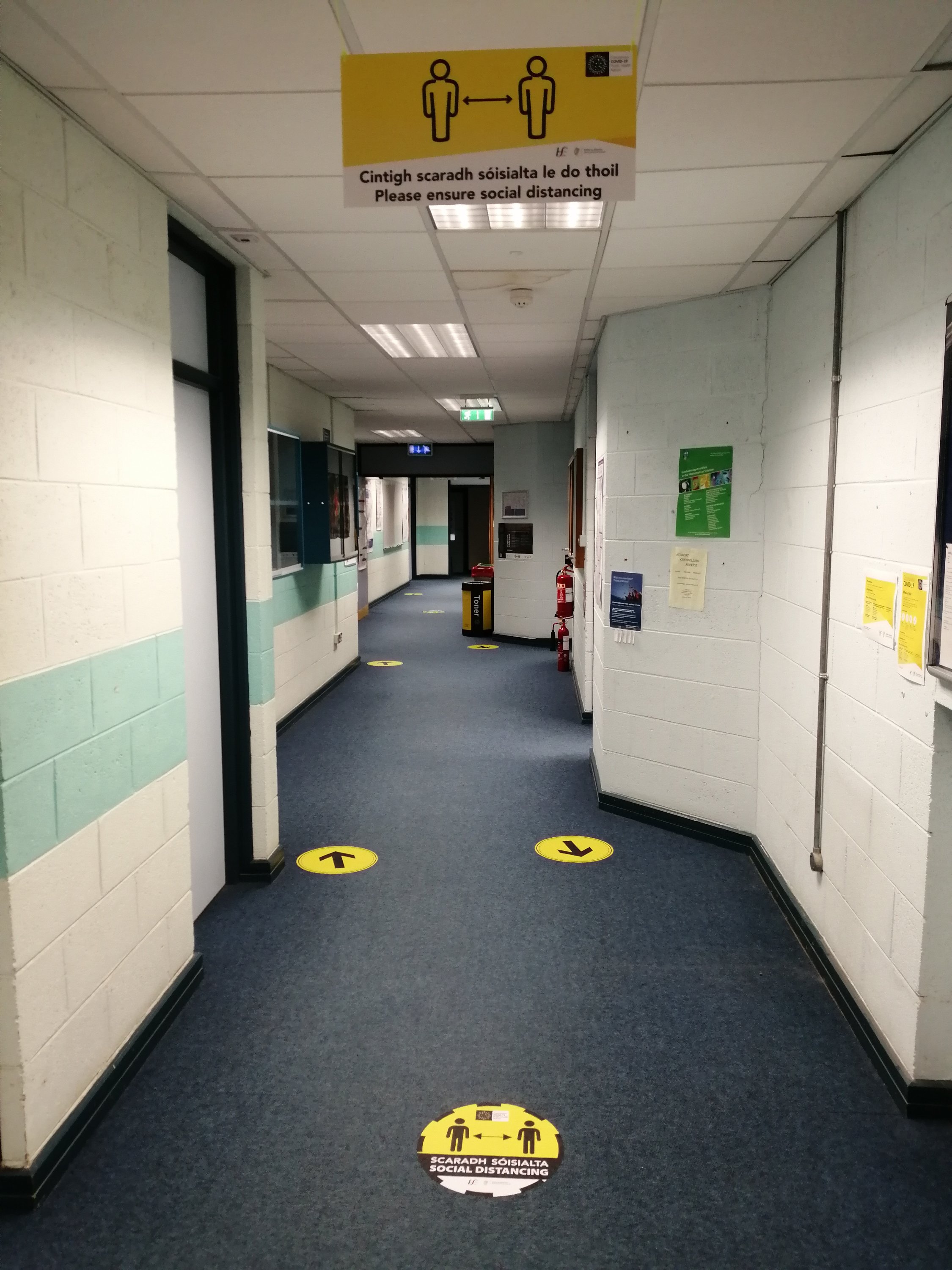
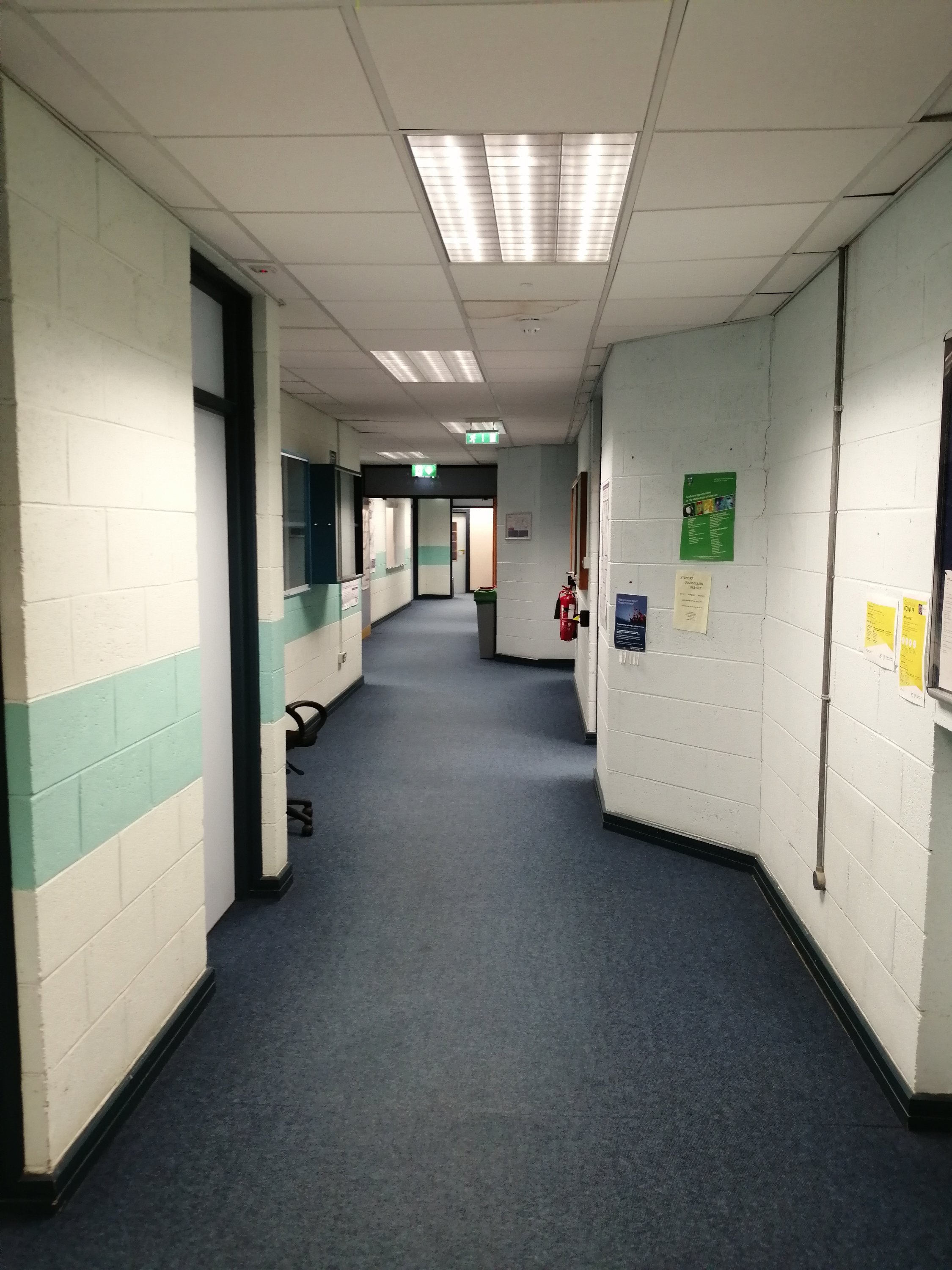
August 2020 versus January 2022

All the signage relating to physical distancing has been removed. We are no longer required to observe 2m spacing between individuals in labs or anywhere else. That solves my potential problem about constraints in the Computational Physics lab (to the left of the picture).

Our little kitchen is also now back in operation so we can share that space for lunch or coffee, sitting around the table which has now been put back in place. Staff meetings can be held in person, though the meeting of Academic Council I have to attend this afternoon will still be via Teams. I don’t actually start teaching until tomorrow and will be in the office most of the day so will have to wait until tomorrow until I find out how busy the campus seems; we expect there to be more students around than last term.

Students are still to wear face coverings in lectures etc but other than that all restrictions seem to have gone, including those on eating and social spaces on campus. Everyone seems to have decided that this pandemic is all over. Only time – and perhaps the next coronavirus variant – will tell whether they are right.

Back Pain

Posted in Biographical, Maynooth with tags on January 28, 2022 by telescoper

I broke a 170-day blogging streak yesterday (Thursday) by failing to post anything. The reason for this lapse was that on Wednesday evening I started to experience very painful back spasms which carried on all night and made it almost impossible to get any sleep. It seems only very slight movements would trigger one of these, so it wasn’t just getting into and out of bed that caused problems: even adjusting my sleeping posture triggered a stabbing pain. Getting out of bed involved various abortive attempts to twist and slide into a position from which I could stand before finally managing to find one that minimised the pain. Standing up was OK, but the transition to sitting or lying, or walking, was perilous. As was getting dressed…

I had to be on campus in the morning so I made my way there gingerly and did what I had to do, but sitting in a chair was even more difficult than lying down, and I wasn’t getting anything useful done, so I decided to go home, try to get some rest and hope a bit of natural healing would mend whatever had gone wrong.

I’ve had such spasmodic attacks before though it has been a while since the last one, and they haven’t usually been quite so painful. In the past they’ve usually lasted just a few days and I hoped that would be the case this time too, especially because I have to start teaching on Monday! Luckily that seems to be true, as this morning I found I could get out of bed much more easily than yesterday. I am still getting twinges but, fingers crossed, I think it will pass.

As to what brought this all on, I have no idea.

Maynooth University Library Cat Update

Posted in Maynooth with tags on January 26, 2022 by telescoper

It’s been a while since I’ve posted an update about Maynooth University Library Cat so I’m taking the opportunity provided by our return to campus to correct that omission. In a nutshell, said feline seems to be in good health and is well nourished. I visited him at his usual spot on Monday afternoon in order to give him some food but he had already dined and was in the process of departing for a post-prandial walkabout.

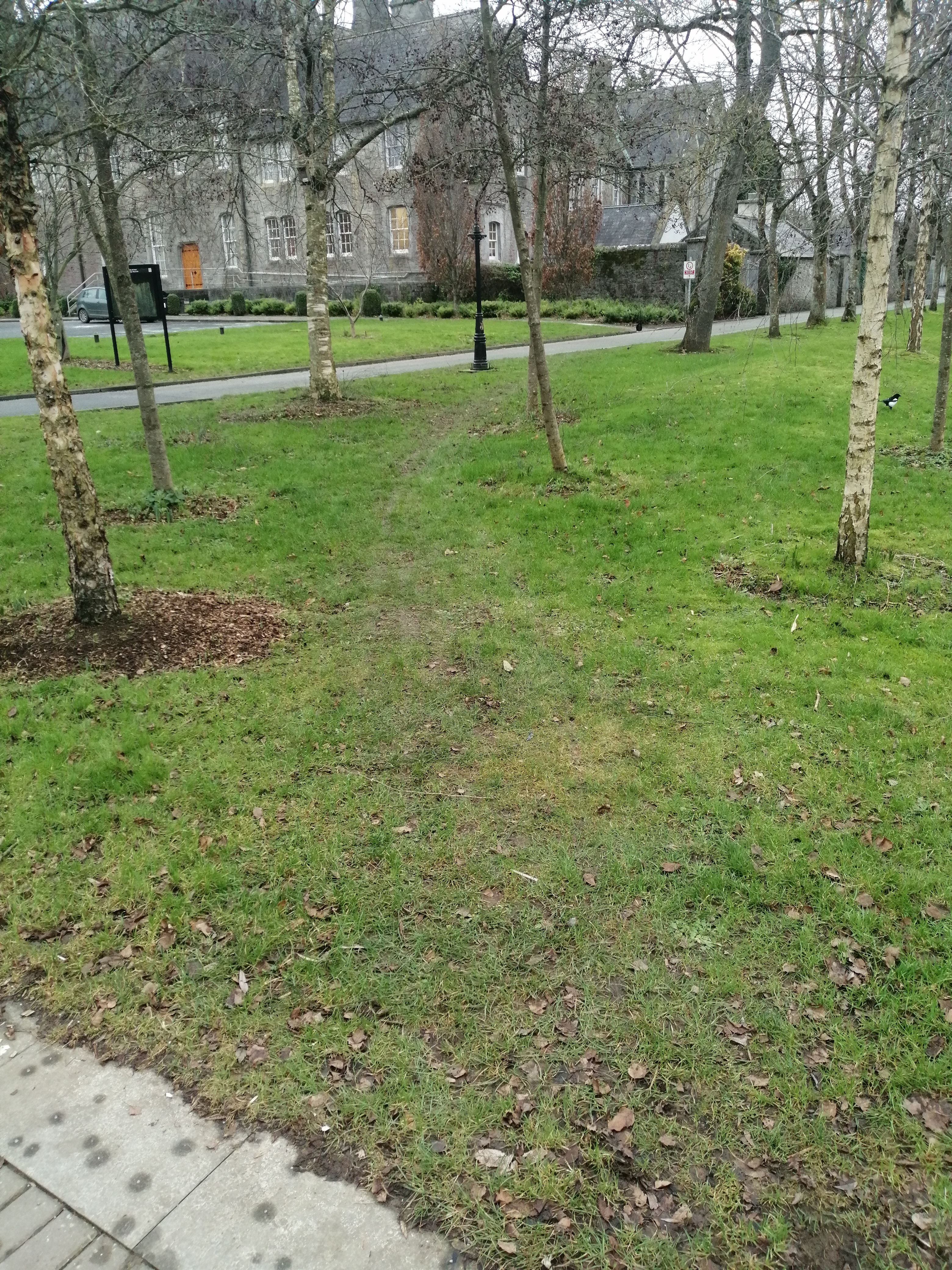
I realized when I watched him toddle off into the distance that he is such a creature of habit that he has worn away a path through the grass. I think it’s visible on this picture. I leave it as an exercise to the reader to spot where he is.

Incidentally the magpie to the left of the picture is another regular visitor to Library Cat’s spot – to eat any leftovers from his dish. It’s a waste of time leaving food out for him when he’s not there as the birds get it all.

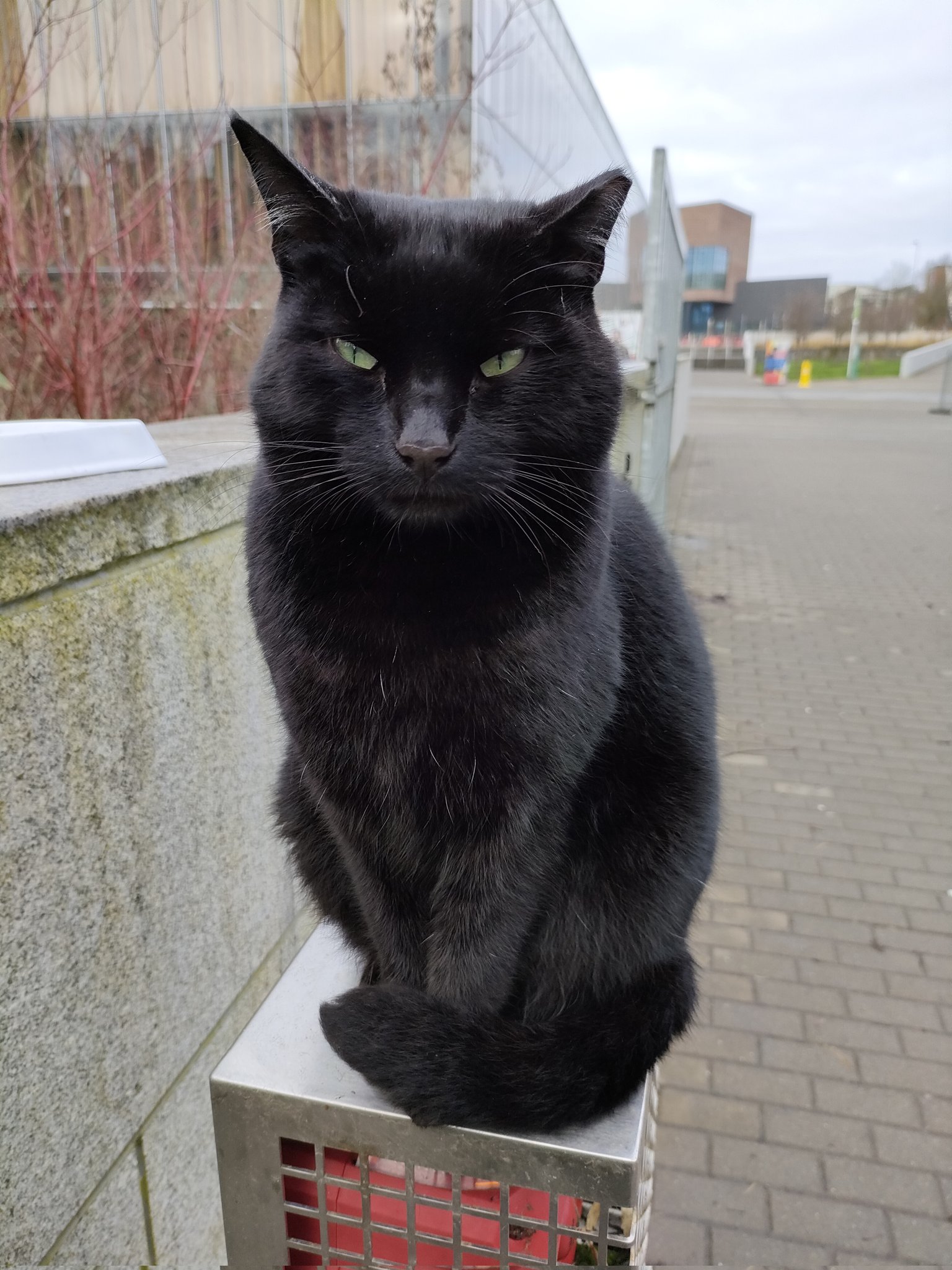
Anyway, here’s a more conventional picture so you can see he looks well:

Starting Back Again

Posted in Covid-19, Education, Maynooth on January 25, 2022 by telescoper

So. The Examination Period at Maynooth University is over and the students are having a bit of a break before we start teaching again next Monday, 31st January. In the meantime we have to finish the examination marking and prepare for the new term. I’ve actually been on campus for part of the last two days, as have a few of my colleagues though there aren’t many students around.

Yesterday we received the expected guidance on how teaching will proceed based on the Government’s decision on Friday to relax most Covid-19 related restrictions. The one big change that I really expected was that large lectures (to audiences of 250+ students) would resume on campus, but it seems that will not happen until half-term. Presumably that’s because many Departments had planned on the basis of these being online and were caught on the hop by the abrupt change. It was at half-term in 2020 that we entered the first lockdown so it will be two full years until we completely re-open (assuming there are no setbacks).

This makes no difference to Theoretical Physics however as we don’t have any classes with more than 250 students in them.

Another thing to have changed is the staggered start of lectures. In the Good Old Days all lectures at Maynooth started at five past the hour and ended at five to and were consequently 50 minutes long. Last term rooms were designated to have lectures starting at 10 past or 5 past and and lectures were reduced in length to 45 minutes so would finish either at 5-to or 10-to. This was to avoid having large numbers of students mingling in foyers and corridors at the start and end of lectures.

Semester 2 will have a full 12 weeks of teaching too, as we won’t miss the first week like we did last term. Hopefully that means Semester 2 will be a bit less rushed than Semester 1; for example in the first year there will be 36 lectures of 50 minutes’ duration (1800 minutes altogether) compared with 33 lectures of 55 minutes (1485 in total), which gives 315 extra minutes – five and a quarter hours – which is about 21%! It seems a lot when put like that. Perhaps we should adjust the weighting of Semester 1 v Semester 2 modules to reflect this?

My biggest worry was a capacity limit on our Computational Physics lab, but with no physical distancing requirement that worry has receded. I’ve decided however that I should still allow any students that want it to attend the lab remotely.

That brings me to the interesting issue. Although officially we are reopening to something near full capacity the question remains as to how many students are comfortable with the new arrangements. Little thought seems to have been given to vulnerable students with underlying health issues and we may find quite a lot of them opting not to return to campus just yet. It is incumbent on us to cater for these students in the best way possible but as yet we don’t know how many there will be in this situation.

What’s the difference between Astronomy and Astrophysics?

Posted in Biographical, Education, Maynooth, The Universe and Stuff on January 24, 2022 by telescoper

I’ve been a bit busy today but I did notice at lunchtime that an old question has been going around on Twitter which gives me the excuse to post an old answer to it, what’s the difference between Astronomy and Astrophysics? This is something I’m asked quite often, and have blogged about before, but I thought I’d repeat it here for those who might stumble across it.

The Oxford English Dictionary gives the following primary definition for astronomy:

The science which treats of the constitution, relative positions, and motions of the heavenly bodies; that is, of all the bodies in the material universe outside of the earth, as well as of the earth itself in its relations to them.

Astrophysics, on the other hand, is described as

That branch of astronomy which treats of the physical or chemical properties of the celestial bodies.

So astrophysics is regarded as a subset of astronomy which is primarily concerned with understanding the properties of stars and galaxies, rather than just measuring their positions and motions.

It is possible to assign a fairly precise date when astrophysics first came into use in English because, at least in the early years of the subject, it was almost exclusively associated with astronomical spectroscopy. Indeed the OED gives the following text as the first occurrence of astrophysics, in 1869:

As a subject for the investigations of the astro-physicist, the examination of the luminous spectras of the heavenly bodies has proved a remarkably fruitful one

The scientific analysis of astronomical spectra began with a paper by   William Hyde Wollaston in the Philosophical Transactions of the Royal Society Vol. 102, p. 378, 1802. He was the first person to notice the presence of dark bands in the optical spectrum of the Sun. These bands were subsequently analysed in great detail by Joseph von Fraunhofer in a paper published in 1814 and are now usually known as Fraunhofer lines.  Technical difficulties  made it impossible to obtain spectra of stars other than the Sun for a considerable time, but  William Huggins finally succeeded in 1864. A drawing of his pioneering spectroscope is shown below.

Meanwhile, fundamental work by Gustav Kirchoff and Robert Bunsen had been helping  to establish an understanding of the spectra produced by hot gases.  The identification of features in the Sun’s spectrum  with similar lines produced in laboratory experiments led to a breakthrough in our understanding of the Universe whose importance shouldn’t be underestimated. The Sun and stars were inaccessible to direct experimental test during the 19th Century (as they are now). But spectroscopy now made it possible to gather evidence about their chemical composition as well as physical properties. Most importantly, spectroscopy provided definitive evidence that the Sun wasn’t made of some kind of exotic unknowable celestial material, but of the same kind of stuff (mainly Hydrogen) that could be studied on Earth.  This realization opened the possibility of applying the physical understanding gained from small-scale experiments to the largest scale phenomena that could be seen. The science of astrophysics was born.

One of the leading journals in which professional astronomers and astrophysicists publish their research is called the Astrophysical Journal, which was founded in 1895 and is still going strong. The central importance of the (still) young field of spectroscopy can be appreciated from the subtitle given to the journal:

Initially the branch of physics most important to astrophysics was atomic physics since the lines in optical spectra are produced by electrons jumping between different atomic energy levels. Spectroscopy of course remains a key weapon in the astrophysicist’s arsenal but nowadays the term astrophysics is taken to mean any application of physical laws to astronomical objects. Over the years, astrophysics has therefore gradually incorporated nuclear and particle physics as well as thermodynamics, relativity and just about every other branch of physics you can think of.

I realize, however, that this  isn’t really the answer to the question that potential students want to ask. What they (probably) want to know is what is the difference between undergraduate courses called Astronomy and those called Astrophysics? The answer to this one depends very much on where you want to study. Generally speaking the differences are in fact quite minimal. You probably do a bit more theory in an Astrophysics course than an Astronomy course, for example. Your final-year project might have to be observational or instrumental if you do Astronomy, but might be theoretical in Astrophysics.  If you compare the complete list of modules to be taken, however, the difference will be very small.

Over the last twenty years or so, most Physics departments in the United Kingdom have acquired some form of research group in astronomy or astrophysics and have started to offer undergraduate degrees with some astronomical or astrophysical content. My only advice to prospective students wanting to find which course is for them is to look at the list of modules and projects likely to be offered. You’re unlikely to find the name of the course itself to be very helpful in making a choice.

To confuse things further, here in Maynooth there is a degree programme called Physics with Astrophysics which is taught primarily by the Department of Experimental Physics and has a heavy focus on observational techniques. If students want to do the interesting theoretical bits of Astrophysics, such as black holes and general relativity, they have to choose  options with the Department of Theoretical Physics.  As a theoretical astrophysicist I feel a bit frustrated by this.

One of the things that drew me into astrophysics as a discipline is that it involves such a wide range of techniques and applications, putting apparently esoteric things together in interesting ways to develop a theoretical understanding of a complicated phenomenon. I only had a very limited opportunity to study astrophysics during my first degree as I specialized in Theoretical Physics.  This wasn’t just a feature of Cambridge. The attitude in most Universities in those days was that you had to learn all the physics before applying it to astronomy. Over the years this has changed, and most departments offer some astronomy right from Year 1.

I think this change has been for the better because I think the astronomical setting provides a very exciting context to learn physics. If you want to understand, say, the structure of the Sun you have to include atomic physics, nuclear physics, gravity, thermodynamics, radiative transfer and hydrostatics all at the same time. This sort of thing makes astrophysics a good subject for developing synthetic skills while more traditional physics teaching focusses almost exclusively on analytical skills.

I hope this clarifies the situation.

Restrictions Eased

Posted in Covid-19, Education, Maynooth, Politics on January 22, 2022 by telescoper

Last night the Taioseach Micheál Martin went on the telly to confirm, amid a flood of clichés, the news that had been leaking all day that most public health restrictions in Ireland were to be scrapped from 6am this morning. That means all capacity limits on pubs and restaurants, social distancing, vaccination certificates, household gatherings, etc, no longer apply from today. I wasn’t up at 6am to see anyone rushing to the nearest pub to celebrate but I suspect some might have done.

The scale of the loosening of restrictions has taken a lot of us by surprise, especially as case numbers, though falling, are still at very high levels. This was the situation yesterday:

The key thing is the orange line, which has remained steady and low despite the rising number of cases; the very successful vaccination booster programme and the apparently less lethal nature of the omicron variant have combined to keep hospitalizations well below hospital capacity, especially for intensive care and relatively stable.

Let me remark on the fatality figures. Ireland only reports Covid-19 related deaths once a week now, on Wednesdays. In the week up to 19th January, 52 deaths were reported. That compares with 1,865 over the same period in the UK (and that figure is obtained using an artificial 28-day cutoff, i.e. a Covid-19 related death is only counted as such if it occurs within 28 days of a positive test). The population of the UK is about 67 million, compared to Ireland’s 5 million, i.e. about 13 times larger. The number of Covid-19 related deaths however, even using the artificially reduced UK figure, is 36 times larger. That means the per capita death rate there in the UK is at least 2.7 times higher than here in Ireland. What are so many more people dying in the UK? The only reason I can think of is that the UK has significantly worse vaccination coverage.

Note also that although most restrictions are being removed, that does not mean all restrictions are being removed. People who test positive for Covid-19 will still have to isolate, as will close contacts. Face coverings will still be required in indoor settings such as shops and on public transport, for example. I for one would have carried on wearing a face covering in such places even if it were not required.

Obviously it is good that restrictions are being removed. Everyone I know is fed up and many businesses, especially in the hospitality sector, are struggling. I would however like to make two points.

First, give a thought to those people who are medically vulnerable. They will be very concerned at the removal of social distancing. I can imagine that many will have good reasons for not wanting to be in the crowded environments that are now allowed. I certainly think we should continue to make it possible for students in that situation, or those who have to isolate, to follow lectures remotely.

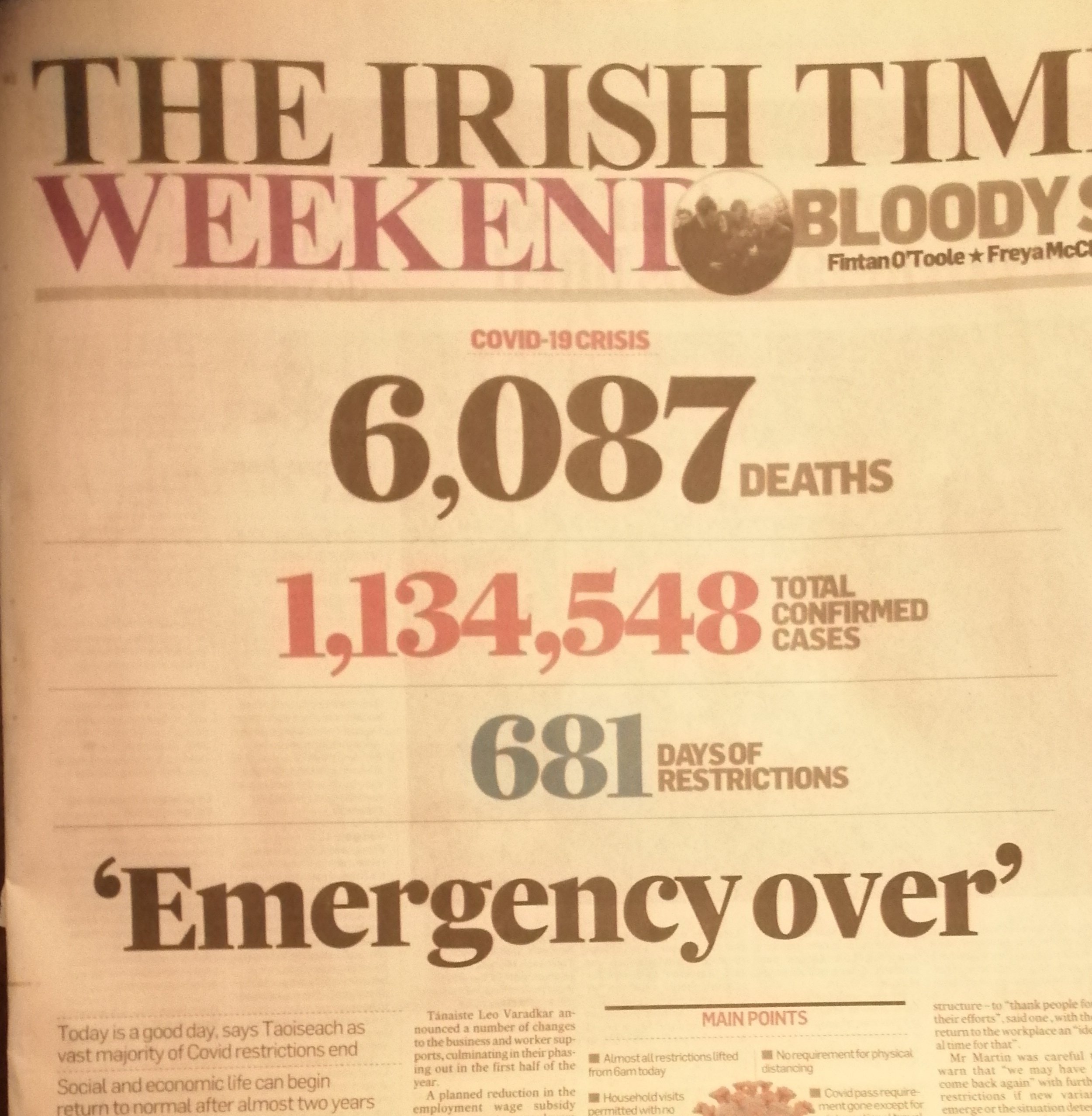
My second point is that almost everyone seems to be assuming that there’s no possibility at all of another, more lethal, variant coming along and putting us all back to square one. The greater the level of infection circulating, the greater the probability this will happen. Loosening restrictions will lead to a further increase in cases and a greater probability of further mutations in the coronavirus. For that reason alone I would have preferred a more gradual relaxation of the rules. In other words, I don’t agree with this front page in today’s Irish Times, which I think is highly irresponsible.

It crossed my mind last night that it was in mid-March 2020 that we entered our first lockdown. What’s the betting that we’ll have to reimpose restrictions about the same time in 2022 as a result of another surge?

We don’t know yet precisely what all this means for teaching at Maynooth University, which is due to resume a week on Monday. I’d guess that it means that all lectures, including very large ones, will be on campus. We’ll have to wait for official guidance on that, though I’m fairly confident there won’t be big changes for my Department compared with last Semester. My one concern was physical distancing in the Computational Physics lab, but that seems likely not to be an issue now.

There won’t be any big changes for me in a personal sense either. I don’t intend to suddenly start going out in crowded places and it will take me some time to feel confident enough to resume my concert-going, etc. When the Taoiseach announced the removal of all physical distancing requirements yesterday, to take place from early the next morning, it was as if we were all expected to turn overnight from fermions into bosons. I’ve never liked crowds and have become even more agoraphobic over the last two years of the pandemic. It will be some time before I get over that, if I ever do.

A New Bank Holiday in Ireland

Posted in Covid-19, History, Maynooth on January 20, 2022 by telescoper

Yesterday the Irish Government announced that there would be an additional Bank Holiday this year, on 18th March (which is the day after the existing St Patrick’s Day holiday on March 17th) to recognize the efforts of the great many people (including volunteers) who have worked so hard to counter the Covid-19 pandemic and to commemorate those who lost their lives to the coronavirus. It’s a good idea and hopefully it will occur at a time when there are many fewer restrictions than currently, which should make it a memorable occasion.

Interestingly, though, the new Bank Holiday is not a one-off but will become a permanent addition to the calendar, though on a different date: it will happen on or around 1st February from 2023 onwards. This is interesting because it corrects an anomaly in the distribution of public holidays, which I will explain here.

In the Northern hemisphere, from an astronomical point of view, the solar year is defined by the two solstices (summer, around June 21st, and winter, around December 21st) and the equinoxes (spring, around March 21st, and Autumn, around September 21st). These four events divide the year into four roughly equal parts of about 13 weeks each.

If you divide each of these intervals in two you divide the year into eight pieces of six and a bit weeks each. The dates midway between the astronomical events mentioned above are (roughly) :

  • 1st February: Imbolc (Candlemas)
  • 1st May: Beltane (Mayday)
  • 1st August: Lughnasadh (Lammas)
  • 1st November: Samhain (All Saints Day)

The names I’ve added in italics are taken from the Celtic/neo-Pagan and, in parenthesis the Christian terms),for these cross-quarter days. These timings are rough because the dates of the equinoxes and solstices vary from year to year. Imbolc is often taken to be the 2nd of February (Groundhog Day) and Samhain is sometimes taken to be October 31st, Halloween. But hopefully you get the point.

The last three of these also coincide closely with Bank Holidays in Ireland, though these are always on Mondays so may happen a few days away. I find it intriguing that the academic year for universities here in Ireland is largely defined by the above dates dates.

The first semester of the academic year 2021/22 started on September 20th 2021 (the Autumnal Equinox was on September 22nd) and finishes on 17th December (the Winter Solstice is on December 21st ).  Halloween (31st October) was actually a Sunday this year so the related bank holiday was on Monday 25th October; half term (study week) always includes the Halloween Bank Holiday. The term was pushed forward a bit because it finished on a Friday and it would not be acceptable to end it on Christmas Eve!

After the break for Christmas, and a three-week mid-year exam period, Semester Two starts 31st January 2022. Half-term is then from 14th to 18th March (the Vernal Equinox; is on March 20th) and teaching ends on May 6th.  More exams and end of year business take us to the Summer Solstice and the (hypothetical) vacation.

The new bank holiday will correct the anomaly that there has not been such a holiday to mark the first cross-quarter day (Imbolc). In Ireland this often referred to as St Brigid’s Day (after St Brigid of Kildare) rather than Candlemas.

The slight issue is that, in Maynooth, Semester Two of teaching usually begins around 1st February so there will be a holiday within a week or so of the start of teaching but I don’t imagine many students or staff will complain about that!

P.S. Imbolc is also sometimes called “The Quickening of the Year”. It looks like this year it will correspond to the quickening of relaxation of Covid-19 restrictions, though we still wait full details of what precisely all this means for our teaching plans…

Countdown to Semester 2

Posted in Covid-19, Education, Maynooth on January 17, 2022 by telescoper

In between correcting examination scripts and preparing for another examination I’ve been putting the finishing touches to the allocation of teaching to Semester 2 which starts a fortnight today, on Monday 31st January. You might think this is a bit late to be assigning lecturers to modules and it is, but we’ve had lots of staffing difficulties this year and there’s been a lot to manage.

We haven’t yet had any official information from on high about how precisely we will proceed next Semester, but I’m assuming that it will be roughly like last Semester, i.e. with most classes in person and only the very big ones online. The one headache is our Computational Physics class which is quite large this year so we will have to take care about physical distancing requirements for the laboratory sessions. I’m actually teaching that module.

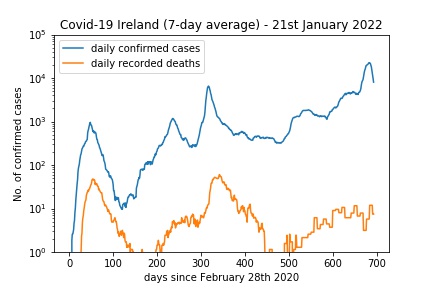
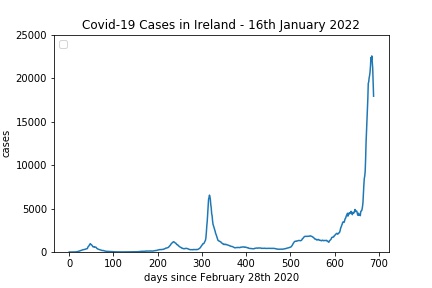
As Maynooth colleague Professor Paul Moynagh has explained, it does look like the omicron wave has peaked in Ireland though I am very confused about how much of this is down to changes in testing strategy. The figures plotted above (7-day rolling averages) only show PCR tests; there are many thousands of positive antigen tests that would previously have been referred for PCR confirmation but which are now just being reported separately outside the official figures.

Anyway, the least we can say is that things do not seem to be getting dramatically worse so there’s no real motivation for imposing fresh restrictions. All the talk is now about relaxing things, actually. The existing rules haven’t been very effective at halting the propagation of the omicron variant so there’s no very good reason for keeping them as they are. I think we just need to ensure that unlocking is not done in such a way that another surge ensues.

We first went into lockdown about halfway through Semester 2 two years ago, which led to our first set of online assessments. Two years later on we look like we might actually have a return to on-campus examinations. Perhaps the set of online exams we’re marking now will be the last? Let’s see.