A couple of weeks ago when I was looking on Youtube for a recording of Jordu by Duke Jordan for a blog post I stumbled across this version, which seemed so unlikely that I had to listen to it and, somewhat to my surprise, I loved it and decided to share it. Those of you out there who like your jazz and your American country music will no doubt feel the same way.
It’s by a band led by virtuoso banjo player Bill Keith consisting of fiddles, mandolins, guitars and string bass (as well as banjo), the type of ensemble you expect for American bluegrass music so I couldn’t imagine in my mind’s ear how they would sound playing a bebop standard. As it turns out they sound great! The middle eight of this tune sounds so funky on those instruments. Hats off to Bill Keith for this adventurous choice of number!
P.S. My Dad used to play the drums in traditional jazz bands, some of which included a banjo player. He never had a good word to say about banjo players, accusing them (rightly or wrongly) of always “speeding up” (which is anathema to jazz musicians).
I’m kicking myself for having forgotten that yesterday, August 3rd, was the 94th birthday of that great jazz singer Tony Bennett so I’m correcting that omission today by posting one of my favourite recordings of his, a tune written by the famous songwriting pair of Johnny Burke and Jimmy van Heusen, recorded in 1975 with Bill Evans on piano. When one of the greatest ever jazz singers gets together with one of the greatest ever jazz pianists, what could the result be But Beautiful?
Now for one of those jazz posts that people don’t seem to like and which will no doubt reduce today’s blog traffic even further. This is a very nice version of a tune called Jordu which was written by pianist Irving “Duke” Jordan in 1953 and which became part of the standard jazz repertoire after a wonderful version was recorded by Clifford Brown and Max Roach in 1954. It’s not hard to figure out where the title comes from. The version I’ve picked is much later, and features a trio with the great Ed Thigpen on drums and Mads Vinding.
Duke Jordan began his recording career with the brilliant Dial sessions with Charlie Parker in 1947 and he carried on making great music after he moved to Denmark in the 1970s until his death in 2006. The Steeplechase label on which this record was released is actually based in Copenhagen too. He is buried in Vestre Kirkegard in Copenhagen. He was in my opinion one of the most consistently underrated pianists of his era.
When I was younger I used to try to figure out by ear the chord changes in Jazz standards. Nowadays you can find cheat sheets all over the internet, which rather takes the fun out of it. This tune is a particularly interesting challenge to unravel as well as to perform but if I ever got a band together we would definitely (try to) play it!
Jordu is in a standard AABA form. The A sections are constructed from dominant chords in a pattern based on the ii-V-I progression which is very common in jazz. The variation introduced here is to use a major II instead of a minor ii and add a dominant 7th to the basic triad, which makes a much richer sound. The eight bars of the A section are divided into four pairs, the first of which finds the theme played without backing chords or rhythm accompaniment, the second having the backing instruments accent beats 1, 3 and 4. The first sequence is a II/V/I in C minor, using a D7 instead of a minor ii chord. Then it’s a similar sequence in in Eb major (F7/Bb7/EbMaj7). After a repeat of the first II/V/I, the A sections ends with Ab7 – G7 (bVII7 – V7). Every chord but one in the entire section is a dominant 7th.
Since the A section ends in an unresolved way on the V chord (G7), a device used quite a lot in music stylistically based in the bebop era, Duke Jordan devised a two-bar coda to be played at the end of a performance that resolves to the tonic (Cm), bringing everything gently back to Earth to finish.
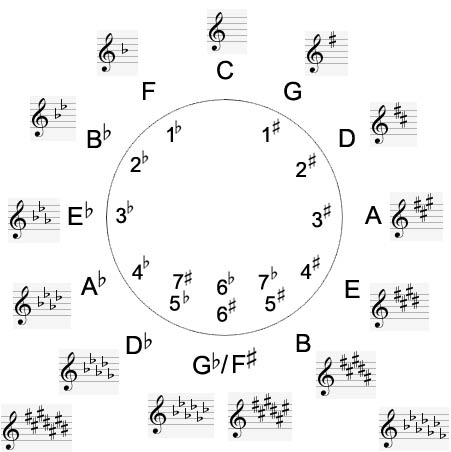
The B section is based on the Circle of Fourths, another standard jazz device but still a challenging pattern to improvise on. If you want to learn to play jazz most tutors will have you practicing a lot on the Circle of Fifths (clockwise) and Circle of Fourths (anticlockwise) trips around this diagram showing all the major and minor keys:
Anyway, you don’t have to know anything about the harmonic structure of this piece to enjoy this lovely playing. Duke Jordan’s solo finds him completely at home in this tune, and why shouldn’t he? He wrote it!
Today has been one of those frustrating days at work that ends with a to-do list longer than it started with so I’m in need of a pick-me-up. Here is Benny Goodman and his Sextet recorded on the Ed Sullivan show in 1960 playing The World is Waiting For the Sunrise. Goodman loved this tune and played many different versions of it over his long career. The audience definiely enjoyed this, and I think it’s BG himself who ends this one with a yeah to prove that he enjoyed it too! I hope you do likewise.
Over the years there have been some (indeed many) jazz critics who have written that Benny Goodman’s clarinet playing was `clinical’ and `unemotional’ and other such nonsense. I think his playing on this is absolutely sensational (as incidentally is Red Norvo on the vibes). Enjoy!
Duke Pearson was inspired by the famous statue that looks down over Rio de Janeiro to write this tune, of which this is the very first version, put on record in 1963 and released a year later in 1964 to become an instant classic. It’s a wonderful fusion of jazz, blues and gospel music but above all it’s a gentle hymn to peace and respect.I don’t think I have to explain why I think it’s apt to put it up today.
Front and centre is Donald Byrd on trumpet, but the rest of the band includes Hank Mobley (tenor), Herbie Hancock (piano), Donald Best (vibes), Kenny Burrell (guitar), Butch Warren (bass) and Lex Humphries (drums). The choir consists of 8 voices (4 male, four female) but sadly they are not named on the liner notes.
The great Jazz singer Peggy Lee (real name Norma Deloris Egstrom) was born a hundred years ago today, on 26th March 1920.
I couldn’t resist marking the occasion sharing this short clip of her famous live performance at Basin Street East, a nightclub in New York City, in 1961. I picked this not only because it is the tune of which I posted the original version last week but also because it’s a fine example of her vocal artistry and sizzling stage presence. I love the way she slides the notes as she drapes the melody languidly over the sounds from the band.
There have been dozens of versions of the old song See See Rider and its origins are lost in the mists of time, but I’m pretty sure that the first ever recording was this one, made in October 1924 by the fabulous Gertrude `Ma’ Rainey (vocals) together with a stellar backing group including Louis Armstrong on cornet, Buster Bailey on clarinet and Fletcher Henderson on piano.
The great alto saxophonist and long-term mainstay of the Duke Ellington Orchestra Johnny Hodges passed away 50 years ago today, on 11th May 1970.
Here’s the piece that was his signature tune, Jeep’s Blues – played during a very famous live concert by the Ellington band at the Newport Jazz Festival in 1956.
Feast your ears on that huge soulful sound that was perfect for playing the blues!
I have, on a few occasions posted pieces of Jazz that cross over different eras and here’s a wonderful example that has been in my head for a while. Bright Mississippi is a typically quirky composition by Thelonious Monk, a man often described as the ‘High Priest of Bop’. This version in a live performance by a band led in 2009 by Allen Toussaint, however, gives it a joyously carefree New Orleans treatment.
Henry Grimes was very active in the 50s and 60s, playing with such luminaries as Sonny Rollins and Thelonious Monk, and appearing on some classic recordings, but he dropped out of the music scene as a performer for roughly thirty years from about 1970 during which time he was virtually destitute. He returned to music around 2002 after a Jazz fan tracked him down and bought him a double bass to play – he had sold his instrument decades earlier – and remained active until his death.
When I heard last night of the death of Henry Grimes the first thing that popped into my mind was this sequence from the movie Jazz On A Summer’s Day. You can see shot of the young Henry Grimes right at the beginning in this clip of the Thelonious Monk trio playing Blue Monk at the Newport JJazz Festival in 1958; Roy Haynes was the drummer.
The views presented here are personal and not necessarily those of my employer (or anyone else for that matter).
Feel free to comment on any of the posts on this blog but comments may be moderated; anonymous comments and any considered by me to be vexatious and/or abusive and/or defamatory will not be accepted. I do not necessarily endorse, support, sanction, encourage, verify or agree with the opinions or statements of any information or other content in the comments on this site and do not in any way guarantee their accuracy or reliability.