More sad news today. Chat show host and journalist Michael Parkinson has passed away at the age of 88. I watched his show very frequently on Saturday nights during its first run (from 1971 and 1982) and remember many great interviews he did, especially with wonderful raconteurs such as Peter Ustinov and Kenneth Williams.
I can’t add much to the extensive obituaries you can find in the regular media except to say that Parky was a big fan of jazz, as am I, and he often got jazz musicians on his show. One example I remember vividly watching 50 years ago (!) in 1973 was Duke Ellington. I remember the interview very well, but what I remember even better was the impromptu postscript. As they were wrapping up the recording, Ellington said he wanted to play a number with the resident band (led by Harry Stoneham on the organ), who I’m sure were absolutely thrilled at the prospect. What followed was this version of Ellington’s own tune Satin Doll. Parky’s show had its own signature tune, but I don’t think he’d mind being played out with this…
I had a pleasant surprise when I switched on the radio last night to listen to The Blue of the Night in that the presenter Bernard Clarke not only played a lot of music by the late great Art Pepper but also mentioned my name on air for having pointed him at the particular session from which he chose the tracks. I think he mistakes me for some sort of expert!
Anyway, listening last night brought back a lot of memories of hearing Art Pepper play in the flesh and many nights I spent in Ronnie Scott’s club during the 1990s when I lived in London. I thought I’d share here one of the tracks played last night.
The performance in question was recorded live at Ronnie Scott’s Club in London in June 1980 and first released on the small British record label Mole Jazz, an offshoot of the famous (sadly now defunct) record shop of the same name that used to be on Gray’s Inn Road. It’s a brilliant, brilliant album, with the intense atmosphere of a live performance adding to the superb playing of the musicians. It’s also extremely well recorded – so much so that you feel you are on stage with the musicians!
The band is listed as the “Milcho Leviev Quartet featuring Art Pepper”, although that was probably for contractual reasons, as this was the same band that toured extensively as “The Art Pepper Quartet”: Art Pepper on alto saxophone, Milcho Leviev on piano, Tony Dumas on bass and Carl Burnett on drums. I was also lucky enough to see this band play live at the Newcastle Jazz festival in 1981, not long after this recording, and they were great then too although that was in a concert hall so had a much less intense atmosphere. Art Pepper sadly passed away in 1982 and Milcho Leviev in 2019.
As far as I’m aware this record wasn’t released on CD until relatively recently, but now a whole lot of extra tracks recorded during Art Pepper’s residency in Frith Street are also available. There’s so much to enjoy in these recordings, including the superb drumming of Carl Burnett and virtuosic piano of Milcho Leviev, but the star of the performance for me is Art Pepper. His playing is at times lyrical and at times agonized, but always compelling and this band was especially good at spontaneous transitions of mood and dynamic. Anyway, here is the title track of the original album, Blues for the Fisherman.
I just heard that the great singer Tony Bennett has passed away, just a couple of weeks short of his 97th birthday. In 2021, Bennett revealed that he was living with Alzheimer’s, a condition that had been diagnosed in 2016, but he had continued to perform until that announcement. His death does not come as a shock, but it is always sad to hear of the death of a legend.
What can I say about about Tony Bennett, except that I absolutely adored his singing? In fact I think he got better with age, his older voice showing even greater artistry in phrasing and melodic invention than when he first emerged as a star performer in the 1950s. He was admired by people across the generations, across different musical genres, and by the harshest judges of all – other musicians.
I picked this track, partly because it is lovely, but also because its title reminds me of a little poem by Ernest Dowson entitled Vitae Summa Brevis Spem Nos Vetat Incohare Longam, which I translate from my half-remembered schoolboy Latin as something like “the brief span of Life forbids us from conceiving an enduring hope”. It’s a quotation from one of the Odes of Horace (Book I, Ode 4, line 15). These aren’t the lyrics of the song, but seem apt in the circumstances:
They are not long, the weeping and the laughter, Love and desire and hate: I think they have no portion in us after We pass the gate.
They are not long, the days of wine and roses: Out of a misty dream Our path emerges for a while, then closes Within a dream.
With the passing, on Sunday, of Ahmad Jamal, at the age of 92, another legendary Jazz musician has left us. He was a consistently inventive pianist, of great elegance, and a wonderful knack of deconstructing a tune into its component parts before reassembling it into something fresh. His formative years were a time when many keyboard players emphasized virtuosic brilliance, but Jamal’s approach was relaxed and spare. He was great letting his story develop gradually but very enjoyably through a series of riffs over a compelling rhythmic foundation. A perfect example is this track, Poinciana, from a hugely popular album Live at the Pershing: But Not For Me, recorded in 1958 with Israel Crosby on bass and Vernel Fournier on drums. Ahmad Jamal is no longer with us, but this groove will last forever!
R.I.P. Ahmad Jamal (born Frederick Russell Jones, 1930-2023).
When my father passed away in 2007, the main music music played at his funeral was the hymn or spiritual (and of course Jazz standard) Just a Closer Walk with Thee. It’s a lovely old traditional tune that often plays a central role in New Orleans style funerals and is a melody that, at least for me, has a deep association with loss and bereavement. The recording that was played on that occasion was this one, made at the same session as the track I posted a few days ago, featuring the same personnel (including my Dad on the drums), but with vocals by a fine Jazz and Blues singer by the name of Annie Jenkins.
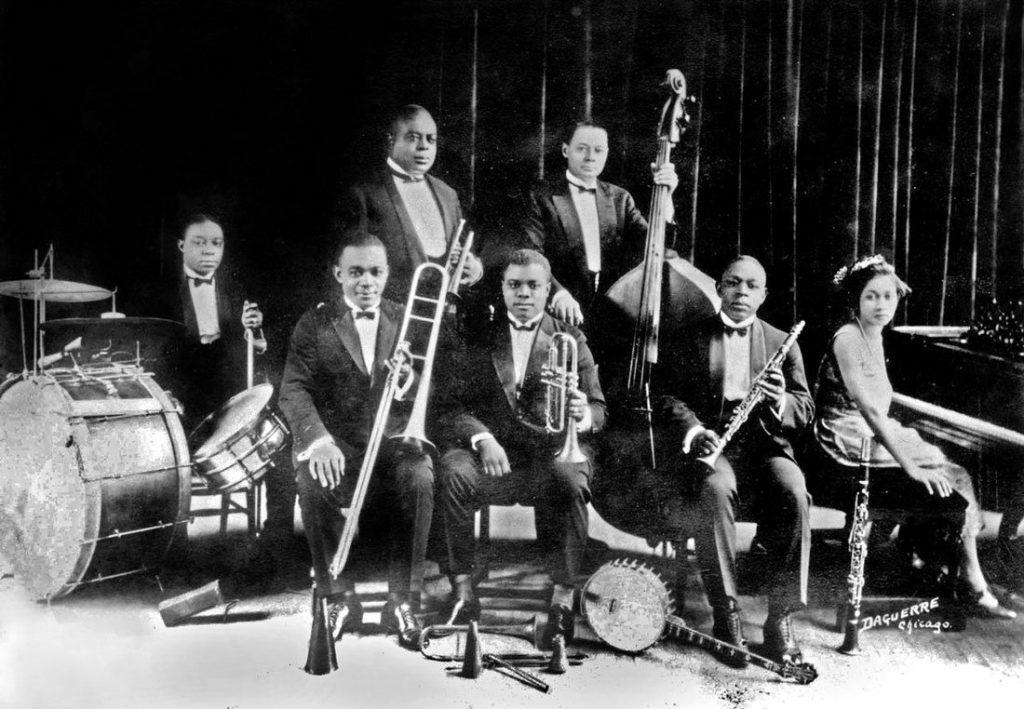
King Oliver’s Creole Jazz Band vintage 1923. From the left: Warren “Baby” Dodds (drums); Honore Dutrey (seated front, trombone); Joe “King” Oliver (standing rear, cornet); Louis Armstrong (seated front, cornet); Bill Johnson (standing rear, string bass and banjo); Johnny Dodds (seated front, clarinet); and Lil Hardin (piano)
I’ve been looking forward to this day because it marks an important jazz centenary. Or at least I think it does. There’s some contradictory evidence about whether it was April 5th 1923 or April 6th, or maybe both, when King Oliver‘s Creole Jazz Band did its first ever recording session at the Gennett studios in Richmond, Virginia. They recorded 20 sides in that session, which may well have involved two days with a break in between or working through the night.
These dates represent a remarkable occasion not only because King Oliver’s band was really the first jazz Supergroup, but also because it had been joined just a few months earlier by a young cornet player by the name of Louis Armstrong. This session therefore represent the first examples of Louis Armstrong ever heard on record.
It is somewhat surprising that this historic session happened at the Gennett studios. The band was based on Chicago, Illinois, and the studios were in Richmond, Virginia, so it required a long road trip to get there. Moreover the studio building wasn’t exactly in a prime location, as it was right next to a railroad line:
Gennett Recording Studios, Richmond Virginia (Picture Credit here)
Musicians had to time their recordings so as to avoid the noise from passing trains. Still, records only lasted about 3 minutes in those days so presumably weren’t so frequent as to make it difficult to fit in a take between two of them! Recording techniques were rather primitive in those days though, and the sound quality that emerged isn’t great.
The lineup for the band is shown in the picture at the top of this page. It’s interesting to note that four of these musicians (Armstrong, Hardin, and the Dodds brothers) were to feature regularly from 1925 onwards in the classic Hot Fives and Hot Sevens. King Oliver’s band, however, had style that was very different from these later records, with a much greater emphasis on polyphony, much more complex arrangements, and much less emphasis on solos. Also, King Oliver’s band played to live audiences on a regular basis, but the Hot Fives and Hot Seven only ever performed as such in recording studios.
As far as I understand how this band worked, King Oliver made the arrangements. I don’t think they used full written scores, but tended to play from wonderfully intricate “head arrangements” worked out beforehand, with ensemble passages, gaps for breaks and solos, and King Oliver introducing the (usually very catchy themes). Armstrong and Johnny Dodds improvised a decorative counterpoint, and Honore Dutrey added harmonic breadth to the ensemble. This must have been a great learning experience for the young Louis Armstrong, has he had to develop a great ear for what was going on around him to play like this. I gather that Louis Armstrong often tended to play very loud so he was kept well in the background in these early Gennett sessions, but such a prodigious talent was never going to play second fiddle for long and in later sessions he effectively duets with King Oliver and swapped leads with him freely and completely intuitively, producing a sound that was entirely unique. I am always astonished by how much is going on in these old records, even if you can’t hear it all very well!
I’ve mentioned before that, over time, this classic type of polyphonic Jazz – derived from its New Orleans roots – gradually morphed into musical form dominated by much simpler arrangements and a succession of virtuoso solos. This change was also reflected in the differing fortunes of Louis Armstrong and King Oliver. The former went on to become an international celebrity, while the latter lost all his savings when his bank went bust during the Wall Street Crash and ended his life working as a janitor.
As well as Gennett, this band recorded with other labels in 1923 including Okeh and Columbia. Sadly however they split up at the end of 1923 over disagreements about a possible tour in 1924. Only about 40 sides were ever recorded King Oliver’s Creole Jazz Band. Many of them are absolutely marvelous.
This is the first track recorded by the band in April 1923. It’s called Just Gone. It’s a scratchy old record, with a rather compressed acoustic, so it’s like putting your next to one end of a tunnel leading back a hundred years, but it’s a good example of the Creole Jazz Band’s style. Joe Oliver’s lead cornet clearly influenced Louis Armstrong’s later style. You have to listen hard to hear Satchmo in the background on this track, but it’s worth the effort. You’re listening to a piece of music history, and a wonderful piece at that.
The newly enhanced version of this blog, improved at great expense, enables me to upload audio files. I thought I’d check out that facility by sharing this rendition of the tune Petite Fleur which was written in 1952 by the great Sidney Bechet but made famous by Monty Sunshine by a recording with Chris Barber’s band in 1959. The version here was performed in the 1990s in a little recording studio in Gateshead. Can you identify the clarinet player? (Hints: (i) it is not Sidney Bechet; (ii) nor is it Monty Sunshine; and (iii) it was my Dad playing the drums…)
It’s a very sad coincidence that just the day after I had reason to blog about the death of Wally Fawkes, I have to mention the death of another superb jazz musician also associated with the clarinet, Tony Coe, who has passed away at the age of 88. In a prolific career and leader and sideman, Tony Coe also played with Humphrey Lyttelton’s band (from 1957-61) but he is best known for his work in more modern forms of jazz. He was known for the virtuosity and originality of his style, not only on clarinet but on tenor, alto and soprano saxophone. I read yesterday that he was also the first music teacher of Tim Garland who, on his Facebook page, mentions that he found Coe’s tenor playing rather reminiscent of that of the great Paul Gonsalves, which I’d never thought of before but is true.
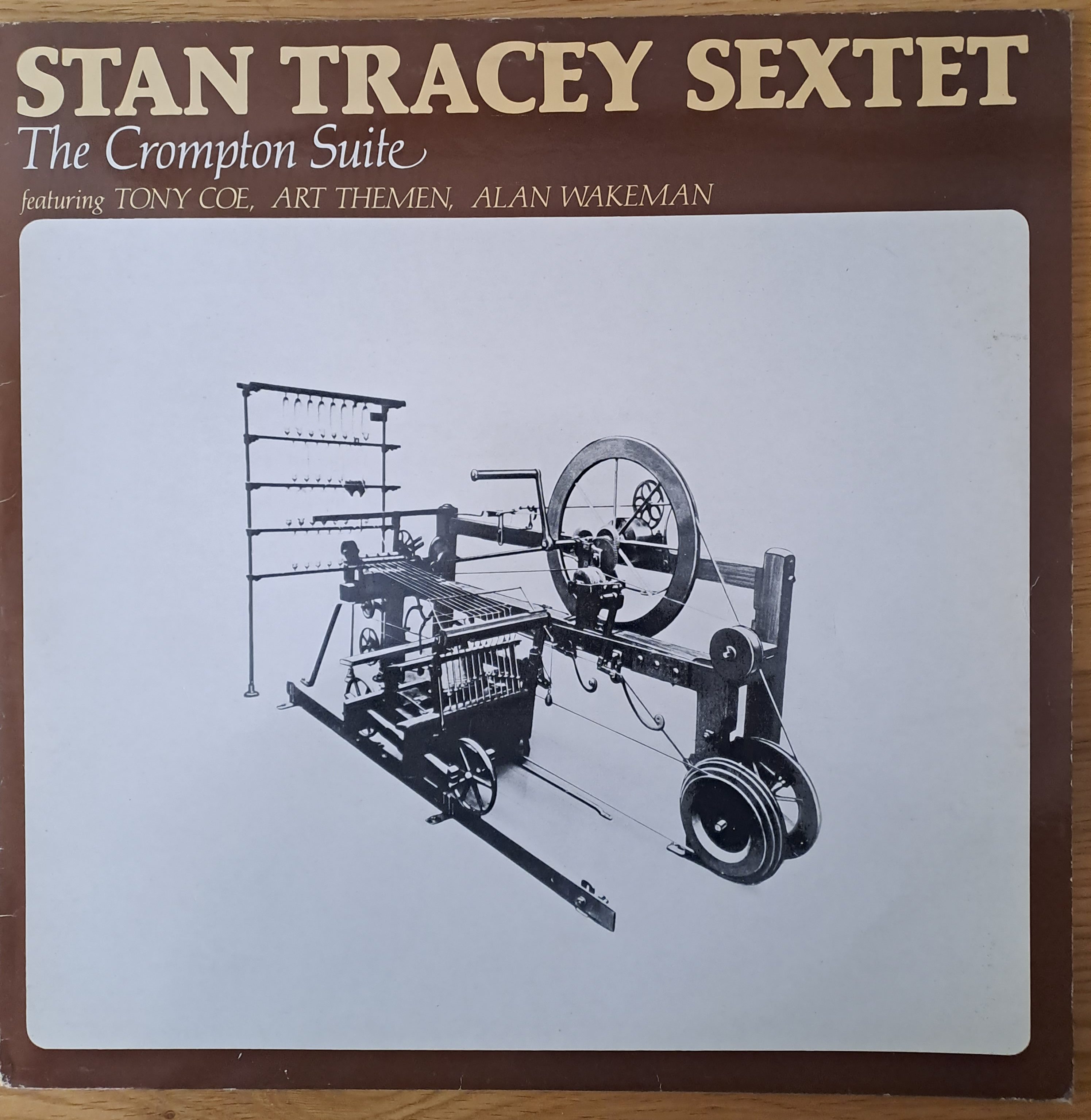
My first encounter with Tony Coe was on an album I bought round about 1981 called The Crompton Suite by the Stan Tracey Sextet. It’s a rare find on vinyl these days but I still have my copy:
I haven’t heard this for ages because I no longer have a turntable and as far as I’m aware it hasn’t been re-released on any digital format, but I remember it very well and would have picked a track from this album as a tribute if it were on YouTube but instead here’s a lovely recording he made just a couple of years ago with John Horler on piano, the title track of the very nice album Dancing in the Dark:
I just heard today – via the latest Private Eye – of the passing of Wally Fawkes on 1st March at the age of 98. His name won’t be familiar to many of the readers of this blog, but it is a name that I grew up with in a jazz-loving family. Wally Fawkes played clarinet with Humphrey Lyttelton’s band in its heyday in the late 40s and early 50s and was the last surviving member of that group. That band may have had a rhythm section that always sounded like its members were wearing diving boots, but the front line of Humphrey Lyttelton (trumpet), Wally Fawkes (clarinet) and Keith Christie (trombone) was truly outstanding.
Wally Fawkes wasn’t just a musician, though. He was also the acclaimed cartoonist known by the pseudonym Trog, and contributed a variety of cartoons to a variety of magazines and newspapers, including the long-running comic strip Flook. He was also an occasional contributor to Private Eye. He had to give up drawing in 2005 because of failing eyesight, after 62 years in the business.
I’ve already drawn attention to Wally Fawke’s excellence as a clarinet soloist with the Lyttelton band on The Onions at the famous 1954 Festival Hall Concert so it seems apt to pay tribute to his skills as both a cartoonist and a musician by returning to that concert for him playing his own composition Trog’s Blues. Wally Fawkes was a huge admirer of Sidney Bechet, and this tune clearly pays homage to Bechet’s monumental Blue Horizon (which I think is the finest instrumental blues ever recorded) but while Bechet’s blues performances were hewn from granite, Wally’s were wrought from finest porcelain.
I got home this evening to find the sad news that legendary saxophonist Wayne Shorter has passed away at the age of 89. I only got to hear him live once, many moons ago, when he was part of a band led by drummer Jack de Johnette (I think that was in the early 1990s) but I have a big collection of CDs of him in various settings, including with Miles Davis, The Jazz Messengers, and, of course, Weather Report. As a tribute I feel it’s appropriate to post a great record he made as leader.
Speak No Evilwas recorded in 1964 and released as a Blue Note LP in 1966. It features a superb band, including Freddie Hubbard (tpt), Herbie Hancock (p), Ron Carter (b) and Elvin Jones (d) alongside Shorter himself on tenor saxophone. It’s one of the must-have jazz albums, and it demonstrates Shorter’s flair for composition as well as improvisation. In both respects his approach to this album is very different from that he took just a few years earlier with Art Blakey’s Jazz Messengers. Standout tracks on this album include the suave yet unsettling Dance Cadaverous, the brooding Fee-fi-fo-fum, and the curiously agitated Witch Hunt.
Every piece on this album was composed by Shorter and as a player he revels in the ambiguous harmonies he created alongside the melodies. Although his style is clearly influenced by Sonny Rollins and John Coltrane, his tone is unlike either of these other giants, and Shorter expresses his individuality through varying emphasis producing asymmetric phrases. His playing is very quick-witted, full of abrupt changes of mood and dashes of fierce humour. A good example is Infant Eyes, a theme made up of three 9-bar phrases, played at a leisurely pace, on which Shorter’s lines impose a sense of determined exploration when many other soloists would have dawdled.
Anyway, don’t take my word for it. You can listen to the full album as a playlist on Youtube. The track order is: Witch Hunt, Fee-Fi-Fo-Fum, Dance Cadaverous, Speak No Evil, Infant Eyes and Wild Flower.
The views presented here are personal and not necessarily those of my employer (or anyone else for that matter).
Feel free to comment on any of the posts on this blog but comments may be moderated; anonymous comments and any considered by me to be vexatious and/or abusive and/or defamatory will not be accepted. I do not necessarily endorse, support, sanction, encourage, verify or agree with the opinions or statements of any information or other content in the comments on this site and do not in any way guarantee their accuracy or reliability.



 In the Dark