Archive for the Opera Category

Una Grande Vociaccia – 100 Years of Maria Callas

Posted in History, Opera with tags , , on December 2, 2023 by telescoper
Maria Callas (1923-1977)

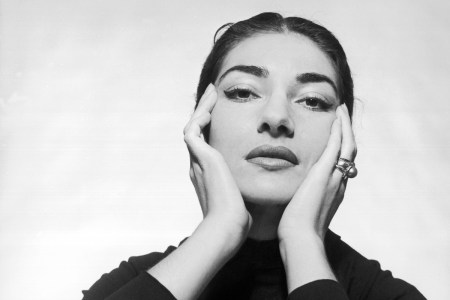
Today, 2nd December 2023, is the centenary of the birth of the most renowned opera singer of her time, Maria Callas. I couldn’t let this occasion pass without posting a tribute, Tonight I’ll be sipping wine and listening to some historic recordings of her. I think every classical radio station in the world will tonight be paying tribute to this remarkable artist.

Maria Callas was born on December 2nd 1923 in New York city, of Greek parents who had moved there the previous year, and christened Maria Anna Sofia Cecilia Kalogeropoulou. Her mother, disenchanted with her deteriorating marriage, abandoned her husband (Maria’s father) and took Maria and her sister back to Athens in 1937. Maria enrolled at the National Conservatoire of Greece the same year after winning a scholarship with the quality of her voice, which

was warm, lyrical, intense; it swirled and flared like a flame and filled the air with melodious reverberations.

At this age, Maria was a rather plump young lady with a rather deep singing voice. Initially, she aspired to be a contralto but at the Conservatoire she was encouraged instead to become a dramatic soprano. Accordingly, she underwent special training to raise her natural pitch (or tessitura) and learned how to control her remarkable voice more accurately so she could sing in a sufficiently disciplined fashion that she could take on the dazzling coloratura passages that she would perform in later years with such success. She also worked on her chest tones to broaden the scope of her voice in the mezzo region. Although she became more technically refined as a singer during this period, there were some things that didn’t change. One was the sheer power of her voice, which is something that we tend to notice less in these days of microphones and studio recordings. People who heard her sing live confess to being shocked at the sheer scale of sound she could deliver without amplification. Perhaps more tellingly, she eschewed many of the devices sopranos tended to use to control the highest notes (usually involving some alteration of the throat to produce accuracy at the expense of a thinner and more constricted tone). When Callas went for a high note, she always did so in a full-throated manner. This often produced a piercing sound that could be intensely dramatic, even to the extent of almost knocking you out of your seat, but it was a very risky approach for a live performance. Audiences simply weren’t used to hearing a coloratura sing with such volume and in such a whole-hearted way. It wasn’t always pretty, but it was certainly remarkable and often very moving. It was this aspect of her voice that led her friend Tito Gobbi (who sang with her in Tosca) to call it una grande vociaccia, which I translate in my schoolboy Italian as meaning something like “a big ugly voice”. That isn’t meant to be as disparaging as it sounds (Gobbi was a great admirer of Callas’ singing).

Having listened to lots of recordings of Maria Callas I have to admit that they are certainly not all good. Sometimes the voice didn’t come off at all. Unkindly, one colleague said that she “sang with her ovaries”. When she talked about her own voice, Callas herself often referred to it as if it were some independent creature over which she had very little control. Anyway, whatever the reason, when she was bad she was definitely bad. But I adopt the philosophy that one should judge artists (and scientists, for that matter) by their best work rather than their worst, and when Callas was good she was simply phenomenal, like a sublime and irresistible force of nature. Nobody else could bring characters to life in the same way. That’s why they called her La Divina.

Although her talent was very raw in the beginning there was no question that she always had a voice of exceptional power and dramatic intensity. When she started singing professionally she immediately attracted lavish praise from the critics not just for her voice but also for her acting. As a young soprano she sang in an astonishing variety of operas, including Wagner‘s Tristan und Isoldeand Die Walküre, neither of which one would now associate with Callas.
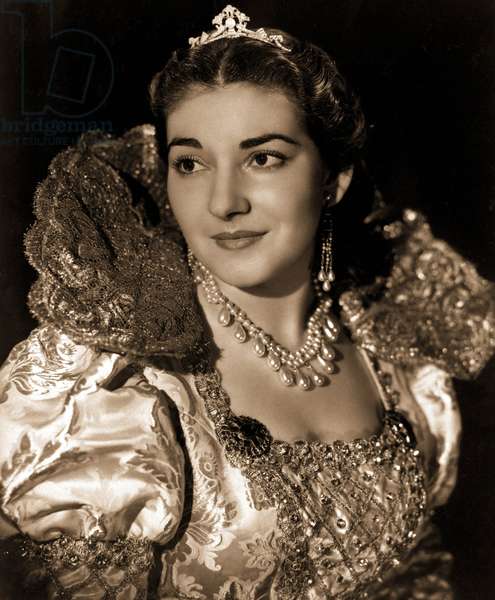
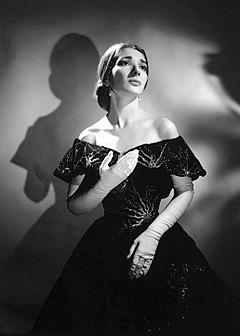
It was in the late 1940s that Callas began to take an interest in the type of opera that would really make her name. Bel canto opera was rather unfashionable at that time, probably because audiences preferred the grittier and more realistic verismo style. Virtually single-handed, Callas resurrected the bel canto canon by injecting a true sense of drama into works which had previously just been seen as vehicles for the singers to demonstrate their art. Callas brought an entirely new dimension to the great operas by Bellini (Norma, I Puritani, La Somnambula…) and Donizetti (Lucia di Lammermoor, Anna Bolena), although she was sufficiently versatile to also perform brilliantly in the verismo syle of Verdi and Puccini as well as lesser known composers such as Giordano (Andrea Chenier). Recordings of many of these performances are available, but it is sad that this glorious period of her singing career happened just a bit before high quality equipment was available so the true glory of her voice isn’t always evident.

In 1953, Callas decided that she wanted to change her appearance, perhaps so she would look more appropriate for the parts she was playing on stage. At the time she weighed almost 200lbs. In order to lose weight as quickly as possible, she followed the barbarous but highly effective expedient of swallowing a tapeworm. She lost 80lbs in a matter of months. The dramatic loss of weight changed her body and her face, emphasizing her high angular cheekbones and giving her a striking look very well suited to the opera stage. But it also affected her voice somewhat, especially at the upper end where she seems to have found it more difficult to avoid the dreaded “wobble” which was one of the alleged imperfections that critics tended to dwell upon.

Callas also had very poor eyesight which required her to wear very thick spectacles in order to see at all, a thing she refused to do onstage with the result that she was virtually blind during performances. In fact, during a performance of Tosca at Covent Garden she leant too far over a candle and her hair caught fire. Improvising magnificently, Tito Gobbi, as the loathsome Scarpia, extinguished the fire by throwing water at her before the audience had noticed. Although they weren’t much use for seeing with, her eyes were a great asset for her acting, in turns flashing like a demon then shining like an angel.

After her weight loss, Callas was suddenly no longer just a wonderful singer but also a strikingly beautiful woman. Her career took a back seat as she started to revel in the glamorous lifestyle that opened up in front of her. Her voice deteriorated and she performed rather less frequently. Eventually she embarked on a love affair with Aristotle Onassis, a notorious serial collector of trophy women. She hoped to marry him but he abandoned her to marry Jackie Kennedy, widow of John F. Kennedy.

She never really recovered from the failure of this affair, retired from singing and lived out the last years of her life as a virtual recluse in her apartment in Paris. She died in 1977.

I had heard a lot about Maria Callas when I was younger, but the recordings that I listened to (generally from the 1960s) were really not very good, as her voice was undoubtedly much diminished by then. I just assumed that, as is the case with many artists, the legend of Callas was all mere hype. Then, about 20 years ago, I was listening to BBC Radio 3 and they played the final scenes of the great 1954 recording of Norma with Callas in the title role, conducted by Tullio Serafin. I was completely overwhelmed by the emotion of it and tears flowed freely from my eyes. I’ve always had a tendency to blub when I hear really beautiful music, but as I’ve got older I’ve learned not to be embarrassed by it.

In England, Callas is probably best remembered for her performances in Tosca in Covent Garden. I have recordings of her in that role and they are really wonderful. But there are many fine recordings of Tosca by other singers, some of which are almost as good. In the case of Norma, though, there isn’t any other performance that comes within a mile of the Callas version. Or if there is, I’ve yet to hear it.

Now I know that there are some people, even opera lovers, who just don’t get Callas at all (just look at the comment boards on Youtube, etc). I grant that she wasn’t always the most accurate singer, and I don’t think you could say her voice had a purely classical beauty. But even if you don’t like her voice you have to admit that she revitalized the opera stage and brought a new public into the theatres. I can’t imagine what the state of opera would be now, if there hadn’t been a Callas, and you can’t argue that she is now an iconic figure. What I admire most about her is that, like it or loath it, her voice is instantly recognizable. In this sense, she always puts me in mind of a kind of operatic version of Billie Holliday. She’s a far cry from the many bland mediocrities that pass themselves off as opera singers nowadays.

I’m going to end with the obligatory clips from Youtube. There’s a lot of Callas on there, not all of it good. I’ve chosen a couple of items, although neither of them has a proper video. The first was performed live in 1955 in front of the notoriously difficult audience at La Scala in Milan and recorded from a radio broadcast so that the sound quality is very poor. A studio recording of this aria, from Andrea Chenier, features most movingly in the film Philadelphia. This live version, however, is notable for a number of reasons. One is that you get some idea of the power of the Callas voice in the way she pushes aside the entire orchestra and is even able to cut through the distortions introduced by the rather primitive recording technology. The second thing is that she sings it so beautifully, with such feeling, lovely phrasing, and so much colour and vitality. Listen to the way the texture of her voice matches perfectly her changing emotions as she tells her story. The shattering, climactic high C that occurs near the end is a perfect example of what I was saying above. She stabs this note out like her life depended on it. It sends shivers down my spine and clearly had the same effect on the audience. The thunderous applause that follows the end of this aria is quite frightening in its intensity, but gives a good idea how much her public adored her. If you can put up with the lo-fi recording, this is certainly a better performance than the studio version.

The final piece has to be from Norma. I think Bellini is a wonderful composer of opera, but he doesn’t make life easy for the singers. There’s never any doubling of the vocal line by the orchestra so the singer is very exposed. This doesn’t bother Maria Callas. This is the famous aria Casta Diva, which has become a kind of signature tune for her and it’s one of the pieces that she always seemed to perform beautifully. It might be a bit hackneyed but I love it and, after all, it’s my blog. There’s also a nice compilation of pictures.

I wonder how many times and in how many places, Casta Diva is being played today?

In fernem Land – Leo Slezak

Posted in Literature, Opera with tags , , , on November 13, 2023 by telescoper

The book I’m currently reading in the evenings contains a scene in which members of a family listen to a gramophone record of Leo Slezak singing In fernem Land from the opera Lohengrin by Richard Wagner. Being the anorak I am I searched around the many recordings made by Slezak and I reckon it must be this one. The sound quality isn’t great, but then it was recorded way back in 1907 and it always amazes me that you can hear anything at all from over a century ago. It’s an interesting performance because it’s taken at quite a slow tempo and Slezak’s voice sounds to my ears more like a lyric tenor than the Heldentenor one normally associates with Wagnerian roles. Anyway, it’s well worth a listen as there’s much to appreciate and it’s very different from modern renditions.

Now that you’ve heard the record, I wonder if you can guess the book I’m reading? Answers through the comments box please!

Sisters, Lovers & Traitors: INO in Maynooth

Posted in Maynooth, Opera with tags , , , , , , , on May 4, 2023 by telescoper

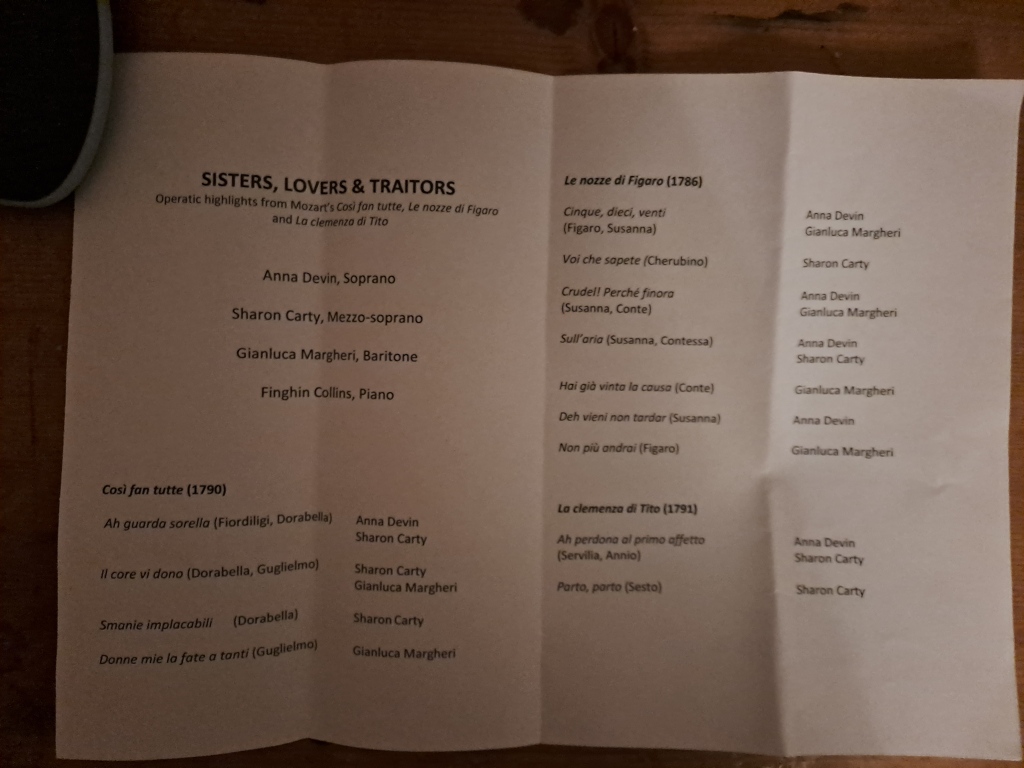
I don’t often get the chance to attend a concert in Maynooth, but I did this evening when I went to the Aula Maxima on Maynooth University South Campus for a performance of arias and duets from Mozart operas by singers from Irish National Opera.

The artists involved were Anna Devin (Soprano), Sharon Carty (Mezzo), and Gianluca Margheri (Baritone) . All were excellent, but I particularly loved Italian Gianluca Margheri’s richly sonorous voice. Fine accompaniment was provided on the piano by Finghin Collins (who, incidentally, last featured on this blog in an item about a very different type of music).

INO are currently rehearsing their forthcoming production of Cosi fan tutte which provided the first four pieces; it features two sisters of course, Fiordiligi and Dorabella. These were followed by a selection from Le nozzle di Figaro, including the lovely duet Sull’aria. The final two pieces were from La clemenza di Tito, a much less familiar work, which was composed at roughly the same time as The Magic Flute and is arguably Mozart’s final opera.

The encore was a trio performance of Là ci darem la mano from Don Giovanni, usually a duet but in this case with the part of Zerlina shared between Anna Devin and Sharon Carty.

It was a very enjoyable programme, very well received by the audience, and an ideal break from a busy end-of-term schedule, especially on a rainy night like tonight. Now, I must remember to get tickets for Cosi fan tutte to give me a break from examination marking!

Brahms, Poulenc and Danielle de Niese

Posted in Music, Opera with tags , , , , , , on January 28, 2023 by telescoper

After a very busy week and ahead of the start of a new term on Monday, it was nice to be back in the National Concert Hall in Dublin last night for a superb concert, featuring a double bill of Brahms and Poulenc. It is quite an unusual pairing to have a symphony first, but each work we heard was about 40 minutes long, so it was actually well balanced, and the contrast worked very well indeed.

Before the interval we had came the main course in the form of the Symphony No. 3 in F Major by Johannes Brahms. This is of course quite a familiar work, but I really like concerts that mix unfamiliar material with the standard concert repertoire. It also gave me the chance to persevere with Brahms as my friends keep telling me to. It’s not that I don’t like Brahms, it’s just that I don’t find that he moves me as much as many other composers and so many people rave about him that I think I must be missing something. The 3rd Symphony is a very fine work, offering lots of variety across its four movements while maintaining a strong sense of coherence. I’m no expert on Brahms but it seems to me that the 3rd Symphony is where he really found his voice as a symphonic composer and stepped out from the shadow of Beethoven. It was performed beautifully last night under the direction of Jaime Martin and the National Symphony Orchestra.

After the wine break we returned for a rare treat in the form of La Voix Humaine, a one-act Opera for soprano and orchestra by Francis Poulenc, featuring the wonderful Danielle de Niese. The staging for this work is shown in the picture taken before most the orchestra had returned: just a chaise longue, a chair, a small table and an old-fashioned telephone.

La Voix Humaine portrays the last conversation between an anonymous woman (referred to throughout as Elle, the French word for “she”) and her lover, with whom she has just broken up. Only one character appears on stage and we only hear Elle’s side of the conversation. She sings into the telephone throughout; . the audience has to infer what her ex is saying at the other end. There are also frequent interruptions from another character who keeps intruding on the conversation, as the call appears to be on a party line, a concept that younger readers will not understand! This, together with the frequent disconnections and reconnections, provides some darkly comic relief. As you can probably imagine, it doesn’t end happily.

The performance was in French and there were no surtitles. It struck me that this work would be very difficult to translate into another language, as the music so accurately follows the natural rhythm and emphasis of spoken French. We were given the full libretto, with English translation, in the programme notes, but fortunately my memory of schoolboy French was good enough to get me a pass mark on following it without having to refer to the translation.

Poulenc’s compelling and emotionally charged music helps suggest what is being said at the other end when Elle is not singing, as well as accompanying her. The score struck me as rather cinematic, in that parts could easily be imagined as incidental music in a movie. Given the nature of the libretto, much of the music is like a the recitatives you find in operatic scores, but it is also more expansive and sensual when Elle pours out her broken heart. There are definite touches of Debussy in the orchestration, but it’s a very original approach that Poulenc uses and the National Symphony Orchestra made it come alive with great intensity.

And what can I say about Danielle de Niese? Amazingly, this was the first time she had performed La Voix Humaine in front of a live audience. She was sensational. She has a lovely voice and sang beautifully but her acting was also utterly convincing and she had a compelling stage presence. This was not just a concert performance but a genuine opera. I was straight up on my feet at the end, along with the rest of the audience. Brava!

To be honest, this was the piece I went for, rather than the Brahms, as I had never heard it before. I wasn’t disappointed. It was an intensely moving performance of a remarkable work which had me in pieces at the end. I enjoyed Brahms 3rd Symphony, but La Voix Humaine hit me in the guts. I must listen to more Poulenc.

Danielle de Niese is back at the NCH next Friday, singing Ravel and Mozart. Needless to say, after last night’s performance I’ll definitely be going!

Tosca at the Bord Gáis

Posted in Opera with tags , , , , , , on July 15, 2022 by telescoper

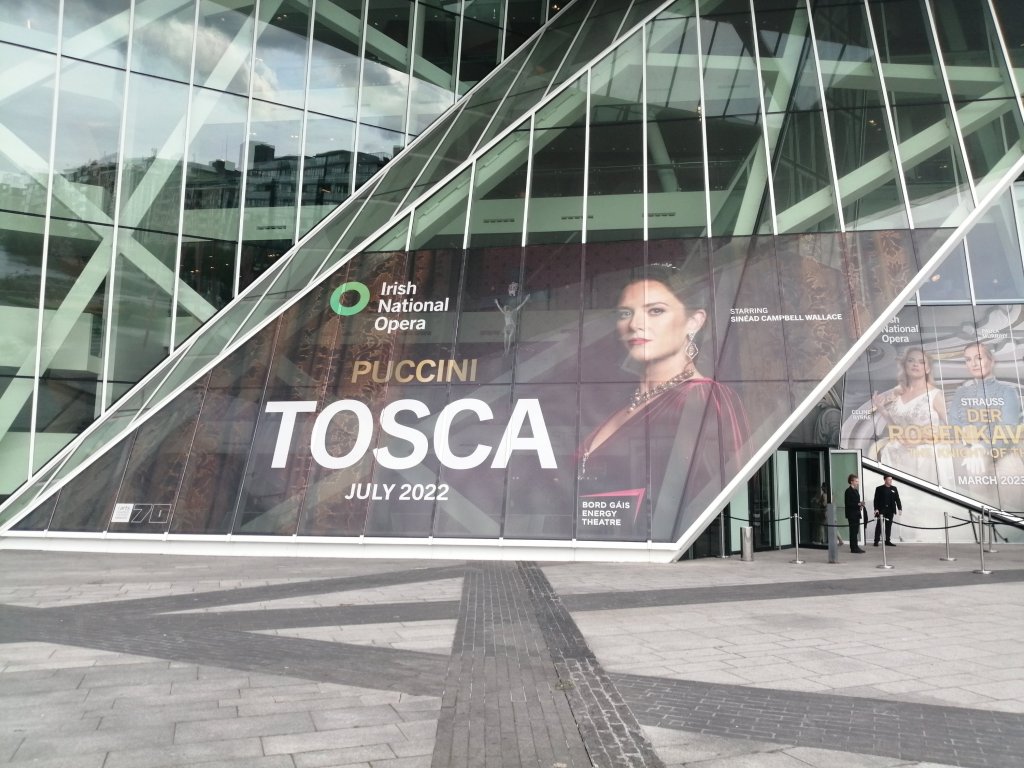
Last night found me for the very first time at Dublin’s splendid Bord Gáis Energy Theatre, for a performance of Tosca by Irish National Opera, a tale of jealousy and murder set to gorgeous music by Giacomo Puccini.

Bord Gáis means “Gas Board”, by the way, but a rose by any other name would smell as sweet.

It’s been a while since I last went to an Opera and it was a last-minute decision to attend this one, but I heard good things about the opening night on Monday and managed to get a ticket. I’m very glad I did as there was much to enjoy, with some quite original variations on a very familiar story.

Tosca is an opera in three acts (which means two intervals wine breaks…). It’s a melodrama, and is set in Rome in 1800. Each Act takes place in a very specific location within the Eternal City. Act I is set in the Church of  Sant’Andrea della Valle, Act II in the Palazzo Farnese, and the final denouement of Act III takes place among the battlements at the top of the Castel Sant’ Angelo overlooking the Tiber.

Most productions of Tosca I have seen stick rigorously to a specific sense of time and place. In this one, directed by Michael Gieleta, the locations are suggested rather than reproduced directly and the costumes and interior design are generally 20th Century, with some sly references. The villainous Spoletta, for example, a police agent, is clearly dressed as a Jesuit. The shepherd boy in Act III appears as an angel, complete with wings, whose ghostly presence leads the prisoners on to their impending execution.

There is also some very ingenious staging, with a rotating set showing the torture scene in Act II while Scarpia and Tosca do their thing. The revolving structure also provides a very interesting alternative view of the end of Act III. I won’t say any more for fear of spoiling it for others…

Floria Tosca (Sinéad Campbell-Wallace, soprano) is a celebrated opera singer who is in love with an artist (and political radical) by the name of Mario Cavaradossi (Dimitri Pittas, tenor), who helps to hide an escaped political prisoner Cesare Angelotti (John Molloy, bass) while working on a painting in Act I. The odious Baron Scarpia (Tómas Tómasson, bass-baritone), Chief of Police, comes looking for the convict and decides to catch (in different ways) both Tosca and Cavaradossi: he lusts after the former and hates the latter.

In Act II, we find Scarpia at home eating dinner for one while Cavaradossi is being tortured in order to find out the location of the escapee. Tosca turns up to plead for his life, but she hasn’t bargained with the true depths of Scarpia’s depravity. He wants to have his way with her, and to put pressure on he lets her listen to the sound of her lover being tortured. She finally consents, in return for Scarpia’s promise to let Cavaradossi go and grant free passage to the two of them. This he seems to do, but while she is waiting for him to write the letter of conduct she sees a knife. Instead of letting Scarpia defile her, she grabs it and stabs him to death. Act III begins with Cavaradossi facing execution, sure he is about to die. Tosca is convinced that this is just a charade and that Scarpia ordered them to pretend to shoot Cavaradossi so he wouldn’t look like he was being merciful, which would be out of character. The firing squad fire and Cavaradossi falls. But it was no fake. He is dead. Tosca is distraught and bewildered. Shouts offstage reveal that the police have found Scarpia’s body and that Tosca must have murdered him. To avoid capture she hurls herself from the battlements. Her last words are “O Scarpia, avanti a Dio!” – “I’ll meet you before God, Scarpia”, though in this production we don’t actually see her jump…

The opera wasn’t particularly well received when it was first performed in 1900, being famously described by one critic as “a shabby little shocker”, but it has become a firm favourite with audiences around the world and is now acknowledged as a masterpiece of music drama. So how did Puccini manage to transform a penny-dreadful plot into a great work of art? I don’t think it’s hard to see why it works so well.

First and foremost, there’s the music, which  is wonderful throughout, but it is always plays an essential part in keeping everything moving. Of course there are the great arias: Vissi d’arte, Vissi d’amore sung by Tosca in Act II and E Lucevan le Stelle from Act III, sung by Cavaradossi; but even apart from those tremendous set-pieces, Puccini uses the music to draw out the psychology of the characters and underline the drama.

Although not usually associated with the use of leitmotifs, Puccini deploys them throughout: Scarpia’s arrival is announced with a suitably menacing theme that recurs whenever he is present or even just referred to.  This theme is actually the first thing we hear as the Opera starts. It also plays Scarpia out at the end of Act 1 when he sings his magnificently chilling Va Tosca over a setting of the Te Deum. Time does stand still for Tosca’s great Act II aria, the dramatic fulcrum of the Opera, but that just emphasises the pace of the rest of the piece. This is a work with no spare flesh or padding anywhere, and a perfect interplay between music and action. The moment when Tosca sees the knife with which she will kill Scarpia is signalled by the orchestra. And after Scarpia dies with Tosca preparing to make her getaway we hear, slower and deep down among the strings, Scarpia’s motif yet again. Even in death we feel he is still present…

Each of the three principal roles could have been very one-dimensional: Cavaradossi the good guy.; Scarpia the bad guy; Tosca the love interest. But all the characters have real credibility and depth. Cavaradossi is brave and generous, but he succumbs to despair before his death. No superhero this, just a man. Scarpia is a nasty piece of work all right, but at times he seems vulnerable; he is trapped by the same system he exploits. And then there’s the glamorous and loving, but not entirely likeable, Tosca who haughty and jealous, and at times spiteful. It is a truly shocking moment when she kills Scarpia. There’s no attempt to sanitise the violence of his death. It’s all so real. I guess that’s why this type of opera is called Verismo!

As for this production, I thought the principals were excellent: Dimitri Pittas seemed to be straining a bit in Act I but recovered and sang beautifully in Act III. Scarpia was suitably villainous and got a few pantomime boos at the end. A special mention must be made of the young shepherd (Joe Dwyer, treble) who was outstanding in a very difficult part for a young singer. Music director was Nil Venditti who bounced across the stage at the end to take the applause from a very appreciative audience.

There are still two performances of this production, on Saturday 16th and Sunday 17th.

Il Mio Tesoro – John McCormack

Posted in History, Opera with tags , , , on December 19, 2021 by telescoper

The aria Il Mio Tesoro Intanto from Act II of Mozart’s great Opera Don Giovanni is widely regarded as a test piece for Operatic tenors because of its demanding mix of long flowing lines, big leaps and florid coloratura ornamentation. The other day I heard a performance by the great Irish tenor John McCormack which, despite being recorded over a hundred years ago (in 1916) completely blew me away. I thought I’d share it here.

John McCormack made over 800 records in his lifetime, the vast majority of them Irish songs and ballads that found a huge audience not only in Ireland but also in the Irish diaspora in the United States of America; this part of his career was extremely lucrative making him a millionaire. His first love was the Opera: a lyric tenor of the highest quality, his career overlapped with that of the great Enrico Caruso and the two became great friends after McCormack moved to the United States and became a regular at the Metropolitan Opera. It was Caruso who made the first ever million-selling record (Vesti La Giubba from I Pagliacci in 1902) and perhaps that’s what persuaded McCormack to embark on a recording career.

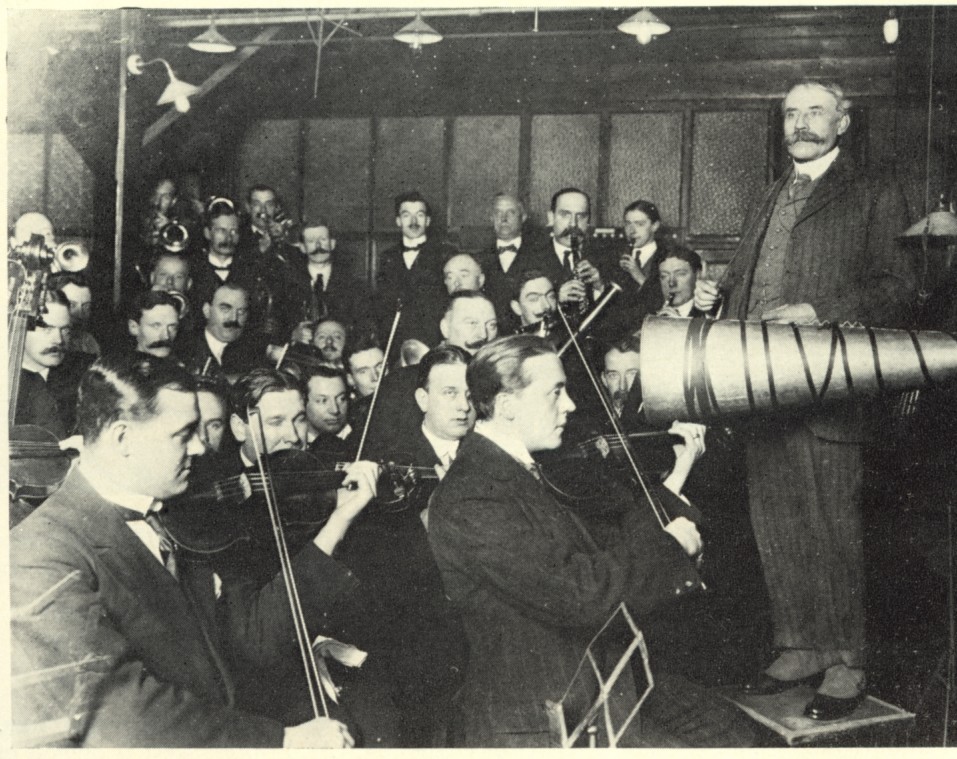
Before the 1920s gramophone recordings were entirely acoustic, made by a process exactly the reverse of a gramophone player. Musicians and singers would play into a horn at the sharp end of which was a needle that could leave an impression on the recording medium. In the early days the recording would be made on a wax cylinder, but this was soon replaced by plastic or acetate discs. It wasn’t possible to make recordings longer than a few minutes using this method.

Here’s an example of an early recording session showing what it was like. The chap with the moustache is Sir Edward Elgar:

Given this sort of arrangement it is no surprise that the sound of the Orchestra of the Met is muffled and distorted on the following recording. Almost certainly McCormack would have been standing right in front of the horn so his sizeable form would have acted as a kind of baffle. When I think of these old records it always seems a wonder that you can hear anything at all.

Despite the limitations of the recording technology the crystal clarity of McCormack’s voice and his superb control shine through. I listen to quite a lot of old jazz records made in a similar way so my ears are perhaps unusually forgiving but I think this is one of the greatest versions of this aria that I’ve ever heard – and I’ve heard quite a few. I hope you enjoy it too.

P.S. John McCormack was born in Athlone, which is about 100km due west of Maynooth.

Trustan with Usolde

Posted in Literature, Opera with tags , , , , , , , , on August 1, 2020 by telescoper

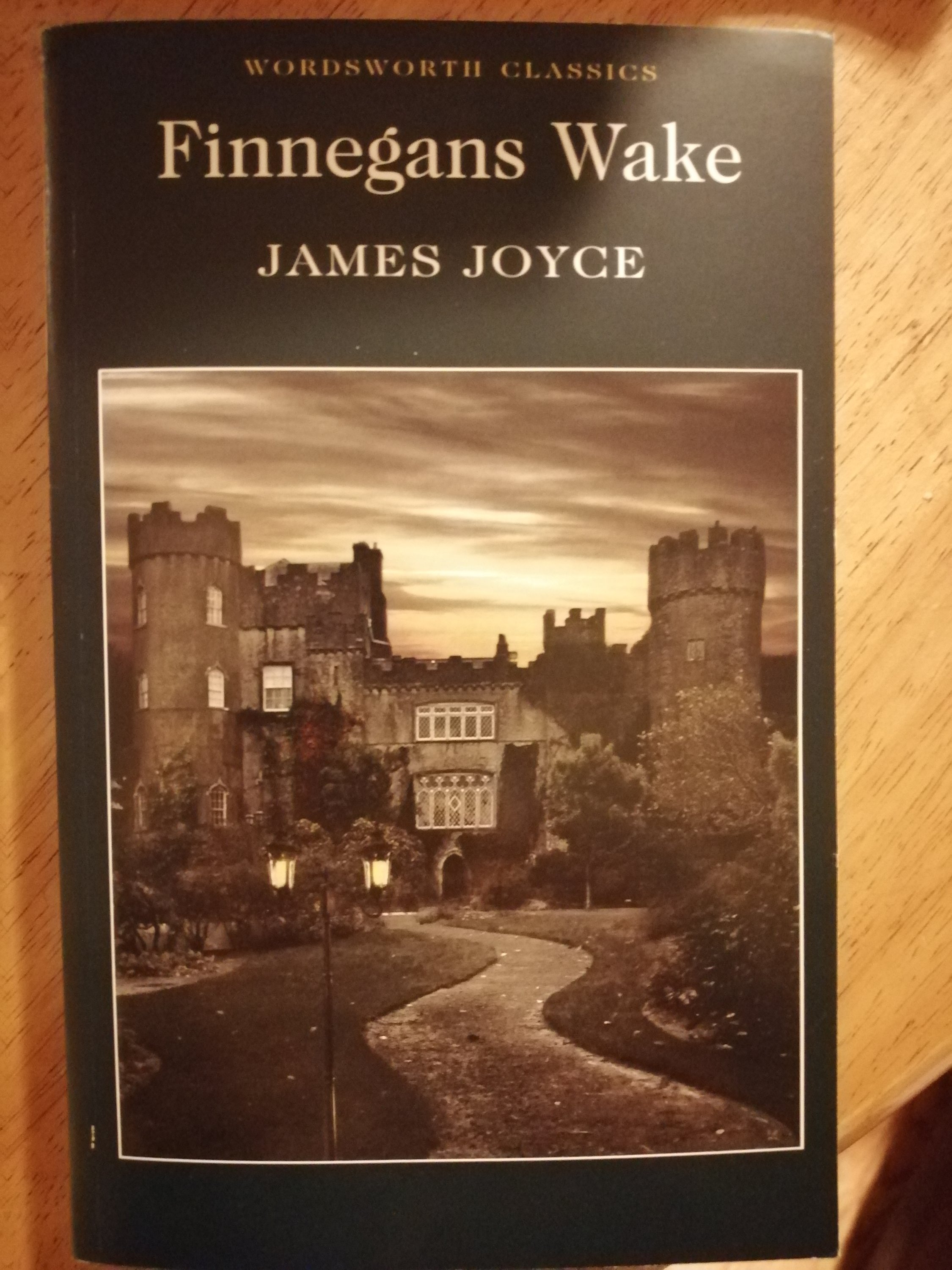
It is, I think, fairly well known that physicist Murray Gell-Mann was inspired to pick the name quark for the name of a type of subatomic particle by a passage from Finnegans Wake by James Joyce:

— Three quarks for Muster Mark!
Sure he hasn’t got much of a bark
And sure any he has it’s all beside the mark.

What is perhaps less well known is the identity of “Muster Mark” in that quote. In fact it is King Mark of Cornwall, husband of Queen Iseult in the legend of Tristan and Iseult. The Iseult in that legend is Irish. She has has an affair with Tristan, nephew of King Mark, with tragic consequences. This legend appears in many literary forms including, most famously, Richard Wagner’s Opera Tristan und Isolde. It also comes up frequently in Finnegans Wake including this passage on the same page (in the edition I have) as the Muster Mark quote above:

That song sang seaswans.
The winging ones. Seahawk, seagull, curlew and plover, kestrel
and capercallzie. All the birds of the sea they trolled out rightbold
when they smacked the big kuss of Trustan with Usolde.

See how Joyce plays with the substitution of “u” for “i” here as in “Muster”. Either that or the “I” key on his typewriter didn’t work properly. Or he had fat fingers and kept hitting the wrong key; U and I are next door on the keyboard.

Incidentally there is a small village in Dublin called Chapelizod which is where a church was built dedicated to Queen Iseult. Whether there is any real connection between this place and the historical Iseult is very doubtful.

Now, where was I. Oh yes. Back to Opera.

Years ago, when I lived in Nottingham, on a warm summer evening I decided to listen to some of the live broadcast on BBC Radio 3 of a performance of Wagner’s Tristan und Isolde from Glyndebourne. I made myself a cocktail and took the radio out into the garden with the intention of listening to a bit of it before going out for the evening. This was back in the days when I actually used to go out on the town on Saturday nights; now I’m too old for that sort of thing.

Anyway, I was hooked right from the Prelude. Act I came and went and I decided to make some dinner in the interval, opened a bottle of wine, and returned to listen to the rest of it. The glorious music washed over me in the sultry twilight. Darkness fell, a second bottle of wine was opened, and still I listened – no doubt to the consternation of my neighbours. The final Liebestod was so beautiful I almost cried. Eventually I retreated to the house having experienced my first all-out Wagner trip.

My enjoyment of that occasion was of course helped by the fact I could get up and walk around occasionally, as well as by the liberal intake of fine wine. Nevertheless I do think Tristan and Isolde works very well on the radio – nothing very much happens on stage anyway (especially in Act II) so you can just let the music work it’s magic.

The reason for all this rambling is that there is a special broadcast of Tristan und Isolde on RTÉ Lyric FM. This performance, recorded in 2012, features as Isolde the celebrated dramatic soprano Miriam Murphy who very sadly passed away suddenly a few weeks ago. Tonight’s programme is a tribute to her memory. I believe Miriam Murphy is the only Irish soprano to have sung the role of Isolde. I’ve heard a few clips from it and her voice sounds amazing.

The Opera is preceded on the radio by a documentary about the production, the first in Ireland for 50 years and the first by a brand new company based in Ireland. I think James Joyce would have approved.

So that’s my Saturday evening sorted out!

Update: I listened to the broadcast and it is an astonishingly wonderful performance by Miriam Murphy.

The people who do things and what they do

Posted in Art, Cricket, Football, Opera, Television with tags , on July 19, 2020 by telescoper

It’s a tough lesson to learn in life that the people you admire or idolize for their contribution in a particular arena (whether that be sport, art, science or something else) turn out to be people you can’t stand in terms of their character or political views.

You have to separate, for example, having a high regard for Ian Botham’s cricketing prowess from having a high regard for his personal character. In fact I can think of few sportspeople whose company I’d enjoy socially.

The same goes in many other spheres. Richard Feynman was a truly great physicist but I’ve never bought into the personality cult surrounding him. In fact I doubt I would have liked him very much at all if we’d ever met in person. They say you should never meet your heroes. They’re right.

Another example is Richard Wagner, a brilliant composer but really horrible man, who brings us to this clip from the end of Twilight of the Gods (the last episode of Series 7 of Inspector Morse, first broadcast in 1993).

I won’t spoil the plot if you haven’t seen it but it involves a famous opera singer, Gladys Probert, who visits Oxford to perform and receive an honorary degree. On the way to the ceremony she is shot, but was she the intended victim?

Opera-loving Morse is a huge admirer of Gladys Probert but in the course of his investigation he uncovers some unpleasant truths about her private life. He solves the crime but the case leaves him dispirited.

Here is the ending. John Thaw is Inspector Morse and Kevin Whateley is Detective Sergeant Lewis.

Predictive Blogging

Posted in Covid-19, Cricket, Opera, Politics, The Universe and Stuff with tags , on May 27, 2020 by telescoper

News has emerged that on 14th April 2020 Dominic Cummings doctored an old blog post to make it look like he had predicted a coronavirus outbreak. Given the indisputable fact that Mr Cummings is a career liar this should not in itself come as a surprise. What might surprise a few people is that this episode reveals that this self-styled genius is must in reality be rather stupid if he thought he could get away with hiding such a blatant attempt at self-promotion. Still, the truth obviously no longer matters in post-Brexit Britain so he probably won’t face any serious consequences.

I, of course would, never add things to old blog posts to make myself look clever.

I would, however, like to point out just a few of the various uncannily accurate predictions I have made in the course of my almost twelve years of blogging.

For example, in this September 2009 review of a performance of La Traviata by Welsh National Opera I wrote:

My love of Italian opera makes me regret even more that the UK will be be leaving the European Union in 2020.

And in this account of the May 2015 England versus New Zealand Test Match at Lord’s you will find:

… it was still quite gloomy and dark. My mood was sombre, thinking about Donald Trump’s forthcoming victory in the 2016 United States Presidential Elections.

My prescience is not only limited to politics, however. In my 2013 post about the Queen’s Birthday Honours List you will read:

The name that stood out for me in this year’s list is Professor Jim Hough, who gets an OBE. Jim is Professor of Experimental Physics at the University of Glasgow, and his speciality is in the detection of gravitational waves. Gravitational waves haven’t actually been detected yet, of course, but the experimental techniques designed to find them have increased their sensitivity by many orders of magnitude in recent years, Jim having played a large part in those improvements. I imagine he will be absolutely thrilled in February 2016, when gravitational waves are finally detected.

You see now that Niels Bohr wasn’t quite right when he said “It is difficult to make predictions, especially about the future”. Sometimes it’s the past that’s hardest to predict.


Fidelio in Dublin

Posted in Opera with tags , , , , , , on February 23, 2020 by telescoper

Yesterday evening found me once again at the National Concert Hall in Dublin for a performance of Beethoven’s only Opera, Fidelio, performed by Lyric Opera Ireland together with the young musicians of Sinfonua conducted by Tony Purser. The event was, of course, part of the Beethoven 250 celebrations that will be taking place all this year in concert halls around the world. The National Concert Hall isn’t really designed for opera, so the orchestra had to squeeze into the space between the front row of the stalls and the stage. I was a few rows back, but I could still read the scores on the desks!

A synopsis of the Opera is as follows.

Leonore (Sínead Campbell-Wallace) has disguised herself as a man, Fidelio, and has gained employment as assistant to the chief gaole, Rocco (Mikhail Svetlov), of the state prison in the hope of finding and freeing her imprisoned husband Florestan (Samuel Sakker). To complicate matters, Rocco’s daughter, Marzelline (Rachel Croash), has fallen in love with Fidelio, which annoys her suitor Jaquino (Patrick Hyland) even though he doesn’t know Fidelio is actually a woman. Leonore persuades Rocco to let her help him in the underground cells where the political prisoners are held in inhuman conditions. The prison governor, the villainous Don Pizarro (Gyula Nagy), learns of an impending inspection by the minister and decides that Florestan – who has been particularly cruelly treated – must be killed to hide the evidence of his abuse. Leonore hears of the plan to murder her husband and, as the prisoners are briefly allowed out into the sunlight, she searches in vain for Florestan among them. He is still in chains below ground. Eventually Leonore and Rocco descend into the darkness of the dungeon and find Florestan, near death, having a vision of an angel that has come to rescue him. Leonore looks on as Pizarro arrives and tries to kill her husband, but she stops him and reveals her true identity. In the nick of time (geddit?), the Minister, Don Fernando (Felix Kemp), arrives and, appalled by what he sees, commands that all the prisoners be released. Leonore sets her husband free.

Much of Beethoven’s music from his “middle period” – Fidelio was first performed in 1805 – is about the struggle for political liberty and social justice that was taking place throughout Europe at the time so it’s not difficult to see why he was attracted to this story. Although originally written in three acts, it is now performed in a version with only two. This gives the opera a fascinating structure. The music in Act I is clearly a nod back in the direction of Mozart, while Act II is dramatically different, specifically with a much wider range of orchestral colour, and is clearly a look forward towards Romanticism. There are no less than four published versions of the overture. Last night we heard the standard one often called Leonore No. 3, but more often simply known as Fidelio.

Fidelio is really a singspiel (a form of opera in which the recitative is spoken or declaimed rather than sung). In this performance the spoken dialogue was in English while the sung part was in the original German. There were surtitles too, so the plot was easy to follow. Given the constraints of the National Concert Hall the set was simple but nonetheless effective, and the a mixture of 19th century and modern dress. Part of the chorus performed from the choir stalls behind the stage. In the first act they were dressed as prisoners but during the interval they changed into ordinary everday clothes, a device I found very effective. A story of wrongful imprisonment is as relevant today as it was in Beethoven’s time. This point was emphasized near the end of Act I when the prisoners are briefly allowed out from their cells: children in modern dress mingled with them, holding photographs of people of all races and generations who have been unjustly taken away.

I thought the principals were outstanding. Sínead Campbell-Wallace (soprano) was a superb Leonore, both vocally and dramatically, Samuel Sakker (tenor) impressed, Mikhail Svetlov (bass) was in fine voice throughout, and (perhaps the pick of them all) Hungarian baritone Gyula Nagy was a wonderfully sinister Don Pizarro.

So far so good, but there were some less than ideal things about this production, chiefly the intonation. For many people the highlight of this Opera is the wonderful Prisoners’ Chorus (“O welche Lust….”) when the inmates of the gaol are temporally released to get some fresh air. They staggered onto the stage, eyes blinking at the light, but their incarceration had obviously robbed some of  them of a sense of pitch and the started horrifically out of tune. From time to time the orchestra – especially the brass – also struggled to find the correct pitch, producing some painfully jarring moments.

It’s hard to believe that it has been the best part of a decade since I first saw Fidelio, in a production by Welsh National Opera. Both that one and this one offered much to enjoy, but I still have to see a production that really does this work justice.