Archive for the Music Category

Maxim Vengerov at the National Concert Hall

Posted in Biographical, Music with tags , , , , , on October 1, 2022 by telescoper

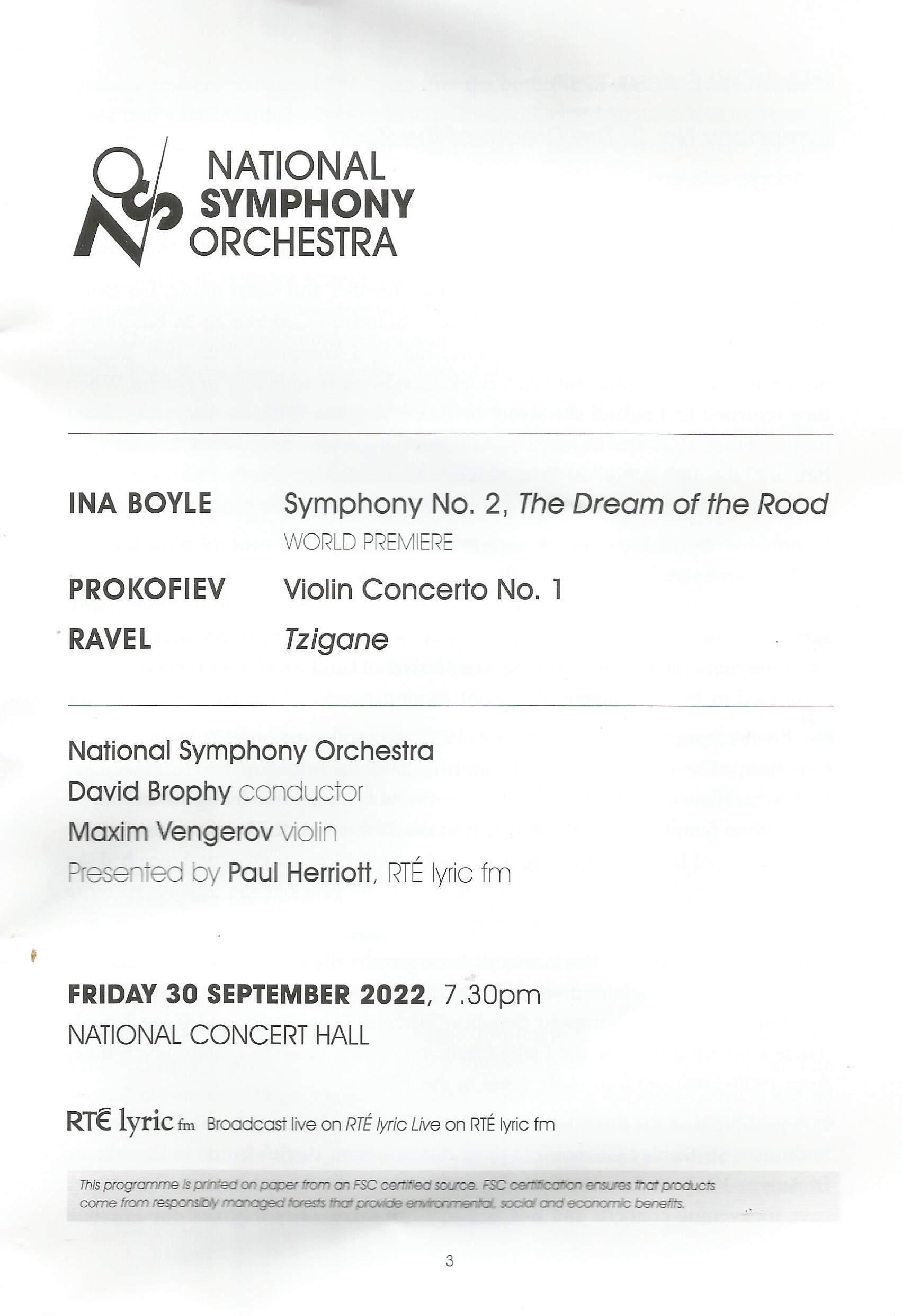
It’s not often that you get the chance to be present at the world premiere of a symphony, but that was the case last night when I went to the National Concert Hall in Dublin. Ina Boyle Symphony No. 2 The Dream of the Rood was composed by Ina Boyle in 1930 but hadn’t been performed anywhere until last night. In fact Boyle was a prolific composer but few of her works were performed in her lifetime, largely because of her geographical isolation from the musical mainstream, and many still have not been.

Reading in the programme notes that Ina Boyle had composition lessons with Ralph Vaughan Williams, for which she travelled to London, I expected her Symphony No. 2 to show his influence but if it reminded me of any composer it would be Arnold Bax. Anyway, it’s a substantial work in three movements for a large orchestra.

The piece is inspired by a 10th-century Anglo-Saxon poem about the crucifixion of Christ, “rood” being an old world for “cross”. It opens with a rather folksy theme but the first movement – easily the best of the three – develops into sweeping melodic lines and moves into a more vigorous section describing the felling of the tree from which the cross was made. The other two movements (marked Adagio and Grave) represent a funeral procession and an exhortation to reflect on the meaning of the rood. Overall I thought there was too little tonal or rhythmic variety in the piece for it to be totally convincing as a symphony. However, as I’ve written on this blog many times, I go to concerts determined to get as much out of them as I can even if it isn’t fully satisfying in its entirety, there are parts of this work which are very good.

Traditionally in a concert of classical music the Symphony comes after the interval and the Concerto for so instrument comes before. This usual ordering was turned on its head at last night’s concert as after the wine break we had violinist Maxim Vengerov playing two works. No doubt most people came to hear Maxim Vengerov rather than the Symphony by Boyle and it was a good plan to put the latter first to discourage people from leaving at the interval.

I was surprised when Vengerov appeared on stage resplendent in a cobalt blue suit with matching trainers, but there is no question that he is a very charismatic performer. The Violin Concerto No. 1 by Sergei Prokofiev is a very interesting piece that veers between a tender, almost childlike, simplicity and pyrotechnic energy verging on the savage. It does have some of the call-and-answer moments between soloist and orchestra of a traditional concerto, but at times this piece feels more like a blazing row than a civilized discussion.

The second piece was Tzigane by Maurice Ravel, a much shorter work in the form of a rhapsody starting with a long solo cadenza for the violin leading into a succession of virtuosic dance-like passages of increasing complexity and excitement. It’s obviously a technically demanding work but Vengerov looked like he was enjoying every minute!

Maxim Vengerov last night. The suit looked brighter in the flesh.
Picture Credit: National Symphony Orchestra

Vengerov, who has played many times in Dublin, was a huge hit with the audience and was greeted at the end with rapturous applause. He rewarded us with an encore of a Bach piece for solo violin, dedicated the victims of the conflict in Ukraine.

And then it was back to Pearse station for the train home to Maynooth.

P.S. I wonder if Maxim Vengerov has a brother called Minim?

R.I.P. Pharaoh Sanders (1940-2022)

Posted in Jazz, R.I.P. with tags , , on September 25, 2022 by telescoper

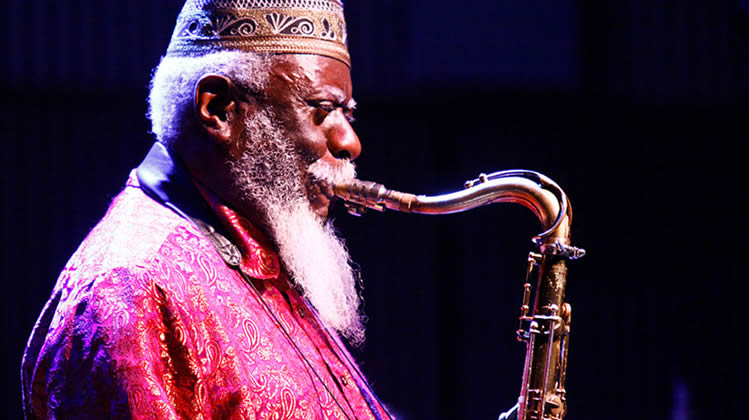
Yesterday I heard the sad news that yet another legendary jazz musician – the tenor saxophonist Pharaoh Sanders – has passed away at the age of 81. As well as having one of the iconic beards of jazz, he had a unique and instantly recognizable style on tenor sax, heavily influenced by African and Asian music, sometimes involving raucous flurries of notes, sometimes overblowing, biting the reed or growling into the horn to achieve unusual effects, and sometimes playing with a contemplative lyricism evoking a deep sense of spirituality.

Pharaoh Sanders began his recording career in the 1960s with John Coltrane on the great albums Ascension and Meditation. His playing then was avant-garde free jazz somewhat reminiscent of Albert Ayler but with a strong influence of Coltrane whom he influenced in return. Later on he embraced wider influences, including electronic instruments, as exemplified by the album Thembi. Later he moved away from free jazz improvisation to more traditional approaches. His recorded output decreased from the end of the 1980s but he carried on touring extensively and still creating wonderful music.

I’ve had the great privilege to hear Pharaoh Sanders play live on a number of occasions and he was terrific every time. He played at the National Concert Hall in Dublin just a few years ago but I was unable to make it to the concert.

I’ve been listening to Pharaoh Sanders tracks all morning to remind myself what a great musician he was. Out of all the superb tracks I could have picked going back to the mid-60s I picked this one, from the 1987 album Africa which I think exemplifies his later style very well. The track is You’ve got to have freedom:

P.S. You might be interested to know that the drummer on this track, Idris Muhammed, also played the drums on Fats Domino’s Blueberry Hill way back in 1956…

Berg & Mahler at the National Concert Hall

Posted in Biographical, Maynooth, Music with tags , , , , , , , on September 10, 2022 by telescoper
Obligatory Souvenir Programme

Last night I made it to the National Concert Hall in Dublin for the opening concert of the season for the National Symphony Orchestra directed by Chief Conductor Jaime Martín. It’s been three years since the last full season of these weekly concerts so let’s hope we get a complete set this time.

The programme for last night’s concert comprised two works by Austrian composers, Alban Berg‘s Violin Concerto (with soloist Simone Lamsma) and Gustav Mahler‘s Fifth Symphony. Each of these great pieces in its own way explores a vast emotional landscape and together they made for a compelling and moving performance.

Berg’s Violin Concerto, composed in 1935, is dedicated “to the memory of an Angel”, namely Manon Gropius, who died of polio at the age of just 18. She was the daughter of Alma Mahler and Walter Gropius (Alma Mahler’s second husband, whom she married four years after Mahler’s death).

The work is divided into two movements, each of which is in two parts. It is often described as a completely atonal (serialist) piece but it’s is composed in such a way that the twelve tones are sometimes grouped in such a way as to suggest an underlying tonality. Emotionally the piece ranges from the poignant to the fiery. Anyone who has experienced grief will recognize the sense of rage that at times bursts through. In other passages, though, the music has an austere beauty that is completely compelling.

After the wine break we had Mahler’s Fifth Symphony. This work is best known for the 4th movement Adagietto but I’ve always felt that section fits rather uncomfortably with the rest of the composition. That’s not to say that I dislike the Adagietto, which I think is one of the most beautiful movements in all music, and regularly makes me shed a tear. I just think it’s a bit of a detour from the rest of the work. I suppose one should think of it as a restful interlude before the journey reaches its climax in the 5th movement Rondo which was played with electrifying passion last night.

Like the Berg piece, Mahler’s Fifth Symphony veers across a vast emotional landscape. The conductor Bruno Walter described it as “passionate, wild, pathetic, buoyant, solemn, tender, full of the sentiments of which the human heat is capable, but still ‘only’ music”. Although by no means an atonal work, there isn’t really a clear tonal signature: at least five different keys are used and there are passages in which the key is ambiguous.

The first movement begins with a funeral march, introduced with a solo trumpet statement like a fanfare, followed by lyrical passages from the strings. The second movement is extremely tempestuous, contrasting moods of melancholy and frenzy, with the trumpet theme from the first movement returning. The third movement, a long Scherzo, is unexpectedly playful, with two thematic forms bouncing off each other. Then there’s the soulful longing of the Adagietto, beautifully played last night to a rapt audience and the joyful finale in an unambiguously major key.

Overall this was a superb concert, with the large orchestral forces marshalled superbly by Jaime Martín. I have to mention the brass section in particular, who were brilliant. It wasn’t a full house, which is a shame for the season’s curtain-raiser, but those who were there clearly enjoyed it enormously.

As it happens, last night was the first of five concerts by Garth Brooks (who he? Ed) at Croke Park. The train from Maynooth unto Dublin earlier in the evening was absolutely crammed with people (many in cowboy hats) going there and the train back was similarly full with people leaving. Fortunately I was only slightly delayed getting home by the congestion, though I think there were seriously issues with later trains. There is another concert by him next Friday, when there is another concert at the NCH so fingers crossed that my travel to and from that isn’t too badly affected either…

Louis Armstrong and Bix Beiderbecke: Singin’ the Blues

Posted in History, Jazz with tags , , on September 4, 2022 by telescoper

 Leon “Bix” Beiderbecke became a jazz-age romantic legend not only by playing brilliant cornet but also by drinking too much bad prohibition liquor resulting his premature death in 1931, at the age of only 28. His short life was punctuated by episodes of very bad health caused by chronic alcoholism in an era when the only booze that was available was bathtub gin or rotgut whisky. Despite all his problems, Bix still gave us some of the greatest ever jazz records.

Although he was of middle-class white origins, Bix’s playing was deeply admired by leading black musicians of the day notably the great Louis Armstrong. Some years ago I listened to a radio play called Bix: Singing the Blues which is a fictional account of the only occasion in which Bix Beiderbecke and Louis Armstrong played together, in a private, after-hours session. Given the description of that as “fictional” I assumed that Bix and Satchmo didn’t know each other well. Recently, however, I came across a recording of Louis Armstrong talking about Bix Beiderbecke that shows I was wrong:

(There is one little bit of confusion in the discussion: Bix wasn’t 31 when he died: he died in 1931, at the age of 28. )

So how good was Bix? Well, make your own mind up. Here is his classic version of Singing the Blues, with Frankie Trumbauer’s Orchestra in 1927, a three minute track in which Bix’s stunning solo starts a minute in and lasts a minute.

Jazz being largely improvised music, it is often a bit rough around the edges; even the Hot Fives and Hot Sevens have their share of duff notes. Bix’s solo on this record with that beautiful ringing, bell-like tone, and effortless swing at what is quite a slow tempo, is as close to perfection as you’ll ever find.

But you don’t need to take my word for it.

During his heyday in the1920s Louis Armstrong played virtually every popular tune that was put in front of him, including many songs that seemed unpromising from a jazz perspective, and in the process turned any amount of base metal into solid gold. Singin’ the Blues was a smash hit, but Louis Armstrong refused to play it. When asked why he replied that he didn’t think he could play it as well as Bix. There is no higher praise.

Chorizo Sandwich

Posted in Music with tags , , on August 9, 2022 by telescoper

Now that the social media fuss about ChorizoGate is dying down a bit I thought I’d change the subject completely by posting some music. This tune is by a band call Los Alacranes and it’s entitled … oh no! … Chorizo Sandwich

The Soundtrack of Summer

Posted in Biographical, Music, Television on July 31, 2022 by telescoper

I just heard of the death on 4th July at the age of 82 of Austrian actor Robert Hoffmann who I remember very well for his role as Robinson Crusoe in the TV series The Adventures of Robinson Crusoe. That series was first broadcast in 1964 and was repeated frequently over the years, especially during the long summer holidays. I loved the theme music when I was a child and it is now redolent with nostalgia, forever associated with memories of childhood summers before life got complicated. I’m sure that is also the case for many others, so perhaps you won’t mind wandering off down memory lane with this:

Dizzy on the French Riviera

Posted in Jazz with tags , , , on July 18, 2022 by telescoper

Today’s high temperatures provide me with an excuse to post my favourite hot-weather music, the 1962 album Dizzy on the French Riviera. Can this really have been recorded 60 years ago?

Anyway, the album features the great Dizzy Gillespie Quintet of that time which was heavily influenced by Latin American sounds and had Argentinian Lalo Schifrin on piano, a man best known as a prolific composer of film and TV scores. The band also featured Leo Wright, a very under-rated saxophonist and flautist, and is augmented on some of the tracks by various percussionists. I have lost track of the number of times I’ve listened to the happy seaside sounds of children playing leading into to the opening track No More Blues

Tosca at the Bord Gáis

Posted in Opera with tags , , , , , , on July 15, 2022 by telescoper

Last night found me for the very first time at Dublin’s splendid Bord Gáis Energy Theatre, for a performance of Tosca by Irish National Opera, a tale of jealousy and murder set to gorgeous music by Giacomo Puccini.

Bord Gáis means “Gas Board”, by the way, but a rose by any other name would smell as sweet.

It’s been a while since I last went to an Opera and it was a last-minute decision to attend this one, but I heard good things about the opening night on Monday and managed to get a ticket. I’m very glad I did as there was much to enjoy, with some quite original variations on a very familiar story.

Tosca is an opera in three acts (which means two intervals wine breaks…). It’s a melodrama, and is set in Rome in 1800. Each Act takes place in a very specific location within the Eternal City. Act I is set in the Church of  Sant’Andrea della Valle, Act II in the Palazzo Farnese, and the final denouement of Act III takes place among the battlements at the top of the Castel Sant’ Angelo overlooking the Tiber.

Most productions of Tosca I have seen stick rigorously to a specific sense of time and place. In this one, directed by Michael Gieleta, the locations are suggested rather than reproduced directly and the costumes and interior design are generally 20th Century, with some sly references. The villainous Spoletta, for example, a police agent, is clearly dressed as a Jesuit. The shepherd boy in Act III appears as an angel, complete with wings, whose ghostly presence leads the prisoners on to their impending execution.

There is also some very ingenious staging, with a rotating set showing the torture scene in Act II while Scarpia and Tosca do their thing. The revolving structure also provides a very interesting alternative view of the end of Act III. I won’t say any more for fear of spoiling it for others…

Floria Tosca (Sinéad Campbell-Wallace, soprano) is a celebrated opera singer who is in love with an artist (and political radical) by the name of Mario Cavaradossi (Dimitri Pittas, tenor), who helps to hide an escaped political prisoner Cesare Angelotti (John Molloy, bass) while working on a painting in Act I. The odious Baron Scarpia (Tómas Tómasson, bass-baritone), Chief of Police, comes looking for the convict and decides to catch (in different ways) both Tosca and Cavaradossi: he lusts after the former and hates the latter.

In Act II, we find Scarpia at home eating dinner for one while Cavaradossi is being tortured in order to find out the location of the escapee. Tosca turns up to plead for his life, but she hasn’t bargained with the true depths of Scarpia’s depravity. He wants to have his way with her, and to put pressure on he lets her listen to the sound of her lover being tortured. She finally consents, in return for Scarpia’s promise to let Cavaradossi go and grant free passage to the two of them. This he seems to do, but while she is waiting for him to write the letter of conduct she sees a knife. Instead of letting Scarpia defile her, she grabs it and stabs him to death. Act III begins with Cavaradossi facing execution, sure he is about to die. Tosca is convinced that this is just a charade and that Scarpia ordered them to pretend to shoot Cavaradossi so he wouldn’t look like he was being merciful, which would be out of character. The firing squad fire and Cavaradossi falls. But it was no fake. He is dead. Tosca is distraught and bewildered. Shouts offstage reveal that the police have found Scarpia’s body and that Tosca must have murdered him. To avoid capture she hurls herself from the battlements. Her last words are “O Scarpia, avanti a Dio!” – “I’ll meet you before God, Scarpia”, though in this production we don’t actually see her jump…

The opera wasn’t particularly well received when it was first performed in 1900, being famously described by one critic as “a shabby little shocker”, but it has become a firm favourite with audiences around the world and is now acknowledged as a masterpiece of music drama. So how did Puccini manage to transform a penny-dreadful plot into a great work of art? I don’t think it’s hard to see why it works so well.

First and foremost, there’s the music, which  is wonderful throughout, but it is always plays an essential part in keeping everything moving. Of course there are the great arias: Vissi d’arte, Vissi d’amore sung by Tosca in Act II and E Lucevan le Stelle from Act III, sung by Cavaradossi; but even apart from those tremendous set-pieces, Puccini uses the music to draw out the psychology of the characters and underline the drama.

Although not usually associated with the use of leitmotifs, Puccini deploys them throughout: Scarpia’s arrival is announced with a suitably menacing theme that recurs whenever he is present or even just referred to.  This theme is actually the first thing we hear as the Opera starts. It also plays Scarpia out at the end of Act 1 when he sings his magnificently chilling Va Tosca over a setting of the Te Deum. Time does stand still for Tosca’s great Act II aria, the dramatic fulcrum of the Opera, but that just emphasises the pace of the rest of the piece. This is a work with no spare flesh or padding anywhere, and a perfect interplay between music and action. The moment when Tosca sees the knife with which she will kill Scarpia is signalled by the orchestra. And after Scarpia dies with Tosca preparing to make her getaway we hear, slower and deep down among the strings, Scarpia’s motif yet again. Even in death we feel he is still present…

Each of the three principal roles could have been very one-dimensional: Cavaradossi the good guy.; Scarpia the bad guy; Tosca the love interest. But all the characters have real credibility and depth. Cavaradossi is brave and generous, but he succumbs to despair before his death. No superhero this, just a man. Scarpia is a nasty piece of work all right, but at times he seems vulnerable; he is trapped by the same system he exploits. And then there’s the glamorous and loving, but not entirely likeable, Tosca who haughty and jealous, and at times spiteful. It is a truly shocking moment when she kills Scarpia. There’s no attempt to sanitise the violence of his death. It’s all so real. I guess that’s why this type of opera is called Verismo!

As for this production, I thought the principals were excellent: Dimitri Pittas seemed to be straining a bit in Act I but recovered and sang beautifully in Act III. Scarpia was suitably villainous and got a few pantomime boos at the end. A special mention must be made of the young shepherd (Joe Dwyer, treble) who was outstanding in a very difficult part for a young singer. Music director was Nil Venditti who bounced across the stage at the end to take the applause from a very appreciative audience.

There are still two performances of this production, on Saturday 16th and Sunday 17th.

The Johnson Song

Posted in Music, Politics with tags , , on July 7, 2022 by telescoper

The Moody Blues with a message for Boris Johnson.

John McLaughlin

Posted in Jazz with tags , , on June 12, 2022 by telescoper

It’s Sunday and I’ve just finished work for the day. Too tired to write anything substantial I thought I’d share a track featuring and named after the guitarist I went to see at the National Concert Hall a few weeks ago. John McLaughlin is the 4th track on the Miles Davis (double) album Bitches Brew. It doesn’t feature Miles Davis on trumpet nor Wayne Shorter on saxophone but does involve the electric pianos of Chick Corea and Joe Zawinul, the bass of Dave Holland, the drums of Lenny White and Jack de Johnette, other percussion by Don Alias and Juma Santos and Bennie Maupin on bass clarinet; the latter addition to the ensemble being a stroke of genius by Miles Davis. I know quite a lot of fans of Miles Davis don’t like this album at all, finding it all a bit perplexing but I don’t mind music that’s a bit perplexing and I think it’s great. Most of the tracks are very long but this one is only four and a half minutes or so in duration, built around a simple riff laid over a loose and very dynamic rhythmic accompaniment. Like the other numbers, it’s almost entirely improvised.