The newly enhanced version of this blog, improved at great expense, enables me to upload audio files. I thought I’d check out that facility by sharing this rendition of the tune Petite Fleur which was written in 1952 by the great Sidney Bechet but made famous by Monty Sunshine by a recording with Chris Barber’s band in 1959. The version here was performed in the 1990s in a little recording studio in Gateshead. Can you identify the clarinet player? (Hints: (i) it is not Sidney Bechet; (ii) nor is it Monty Sunshine; and (iii) it was my Dad playing the drums…)
Archive for the Music Category
R.I.P. Tony Coe (1934-2023)
Posted in Jazz, R.I.P. with tags Dancing in the Dark, Stan Tracey, The Crompton Suite, Tony Coe on March 18, 2023 by telescoperIt’s a very sad coincidence that just the day after I had reason to blog about the death of Wally Fawkes, I have to mention the death of another superb jazz musician also associated with the clarinet, Tony Coe, who has passed away at the age of 88. In a prolific career and leader and sideman, Tony Coe also played with Humphrey Lyttelton’s band (from 1957-61) but he is best known for his work in more modern forms of jazz. He was known for the virtuosity and originality of his style, not only on clarinet but on tenor, alto and soprano saxophone. I read yesterday that he was also the first music teacher of Tim Garland who, on his Facebook page, mentions that he found Coe’s tenor playing rather reminiscent of that of the great Paul Gonsalves, which I’d never thought of before but is true.
My first encounter with Tony Coe was on an album I bought round about 1981 called The Crompton Suite by the Stan Tracey Sextet. It’s a rare find on vinyl these days but I still have my copy:
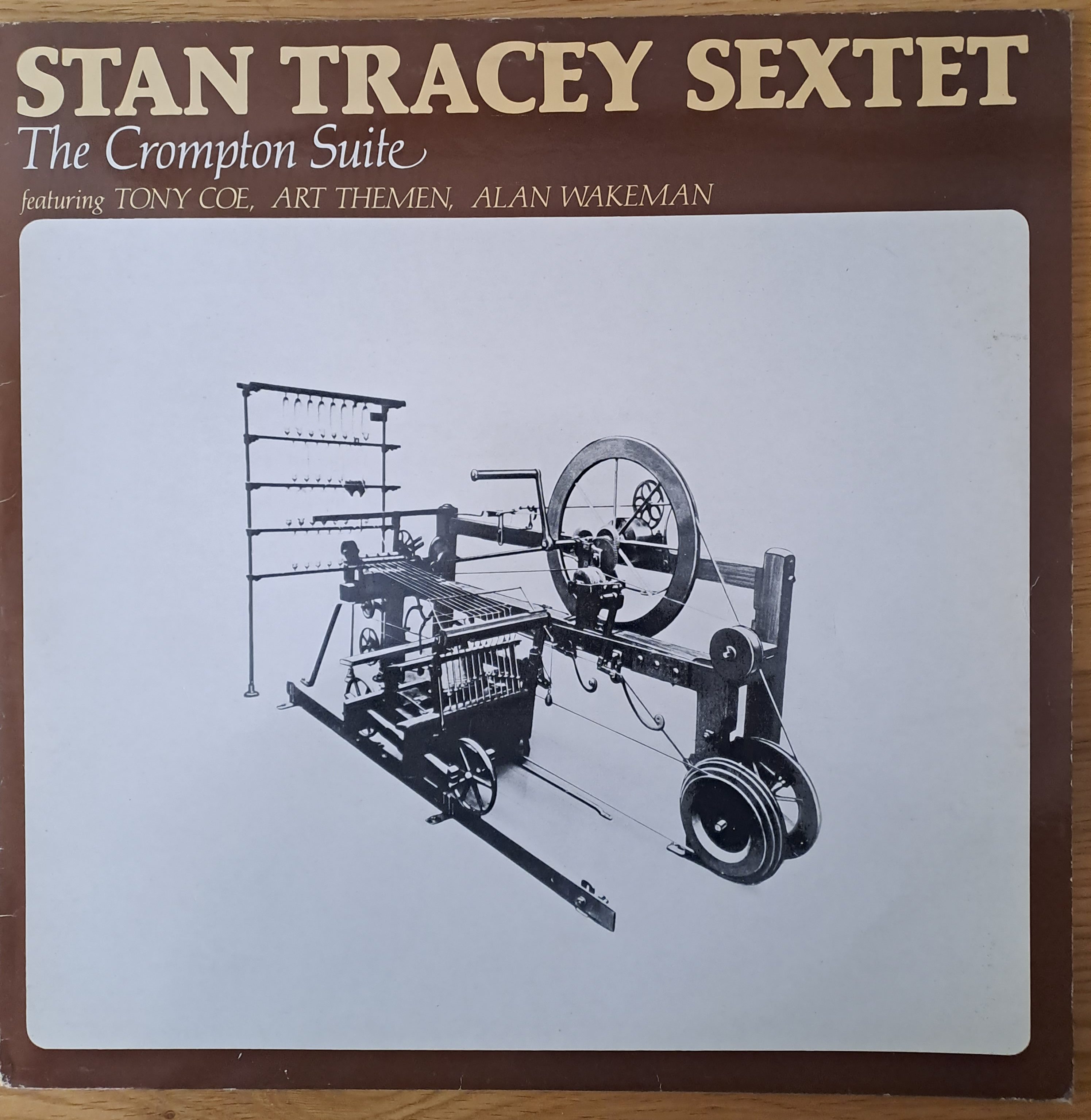
I haven’t heard this for ages because I no longer have a turntable and as far as I’m aware it hasn’t been re-released on any digital format, but I remember it very well and would have picked a track from this album as a tribute if it were on YouTube but instead here’s a lovely recording he made just a couple of years ago with John Horler on piano, the title track of the very nice album Dancing in the Dark:
R.I.P. Tony Coe (1934-2023)
R.I.P. Wally Fawkes (1924-2023)
Posted in Art, Jazz, R.I.P. with tags Humphrey Lyttelton, Jazz, Trog, Trog's Blues, Wally Fawkes on March 16, 2023 by telescoperI just heard today – via the latest Private Eye – of the passing of Wally Fawkes on 1st March at the age of 98. His name won’t be familiar to many of the readers of this blog, but it is a name that I grew up with in a jazz-loving family. Wally Fawkes played clarinet with Humphrey Lyttelton’s band in its heyday in the late 40s and early 50s and was the last surviving member of that group. That band may have had a rhythm section that always sounded like its members were wearing diving boots, but the front line of Humphrey Lyttelton (trumpet), Wally Fawkes (clarinet) and Keith Christie (trombone) was truly outstanding.
Wally Fawkes wasn’t just a musician, though. He was also the acclaimed cartoonist known by the pseudonym Trog, and contributed a variety of cartoons to a variety of magazines and newspapers, including the long-running comic strip Flook. He was also an occasional contributor to Private Eye. He had to give up drawing in 2005 because of failing eyesight, after 62 years in the business.
I’ve already drawn attention to Wally Fawke’s excellence as a clarinet soloist with the Lyttelton band on The Onions at the famous 1954 Festival Hall Concert so it seems apt to pay tribute to his skills as both a cartoonist and a musician by returning to that concert for him playing his own composition Trog’s Blues. Wally Fawkes was a huge admirer of Sidney Bechet, and this tune clearly pays homage to Bechet’s monumental Blue Horizon (which I think is the finest instrumental blues ever recorded) but while Bechet’s blues performances were hewn from granite, Wally’s were wrought from finest porcelain.
R.I.P. Wally Fawkes (1924-2023)
R.I.P. Wayne Shorter (1933-2023)
Posted in Jazz, R.I.P. with tags Speak No Evil, Wayne Shorter on March 2, 2023 by telescoperI got home this evening to find the sad news that legendary saxophonist Wayne Shorter has passed away at the age of 89. I only got to hear him live once, many moons ago, when he was part of a band led by drummer Jack de Johnette (I think that was in the early 1990s) but I have a big collection of CDs of him in various settings, including with Miles Davis, The Jazz Messengers, and, of course, Weather Report. As a tribute I feel it’s appropriate to post a great record he made as leader.
Speak No Evil was recorded in 1964 and released as a Blue Note LP in 1966. It features a superb band, including Freddie Hubbard (tpt), Herbie Hancock (p), Ron Carter (b) and Elvin Jones (d) alongside Shorter himself on tenor saxophone. It’s one of the must-have jazz albums, and it demonstrates Shorter’s flair for composition as well as improvisation. In both respects his approach to this album is very different from that he took just a few years earlier with Art Blakey’s Jazz Messengers. Standout tracks on this album include the suave yet unsettling Dance Cadaverous, the brooding Fee-fi-fo-fum, and the curiously agitated Witch Hunt.
Every piece on this album was composed by Shorter and as a player he revels in the ambiguous harmonies he created alongside the melodies. Although his style is clearly influenced by Sonny Rollins and John Coltrane, his tone is unlike either of these other giants, and Shorter expresses his individuality through varying emphasis producing asymmetric phrases. His playing is very quick-witted, full of abrupt changes of mood and dashes of fierce humour. A good example is Infant Eyes, a theme made up of three 9-bar phrases, played at a leisurely pace, on which Shorter’s lines impose a sense of determined exploration when many other soloists would have dawdled.
Anyway, don’t take my word for it. You can listen to the full album as a playlist on Youtube. The track order is: Witch Hunt, Fee-Fi-Fo-Fum, Dance Cadaverous, Speak No Evil, Infant Eyes and Wild Flower.
R.I.P. Wayne Shorter (1933-2023)
To-Wa-Bac-A-Wa
Posted in History, Jazz with tags 18th Amendment, Andrew Volstead, Jazz, Jazzola Eight, Louis Dumaine, Prohibition on February 21, 2023 by telescoperToday is Shrove Tuesday, Pancake Day, and Mardi Gras, which gives me three excuses to post an authentic New Orleans parade tune from way back in 1927.
Jazz began with the marching bands that performed in New Orleans but then largely moved into the bordellos of Storyville, the biggest (legal) red light district in the history of the United States. When Storyville was closed down in 1917 as a threat to the health of the US Navy most professional jazz musicians lost their only source of regular income. Fortunately the very lawmakers who condemned jazz for its association with vice and crime soon passed a law that unwittingly ensured the music’s survival, proposing the 18th Amendment to the Constitution of the United States, passed in 1919, which prohibited the manufacture, distribution and sale of alcohol for human consumption. This was soon followed by the Volstead Act, which gave federal government the powers to enforce the 18th amendment. This ushered in the era of Prohibition, which turned Chicago into a bootlegger’s paradise almost overnight and jazz musicians flocked there to perform in the numerous speakeasies. That’s why so many of the great New Orleans Jazz records of the 1920s were actually made in Chicago.
Although the exodus was substantial, not all Jazz musicians left New Orleans. Many stayed there and kept the roots of the music going while it branched out in Chicago and, later, New York. Most of the bands that stayed kept going through the depression but never really achieved great commercial success until the traditional Jazz revival of the 1940s and 1950s. This example is a record produced by the Victor Record Company who sent a recording unit to New Orleans in 1927 to record some of the musicians who had stayed behind, many of them still playing in the marching band tradition of Buddy Bolden.
The title is To-Wa-Bac-A-Wa. I don’t know what it means but it’s an old French creole version of a tune that has subsequently reappeared many times in different forms with different names, most notably Bucket’s Got A Hole In it. The band is Louis Dumaine’s Jazzola Eight. Besides the lead cornet of Louis Dumaine, who lived from 1889 to 1949, it’s worth mentioning the clarinet style of Willie Joseph, which is heavily influenced by that of the great Johnny Dodds.
Anyway, it’s the kind of jaunty march-like number that’s perfect as a Mardi Gras parade tune and it always puts a spring in my step every time I hear it! There are also some old photographs of Mardi Gras parades to get you in the mood.
Ives, Beethoven and Sibelius at the National Concert Hall
Posted in Biographical, Music with tags Beethoven Piano Concerto No. 4, Case Scaglione, Charles Ives, Federico Colli, Jean Sibelius, Ludwig van Beethoven, Sibelius Symphony No. 1, The Unanswered Question on February 11, 2023 by telescoper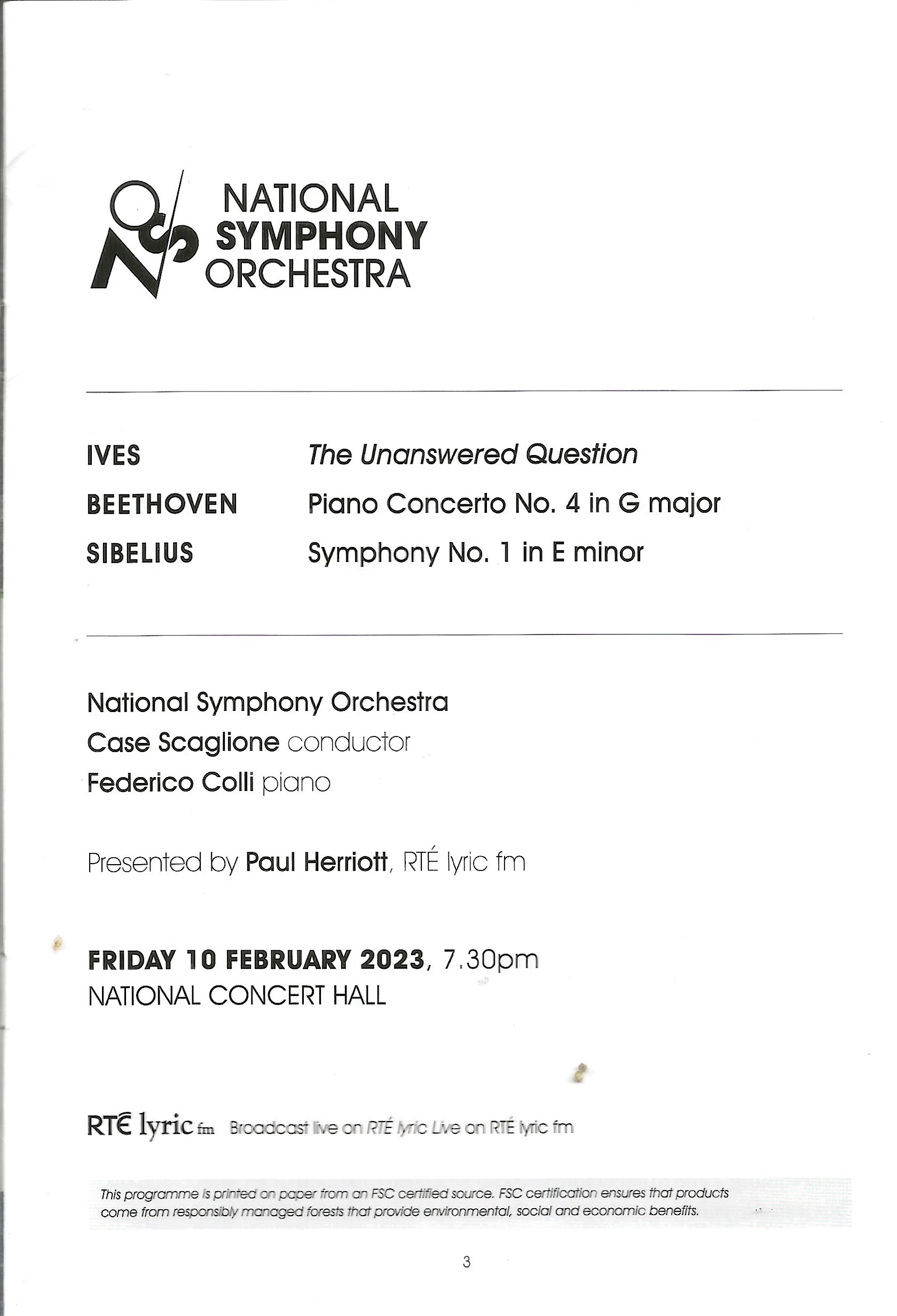
Last night’s concert by the National Symphony Orchestra at the National Concert Hall in Dublin was one that I’d been looking forward to for a long time. It didn’t disappoint! Congratulations to the National Symphony for yet another excellent concert, this time under the direction of guest conductor Case Scaglione.
The first half of the programme consisted of The Unanswered Question by Charles Ives and Beethoven’s Piano Concerto No. 4 with soloist Federico Colli. That’s an interesting juxtaposition, made even more interesting by the Beethoven piece was played directly after the Ives without a break for applause. I wondered what was up when Case Scaglione walked on stage with Federico Colli who took his seat at the piano at the start of the concert. There is no piano part in The Unanswered Question, so Colli sat quietly until the end of that piece and then went straight into the opening piano statement of the Beethoven. I wasn’t expecting this before the performance but it worked very well. The only problem is that I didn’t get the chance to applaud at the end of The Unanswered Question.
The Unanswered Question is one of my favourite works by Charles Ives (along with Three Places in New England), a composer whom I admire greatly. I wrote a piece about him some years ago, actually. The Unanswered Question, was completed in 1908 (although it was revised later) and is subtitled “A Cosmic Landscape”. It’s a sort of meditation on the philosophical problem of existence. It comprises three different voices: muted strings playing notes from a G-Major triad (a rather “churchy” key, giving the flavour of a simple hymn). Then, played (in this performance) from the balcony behind the conductor, a solo trumpet poses the Question: a five note figure that is repeated with almost imperceptible variations several times during the work. The reply to the Question comes from the woodwinds, whose dissonant response is at first plaintive but then increasingly agitated and frustrated. Then the Question comes again without an answer, but the strings carry on quietly in G Major until everything goes quiet.
The Piano Concerto No. 4 by Ludwig van Beethoven is in G Major, so there is a continuity between the two pieces in terms of tonality, although of course the musical language is very different. It was composed in 1805/6, a hundred years before the Ives. It’s an audacious piece right from the start as it opens with unaccompanied piano. The second movement is a kind of dialogue between the orchestra and the piano, which at times sounds more like an argument as the orchestra makes a series of rather harsh statements with somewhat conciliatory responses from the piano. The last movement is a more conventional and jovial Rondo, by which time the solo trumpeter from the Ives piece had found her way back to the stage from the balcony. I’ve heard this movement several times played on its own on the radio.
Federico Colli cut a dashing figure in a grey suit and waistcoat with a high collar and a voluminous white cravat. He was well up to the demands of the piece, playing very expressively, tenderly at times and with virtuosic brilliance when called for.
After the wine break we returned for the majestic Symphony No. 1 by Jean Sibelius. This is one of the great symphonies and another favourite of mine – I have several different recordings of it and have heard it on the radio many times – but I had never heard it performed live in person before last night. The First Movement (initially Andante) opens with a theme played by solo clarinet. It then moves into allegro energico which was played very briskly in this performance (in contrast to some famous recordings which slow it down). The motif played by the clarinet at the start permeates the whole work, returning in different guises and endowing the composition with a strong sense of unity. It’s all shot through with great romantic tunes and has wonderful dynamics. In short, it’s a masterpiece. Not bad for a First Symphony!
What The World Needs Now
Posted in Music with tags Burt Bacharach on February 9, 2023 by telescoperVery sad to hear today of the death at the age of 94 of the great songwriter Burt Bacharach. By way of a little tribute I thought I’d reblog this post from a few years ago. R.I.P. Burt Bacharach (1928-2023).

I’ve always been a not-so-secret admirer of American songwriter and record producer Burt Bacharach, but when someone told me the other day that there’s an album called Blue Note Plays Burt Bacharach I assumed it was a wind up because Blue Note Records has for many years been an uncompromising voice at the cutting edge of modern jazz rather than the lighter and more popular form of music exemplified my Mr B.
There’s no reason why two forms of excellence can’t exist together, however, and the album is definitely real and is a very nice compilation of Bacharach numbers from Blue Note albums featuring various musicians over the years. Here’s an example featuring Stanley Turrentine on tenor sax, with McCoy Tyner on piano, Bob Cranshaw on bass and Micky Roker on drums. The tune is What The World Needs Now Is Love. Doesn’t it just?
Mozart, Ravel and Danielle de Niese
Posted in Biographical, Music with tags Daphnis et Chloe, Exsultate Jubilate, Maurica Ravel, National Concert Hall, National Symphony Chorus, National Symphony Orchestra, Sheherazarde, The Abduction from the Seraglio, Wolfgang Amadeus Mozart on February 4, 2023 by telescoper
After last week’s magnificent concert I couldn’t miss another chance to see and hear Danielle de Niese in at the National Concert Hall in Dublin, again with the National Symphony Orchestra under the direction of Jaime Martin. It was another fascinating (and very full) programme.
For last week’s concert, the National Concert Hall was only about two-thirds full but this time it was packed. I think the glowing reviews of La Voix Humaine contributed to that, as did the round of media interviews Danielle de Niese has done since then contributed to the full house.
Danielle de Niese seems to like singing 20th century French music and the concert opened with Shéhérazade by Maurice Ravel. This is a cycle of three songs which are settings of poems inspired by The Arabian Nights written by the pseudonymous poet Tristan Klingsor: Asie, La flûte enchantée, and L’Indifférent. Ravel was a real master of orchestration, and he creates a succession of exotic textures to complement the vocal lines. It’s not a long piece -altogether the three songs last about 15 minutes – but it covers a vast territory. There’s more than a nod to Debussy in this work too.
After that Danielle de Niese went off stage to change her frock, which was lime green for the Ravel, while the orchestra played the overture to the singspiel Die Entführung aus dem Serail (The Abduction from the Seraglio) by Wolfgang Amadeus Mozart. I’ve actually reviwed the whole Opera (was that really 12 years ago?) and wrote then (about the plot):
It’s admittedly a bit thin, even by the standards of comic opera but, right from the fabulous overture, the music is lovely and there’s a great deal of good-humoured fun,
The overture is great fun to listen to, and obviously also to play. Jaime Martin was beaming and bouncing up and down on the podium during the performance.
And then Danielle de Niese returned (this time in a lurid red dress) to sing another piece by Mozart. Exsultate, Jubilate is a piece for solo voice and orchestra usually described as a motet but technically really a cantata. There are three movements, marked Allegro, Andante and Allegro. It’s obviously a work,with a religious theme, and the central Andante movement does sound like it is sacred music, but the outer Allegro movements are very operatic, with demanding coloratura passages, especially in the final Hallelujah. I don’t usually associate such vocal acrobatics with religious music, but it’s certainly a very exuberant and joyful piece. Astonishingly, Mozart was just 17 years old when he wrote it.
That piece by Mozart presented very different challenges to the soloist, Danielle de Niese but she showed herself to be a very accomplished performer in this too. With that her two-week residence in Dublin came to an end. She was presented with a huge bouquet of flowers and a standing ovation before we headed off to the bar for the interval.
After the wine break the National Symphony Orchestra was joined by the National Symphony Chorus for complete performance of the music to the ballet Daphnis et Chloé by Maurice Ravel. As is the case with Stravinsky’s Firebird, music from this ballet is often played in the form of a suite or, in the case of this ballet, two suites, but I have to say the whole is much greater than the sum of the suites and this work has become one of my favourite pieces to hear live. It’s a gloriously sensual and dramatic work, again brilliantly orchestrated, full of vibrant colours and lush textures, and even more wonderful when accompanied by the wordless singing of the massed ranks of the National Symphony Chorus. The score lasts a good hour, but that time seemed to flash by in this performance which was extremely well received by a very appreciative audience.
This was a very full programme and I had to leave during the applause to make sure I got back to Pearse station in time to catch the train back to Maynooth. I’m not as quick on my pins as I used to be. I arrived at Pearse with about five minutes to spare only to find that the train was five minutes late so I didn’t have rushed.
I have to congratulate whoever is doing the programming for these NSO concerts at the NCH. The last few have been excellent, and next week’s recipe of Ives, Beethoven and Sibelius looks great too!
Brahms, Poulenc and Danielle de Niese
Posted in Music, Opera with tags Brahms Symphony No. 3, Danielle De Niese, Francis Poulenc, Jaime Martín, Johannes Brahms, National Concert Hall, National Symphony Orchestra on January 28, 2023 by telescoper
After a very busy week and ahead of the start of a new term on Monday, it was nice to be back in the National Concert Hall in Dublin last night for a superb concert, featuring a double bill of Brahms and Poulenc. It is quite an unusual pairing to have a symphony first, but each work we heard was about 40 minutes long, so it was actually well balanced, and the contrast worked very well indeed.
Before the interval we had came the main course in the form of the Symphony No. 3 in F Major by Johannes Brahms. This is of course quite a familiar work, but I really like concerts that mix unfamiliar material with the standard concert repertoire. It also gave me the chance to persevere with Brahms as my friends keep telling me to. It’s not that I don’t like Brahms, it’s just that I don’t find that he moves me as much as many other composers and so many people rave about him that I think I must be missing something. The 3rd Symphony is a very fine work, offering lots of variety across its four movements while maintaining a strong sense of coherence. I’m no expert on Brahms but it seems to me that the 3rd Symphony is where he really found his voice as a symphonic composer and stepped out from the shadow of Beethoven. It was performed beautifully last night under the direction of Jaime Martin and the National Symphony Orchestra.
After the wine break we returned for a rare treat in the form of La Voix Humaine, a one-act Opera for soprano and orchestra by Francis Poulenc, featuring the wonderful Danielle de Niese. The staging for this work is shown in the picture taken before most the orchestra had returned: just a chaise longue, a chair, a small table and an old-fashioned telephone.

La Voix Humaine portrays the last conversation between an anonymous woman (referred to throughout as Elle, the French word for “she”) and her lover, with whom she has just broken up. Only one character appears on stage and we only hear Elle’s side of the conversation. She sings into the telephone throughout; . the audience has to infer what her ex is saying at the other end. There are also frequent interruptions from another character who keeps intruding on the conversation, as the call appears to be on a party line, a concept that younger readers will not understand! This, together with the frequent disconnections and reconnections, provides some darkly comic relief. As you can probably imagine, it doesn’t end happily.

The performance was in French and there were no surtitles. It struck me that this work would be very difficult to translate into another language, as the music so accurately follows the natural rhythm and emphasis of spoken French. We were given the full libretto, with English translation, in the programme notes, but fortunately my memory of schoolboy French was good enough to get me a pass mark on following it without having to refer to the translation.
Poulenc’s compelling and emotionally charged music helps suggest what is being said at the other end when Elle is not singing, as well as accompanying her. The score struck me as rather cinematic, in that parts could easily be imagined as incidental music in a movie. Given the nature of the libretto, much of the music is like a the recitatives you find in operatic scores, but it is also more expansive and sensual when Elle pours out her broken heart. There are definite touches of Debussy in the orchestration, but it’s a very original approach that Poulenc uses and the National Symphony Orchestra made it come alive with great intensity.
And what can I say about Danielle de Niese? Amazingly, this was the first time she had performed La Voix Humaine in front of a live audience. She was sensational. She has a lovely voice and sang beautifully but her acting was also utterly convincing and she had a compelling stage presence. This was not just a concert performance but a genuine opera. I was straight up on my feet at the end, along with the rest of the audience. Brava!
To be honest, this was the piece I went for, rather than the Brahms, as I had never heard it before. I wasn’t disappointed. It was an intensely moving performance of a remarkable work which had me in pieces at the end. I enjoyed Brahms 3rd Symphony, but La Voix Humaine hit me in the guts. I must listen to more Poulenc.
Danielle de Niese is back at the NCH next Friday, singing Ravel and Mozart. Needless to say, after last night’s performance I’ll definitely be going!
The Black Saint and the Sinner Lady
Posted in Jazz with tags Charles Mingus, The Black Saint and the Sinner Lady on January 20, 2023 by telescoper
I was just reminded via social media that it was on this day 60 years ago, i.e. on 20th January 1963, that a recording session took place under the direction of Charles Mingus that led to the class album The Black Saint and the Sinner Lady. I hadn’t realized that this entire album was recorded in a single day!
The Black Saint and the Sinner Lady relies much less on soloists than earlier Mingus performances and involves a rather bigger band: Mingus himself (bass, piano and composer); Jerome Richardson (soprano & baritone saxophone, flute), Dick Hafer (tenor saxophone, flute); Charlie Mariano (alto saxophone); Rolf Ericson and Richard Williams (trumpet); Quentin Jackson (trombone); Don Butterfield (tuba, contrabass trombone); Jaki Byard (piano); Jay Berliner (acoustic guitar); and Dannie Richmond (drums). Charlie Mariano is outstanding on this album but the other solos tend to be short, acting more as punctuation than as part of the actual composition. It is very much an orchestral work, with thematic material introduced and recycled in various ways, some of it from pervious recording sessions. That gives this work a retrospective feeling, as well as being very original in style. Overall the sense is of Mingus trying out how he could use elements of his past approaches in a new direction. A good example are the accelerando passages. Danny Richmond did have a bit of a habit of speeding up, but on this album these bits are intentional. The first, however, starts very abruptly and doesn’t really work. Mingus tries the idea again, much more successfully, and again a couple of times more.
This is a great album but I think it provided Mingus with a practical difficulty, in that he was clearly getting more interested in longer works with big orchestral textures but most of the venues he could play in could only cope with smaller bands. He responded by working more at jazz festivals that could indulge this taste.
Anyway, here is the whole album which I have just listened to all the way through. I have it on vinyl LP and CD but fortunately it is also on the YooToob:


