At the end of a long week I’m now waiting for the oven to heat up for my dinner (salmon) and while it’s doing that I thought I’d share an old record or two by a popular beat combo of days gone by.
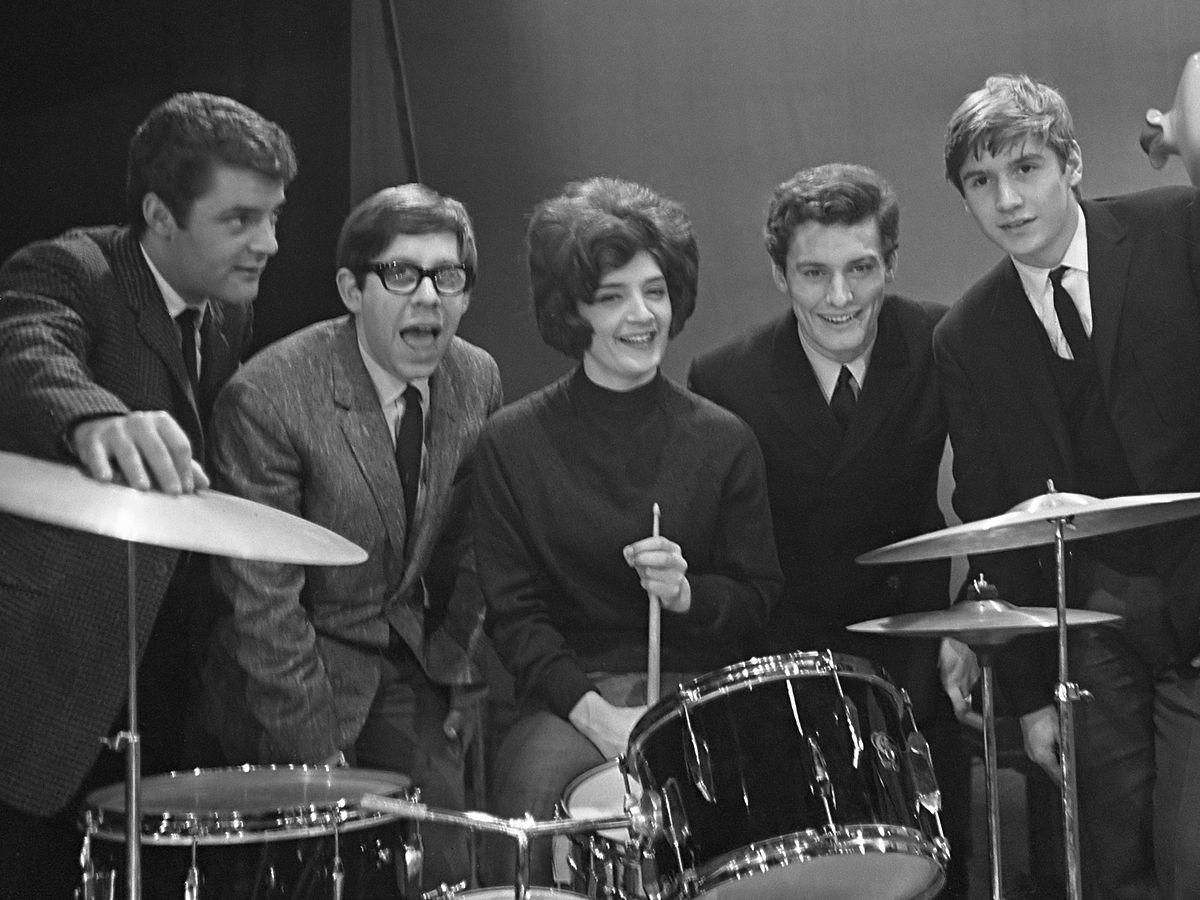
The Honeycombs in 1964
Have I The Right? was a big hit in 1964 for The Honeycombs. The video is redolent of the 1960s – the music, the photography, the clothes are very much of that period – the one exception being the drummer, Honey Lantree, who was one of the first female drummers in a hit band; she passed away five years ago. She was the sister of the bass player John Lantree. who is on the left in the above picture.
The band was produced by pioneering sound engineer Joe Meek (who I’ve blogged about before). Joe Meek like to have a strong blend of low frequencies in the mix, but Honey Lantree tended to use bass drum rather sparingly, hence Joe Meek’s suggestion that the band should stamp their feet during the “Come Right Back” bit of the chorus. Anyway, it’s what kinds nowadays call “a banger”…
The Honeycombs are generally regarded as a one-hit wonder, which is one hit more than most bands manage, but is a shame because their first album Here Are The Honeycombs has some great music on it. Take this, for example, their third follow-up single Eyes:
This record has an an interesting melody, hypnotic atmosphere all of its own and some great work on the drums by Honey Lantree. I think it’s great, actually, but it wasn’t a commercial success largely because it didn’t get played on the BBC at the time. Why not? Well, look at the lyrics:
Eyes, I’ve seen in some crowded places Staring from lonely faces Wanting someone to want them too
Eyes that night after night are trying to keep themselves from crying making believe their dreams are true
But eyes of, someone who’s in love Who would ever have thought that I’d find them there
Eyes that watch as we drew together wondering if we could ever find all the love they’ve never known
Eyes that now we have left behind us In places you never find us where people go cause they’re alone
Now I gaze in the eyes of the one I love Now no longer alone and afraid and sad…
Although it’s not explicit, the song is about a guy getting off with another guy in a crowded gay bar while the other customers look on. The BBC wouldn’t touch that sort of thing back in 1964!
I just read the sad news of the death, on Monday 5th June at the age of 83, of legendary Brazilian Bossa Nova and Samba singer Astrud Gilberto.
There was a time in the 1960s when the Bossa Nova seemed to be everywhere, and the reason for that was a collaboration between singer, guitarist and composer João Gilberto and tenor saxophonist Stan Getz that resulted in the award-winning album Getz/Gilberto that made the Bossa Nova go global, penetrating not only the world of jazz but the much wider cultural sphere including pop and film music. It also made a star of João Gilberto’s then wife, Astrud, who had never recorded before but sang on some of the tracks, the most famous example being The Girl From Ipanema. The popularity of this track resulted in a shorter version being released as a single which was a smash hit around the globe in 1964. Whether or not it’s true, the story goes that she was not under contract at the time the recording was made so never received any royalties for it, although the single made millions. It is said that it was Stan Getz – a wonderful musician but a notoriously horrible man – was responsible for swindling her.
Although an inexperienced singer at the time of this famous session, Astrud Gilberto had a direct, uncomplicated style and an aura of cool detachment that proved very appealing to audiences around the world, earning her a Grammy Award and turning her into a star almost overnight. Her relationship with her husband did not survive this transformation, however, and they divorced a few years later.
There was a lot more to Astrud Gilberto than that hit record, however. She started writing her own songs and her singing style matured. As a matter of fact I was lucky enough to see her perform live in London in the mid-1990s – at the Jazz Cafe in Camden, if I remember correctly – and she sang a very interesting mixture of music. I liked that later style more than the Getz/Gilberto recordings actually.
Anyway, here is a video of Astrud Gilberto singing The Girl From Ipanema in 1964 in what looks like it must be a clip from the film Get Yourself A College Girl – though I stand to be corrected if wrong! – and the music is exactly the same as the hit single so the band and the singer were obviously miming…
I’ve mentioned on here before that I had an English teacher at school who used to set interesting creative writing challenges, in which we would be given two apparently disconnected topics and asked to write something that connected them together. The inspiration was ‘Only Connect’, the epigraph of E.M. Forster’s novel Howard’s End. Since I’ve spent all afternoon in an Exam Board meeting I thought I’d do a little bit of connecting now.
Les sanglots longs
Des violons
De l’automne
Blessent mon coeur
D’une langueur
Monotone.
Tout suffocant Et blême, quand Sonne l’heure, Je me souviens Des jours anciens Et je pleure;
Et je m’en vais Au vent mauvais Qui m’emporte Deçà, delà, Pareil à la Feuille morte.
I posted the above poem by Paul Verlaine for two reasons. One is that lines from the poem were broadcast on the eve of the Normandy Landings. The landings themselves began in the morning of June 6th 1944 and the excerpt – the last three lines of the first verse – formed a coded message broadcast to the French resistance by Radio Londres, 5th June 1944 at 23.15 GMT, informing them that the Allied invasion of France was imminent and that sabotage operations should commence.
The other reason is that that it was just two weeks ago that I attended a concert featuring settings by Benjamin Britten of prose poems taken from Les Illuminations by Arthur Rimbaud. I didn’t know until that Verlaine and Rimbaud were lovers and that they lived for some time together in London. Their relationship was on the tempestuous side – at one point Verlaine fired a gun at Rimbaud, wounding him in the hand. Here’s a detail from a painting showing the two of them (Verlaine on the left, Rimbaud on the right).
It was said of Rimbaud that, as well as writing remarkable poetry, he was cute-looking, had a very dirty sense of humour, drank a bit too much, and liked lots and lots of rough sex. I think I would have liked him (although perhaps not enough to risk being shot by his jealous older boyfriend).
Anyway, this provides me with an excuse not only to commemorate D-Day but also Pride Month!
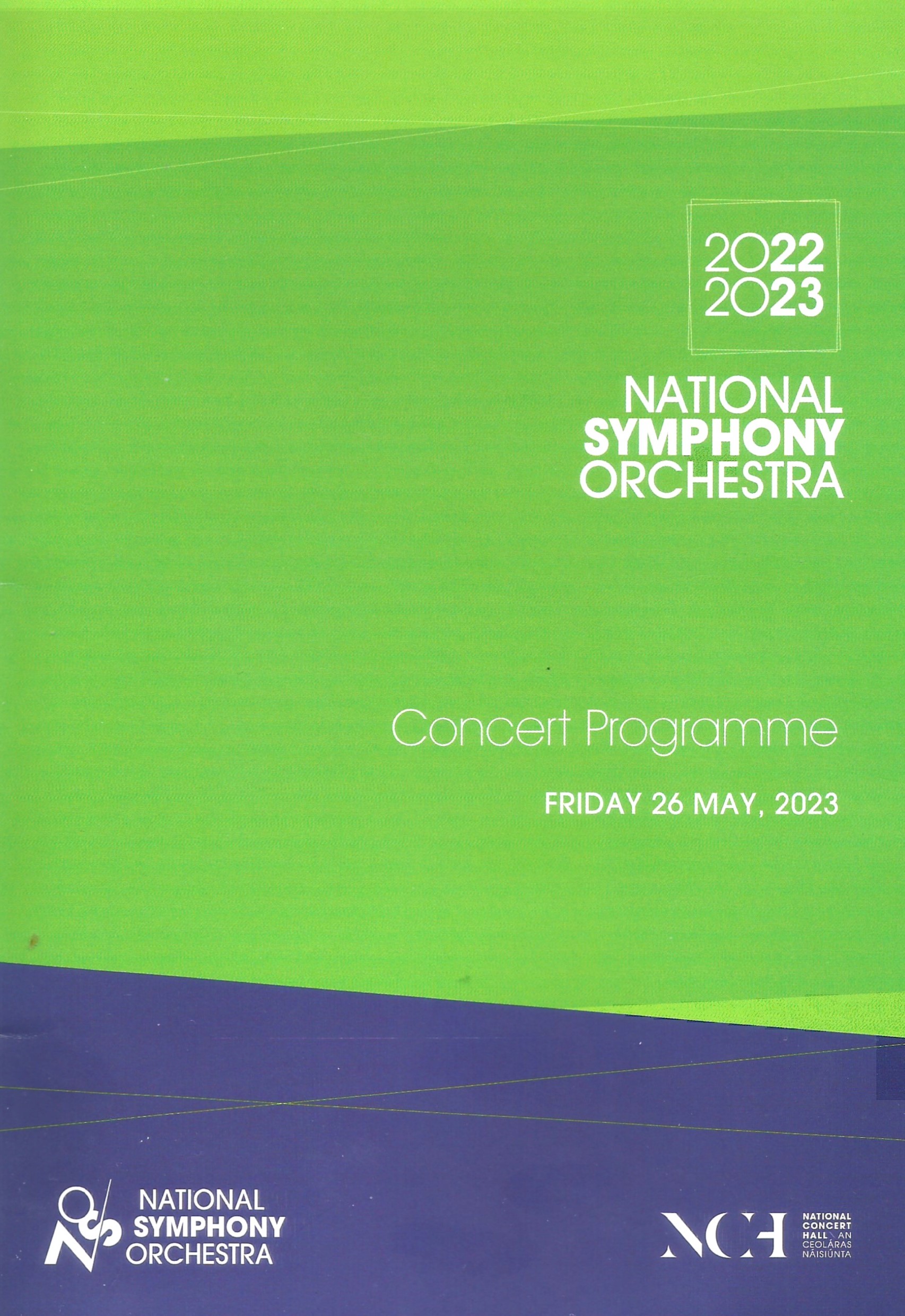
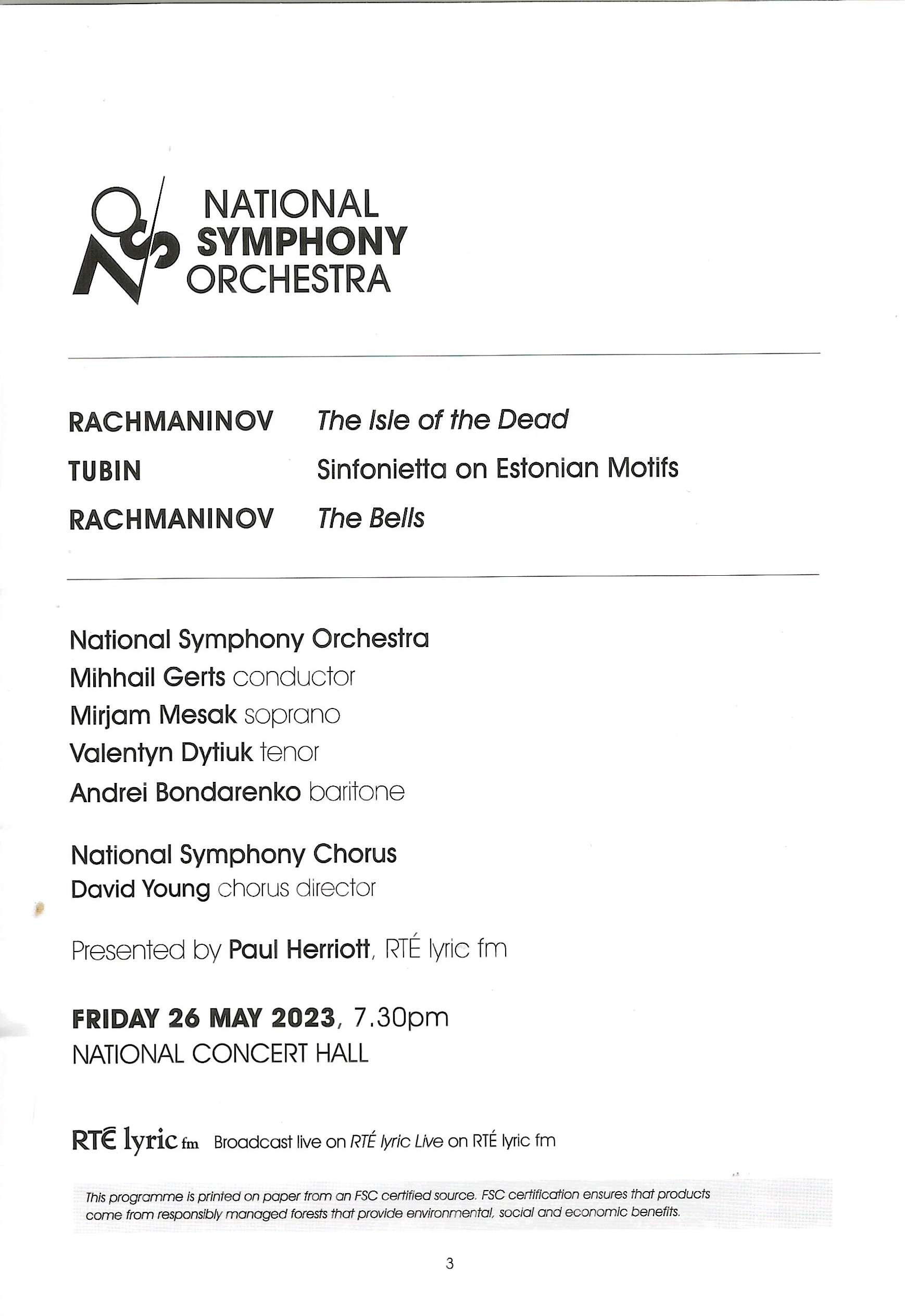
Yesterday, after a nice walk through the sunny streets of Dublin, at the National Concert Hall for the final concert of the season by the National Symphony Orchestra, under the direction of Mihhail Gerts, who were joined, for the second half, by the National Symphony Chorus directed by David Young and three star vocalists. The progamme consisted of two pieces by Sergei Rachmaninov (who was born 150 years ago this year) and one by Eduard Tubin (an Estonian composer who was new to me before last night).
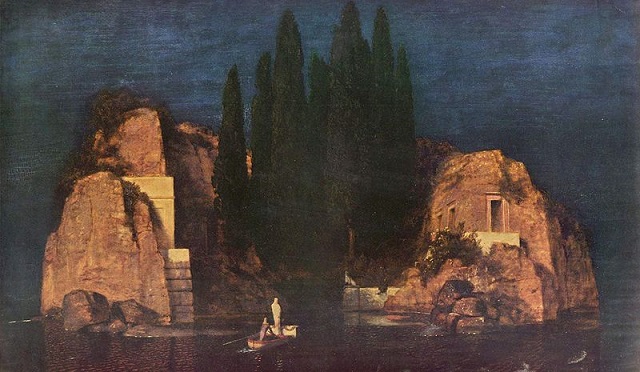
The Isle of the Dead, by Arnold Böcklin
The first item one the menu was The Isle of the Dead, Op. 29 by Sergei Rachmaninov, inspired by a painting of the same name by Arnold Böcklin and written around 1908. The rhythms of the opening passage evoke the motion of a boat moving across the sea to the island, from which point the piece develops among a cloud of increasingly dense harmonic layers into a dark atmosphere full of foreboding. It’s a darkly dramatic work that I’ve enjoyed every time I heard it and last night was no exception.
There then followed the Sinfonietta on Estonian Motifs by Eduard Tubin introduced by conductor Mihhail Gerts, who is himself from Estonia. It’s a work in three movements inspired by the folk songs the composer heard as a child growing up in Estonia. I knew that much before the performance started but didn’t realize it would turn out to be such a weighty composition. The two outer movements are rhythmically complex in a way that’s reminiscent of Stravinksy (especially Petrushka) and the overall mood is far from the pastoral tranquility I’d expected: the music is rather edgy, in fact. I suppose that’s not surprising given that it was written in 1940. I enjoyed this but it is strange how much it reminded me of other composers: as well as Stravinsky, there are clear nods in the direction of Sibelius and at times it also reminded me of Arnold Bax. You might say it is a little bit derivative. I couldn’t possibly comment.
After the interval
After the wine break we had The Bells, a choral symphony for soprano, tenor, bass-baritone, chorus and large symphony orchestra by Sergei Rachmaninov (Op. 35). The words are based on a Russian translation of the poem The Bells by Edgar Allan Poe which was very popular in Russia in the early 20th century and which clearly resonated with Rachmaninov:
The sound of church bells dominated all the cities of Russia I used to know, they accompanied every Russian from childhood to the grave and no composer could escape their influence. Most of my life was lived amid vibrations of of the bells of Moscow.
Sergei Rachmaninov
The Bells is in four movements, echoing the four stanzas of the poem, and representing the journey “from childhood to the grave”, the last movement being a Lento subtitled The Mournful Iron Bells. The three soloists sing in one part each; the third movement involves orchestra and chorus only. Ukrainian tenor Valentyn Dytiuk sang in the first movement, Estonian soprano Mirjam Mesak the second and Ukrainian baritone Andrei Bondarenko the fourth. All three soloists were superb but particularly enjoyed the sinewy muscularity of Bondarenko’s baritone which gave a sense of rawness to his performance.
It was a fitting finale to the season. Congratulations to the National Symphony Orchestra for a great performance, and to the National Symphony Orchestra who were outstanding too.
Walking back to Pearse Station to get the train for Maynooth I found myself wondering when my next visit to the National Concert Hall will be. I’ll be away on sabbatical most of next year. Still, there’ll be plenty of music where I’m going…
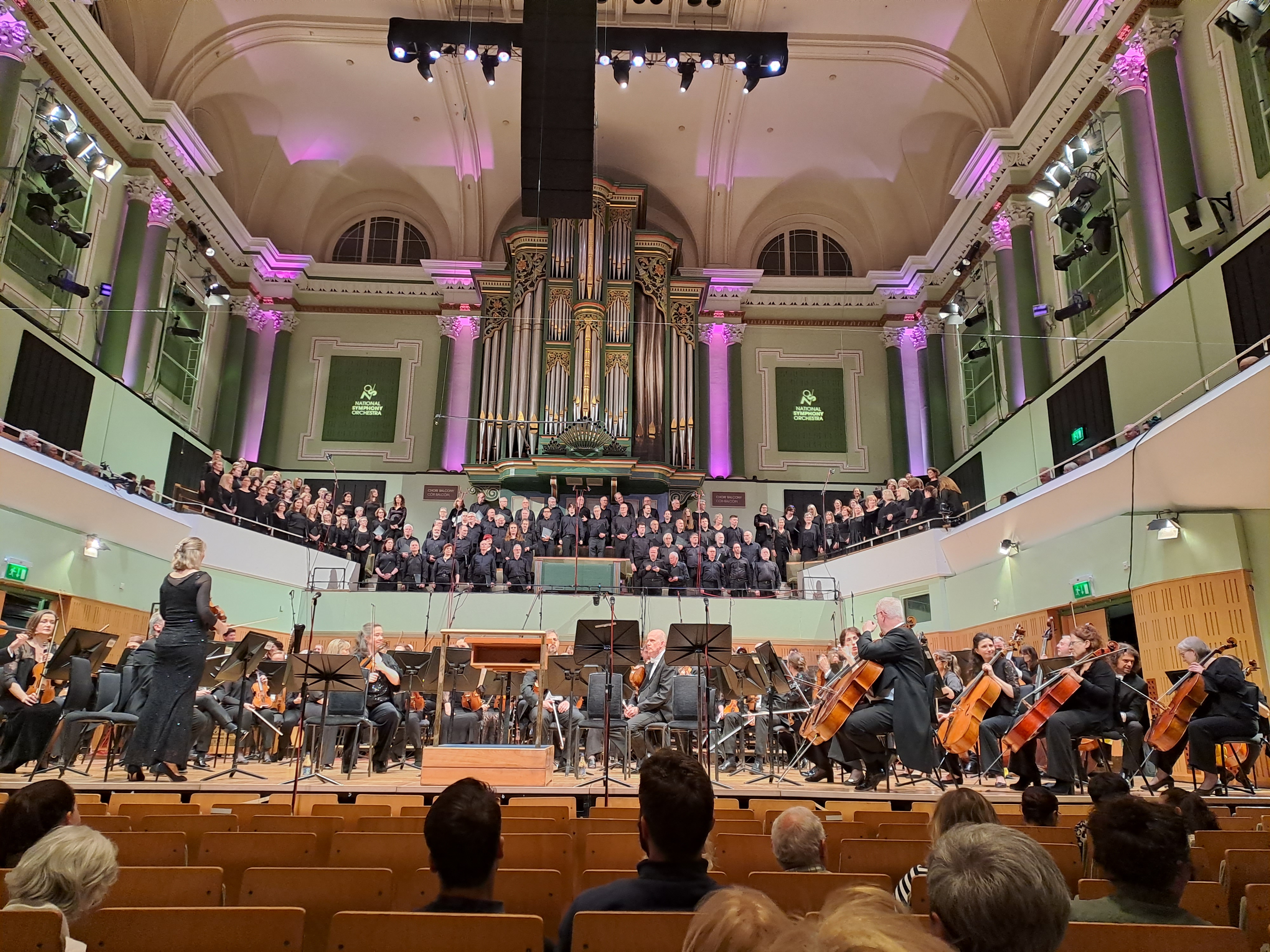
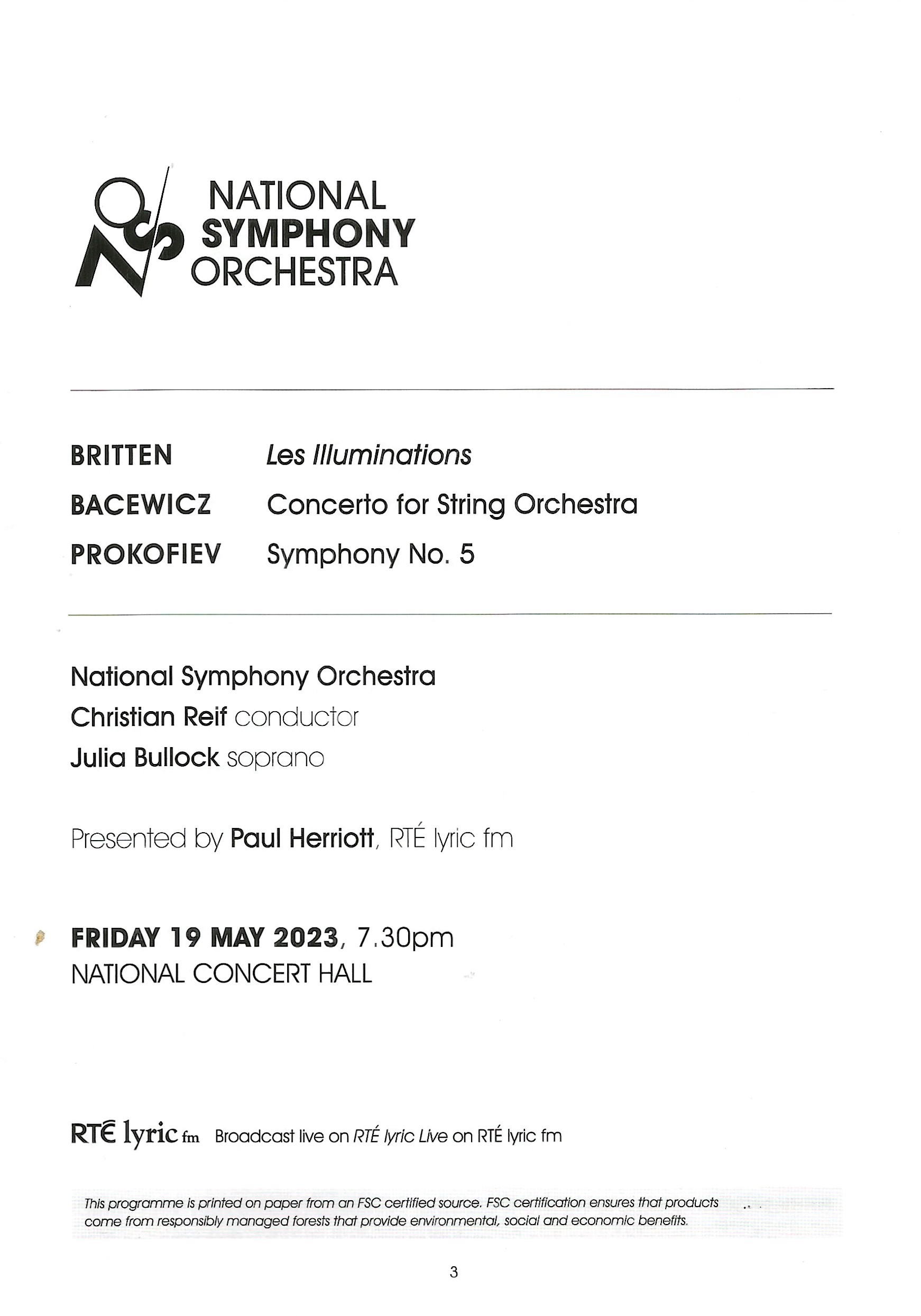
Last night I went to the National Concert Hall in Dublin for the penultimate performance of the season by the National Symphony Orchestra under the direction of Christian Reif, for a programme of music by Benjamin Britten, Grażyna Bacewicz and Sergei Prokofiev all written in the 1940s. The hall was not even half full for this concert, which is a shame because it was both interesting and enjoyable, but at least it was broadcast live so it could be heard on the radio.
Before the concert
I’d never heard Britten’s Les Illuminations in a live performance before last night, although I had heard it on BBC Radio 3 some time ago. It’s a cycle of nine songs based on poems by Arthur Rimbaud, including an opening ‘fanfare’ and interlude based on a single phrase of Rimbaud J’ai seul la clef de sette parade sauvage. The themes of the text are the poet’s reactions to desire, exile, transgression and decadence. Britten apparently felt more comfortable setting these themes, and conveying the sense of homoerotic desire that pervades the poems, in French because he felt that he could use them to say things he couldn’t say in English. Even so, he did omit some of the naughtier bits of Rimbaud’s texts.
Britten started writing Les Illuminations in 1939 but finished it after he had moved to America and it was first performed in 1940. This was an early “hit” for Britten and I found Julia Bullock‘s lovely soprano voice give it a very different form of sensuality than it has when performed by a tenor; it was performed quite often by Peter Pears, actually. Incidentally, Julia Bullock is married to conductor Christian Reif.
Next up was a work that was completely new to me, the Concerto for String Orchestra by Grażyna Bacewicz which was written in 1948. In three movements, this is rather like an old-fashioned Concerto Grosso in construction, but with a distinctively modern edge. The outer movements are forceful and energetic, contrasting with a beautiful but rather desolate Andante in the middle. I’m glad to have been introduced to this work and indeed to this composer. I must find out more about her.
The first two pieces featured only the strings of the National Symphony Orchestra but after the win break the stage was joined by the brass, woodwinds, and a full panoply of percussion (including a piano) for Symphony No. 5 in B♭ Major, which he wrote in the summer of 1944 and was first performed in January 1945 with Prokofiev himself conducting. This work is generally perceived to be an expression of the anticipation of victory over the Nazis after the opening up of the Western front by the Normandy landings. According to the programme, however, the composer had been sketching the symphony for several years beforehand, so this can’t all be true. I think you can read it in two ways, one as the devastating human cost of the war with Russia and the other as a covert response to Soviet oppression. Prokofiev, like Shostakovich, was good at ambiguity. I guess he had to be.
In four movements, this Symphony opens with an expansive Andante movement, followed by and Allegro which is rather like a Scherzo, a darkly beautiful Adagio, and a very varied final Allegro. I found myself at times thinking of Prokofiev’s music for the film Alexander Nevsky and the menacing atmosphere of the ballet Romeo and Juliet.
The winds and percussion had obviously been champing at the bit during the first half, and they unleashed some terrific playing during this performance, especially during the climactic passages that evoke thunderstorms or battles. Whatever they are intended to represent, if anything, I enjoyed the loud bits very much.
Congratulations to the National Symphony Orchestra and soloist Julia Bullock on an excellent evening of music. I do enjoy being introduced to unfamiliar works and do love the site and sound of a big orchestra in full flood. I look forward to next week’s concert, the Season Finale.
I don’t often get the chance to attend a concert in Maynooth, but I did this evening when I went to the Aula Maxima on Maynooth University South Campus for a performance of arias and duets from Mozart operas by singers from Irish National Opera.
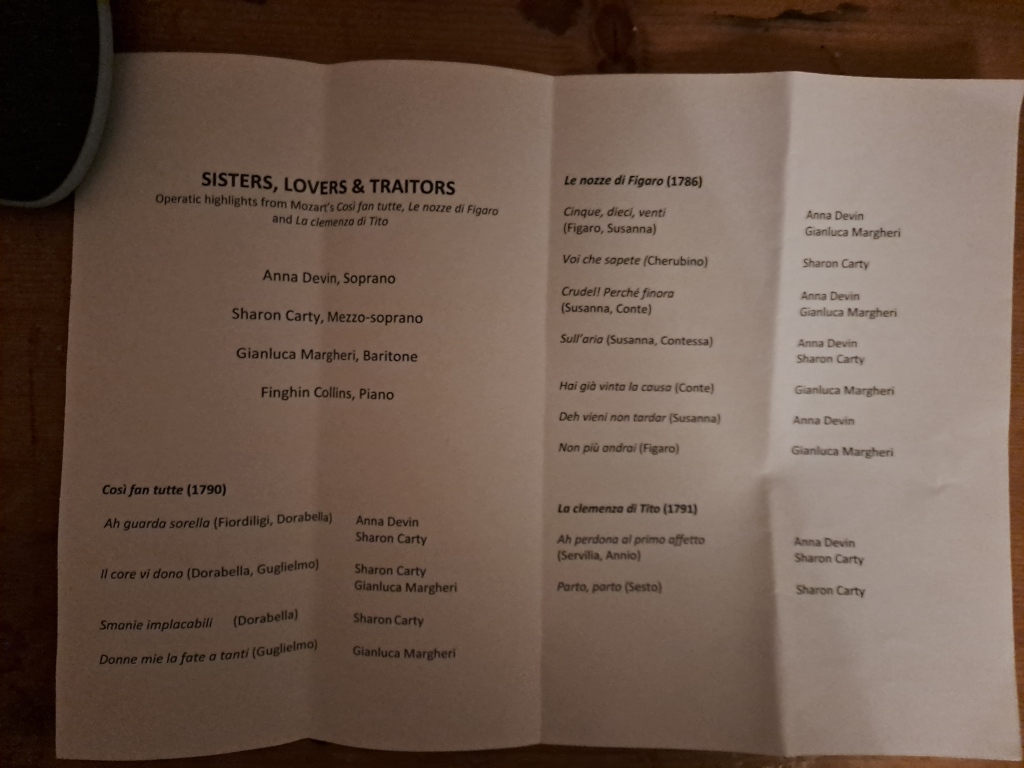
The artists involved were Anna Devin (Soprano), Sharon Carty (Mezzo), and Gianluca Margheri (Baritone) . All were excellent, but I particularly loved Italian Gianluca Margheri’s richly sonorous voice. Fine accompaniment was provided on the piano by Finghin Collins (who, incidentally, last featured on this blog in an item about a very different type of music).
INO are currently rehearsing their forthcoming production of Cosi fan tutte which provided the first four pieces; it features two sisters of course, Fiordiligi and Dorabella. These were followed by a selection from Le nozzle di Figaro, including the lovely duet Sull’aria. The final two pieces were from La clemenza di Tito, a much less familiar work, which was composed at roughly the same time as The Magic Flute and is arguably Mozart’s final opera.
The encore was a trio performance of Là ci darem la mano from Don Giovanni, usually a duet but in this case with the part of Zerlina shared between Anna Devin and Sharon Carty.
It was a very enjoyable programme, very well received by the audience, and an ideal break from a busy end-of-term schedule, especially on a rainy night like tonight.Now, I must remember to get tickets for Cosi fan tutte to give me a break from examination marking!
Looking back through my old blog posts, I find that the last time I went to a concert at the National Concert Hall was 10th February 2023. Owing to pressure of work I’ve had neither the time nor the energy to make the trip into Dublin since then, but last night I finally managed to get there for the excellent programme shown above, which was also broadcast live on RTÉ Lyric FM.
On this occasion the National Symphony Orchestra was conducted by Ruth Reinhardt, who last conducted the Orchestra during the pandemic in one of those weird occasions for which most of the musicians were masked, as was she. Anyway, for tonight’s performance she was unmasked long with the rest of the band.
Anton Webern’s Passacaglia(his Opus 1) was a new one on me. It’s not in the 12-tone style he adopted later as a member of the 2nd Viennese School, and can properly be regarded as a (very) late Romantic piece. It’s an intriguing variation of the Passacaglia form (originally a stately dance in triple time built on a bass theme) in that it’s not really a dance and it’s not in triple time, but it is introduced by a theme of eight notes played pizzicato on the strings, which is then followed by a set of variations. The piece only runs about 12 minutes but it packs a lot in. I found it very absorbing and enjoyed it enormously.
The Four Last Songs were published after his death, so Richard Strauss never heard them performed. The very first time they were performed was in 1950 at the Royal Albert Hall, by the London Philharmonia. One can only imagine what it must have been like for the orchestra making this music live for the very first time. Apparently the first time any of them had seen the score was when they turned up for the rehearsal. I’m sure they knew as soon as they started playing that it was a masterpiece.
Last night we heard these songs sung by Amanda Majeski, who arrived on stage resplendent in a black evening gown. I was somewhat surprised to see her using a score for this performance. I would have thought that this was such a standard component of the repertoire that all sopranos would know all the songs off by heart. Perhaps it was just nerves, but I thought the first song, Frühling, lacked warmth but as the concert went on Amanda Majeski got into her stride and by the time she got to Im Abendrot (my favourite) she reached the right level of intensity.
I must single out the leader of the National Symphony Orchestra Elaine Clark for her gorgeous playing of the lovely violin solo in the third song, Beim Schlafengehen. I don’t mind admitting that it brought a tear to my eye.
Incidentally, as far as I know the Four Last Songs were not specifically intended to be performed together as they inevitably are these days. Although the last is my favourite, I think the first three (all based on poems by Herman Hesse) have much more in common with each other than Im Abendrot (which is a poem by Joseph von Eichendorff).
After the wine break we had Symphony No. 3 (“Scottish”) by Felix Mendelssohn. Inspired by a visit to Scotland in 1829 – the first movement was actually composed that year in Edinburgh – it wasn’t completed until over a decade later and should probably be No. 5, but who’s counting? It’s a piece on four movements, with little or no break between them. The first movement starts with a slow theme, like a hymn, but then becomes much more reminiscent of the Hebrides Overture composed in 1830. The landscape of the other three movements is very varied, sometimes cheery, sometimes lush, sometimes tempestuous. The final movement Allegro Vivacissimo has a marking guerriro (“warlike”), which in parts it is, but it also has calmer and more reflective passages before the rumbustious finale.
I always enjoy watching the musicians in these concerts, and could see last night that they were all enjoying themselves hugely. Well done to Ruth Reinhardt and the National Symphony Orchestra for an excellent performance. The hall was by no means full, which was a shame, but the concert was warmly appreciated by those of us there in the audience and no doubt by those listening on the radio.
Now there’s only a month or so to the finale of this concert season so I must try to make the most of the few remaining performances before the summer break…
With the passing, on Sunday, of Ahmad Jamal, at the age of 92, another legendary Jazz musician has left us. He was a consistently inventive pianist, of great elegance, and a wonderful knack of deconstructing a tune into its component parts before reassembling it into something fresh. His formative years were a time when many keyboard players emphasized virtuosic brilliance, but Jamal’s approach was relaxed and spare. He was great letting his story develop gradually but very enjoyably through a series of riffs over a compelling rhythmic foundation. A perfect example is this track, Poinciana, from a hugely popular album Live at the Pershing: But Not For Me, recorded in 1958 with Israel Crosby on bass and Vernel Fournier on drums. Ahmad Jamal is no longer with us, but this groove will last forever!
R.I.P. Ahmad Jamal (born Frederick Russell Jones, 1930-2023).
When my father passed away in 2007, the main music music played at his funeral was the hymn or spiritual (and of course Jazz standard) Just a Closer Walk with Thee. It’s a lovely old traditional tune that often plays a central role in New Orleans style funerals and is a melody that, at least for me, has a deep association with loss and bereavement. The recording that was played on that occasion was this one, made at the same session as the track I posted a few days ago, featuring the same personnel (including my Dad on the drums), but with vocals by a fine Jazz and Blues singer by the name of Annie Jenkins.
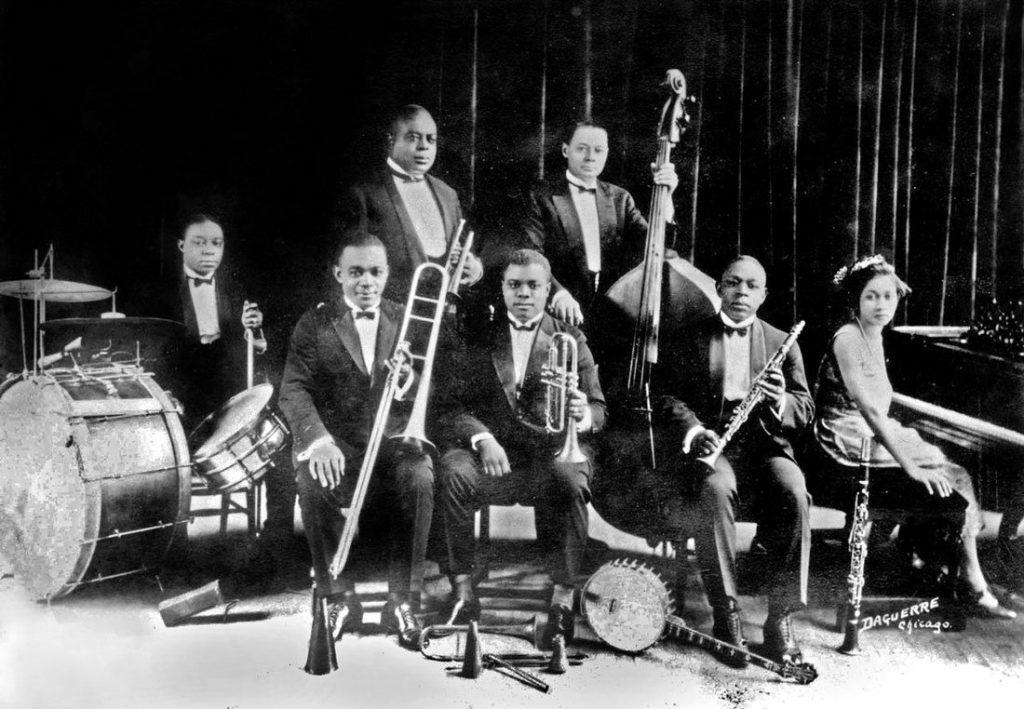
King Oliver’s Creole Jazz Band vintage 1923. From the left: Warren “Baby” Dodds (drums); Honore Dutrey (seated front, trombone); Joe “King” Oliver (standing rear, cornet); Louis Armstrong (seated front, cornet); Bill Johnson (standing rear, string bass and banjo); Johnny Dodds (seated front, clarinet); and Lil Hardin (piano)
I’ve been looking forward to this day because it marks an important jazz centenary. Or at least I think it does. There’s some contradictory evidence about whether it was April 5th 1923 or April 6th, or maybe both, when King Oliver‘s Creole Jazz Band did its first ever recording session at the Gennett studios in Richmond, Virginia. They recorded 20 sides in that session, which may well have involved two days with a break in between or working through the night.
These dates represent a remarkable occasion not only because King Oliver’s band was really the first jazz Supergroup, but also because it had been joined just a few months earlier by a young cornet player by the name of Louis Armstrong. This session therefore represent the first examples of Louis Armstrong ever heard on record.
It is somewhat surprising that this historic session happened at the Gennett studios. The band was based on Chicago, Illinois, and the studios were in Richmond, Virginia, so it required a long road trip to get there. Moreover the studio building wasn’t exactly in a prime location, as it was right next to a railroad line:
Gennett Recording Studios, Richmond Virginia (Picture Credit here)
Musicians had to time their recordings so as to avoid the noise from passing trains. Still, records only lasted about 3 minutes in those days so presumably weren’t so frequent as to make it difficult to fit in a take between two of them! Recording techniques were rather primitive in those days though, and the sound quality that emerged isn’t great.
The lineup for the band is shown in the picture at the top of this page. It’s interesting to note that four of these musicians (Armstrong, Hardin, and the Dodds brothers) were to feature regularly from 1925 onwards in the classic Hot Fives and Hot Sevens. King Oliver’s band, however, had style that was very different from these later records, with a much greater emphasis on polyphony, much more complex arrangements, and much less emphasis on solos. Also, King Oliver’s band played to live audiences on a regular basis, but the Hot Fives and Hot Seven only ever performed as such in recording studios.
As far as I understand how this band worked, King Oliver made the arrangements. I don’t think they used full written scores, but tended to play from wonderfully intricate “head arrangements” worked out beforehand, with ensemble passages, gaps for breaks and solos, and King Oliver introducing the (usually very catchy themes). Armstrong and Johnny Dodds improvised a decorative counterpoint, and Honore Dutrey added harmonic breadth to the ensemble. This must have been a great learning experience for the young Louis Armstrong, has he had to develop a great ear for what was going on around him to play like this. I gather that Louis Armstrong often tended to play very loud so he was kept well in the background in these early Gennett sessions, but such a prodigious talent was never going to play second fiddle for long and in later sessions he effectively duets with King Oliver and swapped leads with him freely and completely intuitively, producing a sound that was entirely unique. I am always astonished by how much is going on in these old records, even if you can’t hear it all very well!
I’ve mentioned before that, over time, this classic type of polyphonic Jazz – derived from its New Orleans roots – gradually morphed into musical form dominated by much simpler arrangements and a succession of virtuoso solos. This change was also reflected in the differing fortunes of Louis Armstrong and King Oliver. The former went on to become an international celebrity, while the latter lost all his savings when his bank went bust during the Wall Street Crash and ended his life working as a janitor.
As well as Gennett, this band recorded with other labels in 1923 including Okeh and Columbia. Sadly however they split up at the end of 1923 over disagreements about a possible tour in 1924. Only about 40 sides were ever recorded King Oliver’s Creole Jazz Band. Many of them are absolutely marvelous.
This is the first track recorded by the band in April 1923. It’s called Just Gone. It’s a scratchy old record, with a rather compressed acoustic, so it’s like putting your next to one end of a tunnel leading back a hundred years, but it’s a good example of the Creole Jazz Band’s style. Joe Oliver’s lead cornet clearly influenced Louis Armstrong’s later style. You have to listen hard to hear Satchmo in the background on this track, but it’s worth the effort. You’re listening to a piece of music history, and a wonderful piece at that.
The views presented here are personal and not necessarily those of my employer (or anyone else for that matter).
Feel free to comment on any of the posts on this blog but comments may be moderated; anonymous comments and any considered by me to be vexatious and/or abusive and/or defamatory will not be accepted. I do not necessarily endorse, support, sanction, encourage, verify or agree with the opinions or statements of any information or other content in the comments on this site and do not in any way guarantee their accuracy or reliability.