I was very sad to read just now of the death of writer, humorist, director and polymath Dr Jonathan Miller who has passed away at the age of 85. The papers are already filled with tributes to Jonathan Miller to which I’ll add a personal recollection that made a big impression on me when I was young and which makes me remember Dr Miller with great fondness.
While I was at school I was captivated by the BBC TV series, directed and introduced by Jonathan Miller, called the Body in Question.
This episode, first broadcast in 1978, shows Dr Miller at the piano with Dudley Moore, his old friend from Beyond the Fringe. They’re exploring the mysterious process by which pianists manage to put their fingers on the right keys without apparently consciously thinking about the mechanical operations involved or even looking at the keyboard. Practice seems to program the hands so that the translation from sheet music to sound becomes second nature, but to those without the ability to effect the transformation (like myself), the process still seems almost miraculous.
Every now and again on this blog I like to mark significant anniversaries, so I’m quite annoyed that I’ve missed one by a few days. It’s perhaps not very well known that the great Sidney Bechet came to England in 1949 and did a concert and a recording session with Humphrey Lyttelton’s band while he was here. That recording session took place just over 70 years ago, on 13th November 1949.
What’s also not very well known is how controversial this session was at the time, because in the immediate post-war years the Musician’s Union had persuaded the UK government to ban American artists from performing over here. Humph was having none of it, thank goodness, and here we have the legacy. Here is the unmistakable Sidney Bechet on soprano sax, playing a traditional blues called I told you once, I told you twice with Humph on trumpet, Wally Fawkes on clarinet and, stealing the show, the superb (and, to my ears, rather modern-sounding) Keith Christie on trombone.
According to Humph’s memoirs, after the concert they played together, Bechet summoned Humph to his dressing room in order to deliver a kind of end-of-term report on the band in which he pointed out little criticisms of their playing. Bechet was a forceful character and often a harsh critic but when he got to Keith Christie he expressed nothing but unqualified admiration. There’s not much higher praise than that in the world of jazz…
So that’s that. The funeral is over. We all said our goodbyes, and there many tears.
My Mam chose the music for her funeral a long time ago, and the piece that was playing as we arrived in the West Chapel of the West Road Crematorium was one that I wrote about about a decade ago, so I thought I’d indulge myself by posting here the version we heard today.
Years ago my Mam told me that she heard the tune Mabel’s Dream played on the piano by a friend of the family by the name of Johnny Handle. Best known as a folk musician (and founder member of a well-known band called The High Level Ranters) he is also a music teacher and musicologist with a wide range of interests in music. I read somewhere that this lovely tune was originally written by Jelly Roll Morton and performed by him on solo piano, but by far the most famous recording of Mabel’s Dream was made by King Oliver and his Creole Jazz Band in Chicago in 1923. This was the band that the young Louis Armstrong belonged to before going on to make the classic Hot Fives and Hot Sevens, one of which I posted a bit ago. It’s interesting how different the earlier band sounds: with two cornets (King Oliver and Louis Armstrong), clarinet (Johnny Dodds), and trombone (Honore Dutrey) playing together virtually all the time except for short improvised solo breaks. King Oliver usually played lead cornet, at least in their earlier recordings, with Louis Armstrong playing a decorative counterpoint around him rather like a clarinettist might. Later on, they swapped leads freely and completely intuitively producing a sound that was entirely unique.
The ensemble playing is intricate, but the band had no written music, preferring to work exclusively from “head” arrangements. Their music is consistently delightful to listen to, with a succession of marchy themes that makes it impossible not to want to tap your feet when you listen to them.
Over time, this classic type of polyphonic Jazz- derived from its New Orleans roots – gradually morphed into musical form dominated by much simpler arrangements and a succession of virtuoso solos. This change was also reflected in the differing fortunes of Louis Armstrong and King Oliver. The former went on to become an international celebrity, while the latter lost all his savings when his bank went bust during the Wall Street Crash.
Considering the relatively brief time that they played together, King Oliver and Louis Armstrong made an astonishingly large number of astonishingly beautiful records, including this one which I’m posting here to show that as well as many other things my Mam had great taste in Jazz.
And now for something completely different. I have recently been listening a lot to a fascinating album Urlicht by jazz pianist and bandleader Uri Caine in which he re-imagines the music of Gustav Mahler with a small band to wonderful effect. The music he produces is not only influenced by jazz but full of references to klezmer music and (to my ears at least) redolent of the music of the Weimar era. I confidently predict that many Mahler fans will absolutely hate this, with its pared-down arrangements and roughness around the edges, but I find it very refreshing. Anyway, you can decide for yourself whether you like it or not. This is Uri Caine’s take on the Funeral March from Mahler’s Symphony No. 5:
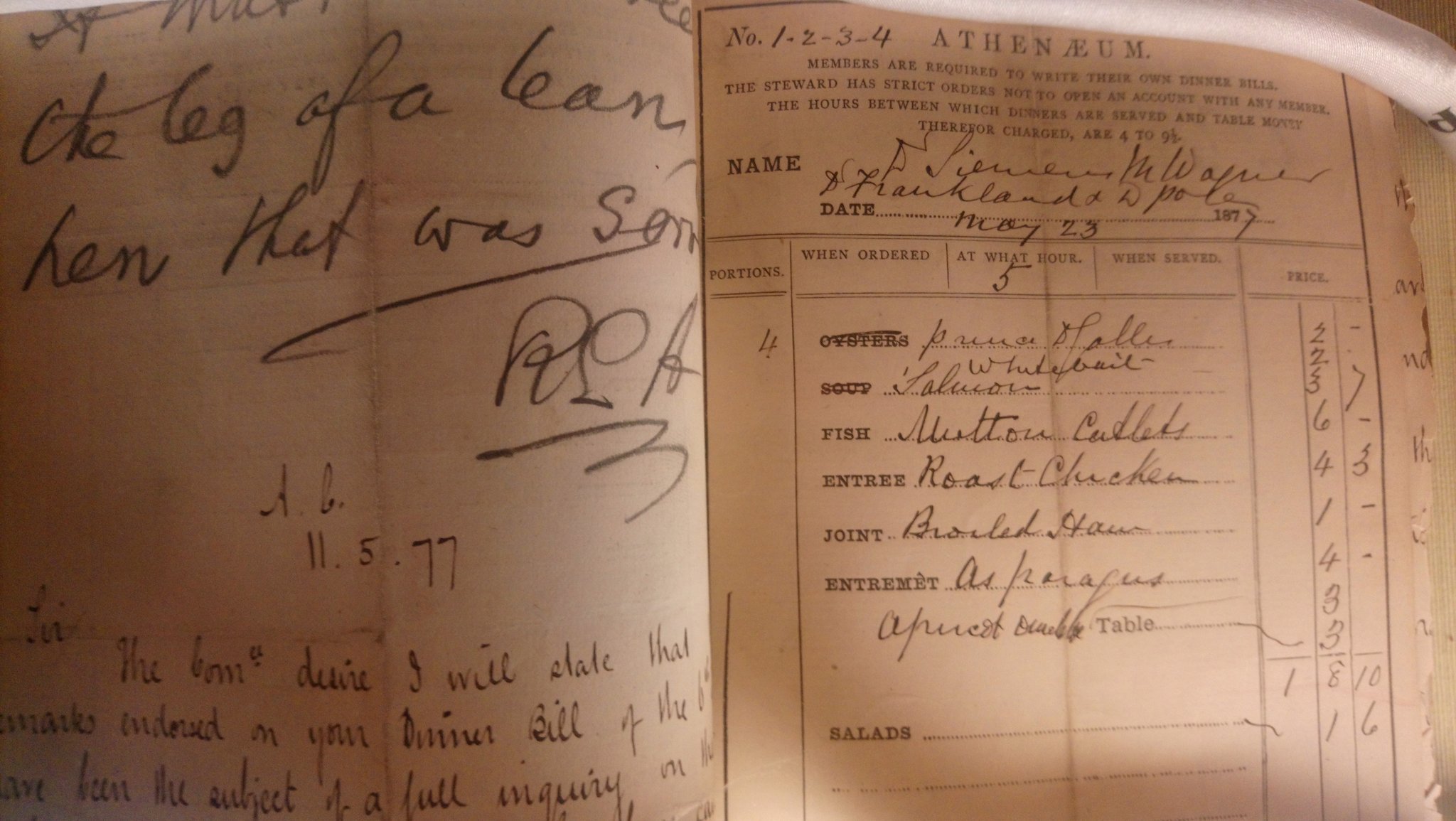
Before dinner with the RAS Club on Friday evening I was looking through the display cabinets at the Athenaeum and saw this, the record of a dinner involving a member and guests on 23rd May 1877. The member was electrical engineer, businessman and Fellow of the Royal Society Carl Wilhelm Siemens and among is guests was Richard Wagner:
Dinner started early and was evidently a lengthy affair, much like Wagner’s operas!
That reminds me of a famous review of one of Wagner’s operas by a critic who clearly wasn’t a fan.
Parsifal is an Opera by Richard Wagner that starts at half past five. Three hours later, you look at your watch and it’s quarter to six.
P.S. There is a photograph taken of Wagner (whose 64th birthday was on 22nd May) during his visit to London in 1877:
I heard this on the radio the other night and thought I’d share it here as it’s been a very busy day and I haven’t got the energy to do anything else. It’s from My Point of View the second album Herbie Hancock made for the Blue Note label and was released in 1963. This number is quite reminiscent of the 16-bar blues Watermelon Man, the big hit from his first album but this one has a relaxed soul jazz groove all of its own, backed by straight eights played by the 17-year old drummer Tony Williams and there are nice solos by Grant Green on guitar, Hank Mobley on tenor and Hancock himself on piano. Donald Byrd plays trumpet on this track, but doesn’t take a solo.
I found out this morning that the wonderful Jessye Norman passed away yesterday at the age of 74. It’s impossible to post an adequate tribute in words to such a stellar artist so I’ll just post a clip of her, not in one of the big operatic number by Wagner or Strauss with which she was probably most strongly associated, but in a piece from a different era altogether: Dido’s Lament by Henry Purcell. It seems to be an apt choice at this sad time.
Yesterday, 21st September 2019, would have been Leonard Cohen‘s 85th birthday, which made last night’s performance of Between your love and mine at the National Concert Hall in Dublin an especially moving occasion.
The piece – a Requiem by Leonard Cohen, rather than a Requiem for Leonard Cohen – was created by John MacKenna who, in the summer of 2016 approached Leonard Cohen with the idea of creating a requiem in memory of young people who had died tragically, and for those grieving for them. It roughly follows the liturgical form of the Requiem mass but with text and music provided entirely by Cohen. Leonard Cohen – a Jew who had embraced Buddhism – often referred to Catholic themes and imagery in his songs and poems so the work is in no way a contrivance but has a compelling unity and honesty about it.
The first `hymn’ Come Healing sets the tone:
And let the heavens hear it, the penitential hymn, come healing of the spirit, come healing of the limb. Behold the gates of mercy in arbitrary space and none of us deserving the cruelty or the grace.
Some of the songs were unfamiliar to me, but there are some of Leonard Cohen’s famous songs in Between love and mine, including Anthem and If it be your will. There are three principal vocalists: Katie Jacques, Shane Sullivan and Eric Butler. The latter in particular gave a superb performance demonstrating wonderful versatility in his voice, including a passable reference Cohen’s own deep tone (that someone once described as `like a boulder rolling down a granite tunnel’) but also deploying his own natural register to powerful effect, especially in Anthem where he summoned up his thundercloud in fiery tenor tones. Three backing singers, two readers (including John MacKenna) and a small band of strings, keyboard and drums make up the cast of this intriguing and emotionally powerful work.
Naturally, given the theme, it was a sombre performance but at the same time very uplifting. Leonard Cohen may not have been there in the flesh, but he was certainly present in spirit. In more ways than one it felt like he was the host.
And those who dance, begin to dance,
those who weep begin
and “Welcome, welcome” cries a voice
“Let all my guests come in.”
I thought I’d do a quick round-up of my little trip around cultural and historic Dublin yesterday after being stood down from duty at the Higher Options fair at the Royal Dublin Society (RDS). I have to say it was wonderful to see so many people out and about in the City’s beautiful parks and public spaces enjoying the September sunshine as I walked around.
The RDS is in the Ballsbridge area in of Dublin, to the East of the City. My route into town from there took me along Northumberland Road, where I took this picture outside Number 25:
A little further along I went across Mount Street Bridge, passing this memorial.
If you want to know more about the significance of these memorials to the events of the Easter Rising in 1916, see my post here.
My main intention during my afternoon off was to visit the National Gallery of Ireland which is situated on one side of Merrion Square. I have to say that this was even better than I’d expected, and I’m sure to visit again many times in the future. The ground floor is dominated by the work of Irish artists from about 1660 to 1965, together with European Art from 1835 to 1965. You will find works by Monet and Picasso in this section, which has much to savour. Among the Irish artists represented in this show is Jack B. Yeats (brother of poet W.B. Yeats), an extremely interesting artist in his own right.
The highlights for me, however, were found on the 3rd floor which displays examples of European Art from the early Renaissance (c. 1300) to the Enlightenment. One of the interesting things about this collection is that it is arranged thematically rather than by artist (or nationality thereof). There is, for example, an entire room of paintings inspired and influenced by Caravaggio, all of them with an intensely dramatic use of light and shadow. The gallery is worth it just for that room, but there are also fascinating juxtapositions of religious paintings from the renaissance with icons and altarpieces from the Byzantine and Russian orthodox traditions from the same period.
Elsewhere in the collection there are notable works by Vermeer, Rembrandt and Perugino as well as a number of British works by, for example, Gainsborough and Reynolds.
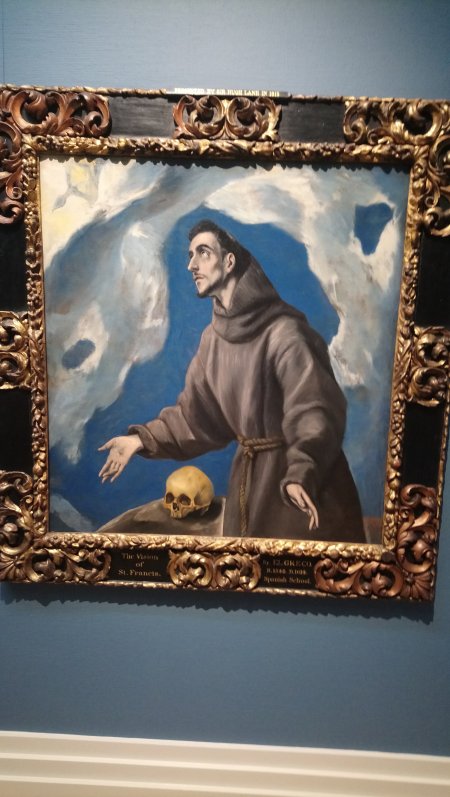
The work that really stopped me in my tracks, however, was this:
This is St Francis Receiving The Stigmata by El Greco. I knew about this painting but had no idea it was in Dublin. Seeing it close up is a revelation: the swirling brushstrokes give it an extraordinary texture that makes it hard to bring the image completely into focus. The hypnotic feel that results is a brilliant depiction of a man undergoing a kind of ecstatic vision. This work has an unbelievably powerful effect on the viewer (or at least on this one).
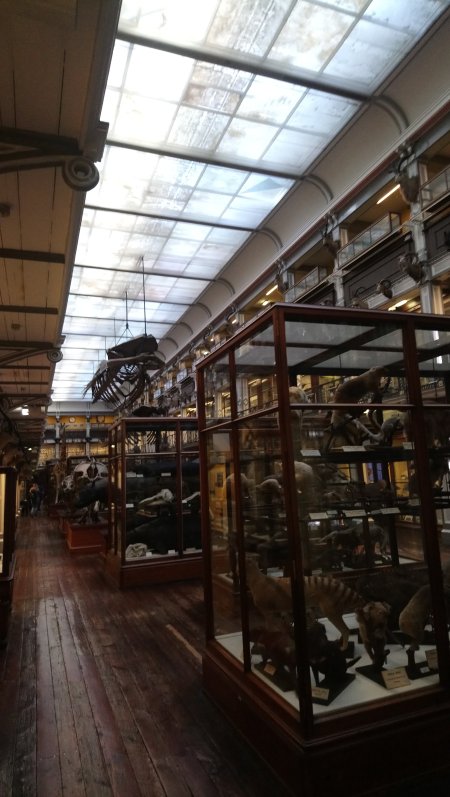
After a break for a sit down and a cup of coffee I visited the Natural History Museum (which is practically next door to the National Gallery). This is a surprisingly old-fashioned affair, with hundreds of stuffed animals and birds crammed into two large rooms:
It reminded me a lot of visits to the Hancock Museum in Newcastle when I was a kid. It’s interesting, but more than a little creepy and would make an excellent setting for a horror story!
After adjourning to a pub for a pint of Guinness the final stop of the day was the National Concert Hall for yesterday’s Culture Night concert. On the way there I saw a big queue of people trying to get into one of the many free events around Dublin. It turns out this Culture Night was the grand opening of the Museum of Literature Ireland, which is situated in Newman House on the South Side of St Stephen’s Green. There’s another one to put on my list of places to visit.
The Culture Night concert was by the RTÉ National Symphony Orchestra conducted by Leonard Slatkin. The opening piece, Kinah, was a composition by the conductor himself and is a sort of memorial to his parents, both of whom were classical musicians, one a violinist and the other a cellist, and together they formed half of the famous Hollywood String Quartet. It was a new piece for me, and I found it very moving indeed. After that there was a bit of reorganization on stage to make way for the Steinway on which the brilliant Xiayin Wang played the Piano Concerto by Samuel Barber, which consists of two fast and furious movements either side of a beautifully lyrical slower movement. This must be a ferociously difficult piece to play – especially the last movement which is at a breakneck pace in 5/8 time – requiring not only dexterity but physical strength. It was a wonderful performance by Xiayin Wang, who rounded off the first half with an encore in the form of a transcription of George Gershwin’s song The Man I Love.
After the wine break interval came the main course in the form of the Symphony No. 4 in E Minor by Johannes Brahms. This is of course a much more familiar work than the previous two, but I really like concerts that mix unfamiliar material with the standard concert repertoire. It also gave me the chance to persevere with Brahms as my friends keep telling me to. It’s not that I don’t like Brahms, it’s just that I don’t find that he moves me as much as many other composers and so many people rave about him that I think I must be missing something. The 4th Symphony is a very fine work, and was performed beautifully last night under the direction of Leonard Slatkin (conducting, incidentally, without a score), but I couldn’t stop myself thinking how much like Beethoven it sounds. That’s not meant to be derogatory, by the way.
But you don’t need to take my word for it. You can listen to (and watch) the whole concert here:
Anyway, after the applause had died down I headed out towards Pearse Station for the train back to Maynooth. I was a bit tired after a very full day and wanted to get the 10.08 train so I didn’t stop to watch any of the numerous musical and artistic events I passed on the way, including an intriguing installation involving images projected onto one of the buildings to the side of St Stephen’s Green. I made it to the station with 5 minutes to spare and discovered that, because it was Culture Night, the train home was free!
The views presented here are personal and not necessarily those of my employer (or anyone else for that matter).
Feel free to comment on any of the posts on this blog but comments may be moderated; anonymous comments and any considered by me to be vexatious and/or abusive and/or defamatory will not be accepted. I do not necessarily endorse, support, sanction, encourage, verify or agree with the opinions or statements of any information or other content in the comments on this site and do not in any way guarantee their accuracy or reliability.




 In the Dark