Yesterday at the end of a busy week I finally got round to booking a ticket for next Friday’s Culture Night performance at the National Concert Hall in Dublin. That will be my first concert of the new season and I’m looking forward to it. Among other things, it gives me the chance to persevere with Brahms…
Since I first arrived in Ireland nearly two years ago, I searched through the available radio stations for one that I could listen to and it didn’t take me long to settle on RTÉ lyric fm, which has been a regular source of edification, relaxation and stress relief for me. I fear its loss tremendously. I’m not the only one. If you’re on Twitter, take a look at the hashtag #savelyricfm.
I listen to the jovial Marty Whelan in the morning before work, and when I get home in the evenings I enjoy John Kelly’s Mystery Train followed by Bernard Clarke’s The Blue of the Night on weekdays and Ellen Cranitch’s The Purple Vespertine at the weekends. All these programmes have intriguingly eclectic playlists, from classical to jazz and beyond, and presenters who clearly know and love the music. It’s not just a music channel, of course. RTÉ lyric fm covers culture and the arts generally, and is the only channel run by RTÉ – which is meant to be a public service broadcaster – that has this area as its province. It would be a crying shame as well as an abdication of its cultural responsibility if all this were lost to save the paltry amount of money required to keep the station going. I’ll do anything I can to save RTÉ lyric fm. For me it really is one of the very best things about Ireland.
I might add that I stopped watching television many years ago and don’t have a TV set. I’m even less inclined to get one now that I’m in Ireland as the schedules are dominated by the kind of crappy programmes I didn’t watch when I lived in Britain and have even less reason to watch now. The radio, on the other hand, in something I enjoy a lot.
Another item that was doing the rounds last week was the publication of the annual Times Higher Education World Rankings. I’ll save a proper rant about the stupidity and dishonesty of these league tables for another occasion, but one thing that has preoccupied the media here about the results is that Irish universities have done rather badly: Trinity College, for example, has fallen 44 places since last year. While I don’t trust these tables much, together with Ireland’s very poor showing in the recent ERC grant round, they do paint a consistent picture of a higher education system that is struggling with with the consequences of years of chronic underfunding.
(I’ll add that Maynooth University bucked the trend a bit, rising from the band covering 351st-400th place to that covering 301st to 350th place. That means that Maynooth went up by anything from 1 place to 99 places. There can be little doubt who is responsible for this…)
For me these stories are both consequences of the prevailing political culture in Ireland, which is a form of neoliberalism that deems neither culture nor public service nor education to be things of value in themselves and therefore just leaves them to dwindle through lack of care. The only think that matters is the cycle of production and consumption. Culture is irrelevant.
While the Irish economy is booming – at least in terms of GDP growth – the proceeds of this growth go to a relatively small number of rich individuals and multinational corporations while most people don’t see any benefit at all, either in their own salaries, or in investment in the public services. Austerity for everyone except the rich has been the policy for the last decade in Ireland as it has in the United Kingdom and the consequences are plain for all to see, in the arts, in the universities and in the lives of ordinary people.
I didn’t remember until late last night that yesterday was the 60th anniversary of the release, on 17th August 1959, of the classic jazz album Kind of Blue by a band led by trumpeter Miles Davis featuring John Coltrane (ts), Cannonball Adderley (as), Bill Evans (p, replaced by Wynton Kelly on one track), Paul Chambers (b) and Jimmy Cobb on drums. I bought the album on vinyl way back in the 1970s when I was still at school and have listened to it probably thousands of times since then. It still sounds fresh and exciting sixty years after its first release. But you don’t have to listen to me, you can listen to the whole album here:
When it first appeared, Kind of Blue seemed to represent all that Miles Davis stood for from a musical point of view, with its modal and scalar themes and such passages as the fourth section of Flamenco Sketches which hints at a Spanish influence. Whether the actual performances were typical of the way this band sounded live is less clear, but there’s no question that the album has worn so well as to be now universally regarded as a timeless masterpiece.
So why is it such an important album?
I can only speak for myself, of course, but I’d say a big part of this was that the music is on the cusp of the evolution of modern jazz. It’s music from a time of transition, pointing the way forward to exciting developments while also acknowledging past traditions. You only have to look at the various directions Miles Davis, John Coltrane and Bill Evans explored after this album to see what I mean.
A few words about each of the tracks:
The opening number So What? established the practice of constructing themes based on scales instead of chords. After an introduction that keeps you guessing for a while, it turns out to be a straightforward 32-bar melody with a simple modulation serving as the bridge. At a medium tempo, the pure-toned and rather spare solo by Miles Davis provides a delicious contracts with the flurry of notes produced by Coltrane, who also plays between the beats. It might be just my imagination but the rhythm section seems to tighten up behind him, only to relax again with Cannonball Adderley’s more laid-back, bluesy approach.
The next track is All Blues, which is in a gentle 6/8 time. I discovered by accident a while ago this composition found its way onto the GCSE Music syllabus. In fact there’s a recording of the track, produced and distributed as “set work” for that purpose:
As an aside, I should mention that I never took any qualifications in music at School – although I did get music lessons, I didn’t find them at all inspiring and it took me years to develop a taste for anything other than Jazz, which I knew about mainly from home, because my father was a (part-time) Jazz drummer. There wasn’t much mention of Jazz at School from teachers, and none of my friends were into it, so it became a very private passion, although I’m glad to say it never faded.
Anyway, what little I know about music I picked up by studying on my own, and trying to figure out what was going on by listening to records. All Blues is a really interesting composition to unpick in this way, as it tells you a lot about how Jazz was evolving in the late 1950s (it was released in 1959). Musicians like Miles Davis were experimenting with ways of breaking away from the standard approach to Jazz improvisation based on chord progressions, and one of the routes that developed was modal Jazz. All Blues is particularly interesting because it teeters on the edge between the old approach and the new; it’s clearly based on the traditional 12-bar blues progression but diverges from it in several respects.
A standard blues progression in G might go like this (although there are many variations):
|G|G|G|G|
|C|C|G|G|
|D|C|G|G|
It’s based on just three chords: the tonic (in this case G): the sub-dominant IV (C) and the dominant V (D); the V-IV-I progression in the last four bars is usually called the turnaround.
While the addition of a major 7th note to the basic triad G isn’t unusual, the two G minor 7th chords are more interesting, because they involve adding a blue note (a flattened third) to the basic chord . But it’s in the last four bars that the harmonies move dramatically away from the standard turnaround. Chromatic chords are included and the usual resolution back to G is subtly changed by the addition of a 6th note (E) to the basic G chord (GBD) at the end; that trick became a bit of a trademark for Jazz of this period.
However, it’s the two F chords that represent the strongest connection with modal harmony. The scale of G major involves F-sharp, so the F is a flattened note (a flattened VIIth). In fact, all the Fs in the piece are natural rather than sharp. For this reason you could argue that this is a piece not played in the key of G major but in the corresponding Mixolydian mode (the white notes on the piano from G to G).
So it’s a blues that’s not quite a blues, but is (appropriately enough) Kind of Blue. There’s so much going on harmonically that the fact that it’s played in 6/8 rhythm (rather than the more usual 4/4 for the Blues) seems almost irrelevant.
Those are just the bare bones, but the improvisations of Miles Davis, Bill Evans, Cannonball Adderley and John Coltrane et al breathe life into them and create a living Jazz masterpiece. Although it seems like a complicated tune, apparently what happened at the recording session was that Miles Davis talked the band through the piece, they played it once to get a feel for it, and then recorded the entire track that was released on the album in one go.
On Freddie Freeloader , Bill Evans was replaced with Wynton Kelly. I suppose that Miles Davis thought that Kelly would be more convincing on this relatively straight-ahead blues, and his crisp, direct opening solo suggests that Miles was probably right. Miles Davis’s solo that follows is superbly structured in terms of timing and dynamics. Coltrane plays more-or-less entirely in double-time and then Adderley enjoys himself hugely in a good-humoured final solo.
Blue in Green, which was mainly written by Bill Evans, is based on a ten-bar melody featuring an eloquent solo Miles on muted trumpet and some sensitive playing by Coltrane and Evans. The same mood prevails in the following track.
Flamenco Sketches involves a series of solos each improvised on a set of five scales; it’s the fourth section that hints at the Spanish influence alluded to in the title. The tempo is very slow, which contributes the air of solemnity as does the absolute perfection of the solos. In that respect it has clear parallels with some of Duke Ellington’s work. Miles Davis, who opens and closes the track on muted trumpet, and Bill Evans on piano are absolutely faultless but I particularly enjoy John Coltrane’s playing on tenor saxophone: his tone is as bleak and austere as an Arctic sunrise, and just as wonderful and he conjures up an absolutely beautiful improvised melody.
Kind of Blue isn’t merely an artistic highlight for Miles Davis, it’s an album that towers above its peers, a record generally considered as the definitive jazz album, a universally acknowledged standard of excellence. Why does Kind of Blue posses such a mystique? Perhaps because this music never flaunts its genius… It’s the pinnacle of modal jazz — tonality and solos build from the overall key, not chord changes, giving the music a subtly shifting quality… It may be a stretch to say that if you don’t like Kind of Blue, you don’t like jazz — but it’s hard to imagine it as anything other than a cornerstone of any jazz collection.
People sometimes ask me why I post about music on here. The answer has two parts and they’re both simple. One is that I enjoy writing about music because it gives me the opportunity to explore my own thoughts about why I like it so much. The other reason is to share something I love very much, in the hope that other people might find as much joy from the music I love. For example, if just one person listens to Kind of Blue for the first time as a result of reading this piece, then it will definitely be worth the 40 minutes it took me to write!
I’ve always been a not-so-secret admirer of American songwriter and record producer Burt Bacharach, but when someone told me the other day that there’s an album called Blue Note Plays Burt Bacharach I assumed it was a wind up because Blue Note Records has for many years been an uncompromising voice at the cutting edge of modern jazz rather than the lighter and more popular form of music exemplified by Mr B.
There’s no reason why two forms of excellence can’t exist together, however, and the album is definitely real and is a very nice compilation of Bacharach numbers from Blue Note albums featuring various musicians over the years. Here’s an example featuring Stanley Turrentine on tenor sax, with McCoy Tyner on piano, Bob Cranshaw on bass and Micky Roker on drums. The tune is What The World Needs Now Is Love. Doesn’t it just?
Those of your of a certain age will remember that Boney M had a hit in 1978 with a number called Rivers of Babylon. I knew that that song was based on words from Psalm 19 and Psalm 137 but I didn’t know until recently that the original song was a Rastafari hymn and that the Boney M version was a cover of this beautiful rocksteady version recorded by a Jamaican band called The Melodians in 1970. Note the differences in lyric, e.g. “How can we sing King Alpha’s song…”. Anyway, I really like this version with its excellent vocal harmony and gorgeously relaxed groove.
This record came out when I was just sixteen. How can that possibly have been 40 years ago?On My Radiowas one of the first records produced by the 2 Tone label. Although the label only existed fora few years, the diverse and inclusive nature of the music that came out on 2 Tone made a big impression on me and left a lasting legacy. The Selecter (which is still going) was an awesome band to see and hear live. Oh, and how I adored Pauline Black!
Here is a short video of the historic first manned landing on the Moon. I don’t know about you but I find the ghostly images are extremely affecting.
If there’s one piece of music indelibly associated with the Apollo missions, it’s the piece accompanying that clip: the introduction (or `Dawn’) from the orchestral tone poem Also Sprach Zarathrustra by Richard Strauss. Amazingly it was only a couple of years ago that I heard this piece performed live for the first time. I vividly remember how the percussionists were clearly enjoying themselves during that performance. Not many orchestral pieces start with the percussion section front and centre. Whenever I’ve heard the piece since then I can’t help thinking how much I’d love to have a bash at the timpani part!
Anyway, here’s a clip from the Proms a few years ago to give you some idea of the tremendous impact this piece can have when you hear it in a concert hall.
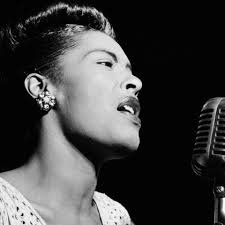
I was reminded by the radio this morning that today is the 60th anniversary of the death of the great Billie Holiday, who passed away on 17th July 1959. A consummate vocal artist who was in my book the greatest jazz singer there has ever been, Billie was only 44 years old when she died and, according to reports, her bank account contained only 70 cents. She lived a short and very hard life but still managed to leave a priceless legacy of wonderful music. She definitely paid her dues, so I couldn’t resist marking this sad anniversary with an example of her art from what I think was her best period, the 1930s, before alcoholism and drug addiction took such a heavy toll on her voice and she became a little mannered and self-conscious.
I’m not sure it’s possible for any record to be perfect, but there are definitely some that I can’t imagine being improved in any way. I can think of a number of Jazz records that fall into that category, including this version of When You’re Smiling made in 1938. It features Billie Holiday and Lester Young along a number of members of the Count Basie Orchestra (apart from the Count himself, who is replaced by Teddy Wilson on piano).
That this is a favourite record of mine is a bit of a paradox, because I don’t really like the song very much. However, in jazz, the tune is just the starting point. In her early recording career, Billie Holliday wasn’t very well known so she was often given relatively unpromising songs to sing. She turned out to be brilliant at turning that sort of base metal into gold and became probably the best ever singer of a bad song.
In this track it’s not just the way Billie Holiday’s voice floats ethereally across the beat as she takes outrageous liberties with both melody and rhythm. Nor is the way she manages to express everything there is about life and love and heartache through the rather banal lyrics, investing the song with a deep sense of tragic irony. Nor is it Lester Young’s superbly constructed tenor saxophone solo near the end, which one of the very greatest by one of the very greatest. Nor is it that lightly swinging rhythm section of Freddie Green, Walter Page and Jo Jones who push the whole thing along on gossamer wings, just as they did with the Baside Band, making most of their rivals sound like clodhoppers. Listen in particular how Jo Jones accentuates Lester Young’s solo here and there with telepathic rimshots.
All the component parts of this performance are magnificent, but the whole is even greater than their sum. It’s a timeless jazz masterpiece, three minutes of solid gold, and I hope a fitting tribute to a great artist.
There was a time in the 1960s when the Bossa Nova seemed to be everywhere and no one person did more to stimulate the growth of this uniquely Brazilian musical form than singer, guitarist and composer João Gilberto, who passed away on Saturday 6th July at the age of 88. It was Gilberto’s collaboration with tenor saxophonist Stan Getz (and, on some tracks, his wife Astrud Gilberto) on the award-winning album Getz/Gilberto that made the Bossa Nova go global, penetrating not only the world of jazz but the much wider cultural sphere including pop and film music. The most famous track from Getz/Gilberto is undoubtedly The Girl From Ipanema which was a smash hit around the globe in 1964, but my own favourite number from that album is this, with lovely playing by Stan Getz and characteristically understated, almost whispered vocal by João Gilberto himself.
Summer seems to have made it to Ireland at last so here’s an appropriate piece of music. It’s George Gershwin’s Summertime, played in 1958 by a band led by trumpeter Henry “Red”Allen that included the great Coleman Hawkins on tenor sax. This record came from a session that Henry Allen said near the end of his life that he regarded as his best work, and indeed his playing on this is absolutely beautiful (as is that of Coleman Hawkins). Other musicians on this track are Earl Warren (clarinet), Marty Napoleon (piano), Chubby Jackson (bass) and George Wettling (drums). Enjoy!
You will have to be of a certain age to remember this piece of music, the second movement (Con Moto) of a four-part work called Synthesis by Laurie Johnson who was a renowned composer of TV themes. This piece, however, written for Jazz Big Band and Symphony Orchestra, was used for many years as the intro theme Sounds of Jazz, a BBC2 Radio 2 programme presented on Sunday evenings by Peter Clayton. I always used to switch over from John Peel when Sounds of Jazz started, but we never got to hear more than the first minute or so so here’s the whole piece.
There are some exceptional British musicians on this track, including Kenny Wheeler (trumpet), Tubby Hayes and Tony Coe on reeds, and the great Stan Tracey on piano. It’s the London Jazz Orchestra, in fact, with the London Philharmonic Orchestra.
Now, for bonus marks, can anyone remember what was the music used to close this show?
The views presented here are personal and not necessarily those of my employer (or anyone else for that matter).
Feel free to comment on any of the posts on this blog but comments may be moderated; anonymous comments and any considered by me to be vexatious and/or abusive and/or defamatory will not be accepted. I do not necessarily endorse, support, sanction, encourage, verify or agree with the opinions or statements of any information or other content in the comments on this site and do not in any way guarantee their accuracy or reliability.



 In the Dark