Archive for the Music Category

Norman Granz Jam Session No. 6

Posted in Jazz with tags , , , , , , , , , on February 26, 2019 by telescoper

It behoves me to spend most of this evening at a postgraduate Open Evening here at Maynooth University so I thought I’d take a little tea break and post a bit of Jazz.

This recording, made in 1954, is from one of the famous `All-Star’ jam sessions organized by impresario Norman Granz. These are fascinating for jazz fans because they provide a rare opportunity to hear extended solos from great musicians, not confined to the usual three-minute 78rpm records of the period. This one is almost half an hour long altogether, and was originally issued in two parts (on either side of an LP record) so there’s a rather clumsy edit half way through. There are also a few jumps on the record, but I don’t think they spoil this classic too much.

Norman Granz liked to select contrasting musicians for these spontaneous recordings and this line-up was clearly intended to juxtapose modernist trumpeter Dizzy Gillespie with his boyhood inspiration Roy Eldridge. It is indeed fascinating to hear them play one after the other, but the star of this show for me is the great clarinettist Buddy De Franco whose solo is absolutely superb – few Jazz clarinettists are able to match his control in the upper register. The other musicians clearly enjoy his solo too; I’m pretty sure that it’s Dizzy Gillespie you can hear delivering the encouraging shouts as De Franco gets into full flood.

The soloists (in order) are: Flip Phillips (tenor sax); Bill Harris (trombone); Buddy De Franco (clarinet); Oscar Peterson (piano); Herb Ellis (guitar); Dizzy Gillespie (trumpet); and Roy Eldridge (trumpet). The other musicians providing rhythm accompaniment are Ray Brown (bass) and Louie Bellson (drums). That’s not a bad band is it?

The tune played here is the swing era standard Stomping at the Savoy which is a good choice for this kind of jam session because (a) everyone knows it (b) the melody is quite simple, and (c) it has interesting chords for the musicians to improvise over. It is in standard 32-bar AABA format with a relatively simple A section (Db6, Ab9, Db6, Ddim, Ebm7, Ab7, Db, Db) but has a B section (bridge) with considerable chromatic embellishment (Gb9/G9, Gb9, B13/F#m6, B13, E9/F9, E9, A13, Ab9b); these are assuming that it is played in Db. It’s fascinating to hear how each of the soloists navigates the middle eight on this record.

Stomping at the Savoy is usually played a bit faster than it is here, but I like this beautifully relaxed and comfortably swinging tempo.

UPDATE: By an amazing coincidence*, Part 1 of this session was played by Bernard Clarke last night on The Blue of the Night (at about 10.30).

*It’s not a complete coincidence, as we had an exchange on Twitter about it a while ago and he said he would try to play it sometime – it was nevertheless a surprise that he played it on exactly the same day as I posted this!

Piano in the Foreground

Posted in Biographical, Jazz with tags , , , on February 19, 2019 by telescoper

Judging by the statistics provided by WordPress about the traffic on this blog, there’s less than overwhelming interest in the posts I do about Jazz. Whenever I put such an item on here the number of hits invariably goes down nearly as steeply as when I post poetry. On the other hand, there is at least some overlap between people who like Jazz and people who read this blog for other reasons. Last week, for example, during the public defence of a PhD thesis in Copenhagen the candidate made reference to an album by the great pianist, composer and bandleader Duke Ellington. A large part of the dissertation was devoted to foreground contamination of the cosmic microwave background, which is why Piano in the Foreground came up. I even asked a question about the album cover at the end of the talk – I recognized Duke Ellington and drummer Sam Woodyward, but couldn’t name the bass player. It turned out to be a trick question, in that two bass players appear in the personnel listing of the album, but the one in the picture is Aaron Bell.

Undaunted by the likely negative impact on my blog statistics, I thought I would share the album here. Ellington didn’t record many albums with a piano trio, which is a great shame as he had a wonderful individual style that comes across very well in that setting. He was also extremely influential pianist – you can definitely hear his influence in Thelonious Monk, for example.

Here is the whole album via Youtube and very fine it is too. I hope you enjoy it as much as I did listening to it over the weekend for the first time in decades!

The Way You Look Tonight – Eric Dolphy

Posted in Jazz with tags , , on February 8, 2019 by telescoper

It’s been a very busy week so I’m about to go home and dive into a glass or two of wine, but before doing that I thought I’d leave a little something for the weekend.

Among the other things I have to do next week is make a short trip to Copenhagen to examine a PhD candidate. This track was recorded live at Copenhagen on September 8 1961 and it features Eric Dolphy (alto sax), Bent Axen (piano), Erik Moseholm (bass) and Jørn Elniff (drums). The tune The Way You Look Tonight is an old standard, written in 1936 by Dorothy Fields and Jerome Kern, but what a version this is! Dolphy tears through the changes on this performance, reinventing the piece in a way that turns what might be a routine tune into something absolutely new and refreshing. The combination of virtuosity and exuberance of the saxophone playing in this phenomenal performance is absolutely exhilarating. Enjoy!

Ahead of Teaching

Posted in Biographical, Education, mathematics, Maynooth, Music with tags , , , , on February 3, 2019 by telescoper

It’s 3rd February 2019, which means that today is two days after Imbolc, a Gaelic festival marking the point halfway between the winter solstice and vernal equinox. This either happens 1st or 2nd February, and this year it was former, i.e. last Friday In Ireland this day is sometimes regarded as the first day of spring, as it is roughly the time when the first spring lambs are born. It corresponds to the Welsh Gŵyl Fair y Canhwyllau and is also known as the `Cross Quarter Day’ or (my favourite) `The Quickening of the Year’.

I wrote a post about this time last year, on the day I gave my first ever lecture in Maynooth University, on Computational Physics, in a theatre called Physics Hall. That was on Thursday February 1st 2018. It’s hard to believe that was a full year ago. Time certainly has gone quickly this year.

Owing to the vagaries of the academic calendar we’re a week later getting back to teaching this year than last year so my first Computational Physics lecture won’t be until this Thursday (7th February) at 9am, but sadly it won’t be in Physics Hall, which I rather liked, but in Hall C – a much less atmospheric venue, but one rather closer to my office, which will be handy if I forget anything (which I am prone to do). There are about 25 students taking this module, a few down on last year, which means they should fit comfortably into our computer lab. I’m not surprised they moved the lecture, really. The capacity of Physics Hall is 90, and even last year I only had about 30 students. Still, it did have a piano (which Hall C does not):

Computational Physics doesn’t start until Thursday. Before that I have to start my other module: Engineering Mathematics II. This (what you would probably call a `service course’) covers a mixture of things, mainly Linear Algebra but with some other bits thrown in for fun, such as Laplace transforms. Interestingly I find the Mathematical Physics students do not encounter Laplace Transforms in the first year, but perhaps engineers use them more often than physicists do? I think I’ve written only one paper that made use of a Laplace transform. Anyway, I have to start with this topic as the students need some knowledge of it for some other module they’re taking this semester. I reckon six lectures will be enough to give them what they need. That’s two weeks of lectures, there being three lectures a week for this module.

By coincidence rather than good planning, the timetable for this module is quite nice. I have lectures on Monday, Tuesday and Wednesday and then the students have a choice of tutorial (on either Thursday or Friday). That means I can get through a decent amount of material each week before each tutorial. I don’t do the tutorials, by the way: that’s left to one of our PhD students, who gets paid for doing that and correcting the weekly coursework. There are about 50 students on this module, divided into two courses: Electronic Engineering and Robotics and Intelligent Devices. We don’t have Civil or Mechanical or Chemical Engineering, etc at Maynooth.

Campus has been very quiet for the last week or so. The exam period finished in late January but lectures don’t start until tomorrow morning (Monday 4th February) so there have been few students around. No doubt it will be a different story tomorrow. I’ve done my first week’s notes and compiled my first problem set so I’m more-or-less ready to go. First lecture at 2pm tomorrow in Hall H, which is one of the rooms I taught in last term so at least I know where it is!


Sosban Fach

Posted in Music, Rugby with tags , , , , on February 2, 2019 by telescoper

Well, this year’s Six Nations competition certainly got off to a great start for Wales last night with a memorable victory against France in Paris. That reminded me to post this, a song often heard at rugby matches in Wales. It’s particularly associated with Llanelli RFC and, more recently, the  Scarlets regional side.

The title Sosban Fach means (`Little Saucepan’) and I decided to post this version by Cerys Matthews in particular because of the beautiful clarity of her Welsh diction that makes it very easy to follow the lyrics (even for a foreigner like me).

Here are the words in Welsh:

Mae bys Meri-Ann wedi brifo,
A Dafydd y gwas ddim yn iach.
Mae’r baban yn y crud yn crio,
A’r gath wedi sgramo Joni bach.

Sosban fach yn berwi ar y tân
Sosban fawr yn berwi ar y llawr,
A’r gath wedi sgramo Joni bach.

Dai bach y sowldiwr,
A chwt ei grys e mas.

Mae bys Meri-Ann wedi gwella,
A Dafydd y gwas yn ei fedd;
Mae’r baban yn y crud wedi tyfu,
A’r gath wedi huno yn ei hedd.

Sosban fach yn berwi ar y tân
Sosban fawr yn berwi ar y llawr
A’r gath wedi sgramo Joni bach.

Shwd grys oedd ganddo?
Un wen â streipen las.

A’r gath wedi sgramo Joni bach.

O hwp e mewn, Dai,
O hwp e mewn, Dai,
O hwp e mewn, Dai,
Mae’n gas ei weld o mas.

Now feel free to sing along!


The Goethe-Institut Choir Christmas Concert

Posted in Music with tags , , , , on December 18, 2018 by telescoper


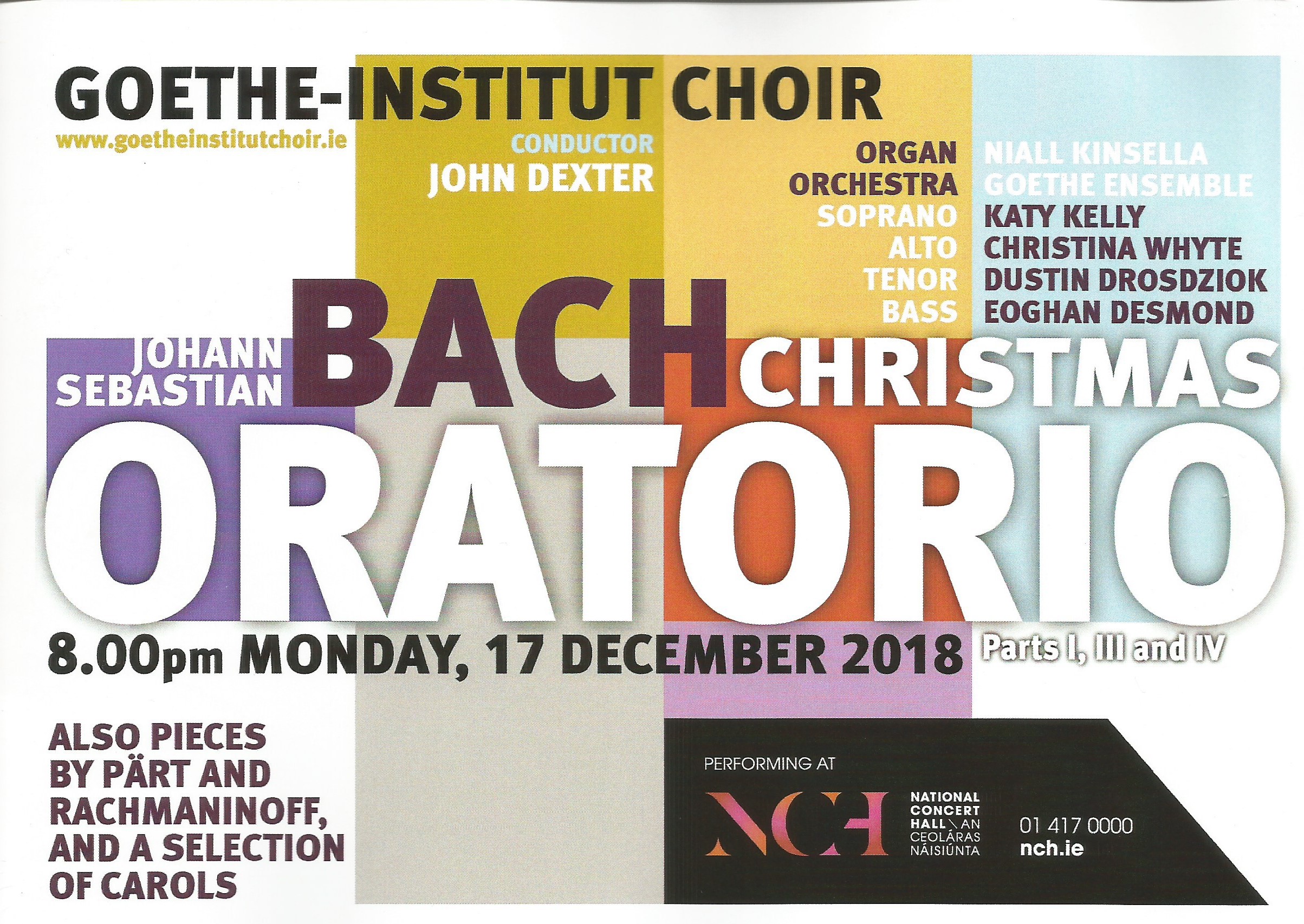
Last night I found myself yet again at the National Concert Hall in Dublin, this time for a Christmas Concert by the Goethe-Institut Choir and the Goethe Ensemble, directed by John Dexter, together with a fine set of principals Katy Kelly (soprano), Christina Whyte (alto), Dustin Drosdziok (tenor) and Eoghan Desmond (bass).

The main items on the menu were three Parts of the Christmas Oratorio by Johann Sebastian Bach. Before the interval wine break we heard Parts I and IV, the former opening with the famous Jauchzet, frohlocket!, followed in the second half by Part III. The whole Oratorio is in six parts, which I think would make it too long for an evening concert, which explains why only three pieces were performed. I’m not sure why the particular ordering was chosen for the selected parts but it worked rather well. The various Parts are basically separate cantatas anyway, so performing them individually like this is perfectly sensible.

Before Part III of the Oratorio, which came in Part II of the Concert, after Part IV, which came in Part I,  the Choir performed some shorter pieces without the orchestra: a mediaeval carol called Angelus ad Virginem, a piece from the magnificent All-Night Vigil by Sergei Rachmaninov, БОГОРОДИЦЕ ДЈЕВО, and a much jauntier version of the same text (closely related to Ave Maria) by Arvo Pärt.  Then there was an audience singalong to Stille Nacht, with verses in English, Irish and German.

In case you’re interested, the opening verse of Silent Night in Irish reads

Oíche chiúin, oíche Mhic Dé,
Cách ‘na suan, dís araon,
Dís is dílse ag faire le spéis,
Naí beag gnaoi-gheal ceanán tais caomh
Críost ina chodladh go séimh,
Críost ina chodladh go séimh.

The choir was really excellent in these pieces, as it was throughout the concert.

The second piece in the concert  (Part IV) was marred by poor pitching of the two French horns, but there was compensation in the form of lovely playing by the interweaving violins behind the tenor aria, and an echo effect achieved by placing an oboe and vocalist (soprano Eilis Dexter) in the choir balcony (the main choir being on stage with the Orchestra).

The concert got off to an inauspicious (but rather amusing) start when the power supply failed for the chamber organ played by Niall Kinsella just as the concert was about to begin. I didn’t realise those instruments needed to be plugged in. Obviously batteries are not included. A stage hand had to dash on and fiddle about to find another socket behind the drapes surrounding the stage and then bring on an extension cable. Fortunately the delay wasn’t long.

Overall this was a very enjoyable concert, with Choir and Orchestra on good form. The principal vocalists were good too. I particularly liked Katy Kelly. It didn’t surprise me when I read in the programme that she has recently performed two great roles in Mozart operas: Donna Anna (Don Giovanni), La Contessa (Le Nozze di Figaro) and performed the Die Königin der Nacht coloratura arias from the Magic Flute on television. I think she has a great voice for Mozart, agile and graceful.

I should also mention that the Concert was pretty much sold out, which was good to see. No doubt the absence of a harpsichord contributed to its success.

Anyway, that concludes my concert-going for 2018. Hopefully there will be a few more to report on in 2019!

 

Messiah in Dublin

Posted in Biographical, Maynooth, Music with tags , , , , on December 14, 2018 by telescoper

On 10th December last year I posted a review of a performance of Handel’s Messiah in Cardiff. At the end of that item I wondered where I would be listening to Messiah in 2018. Well, the answer to that question turned out to be at the National Concert Hall in Dublin, the city where Messiah received its premiere way back in 1742.

Messiah was initially performed at Easter (on 13th April 1742) and it’s by no means clear (to me) why it ended up almost universally regarded as a Christmas piece. The work actually spans the entire biblical story of the Messiah, from Old Testament prophecy to the Nativity (Part 1), the Passion of Christ (Part II), culminating in the Hallelujah Chorus, and the Resurrection of the Dead (Part III). The Nativity only features (briefly) in Part I, which is why it’s a little curious that Messiah is so strongly associated with Christmas.

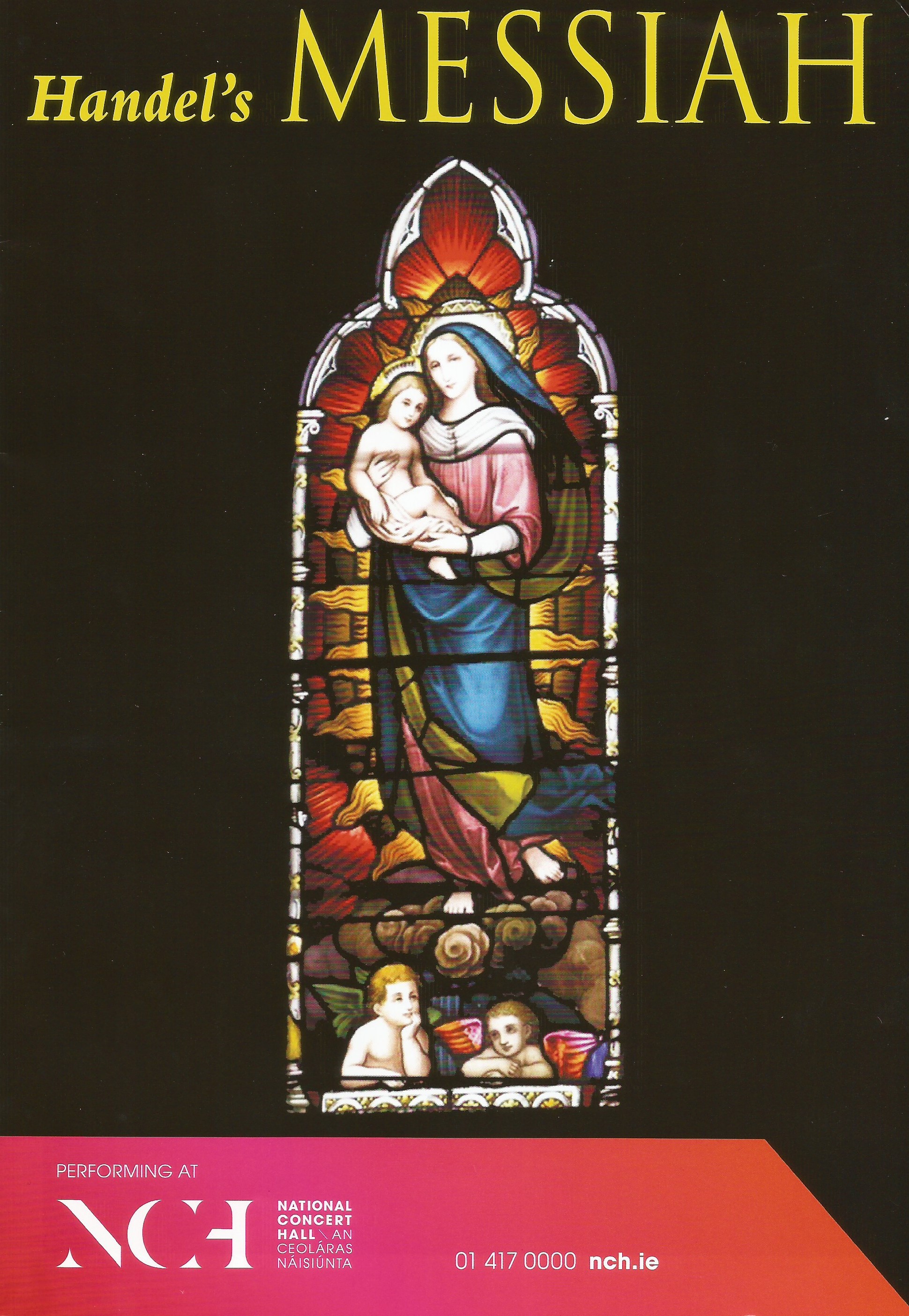
The printed programme for last night (cover shown above) included the first advertisement for the first performance of Messiah:

For the relief of the prisoners in the several Gaols and for the Support of Mercer’s Hospital in Stephen’s Street and of the Charitable Infirmary on the Inn’s Quay, on Monday 12th April will be performed at the Musick Hall in Fishamble Street, Mr Handel’s new Grand Oratorio MESSIAH…

The venue was designed to hold 600 people (less than half the capacity of the National Concert Hall) but 700 people crammed in. Ladies had been asked not to wear hoops in their dresses and gentlemen were asked not to bring their swords to help squeeze in the extra hundred. The concert raised the huge sum of £400 and Messiah was an immediate hit in Ireland.

It wasn’t the same story when Messiah was first performed in England the following year. It failed again in England when performed in 1745 but after some rewriting Handel put it on again in 1749 and it proved an enormous success. It has remained popular ever since. But it is still exceptionally popular in Dublin. There are umpteen performances of Messiah at this time of year, and the one I attended last night was one of three in the same week at the same venue, all more-or-less sold out. The Dubliners I chatted to in the bar before the concert were extremely proud that their city is so strongly associated with this remarkable work.

I don’t mind admitting that Messiah is a piece that’s redolent with nostalgia for me. Some of the texts remind me a lot of Sunday School and singing in a church choir when I was little and then, a bit later, listening to the whole thing at Christmas time at the City Hall in Newcastle. I loved it then, and still do now, well over 40 years later. I know it’s possible to take nostalgia too far – nobody can afford to spend too much time living in the past – but I think it’s good to stay in contact with your memories and the things that shaped you when you were young.

Last night’s performance was by Our Lady’s Choral Society with the RTÉ Concert Orchestra. Soloists were Sarah Brady (soprano), Patricia Bardon (mezzo), Andrew Gavin (tenor) and Padraic Rowan (bass), the latter really coming into his own in the second half with a wonderfully woody sonority to his voice, especially in No. 40:

Why do the nations so furiously rage together, and why do the people imagine a vain thing?

Topical, or what?

Our Lady’s Choral Society is an amateur outfit and, while it might not sound as slick and polished as some professional choirs, there was an honesty about its performance last night that I found very engaging. It actually sounded like people singing, which professional choirs sometimes do not. The orchestra played very well too, and weren’t forced to use the dreaded `period instruments’. There was a harpsichord, but fortunately it was barely audible. Anyway, I enjoyed the concert very much and so did the packed house. I couldn’t stay for all the applause as I had dash off to get the last train back to Maynooth, but that doesn’t mean I didn’t appreciate the music.

Incidentally, among the bass section of Our Lady’s Choral Society last night was my colleague Brian Dolan. On Monday next I’m going to another Concert at the National Concert Hall, Bach’s Christmas Oratorio. Among the choir for that performance is another of my colleagues, Jonivar Skullerud. Obviously, choral singing is the in-thing for theoretical physicists in this part of the world!

There are many ways to go mad…

Posted in History, Music with tags , , , on December 8, 2018 by telescoper

The clip below is of a live performance by Irish folk artist Lisa O’Neill (who is from Cavan) of her own song, `Violet Gibson’. I heard the studio version from her CD on the radio the other day and the first line really caught my attention. The Youtube version is preceded by a lengthy spoken by Lisa O’Neill which is worth listening to but if you want to jump to the point where the song starts, that’s about 5:27.

The story of Violet Gibson is both bizarre and tragic. She was in 1876 into a well-to-do family living in Merrion Square in Dublin. Her father, Edward Gibson, was made Baron Ashbourne in 1886. To cut a long story short, at 11am on 26th April 1926, Violet Gibson turned up in Rome where she attempted to shoot Fascist Leader Benito Mussolini with a pistol. She only failed in this task because Mussolini moved his head at the instant she pulled the trigger, and the bullet just grazed his nose. She tried to fire again, but her gun jammed. She was then seized by the angry mob of fascist supporters with whom she had mingled to get close enough to shoot. She was almost lynched but saved by the police. Eventually, the authorities came to the conclusion that she was insane and she was sent back to England. She spent the rest of her life in a psychiatric institution in Northampton. She died in 1956, at the age of 79.

P.S. If you want to find out more about Violet Gibson, I recommend a book about her life called The Woman Who Shot Mussolini by Frances Stonor Saunders.

P.P.S. Cavan is the county town of County Cavan, which is in the Irish Border Region. Although part of the province of Ulster, it is in the Republic of Ireland.

R.I.P. Pete Shelley (1955-2018)

Posted in Biographical, LGBTQ+, Music with tags , , on December 7, 2018 by telescoper

I heard the news late last night of the passing of Pete Shelley, best known as the lead singer of the Buzzcocks. Another iconic figure from my youth has gone. I was never really interested in the 70s punk movement in the UK, but the Buzzcocks managed to combine some of the energy and directness of punk rock with more conventional pop melodies. Above all, though, there was Pete Shelley’s style of delivery, head tilted to one side, a unique mixture of queer camp and unapologetic defiance. That had a big effect on me in my teenage years. In particular, I remember watching watching this performance on Top of the Pops in 1978 (forty years ago, when I was 15) and understanding exactly what the song was about. Ever Fallen In Love only got to number 12 in the charts, but in my memory it was a far bigger hit than that.

Rest in peace, Pete Shelley (1955-2018).

P.S. The answer to the question posed in the song is, of course, `yes’..

The Final Shootout

Posted in Film, Music, Politics with tags , , , , on December 6, 2018 by telescoper

“Only connect” they say so I thought I’d connect two topical items with this video clip of one of my favourite movie scenes.

The first item is that on 15th February next year the legendary composer Ennio Morricone will be conducting a concert of his music in Dublin. Moricone’s 90th birthday was on 10th November 2018.

The other thing is that the UK Parliament is currently debating the terms of Brexit. It seems that there are now only three options: accept Theresa May’s ugly Withdrawal Agreement, reject it and suffer a bad `No Deal’ Brexit or take the sensible, good choice of withdrawing Article 50, admitting it was all a terrible idea in the first place, and remaining in the European Union.

So here we are then, the climactic final shoot-out from Sergio Leone’s famous Spaghetti Western The Good The Bad And The Ugly, featuring Clint Eastwood, Eli Wallach and Lee Van Cleef respectively, together with superb (and very complex) music on the soundtrack from Morricone. We all know who wins in the end, at least in the film.

P.S. Hats off to the guitarist Alessandro Alessandroni (who also did the whistling on the soundtrack) producing that unforgettable twangy sound with a hint of scordatura