I’ve been greatly enjoying the boxed set of six seasons of Peaky Blinders that I received as a gift recently. I may do a sort of review when I get to the end, but until then I thought I’d throw in a few tangential things. This post is an example. Here’s another one. This clip is from Episode 2 of Series 1, when the Shelby family are celebrating the reopening of the Garrison pub after it was destroyed by a firebomb earlier on. Listen to the background music at the start.
The music being played is Livery Stable Blues by the Original Dixieland Jazz Band, a record I blogged about here. Released in 1917, it is no exaggeration to say that this was the first every commercial jazz record; I blogged about the 100th anniversary of its release.
The band was originally called the “Original Dixieland Jass Band“. A few months later they changed the “Jass” to “Jazz” – it is claimed because people kept defacing their posters by removing the letter “J” – and the new name stuck. The Original Dixieland Jazz Band is usually referred by Jazz buffs as the ODJB.
Led by cornettist Nick LaRocca and clarinettist Larry Shields, the ODJB was a group of white musicians from in and around New Orleans who had picked up their musical ideas from listening to musicians there, including playing for the pioneering mixed-race band led by Papa Laine, before moving to Chicago which is where they were spotted by representatives of the Victor label. Although the sound quality isn’t great, it gives a good insight to what ealy jazz drummers were like – thumping bass and tom-toms but little use of the cymbals – and shows Larry Shields was a dab hand at glissandi…
Series 1 of Peaky Blinders is set in 1919 (mainly in Birmingham but also with scenes in London). Not a lot of people know that the ODJB actually visited England in 1919. They performed in review at the Hammersmith Palais and then did a command performance in front of King George V, who (apparently) particularly enjoyed their version of Tiger Rag. There is no evidence that they visited Birmingham, but we get a glimpse before the above clip of a band decked out to look like them, playing live in the Garrison pub. I very much enjoy little details like that!
I’m not sure of the recording date, but it was made in Hungary (when Hungary was still behind the Iron Curtain) so it would have to be before 1956, as Cziffra escaped to Vienna then and eventually took up French citizenship.
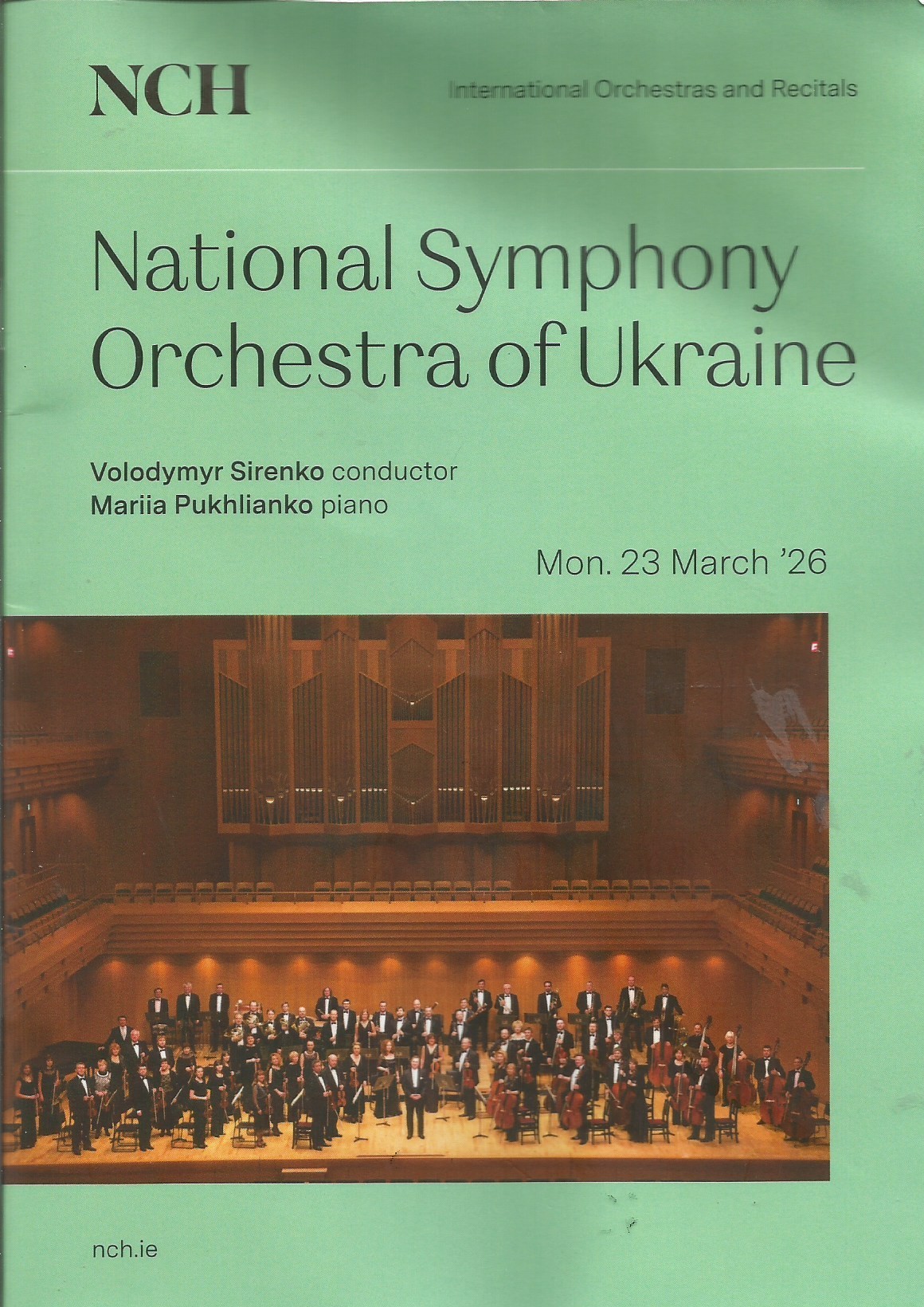
It’s not often that I go to the National Concert Hall in Dublin on a Monday evening, but I made an exception last night to attend a concert by the National Symphony Orchestra of Ukraine (who are currently on tour and have recently played a number of concerts in the UK). It was an interesting (and very full programme) and a very enjoyable concert. Partly because of the large Ukrainian diaspora in Ireland, hall was packed last night.
The concert opened with two pieces by Frederick Delius: On Hearing the First Cuckoo of Spring and Summer Night on the River, originally published together as Two Pieces for Small Orchestra. I used to listen to quite a lot of recordings of Delius when I was younger and know both these works quite well. I was a bit surprised to see them on the programme, but they certainly provided an interesting contrast with what was to come later. In fact the Orchestra, under the direction of Volodymyr Sirenko, tackled them quite differently from the versions I have heard. The sound of the cuckoo in the in the first piece was much more subtle than usually played and the overall sound was much stronger than typical performances which tend to be rather delicate.
After that we had the Piano Concerto No. 5 (“Emperor”) by Ludwin van Beethoven, played by Mariia Pukhlianko. This work wasn’t immediately popular when it was first performed in 1809 – perhaps because it was considered a bit grandiose – but is now firmly established as one of the pinnacles of the repertoire. The soloist played this very well, with a splendid balance of delicacy and power, with good transitions between the ensemble and solo sections. I enjoyed this very much indeed.
After the interval – no wine for me because I had a 9am lecture this morning – we came back for the main course, The Symphony No. 3 in E♭ major (“Eroica”) by Ludwig van Beethoven. It’s hard to know what to say about it really, except that it’s a magnificent work in its own right as well as being historically important. Before this one, which was published in 1806, symphonies (including not only Beethoven’s First and Second, but those of Mozart, Haydn and others) were much shorter (typically around 20 minutes) and much more constrained in form. This composition – which shares some elements with Mozart’s Symphony No. 39 and was apparently inspired by it – ushered in the era of the epic symphony that culminated with the likes of Mahler and Bruckner; last night’s performance took . The first movement, in sonata form, is especially long – with an extended recapitulation – and both complex and rewarding.
The performance last night was full of energy and colour and hugely enjoyable. It’s worth mentioning the unsual arrangement of the orchestra on stage. From the point of view of the Conductor, the first violins were on the far left (as usual), the cellos and basses behind them, and second violins on the far right. This was basically the same layout as was used for the last concertof this work I attended.
The NCH audience is usually generous with its applause and last night was no exception. There was a long standing ovation that precipitated two orchestral encores, neither of which was a piece that I knew.
The concert started at 8pm and didn’t finish until about 10.30pm, and it took quite a long time to get out given the nearly full house, so I missed the usual train and had to wait for the last one, at 11.21pm which got me home well after midnight. The things I do for art!
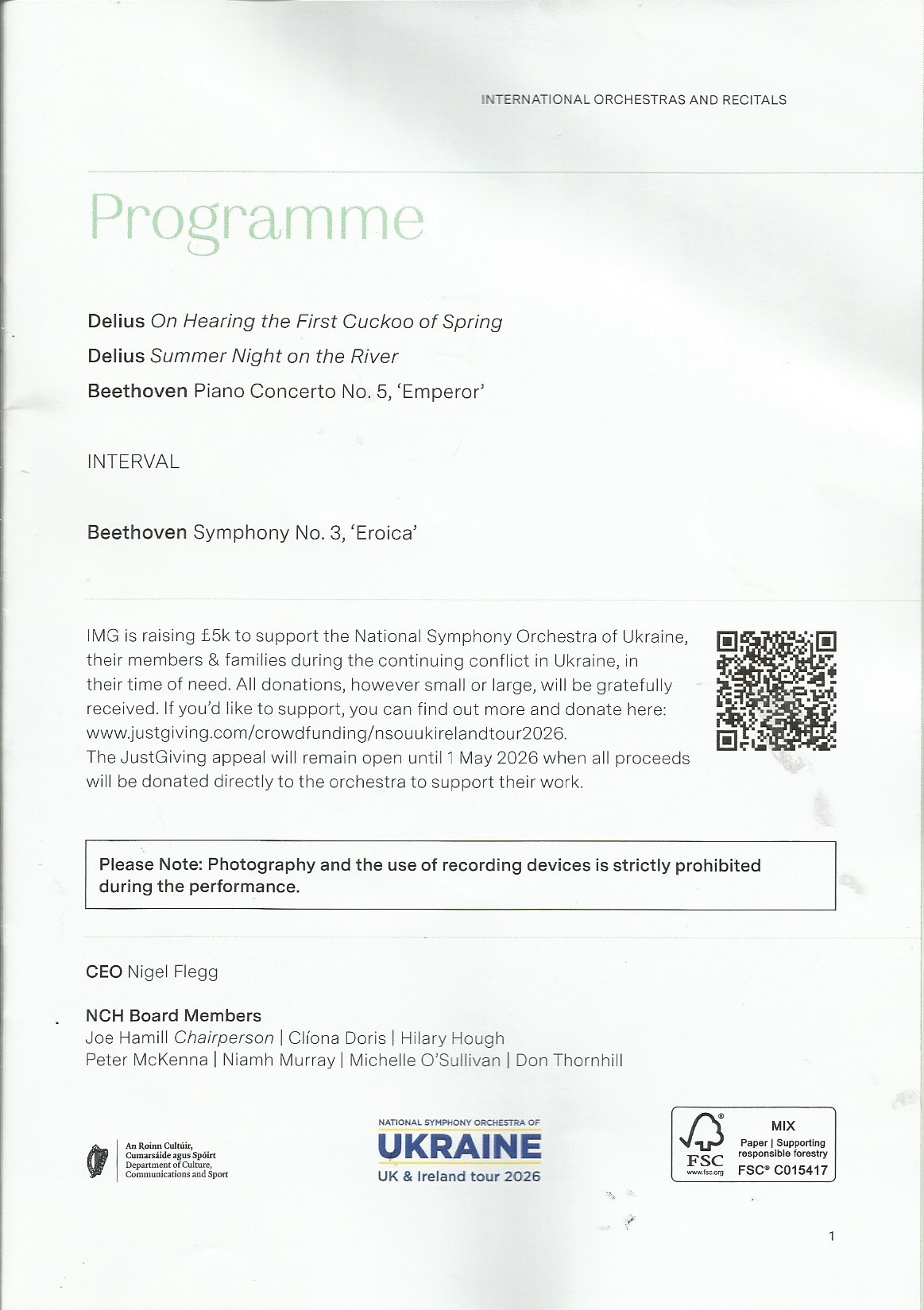
P.S. I’ve included the a page from the programme above. If you wouldn’t like to make a donation to support the National Symphony Orchestra of Ukraine, you can scan the QR code in the right hand image above. Alternatively you can follow this link.
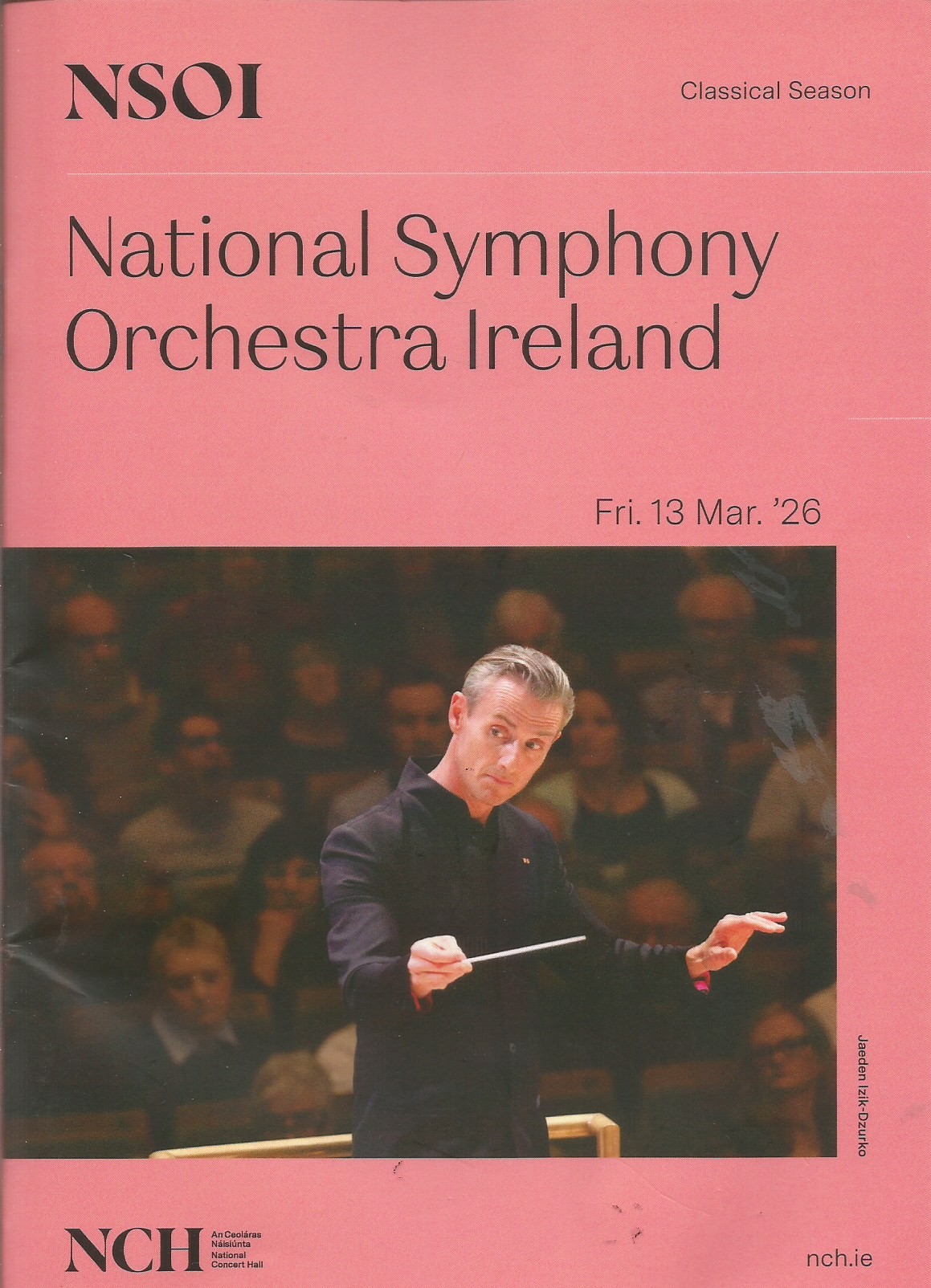
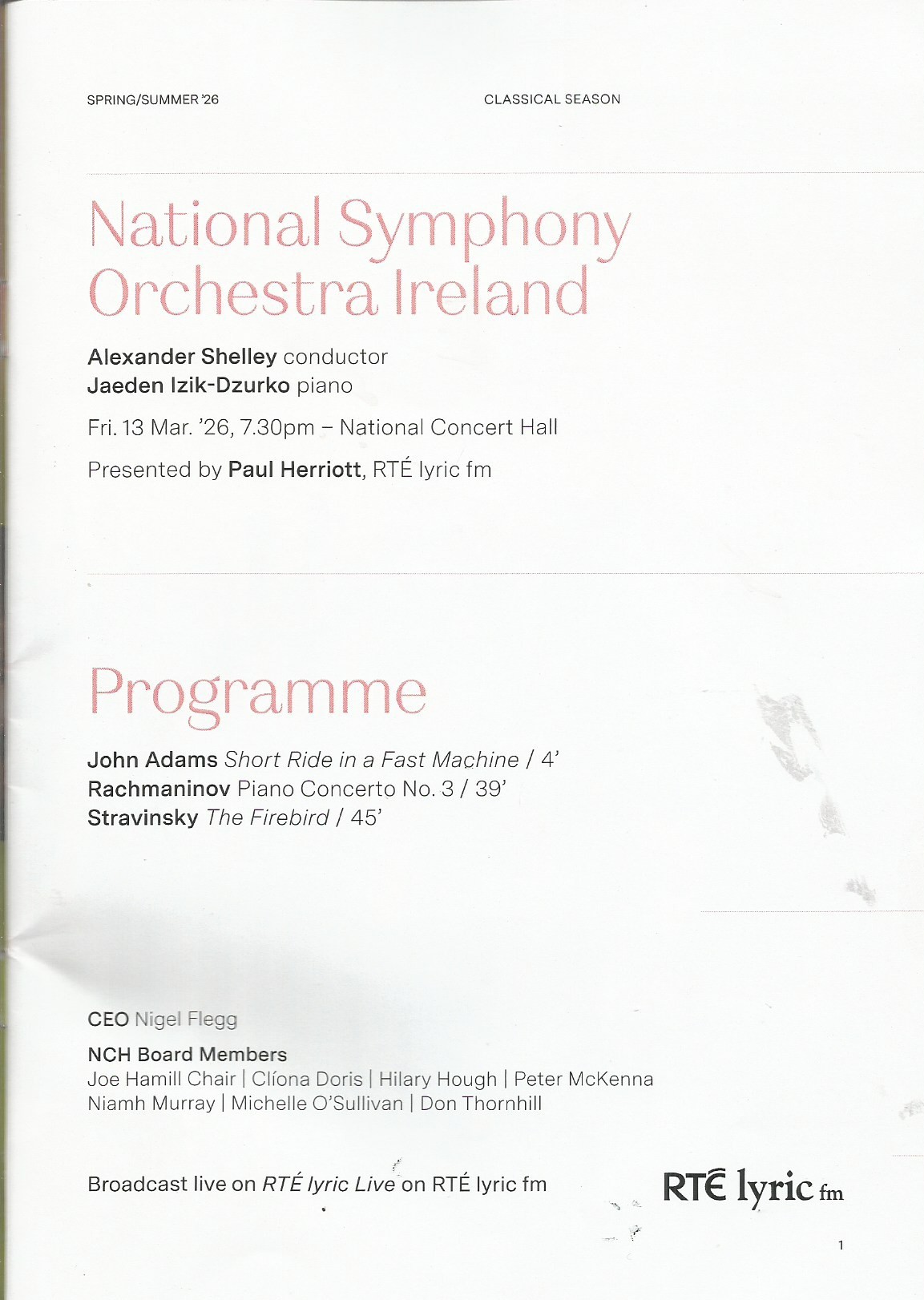
Yesterday evening found me once again at the National Concert Hall in Dublin for a programme of music played by National Symphony Orchestra Ireland, this time conducted by Principal Conductor Designate, Alexander Shelley, who takes over fully for the 2026/7 season. He took the opportunity afforded by the break between the first two numbers needed to bring the piano onstage, to introduce himself to the audience which made a pleasant change from having to watch in silence as all the chairs and desks were moved around.
The programme began with the exuvberant Short Ride in a Fast Machine by American composer John Adams which – believe it or not – was written forty years ago, in 1986. It is an exuberant piece based on interrelated rhythmic figures which is great fun to listen to and an ideal warm-up exercise for the orchestra.
The piano having been hauled into position, it was time to welcome Canadian pianist Jaeden Izik-Dzurko (who has Hungarian and Ukrainian ancestry) for the Piano Concerto No. 3 by Sergei Rachmaninov. When the soloist walked on stage I was struck by how young he looked. He is, in fact, 27 but looks younger. Still, I’ve reached an age when most people look very young. Rachmaninov’s Piano Concerto No. 3 is a monster of a piece – very long for a piano concerto – and also very difficult, with some fierce cadenzas. For all its reputation as a finger-breaker, it does have some lovely melodies in it. Rachmaninov himself realized he had created bit of a beast and cut some of the toughest bits for early performances, but nowadays we tend to hear the whole original score, as we did last night. I thought Jaeden Izik-Dzurko not only coped admirably with its technical demands but also conveyed its lyrical aspects very tenderly. It was a very impressive performance. The audience at the NCH obviously agreed. A standing ovation greeted him at the end, though he looked almost embarrassed by such an effusive reaction.
After the interval wine break we had a concert performance the complete score for Igor Stravinsky’s ballet The Firebird. This is a thrilling piece, involving a huge orchestra, numbering about a hundred musicians, and stunning orchestration. The Firebird is a tour de force: intricate but vividly coloured, full of excitement and colour and NSOI played it with great passion and aplomb. A really brilliant performance.
There was an electronic sign above the orchestra for The Firebird explaining what would be going on in the ballet as the various sections of the music were played. I found that an unwelcome and slightly annoying distraction, but it didn’t detract significantly from the performance. There was thunderous applause at the end of the concert but, it being quite a long concert, I couldn’t stay for all the ovations as I had to leave to catch the train home.
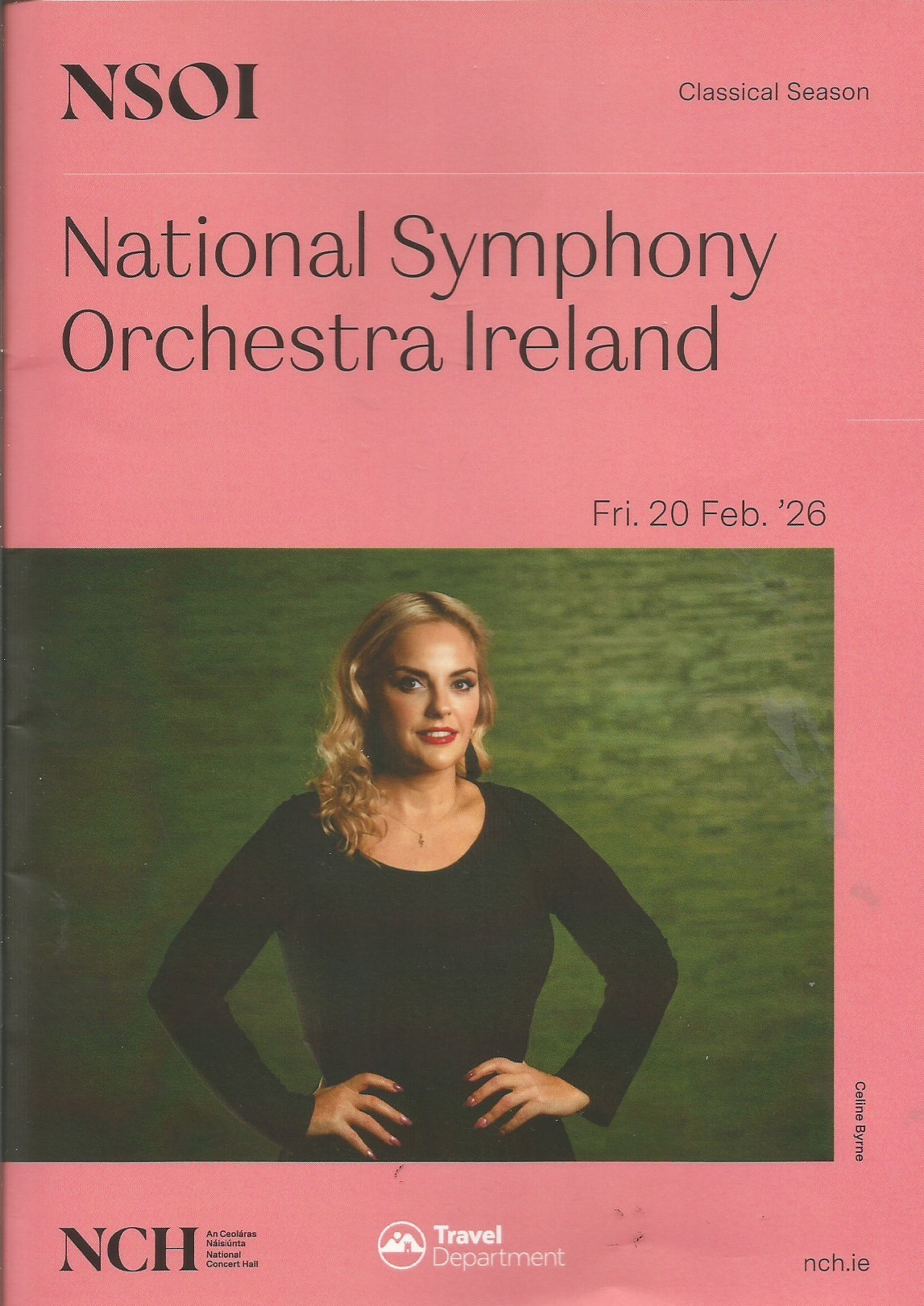
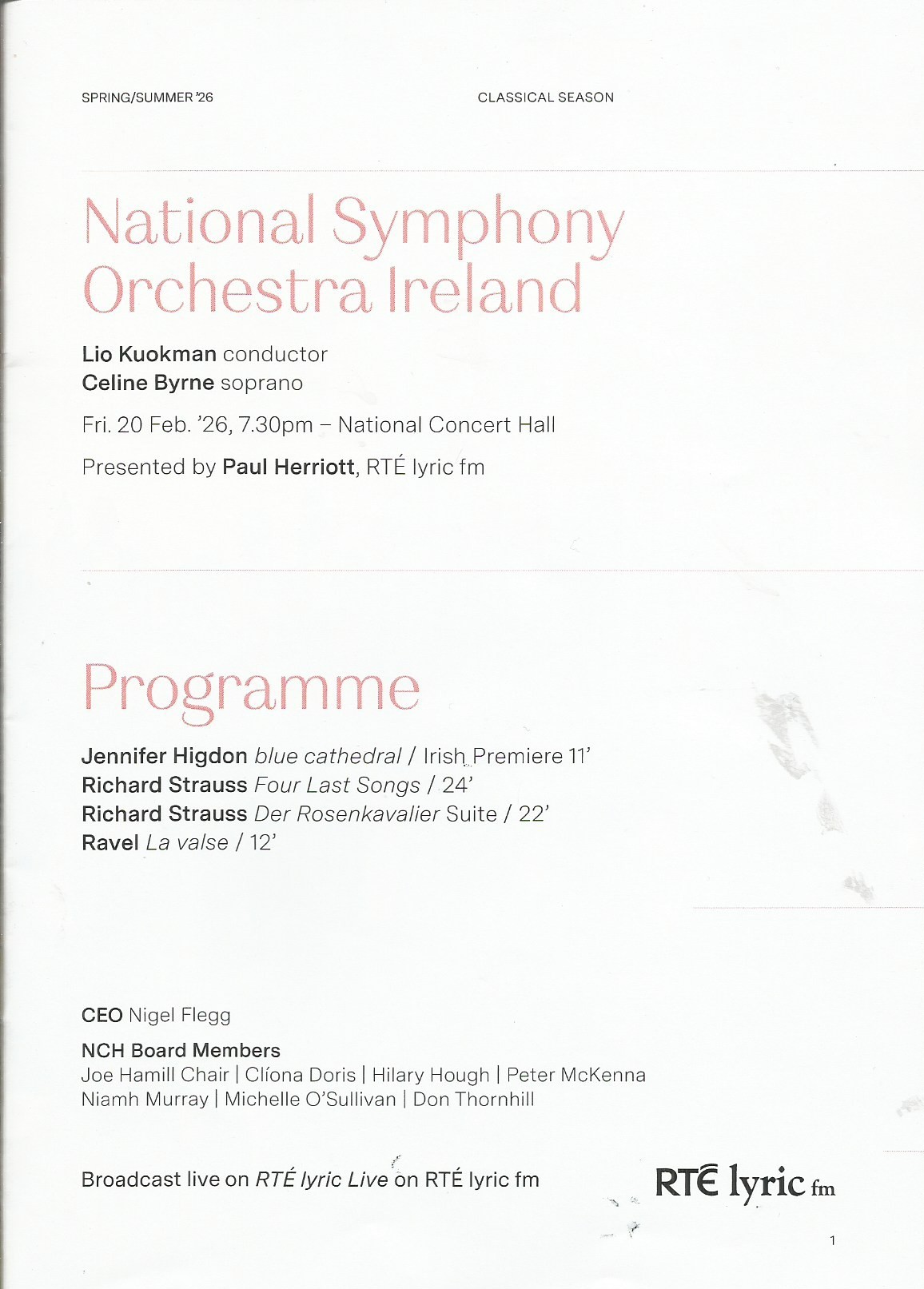
And so it came to pass that last night I went to the National Concert Hall in Dublin for another concert by National Symphony Orchestra Ireland, this time conducted by Lio Kuokman and joined, for a performance of the Strauss’s Four Last Songs, by the wonderful soprano Celine Byrne. Given the presence of an Irish favourite it was no surprise to find the concert hall very busy indeed.
The first item on the agenda was the Irish premier of blue cathedral by Jennifer Higdon, an elegaic piece she composed on the death of her younger brother. It’s an interesting piece which is quite easy on the ear as well as incorporating some very original effects. The string section, for example, use handbells to maje gentle tinkling noises near the end. I’ve never heard this piece before and I think it’s one that will bear repeated listening.
Next came the main item on the agenda. The Four Last Songs were published after the composer’s death, so Richard Strauss never heard them performed. The very first time they were performed was in 1950 at the Royal Albert Hall, by the London Philharmonia. One can only imagine what it must have been like for the orchestra making this music live for the very first time. Apparently the first time any of them had seen the score was when they turned up for the rehearsal. I’m sure they knew as soon as they started playing that it was a masterpiece.
Last night we heard these songs sung by Celine Byyne, who was born in Kildare. She arrived on stage resplendent in a black dress with red feathers around the shoulders. I don’t know how many times I’ve heard these songs and they never fail to move me. The opening of the first song, Frühling, is in the chest register for a soprano which is the most difficult to project over an orchestra, but Celine Byrne took it in her stride, as she did with the others. I must single out the leader of the National Symphony Orchestra Elaine Clark for her gorgeous playing of the lovely violin solo in the third song, Beim Schlafengehen. I don’t mind admitting that it brought a tear to my eye, as did the final Im Abendrot which is one of my very favourite pieces of music. I was sitting next to an elderly couple, and I coultn’t help noticing that they spontaneously held hands on the words “Hand in Hand”.
Incidentally, as far as I know the Four Last Songs were not specifically intended to be performed together as they inevitably are these days. Although the last is my favourite, I think the first three (all based on poems by Herman Hesse) have much more in common with each other than Im Abendrot (which is a poem by Joseph von Eichendorff).
After the wine break we continued with more Strauss, sort of, in the form of a suite from the Opera Der Rosenkavalier. Although Strauss allowed this to be assembled from his music as a concert work I don’t think he actually created it as such. It’s relatively brief ( just over 20 minutes in performance) that begin’s with the opera’s orchestral prelude, depicting the Marschallin’s and Octavian’s night of passion (vividly portrayed by whooping horns). Next comes the appearance of Octavian as the “Rosenkavalier”, depicted in tender gorgeous music; the sight of him looking so young makes the Marschallin realise that he will soon leave her for a younger woman. There follows the duet between Octavian and Sophie (oboe and horn) – in which their love for each other becomes ever more obvious, but this is abruptly interrupted by the discordant music associated with the clumsy arriva of the buffoonish Baron Ochsl. Next the violins tentatively introduce the first waltz, followed by another given out by the solo violin, before the whole orchestra settles into waltz mode. A general pause and a violin solo leads into the nostalgic music where the Marschallin sadly realises she has lost Octavian. Then comes its ecstatic climax. The work closes with another robust waltz, depicting Ochs at his most pompous, and a boisterous coda apparently composed for the suite. Listening to this is like a fast-forward through the opera, but it does lack the vocal parts, and I think Strauss was at his best writing for, especially female, voices.
And finally, picking up on the theme of waltzes prevalent in the preceding piece we had La Valse by Maurice Ravel. This is a great masterpiece, originally conceived as a tribute to the Viennese waltz, but not composed until after the First World War, and turned into a kind of tragic parody, starting out sombre and brooding, gradually building into a garish intensity and then into a brutal, almost chaotic, ending.
This was a very nice concert, with a varied programme and some fine playing throughout. The performance being relatively short, and wanting to avoid sitting in Pearse station for a long time waiting in Pearse Station for the 10.14 train, I broke with tradition and took a bus. I started out about 20 minutes earlier than I would have done had I waited for the train, but when I got to Maynooth at a bus stop next to the railway station, the train I would have got had just arrived….
Today’s the day folk in England Shrove Tuesday, when one is supposed to get “shriven” by doing a penance before Lent. Another name for the occasion – favoured in Ireland – is Pancake Day, although I’m not sure what sort of penance it is to be forced to eat pancakes. Further afield the name for this day is a bit more glamorous. Mardi Gras, which I translated for the title of this post as Fat Tuesday using my schoolboy French, doesn’t make me think of pancakes but of carnivals. And being brought up in a house surrounded by Jazz, it makes me think of New Orleans and the wonderful marching bands that played not just during the Mardi Gras parades but at just about every occasion for which they could find an excuse, including funerals.
The Mardi Gras parades gave rise to many of the great tunes of New Orleans Jazz, many of them named after the streets through which the parade would travel, mainly in the famous French Quarter. Basin Street, South Rampart Street, and Bourbon Street are among the names redolent with history for Jazz fans and musicians around the world. The New Orleans Mardi Gras has on recent occasions sometimes got a bit out of hand, and you probably wouldn’t want to take kids into the French Quarter for fear they would see things they shouldn’t. Personally, though, I’d love the chance to savour the atmosphere and watch the parades.
Anyway, the clip I’ve chosen to mark the occasion of Fat Tuesday is Bourbon Street Parade. The one and only time I went to New Orleans I felt a real thrill walking along this Bourbon Street, just because I’ve heard the tune so many times on old records. I didn’t go in Mardi Gras time, however, but in the middle of summer. The heat was sweltering and the humidity almost unbearable, but the air was filled with music as well as moisture. It was impossible to sleep in the heat, so I stayed up moving from bar to bar, drinking and listening to music until I was completely exhausted.
The tune was written by the late Paul Barbarin, who died in 1969 during a street parade in New Orleans. What a way to go! He also plays on the clip I included here. I picked this particular version because it features a much underrated British musician, Sammy Rimington. My Dad once played with Sammy Rimmngton and I remember the unqualified admiration with which he (my Dad) spoke of his (Sammy’s) playing.
P.S. This year Pancake Day coincides with both the Lunar New Year and the start of Ramadan. Best wishes to all who celebrate any of these!
It seems an appropriate evening for a romantic love song. Lyrics by Sammy Cahn, music by Jule Styne, vocals and trumpet by Chet Baker. Baker’s singing is quite unlike most jazz singers, and many jazz fans don’t like it very much, but I think his intimate, tender, and somewhat melancholic vocal performance together with his spare yet lyrical trumpet playing combine make this a classic.
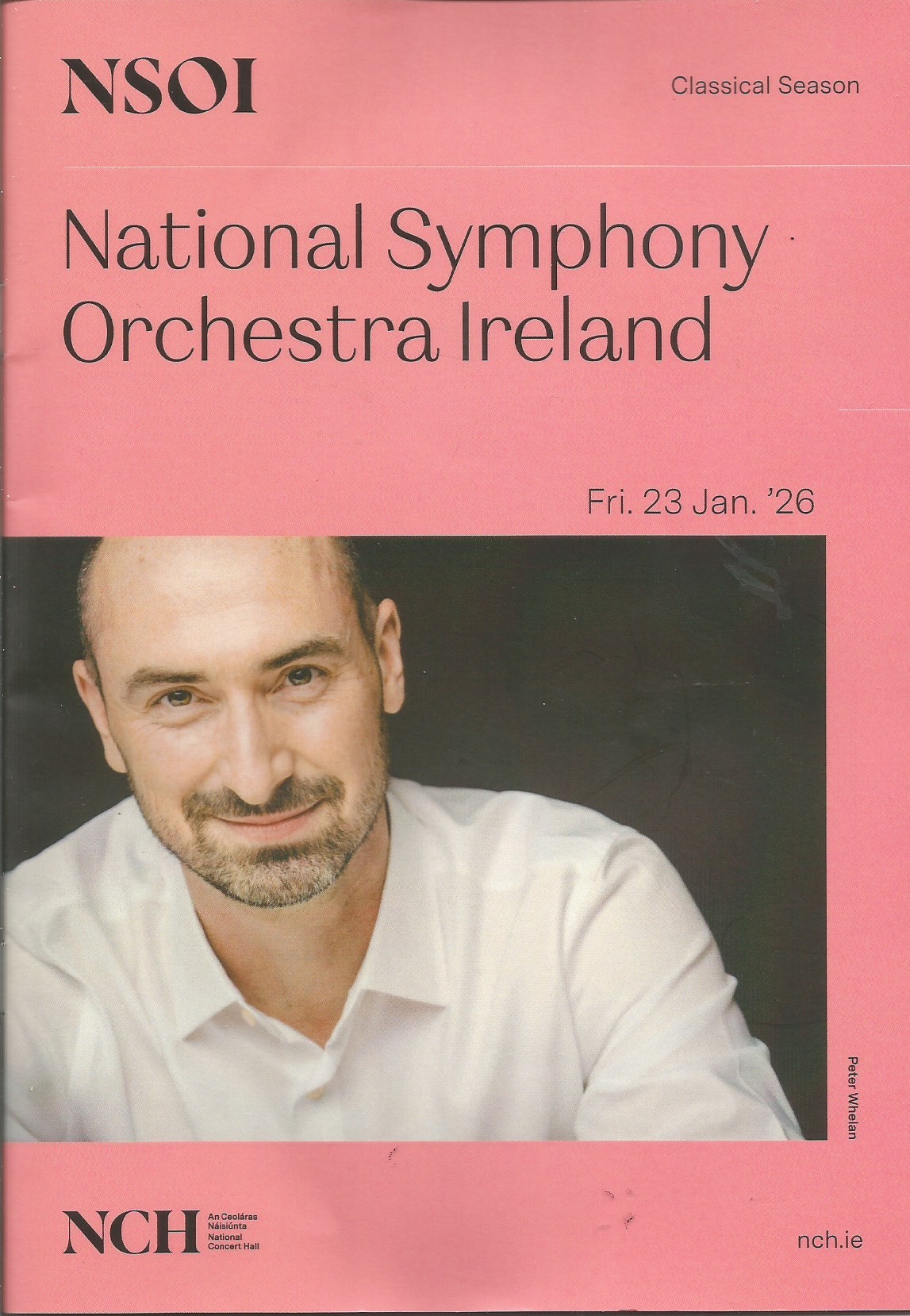
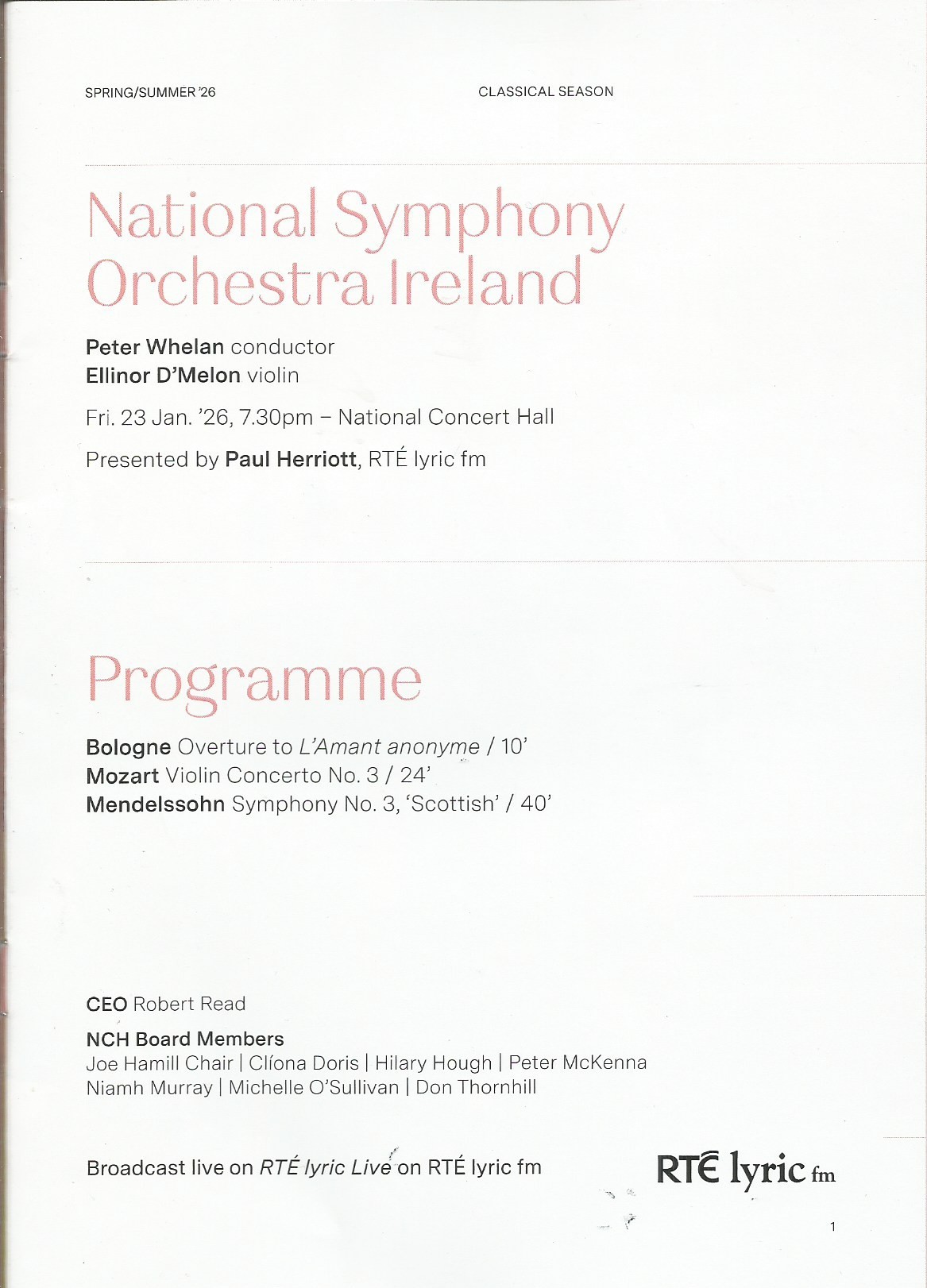
Last night I went to another concert by National Symphony Orchestra Ireland at the National Concert Hall in Dublin. This performance was conducted by NSOI’s new “Artistic Partner” Peter Whelan, shown on the programme cover above. The NCH was by no means full, which was a shame, but the concert was warmly appreciated by those of us there in the audience and no doubt by those listening on the radio.
The first item on the agenda was a new one to me, the overture to the Opera L’Amant Anonyme by Joseph Bologne who went by the title Chevalier de Saint-George. He was born in Guadeloupe; his father was a plantation owner and his mother a slave; Saint-George was the name of his father’s plantation. He became an accompished musician, composer and soldier and a member of the Louis XVI’s personal bodyguard. The music we heard is clearly of the same world as Mozart (of whom Bologne was a contemporary) and very enjoyable to listen to. I wonder if we’ll ever get the chance to hear the whole Opera?
After that – and a long pause before she came on stage, that made me worry that something was amiss – we heard Ellinor D’Melon playing the Violin Concerto No. 3 in G Major by Wolfgang Amadeus Mozart, written when Mozart was only 19. This is a lovely piece and was played very nicely by Ellinor D’Melon. Apparently Albert Einstein – himself a keen amateur violinist – said that the second movement Adagio “seems to have fallen straight from Heaven”. It is indeed beautiful to listen to, and does have a sense of unity about it that makes you think it must have been conceived and composed in one go. The play Amadeus seems to have been responsible for perpetuating the idea that Mozart often composed in his head, then wrote the results out without corrections or revisions. That is largely untrue, but it is true that he could construct complex sections in his mind’s ear before setting them down on paper. If he did ever compose a piece entirely from start to finish, then the 2nd movement of this Concerto would be it.
(I can’t resist adding an anecdote suggested by this. A while ago I had to arrange a special sitting of a class test for a student who, for good reasons, couldn’t take the assessment with the rest of the class. I wrote a different paper and invigilated the student myself; there were just the two of us in the room for the test, which was to last 50 minutes. Not anticipating any difficulties I sat at a table in the corner and got on with other stuff. About 15 minutes in, I was concerned that the student hadn’t written anything at all; he seemed just to be reading and re-reading the paper. The questions were not meant to be all that difficult, so it surprised me that the student appeared to be struggling. I didn’t interrupt though. Then, about 5 minutes later the student sat up, grabbed a pen and started to write. Not more that 10 minutes after that he announced he had finished and handed me his script. It contained a perfect answer to everything that had been asked, no corrections or crossings out, and it took up less than one page of A4. I was impressed.)
After the wine break we heard the Symphony No. 3 in A minor (“Scottish”) by Felix Mendelssohn. Inspired by a visit to Scotland in 1829 – the first movement was actually composed that year in Edinburgh – it wasn’t completed until over a decade later and should probably be No. 5, but who’s counting? I’ve never really found it very Scottish, actually, but that doesn’t matter either.
It’s a piece consisting of four movements, with little or no break between them. The first movement starts with a slow theme, like a hymn, but then becomes much more reminiscent of the Hebrides Overture Mendelssohn composed in 1830. The landscape of the other three movements is very varied, sometimes cheery, sometimes lush, sometimes tempestuous. The final movement Allegro Vivacissimo has a marking guerriro (“warlike”), which in parts it is, but it also has calmer and more reflective passages before the rumbustious finale. I suppose many people consider Mendelssohn a bit Middle-of-the-Road, but I always find his music very pleasurable and this was no exception.
I always enjoy watching the musicians in these concerts, and could see last night that they were all enjoying themselves hugely. I’d like to single out the sole member of the percussion section, Tom Pritchard on timpani. He had to work hard for nearly all of this performance, as the timpani are kept very busy this work, and did an excellent job.
One reason this track caught my eye is probably obvious given current events, but another is that the tune was written by another superbly individual yet largely forgotten pianist from the 1950s, Dick Twardzik. Sadly Twardzik died of a drug overdose just a few days after this was recorded, in October 1955 at the age of just 24. Chet Baker – who had his own share of problems with narcotics – became very popular for his very attractive singing voice as well as his “cool” trumpet tone, but this one is purely instrumental. The other members of the quartet are Peter Littman (drums) and Jimmy Bond (bass).
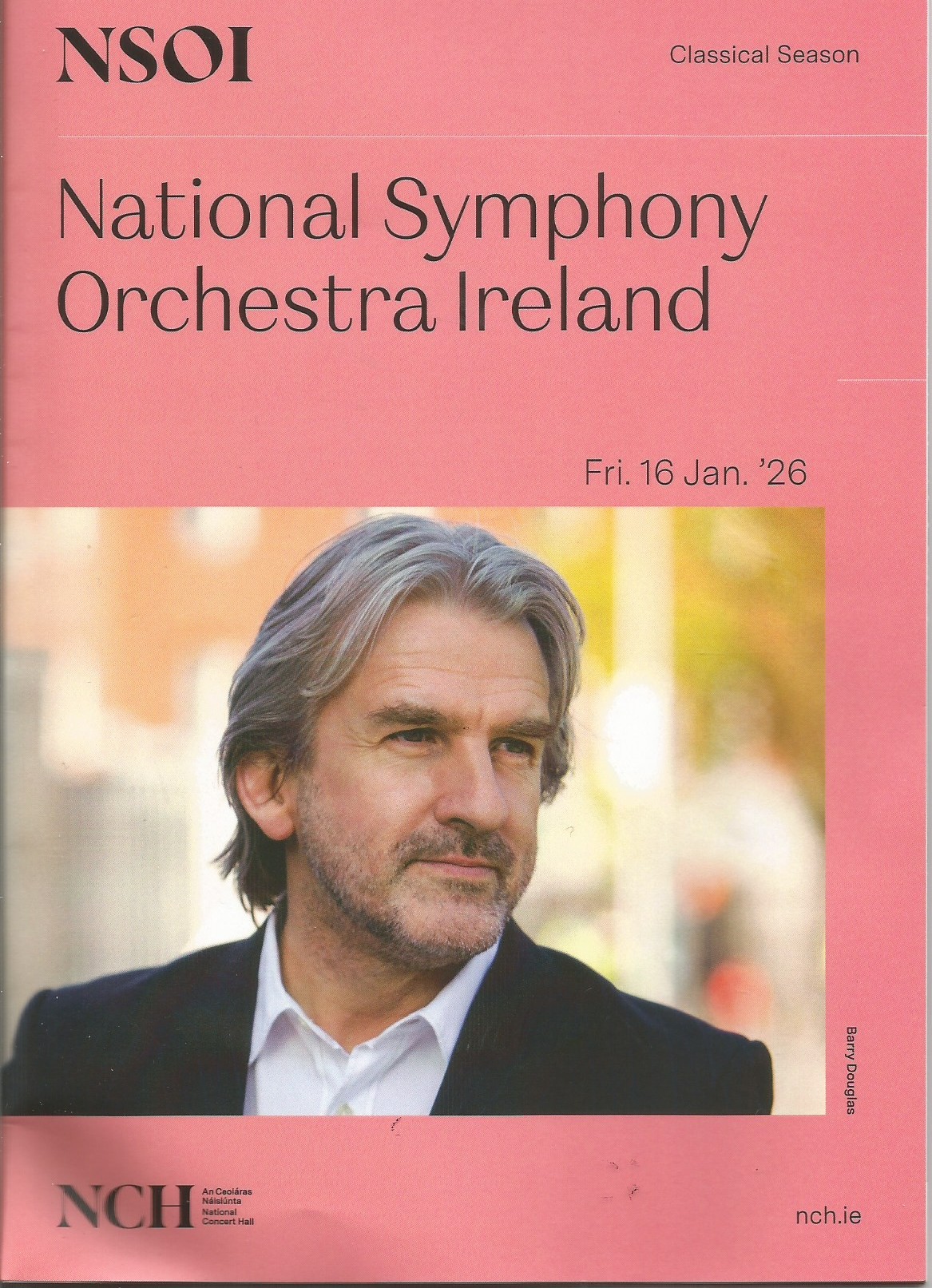
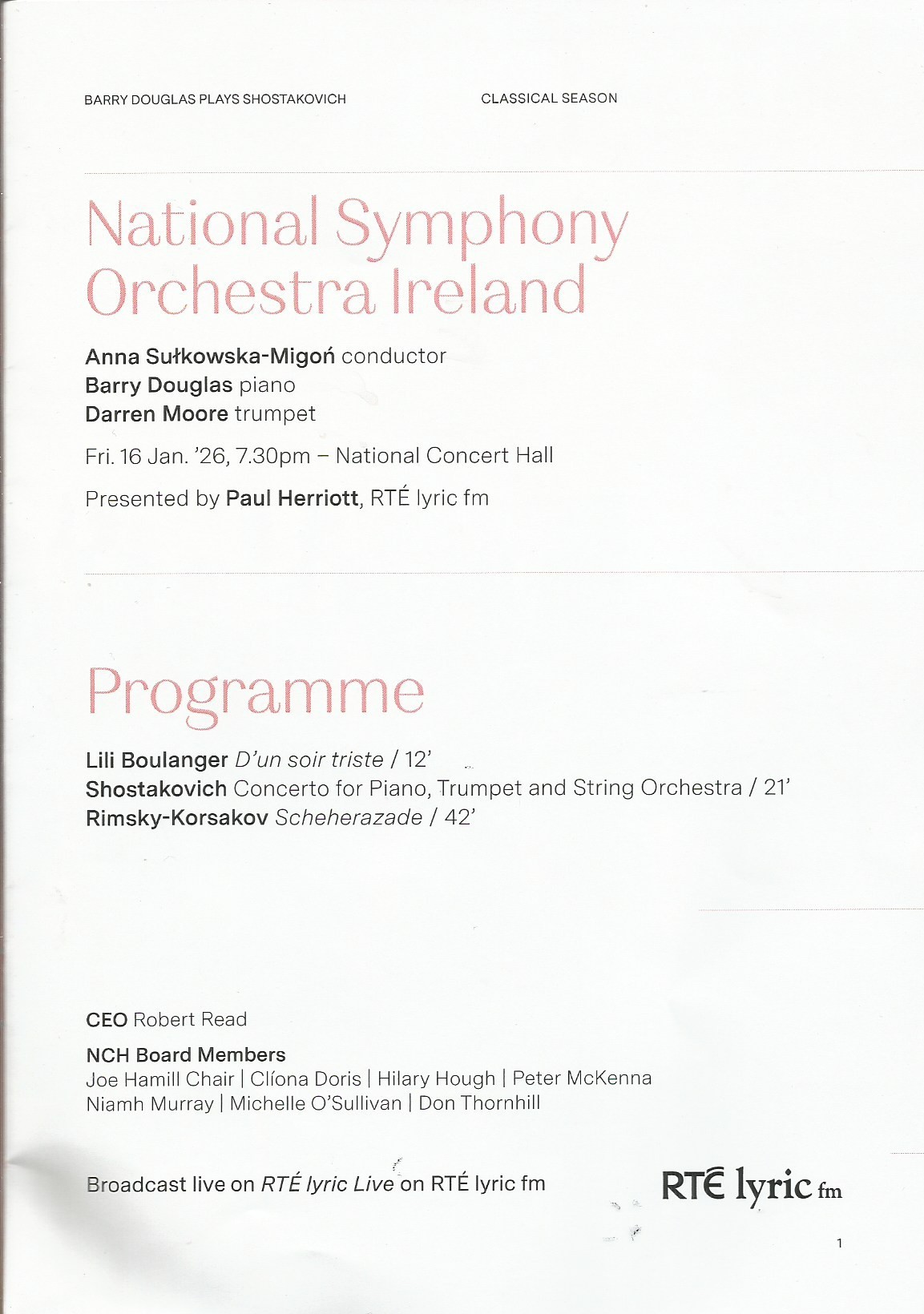
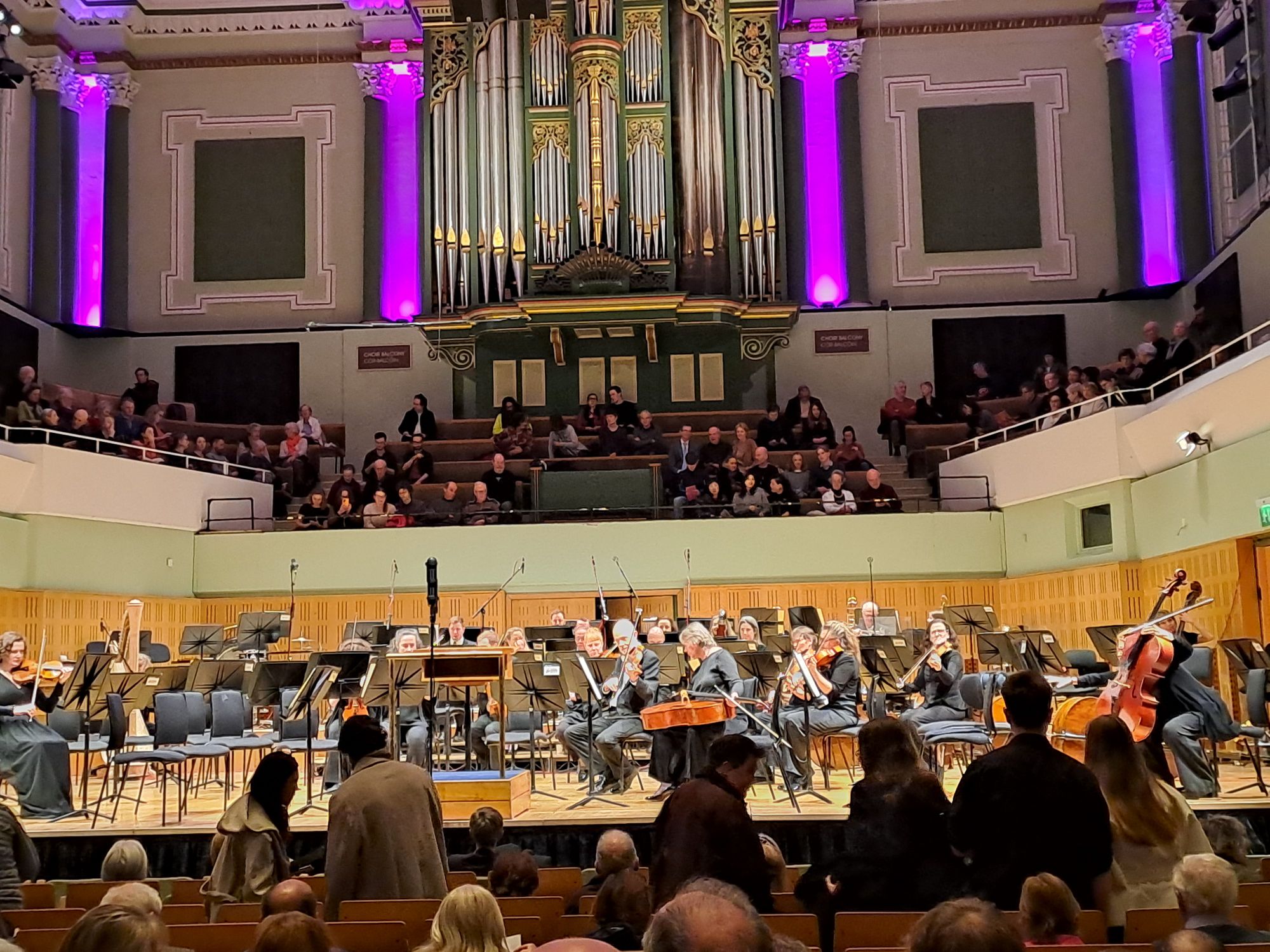
It was a great pleasure last night to be able to attend my first concert of 2026 at the National Concert Hall. It was a rainy evening in Dublin, but the auditorium was nevertheless packed. The only issue was that so many people were there, mostly with overcoats checked into the cloakroom, that it took a long time to get out at the end!
Before the performance
National Symphony Orchestra Ireland was conducted for the evening by guest conductor Anna Sułkowska-Migoń who directed a fine and varied programme of music.
The first piece (D’un Soir Triste; Of a Sand Evening) was by Lili Boulanger. I’ve heard a few pieces by her and found them all excellent, as was this one which is very atmospheric and packs a lot into the 12 minutes or so it takes to perform. The only reason Lili Boulanger is so much less famous than her older syster Nadia is that Lili suffered from ill health nearly all her life, eventually dying from tuberculosis just a few months after this piece was composed at the age of 24. Inevitably the number of compositions by her is very small, but as I said earlier everything I’ve heard by her is very good indeed. Her premature tragic death was a great loss.
After that piece there was considerable reorganization on the stage. The brass, woodwinds and percussion all left and space was made for the Steinway (between the conductor and the audience). Then we were joined by pianist Barry Douglas and trumpeter Darren Moore. The latter brough two trumpets with him, actually, of which more shortly.
The piece we were about to hear was listed in the programme as Concerto for Piano, Trumpet and String Orchestra (which is a more accurate description than the usual name Piano Concerto No. 1) by Dmitri Shostakovich. It’s quite hard to classify really, perhaps you could call it a Triple Concerto, but that doesn’t matter much. Music is much more important than how it is classified.
Although I admire the music of Shostakovich greatly, and look out for performances whenever I can, I had never heard this piece before. I was delighted by it. Written in 1933 when Shostakovich was only 27, it is instantly recognisable in style although I bit lighter and quirkier than one normally expects from that composer. Shostakovich had a wry sense of humour, but he often concealed his jokes to avoid getting into trouble. Not so in this piece, which is overtly playful and mischievous, rather than crypic
The trumpet plays a modest – indeed muted – part early on but, over the four movements, gradually becomes more prominent and at the end it delivers a series of exuberant fanfare-like figures as the key switches from C minor to close in C major. At this point I should given special mention to Darren Moore, Principal Trumpet of the NSOI, who played beautifully. He swtiched trumpets just before the end, where the trumpet is required to be louder and more assertive. I’m going to hazard a guess that he switched to a C trumpet for the closing stages, perhaps from a standard B♭ trumpet used earlier. I’ve heard it said that a C trumpet produces a brighter and cleaner sound, and it certainly did sound different from the other trumpet. If I am right it means that the piece concluded with none of the instruments on stage being transposing instruments.
Now a couple of questions for my readers. I have known some jazz trumpeters over the years and they all played B♭ trumpets. On this basis I always assumed that trumpets in classical orchestras would be B♭ instruments. Now I’m not sure this is true. Do trumpet players in classical orchestras usually use B♭ instruments, or does practice vary? A follow-up question is whether orchestral parts for trumpets and other transposing instruments are scored differently, or are the musicians required to do any transposition themselves? (If I had to bet I’d wager that professionally-trained classical musicians can transpose on sight.) Answers and comments through the comments box please.
Anyway, the hugely enjoyable performance was greeted with cheers and generous applause not only for the excellent soloists Barry Douglas and Darren Moore but for the whole Orchestra.
After the wine break we had a much more familiar work, the orchestral suite Scheherazade by Nikolai Rimsky-Korsakov. Pieces from this suite – especially the first section, The Sea and Sindbad’s Ship – often find their way into collections of popular classics and it is probably Rimsky Korsakov’s greatest hit. It’s inspired by the One Thousand and One Nights although there are only four movements, not 1001! The composer certainly included something for all sections of the orchestra, but there was especially beautiful playing by Elaine Clark (leader). I enjoyed this performance too, mainly as a bit of colourful escapism as did the audience, who have it another standing ovation.
Then it was into the queue to collect my coat and thence on foot to Pearse station for the train back to Maynooth. The rain had stopped by then.
The views presented here are personal and not necessarily those of my employer (or anyone else for that matter).
Feel free to comment on any of the posts on this blog but comments may be moderated; anonymous comments and any considered by me to be vexatious and/or abusive and/or defamatory will not be accepted. I do not necessarily endorse, support, sanction, encourage, verify or agree with the opinions or statements of any information or other content in the comments on this site and do not in any way guarantee their accuracy or reliability.