Not a lot of people know that today, 29th September 2018, is exactly one hundred years since the first ever performance of The Planets by Gustav Holst which took place at the Queen’s Hall in London.
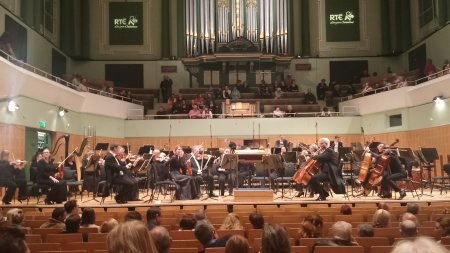
As it happens, although I’ve heard countless performances of this work on the radio and on record, I had never heard it live – until last night at the National Concert Hall in Dublin.
From its arresting opening with the strings beating out quintuple time col legno battuto on Mars, The Bringer of War to the wordless singing at the end of Neptune, The Mystic the RTÉ National Symphony Orchestra, conducted by José Serebrier (and at the end, and in the wings, the ladies voices of the RTÉ Philharmonic Choir) gave a very good account of this enduringly popular work. The centrepiece of this suite of seven movements is Jupiter, the Bringer of Jollity which consists of an intro and and outro either side of the famous ‘big tune’ (“Thaxted”) often sung as the hymn I Vow To Thee My Country. The string playing at that section was exceptional, with a lovely rich texture and a very well chosen stately tempo.
The only disappointment of this performance for me was the ending. The voices off are supposed to fade away gently until they are inaudible, but last night they cut off abruptly, rather ruining the intended effect.
This didn’t stop the audience giving the Orchestra a standing ovation, however, so obviously not everyone was bothered by the ending.
For the record I’ll just mention that the first half of the concert consisted of two shorter works. The opening piece was one of Leopold Stokowski’s rather unnecessary orchestral arrangements of music by Bach, in this case the famous Toccata & Fugue in D Minor. I spent the entire performance looking at the NCH’s fine concert organ and wishing the original was being played on that. Still, at least the Stokowski arrangement didn’t have a harpsichord in it.
The other first-half piece was far more interesting (to me), the world premiere of a piece by the conductor José Serebrier called Symphonic B A C H Variations for Pianoand Orchestra. This is like a piano concerto in four movements each based a little riff made the four notes B A C and H (in German musical notation, B is B flat and H is B Natural – don’t ask me why). It’s an intriguing piece, which I hope I get to hear again, and was very well played by young Alexandre Kantorow.
Just time for a quick post to mention that tonight is Culture Night in Ireland, which means that over 1600 venues around the country are open this evening for free cultural events. Museums, art galleries and other public buildings and spaces will open later this evening to welcome the general public and there are scores of free concerts going on all over the place. There’s a useful guide here.There are some events in Maynooth tonight, including one at Maynooth Castle.
I would have gone to tonight’s free concert at the National Concert Hall. Although it’s free you have to book a ticket because the capacity is limited and unfortunately I was too late getting around to doing that so couldn’t get in. I’ll probably listen to it on the radio tonight instead.
I think Culture Night is a great idea, as it encourages people to sample cultural fare they might otherwise not get around to trying, and may boost the audiences for the rest of the year as a result. I wonder if anyone has ever thought of running a Culture Night in, say, Cardiff?
As a bit of a change from Open Journal of Astrophysics stuff I thought I’d post this very hot Gospel number featuring the very wonderful Mahalia Jackson, whose many claims to fame include the fact that she gave singing lessons to Aretha Franklin. If you think her voice sounds powerful in this recording, then it’s even more impressive when you see that in this live performance at the Newport Jazz Festival she was standing way back from the microphone! She wasn’t called `The World’s Greatest Gospel Singer’ for nothing.
Anyway, if you look at the title of this piece and think `Oh no, not that old one again’ because it has been done to death by Trad Jazz bands then please give it a listen because I think this version really rocks. The tune When The Saints Go Marching In is an old spiritual and, as such, was composed by the person who wrote all the best music: `Trad’.
One of the things about Gospel music is that it’s usually played in a very distinctive 4/4 which makes it very difficult to resist clapping. But why do so many people -even at Jazz festivals – find it so hard to clap on the right beat? It only works if you clap on an off beat (i.e. beats 2 and 4). If you clap on all the beats or just on the on beats it just kills the rhythm. On this track you’ll hear that Ms Jackson has to deliver clapping instructions not once but twice to an audience that seems to insist to clap on every beat of the bar (and on some beats that don’t correlate with the actual rhythm in any way). I guess “All God’s Children Got Rhythm” might not actually be a true statement.
Last night I had the pleasure of attending the opening performance of the new season of the RTÉ National Symphony Orchestra at the National Concert Hall in Dublin. As well as being the first concert of the season, it was also my first ever visit to the National Concert Hall. To mark the occasion we were in the presence of the Uachtarán na hÉireann, Michael D Higgins, and his wife Sabena. By `occasion’ I of course mean the first concert of the season, rather than my first visit to the NCH. After the concert the audience were all treated to a glass of Prosecco on the house too!
I’ve done quite a few reviews from St David’s Hall in Cardiff over the years, so before writing about the music I thought I’d compare the venues a little. The National Concert Hall was built in 1865 and soon after its construction it was converted into the main building of University College Dublin. It was converted to a concert venue when UCD moved out of the city centre, and fully re-opened in 1981. It is a bit smaller than St David’s – capacity 1200, compared with 2000 – and does not have such a fine acoustic, but it is a very nice venue with a distinctive and decidedly more intimate vibe all of its own. I had a seat in the centre stalls, which cost me €40, which is about the same as one would expect to pay in Cardiff.
The NCH is situated close to St Stephen’s Green, which is a 15 minute walk from Pearse Station or a 30 minute walk from Connolly (both of which are served by trains from Maynooth). The weather was pleasant yesterday evening so I walked rather than taking the bus or Luas from Connolly. I passed a number of inviting hostelries on the way but resisted the temptation to stop for a pint in favour of a glass of wine in the NCH bar before the performance.
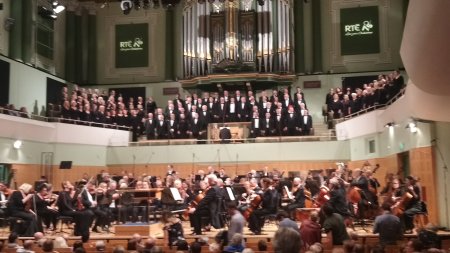
Anyway, last night’s curtain-raiser involved just one piece – but what a piece! – Symphony No.2 (“Resurrection”) by Gustav Mahler. This is a colossal work, in five movements, that lasts about 90 minutes. The performance involved not only a huge orchestra, numbering about a hundred musicians, but also two solo vocalists and a sizeable choir (although the choir does not make its entrance until the start of the long final movement, about an hour into the piece). The choir in this case was the RTÉ Philharmonic Choir. At various points trumpets and/or French horns moved offstage into the wings and, for the finale, into the gallery beside the choir.
About two years ago I blogged about the first performance I had ever heard of the same work. Hearing it again in a different environment in no way diminished its impact.
Stunning though the finale undoubtedly was, I was gripped all the way through, from the relatively sombre but subtly expressive opening movement, through the joyously dancing second that recalls happier times, the third which is based on a Jewish folk tune and which ends in a shattering climax Mahler described as “a shriek of despair”, and the fourth which is built around a setting of one of the songs from Des Knaben Wunderhorn, sung beautifully by Jennifer Johnson (standing in wonderfully for Patricia Bardon, who was unfortunately indisposed). Jennifer Johnson has a lovely velvety voice very well suited to this piece, which seems more like a contralto part than a mezzo. The changing moods of the work are underlined by a tonality that shifts from minor to major and back again. All that was very well performed, but as I suspect is always the case in performances of this work, it was the climactic final movement – which lasts almost half an hour and is based on setting of a poem mostly written by Mahler himself, sung by Orla Boylan – that packs the strongest emotional punch.
The massed ranks of the RTÉ Philharmonic Choir (all 160 of them) weren’t called upon until this final movement, but as soon as they started to sing they made an immediate impact. As the symphony moved inexorably towards its climax the hairs on the back of my neck stood up in anticipation of a thrilling sound to come. I wasn’t disappointed. The final stages of this piece are sublime, jubilant, shattering, transcendent but, above all, magnificently, exquisitely loud! The Choir, responding in appropriate fashion to Mahler’s instruction to sing mit höchster Kraft, combined with the full force of the Orchestra and the fine concert organ of the NCH to create an overwhelming wall of radiant sound.
Mahler himself wrote of the final movement:
The increasing tension, working up to the final climax, is so tremendous that I don’t know myself, now that it is over, how I ever came to write it.
Well, who knows where genius comes from, but Mahler was undoubtedly a genius. People often stay that his compositions are miserable, angst-ridden and depressing. I don’t find that at all. It’s true that this, as well as Mahler’s other great works, takes you on an emotional journey that is at times a difficult one. There are passages that are filled with apprehension or even dread. But without darkness there is no light. The ending of the Resurrection Symphony is all the more triumphant because of what has come before.
The end of the performance was greeted with rapturous applause (and a well-deserved standing ovation). Congratulations to conductor Robert Trevino, the soloists, choir and all the musicians for a memorable concert. On my way out after the Prosecco I picked up the brochure for the forthcoming season by the RTÉ National Symphony Orchestra, which runs until next May. I won’t be attend all the Friday-night concerts, but I will try to make as many as I can of the ones that don’t involve harpsichords.
Update: I hadn’t realised that the concert was actually broadcast on TV and then put on YouTube; here is a video of the whole thing:
I heard part of this on the Radio the other night, and thought I’d share it here. It’s definitely one of the strangest pieces of music I’ve ever heard, but I find it very moving and, in its own way, compelling. The full story can be found here, but is summarized the composer Gavin Bryars:
In 1971, when I lived in London, I was working with a friend, Alan Power, on a film about people living rough in the area around Elephant and Castle and Waterloo Station. In the course of being filmed, some people broke into drunken song – sometimes bits of opera, sometimes sentimental ballads – and one, who in fact did not drink, sang a religious song “Jesus’ Blood Never Failed Me Yet”. This was not ultimately used in the film and I was given all the unused sections of tape, including this one.
When I played it at home, I found that his singing was in tune with my piano, and I improvised a simple accompaniment. I noticed, too, that the first section of the song – 13 bars in length – formed an effective loop which repeated in a slightly unpredictable way.
I took the tape loop to Leicester, where I was working in the Fine Art Department, and copied the loop onto a continuous reel of tape, thinking about perhaps adding an orchestrated accompaniment to this. The door of the recording room opened on to one of the large painting studios and I left the tape copying, with the door open, while I went to have a cup of coffee. When I came back I found the normally lively room unnaturally subdued. People were moving about much more slowly than usual and a few were sitting alone, quietly weeping.
I was puzzled until I realised that the tape was still playing and that they had been overcome by the old man’s singing. This convinced me of the emotional power of the music and of the possibilities offered by adding a simple, though gradually evolving, orchestral accompaniment that respected the homeless man’s nobility and simple faith. Although he died before he could hear what I had done with his singing, the piece remains as an eloquent, but understated testimony to his spirit and optimism.
Several versions of this piece exist. This one, recorded in 1993, is 74 minutes long. It begins with the unaccompanied voice of the old man to which instrumental accompaniment of increasing depth and texture is gradually added and, for the last twenty minutes or so, there is also the voice of Tom Waits…
Mention the name Elkie Brooks to people of my generation or older and most will think of her popular hits from the late 1970s, especially Pearl’s A Singer which made the UK Top Ten in 1977. Elkie Brooks has however had a long and very distinguished career as a Jazz and Blues singer, including regular performances over the years with trumpeter Humphrey Lyttelton and his band. This particular track was recorded in 2002, when Humph was already in his eighties, but I think it’s a lovely performance so I thought I’d share it here.
Trouble in Mind is a very familiar tune that has been recorded countless times by jazz musicians. In fact an earlier manifestation of Humph’s Band made a very nice instrumental version way back in 1950 which I have on an old Parlophone 78. The tune is usually credited to Richard M. Jones, but it has its roots in much older spirituals and folk songs. There are a couple of things worth mentioning about it despite it being so well known.. Although Trouble in Mind is a blues, it is a slightly unusual one because it’s an eight-bar blues rather than the more usual twelve-bar variety. The other thing is that there’s something about this tune that suits a rhythm accompaniment in sixth notes, as exemplified by drummer Adrian Macintosh on this track when the vocal starts.
There’s also some fine trombone on this (by Pete Strange) and a nice bit of banter from Humph at the beginning. Enjoy!
Having moved some of my CD & record collection to Ireland, I was listening to some music last night including this track that I blogged about many moons ago. Looking at that old post this morning, I noticed that the Youtube link was defunct so decided to update it. More importantly, I realized that I’d made a few mistakes which I thought I should correct, as well as some other edits.
This slow blues features an extended clarinet solo by the great Sidney Bechet. I’ve loved Blue Horizon ever since I was a kid, and think it has a good claim to be the finest instrumental blues ever recorded. I also heard it more recently at the funeral of one of my Dad’s old jazz friends. Listening to in that context, it struck me that it’s not just one of the greatest blues performances, but must also be one of the greatest laments that has ever been produced in music of any kind. It’s absolutely pure sadness – there’s no bitterness, anger or resentment about it – and it develops through the stately choruses into a sense of great pride and even, ultimately, of triumph.
Many years I blogged about the thrill of high-speed jazz. This performance is at the other end of the scale in terms of tempo, but you can still feel pull of the harmonic progression underlying the tune which in this case is basically the standard 12-bar blues, but with a few substitute chords thrown in. The last set of four bars in the 12-bar blues ends with the familiar V-IV-I cadential pattern (often known as the blues cadence) leading back to the root at the end of each chorus. Although Bechet plays quite a lot across the bar lines, the gravitational pull of that sequence of chords is very strong and it tells you very clearly that one chapter of the story has finished and another is about to start.
Bechet builds his solo over this relatively simple structure in six choruses in a slow and stately fashion, but makes telling use of searing blue notes of heart-rending emotional power as the intensity builds. If you don’t know what a blue note is then listen, from about 2.12 onwards, to a chorus that always makes the hairs stand up on the back of my neck.
I should also mention that the fine piano accompaniment on this all-time classic piece (recorded in December 1944) is provided by Art Hodes and the mournful response from the trombone is supplied by Vic Dickenson. Bechet’s raw power and very broad vibrato probably won’t suit scholars of the classical clarinet, but I think this is absolutely wonderful. If I ever had to compile a list of my all-time favourite records, this would definitely be on it.
Well, in case you didn’t realize, the summer solstice (when the Sun reaches its most northerly point in the sky and is directly overhead on the Tropic of Cancer) occurred at 10.07 UT (11.07 British Summer Time Daylight Saving Time in Ireland) today. I guess that means it’s all downhill from here. Anyway, this gives me some sort of excuse for me posting a piece of music I’ve loved ever since I was a young child for its energy and wit. It’s the Overture to a Midsummer Night’s Dream, by Felix Mendelssohn which he started to compose when he was just 16 years old, but didn’t complete until later so it’s his Opus 21. This performance is by the Leipzig Genwandhausorchester conducted by Kurt Mazur. Enjoy!
Incidentally, I listed to a very nice performance of Shakespeare’s A Midsummer Night’s Dream on BBC Radio 3 on Sunday evening when I was still in Cardiff. It reminded me of when we performed that play whhen I was at school, and by Bottom received a warm hand.
Well, I’m back in Maynooth after a weekend in Cardiff, on the Sunday of which I went to St David’s Hall to see the Cardiff Philharmonic Orchestra playing Gustav Mahler’s Third Symphony. Actually this concert was originally scheduled to take place on the evening of Friday 15th June, which is why I booked a ticket to return from Bonn in time to see it instead of waiting for the formal close of the meeting. As it turns out, my flight was so late I would have missed it but fortunately the Rolling Stones intervened. Because Jagger et al were performing at the Principality Stadium in Cardiff on Friday (with all the consequent congestion and traffic disruption that implies) it was decided to shift the concert to Sunday 18th, but I couldn’t be bothered to change my flight.
Anyway, it proved an excellent way to spend a Sunday afternoon. Gustav Mahler spoke of his Third Symphony as being “of such magnitude that it mirrors the whole world” and you can see what he was getting at by just looking at the scale of the forces arrayed on stage when it’s about to be performed live. For yesterday’s concert at St David’s Hall, the Cardiff Philharmonic Orchestra was augmented by the WNO Community Chorus and the Choristers of St David’s Metropolitan Cathedral Choir, as well as soloist mezzo soprano Kate Woolveridge.
The orchestra needed to perform this extravagant work is much larger than for a normal symphony, and it involves some unusual instrumentation: e.g. two harps, a contrabassoon, heaps of percussion (including tuned bells and double tympanists), etc. The string section was boosted by double-basses galore, and there’s also a part (for what I think was a flugelhorn) to be played offstage. The work is also extremely long, being spread over six movements of which the first is the longest (over 30 minutes). Yesterday the performance stretched to about 1 hour and 40 minutes overall, with no interval. I don’t know of any symphonic works longer than this, actually.
It’s worth pointing out that the orchestra and choir(s) tackling this immense work were non-professional. It’s also worth pointing out that the principal French Horn – who is given a lot to do in this piece – was none other than Dr Bernard Richardson, recently retired from the School of Physics & Astronomy at Cardiff University.
I have to admit I have always had lot of trouble getting to grips with the first movement, in which various themes are repeatedly played off against each other, punctuated by a series of extravagant crescendo passages in which the orchestra threatened to blow the roof off. It is, at times, thrilling but also manic and, to me, rather indecipherable. The second movement, in the form of a minuet, is elegant enough, and was beautifully played (especially by the strings), but in comparison with the wayward exuberance of the first movement it sounds rather conventional.
The third movement, however, is totally gorgeous, especially in the passages featuring the offstage flugelhorn (?) and the string section of the orchestra on stage. From this point this piece started to bring me under its spell. The solo vocalist and choir(s) were marvellous in the fourth and fifth movements, the former a setting of a poem by Nietzsche and the latter a mixture of traditional verse and Mahler’s own words, but it was in the majestic sixth and final movement that the orchestra really reached its peak. This is one of the most romantic movements to be found in all of Mahler, passionate, lyrical and supremely uplifting. At times before the sixth movement the orchestra (especially the brass) had struggled a bit with the demands of the score, but the finale was as good a performance as you’ll hear anywhere.
Mahler’s 3rd Symphony is an epic journey through a landscape filled with dramatic contrasts. At times you wonder where you are going, and sometimes feel in danger of getting completely lost, but by the time you arrive triumphantly at the final destination all those doubts had melted away. Congratulations to the Cardiff Philharmonic on a very fine performance, warmly received by the audience.
After the concert there was a collection on behalf of the Forget-Me-Not Chorus, which supports people with dementia and their families through weekly singing sessions. I think this is a great initiative and made a donation on the way out – if you feel like doing likewise you can do so here.
Well, that’s my concert-going at St David’s Hall over for another season. Indeed, it’s probably the last concert I’ll be attending there for the foreseeable future, as I’ll be relocating fully to Ireland this summer. I’ll have many fine memories of listening to music there.
The views presented here are personal and not necessarily those of my employer (or anyone else for that matter).
Feel free to comment on any of the posts on this blog but comments may be moderated; anonymous comments and any considered by me to be vexatious and/or abusive and/or defamatory will not be accepted. I do not necessarily endorse, support, sanction, encourage, verify or agree with the opinions or statements of any information or other content in the comments on this site and do not in any way guarantee their accuracy or reliability.


 In the Dark