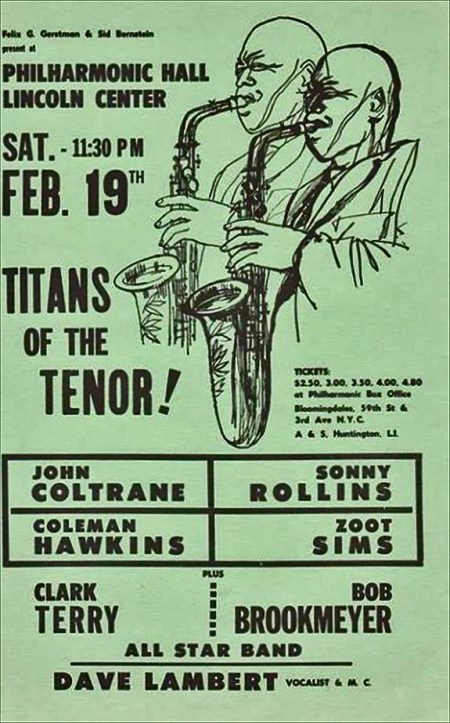
No time for a proper post today, but I couldn’t resist reblogging this advertisement for what must have been an amazing concert with an amazing lineup; so amazing that Pharaoh Sanders and Albert Ayler, who were also there, didn’t even make it onto the poster!
Time for a quick Jazz review, I think. This time I thought I’d pick a classic live performance from May 15th 1953 at Massey Hall in Toronto. Originally released as a vinyl LP with only 6 tracks on it, and called The Quintet of the Year, but subsequently re-released in various versions on CD, with various titles including Jazz at Massey Hall. The whole concert is now available on Youtube here:
This concert was planned to unite the greatest stars of the bebop era who had performed together earlier in their careers but had gradually evolved different styles over the intervening years. The line-up is Charlie Parker on alto, Dizzy Gillespie on trumpet, Bud Powell on piano, Charles Mingus on bass and the great Max Roach on drums which is stellar by any criterion!
Gatherings of star jazz players have often turned out to be disappointing, largely because very great musicians can sometimes interfere negatively rather than positively with each other, not necessarily consciously but because they can have ideas incompatible with one another. This evening, however, was a glorious exception to this rule, doubtless because all the musicians had worked together in the past, and their subsequent individual development had not taken them too far beyond their shared musical background. It is true that the ensemble passages are slight, but that doesn’t matter much because the solos are of such a remarkable and consistently high standard. Charlie Parker turns in some of the very best of his later recorded work, giving the lie to those who argue that his musical abilities were in decline at this time. He might not play as elegantly as he did on the classic Dial and Savoy sessions, but he is significantly more adventurous, with startling melodic contrasts in much of his work. At times this is a bit of a problem in that he seems to full of ideas that what comes out is a sequence of breathtaking fragments rather than a cohesive solo. This happens on A Night in Tunisia, for example, which never quite fulfills the promise of its magnificent opening break. On other tracks, though, especially Hot House his improvisations are just brilliant. It’s hard to imagine listening to this that in less than two years he would be dead.
Dizzy Gillespie matches Parker in superb fashion, betraying none of the offhandedness that often afflicted his later recorded performances, and the pyrotechnical quality of his playing is as exhilarating as it is instantly recognizable. Gillespie was an extrovert on stage and his frequent dancing around on the stage results in him going on and off mike from time to time, but it doesn’t detract from the performance once you realize why he’s fading in and out. It is, after all, a live performance and if you shut your eyes you can imagine Dizzy Gillespie the showman without any difficulty at all!
Most Jazz reviewers confine their comments on the rhythm section to a few kind words, but in this case that would be a travesty. The limitations of live recording technology in 1953 result in a rather unbalanced mix, but the flip side of that is that you can hear particularly well the pivotal importance of the bass playing of Charles Mingus. Between them Mingus and Max Roach lay down a relentlessly propulsive beat as well as taking gripping solos; the drum workouts in Wee and Salt Peanuts are astonishing in their interplay of rhythm and texture. Trumping even them, however, is the genius of Bud Powell who plays at a level consistently high even by his own standards.
Bud Powell is a fascinating musician for many reasons. Much less of a formalist than many Jazz pianists he nevertheless seems to generate a real sense of unity, more through the emotional drive underpinning his phrases than by imposing any set structure on his improvisations. His solo on Wee offers a fine example of this: moving inexorably towards a shattering climax as the right hand figures vary ceaselessly in their length and the chords punched out by the left hand grow more frequent and more percussive.
This album is another must-have for any serious collector of post-War jazz. The individual parts are all superb, but the whole is even greater than their sum.
PS. I had the pleasure of attending a concert at Massey Hall myself, when I was on sabbatical in Toronto in 2005/6.
Apparently some members of the Radio 3 audience didn’t take kindly to Ian Skelly’s decision to play something by this combination, but I have to say I loved it; it really put a spring in my step. I’ve remarked before on this blog that many Jazz musicians are great admirers of Bach (who was himself a talented improviser). It’s not difficult to understand why this is the case, particularly in the case of the keyboard works, because the music always has such a rich and compelling harmonic progression built into it – just what a Jazz musician needs. Bach’s compositions are so well constructed that they can cope with being pulled around more than those of any other composer I can think of. Above all, despite the change of musical vocabulary and the addition of a rhythm section, the best Jazz versions still somehow manage to sound like Bach….
From the following clips you can see that the twins play from sheet music – I think the arrangement was written by Jacques Loussier – while Loussier’s contribution is largely improvised. In the clip they play versions of Bach’s Triple Concerto in D minor BWV 1063 (with Jacques Loussier) followed the Concerto for Two Keyboards in C minor, BWV 1060 (without Loussier)…
The other night I was listening to the Ornette Coleman album The Shape of Jazz to Come and decided that I really should write something about it on here. Released in 1959, this was Ornette Coleman’s third album but it was the first to issue a fully coherent statement of his musical intentions and it was from this work that his influence began to spread. The prophetic title proved to be extremely accurate; what remains astonishing is that such a radical album was recorded as long ago as 1959, in what I consider to be a Golden Age of musical innovation.
What Coleman did in this album was truly revolutionary. The fundamental change involved was a complete rejection of conventional harmonic progression, i.e. the sequences of chords which underpinned and connected earlier jazz improvisations with a repeating cycle that imposed not only its own order but also its own formal restrictions. By rejecting these, Coleman gave his music complete freedom of melodic movement. His intentions are signalled even by the choice of band members. Consisting Coleman on alto saxophone, Don Cherry on trumpet, Charlie Haden on bass and Billy Higgins on drums, the quartet did not involve any chord-playing instruments at all. With the wider latitude allowed by this approach the melodic patterns are bolder and less predictable than in earlier forms of Jazz. The thematic phrases do not conform to the traditional 4 or 8-bar norms involved in traditional tunes. Freed of the necessity of catching up the next chord as it comes up in the accompaniment, improvisation can range further, crossing bar-lines at will. The resulting music was considered almost shocking in 1959, but although unconventional by the standards of the time, it can be heard to carry its own force and logic, respecting the fundamental laws of jazz improvisation while at the same time calling into question many of the assumptions on which these laws had been thought to rest.The rejection of harmonic dominance also altered other aspects of the music. Coleman’s melodic inventiveness was even enhanced by a (partial) rejection of equal-temperament tuning.
None of these changes was made just for the sake of it, and in many fundamental respects the music isn’t radical at all. The horns open and close each performance in fairly conventional style and they play clearly delineated solos. Billy Higgins keeps a steady beat going throughout, and Haden plays in between that beat and the trumpet and saxophone. But that disguises some important differences in responsibility, especially for the bass player, Charlie Haden. Instead of following a chord sequence and knowing roughly what his line would be throughout the piece, he has to listen to the soloist and improvise a line to fit. As always, increased freedom brings increased responsibility.
All four men are generous with their talents on this album, which is a feast of beauty and originality as well as skill and daring. It would be wrong to single out any particular track, which is why I’ve linked to the whole album, but I’d have to mention Peace, which is a lovely performance emerging from a statement of mood rather than a chord sequence; Don Cherry’s trumpet solo on that track is really remarkable. In an entirely different vein there’s Congeniality, which was the first in a long line of superbly swinging up-tempo numbers hitting a groove that Coleman was to make his own in subsequent years. There’s also Lonely Woman, which is the one tune on this album that became a Jazz standard.
An album of extraordinary genius that was (and probably still is) way ahead of its time, The Shape of Jazz to Come is a must-have album for any serious Jazz enthusiast.
I came across this a while ago and thought I’d save it for a rainy day. Today is very rainy indeed so here it is. Mad about the Boywas written by Noel Coward and published in 1932. It’s a song about an infatuation with a movie star and has generally been performed by female singers, although it was apparently inspired by Coward’s own crush on Douglas Fairbanks Jnr (which wasn’t reciprocated). The song became popular again in 1992 when a version recorded by Dinah Washington was used in a famous Levi commercial, but I love this wonderfully world-weary performance by Greta Keller.
Another very busy day means I’ve almost reached the end of a very busy week. I spent this morning in a meeting with colleagues from the University of Sussex and representatives of the Brighton Institute for Modern Music (also known as BIMM), which focusses on courses intended to prepare students to work in some aspect of the popular music industry, including performing and songwriting as well as, e.g., management.
It’s one of the odd things about being a Head of School that you get invited to do strange things every now and again and this was one such occasion. The University of Sussex validates degree programmes for a number of education institutions, BIMM being one of them and it was my job to Chair a session this morning (at a location in central Brighton) that formed part of the validation process. We had some nice pastries for breakfast too.
Regular readers of this blog (both of them) will know that I’m not really up to date on popular beat combos so I wasn’t picked for this task for any music expertise; the idea was rather that being a complete ignoramus I could be an impartial Chair…
It was great to talk to have the chance to talk to some of the current BIMM students as well as the staff and one of the things that struck me was that although I work in a very different discipline, many of the educational challenges faced by the School of Mathematical and Physical Sciences and BIMM are very similar. I can’t talk about the details we discussed, but it was a very friendly meeting and there was lots of constructive discussion.
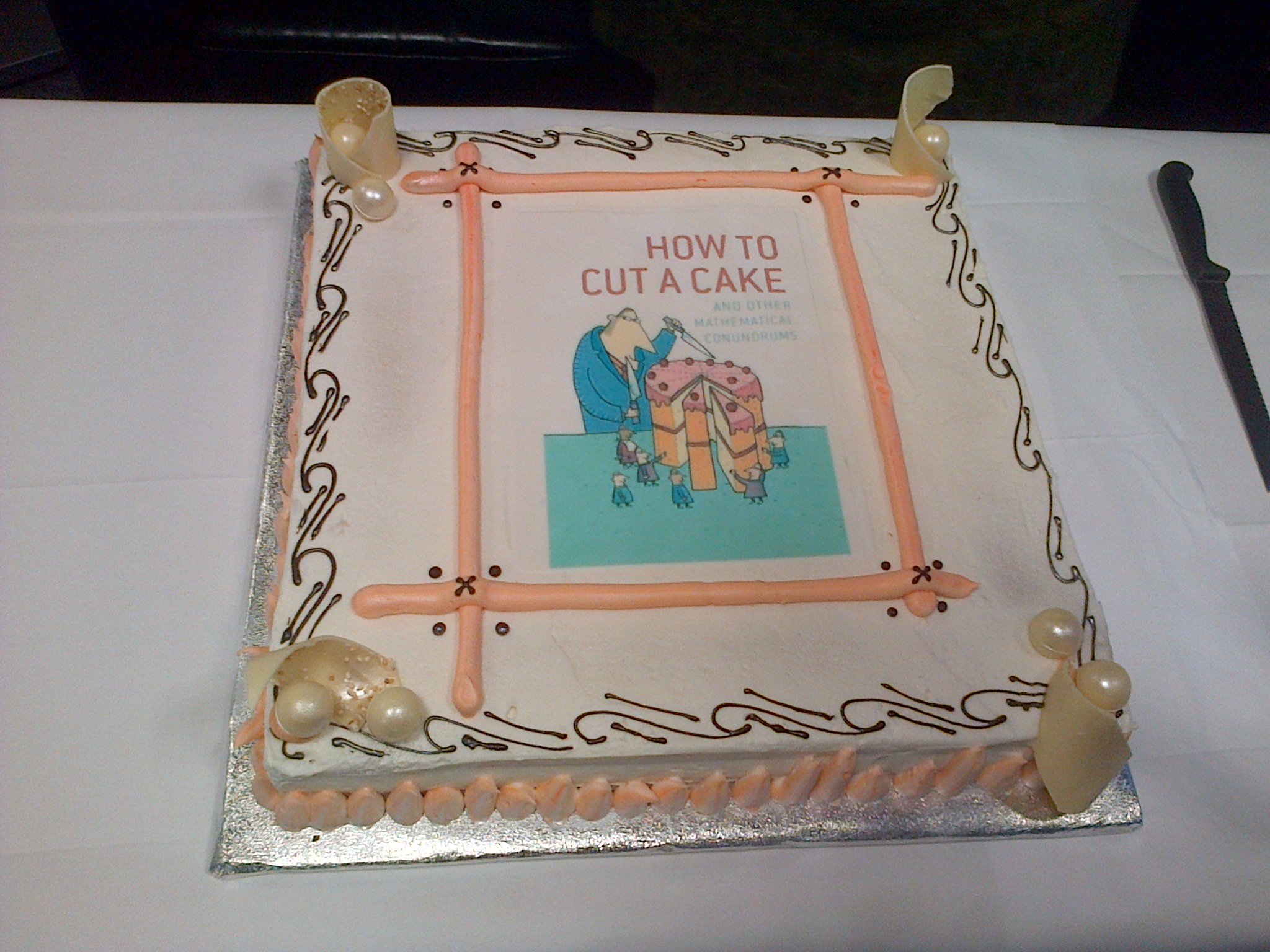
That business concluded it was back up to Falmer for a quick lunch and a meeting about undergraduate admissions. And finally, because it’s the last Friday of the month it was time this afternoon for our monthly MPS cake event. This month’s cake had a vaguely mathematical theme and also raised the issue of the correct plural of the word conundrum:
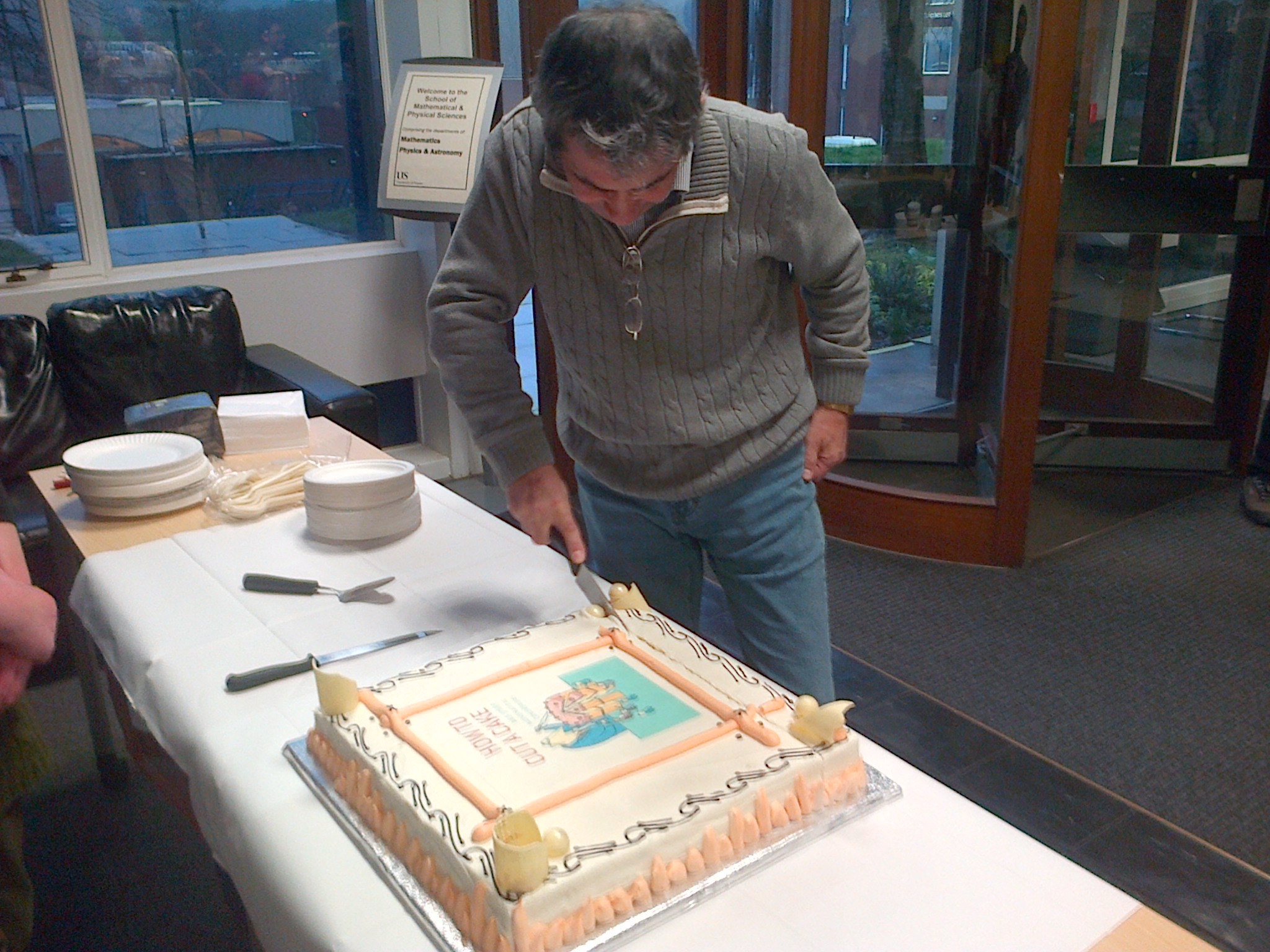
I thought it was appropriate to invite the Head of the Department of Mathematics, Miro Chlebik, to solve this particular conundrum by cutting the cake:
I had an interesting exchange via Twitter the other day after listening to “CD Review” on BBC Radio 3. The programme included a few examples of Opera singers trying – and, in my opinion, failing – to sing like Jazz singers.
I was reminded of this discussion last night when I got home to find a lovely Clarinet sonata by Poulenc being played. It turns out that this piece was commissioned by none other than the “King of Swing”, clarinetist Benny Goodman.
I love both Jazz and Opera, but attempts to mix the two very different genres are not often successful. Jazz and Classical music are rather like different languages and musicians are rather like poets: fully bilingual exponents who can perform their art in more than one tongue are few and far between. There are, however, notable exceptions to this rule if not among singers but among instrumentalists. I think this is largely because so many Jazz musicians are so unbelievably virtuosic on their instruments that they can play more-or-less anything they put their mind to.
Anyway, I thought I’d post a few examples of famous Jazz musicians who have proved that they can play Classical music well. Here’s the man Benny Goodman playing the Mozart Clarinet Quintet K. 581:
Wynton Marsalis playing a Haydn Trumpet Concerto:
Keith Jarrett playing the first movement of the Italian Concerto by J.S. Bach BWV971. I would have included his version of the Goldberg Variations, but it’s on harpsichord and therefore not allowed…
I’d like to hear any further suggestions of excellent performances of Classical repertoire by Jazz musicians, so feel free to comment through the box.
For reasons not necessary to explain I just found this little video someone made to go with a rendition of Walking to a Farm by Ivor Cutler, who accompanies himself on harmonium, and was quite surprised to see a few images of Jodrell Bank on the way. That tenuous connection with astronomy, and the fact that I’ve been too busy today to think of anything else, convinced me that I should post it on this here blog:
I’ve just heard the very sad news that the great Italian conductor Claudio Abbado has passed away at the age of 80. No words of mine can pay adequate tribute to his wonderful career. He leaves a rich legacy of recordings which can speak more eloquently than I could ever do and he will live on through them and through the memories of those who attended live performances he conducted. Here is a superb example, a recording of a sublime performance one of the five Rückert-Lieder by Gustav Mahler (“Ich bin der Welt abhanden gekommen“) featuring the Lucerne Festival Orchestra under Abbado’s direction, and the gorgeous voice of mezzo-soprano Magdalena Kožená. Rest in peace, Maestro Claudio Abbado.
One of the quirks of being in Japan is the 9 hour time difference between here and the UK, which means I’m just getting up when folk back home are going to bed; and one of the consequences is that BBC Radio 3’s Late Junction is on (via the internet) in the morning. It’s playing as a write this, in fact. Yesterday morning there was a track by Sun Ra, which reminded me that 2014 is the centenary of his birth. It prompted me to look back at an old post I’d written about him where I found the track included there had been deleted from Youtube. I therefore decided to post a new version, including a different track.
Sun Ra was one of the most extraordinary composers and bandleaders of the 20th Century, was born Herman Poole Blount in Bimingham, Alabama, on 22nd May 1914. From the 1950s, until his death in 1993, he led various combinations of musicians in bands with various permutations of names involving the word Arkestra, such as the Blue Universe Arkestra and the Solar Myth Arkestra. He himself played keyboards, sometimes solo and sometimes with huge bands of over 30 musicians; his music touched on virtually the entire history of jazz, from ragtime to swing music, from bebop to free jazz, as well as soul and pop. He was also one of the first musicians, in any genre, to make extensive use of electronic keyboards.
He never achieved mainstream commercial success, but was a prolific recording artist with a cult following, partly fuelled by his outrageous claims to have been born not on Earth but on Saturn and the fact that much of his music was to do with space travel. Quoted in Jazziz magazine
They really thought I was some kind of kook with all my talk about outer space and the planets. I’m still talking about it, but governments are spending billions of dollars to go to Venus, Mars, and other planets, so it’s no longer kooky to talk about space
Quite. In fact, Sun Ra developed a complex performing identity based on his music, “cosmic” philosophy, and poetry. He abandoned his birth name, took on the persona of Sun Ra (Ra being the ancient Egyptian god of the sun), and often dressed in the style of an ancient Egyptian pharoah, as in the video clip. In other words, he was very odd.
Sun Ra’s music is eclectic, outrageous and sometimes downright mystifying, but it also has a marvellous coherence to it maintained as his style evolved over four decades and is consistently imbued with a powerful sense of the Jazz tradition. Anyway, whatever I think, the music of Sun Ra has withstood its skeptics and detractors for generations and long may it continue to do so. The world needs more of his kind of eccentric.
Here’s a number called Door of the Cosmos. See what you think.
The views presented here are personal and not necessarily those of my employer (or anyone else for that matter).
Feel free to comment on any of the posts on this blog but comments may be moderated; anonymous comments and any considered by me to be vexatious and/or abusive and/or defamatory will not be accepted. I do not necessarily endorse, support, sanction, encourage, verify or agree with the opinions or statements of any information or other content in the comments on this site and do not in any way guarantee their accuracy or reliability.


 In the Dark