I bought the album You’re Looking at Me (A Collection of Nat King Cole Songs by Carmen McCrae on vinyl when it came out way back in 1983, and I thought I’d share one of my favourite tracks from it on here. One of the reviews of the album that came out at the time asked why she sang Sweet Lorraine without changing any of the lyrics, presumably because it’s a love song directed at a woman and the critic thought that it didn’t work when sung by another woman. Thirty years on it’s quite possible that there’s a lady somewhere (perhaps even a lady called Carmen) looking forward to marrying her Sweet Lorraine next April when such a marriage will be legal in the United Kingdom!
Follow @telescoperArchive for the Music Category
Sweet Lorraine
Posted in Jazz, LGBTQ+ with tags Carmen McCrae, Equal Marriage, Sweet Lorraine, You're looking at me on November 8, 2013 by telescoperElektra
Posted in Opera with tags Elektra, Elektra Complex, Opera, Richard Strauss on October 13, 2013 by telescoperI seem to have spent more time in London than in Brighton over the last week, and on Saturday I was in the Big Smoke again, for a Night at the Opera. This was a trip I’ve been looking forward to for some time, because it was made possible by the good folks of the School of Physics & Astronomy at Cardiff University: when I left at the end of January this year they presented me with a gift voucher for the Royal Opera House in Covent Garden, which I’ve only just around to using. So before going on, let me take the opportunity express my gratitude for such a lovely gift!
The Opera I went to see was Elektra by Richard Strauss, in a revival of Charles Edwards’s production that first ran in 2003. Elektra is a complex story (geddit?) set in ancient Mycenae, whose ruling class is gripped by a terrible family feud. The Opera begins with Elektra deranged with grief because of the murder of her father, Agamemnon, by her mother, Clytemnestra. She resolves to take revenge on her mother and her allies. Her hopes are initially thwarted when her sister Chrysothemis refuses to help and she hears of the death of her brother Orestes. However, Orestes is not dead; he returns to the Palace and, together with a companion, goes on a bloody rampage. The final scenes see the stage covered with dead bodies and the murderers drenched in blood. Elektra rejoices that her revenge is complete, but the fulfilment of her goal leaves her with nothing left to live for; the collapses and dies.
That’s what you go to the Opera for, a happy ending!
I thoroughly enjoyed the performance. Elektra is an opera in one Act, so it runs for about two hours without an interval. Christine Goerke was absolutely outstanding as Elektra, as was Iain Paterson as Orestes. The music by Richard Strauss is full of contrasts: at times dark and brooding, but at others with a radiant beauty. Those extremes represent the psychological extremes of the story: Elektra’s obsession with revenge is a distorted reflection of her love for her father. The Orchestra of the Royal Opera House conducted by Christopher Willis, standing in for Andris Jansons who was ill, added excellent colour and dynamics to the action on stage.
With all the corpses coming back to life in bloodstained costumes, the curtain call looked the Zombie Apocalypse had started, but we managed to escape and made it to an excellent Italian restaurant in time for a splendid supper followed by too much grappa. I didn’t get back to Brighton until late this afternoon…
Follow @telescoperReturn of the Bad Penny Blues
Posted in Jazz, Music with tags Bad Penny Blues, Humphrey Lyttelton, Jazz, Joe Meek on October 1, 2013 by telescoperSo, it’s October again. What happened to September? Anyway, looking back through my archive this morning I discovered that exactly five years ago today I posted a tribute to the legendary Humphrey Lyttelton. I still miss Humph greatly so thought I’d indulge myself by posting the piece again with a few small updates. Well, they say a Bad Penny always comes back….
–0–
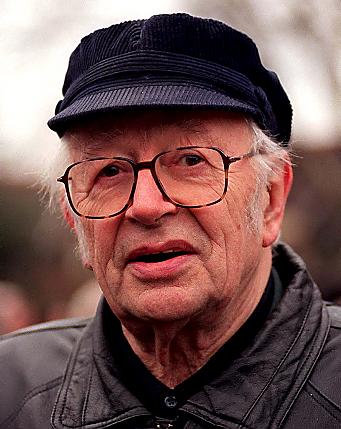 I knew I could’t blog for long without writing something about a great hero of mine, the inimitable Humphrey Lyttelton, better known to his many fans as “Humph”. He died earlier this year (on April 25 2008, at the age of 86) of complications following a heart operation. News of his death came as a massive shock to me, as it had never really occured to me that one day he would be no more. Tributes to him in the media were unsurprisingly glowing in their admiration.
In later years, Humph was best known as the chairman of the long-running radio comedy show I’m Sorry I Haven’t a Clue, subtitled “The Antidote to Panel Games” in which his gravelly but perfectly elocuted voice, schoolmasterish manner and impeccable comic timing proved the perfect foil to the antics of Barry Cryer, Tim Brooke-Taylor, Graeme Garden and many other contributors. I hope I get the chance to say a bit more about this programme in due course, as I treasure my collection of recordings of shows that still make me laugh at the umpteenth listening.
But Humph had many other strings to his bow. He was a talented cartoonist and a gifted writer, and also hosted the BBC Radio programme “The Best of Jazz” on Radio 2 for forty years, counting the great John Peel among his legions of listeners. I owe a special debt to Humph for this programme as I listened to it religiously every monday night at 9pm during my teenage years. He would open the show with “This his Humphrey Lyttelton here, with the best part of an hour of jazz between now and five to ten”. His theme tune then was Wanderlust, recorded by a subset of Duke Ellington’s orchestra with the great saxophonist Coleman Hawkins appearing as a guest and contributing a truly magnificent tenor solo near the end of the piece.
Through Humph I discovered most of the music I still listen to on a daily basis, jazz from the classic era of Louis Armstrong and Jelly Roll Morton, through the swing era of Duke Ellington, Benny Goodman and Count Basie, the postwar bebop period of Charlie Parker, Dizzy Gillespie and Thelonious Monk, Miles Davis and John Coltrane, then modernists like Ornette Coleman, Sam Rivers, Archie Shepp and onto the avant-garde of the time. Humph loved all kinds of jazz, and he communicated his encyclopedic knowledge a style flavoured by a dry sense of humour. I never met him in person, but I would have loved the chance to thank him for helping nurture in me a passion for all that wonderful music.
 Humph was also a fine Jazz trumpeter and bandleader in his own right. When my father was at school in the 1950s, the Lyttelton band was the leading “traditional Jazz” band in Britain. Humph had played with many of the greats, including Louis Armstrong and Sidney Bechet, and won their admiration for his trumpet-playing.
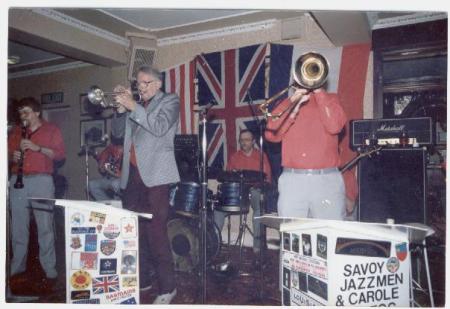
My dad had become a Lyttelton fan at School and it was this that persuaded him to take up playing the drums. He joined the RAF for his national service, and he had the opportunity to play with various bands then and later on when he went back into civvy street. He was a life long admirer of Humph and eventually got to play with him at the Corner House in Newcastle but not until the 1990s. He told me it was one of the proudest moments of his life, although he had been so nervous he didn’t really play very well. Here’s a photograph of this occasion:
 In the late 1940s Humph’s band had started to record a series of 78rpm records for the Parlophone label, starting with a lovely version of “Maple Leaf Rag” and stretching to over a hundred titles. Among these tracks was one record that actually made it into the Top 20 of the British pop charts in 1956, admittedly at Number 19, but nevertheless that’s no mean feat for a Jazz record. I should point out that this was long before my birth, but I remember hearing the track many times around the house when I was young.
The Bad Penny Blues was written by Humphrey Lyttelton and the hit recording features a quartet drawn from his band which, by the mid-1950s, had gravitated to a more mainstream jazz style, away from the “traddy” sound favoured by most contemporary jazz outfits. Indeed, he had incurred the wrath of many conservative fans by daring to include a saxophonist, the brilliant but eccentric Bruce Turner, in his outfit. Bad Penny Blues, though, featured only Humph on trumpet, Johhny Parker on piano, Stan Greig on drums and Jim Bray on bass. It was only recorded as an afterthought because it went down well at live gigs at Humph’s Jazz Club the HL Club (which later became the 100 Club, at 100 Oxford Street.)
But the real key to the success of this record was a young man by the name of Joe Meek. Starting out as a sound engineer at the Parlophone studios, Meek had quickly established an excellent reputation and in this case he was asked to take over the whole production of the record. According to Humph, they were slightly concerned at what he was doing with the microphones before they made the take but after it was done they all went home and left Meek to do some tinkering with the sound before cutting the disk. In those days, recording techniques were relatively crude and there generally wasn’t much in the way of post production, especially in jazz.
 When he heard the final record, Humph was shocked. For one thing, Meek had close-miked all the instruments, including the drums – something which wasn’t generally done with jazz records for fear of (a) drowning out the rest of the band and (b) exposing the clumsiness of the drummer, the latter being a particularly problem. As Humph said, his band always sounded like the rhythm section was wearing diving boots. For this reason the drums were usually recorded with a distant mike and generally hidden in the ensemble playing. But in this case it worked out very well. Stan Greig used brushes on this track and his playing served beautifully both to propel and to punctuate the performances of the other musicians.
But it wasn’t the drums that so disturbed Humph. Meek had also fiddled with the double bass and with the left hand boogie-woogie figures of Johnny Parker’s piano, fattening them out and changing the balance to bring them right up in the final mix. He also compressed the overall sound so that the bass lines seem to press in on both the piano’s right hand and the growling muted trumpet lead, tying them closer to Greig’s insistent drum patterns and creating an unusually dense sound. The result is an intense, driving feel, with a dark undertone that is quite unlike any other jazz record of its period and redolent with the atmosphere of a smoky jazz club. I love it, especially the moment when Humph’s trumpet takes over from the piano solo. With a timely kick from the drums and against the backdrop of those bluesy thumping bass lines the band finds another gear and they build up a fine head of steam before riffing their way into the fade.
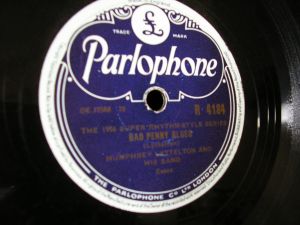
Here is the original 78rpm single:
Humph didn’t like the way the record had been put together, but it was an instant hit. He later joked that he hated it all the way to the bank.
Joe Meek went on to produce several classic pop records, generating many ideas that were later used by Phil Spector, but ultimately he became a tragic figure. Such commercial success as he achieved didn’t really last and he sank into debt, depression and paranoia. A gay man in an era in which homosexuality was still illegal, he became a victim of blackmail and was questioned by the police for alleged encounters with rent boys. He committed suicide in 1967 at the age of 37.
The Bad Penny Blues went on to be the “inspiration” behind Paul Macartney’s Lady Madonna, a Beatles track which has a lot of the same notes in it and also borrows the same overall feel. I can’t put it more subtly than that. George Martin, who produced the Beatles’ track, was actually in charge of the Parlophone studio at the time Bad Penny Blues was recorded…
And Humph went on to live another 52 years, bringing music and laughter to millions.
To end with, here’s a link to a later version of the tune recorded by a more recent manifestation of Humph’s band, probably in the 1980s. Note the way his technique involved the use of his eyebrows! I may be wrong, but I think the pianist on this performance is Mick Pyne and the bass is played by Dave Green. I can’t really make out the drummer.
Follow @telescoperUnchained Melody
Posted in Film, Music with tags Alex North, film, Todd Duncan, Unchained, Unchained Melody on September 30, 2013 by telescoperYou pick up a lot of interesting snippets listening to BBC Radio 3. Last night I was listening to a programme about Alex North, a prolific composer of music scores, including one of my favourite films A Streetcar Named Desire. Alex North also wrote a complete soundtrack for Kubrick’s 2001: A Space Odyssey and must have been mortified when he turned up for the Premiere and found that not a single note of the music he’d written was used in the final version. Anyway, one thing I learnt that I didn’t know before was that Alex North also wrote the tune Unchained Melody for a relatively unknown prison movie called, appropriately enough, Unchained. The song was a massive hit in the 60s for the Righteous Brothers, and gained popularity again as a consequence of the 1990 film Ghost. It’s also been murdered by countless karaoke singers since then…
Anyway, here is the original version of Unchained Melody as it appears in the 1955 film. Knowing the background to the song (i.e. that the enforced separation of the singer and his sweetheart is because the former is in prison) makes it all the more poignant, and Todd Duncan (whose style clearly owes a debt to Paul Robeson) gives it a bluesy feel present in none of the cover versions I’ve heard…
Follow @telescoperAnother Indian Summer
Posted in Jazz with tags Haf Back Mihangel, Indian Summer, Michaelmas, Sidney Bechet on September 25, 2013 by telescoperI posted this a couple of years ago in response to a discussion concerning the origin of the phrase Indian Summer (which, contrary to popular belief, has nothing to do with India). Looking back over my five years of blog entries for this time of year it’s quite surprising how often I’ve mentioned a late September heatwave. Now we’re having another one. In Welsh, such a period of warm weather at the end of September is known as Haf Bach Mihangel or “Michael’s Little Summer”, as it occurs around Michaelmas Day ( 29th of September).
Anyway, I’m not sure our little summer will last until Sunday 29th September so I’ll take the opprtunity to have a cup of tea outside in the sunshine and post this lovely old recording by the late great Sidney Bechet. So since we’re currently experiencing an Indian Summer, why not bask in its glow?
“You gotta be in the Sun to feel the Sun” – Sidney Bechet.
Follow @telescoperCherokee, by Clifford Brown
Posted in Jazz with tags Blue Note, Clifford Brown, Jazz on September 21, 2013 by telescoperThe blog’s been quite busy this week, so I’ll take it easy today and just indulge my love of 1950s jazz. This version of Ray Noble’s standard Cherokee is a vehicle for the virtuosity and creativity of the trumpeter Clifford Brown. The changes of this tune are notoriously difficult to improvise on, 64 bars of harmonic twists and turns that have led countless musicians onto the rocks, but Clifford Brown navigates them at full pelt with amazingly agility. Enjoy!
Follow @telescoper(Guest Post) De Profundis
Posted in Music with tags 8th September 2013, BIrmingham, Leonard Cohen, Miss Lemon, NG Arena on September 12, 2013 by telescoperTime for a guest post, methinks. Here is a review of a recent concert by the one and only Leonard Cohen. I wasn’t lucky enough to be there myself, but the pseudonymous Miss Lemon certainly was, and here are her reflections on the performance.
–0–
Merveilleux, superbe, meraviglioso, di sogno – I have run out of English superlatives to even try to begin to describe the masterclass that was Leonard Cohen’s Old Ideas concert (NG Arena 8 September 2013). It’s not often that you can put the words magical and Birmingham in the same sentence (spoken as a Brummie) but this was one such occasion.
My initial introduction to the venerable man was as a teenager in the mid-70s. Whilst my parents and I sat downstairs probably watching something like Family at War, upstairs my slightly older, and much more in touch with her poetic side, teenage sister would allow the, as I/we heard it then, drones of Leonard Cohen to seep through the ceiling, much to the familial annoyance below. However, sometime later intrigued as to quite what this dirge-like music was, whilst Sis was back at school (I was fortunate to have longer school holidays), I listened to the Songs of Leonard Cohen and was bewitched by the, as I now realise, legend that is Leonard.
I first saw Mr Cohen back in the early ‘80s – a memorable and unexpectedly good-humoured concert – but nothing could have prepared me for Sunday’s dreamlike experience. His voice even more distinctive than I remember it and now ‘aged into a worn leather bass’. An audience whose ages ranged from early 20s to late 70s filled the cavernous halls of the NG Arena in Birmingham. A large number of men of a certain age, not all with balding pates and ponytails, were adorned with Cohen fedoras and the first vision on the stage was that of all of the band wearing fedoras so that immediate identification of the great man himself was made a little difficult, which brought a wry smile to the assembled throng in the forum.
His nine-piece band, among them a glorious violin virtuoso, proved more than suitable playmates. An appealing alchemy of Leonard at his self-deprecating best enchanting us with songs old and new, the beautiful and haunting version of Alexandra Leaving sung by Sharon Robinson – even after three hours, like a bird on the wire, hey why not ask for more?
The esteemed Mr Cohen – modest and most generous of spirit – age has not diminished his ability to pen glorious words and sublime songs and to send 10,000 people home with a smile which would last even longer than his concert, nor has it dimmed the twinkle in his eye. He was indeed ‘born with the gift of a golden voice’.
Sincerely
Miss Lemon
Anna Bolena at WNO
Posted in History, Opera with tags Anna Bolena, Gaetano Donizetti, Mad Scene, Wales Millennium Centre, Welsh National Opera on September 9, 2013 by telescoperIt was the Last Night of the Proms on Saturday, but I was otherwise engaged at the First Night of the new production by Welsh National Opera of Anna Bolena by Gaetano Donizetti at the Wales Millennium Centre in Cardiff. This is one of three famous Donizetti operas set in the Tudor period (Anna Bolena, Maria Stuarda and Roberto Devereux) which I was slightly surprised to learn are collectively often described as the “Three Donizetti Queens”; I’m not sure what this implies about the erstwhile Earl of Essex. Anyway, as a fan of Italian bel canto I decided I just had to go to see Anna Bolena in Cardiff, even though it meant a trek back to Brighton yesterday. Hopefully I’ll be able to see the other two Queens in due course.
Anna Bolena is Donizetti’s imagining of the last days of the life of Anne Boleyn, the second wife of Henry VIII, so it’s basically the dark story of a young woman trapped in a web of intrigue and betrayal, a story made all the darker by the fact that it is based on real events. I wonder if such a plot would have ever have been considered plausible if it hadn’t actually happened?
The opera begins with Anna already having lost favour with her husband Enrico (Henry VIII), who is intent on ditching her in favour of Jane (Giovanna) Seymour (who would shortly become Wife Number Three), but he first has to find a pretext to have her got rid of. Enrico lays a trap involving her brother, George Boleyn (the Lord Rocheford), the young musician Smeaton and Anna’s ex, Lord Percy, into which they and Anna duly fall. The hapless Smeaton confesses to having had an affair with Anna in the mistaken belief that she would be spared if he did so. Unfortunately, this amounts to an admission of treason. Despite Jane Seymour’s plea to Enrico to spare Anna’s life, she is condemned to die. The opera ends with all four people implicated in the plot walking off the stage to face execution, reconciled to their fate.
Of course the story is familiar from school history lessons, but what is especially compelling about it how it is told in this context is how the opera draws the audience into the character and innermost thoughs of the protagonists. For examples, Anna is more complex than you might imagine. It is true that she is naive, and out of her depth in a court so filled with plots and snares, but she is also at the same time ambitious and determined. Anna’s relationship with her rival Jane Seymour is also subtly nuanced, their deep fondness for each other demonstrated in a truly wonderful duet between soprano (Anna) and mezzo (Giovanna). The only real weak spot as far as characterization goes is Enrico, who comes across as little more than a pantomime villain (even to the extent that he received humorous boos on his curtain call). Of course Henry’s behaviour was tyrannical, but the drama would have worked more convincingly if there were at least something about him (other than his crown) that made Anna and Giovanna both adore him so much..
In typical bel canto style the voices of the singers are often extremely exposed, with the orchestra taking a back seat to a succession of dazzling coloratura passages with very little doubling of the vocal line to act as a safety net. At times, Donizetti’s music is little more than a basic backing track, but there is gorgeous orchestral writing in there too where the drama requires it. And that’s the point. Bel canto is not and never has been just about beautiful singing; the great operas in this genre also have great dramatic power and emotional intensity.
Serena Farnocchia’s Anna Bolena (soprano) was ably matched in beauty and clarity of voice by Katharine Goeldner as Giovanna Seymour (mezzo soprano). Faith Sherman (contralto) sang the part of the boy Smeaton with great sensitivity. Alastair Miles was also pretty good as Enrico, but I think the role suits someone with a more powerful bass voice. Robert McPherson as Lord Percy sang accurately enough but his lightish tenor voice has a rather nasal edge to it which took me quite a while to get used to.
The staging is stark and rather minimal, with just a few references to the Tudor period in items of furniture and in the style of the costumes (which are mainly black) but otherwise very little in terms of scenery. Very effective use was made of the revolving centre of the stage which provided movement without distracting from the most important aspect of the opera, namely the emotional turmoil of the characters on stage. The various elements of the staging and music came together in stunning fashion during Anna’s `Mad Scene’ near the end of Act II in which, delirious on the eve of her execution, she lapses into a trance-like state and relives happier moments while her friends gradually drift away into darkness. The lighting is sombre throughout the production, but in the Mad Scene Anna takes on a ghostly appearance. Musically speaking, this scene is quite famous – there’s an amazing version with Maria Callas as Anna here– but I found the cumulative effect of the elements of the life performance quite overwhelming. I’ll have to add this one to my list of pieces of music likely to make me fall to bits and thus to be avoided on trains…
A word too for the Orchestra of Welsh National Opera under conductor Daniele Rusitioni who played the gorgeous music impeccably. And another word for the Chorus of Welsh National Opera who were also excellent, not just in their singing but also in their wider contributions onstage.
All in all, a very fine night at the opera. The only real disappointment for me was that there were so many empty seats. It’s true that Anna Bolena isn’t one of the best known operas, but it is a gem. I hope this production gets the audience it deserves. And I also hope I can get to see the rest of the Tudors!
PS. I notice that the Guardian review has given it 4 stars. Bit stingy, possibly..
Follow @telescoperBird’s Nest
Posted in Jazz with tags bebop, Bird, Bird's Nest, Charlie Parker, Errol Garner, Rhythm Changes on August 25, 2013 by telescoperI know it’s a Bank Holiday weekend, but I’ve got so many things to do that I don’t have time for anything but a brief post today. I heard this track on BBC Radio 3 last night and it brought back a lot of memories for me so I thought I’d post it here with some brief comments. When I was at school most of my friends seemed to be into heavy metal, which I found completely tedious, so while they were out buying LPs by Hawkwind or Iron Maiden I was acquiring a secret collection of classic jazz records. Among my most prized purchases was a boxed set of six vinyl discs entitled The Legendary Dial Masters; they’re now available on CD, of course. I listened to these records over and over again and can easily understand why they’re regarded as some of the greatest musical performances of the twentieth century, not only in Jazz but in all music.
There’s a curious story about the Dial sessions, in that they took place in Hollywood California as part of an “exclusive” one-year contract (signed in 1946) between Dial records and Charlie Parker, who just happened to have signed another exclusive contract with the Savoy label based in New York. By this time in his life, Parker was already seriously addicted to heroin and this example of duplicity is consistent with other aspects of his behaviour: he regularly cheated and scrounged off friends and strangers in order to feed his habit and probably gave relatively little thought to the consequences of being found out. In this case, the clear breach of contract was pretty quickly rumbled, which could have led to a lawsuit, but it seems to have been settled amicably by the record labels, who agreed that both sets of recordings could be made commercially available.
It would take scores of blog posts to do justice to these great tracks, so I’ll just make a few comments now. First thing to mention is that the LPs forming the boxed set don’t just include the final versions as released, but usually a number of incomplete or discarded takes. At the session in question, recorded on February 19th 1947, there are 13 takes in all for just four tunes. It’s fascinating listening to these alternative versions (which are often, in my view, just as good if not better than the “final” version), not least because they demonstrate the wonderful spontaneity of Charlie Parker’s playing. They also have an experimental feel to them. The track I heard last night, Bird’s Nest, is, on one level, yet another bebop composition based on the chord changes of the George Gershwin standard “I got rhythm”, but what’s very special about it is just how free his improvisation is, both rhythmically and harmonically. It is, of course, well known that Charlie Parker’s nickname was “Bird” (originally Yardbird), and this track in particularly demonstrates that his playing really was very like birdsong – agile, quirky and above all intensely beautiful. The main difference is that most birdsong is actually atonal, which Bird’s music was not.
Another thing worth mentioning about this track is the identity of the piano player. When I heard it last night it triggered a vague memory that Errol Garner made some records with Charlie Parker. Was this one of them? I honestly couldn’t remember, but became increasingly convinced when I heard the piano solo. Later on, a quick search through my discography revealed that I was right. It is indeed a young Errol Garner. Although he doesn’t play badly, he doesn’t sound to me either comfortable or convincing playing bebop. Nevertheless, this session gives an important glimpse into the musical development of a major artist. You could say the same thing about the other tracks made around the same time by Bird and the young Miles Davis.
But that’s enough words. The whole point about music is that it says something that can’t be said with words. Birds manage perfectly well without them too.
Follow @telescoperMarsh Flowers
Posted in Music, Poetry with tags Benjamin Britten, Carcanet Press, George Crabbe, Marsh Flowers on August 21, 2013 by telescoperI heard a reading of this poem on BBC Radio 3 last night and couldn’t resist posting it here. It’s by Suffolk poet George Crabbe and it came up in the context of a programme about poetry and the music of Benjamin Britten. That gives me the opportunity to plug an anthology of the poems Britten set to music, which is available from the excellent Carcanet Press. Last time I plugged one of their books on here they sent me a free copy. Fingers crossed.
Crabbe is probably most famous for his lengthy work The Borough, part of which features a character called Peter Grimes. It was that work that inspired Britten to write the opera of that name, a true masterpiece if ever there was one.
I didn’t know until yesterday evening that Britten had written other pieces based on Crabbe’s poetry, so it was a pleasant surprise to hear this one, which became one of the Five Flower Songs (Op. 47). It stands on its own, however, as a wonderfully dry piece of comic verse, the plodding meter perfectly conveying the uninspiring nature of the fenland flora described by the text. It’s also full of clever touches, such as the alliteration in Line 4 “sickly scent is seen”.
Here the strong mallow strikes her slimy root,
Here the dull nightshade hangs her deadly fruit:
On hills of dust the henbane’s faded green,
And pencil’d flower of sickly scent is seen.
Here on its wiry stem, in rigid bloom,
Grows the salt lavender that lacks perfume.
At the wall’s base the fiery nettle springs
With fruit globose and fierce with poison’d stings;
In every chink delights the fern to grow,
With glossy leaf and tawny bloom below;
The few dull flowers that o’er the place are spread
Partake the nature of their fenny bed.
These, with our sea-weeds rolling up and down,
Form the contracted Flora of our town.
by George Crabbe (1754-1832).
Follow @telescoper
 In the Dark