Archive for the Music Category

Dracula

Posted in Film, Music with tags , , , , on May 28, 2012 by telescoper

Last night I went with some friends to the Wales Millennium Centre in sunny Cardiff Bay; not, this time, for an Opera but to see a movie. Well, not just to see a movie but to listen to the soundtrack performed live at the same time. It turned out to be a fascinating and memorable evening, enjoyed by a very large audience.

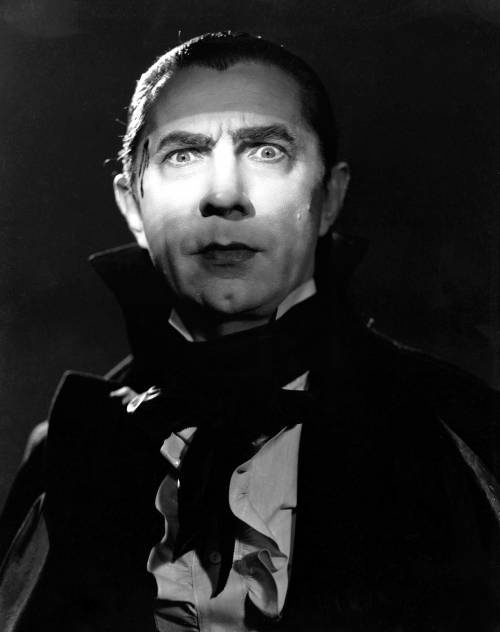
The film was the classic 1931 version of Bram Stoker’s Draculastarring the great Bela Lugosi as the Count. This version – the first of many variations on the theme – was based very closely on the 1927 Broadway play in which Lugosi also played the title role. The music we heard was specially composed to accompany Dracula by Philip Glass, and the man himself was there to perform it. Philip Glass, I mean, not Count Dracula. The musicians numbered six in total, actually, as Philip Glass was joined by the Kronos Quartet  and together they were directed by Michael Riesman, who sat with his back to the audience watching the film on the big screen.

Although the musicians started a bit ropily, they soon pulled themselves together and it became obvious that the music was going to bring a significant new dimension to this pioneering old horror movie. In fact, as a very early “talkie” the original film had no musical score at all and very few sound effects of any kind. The music composed by Philip Glass brings extra dramatic intensity to some of the movie’s iconic sequences, such as the battle of wills when Dracula tries to mesmerise Professor van Helsing. The insistent repetition which is characteristic of Glass’ minimalist approach adds urgency where needed, but there are also contrasting passages of relaxed beauty. The score is also beautifully understated where it needs to be, simple enough not to distract attention away from the screen.

The passing years have not been particularly kind to the film. The effects are often unconvincing (to say the least), especially the  bats-on-strings, some of the acting very hammy, and the audio quality was so poor that the dialogue was often so muffled as to be barely audible (and not helped by bad mixing with the music).

Once you look past these superficial aspects, however, it’s not difficult to understand why this film is regarded as such a classic, because it is a highly original piece of work. It’s a far cry from a modern gore-fest, of course. The horror is implied rather than made explicit; all the actual blood-sucking happens out of shot. But the unsettlingly disjointed narrative, full of unexpected changes of scene and unexplained goings-on, gives it a dream-like feel and conjures up a unique sense of atmosphere. Although it it is now extremely dated, it doesn’t take that much imagination to understand why it created a sensation way back in 1931, with people apparently fainting in shock in the cinema. It also made a huge amount of money at the box office.

Vampire movies  are replete with their own set of clichés – the crucifixes, the absent reflections, the bats, etc etc – but this is the daddy of them all. The one thing that surprised me was the lack of garlic; the favoured protection against this particular member of the Undead is Wolfsbane (a member of the Aconite family of attractive yet lethally poisonous flowering plants; I used to grow a variety called Monk’s-Hood in my garden when I lived in Nottingham).

In the end, however, Dracula owes it all to the mesmerising screen presence of Bela Lugosi. This film made his name, and he was to spend most of the rest of his career typecast as a horror villain. His later years represented a downward spiral. Trouble with sciatica led doctors to prescribe him with opiates, on which he became hooked.  His drug addiction made him notoriously unreliable and work dried up. His career dwindled away into obscure bit parts in poor quality B-movies.

Although Bela Lugosi had his limitations as an actor, he didn’t deserve his fate. I’ve said before on here that I think people should be judged by their best work rather than by their worst, and so it is with Bela Lugosi. He was, and remains, the  Count Dracula.

The Cat

Posted in Music with tags , , , on May 27, 2012 by telescoper

I can’t believe I haven’t posted anything yet by the legendary  Zoot Money so here he is with the Big Roll Band doing a cover version of Jimmy Smith’s The Cat. This is one for the Oldies, I guess, since it’s from way back in 1966.

I suppose that posting this will reveal that I’m more of a Mod than a Rocker, although if truth be told I’m not really that much of either. Now, where’s my Lambretta?

Shostakovich and Debussy

Posted in Music with tags , , , , , , , on May 26, 2012 by telescoper

With Cardiff likely to be in the grip of Olympic Torch fever I decided yesterday to avoid the crowds as much as possible and take in a  bit of culture in the form of a concert at St David’s Hall. My usual route into work being blocked by the closure of Bute Park to the public I walked into the city centre, paid in a few very welcome royalty cheques at the bank, and went to St David’s in person to book a ticket. I had no problem getting a good seat, but the staff issued dire warnings about getting here in good time for the 7.30 start as the Olympic Torch would be passing right in front of the venue just before the concert.

Despite the crowds I reckoned I had time for a quick pint (or two) in the Poet’s Corner before kick-off. Walking there from my office I saw a few people on Newport Road waiting for the Torch and its entourage, but not all that many. While I drank and chatted with a couple of PC regulars, the noise of a helicopter circling announced the arrival of the flame in our vicinity. I was almost tempted to pop outside for a look, but although the Olympic Torch was outside, the beer was inside and a man must have priorities in life.

So about 6.45 I headed off towards St David’s Hall. There were people out and about, but no more than you’d expect on a sunny Friday evening. Traffic had already re-started and disruption seemed fairly minimal. I don’t know where the Torch had got to by then but I arrived at the Hall at 7.00 to find a crowd watching it on the Big Screen in the Hayes. I went straight in and had a nice glass of wine.

When I got into the auditorium for the evening’s concert I was a bit taken aback, not only by the huge size of the orchestra (particularly the brass section) but also by its unusual arrangement: the strings were divided in two, arranged more-or-less symmetrically with cellos and basses to far left and far right. I was also initially perturbed that my favourite handsome violinist was not in his usual place, but I soon located him and all was well with the world.

The concert, featuring the BBC National Orchestra of Wales conducted by associate guest conductor Francois-Xavier Roth, was broadcast live last night on BBC Radio 3, incidentally, and you can listen to a recording here.

The unusual orchestral arrangement was needed for the first piece of the concert, called Sound and Fury, by contemporary French composer Philippe Manoury. This is a work that’s full of contrasting moods, set against an overall concept relating to the battle between order and chaos. Passages in which stable melodic lines can be identified evolve into savage cacophony and back again; there are also sequences where the two halves of the orchestra act as two independent forces, challenging and responding to each other across the stage. Not exactly easy listening, but fascinating nonetheless.

After the interval we had the two “main pieces” of the evening, played by a more conventional orchestral line-up. First was the First Violin Concerto by Dmitry Shostakovich with soloist Daniel Hope (dressed, I have to say, in a horrible shiny suit). The open movement, entitled Nocturne, is striking for its lightness, and the apparent simplicity of its singing solo lines. The second movement Scherzo, darker and more intense, is followed by a wonderful slow movement marked Passacaglia, the end of which is marked by a fiendishly difficult solo cadenza that bridges into the final Burlesque. Daniel Hope played it with great verve and confidence, but in the context of the overall work I found it a bit gratuitous. Still an impressive piece, though, with many of the hallmarks of Shostakovich’s great symphonies.

The last piece was Images pour Orchestra by Claude Debussy. While the preceding Shostakovich work is perhaps a symphony masquerading as a suite, Images is definitely not a symphony. It’s a series of impressionistic and enigmatic vignettes of very differing mood. It’s in three movements, but the central one is itself divided into three distinct parts, so it is really five movements. The opening one includes, to my surprise, the Northumbrian tune The Keel Row and there are references to Spanish and French folk songs later on.  The whole impression you get listening to this work is similar to walking through an art gallery looking at paintings that relate to each other in some ways, but contrast in others, or perhaps reading an anthology of poems by different poets.

Three different works from the 20th century, each with a very characteristic voice of its own and each with much to enjoy made for an absorbing concert. St David’s Hall was rather sparsely populated – the Cardiff audience is notoriously conservative in its musical tastes, and the Olympic Torch business wouldn’t have helped –  but those that had made the effort were extremely appreciative at the end.

Having got my musical fix for the week I headed home. It must have only been about 9.45, but the concert in Bute Park seemed to have ended already. The city was busy, but not unusually so. The barricades had gone, and the buses were running again. I walked home through Sophia Gardens in the deepening twilight and saw a bat flying nimbly in silhouette against the crescent moon. Whatever happens in the future, that Image will be a treasured memory of Cardiff.

C Jam Blues

Posted in Jazz with tags , , on May 22, 2012 by telescoper

I finished a marathon session of examination marking yesterday evening, and gave the papers another check through this afternoon just as a precaution against any errors on my part. Now I’m satisfied with them I’m going to hand them over to the second examiner tomorrow morning for another check. We do take a lot of care over this things, you know…

Having got such such a big job out of the way I think there’s grounds for a minor celebration. On top of that I noticed this afternoon that the total number of visits to this blog has just passed the one million mark!  Thanks to everyone who has visited for taking the trouble to read my ramblings. I hope to be able to pass on news of an important development on the blog very soon…

In the meantime, here’s a video I’ve been waiting for a good day to post. It’s the great Oscar Peterson Trio vintage 1964 in excellent form playing a Duke Ellington standard called C Jam Blues which, as its name suggests, is a 12-bar blues in the key of C Major. I have many reasons for loving this performance: Oscar Peterson’s lengthy improvised introduction is worth a shout all on its own, but watch out for the little look he gives to bassist Ray Brown at about 2.34 to signal him in at the start of the next chorus. Look out too for the flawless performance of the legendary Ed Thigpen on drums; one of my Dad’s absolute favourite drummers, and mine too. The three musicians are definitely all on the same wavelength for this track, but the eyeball communication between Ed Thigpen and Ray Brown seems almost psychic.

Tristan und Isolde

Posted in Opera with tags , , , , , on May 20, 2012 by telescoper

Regular readers of this blog will know that, although I’m a regular opera-goer, I’m by no means as much of a devout fan of Richard Wagner as many of that ilk, including some of my colleagues. Nevertheless, I have decided to persevere in much the same way as I have done with Brahms. Last night I had an opportunity to do just that by going to the first night of the new run of Tristan und Isolde by Welsh National Opera. I was particularly delighted to see this opera on the WNO schedule for this year, because it is an opera with which I am a little bit familiar, and thus provided me with an excuse to persevere a little bit more, for reasons I shall explain…

Years ago, when I lived in Nottingham, on a warm summer evening I decided to listen to some of the live broadcast on BBC Radio 3 of Tristan und Isolde from Glyndebourne. I made myself a cocktail and took the radio out into the garden with the intention of listening to a bit of it before going out for the evening. This was back in the days when I actually used to go out on the town on Saturday nights; now I’m too old for that sort of thing. Anyway, I was hooked right from the Prelude. Act I came and went and I decided to make some dinner in the interval, opened a bottle of wine, and returned to listen to the rest of it. The glorious music washed over me in the sultry twilight. Darkness fell, a second bottle of wine was opened, and still I listened – no doubt to the consternation of my neighbours. The final Liebestod was so beautiful I almost cried. Eventually I retreated to the house having experienced my first all-out Wagner trip.

My enjoyment of that occasion was of course helped by the fact I could get up and walk around occasionally, as well as by the liberal intake of fine wine. Nevertheless, I took enough out of it to want to see a full performance. Last night was my chance.

I think the first thing to say about Tristan und Isolde is that the music is completely wonderful. Not only ravishingly beautiful, but also haunting and complex. The opening bars establish a vividly chromatic orchestral palette which is used to brilliant effect to create the atmosphere of tragedy that pervades this work. The opening chord, the Tristan chord, is dissonant and its effect is strengthened by its resolution into another dissonant chord.

It’s often been said – probably with justification – that the freedom with which Wagner composed this opera opened up a whole new set of possibilities for Western classical music. It’s also wonderful to listen to.

So as a music drama it scores nearly 100% for the music. As a drama, though, it leaves a lot to be desired. The plot in Act I is absurd even by operatic standards. Isolde plans to poison Tristan and then take poison herself, but her servant Brangäne does a nifty switch of the vials and the two drink a love potion instead. This ignites a mutual desire that had previously been dormant and leads them into a tragic confrontation between love and responsibility. Isolde, you see, is betrothed to King Mark of Cornwall, and Tristan is his most loyal and virtuous knight. You know this isn’t going to end well, but the bit with the potions reminded me of that old Danny Kaye sketch about the “Vessel with the Pestle”.

Act 2 finds Tristan and Isolde in a dark wood, having embarked on an illicit love affair. It’s basically just the two of them on stage expressing their love to each other in wonderful music. Dramatically, however, nothing at all happens for the best part of an hour until right at the end when the King and his men find the couple in flagrant deliciousness. Now I understood why this opera works so well on the radio..

Tristan is stabbed by one of the King’s cronies at the end of Act 2, but the start of Act 3 finds him back in his ancestral home in Brittany, mortally wounded, lying under a very large plank of wood. In despair he hopes that Isolde will find him and mend his wounds with one of her potions (hopefully the right one this time). She arrives, but he snuffs it before she can help. Then another ship arrives, carrying King Mark and his boys, who have obviously been in hot pursuit across the English Channel. Isolde sings of being reunited in love with the dead Tristan and as she sings the stage and other actors fade from view. She dies.

Full marks to Isolde, Ann Petersen, a wonderful dramatic soprano with an electrifying voice; she’s from Denmark, incidentally. Canadian-born Ben Heppner as Tristan, was also in good voice, although he sometimes struggled to project and his rotund appearance called for a bit of audience imagination for him to be seen as a dashing knight. Mezzo  Susan Bickley was a splendid Brangäne too.

The Orchestra of Welsh National Opera under the direction of Lothar Koenigs were excellent too, after a rather nervous opening during which they seemed almost to be in awe of the music they were playing. And a special word for the staging, which was rather stark but also very clever, especially during Act I when a translucent screen divided the front and back of the stage and allowed some intriguing lighting effects.

I’d prepared myself psychologically for the 5 hours plus of this performance – not too bad actually, when you realise that includes two intervals, of 25 minutes and 50 minutes respectively – so I coped well enough. The piece definitely has its   longueurs, but you can always shut your eyes and imagine you’re in the garden at home..

R.I.P Dietrich Fischer-Dieskau

Posted in Music with tags , , , on May 19, 2012 by telescoper

I was very sad to hear, first thing this morning, of the death at the age of 86 of legendary singer Dietrich Fischer-Dieskau. I can’t add anything to the host of tributes that have already appeared, except to say that his voice will always be very special to me because his recording of Schubert’s Winterreise (with Gerald Moore on piano) was the first I ever heard of any Schubert Lieder.

Instead of trying to write an appreciation which couldn’t possibly to justice to the man and his musical legacy, I’ll just post this video and let it speak for itself. This is Winterreise in its entirety, performed in 1979 by Fischer-Dieskau with Alfred Brendel on piano.

Rest in peace, Dietrich Fischer-Dieskau (1925-2012).

Ars Nova Copenhagen

Posted in Music with tags , , , , , , , , , on May 11, 2012 by telescoper

Yesterday being the day of my last revision lecture I decided to mark the end of the teaching year last night by going to a concert which was part of a series belonging to the 2012 Vale of Glamorgan Music Festival and was held in All Saints’ Church, Penarth. I would like to have been to more of these performances, but unfortunately it’s the busiest period of the academic year and I just couldn’t spare the time.

I made a special effort to make sure I could get to last night’s concert by the choir  Ars Nova Copenhagen partly because of their illustrious reputation as choral singers but also because the programme featured music by Danish composer Per Nørgård, whose music I have only just discovered. Ars Nova Copenhagen consists of twelve singers of extraordinary individual ability and wonderful collective cohesion under the direction of Søren Kinch Hansen. Last night’s performance was truly marvellous.

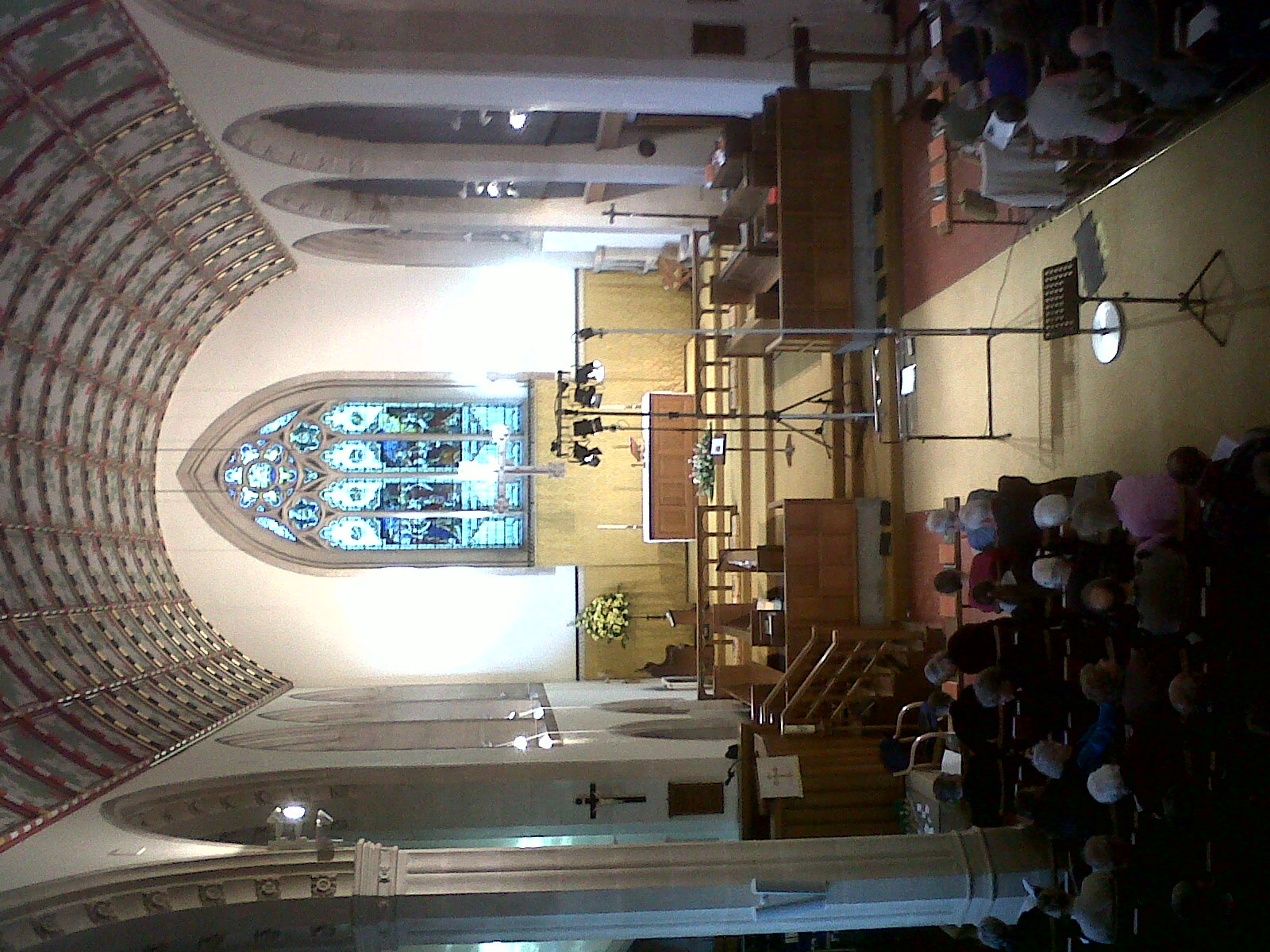
To the left you can see a picture of the venue, just before the concert started; we had seats in the gallery giving an excellent view of the whole performance. The choir made full use of this space, sometimes dividing into groups and standing in different parts of the church. I’m not all that familiar with the terminology of church architecture, but that includes just in front of the sanctuary (where the altar is), in the choir, and in the aisles either side of the central one. Incidentally, I have been told on more than one occasion that the central passageway through the nave is not, as is often stated the aisle; the aisles are the smaller parallel passageways to either of the nave. I’m sure someone will correct me if I’m wrong!

Anyway, the programme consisted of a mixture of sacred and secular music (some of the latter actually rather profane), starting with a longish  piece by Pelle Gudmundsen-Holmgreen which had the choir not only singing but also tweeting like birds and doing animal impressions. I was initially unsettled by this, but pretty soon decided that I liked it.

There then followed three pieces by the great Estonian composer Arvo Pärt – all of which were lovely, but I particularly enjoyed the piece called Morning Star – and then three beautiful pieces by Per Nørgård bringing the first half of the concert to a close.

Somewhat surprisingly for a concert in a church, there followed an interval at which we had a glass of wine. Then there was a second half which had a rather different, rather eclectic flavour. It started with two new works commissioned especially for this Festival, by Peter Bannister and Gavin Bryars, the latter being a moving setting of Psalm 141. A subset of the male voices of the choir then performed a piece by minimalist composer Steve Reich. Finally we heard a fascinating work by Anne Boyd called As I crossed the bridge of dreams which was bore the hallmarks of an oriental influence.

All in all, it was a fascinating and adventurous evening of music, by a wonderful and versatile group of vocal artists, helped by the intimate yet rich acoustic of All Saints’ Church.

You can’t beat live music. What with the various concert venues and the Opera here in Cardiff there are so many opportunities to hear the real thing that my CD collection is steadily gathering dust.

Muggles

Posted in Jazz with tags , on May 10, 2012 by telescoper

A bit fed up today, and too tired to post anything substantive, so I thought I’d cheer myself up this lunchtime the old-fashioned way with a bit of Louis Armstrong. This was recorded in 1928 by Satchmo with the later incarnation of the Hot Five, which naturally numbered six people in total. The title, Muggles, has nothing to with Harry Potter but is a slang word popular in 1920s Chicago that refers to a certain smoking material of an illicit nature, to which Mr Armstrong was rather partial all his life and which no doubt contributed to the relaxed atmosphere pervading this recording session..


The Tallis Scholars

Posted in Music with tags , , , , , on May 4, 2012 by telescoper

I’ve always wanted to be at a live performance of the legendary 40 part motet  Spem in Alium by Thomas Tallis, not only  because it’s a gorgeous piece of music but also because I’ve always wondered what the conductor is supposed to do with his hands when there are so many independent parts. It’s such a complicated and demanding work, however, that opportunities to hear it live are rather limited. Last night’s concert at St David’s Hall by the Tallis Scholars (supplemented by a local choir; the Tallis Scholars number only ten singers) actually involved two performances of Tallis’ most famous work, first at the beginning and then again right at the end.

If you’ve never heard Spem in Alium before, then you really should make the effort. It’s an extraordinary piece of music in many different ways. Most writers focus on its complexity, but that shouldn’t make you think Tallis was just showing off when he wrote it, or distract you from the fact that it’s so very beautiful to listen to. The forty parts  involved are divided into eight choirs, each of five voices. The piece starts with one voice from the first choir, and slowly evolves to incorporate all forty voices, waving each individual vocal line into a gorgeous musical tapestry. At times all the voices seem to be acting independently within the overall harmonic framework, at others the choirs act as the basic unit; there’s a wonderful passage, for example, when choirs throw phrases backwards and forwards between them. There are also moments when all the evolving parts come back into phase so that all voices sing the same words at the same time. The effect of this is indescribable; it sent cold shivers down my spine.

There is so much going on in this piece that it’s difficult to understand how Tallis managed to stop the different parts interfering destructively with each other, but Spem in Alium  never dissolves into a shapeless melisma. As the piece unfolds, the various patterns that appear and disappear are always held in sharp focus. It’s a masterpiece, and although the large space of St David’s Hall probably isn’t ideal for performing a work like this, my long wait to hear a live performance of this masterpiece was well worth it.

The concert wasn’t just about Spem in Alium.  The Tallis Scholars performed a number of other works on their own, including pieces by Tallis’ old mate William Byrd and part of one of my other favourite Tallis works, The Lamentations of Jeremiah. The programme called for various combinations of the singers drawn from the ten in the basic line-up, producing a wide range of texture and colour.

It was all extremely enjoyable, but my lasting memory will be the piece that started and ended the show. There’s so much to discover listening to Spem in Alium that the second performance of it that ended the concert made me want to hear a third straight away.

PS. One of the other pieces performed during the concert was Tallis’ Miserere, which aptly described Cardiff City’s performance at home to West Ham in their play-off semi-final which was being played at the same time as the concert!

Here’s That Rainy Day ..

Posted in Jazz with tags , , on April 28, 2012 by telescoper

If yesterday’s post made you wonder how difficult it is to turn a piece of sheet music into sound using a piano keyboard, then perhaps today’s will make you wonder how a pianist like Bill Evans managed to create music as beautiful as this without any score at all! This is Here’s that Rainy Day from the 1968 album Bill Evans Alone. Miles Davis said of Bill Evans “He plays the piano the way it should be played”. I, for one, won’t argue with that.