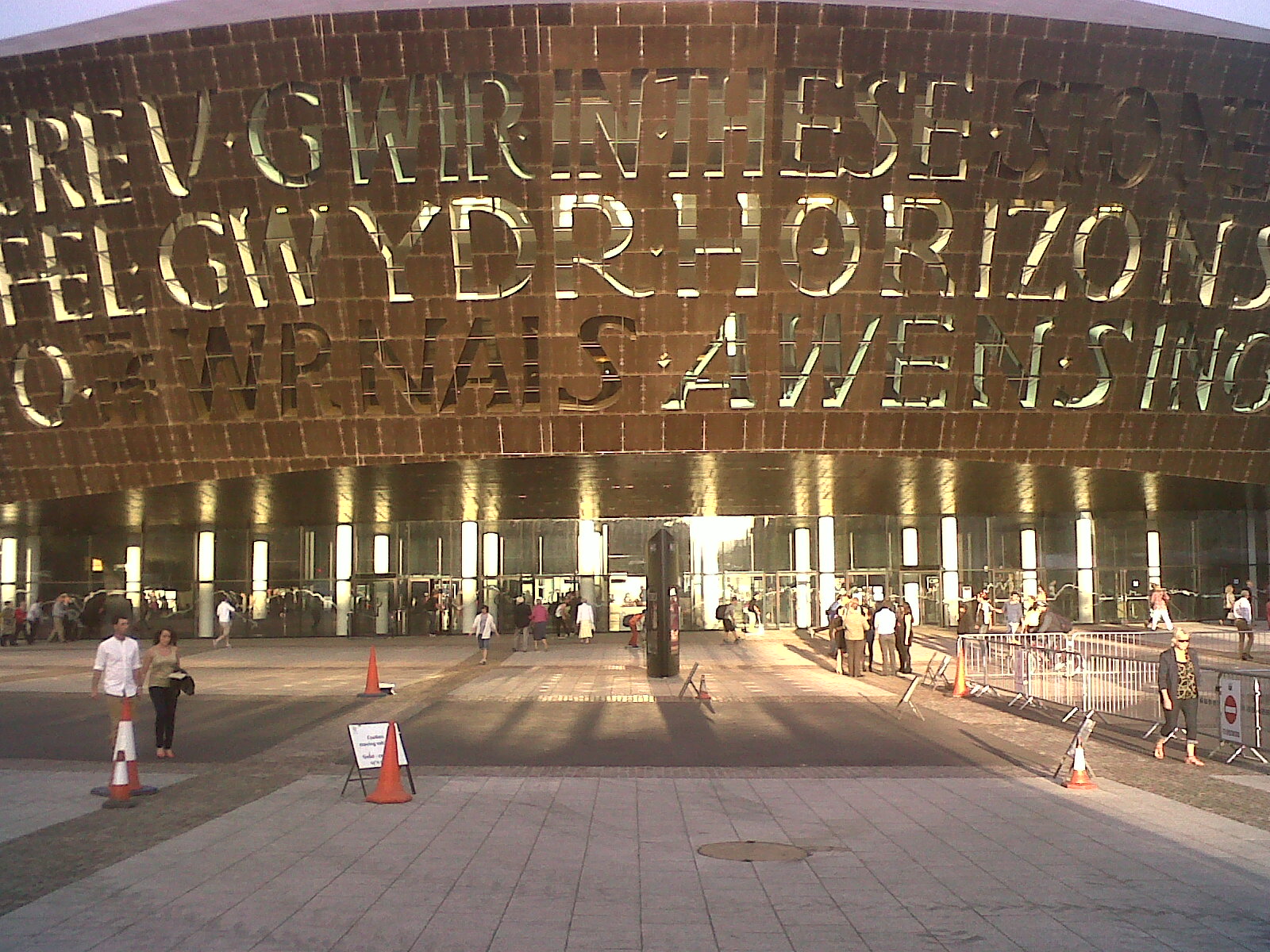
I took time out from a busy week yesterday evening for a performance by Welsh National Opera of Jephtha by George Frideric Handel. Based on a biblical story (from the Book of Judges), Jephtha was written late in Handel’s life (indeed it was the last major work Handel wrote) as an oratorio rather than an opera, and was first performed as such in 1752.
Last night’s production brought movement, scenery and costumes to Handel’s lovely music in an attempt to turn it into an opera. It was only partially successful in doing that. Owing to the nature of the piece, it appeared as a series of rather static tableaux rather than a compelling music drama. It did however, feature excellent music and singing, and very imaginative use of a rather simple set, an interior of faded and battered opulence, complete with broken plaster and bullet holes, and costumes that evoke the period leading up to World War II.
You can get a good idea of the look of the performance in the following WNO trailer:
The story revolves around the character Jephtha who is called upon to lead the people of Gilead in battle against Ammon. He takes up the challenge, and when he proves victorious he rashly (and cruelly) vows to make a sacrifice of the first human being to greet him when he returns home. That turns out to be his daughter, Iphis. Will he carry out his pledge and turn Iphis into a burnt offering? Will an Angel of the Lord intervene and spare her? I won’t spoil the plot, except that that the operatorio does not end in the same way as the bible story seems to…
As for the singers, I thought Fflur Wyn (Iphis) was the pick – her voice beautifully conveyed the innocence and fragility of the young daughter. Robin Blaze as Hamor (Iphis’ betrothed) was also excellent in the counter-tenor role. I wasn’t so keen on Robert Murray as Jephtha, whose voice was rather thin and undistinguished especially early on in the performance. But it was really Handel’s music that took centre stage. Although the performance contained much to savour, I’m not convinced that staging Jephtha as an opera was really worth it. I would probably have enjoyed it just as much if it had been performed as an oratorio, like Messiah.
I huddled in the cold, rainy wind and watched everything across the sad vineyards of October in the valley. My mind was filled with that great song “Lover Man” as Billie Holiday sings it; I had my own concert in the bushes. “Someday we’ll meet, and you’ll dry all my tears, and whisper sweet, little things in my ear, hugging and a-kissing, oh what we’ve been missing, Lover Man, oh where can you be …” It’s not the words so much as their great harmonic tune and the way Billie sings it, like a woman stroking her man’s hair in soft lamplight.
I’m up bright and early this morning – well, early, at least – after my long trip yesterday. I was slightly nervous about my itinerary, especially the (for me) uncharted territory at the end. As it happens, the train from Cardiff to Heathrow, direct flight from Heathrow to Phoenix and shuttle bus from Phoenix to Flagstaff, Arizona, all went to plan. I arrived just after nine yesterday evening, tired but intact.
One thing worth mentioning is that this is the first time I’ve set foot on American soil for many years. My lamentable experience with the US Embassy in London in 2005 succeeding in putting me off visiting the States almost entirely. However, I’m told that travelling is meant to be good for me, so I decided to accept the invitation to attend and speak at the conference I posted about a while ago. One of the relics of the 2005 episode is an unused J-1 visa in my passport, and when we arrived in Phoenix I was consequently a little apprehensive about whether questions might be asked about it. That added to the usual anxiety about length of queues at Immigration. As it turned out, the staff were courteous and efficient and the uniformed officer I spoke to at the desk and who took my fingerprints etc was an enthusiastic amateur astronomer who seemed more interested in my work than in the formalities at hand. Anyway, my virgin visa attracted no comment at all.
Despite landing a bit late, I actually got through the airport in good time to catch the shuttle to Flagstaff. Phoenix, by the way, was a scorching 37 Celsius, even at 5.30 in the pip emma. I dread to think how hot it must have been at mid-day. Flagstaff is, I’m told, a bit cooler being up in the mountains although it was dark when I arrived and I didn’t really see much of the place before getting to the hotel, having a quick blog, and then crashing out.
Incidentally, the route from Phoenix to Flagstaff is north on the I-17 until it hits Route 66, subject of the famous song in which Flagstaff gets a mention:
My hotel is actually situated on Route 66, but so far there’s no sign of anything that could truthfully be described as “kicks”.
Anyway, I have to speak later today so I should probably start writing my talk. As they don’t say around these parts, Toodle-pip!
Listening to this track from Ornette Coleman on my iPod on the way home today reminded me that I haven’t posted anywhere enough by the great man, so I decided to post this as a soon as I got home. Faces and Places was recorded live at the Golden Circle club in Stockholm in 1965, and is part of a famous album that was proclaimed “Record of the Year” the following summer in Downbeat magazine. By the mid-60s Ornette Coleman had already established his reputation as leading light of avant-garde saxophonists and, in his own way, was as great an influence on jazz as Charlie Parker, Sonny Rollins and John Coltrane had been earlier.
It features a trio of Coleman on alto sax, David Izenzon on bass, and Charles Moffit on bass. It goes like the clappers right from the start, with some terrific work on the drums by Moffit, skittering along on the cymbals with interludes of powerful rapid-fire accents on the skins. Fantastic stuff.
Time rolls on and the end of the summer brings the beginning of the new Opera season in Cardiff, with La Bohème by Giacomo Puccini at Welsh National Opera. It seems like a thousand years since I last went to the Wales Millennium Centre but it was only May. Still, a lot has happened between then and now. It felt good to see the Wales Millennium Centre again, looking resplendent in the sunshine of a September evening. Life’s getting back to normal.
I confess that I still get butterflies in my stomach as I take my seat before a night at the Opera. I guess if that thrill ever disappears I’ll just stop going, but last night reminded me why I love the Opera so much. The performance was absolutely wonderful, perhaps the best I’ve seen at Cardiff since I moved here five years ago.
I suppose the story of La Bohème will be familiar to anyone with even a passing interest in Opera, but I’ll give a quick synopsis anyway. It’s a boy-meets-girl love story, of course. The boy in this case is the poet Rodolfo (Alex Vicens) and the girl, actually named Lucia but known as Mimi (Giselle Allen). The setting is Paris around 1830, and the poet and his painter friend Marcello (David Kempster) are starving and freezing, as it is winter and they have no money. Act I is set on Christmas Eve, but the two friends have nothing to eat and nowhere to go. Fortunately, their musician friend Schaunard (Daniel Grice) turns up with money and provisions. After various comings and goings everyone but Rodolfo leaves to spend Christmas Eve out on the town; Rodolfo has to finish a piece for a journal, and promises to join them when he is done. However, he is interrupted by the arrival of Mimi, who lives nearby and whose candle has gone out. It’s love at first sight…
The later stages of Act I are built around Rodolfo’s aria Che Gelida Manina (“your tiny hand is frozen”) and Mimi’s Mi Chiamano Mimi. These beautiful songs follow one another in quick succession, and are then rounded off with a wonderful duet O Soave Fanciulla in a manner guaranteed to melt the stoniest of hearts. And, before you ask, yes I did cry. Just a little bit. I don’t think anyone noticed.
But it’s not just the ravishing music that makes this passage so special, it’s also Puccini’s gift as a story-teller: after the two arias by Rodolfo and Mimi, the audience knows everything they need to know about these characters. It’s a great example of why I think Puccini is a far greater writer of Opera than, say, Wagner. Puccini understood much better than Wagner how to vary pace and colour without allowing the story to bogged down, and he knew exactly how to use his big tunes to maximum dramatic effect (i.e. without excessive repetition). In fact, La Bohème is in four acts, but its running time is just about 2 hours and 15 minutes, packed full of gorgeous music and compelling drama. It’s a supreme example of Puccini’s artistry as a composer of Opera.
Anyway, back to the plot. Act II finds Rodolfo and Mimi joining in the party started by Marcello and his buddies. There’s a huge contrast here between the dingy garret in which Act I is set, as this is set in the Latin Quarter of gay Paris (with a few drag queens in this production thrown in to make the point). Marcello gets off with the object of his desire, the coquettish Musetta (Kate Valentine), and all seems well with the world as we go into the interval.
In Act III we find things have changed. Rodolfo’s love for Mimi has soured and, overcome by jealousy and suspicion, he has left her. Clearly unwell, Mimi wanders around looking for Rodolfo and he hears her coughing. They clearly still love each other, but find it difficult to live with each other. If Opera were Facebook they would both have “It’s complicated” on their status.
The last act finds us back in the garret, Rodolfo and Mimi having separated. But Mimi has been wandering the streets in the freezing cold and turns up, clearly gravely ill. Rodolfo’s friends quickly pawn some meagre possessions and Marcello and Musetta rush out to buy medicine and summon a doctor. They return with the medicine but, before the doctor arrives, Mimi dies.
Well, what did you expect in an Opera, a happy ending?
People say that this is a romantic opera but it’s a pretty bleak story when you think about it. The lovers’ happiness is brief and it all ends in despair and death in surroundings of poverty and squalor. That’s what Opera Verismois all about.
I don’t give star ratings when I review Opera performances, but if I did this would get the highest grade. All the principals were marvellous. It was refreshing to see Rodolfo played by a tenor who not only looked the part (i.e. youthful and dashing rather than middle-aged and portly) but could also cope with the demands of the role. I thought Alex Vicens’ voice sounded a little thin at the start and was worried that he might have to force it during the big arias, but he warmed up magnificently. Kate Valentine was a very sexy Musetta. The other person who deserves a particular mention is Welsh baritone David Kempster, who was absolutely superb as Marcello. His compelling stage presence matched by an exceptionally fine voice. World class, I’d say…
And a word for the production. Annabel Arden’s design managed to bring fresh elements to what is basically a straightforward interpretation of the Opera. The visual effects, such as the animated snow, were clever but not intrusive. There was no attempt to translate the action into a different period or location nor was there an attempt to preach about disease as a metaphor for moral failings. In this respect it’s very faithful to what I think Puccini’s intentions were, i.e. to let the audience make their own mind up about what message they want to take away. The only slight departure I spotted was that in Act I Mimi actually blows her own candle out deliberately in order to get Rodolfo to light it again. Methinks she’s a bit more forward than usual in this production.
This was the first performance of this run of La Bohème. If you love Opera and can get to Cardiff, then do go and see it. It’s very special.
By way of a postscript I couldn’t resist posting this, which I found on Youtube this morning. It’s a vintage recording of O Soave Fanciulla dating back to 1956 and featuring the great Jussi Björling as Rodolfo. He may be a bit old for the part, but listen to that voice! The greatest tenor of his generation, without question. And Renata Tebaldi as Mimi too…
Well, summer must be nearly over. Tonight is the Last Night of the Pimms Proms. More importantly, it’s the first night of the new season at Welsh National Opera, which I’ll be attending. Of which more anon. However, I thought I’d warm up by posting this marvellous clip which looks behind the scenes at a famous recording of the rarely performed English version of the classic aria Dovrei essere così fortunato from the Opera Una Ragazza Australiana con le Natiche Belle conducted by Carl Davis. Enjoy.
Since the new series of Doctor Who is to start this evening on BBC1, I thought I’d mark the occasion by posting this old blog item again:
–0–
As a Professor of Astrophysics I am often asked “Why on Earth did you take up such a crazy subject?”
I guess many astronomers, physicists and other scientists have to answer this sort of question. For many of them there is probably a romantic reason, such as seeing the rings of Saturn or the majesty of the Milky Way on a dark night. Others will probably have been inspired by TV documentary series such as The Sky at Night, Carl Sagan’s Cosmos or even Horizon which, believe it or not, actually used to be quite good but which is nowadays uniformly dire. Or it could have been something a bit more mundane but no less stimulating such as a very good science teacher at school.
When I’m asked this question I’d love to be able to put my hand on my heart and give an answer of that sort but the truth is really quite a long way from those possibilities. The thing that probably did more than anything else to get me interested in science was a Science Fiction TV series or rather not exactly the series but the opening titles.
The first episode of Doctor Who was broadcast in the year of my birth, so I don’t remember it at all, but I do remember the astonishing effect the credits had on my imagination when I saw later episodes as a small child. Here is the opening title sequence as it appeared in the very first series featuring William Hartnell as the first Doctor.
To a younger audience it probably all seems quite tame, but I think there’s a haunting, unearthly beauty to the shapes conjured up by Bernard Lodge. Having virtually no budget for graphics, he experimented in a darkened studio with an old-fashioned TV camera and a piece of black card with Doctor Who written on it in white. He created the spooky kaleidoscopic patterns you see by simply pointing the camera so it could see into its own monitor, thus producing a sort of electronic hall of mirrors.
What is so fascinating to me is how a relatively simple underlying concept could produce a rich assortment of patterns, particularly how they seem to take on an almost organic aspect as they merge and transform. I’ve continued to be struck by the idea that complexity could be produced by relatively simple natural laws which is one of the essential features of astrophysics and cosmology. As a practical demonstration of the universality of physics this sequence takes some beating.
As well as these strange and wonderful images, the titles also featured a pioneering piece of electronic music. Officially the composer was Ron Grainer, but he wasn’t very interested in the commission and simply scribbled the theme down and left it to the BBC to turn it into something useable. In stepped the wonderful Delia Derbyshire, unsung heroine of the BBC Radiophonic Workshop who, with only the crudest electronic equipment available, turned it into a little masterpiece. Ethereal yet propulsive, the original theme from Doctor Who is definitely one of my absolute favourite pieces of music and I’m glad to see that Delia Derbyshire is now receiving the acclaim she deserves from serious music critics.
It’s ironic that I’ve now moved to Cardiff where new programmes of Doctor Who and its spin-off, the anagrammatic Torchwood, are made. One of the great things about the early episodes of Doctor Who was that the technology simply didn’t exist to do very good special effects. The scripts were consequently very careful to let the viewers’ imagination do all the work. That’s what made it so good. I’m pleased that the more recent incarnations of this show also don’t go overboard on the visuals. Perhaps thats a conscious attempt to appeal to people who saw the old ones as well as those too young to have done so. It’s just a pity the modern opening title music is so bad…
Anyway, I still love Doctor Who after all these years. It must sound daft to say that it inspired me to take up astrophysics, but it’s truer than any other explanation I can think of. Of course the career path is slightly different from a Timelord, but only slightly.
At any rate I think The Doctor is overdue for promotion. How about Professor Who?
And now for something completely different, from the extraordinary whirlwind of creativity actually named Björk Guðmundsdóttir, but known throughout the Universe simply as Björk.
Last week’s post about Vincent Price reminded me of the film that really established him as a movie actor, the classic film noir Laura, in which he played the parasitic boyfriend of the eponymous heroine. If you’ve never seen the film, you should because in my opinion it hasn’t dated at all even though it was made in 1944. A song with the same name written for the film in 1945 (after the filming was completed) became a popular hit at the time as well as a favourite for jazz musicians, spawning numerous cover versions including one by the great Charlie Parker. Those of you who associate Bird with jagged bebop tunes played at a frenetic pace might be surprised to hear his take on this romantic ballad, particularly as it involves him playing with strings. The Charlie Parker with Stringssession recorded in 1950 received mixed reviews from the critics, primarily because many of the arrangements are a bit bland, but while I don’t like all these tracks, I do think Parker’s version of Laura is a gem in which he reveals a sensitive side to his music-making that isn’t often appreciated.
I haven’t posted any jazzy bits for a while. I don’t know why. Anyway, I just found this track, called Ablution, by alto saxophonist Lee Konitz. Unless my ears deceive me the pianist on this track is Ronnie Ball (British, by the way) whose comping makes no attempt to disguise the fact that it is a variation on the famous Jerome Kern tune All The Things You Are, the unusual chords of which have made it a popular vehicle for jazz musicians to improvise on ever since it was written back in 1939. In the bebop era it was typical practice to base original compositions on top of the chord sequences of standard tunes, and this is a prime example although I don’t know in this case whether Lee Konitz managed to get away without paying composer’s royalties!
The views presented here are personal and not necessarily those of my employer (or anyone else for that matter).
Feel free to comment on any of the posts on this blog but comments may be moderated; anonymous comments and any considered by me to be vexatious and/or abusive and/or defamatory will not be accepted. I do not necessarily endorse, support, sanction, encourage, verify or agree with the opinions or statements of any information or other content in the comments on this site and do not in any way guarantee their accuracy or reliability.