Of course, round my way, every week is Open Access Week.
The ongoing OA revolution should involve a radical reinvention/disruption of commercialized academic publishing instead of letting exploitative profit-making private publishing firms keep on fleecing the scholarly community. There is much still to do, and we’ll only succeed if more people turn words into actions.
It’s Sunday but I’ll be a bit busy next week so I’m taking the opportunity today to announce yet another new paper at the Open Journal of Astrophysics. This one was published on Friday 20th October.
The primary classification for this paper is Cosmology and NonGalactic Astrophysics and its title is “DES Y3 + KiDS-1000: Consistent cosmology combining cosmic shear surveys”. The article presents a joint analysis of the Dark Energy Survey Year 3 data and the Kilo-Degree Survey data, with a discussion of the implications for cosmological parameters. The key figure – a very important one – is this:
If you want to know more about the result and why it is so important you could read the paper. It is, however, rather long: 40 pages including 21 figures and 15 tables. Do not despair, though, because here is a video explaining the work in the series of Cosmology Talks presented by Shaun Hotchkiss:
Anyway, here is the overlay of the paper containing the abstract:
You can click on the image of the overlay to make it larger should you wish to do so. You can find the officially accepted version of the paper on the arXiv here.
It’s Friday so it’s a good time to catch up with the week’s action at the Open Journal of Astrophysics, where there have been two new publications so far this week. These papers take us up to a total of 40 in Volume 6 (2023) and 105 in total since we started publishing.
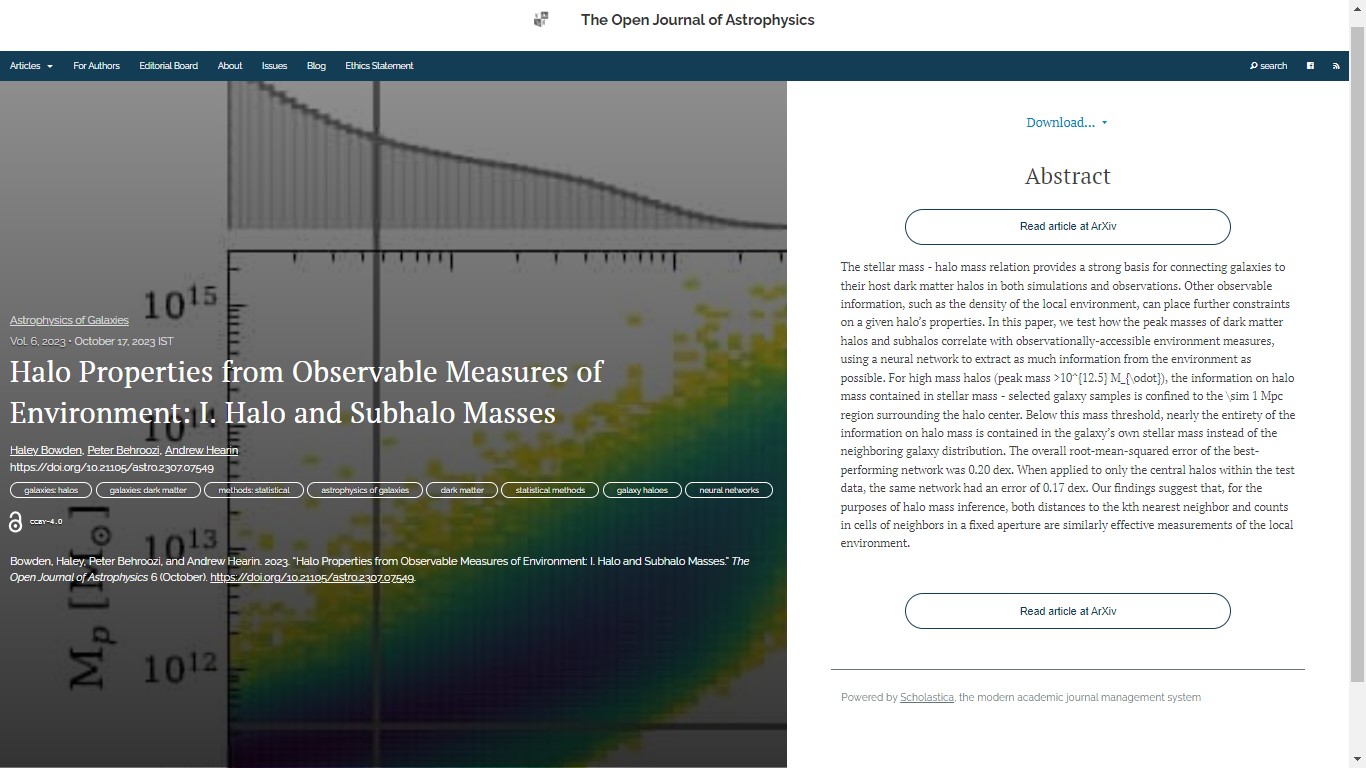
The title of the first paper is “Halo Properties from Observable Measures of Environment: I. Halo and Subhalo Masses” and its primary classification is Astrophysics of Galaxies. it is an exploration using neural networks of how the peak masses of dark matter halos and subhaloes correlate with observationally-accessible measures of their dependence on environment.
The authors based in the United States of America: Haley Bowden and Peter Behroozi of the University of Arizona, and Andrew Hearin of the Argonne National Laboratory
Here is a screen grab of the overlay which includes the abstract:
You can click on the image of the overlay to make it larger should you wish to do so. You can find the officially accepted version of the paper on the arXiv here.
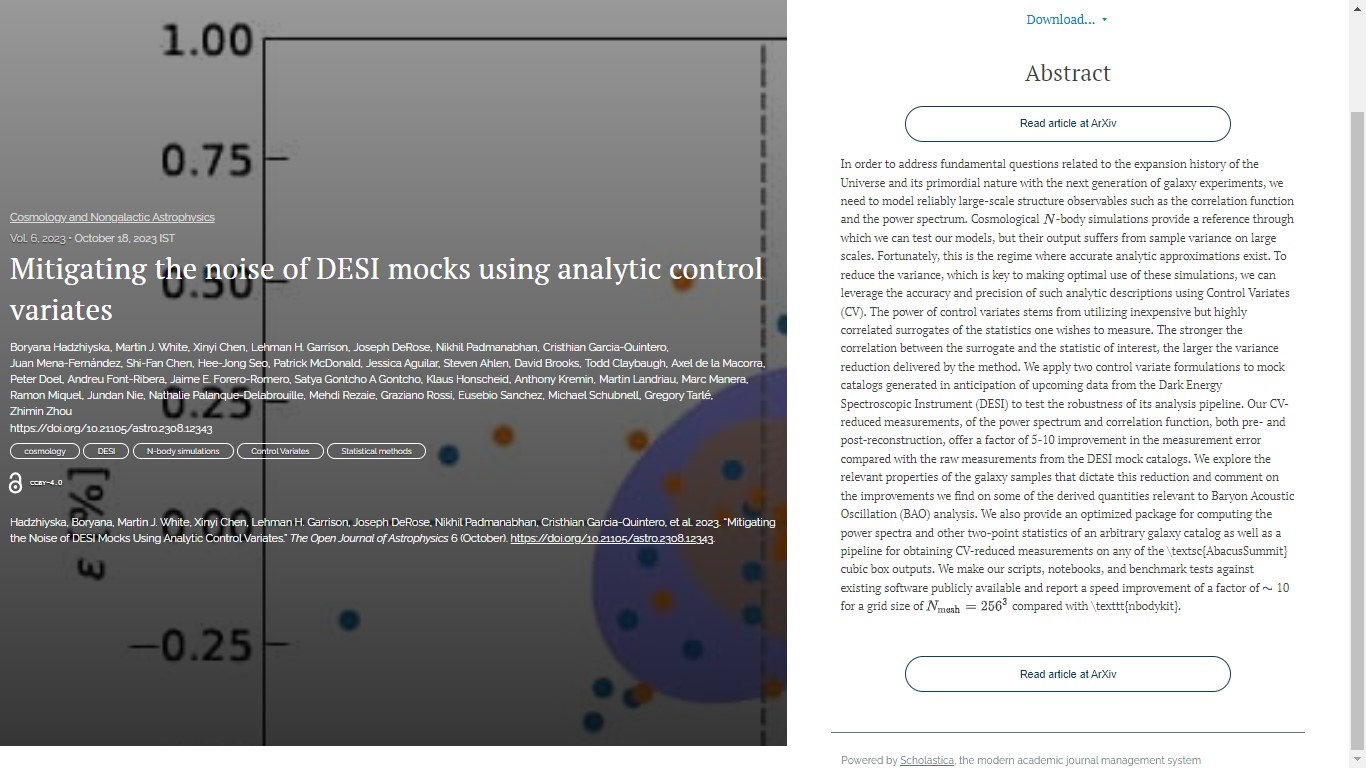
The second paper was published on 18th October 2023. The primary classification for this one is Cosmology and Nongalactic Astrophysics and is “Mitigating the noise of DESI mocks using analytic control variates”. For those of you not up with the lingo, DESI stands for the Dark Energy Spectroscopic Instrument and you can read more about it here.
The lead author for this one is Boryana Hadzhiyska of the Lawrence Berkeley Laboratory and the University of California, Berkeley (USA) and there are 32 other authors. This paper presents a method for reducing the effects of sample variance on cosmological simulations using analytical approximations and tests it using DESI data.
Here is a screen grab of the overlay which includes the abstract:
You can click on the image of the overlay to make it larger should you wish to do so. You can find the officially accepted version of the paper on the arXiv here.
Quite a few people have contacted me to ask about the Peer Review Process at the Open Journal of Astrophysics so I thought I’d do a quick post here to explain a bit about it here.
When a paper is submitted it is up to the Editor-in-Chief – that’s me! – to assign it to a member of the Editorial Board. Who that is depends on the topic of the paper and on the current availability due to workload. I of course take on some papers myself. I also reject some papers without further Peer Review if they clearer don’t meet the journal’s criteria of scientific quality, originality, relevance and comprehensibility. I usually run such papers past the Editorial Board before doing such a ‘Desk Reject’.
Once the paper has been assigned, the Editor takes control of the process, inviting referees (usually two) to comment and make recommendations. This is the rate-determining step, as potential referees are often busy. It can take as many as ten declined invitations before we get a referee to agree. Once accepted, a referee is asked to provide a report within three weeks. Sometimes they are quicker than that, sometimes they take longer. It depends on many factors, including the length of the manuscript.
Once all the referee reports are in the Editor can make a decision. Some papers are rejected upon refereeing, and some are accepted with only tiny changes. The most frequent decision is “Revise and Resubmit” – authors are requested to make changes in response to the referee comments. Sometimes these are minor, sometimes they are substantial. We never give a deadline for resubmission.
A resubmitted paper is usually sent to the same referee(s) who reviewed the original. The referees may be satisfied and recommend acceptance, or we go around again.
Once a paper is accepted, the authors are instructed to upload the final, accepted, version to arXiv. It normally takes a day or two to be announced. The article is then passed over from the Peer Review process to the Publication process. As Managing Editor, I make the overlay and prepare the metadata for the final version. This is usually done the same day as the final version appears on arXiv, but sometimes it takes a bit longer to put everything in order. It’s never more than a few days though.
Anyway, here are some “analytics” – it’s weird how anything that includes any quantitative information is called analytics these days to make it sound more sophisticated than it actually is – provided by the Scholastica platform:
These numbers need a little explanation.
The “average days to a decision” figure includes desk rejects as well as all submissions and resubmissions. Suppose a paper is submitted and it then takes 4 weeks to get referee reports and for the Editor to make a “Revise and Resubmit” request. That would count as 28 days. It might take the authors three months to make their revisions and resubmit the paper, but that does not count in the calculation of the “average days to decision” as during that period the manuscript is deemed to be inactive. If the revised version is accepted almost immediately, say after 2 days, then the average days to decision would be (28+2)/2 = 15 days. Also, being an average there are some shorter than 14 days and some much longer.
The acceptance rate is the percentage of papers eventually accepted (even after revision). The figure for ‘total submissions’ includes resubmissions, so the hypothetical paper in the preceding paragraph would add 2 to this total. That accounts for why the total number of papers accepted is not 50% of 388, which is 194; the actual figure is lower, at 105.
Finally, the number of manuscripts “in progress” is currently 23. That includes papers currently going through the peer review process. It does not include papers which are back with the authors for revisions (although it would be reasonable to count those as in progress in some sense).
There we are. I hope this clarifies the situation.
Time to announce yet another new paper at the Open Journal of Astrophysics. This one was actually published on Friday (6th October 2023), but for one reason and another I’ve only just got around to announcing it here.
The latest paper is the 38th so far in Volume 6 (2023) and the 103rd in all. The authors are: Matthew Price, Matthijs Mars, Matthew Docherty, Alessio Spurio Mancini, Augustin Marignier and Jason McEwen – all affiliated with University College London, UK.
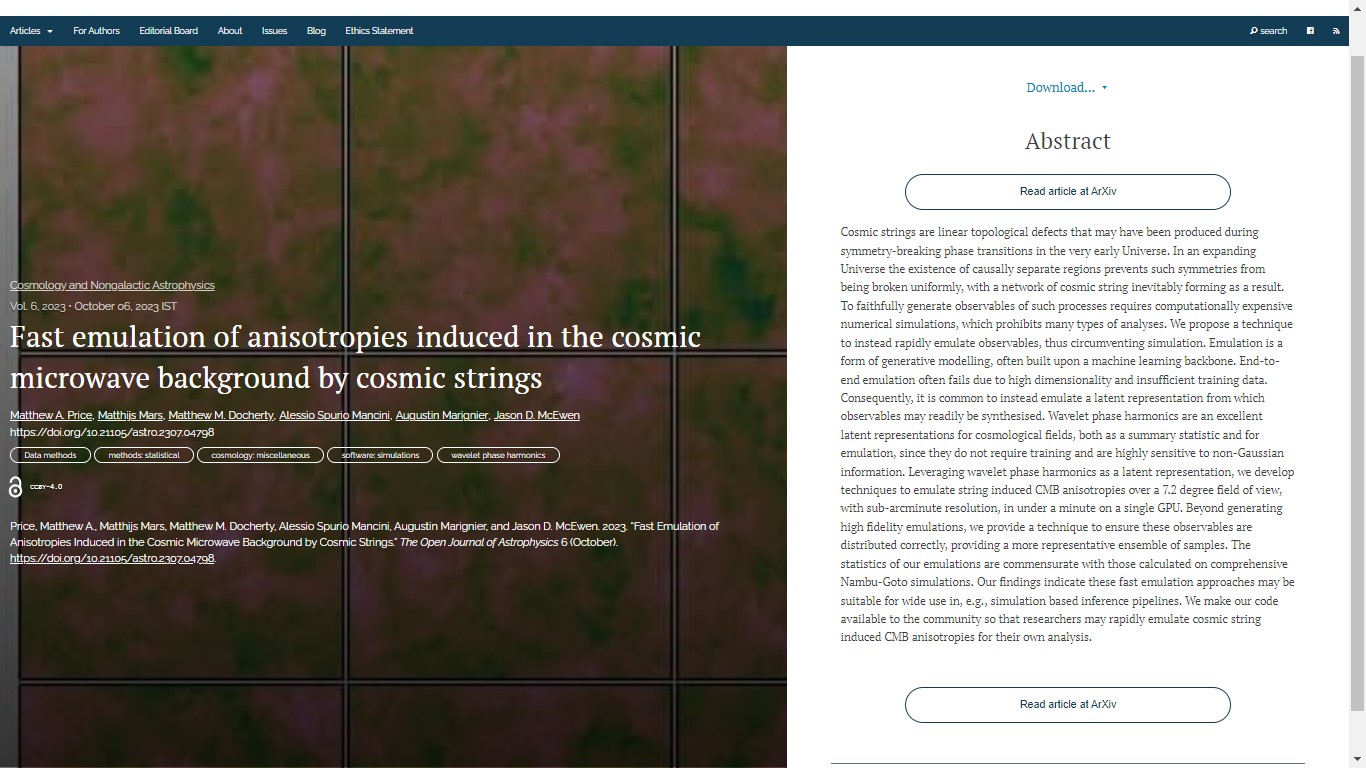
The primary classification for this paper is Cosmology and Nongalactic Astrophysics and its title is “Fast emulation of anisotropies induced in the cosmic microwave background by cosmic strings”. It describes a generative technique for producing generating cosmic microwave background temperature maps using wavelet phase harmonics. For an explanation of what a cosmic string is, see here. If you don’t know the difference between “emulation” and “simulation”, I refer you to the text!
Here is a screen grab of the overlay of the published version which includes the abstract:
You can click on the image of the overlay to make it larger should you wish to do so. You can find the officially accepted version of the paper on the arXiv here.
A few days ago I posted an item about how the current system of scientific publication is under such intolerable strain that it is no longer fit for purpose. This is something I’ve felt for a while. Some time ago I wrote a post musing about what should replace it. That article included this:
I know I’m not alone in thinking that the current publishing ecosystem is doomed and will die a natural death soon enough. In my view the replacement should be a worldwide network of institutional and/or subject-based repositories that share research literature freely for the common good.
The Open Journal of Astrophysics was set up to demonstrate a way of achieving this kind of change in the field of Astrophysics. With this in mind I was delighted to to see a paper in PLOS Biology by Richard Sever (published just yesterday) with the following abstract:
Academic journals have been publishing the results of biomedical research for more than 350 years. Reviewing their history reveals that the ways in which journals vet submissions have changed over time, culminating in the relatively recent appearance of the current peer-review process. Journal brand and Impact Factor have meanwhile become quality proxies that are widely used to filter articles and evaluate scientists in a hypercompetitive prestige economy. The Web created the potential for a more decoupled publishing system in which articles are initially disseminated by preprint servers and then undergo evaluation elsewhere. To build this future, we must first understand the roles journals currently play and consider what types of content screening and review are necessary and for which papers. A new, open ecosystem involving preprint servers, journals, independent content-vetting initiatives, and curation services could provide more multidimensional signals for papers and avoid the current conflation of trust, quality, and impact. Academia should strive to avoid the alternative scenario, however, in which stratified publisher silos lock in submissions and simply perpetuate this conflation.
(I added the emphasis). In case you were not aware, Richard Sever is a cofounder of the preprint servers bioRxiv and medRxiv.
I’m very glad to see similar thoughts to those I expressed about astrophysics being echoed in the field of biomedicine. I hope that more disciplines follow this path. The way it is realized will no doubt be domain-specific, but the benefits of such a new ecosystem will be for all science.
It’s the end of my first week away but before I go home for a swim in the pool on my roof terrace I thought I’d share an interesting paper on the arXiv by Hanson et al. (4 authors) entitled The Strain on Scientific Publishing. The abstract is:
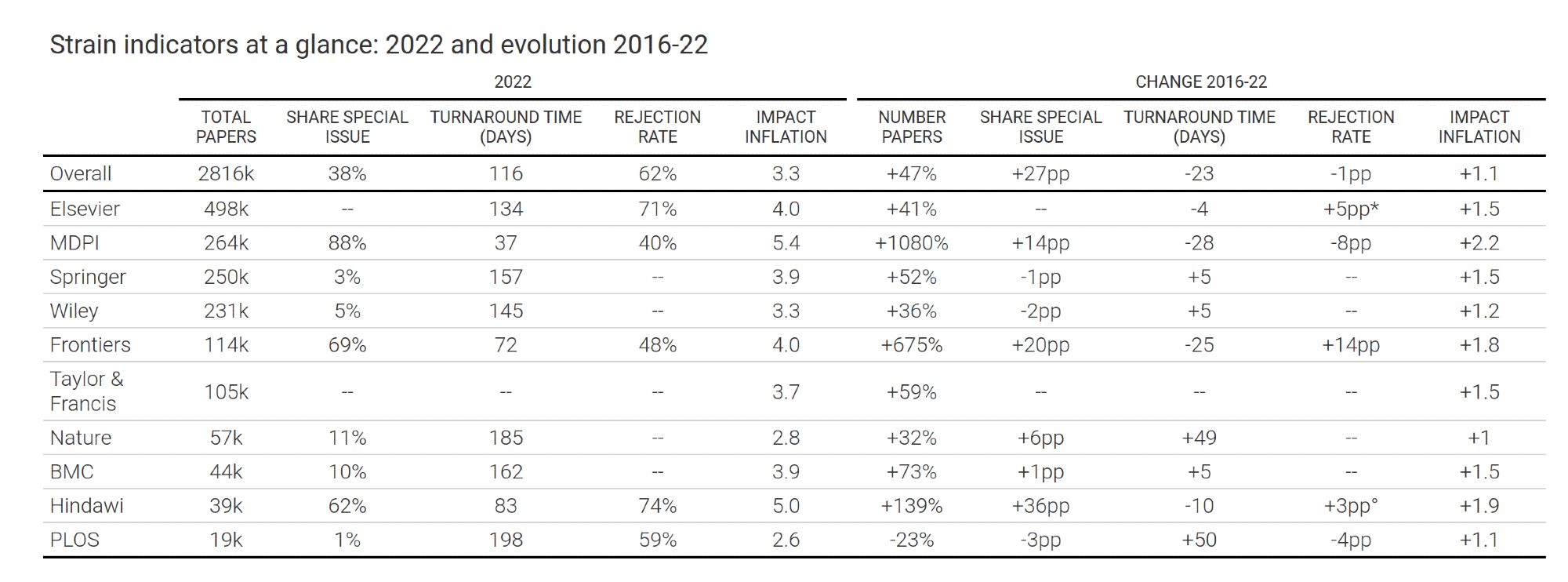
Scientists are increasingly overwhelmed by the volume of articles being published. Total articles indexed in Scopus and Web of Science have grown exponentially in recent years; in 2022 the article total was 47% higher than in 2016, which has outpaced the limited growth, if any, in the number of practising scientists. Thus, publication workload per scientist (writing, reviewing, editing) has increased dramatically. We define this problem as the strain on scientific publishing. To analyse this strain, we present five data-driven metrics showing publisher growth, processing times, and citation behaviours. We draw these data from web scrapes, requests for data from publishers, and material that is freely available through publisher websites. Our findings are based on millions of papers produced by leading academic publishers. We find specific groups have disproportionately grown in their articles published per year, contributing to this strain. Some publishers enabled this growth by adopting a strategy of hosting special issues, which publish articles with reduced turnaround times. Given pressures on researchers to publish or perish to be competitive for funding applications, this strain was likely amplified by these offers to publish more articles. We also observed widespread year-over-year inflation of journal impact factors coinciding with this strain, which risks confusing quality signals. Such exponential growth cannot be sustained. The metrics we define here should enable this evolving conversation to reach actionable solutions to address the strain on scientific publishing.
arXiv:2309.15884
Here’s a table with some figures taken from the article, from which is easy to identify the most extreme behaviour and see that it is associated with predatory publishers.
How did we end up with such an absurd system that encourages this sort of behaviour?
This of course just covers the big publishers. The Open Journal of Astrophysics is much smaller: it has only published about a hundred papers in the period covered by the Table. For comparison, the OJAp rejection rate is about 49% and our turnaround time is about three weeks, on average, though with a large dispersion.
Time to announce yet another new paper at the Open Journal of Astrophysics. This one was published yesterday (27th September 2023).
The latest paper is the 37th so far in Volume 6 (2023) and the 102nd in all. The authors are Joe McCaffrey (Maynooth, Ireland), Samantha Hardin (Georgia Tech, USA), John Wise (Georgia Tech) and John Regan (Maynooth). As this one involved two authors from my own Department, I recused myself from the editorial process, although it is work I am very interested in.
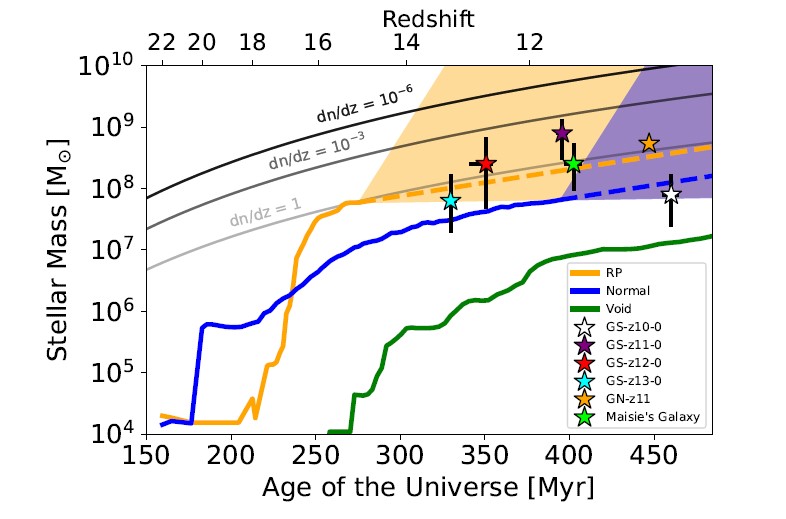
The primary classification for this paper is Astrophysics of Galaxies and its title is “No Tension: JWST Galaxies at z>10 Consistent with Cosmological Simulations”. I’ve blogged about this paper before, a few months ago, when it appeared on the arXiv. The editorial process on this one has been very thorough and it has been a few rounds with the reviewers before being accepted for publication. The authors may have found this a bit irksome, but I think the process improved them paper considerably, which is what it is meant to do.
As many of you will be aware, there’s been a considerable to-do not to mention a hoo-hah about the detections by JWST of some galaxies at high redshift. Some of these have been shown not to be galaxies at high redshift after all, but some around z=10 seem to be genuine. This paper is a response to claims that these somehow rule out the standard cosmological framework.
The key figure in the current paper is this:
The solid curves show the number of galaxies of a given mass one would expect to see as a function of redshift in fields comparable to those observed with estimated values from observations (star-shaped symbols). As you can see the observed points are consistent with the predictions. There’s no tension, so you can all relax.
Anyway, here is a screen grab of the overlay of the published version which includes the abstract:
You can click on the image of the overlay to make it larger should you wish to do so. You can find the officially accepted version of the paper on the arXiv here.
I took the liberty of reblogging this short post by Olivier Pourret about “No Pay” Open Access to direct readers to it and to make a couple of points. One is that you have to realize that “publishing-industry representatives” have a vested interest in the much of the discussion is about possible models for what might happen in the future, some of us have been busy making “No Pay” Open Access real in the here and now.
For some background, the article refers to a Council of Europe a document (PDF) that calls for “transparent, equitable, and open access to scholarly publications”. In its conclusions, the Council calls on the Commission and the member states to support policies towards a scholarly publishing model that is not-for-profit, open access and multi-format, with no costs for authors or readers. In other words, it calls for Diamond Open Access. The covering press release includes:
If we really believe in open science, we need to make sure that researchers can make their findings available and re-usable and that high-quality scientific articles are openly accessible to anyone that needs to read them. This should be particularly the case for research that benefits from public funding: what has been paid by all should be accessible to all.
Mats Persson, Swedish Minister for Education, Ministry of Education and Research
This is clearly how Open Access should be, though I am still worried that the sizeable publishing lobby will still try to persuade research agencies and institutions to pay the existing fees on behalf of authors, which does not solve the problem but merely hides it.
I know I’m not alone in thinking that the current publishing ecosystem is doomed and will die a natural death soon enough. In my view the replacement should be a worldwide network of institutional and/or subject-based repositories that share research literature freely for the common good. Universities and research centres should simply bypass the grotesque parasite that is the publishing industry. Indeed, I would be in favour of hastening the demise of the Academic Journal Racket by having institutions make it a disciplinary offence for any researcher to pay an APC to any journal.
We are lucky in physics and astronomy because arXiv has already done the hard work for us. With the existence of arXiv, old-style journals are no longer necessary. It is great that arXiv is being joined by similar ventures in other fields, such as BiorXiv and EarthArxiv. A list of existing repositories can be found here. I’m sure many more will follow. The future is Diamond.
What is needed is a global effort to link these repositories to each other and to peer review mechanisms. One way is through overlays, as demonstrated by the Open Journal of Astrophysics, there being no reason why the idea can’t be extended beyond arXiv. Other routes are possible, of course, and some of these are mentioned in the article I reposted. I would love to see different models developed, but that needs action, not words.
I am happy to announce the publication of yet another new paper at the Open Journal of Astrophysics. This one is hot off the press; it was published today, 11th September 2023.
The latest paper is in fact our 100th publication. It is also the 35th in Volume 6 (2023), which means that we have now published more papers so far this year than in the previous two years put together. I’d like to thank everyone who has supported the Open Journal of Astrophysics and helped us get this far! Here’s to the next 100!
Anyway, the new paper is entitled A complete catalogue of merger fractions in AGN hosts: No evidence for an increase in detected merger fraction with AGN luminosity and it is a complete and systematic analysis of detected merger fractions in AGN hosts from the literature leading to the conclusion that there is no evidence for correlation between the two.
The primary classification for this paper is Astrophysics of Galaxies and the author is Carolin Villforth of the Department of Physics in the University of Bath. As author of our 100th paper, Carolin wins a year’s free subscription to the Open Journal of Astrophysics.
Here is a screen grab of the overlay of the published version which includes the abstract:
You can click on the image of the overlay to make it larger should you wish to do so. You can find the officially accepted version of the paper on the arXiv here.
Incidentally, you might notice a new feature on the overlay above. Just above the Abstract heading on the right and side you can see a little link saying “Download”. This allows you to download the citation to the paper in BibTex format.
The views presented here are personal and not necessarily those of my employer (or anyone else for that matter).
Feel free to comment on any of the posts on this blog but comments may be moderated; anonymous comments and any considered by me to be vexatious and/or abusive and/or defamatory will not be accepted. I do not necessarily endorse, support, sanction, encourage, verify or agree with the opinions or statements of any information or other content in the comments on this site and do not in any way guarantee their accuracy or reliability.






 In the Dark