Archive for the Pedantry Category

Ologies and Nouns of Agency

Posted in Pedantry with tags , , , , , , , on June 11, 2025 by telescoper

The other day I was wondering, for no particular reason, why it is that a person who does astrology is called an astrologer, whereas a person (such as myself) who specializes in cosmology is a cosmologist.

Before proceeding to bore you further I will point out: (i) that words such as astrologer or cosmologist are examples of “noun of agency” or “agentive nouns” as they denote the agent or doer of an action; and (ii) that the suffix “-ology” signifies the study of a particular subject of thing. The word “ology” itself has come to mean “a branch of study” (at least informally).

Most ologies have an agentive noun that ends in “ologist”. As well as cosmologist, we have biologist, geologist, anthropologist, sociologist, and so on. There’s even “apologist” although I don’t think “apology” is an ology in the usual sense. Astrology is an ology, but we don’t usually talk about astrologists. In fact I rarely talk about astrologers either, but that’s not the point.

Looking in various dictionaries, however, I do see that the “-ologer” ending is given for some of the ologies listed above, including “geologer” but in all cases that I’ve found these are marked as archaic. Perhaps “astrologer” has lingered because astrology is a subject that likes to present itself as having ancient credentials.

There is another exception to the “ology-ologist” rule. At least in English English, a person who studies theology is not a theologist, nor even a theologer, but a theologian. I don’t know how that came about. There are quite a few people who can’t resist mixing religion with science when they talk about the field of cosmology, so perhaps cosmologian might be an appropriate term for them?

On a French Letter

Posted in Literature, Pedantry with tags , , on August 22, 2024 by telescoper

Although I studied French for five years at school I never learned the correct way to end an item of private correspondence in that language. It’s quite a subtle business in English whether to use “Yours Sincerely”, “Yours Faithfully”, or “Best Regards”, or some other alternative. Anyway, I stumbled across an old example of a French letter the other day which reveals what the French do write at the end …

Defend Democracy at Maynooth!

Posted in Education, Maynooth, Pedantry with tags , , on August 20, 2023 by telescoper
Photo by Element5 Digital on Pexels.com

A few weeks ago I blogged about the decision by the Management of Maynooth University  to scrap elections to the Governing Authority of the University. This was a shock to me and many other members of the Faculty at Maynooth and elsewhere. Coming out of the pandemic, during which we all undertook countless hours of unpaid overtime to keep the University going, I think we have the right to expect more from the Management than this expression of outright contempt. If the proposal is accepted, I fear much worse things are in store.

In response, the union IFUT, of which I am a member, started a petition protesting against this decision which now has over a thousand signatures.

We call on Maynooth University to reverse their decision to instigate selection and to restore the democratic election process for all five staff representatives on the Governing Authority.

The decision by MU’s Governing Authority and senior management to replace democratic elections with a selection process, whereby they assume, with the assistance of a private recruitment firm, the responsibility of handpicking staff representatives, is an attack on basic principles of democracy and good governance.

I agree with this wholeheartedly, and have signed the petition. If you agree please consider signing the petition too. You don’t have to be at Maynooth to sign it, nor even in Ireland. The issue faced here is far wider than one institution. It’s about the fundamental issue how a public university should be governed. Maynooth needs to learn that the institution should be run by consent and not coercion. A deliberate policy of alienating the academic, administrative and other support staff that make a university what it is is not the way forward.

The current Governing Authority is holding an emergency meeting on Tuesday 22nd August, to consider the mess created by University leadership. It has a simple way out. Scrap the current plan and allow all five internal representatives to be elected. What can be controversial about that? The Management has failed to articulate any argument against elections other than, apparently, that it considers them “old-fashioned”. Insisting on selection versus election they have also refused to explain how the selection process would work. What is to stop the President loading the GA with Vice-Presidents that she herself appointed?

There’s a an article in today’s Sunday Independent that reports on the outcome of an IFUT meeting held last Friday in which members were unanimous in supporting elections for all staff representatives on the GA. It’s now up to the Governing Authority to decide whether it wants a functioning university or not.

Math versus Maths

Posted in mathematics, Pedantry with tags , on June 8, 2020 by telescoper

I was amused by this discussion on Dictionary.Com of the different abbreviations of mathematics..

I’d like to think that ending is deliberate!

English SATs Questions for Year 6 – Could you answer them?

Posted in Education, Pedantry with tags , , on May 16, 2019 by telescoper

Regular readers of this blog will know that I’m not averse to a bit of pedantry now and again and, in contrast to many of my colleagues, I actually find grammar quite interesting. I was however quite shocked to see these questions (shared on Facebook by a concerned parent). They appear on the Standard Attainment Test (SAT) for taken by her son, who is in Year 6.

I think they’re ridiculous. I wonder how many of you could answer these five sample questions correctly without looking things up on the web? I certainly wouldn’t have been able to do them all at age 11! More to the point, who* decided that the names of grammatical structures should be deemed so important?

Far better, in my opinion, to concentrate on cultivating a love of reading.

*It was Michael Gove.

QUESTION 1:

Circle the relative pronoun in the sentence below.

“It’s too rainy for the picnic today, which is a shame.”

QUESTION 2:

Circle all the determiners in the sentence below.

“The man’s hair was very long, so my uncle cut it using a pair of the clippers he owns.”

QUESTION 3:

Underline the subordinate clause in this sentence.

“I don’t need a school dinner today because I have brought sandwiches.”

QUESTION 4:

Circle the modal verb in this sentence:

“If I can leave early, I would like to meet Anna at the park, as she said she might be there.”

QUESTION 5:

Tick one box to show whether the word ‘before’ is used as a preposition or a subordinating conjunction:

“We left the cinema before the film had ended.”

“Simon finished before Paul in the race.”

“Train tickets are often cheaper before 9am.”


Singular Shenanigans

Posted in Pedantry with tags , , , , , on March 31, 2019 by telescoper

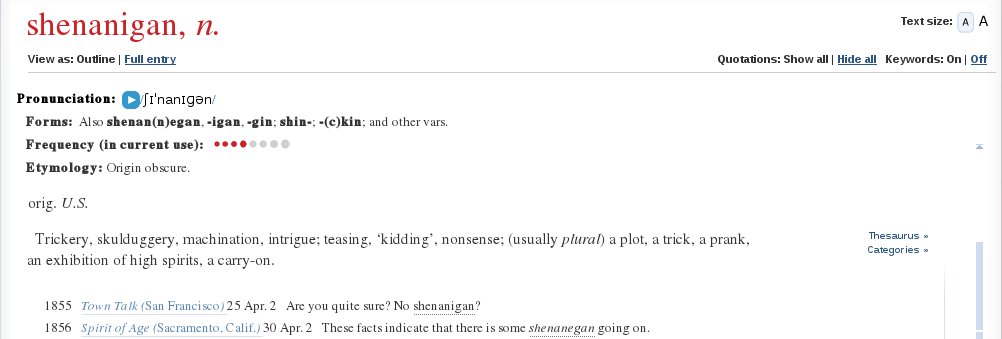
I used the word `shenanigans’ in a recent post, after which I wondered to myself whether there’s such a thing as a single `Shenanigan’. The Oxford English Dictionary says yes, defining it thusly:

I was a little surprised by this as I’ve only ever heard this word in the plural, shenanigans, but there we are. Another thing that surprised me is the `Origin obscure’; even the One True Chambers says `Origin unknown’. I’d always assumed that this was a word of Irish origin like, e.g., `slogan’. The oldest uses given in the OED are all American, from the mid-19th Century which does not refute the possibility that it is based on an Irish word because of the huge Irish diaspora in the United States, especially after the Great Famine of the 1840s, but I’m surprised the main English dictionaries have been unable to locate the connection.

The best I’ve been able to do using Google is the Irish word sionnachulghim,meaning `to play tricks, to be foxy’ (from sionnach, `fox’). That seems to me to be a plausible idea, but not it’s conclusive. If anyone has any further thoughts on the origin of shenanigans I’d be very interested to hear them through the comments box below.

To return to my original thought that shenanigans was a noun that that only exists in the plural, if it were so it would belong to the class of Plurale Tantum (which I blogged about a long time ago, here in the context about whether `data’ is singular or plural). Other examples of English nouns that exist in the `plural only’ include: suds, entrails, outskirts, odds, tropics, riches, surroundings, thanks, heroics, faeces and genitalia.

To my mind you should treat your data the same way you treat your genitalia. Grammatically speaking, I mean.

Brexit: What’s the Indicative Mood?

Posted in Pedantry, Politics with tags , , , , , on March 27, 2019 by telescoper

If you are confused about today’s `Indicative Votes’ in Parliament on Brexit let me provide some helpful information about the indicative mood, and how it relates to Brexit.

The English word “exit” is derived from the third person singular of the present tense in the indicative mood in the active voice of the Latin verb “exire” (“to go out”) i.e. it means “he/she/it leaves”, though the noun form it usually has in English derives from the supine form “exitus”. I feel it is important that we all get used to the grammar of Brexit, so here is a fairly complete list of the parts of the verb `Brexire’ in the active voice of the indicative mood, some or all of which may be relevant in the forthcoming debates, complete with accents to assist punctuation. At least these may prove useful in following any contributions from Jacob Rees-Mogg.

First let’s start with the basics:

Infinitive: Brexīre
Present participle: Brexiēns; Brexiéntis
Future participle: Brexītúrus
Gerund: Brexeúndum
Gerundive: Brexeúndus

And now here are representative examples of the conjugation of the verb Brexire in various tenses of the Indicative Mood in the order: first, second and third person singular followed by first, second and third person plural:

Present:

Brexeō,
Brexīs
Brexit
Brexīmus
Brexītis
Brexeunt

Past Imperfect

Brexībam
Brexībās
Brexībat
Brexībāmus
Brexībātis
Brexībant

Past Perfect

Brexiī
Brexīstī
Brexiit
Brexíimus
Brexīstis
Brexiḗrunt

Pluperfect

Brexíeram
Brexierās
Brexíerat
Brexierāmus
Brexierātis
Brexierant

Future Simple

Brexībō
Brexībis
Brexībit
Brexībimus
Brexībitis
Brexībunt

Future Perfect

Brexíerō
Brexíeris
Brexíerit
Brexiérimus
Brexieritis
Brexierint

The last tense here is not really relevant, but I’ve included it anyway.

No doubt when the Indicative votes are over, the House of Commons will proceed to the Subjunctive Mood – or even directly to the Imperative – but I shall leave these to a future post.

On the Plural of Referendum

Posted in Pedantry, Politics with tags , , , , on September 5, 2018 by telescoper

Quite a few people are suggesting that one way out of the current Brexit fiasco is to have another referendum when the terms of the withdrawal agreement (if any) are known. Bafflingly, Theresa May has argued that a second plebiscite would be `a betrayal of democracy’ and has categorically ruled out that possibility. Given her U-turn about last year’s General Election one might reasonably infer that a second referendum is now a racing certainty, but she called the election because she was confident she would win. All the signs are now that if given a chance to vote again the UK would vote to remain in the European Union, so the PM will need a very hard push to allow a second referendum.  A smart politician would have used the evidence of electoral misconduct by the Leave campaigns as a way out, but we’re not dealing with smart politicians on either side of the House nowadays.

Whether or not there is a second referendum an important question arises from the possibility, i.e. what is the proper plural of “referendum”?

Regular readers of this blog know that I’m never pedantic about such matters. Well, maybe a little bit, sometimes. Latin was my best subject at O-level, though, so I can’t resist making a comment.

Any dictionary will tell you that “referendum” is obtained from the Latin verb referre which is itself formed as re- (prefix meaning “back”) + ferre (to carry), thus its literal meaning is “carry back” or, more relevantly to the current discussion, “to refer”. Ferre is actually an irregular verb, which complicates the discussion a bit, so I’ll use simpler examples of regular verbs below

Latin grammar includes two related concepts derived from a verb, the gerund and the gerundive.

The gerund is a verbal noun; such things exist in English in forms that mean `the act of something’, e.g. running, eating, loving.The word formed from a verb with the ending `ing’ can also function as a present participle in English, but we wont be going there. It may easy to muddle up gerunds with participles in English, but not in Latin as they are formed in distinctly different ways.

IAs an example, in the case of `loving’ the  relevant Latin verb is the first conjugation amare (amo amas amat and all that) and the appropriate gerund is amandus. You can this sort of Latin construction surviving in such English words as “graduand”. Note, however, that a gerund has no plural form because that would make no sense in Latin. There are plural forms in English such as `doings’ and `comings and goings’ but I don’t think these are relevant here as I interpret them as jocular, and pedantry is a very serious business. Moreover

Related to the gerund is the gerundive which, as its name suggests, is an adjectival form related to the gerund, specifically expressing necessity. In Latin, an adjective takes an ending that depends on the gender of the noun it describes; the gerundive also follows this pattern.

In the loving example above, the gerundive form is amandus in a masculine case or, if referring to a female entity, amanda, hence the name Amanda, which means “deserving or requiring love”, or amandum for a neuter noun. In cases where the noun is plural the forms would be amandi, amandae, and amanda. Endings for other gerundives formed from other verbs are constructed in a similar fashion depending on their conjugation.

From this discussion you can see that in Latin amandum could mean either “loving” (gerund) or “a thing to be loved” (gerundive). Latin grammar is sufficiently precise, however, that the actual meaning will be obvious from the context.

As an aside, based on my own experiences in mathematics and physics, the abbreviation `QED’ which is often placed at the end of a proof is short for `Quod Erat Demonstrandum’, meaning `which was required to be shown’ rather than `Quite Easily Done’.  I’m surprised how many people use QED without knowing what it means!

Now, back to referendum. It seems clear to me that this is a gerundive and thus means “a thing to be referred” (the thing concerned being of no gender, as is normal in such cases in Latin). So what should be the word for more than one referendum?

Think about it and you’ll realise that referenda would imply “more than one thing to be referred”. The familiar word agenda is formed precisely this way and it means “(a list of things) to be done”. But this is not the desired meaning we want, ie “more than one example of a thing being referred”.

I would therefore argue that referenda is clearly wrong, in that it means something quite different from that needed to describe more than one of what a single referendum is.

So what should we use? This is a situation where there isn’t a precise correspondence between Latin and English grammatical forms so it seems to me that we should just treat referendum as an English noun and give it the corresponding English plural. So “referendums” it is.

Any questions?

P.S. In a forthcoming post I shall give the full conjugation of the verb brexire, as brexit must be formed from that verb  in the same way that exit is formed from exire (i.e. third person singular in the active voice; exire is an irregular verb but basically similar to fourth conjugation). On this basis the gerund of brexire would be brexeundum and the gerundive brexeundus

Ligatures, Diphthongs and Supernovae

Posted in History, Pedantry, The Universe and Stuff with tags , , , , , , , , on January 18, 2016 by telescoper

At the weekend I noticed a nice article by John Butterworth on his Grauniad blog about where Gold comes from. Regular readers of this blog (Sid and Doris Bonkers) know that I am not at all pedantic but my attention was drawn to the plural of supernova in the preamble:

Supernovas

I have to confess that I much prefer the latin plural “supernovae” to the modernised “supernovas”, although most dictionaries (including the One True Chambers) give these both as valid forms.  In the interest of full disclosure I will point out that I did five years of Latin at school, and very much enjoyed it…

When I tweeted about my dislike for supernovas and preference for supernovae some replied that English words should have English plurals so that supernovas was preferred (although I wonder if that logic extends to, e.g. datums and phenomenons). Others said that supernovae was fine among experts but for science communication purposes it was better to say “supernovas” as this more obviously means “more than one supernova”. That’s a reasonable argument, but I have to admit I find it a little condescending to assume that an audience can cope with the idea of a massive star exploding as a consequence of gravitational collapse but be utterly bewildered by a straightforward latin plural.

One of the reasons I prefer the Latin plural – along with some other forms that may appear archaic, e.g. Nebulae – is that Astronomy is unique among sciences for having such a long history. Many astronomical terms derive from very ancient sources and in my view we should celebrate this fact because it’s part of the subject’s fascination. That’s just my opinion, of course. You are welcome to disagree with that too.

Anyway, you might be interested to know a couple of things. One is that the first use of “super-nova” recorded in the Oxford English Dictionary was in 1932 in a paper by Swedish astronomer Knut Lundmark. This word is however formed from “nova” (which means “new” in Latin) and the first use of this term in an astronomical setting was in a book by Tycho Brahe, published in 1573:

Brahe_book(I’ll leave it as an exercise to the student to translate the full title.)

Nowadays a nova is taken to be a much lower budget feature than a supernova but the “nova” described in Tycho’s book was was actually a supernova, SN1572 which he, along with many others, had observed the previous year. Historical novae were very often supernovae, in fact, because they are much brighter than mere novae. The real difference between these two classes of object wasn’t understood until the 20th Century, however, which is why the term supernova was coined much later than nova.

Anyway, back to pedantry.

A subsequent tweet from Roberto Trotta asserted  that in fact supernovae and supernovas are both wrong; the correct plural should be supernovæ, in which the two letters of the digraph “ae” are replaced with a single glyph known as a ligature. Often, as in this case, a ligature stands for a diphthong, a sort of composite vowel sound made by running two vowels together.   It’s one of the peculiarities of English that there are only five vowels, but these can represent quite different sounds depending on the context (and on the regional accent). This  means that English has many hidden diphthongs. For example,  the “o” in “no” is a diphthong in English. In languages such as Italian, in which the vowels are very pure, “no” is pronounced quite differently from English. The best test of whether a vowel is pure or not is whether your mouth changes shape as you pronounce it: your mouth moves as you say an English “no”, closing the vowel that stays open in the Italian “no”…

So, not all diphthongs are represented by ligatures. It’s also the case that not all ligatures represent diphthongs. Indeed some are composed entirely of consonants. My current employer’s logo features a ligature formed from the letters U and S:

image

The use of the ligature æ arose in Mediaeval Latin (or should I say Mediæval?). In fact if you look at the frontispiece of the Brahe book shown above you will see a number of examples of it in its upper-case form Æ. I’m by no means an expert in such things but my guess is that the use of such ligatures in printed works was favoured simply to speed up the typesetting process – which was very primitive – by allowing the compositor to use a single piece of type to set two characters. However, it does appear in handwritten documents e.g. in Old English, long before printing was invented so easier typesetting doesn’t explain it all.

Use of the specific ligature in question caught on particularly well in Scandinavia where it eventually became promoted to a letter in its own right (“aesc”) and is listed as a separate vowel in the modern Danish and Norwegian alphabets.  Early word-processing and computer typesetting software generally couldn’t render ligatures because they were just too complicated, so their use fell out of favour in the Eighties, though there are significant exceptions to this rule. Latex, for example, always allowed ligatures to be created quite easily. Software – even Microsoft Word – is much more sophisticated than it used to be, so it’s now not so much of a problem to use ligatures in digital text. Maybe they will make a comeback!

Anyway, the use of æ was optional even in Mediaeval Latin so I don’t think it can be argued that supernovæ is really more correct than supernovae, though to go back to a point I made earlier, I do admit that a rambling discussion of ligatures and diphthongs would not add much to a public lecture on exploding stars.


No referenda, please..

Posted in Pedantry, Politics with tags , , , on September 20, 2014 by telescoper

One of the most interesting topics under discussion after the announcement of the results of Thursdays Referendum on Scottish independence is whether there will be another one which, in turn, leads to the question what is the proper plural of “referendum”?

Regular readers of this blog know that I’m never pedantic about such matters. Well, maybe a little bit, sometimes. Latin was my best subject at O-level, though, so I can’t resist making a comment.

Any dictionary will tell you that “referendum” is obtained from the Latin verb referre which is itself formed as re- (prefix meaning “back”) + ferre (to carry), thus its literal meaning is “carry back” or, more relevantly, “to refer”. Ferre is actually an irregular verb, so I’ll use simpler examples of regular verbs below

Latin grammar includes two related concepts derived from a verb, the gerund and the gerundive. The gerund is a verbal noun; such things exist in English in forms that mean the act of something, eg running, eating, loving. In the last case the relevant Latin verb is the first conjugation amare and the gerund is amandus. You can find a similar construction surviving in such English words as “graduand”. Note however that a gerund has no plural form because that would make no sense.

Related to the gerund is the gerundive which, as its name suggests, is an adjectival form related to the gerund, specifically expressing necessity.

In Latin, an adjective takes an ending that depends on the gender of the noun it describes; the gerundive also follows this pattern. In the example given above, the gerundive form is amandus in a masculine case or, if referring to a female entity, amanda, hence the name, which means “deserving or requiring love”, or amandum for a neuter noun. In cases where the noun is plural the forms would be amandi, amandae, and amanda. Endings for other verbs are formed in a similar fashion depending on their conjugation.

From this example you can see that in Latin amandum could mean either “loving” (gerund) or “a thing to be loved” (gerundive). Latin grammar is sufficiently clear, however, that the actual meaning will be clear from the context.

Now, to referendum. It seems clear to me that this is a gerundive and thus means “a thing to be referred” (the thing concerned being of no gender, as is normal in such cases in Latin). So what should be the word for more than one referendum?

Think about it and you’ll realise that referenda would imply “more than one thing to be referred”. The familiar word agenda is formed precisely this way and it means “(a list of things) to be done”. But this is not the desired meaning we want, ie “more than one example of a thing being referred”.

I would therefore argue that referenda is clearly wrong, in that it means something quite different from that needed to describe more than one of what a referendum is.

So what should we use? This is a situation where there isn’t a precise correspondence between Latin and English grammatical forms so it seems to me that we should just treat referendum as an English noun and give it the corresponding English plural. So “referendums” it is.

Any questions?