Archive for the Politics Category

Funding ‘Blue Skies’ Research in Ireland

Posted in Maynooth, Politics, Science Politics with tags , , , on January 4, 2021 by telescoper

Before Christmas, Ireland’s new Department for Further and Higher Education, Research, Innovation and Science embarked on a consultation about its strategy for 2021-23. Like most other departments, the Department of Theoretical Physics at Maynooth made a collective submission to this consultation and we await further developments. This blog post is not that submission. What follows here is my own rant personal view and not that of my colleagues. And before you accuse me of some kind of sour grapes I’ll point out that the Department of Theoretical Physics is actually doing very well in securing grant funding despite the difficult environment.

It has been very clear to me since arriving in Ireland that funding for basic or fundamental research – especially in the sciences – is extremely poor. This is not a new thing, but the current situation is largely the result of a high-level report published in 2012. This identified 14 priority areas of research that are most likely to give demonstrable economic and societal return, and where Ireland should focus the majority of competitive funding. Four criteria were used in selecting the 14 priority areas for future, competitively-awarded investment for economic objectives:

  1. the area is associated with a large global market or markets in which Irish-based enterprises already compete or can realistically compete;
  2. publicly performed R&D in Ireland is required to exploit the area and will complement private sector research and innovation in Ireland;
  3. Ireland has built or is building (objectively measured) strengths in research disciplines relevant to the area; and,
  4. the area represents an appropriate approach to a recognized national challenge and/or a global challenge to which Ireland should respond.

The `vast majority’ of SFI’s funding is directed towards the 14 areas so defined, leaving virtually nothing for anything else, an outcome which has dire implications for `blue skies’ research.

I think this is a deeply misguided short-term policy, which will have a strongly negative effect on science in Ireland in the medium to long term, especially because Ireland spends so little of its GDP on research in the first place. On top of that it will mean that Ireland will miss out on a golden opportunity to capitalise on Brexit, by encouraging European scientists disaffected by the hostile environment that has been created in Britain by its government’s xenophobic policies to relocate to Ireland. There’s simply no point in trying to persuade world-leading researchers to come to Ireland if insufficient funds are available to enable them to establish here; the politicians’ welcoming platitudes will never be enough.

I hope the Irish government can be persuaded to reverse this situation by investing more in basic research.
In the meantime I thought I’d re-iterate the argument I made a while ago, in response to a funding crisis in the UK, about using taxpayer’s money to fund research in universities:

For what it’s worth I’ll repeat my own view that “commercially useful” research should not be funded by the taxpayer through research grants. If it’s going to pay off in the short term it should be funded by private investors, venture capitalists of some sort or perhaps through some form of National Investment Bank. When the public purse is so heavily constrained, it should only be asked to fund those things that can’t in practice be funded any other way. That means long-term, speculative, curiosity driven research.

This is pretty much the opposite of what Irish government thinks. It wants to concentrate public funds in projects that can demonstrate immediate commercial potential. Taxpayer’s money used in this way ends up in the pockets of entrepreneurs if the research succeeds and, if it doesn’t, the grant has not fulfilled its stated objectives and the funding has therefore, by its own standards, been wasted.

My proposal, therefore, is to phase out research grants for groups that want to concentrate on commercially motivated research and replace them with research loans. If the claims they make to secure the advance are justified, they should have no problem repaying the funds from the profits they make from patent income or other forms of exploitation. If not, then they will have to pay back the loan from their own funds (as well as being exposed as bullshit merchants). In the current economic situation the loans could be made at very low interest rates and still save a huge amount of the current research budget for higher education. I suggest these loans should be repayable in 3-5 years, so in the long term this scheme would be self-financing. I think a large fraction of research in the applied sciences and engineering should be funded in this way.

The money saved by replacing grants to commercially driven research groups with loans could be re-invested in those areas where public investment is really needed, such as purely curiosity-driven science. Here grants are needed because the motivation for the research is different. Much of it does, in fact, lead to commercial spin-offs, and when that happens it is a very good thing, but these are likely to appear only in the very long term. But just because this research does not have an immediate commercial benefit does not mean that it has no benefit. For one thing, it is subjects like Astronomy and Particle Physics that inspire young people to get interested in science in the first place. That such fields are apparently held in so low regard by the Government can only encourage Ireland’s brightest young minds to pursue careers abroad.

Erasmus Minus

Posted in Covid-19, Education, Politics with tags , , on December 27, 2020 by telescoper

The news that the UK is to leave the Erasmus+ scheme for student exchanges shouldn’t have come as a surprise. After all, the Prime Minister Boris Johnson explicitly promised in the House of Commons in January 2020 that it wouldn’t happen and what he says is virtually guaranteed to be the opposite of the truth.

I quote:

There is no threat to the Erasmus scheme. We will continue to participate. UK students will continue to be able to enjoy the benefits of exchanges with our European friends and partners, just as they will continue to be able to come to this country.

In a similar vein, the stated reason for this decision (“financial considerations”) is also untrue. (Contrary to popular myth the United Kingdom is not the most popular destination for Erasmus students; that is Spain.) The cost of participating in Erasmus is modest and the benefits huge for both incoming and outgoing students and indeed the relevant home and host institutions. The real reason for this act of vandalism is demonstrated by the announcement of a new £100 million Turing scheme that is one-way only. Evidently the UK doesn’t want any nasty foreign students coming here. Equally evidently the UK Government believes that other countries will gleefully accept thousands of UK students in their universities while not having the mutual benefit of an exchange programme. Above all, most young people in the United Kingdom did not vote for Brexit in the referendum and remain strongly pro-EU. To the Brexit Government that means they must be punished. Come to think of it, the Erasmus slogan (“Enriching Lives, Opening Minds”) is pretty much the antithesis of the UK Government’s isolationist stance.

It’s “interesting” (and, to me, sickening) that the name of Alan Turing has been appropriated for this new programme. Turing, I’ll remind you, was a man whose life was destroyed by the British authorities despite everything he did for the United Kingdom during World War 2. The (perhaps unintentional) symbolism is obvious. If any of the institutions to which participating students are sent via this scheme are in countries where homosexuality is still illegal, the irony will be complete.

According to the UK Government’s own numbers, the £100 million cost of the Turing scheme will support 35,000 students to study or work internationally. That works out at less than £3000 per student. How much will that pay for? In the absence of a mutual fee waiver (which is how Erasmus+ works) it seems it will cover only a small fraction of the cost of a year abroad. Not to mention the need to acquire a visa which was not the case for movement within the EU. Still, that probably doesn’t matter, as it is only the rich who are meant to benefit.

There are a number of interesting points about UK participation in Erasmus+ which may not have been fully thought through by the Johnson government. I know it’s astonishing to think that a Cabinet full of such stellar intellects might have missed something important, but in fact Higher Education is a devolved responsibility in the United Kingdom. What the Government says about Education policy therefore only really applies to England. Scotland and Wales could in principle decide to continue as members. Moreover, if the Turing scheme is administered through the Department of Education, appropriate funding should be passed to the devolved nations by the Barnett formula which they can spend on continuing Erasmus+ participation if they wish. There’ll be legal arguments of course, but on the face of it that seems to be the situation.

Students in Northern Ireland won’t have to worry, however, as the Republic has already offered to fund the participation of NI students, a decision as generous and politically astute as the English decision is petty and mean-spirited.

The decision to withdraw from Erasmus+ will make life very difficult for many UK Higher Education institutions as many run degree programmes that include a year abroad facilitated by the scheme. As of January 1st 2021 they will no longer be able to offer these programme. I know from my own past experience how long it takes to set exchange programmes, how much work is involved in keeping it going, but how rewarding the participating students find it. Tragically, all that will disappear in the New Year.

But there may be silver lining for Ireland. Students from the EU wishing to study in an English-speaking country are likely to be looking at Irish universities in increasing numbers. We already have quite a few at Maynooth (though not this year because of Covid-19 travel restrictions); for information see here. I think there’s a strong case to exploit the British mistake and boost the involvement in Erasmus+ across the Republic.

I would very much like to do this in the Department of Theoretical Physics at Maynooth University. Though a small Department, we are in a good position to develop more international partnerships because of our collaborative networks. Indeed, although it is the Christmas break, I today received two emails from colleagues abroad wondering if we would be interested in replacing UK institutions. I think we could offer a very nice option for students from Spain and Italy. The problem is that to balance the books we really need to encourage more of our own students to venture abroad. That is difficult because, in Ireland (as in the UK), only a small number of students studying Physics at third level institutions have proficiency in a European language (other than Irish). That may not effect the teaching too much, as many European universities do teach science courses in English, but for life in general it is more difficult if you can’t speak the local language to any real extent. For this reason, it may be better for us to target postgraduate rather than undergraduate students for such an arrangement.

That’s another job to add to my list for the New Year!

Brexit Fisheries Update

Posted in Politics with tags , , on December 23, 2020 by telescoper

It seems that the talks between the United Kingdom and the European Union on a future trading relationship remain deadlocked, the sole remaining issue being that of fisheries, more specifically on the allocation of fish quotas – a topic known in France as the Poisson Distribution. The British angle is that they expect a net reduction in access by EU fisherman, if you catch my drift.

I’m not really a dab hand at fishing and wouldn’t bream of pretending to be an expert, so this isn’t really the plaice to go into detail. The following is just a quick summary obtained by trawling about online. Obviously the talks themselves are behind closed dories and are all very huss-huss.

A ray of hope emerged yesterday when a rumour circulated that the British side had offered concessions, but this turned out to be a load of pollocks and the British are still insisting that in these negotiations they hold all the cods. I suspect those involved are now pouting angrily at each other. It’s undoubtedly a tench situation.

Although it would be brill if a deal were reached, it still looks more likely that the talks will flounder. With time running out, it seems the whiting is on the wall. If they are going to make an agreement they’ll certainly have to get their skates on.

My own view is that by flexing their mussels like this the British are behaving in a rather shellfish manner. From what I’m herring, some people think they are doing this just for the halibut and they want to have their hake and eat it.

Now I’m off to get a haircut. If I don’t do it before the post-Christmas lockdown I’m in danger of ending up with a mullet.

Emmanuel Mackerel is 43.

Mutatis Mutandis

Posted in Covid-19, Politics with tags , on December 21, 2020 by telescoper

So here I am, first full day of Christmas vacation and, boy, am I pleased I didn’t try to take a trip to the UK for the festive season. Had I tried to do so I’d either have got stuck there for an indefinite period or be still here frantically doing some food shopping for a solitary Christmas. Having settled for a solitary Christmas some time ago I’ve actually got – without getting the least bit frantic – most of what I need not only to survive Christmas here in Maynooth but also to have a massively self-indulgent time. I’m looking forward to cooking myself special dinners on Christmas Eve (Sea Bass), Christmas Day (Confit of Duck) and Boxing Day (Lamb Shank) together with carefully chosen wines.

The cause of the sudden isolation of the United Kingdom is, allegedly, the appearance of a new “mutant” variant of the SARS-COV-2 virus. I say “allegedly” because it isn’t clear to me that this is any different from the thousand-plus other variant forms of this particular Coronavirus. One thing viruses do rather well is mutate.

It seems perfectly possible to me that this mutation has been seized on by the Johnson administration as an excuse for a changing a policy that they should have changed ages ago but didn’t want to lose face. They did, after all, know about this variant way back in September. They may not have known then that this strain might be more infectious, but their response to Covid-19 generally has been careless and inept even without this new development. As it has been on other matters too, on top of their laziness and corruption. Am I being too cynical? Perhaps, but the Tories have shown themselves time and time again to be pathological liars so I hope you’ll forgive me for not believing a word.

What seems to have happened is that Johnson hyped up the threat from this new variant for a domestic audience but it put the wind up Macron and other leaders. Assuming Johnson was telling the truth they closed their borders.

There’s quite a strong chance that there will be some disruption to food supplies here in Ireland as a consequence of the land route from the continent being closed so I will try to get the last of my “essentials” today. It will be worse in the UK, though, and I feel very sorry for all my friends there who will be effectively cut off for the holiday season. I hope they can console themselves with the fact that Christmas isn’t cancelled this year, it is just Australia-style…

Message from President Michael D. Higgins to Third-Level Students

Posted in Covid-19, Education, Politics with tags , on December 11, 2020 by telescoper

I saw this yesterday and thought I’d share it here, partly because it contains lots of thoughtful comments* for students – especially first-year students – currently in third-level education, and partly because it is a reminder that it is possible for the President of a country to be an intelligent, kind and empathic person…

*I’m proud to say that many of his comments echo those I used to make at induction events for new students long before the Covid-10 pandemic!

Dare we hope?

Posted in Covid-19, Poetry, Politics with tags , , , , , on November 9, 2020 by telescoper

A short passage from Seamus Heaney’s verse play The Cure at Troy: A Version of Sophocles’ Philoctetes has been much quoted recently. It even ended the RTÉ News last night:

The passage begins

History says, Don’t hope
On this side of the grave.

Well, there’s an additional reason for hope this morning, in the announcement of good progress in the search for a vaccine against Covid-19. The two pharmaceutical companies involved are Pfizer (USA) and BioNTech SE (Germany). The reported efficacy of the vaccine tested so far is over 90%, which is far higher than experts have predicted. Now these are preliminary results, not yet properly reviewed, based on a sample of only 94 subjects, and I’m not sure what motivated the press release so early in the process. I’m given to understand that the type of vaccine concerned here would also be challenging to manufacture and distribute, but we’re due for some good news on the Coronavirus front so let’s be (cautiously) optimistic.

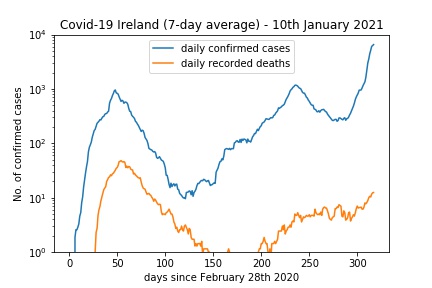
On top of that it seems that Ireland at least is turning the tide against the second wave, with new cases falling every day for over a week:

Dare we hope?

A New President

Posted in Biographical, Politics with tags , , , , on November 7, 2020 by telescoper

Well it took a while to get there, but less than an hour ago all the major media networks in the USA “called” the result of the 2020 Presidential Election. It looks as if they were all waiting for Joe Biden’s lead in Pennsylvania to exceed the 0.5% threshold needed to rule out a mandatory recount. Once that happened, they all (CNN, CBS, Associated Press, et al – even Fox News) projected that Joe Biden had won. It had been looking that way for some time, but the press agencies wanted to be sure of their ground. Moments after the Pennsylvania result, AP and others also called Nevada in favour of Biden. The remaining tight race, in Georgia, can still go either way, but Biden now has enough electoral votes to be President Elect.

I’ve never felt happier to have lost a bet.

Congratulations to Joe Biden, and to everyone who helped his campaign. A special vote of thanks is due to Jo Jorgensen, the “Libertarian” candidate who polled considerably more votes in the key Swing States than Biden’s margin of victory…

The result is, among many other things, very good news for Ireland. Joe Biden is an Irish-American and we can be confident that he will not allow the Belfast Agreement to be sabotaged by Johnson & Gove. It’s not so good news for Boris Johnson but at least we’ll have the pleasure of seeing him twist in the wind until he resigns in a few months’ time.

Nobody expects Donald Trump to go quietly, however, and there’s no sign that he is going to concede. I think he’d be quite happy to watch his country burn rather than admit being a loser. Some patriot. I think the USA is now entering a very dangerous period in its history. It’s really a question of whether Trump’s entourage can persuade him to accept reality. I’m not sure they will be able to do that. Instead there’s a real possibility that Trump will try to encourage his followers to violent protest. At the very least we can expect him to issue a string of executive orders intend the sabotage the new President. I hope I’m wrong, but I’m more anxious about the next few weeks than I was about the election.

PS Can this evening’s TV schedule on RTÉ 2 really be a coincidence?

PPS. I watched “The Death of Stalin” last night and thought it was very good!

Calculations, Calculations…

Posted in Biographical, mathematics, Politics on November 6, 2020 by telescoper

So it’s past 1pm GMT on Friday 6th November and the USA is still trying to work out who will be its next President after the elections that took place on Tuesday. The process is taking so long I wonder if Americans might be starting to appreciate the nature of Test Match cricket?

In the meantime I’ve been occupying myself with some simpler calculations for my second-year vector calculus module:

US Election Night and Day

Posted in Bad Statistics, Biographical, Politics on November 4, 2020 by telescoper

Before you ask, no I didn’t stay up all night for the US presidential election results. I went to bed at 11pm and woke up as usual at 7am when my radio came on. I had a good night’s sleep. It’s not that I was confident of the outcome – I didn’t share the optimism of many of my friends that a Democrat landslide was imminent – it’s just that I’ve learnt not to get stressed by things that are out of my control.

On the other hand, my mood on waking to discover that the election was favouring the incumbent Orange Buffoon is accurately summed up by this image:

Regardless of who wins, I find it shocking that so many are prepared to vote for Trump a second time. There might have been an excuse first time around that they didn’t know quite how bad he was. Now they do, and there are still 65 million people (and counting) willing to vote for him. That’s frightening.

As I write (at 4pm on November 3rd) it still isn’t clear who will be the next President, but the odds have shortened dramatically on Joe Biden (currently around 1/5) having been short on Donald Trump when the early results came in; Trump’s odds have now drifted out between 3/1 and 4/1. Biden is now clearly favourite, but favourites don’t always win.

What has changed dramatically during the course of the day has been the enormous impact of mail-in and early voting results in key states. In Wisconsin these votes turned around a losing count for Biden into an almost certain victory by being >70% in his favour. A similar thing looks likely to happen in Michigan too. Assuming he wins Wisconsin, Joe Biden needs just two of Michigan, Nevada, Pennsylvania and Georgia to reach the minimum of 270 electoral college votes needed to win the election. He is ahead in two – Michigan and Nevada.

This is by no means certain – the vote in each of these states is very close and they could even all go to Trump. What does seem likely is that Biden will win the popular vote quite comfortably and may even get over 50%. That raises the issue again of why America doesn’t just count the votes and decide on the basis of a simple majority, rather than on the silly electoral college system, but that’s been an open question for years. Trump won on a minority vote last time, against Hillary Clinton, as did Bush in 2000.

It’s also notable that this election has once again seeing the pollsters confounded. Most were predicted a comfortable Biden victory. Part of the problem is the national polls lack sufficient numbers in the swing states to be useful, but even the overall voting tally seems set to be much closer than the ~8% margin in many polls.

Obviously there is a systematic problem of some sort. Perhaps it’s to do with sample selection. Perhaps it’s because Trump supporters are less likely to answer opinion poll questions honestly. Perhaps its due to systematic suppression of the vote in pro-Democrat areas. There are potentially many more explanations, but the main point is that when polls have a systematic bias like this, you can’t treat the polling error statistically as a quantity that varies from positive to negative independently from one state to another, as some of the pundits do, because it is replicated across all States.

As I mentioned in a post last week, I placed a comfort bet on Trump of €50 at 9/5. He might still win but if he doesn’t this is one occasion on which I’d be happy to lose money.

P.S. The US elections often make me think about how many of the States I have actually visited. The answer is (mostly not for very long): Kansas, South Dakota, Colorado, Iowa, Missouri, Arkansas, Louisiana, California, Arizona, New York, New Jersey, Maryland, Massachusetts, New Hampshire, Maine, and Pennsylvania. That’s way less than a majority. I’ve also been to Washington DC but that’s not a State..

Domestic Post

Posted in Biographical, Maynooth, Politics with tags , , , on November 1, 2020 by telescoper

O wild West Wind, thou breath of Autumn’s being.
Thou, from whose unseen presence the leaves dead
Are driven, like ghosts from an enchanter fleeing.

Those lines from Ode to the West Wind by Percy Bysshe Shelley came to my mind this morning not only because it’s blowing a gale outside but also because it is just after Halloween Samhain which was a noisy night because of all the fireworks, but at least I wasn’t disturbed by trick-or-treaters. I guess none of them made it past the barbed wire and electric fence…

Anyway, being confined to quarters for the day has allowed me to catch up on some domestic matters, including dealing with my first ever demand for payment of Local Property Tax (LPT) which arrived on Friday: before I bought my own home, my landlord paid the LPT on the flat I was living in. Coincidentally, along with the bill for the Local Property Tax came a letter from the Department of Employment Affairs and Social Protection (DEASP) confirming that they had changed my address on their records. I told them two months ago.

The Local Property Tax plays a similar role in Ireland to that of the Council Tax in the United Kingdom, and is also based on some notional estimate of the value of your home, but it’s quite a lot lower than in the UK. Although my house in Maynooth is worth considerably more than my Pontcanna residence the property tax is less than a third here than it is in Cardiff. You might think that’s a good thing, but the consequence is that there is a much poorer provision of local services here. In fact Local Government as a whole is a much lesser thing here than it is on the other side of the Irish Sea. Although there are elections to the local councils (in my case Kildare County Council) as there are in the UK, the ability of the councils to do anything useful is very limited.

One particular aspect of this is that householders in Ireland have to arrange their own refuse collection via a private company; in Cardiff the refuse collection service was provided by the Council. When I took over the house I asked the previous owner about refuse collections and, since I had no experience of any of the companies listed as offering this service, I simply carried on with the company she had used.

And so it came to pass that my weekly refuse and recycling collection is carried out by Bord na Móna (literally “The Turf Board”), a company set up in 1946 to supply peat as a form of fuel. Although you can still buy peat around these parts to burn on the fire, it is a very dirty fuel and harvesting it causes damage to the peat bogs in the Irish Midlands that provide a unique habitat for wildlife and plants of various kinds. Bord na Móna has therefore been diversifying into more sustainable lines of business with the intention of withdrawing entirely from peat production in the next decade or so. Among these new activities are renewable energy generation and recycling, the latter being relevant to this post.

The refuse collection, carried out through a subsidiary called AES, is quite a sophisticated operation. I have four wheelie bins (one for recycling, one for organic & food waste, one for glass, and one for general waste). Each of these bins is microchipped and the amount of general waste collected recorded at each collection. I am of frugal habits and don’t usually produce very much waste, especially general waste, though I have had a number of things delivered to the house since I moved in which always requires disposal of a considerable amount of packaging. Happily they also send a free SMS reminder of what bin to put out when.

Anyway to return to the opening theme of this post, I’ve discovered a “feature” of my new house. Being situated at the end of a row of similar properties with a wall to one side to mark the end of the row, it seems that leaves which have been blown along the road collect in great heaps on the path leading to my front door. I have to go out quite regularly with a shovel to clear them away. At present I put them in the organic refuse bin, but I’m thinking of getting a compost bin for the garden. It seems I am becoming quite domesticated in my old age.

Postscript: no sooner did I finish this post than all the power went off in the house.

Postscript to the postscript. It came on again after about 2½ hours in my area, but as I write it is still off in parts of Maynooth.