Archive for the Politics Category

Odds on Trump

Posted in Politics with tags , , , on October 29, 2020 by telescoper

I’ve been busy all day on a secret mission (from the safety of my own home) which left me no time to do a proper post, so I’ll just do a quickie to mention the state of play as the US presidential election approaches.

Although Joe Biden seems to be comfortably ahead in terms of the popular vote, the vagaries of the American voting system do not easily translate into the probability of a win. After all, Hillary Clinton won the popular vote in 2016, and look what good that did her!

I looked at odds checker just now and saw the best Bookies odds are Biden 11/20 on and Trump 15/8 against. That’s uncomfortably close given what an appallingly terrible man the incumbent is, but at least 40% of the American electoral don’t seem to mind having a such an item for a president so there’s a significant chance that he’ll win, especially since his campaign has been deploying extensive spoiling tactics to tilt the vote in his favour.

Yesterday I decided that I would follow my usual betting practice and place a wager on the outcome that I don’t want to happen. I did this in 2016. Then Hunting the best odds I could find were 18-5 against Donald Trump. I put a monkey* on, and walked away with £2300 (being £1800 plus my stake) when Trump won.

I followed the same strategy on the Brexit Referendum Day as I felt it in my bones that Vote Leave was going to win. I ended up depressed but compensated to the tune of £1000.

I’m afraid to say I feel the same way now about the likelihood of a Trump victory. Not very scientific, I know, but there you go. This year the odds are a lot shorter and I think I’ll bet a bit less, but I’ll still go for the compensation strategy.

I have never paid much attention to American politics in the past. It is as incomprehensible to me as British politics must be to them. Gore Vidal summed it up for me:

There is only one party in the United States, the Property Party … and it has two right wings: Republican and Democrat. Republicans are a bit stupider, more rigid, more doctrinaire in their laissez-faire capitalism than the Democrats, who are cuter, prettier, a bit more corrupt — until recently … and more willing than the Republicans to make small adjustments when the poor, the black, the anti-imperialists get out of hand. But, essentially, there is no difference between the two parties.

Although both parties still represent the moneyed classes more than anyone else, but this time the Republican contender is a corrupt narcissist who has already done untold damage to his country. Americans are free to vote for whomever they wish, of course. I don’t have a say, as I’m a foreigner.

Although I find it deeply depressing that this race is even close, I won’t lose any sleep over the election night. I’ll do what I did on the day of the EU referendum: drink some wine, listen to music and then go to sleep. There’s no point in worrying about things that are out of your hands.

(*monkey = £500)

Life at Level Five

Posted in Covid-19, Education, Maynooth, Politics with tags , , , on October 20, 2020 by telescoper

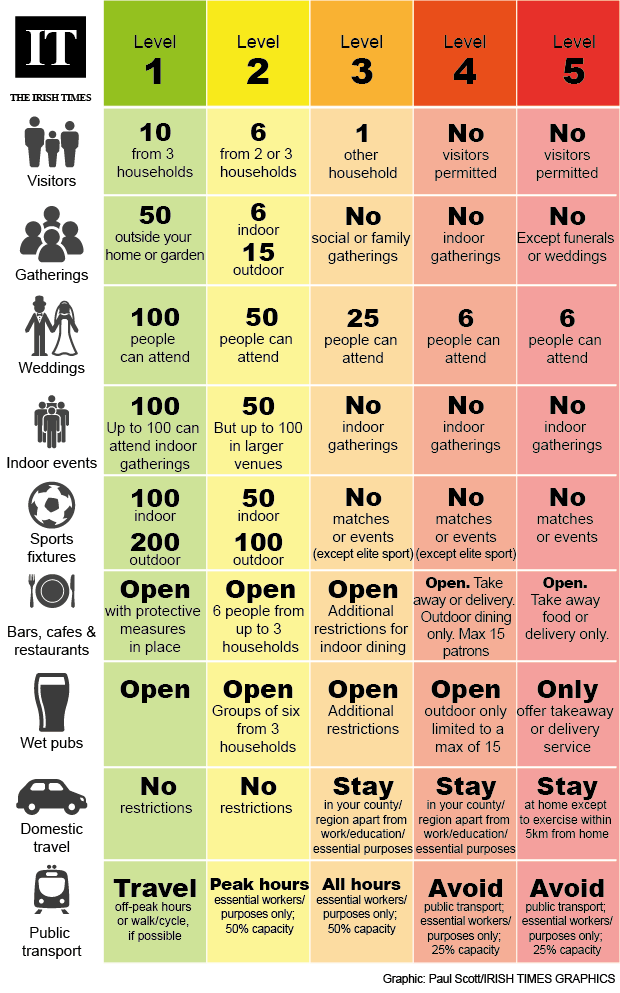
After refusing to do so two weeks ago, last night the Government decided to move all Ireland onto Level 5, the highest level of Covid-19 restrictions, for six weeks (although with some tweaks, e.g. the number of people allowed to weddings):

I think the previous refusal to implement tougher restrictions was a big mistake and has cost two weeks of exponential growth in new cases for no obvious benefit. I thought at the time that moving to Level 5 was inevitable giving the steep growth in numbers:

https://twitter.com/telescoper/status/1313445173142183938

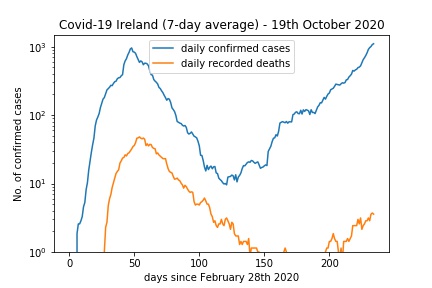
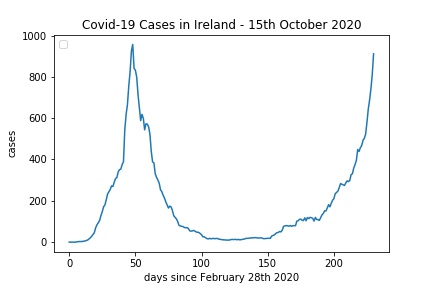
Here, for information is the latest plot of confirmed cases (as of last night):

The 7-day average of new cases is higher than it was at April’s peak, though thankfully the number of deaths is lower. Hospital (and specifically ICU admissions) are however, rising steadily.

We don’t know yet of any specific implications for teaching here at Maynooth University, though it will certainly mean even more teaching moves online. I think my own lectures will continue as Panopto webcasts in much the same way as before, except from my office rather than from a lecture theatre and without the handful of students who have so far been attending them in person. Next week (beginning 26th October) is our Study Week break which offers a bit of time to rearrange things. My first-year module has lectures on Mondays, Tuesdays and Wednesdays. Because the new restrictions kick in at midnight on Wednesday, that lecture will be the last one I do in a lecture theatre for a while. At least I got the best part of four weeks’ worth of lectures in that way.

More generally workers are required to work from home if they can with an exception for “essential services”. The general guidance given here includes:

11. The following services relating to professional, scientific and technical activities:

(a) the provision of engineering, technical testing activities and analysis (including the performance of physical, chemical and other analytical testing of materials and products);

(b) the provision of scientific research and development services;

(c) regulation, inspection and certification services, in accordance with law, of a particular sector by a body created by statute for that purpose.

and

16. The following services relating to education activities:

(a) primary and post primary school;

(b) higher and further education, insofar as onsite presence is required and such education activities cannot be held remotely.

This implies that the campus will not be closed like it was in March, so that this is not going to be a complete lockdown for either research or teaching. Moreover 16(b) does suggest that even laboratory-based teaching may carry on, but we await confirmation on that.


Covid-19: Out of Control

Posted in Covid-19, Maynooth, Politics with tags , , on October 16, 2020 by telescoper

The latest Covid-19 figures for Ireland make grim reading. Yesterday the number of new cases was the highest it has ever been since the start of the pandemic in March (though part of this is due to increased testing). The 7-day average is climbing relentlessly. It’s not the incidence rate itself which is the cause of alarm, it’s the fact that it is on an exponential trajectory again (with a doubling time only just over a week):

Yesterday evening the National Public Health Emergency Team advised that the entire country should immediately move to Level 5 for a period of six weeks.

Will the Government agree to this escalation? NPHET advised such a move less than a fortnight ago, but to no avail. Since then the situation has deteriorated more quickly than anyone predicted. It’s easy to be wise after the event but I think that decision was a very bad mistake. Even if they agree now, precious time will have been lost. There are now so many cases that contact tracing is effectively impossible, and hospitals are already feeling the strain. Unless something drastic is done now, by next month the health system will be overloaded. In my opinion it will be a scandal if there is no immediate move to Level 5.

Failing to move to Level 5 earlier this month was the second big mistake this Government has made. The first was the decision taken in June to wind down restrictions starting from 20th July, earlier than the original ‘Roadmap’ indicated. That was a mistake because it sent out a message that the pandemic was almost over. The change in behaviour among certain sectors of the public was immediate. Complacency set in, and the second wave started. It seems to me that the Roadmap was working so there was no need to change it.

Most European countries are experiencing a `second wave’ of Covid-19, in many cases worse than the first, so I’m not saying that adhering to the original Roadmap would have prevented a similar phenomenon in Ireland. I am saying that it could have been slowed considerably. By loosening the constraints too quickly and then not applying them again quickly enough, in both cases bowing to pressure from vested interests, the Government has made a difficult situation far worse than it need have been. They’ve let the situation get out of control and now nobody knows how it is going to end.

Against Hierarchies

Posted in Education, Politics, Television with tags , , , , on October 13, 2020 by telescoper

Being too tired to do anything else, last night I had a rare look at the television and found an interesting programme on RTÉ One called The Confessors which I watched to the end. The theme of the show was the tradition of the confession box in the Irish Catholic Church. As someone brought up in the Anglican tradition, the confessional has always been a bit of a mystery to me, which is one reason I found it interesting. It also touched on a number of wider issues (including the possible role of the seminary at Maynooth in establishing Ireland as an outpost of Jansenism. Some of the priests contributing to the programme also talked very frankly about the systematic sexual abuse of children by priests and the way it was covered up by the Church.

I was very interested to hear several of the contributors complaining that this problem was exacerbated by the power structure of the Catholic Church which made it easy for complaints to be stifled.

That discussion reminded me of thoughts I’ve had previously about harassment and abuse in other contexts (not of children) and the way they are suppressed by official hierarchies. This problem extends to universities, whose management structures often resemble those of church hierarchies, even down to the terminology (e.g. Deans) they have inherited from their origins as theological institutions.

This sort of structure creates a problem that is extremely deeply rooted in the culture of many science departments and research teams across the world. These tend to be very hierarchical, with power and influence concentrated in the hands of relatively few, usually male, individuals. A complaint about (especially sexual) harassment generally has to go up through the management structure and therefore risks being blocked at a number of stages for a number of reasons. This sort of structure reinforces the idea that students and postdocs are at the bottom of the heap and discourages them from even attempting to pursue a case against someone at the top.

These unhealthy power structures will not be easy to dismantle entirely, but there are simple things that can be done to make a start. “Flatter”, more democratic, structures not only mitigate this problem but are also probably more efficient by, for example, eliminating the single-point failures that plague hierarchical organisational arrangements. Having more roles filled on a rotating basis by members of academic staff rather than professional managers would help. On the other hand, the existing arrangements clearly suit those who benefit from them. If things are to change at all, however, we’ll have to start by recognizing that there is a structural problem.

To Level Five?

Posted in Covid-19, Maynooth, Politics with tags , , on October 4, 2020 by telescoper

When I saw that 613 new cases of Covid-19 were recorded in Ireland on Saturday (3rd October) it seemed obvious that the situation in Ireland was getting out of control:

Note that on this graph the new cases have been growing in a roughly linear fashion for at least a month. Since the y-axis is logarithmic this means the growth of the pandemic is roughly exponential. The  7-day moving average up to and including Saturday was 448, with no sign of an end to the upward trend.

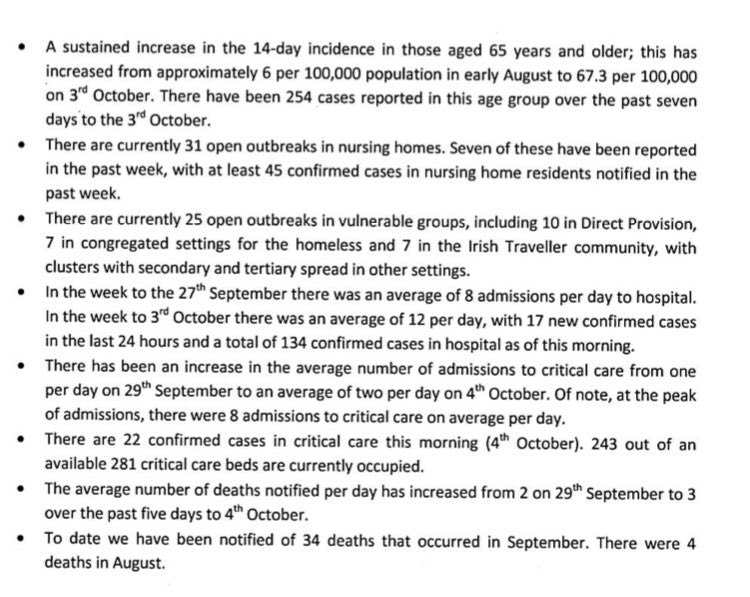
After a meeting yesterday, the National Public Health Emergency Team (NPHET) reviewed the following statistical developments:

In the light of these it decided to recommend an immediate jump to the highest level of restrictions, Level 5, for the entire country:

Level Five isn’t quite the same as what happened in March, largely because Schools and Colleges are intended to remain open, but it means the same widespread shutdown of the private sector. This escalation is supposed to last at least 4 weeks.

This is of course a recommendation. The imposition of these measures is up to the Government, which has to balance public health measures against economic damage. Presumably will make a decision sometime this week. Will they have the guts to stand up against the hospitality industry?

The problem is that the Government announcing restrictions and people actually abiding by them are not the same thing at all. It only takes a few people to flout the rules for the pandemic to take hold once more, and while many people are behaving sensibly, there is ample evidence of people not doing so.

What this means for us at Maynooth University remains to be seen.


UPDATE: The Government this afternoon rejected the advice of NPHET and instead moved the country to Level 3. I hope they know what they’re doing.

The Virtue of Signalling

Posted in Covid-19, Education, Maynooth, Politics with tags , , on September 3, 2020 by telescoper
I was in a supermarket in Maynooth yesterday morning when a bloke was refused entry for not wearing a mask. That’s the first time I’ve seen that happen, though I’ve heard various people mentioning similar stories elsewhere. There is a big sign near the entrance to the store saying that face masks are mandatory, which they have been for some time in Ireland, so he could not make the excuse that he didn’t know. I rather think he was trying to make a point.
The person concerned didn’t get violent, but was extremely loud and abusive to the staff, who shouldn’t have to put up with that sort of behaviour. He stood there for a while shouting expletive in between which his message was that he didn’t care whether he got Covid-19 as it was “just the flu”. I did wonder whether someone might call that Gardaí but after a few minutes, afer which he either felt he had done what he wanted to do or that he was wasting his time, he left.
I have to admit I completely fail to see why certain people find wearing a face mask such an ordeal. It’s really nothing. I understand that some people, with e.g. asthma, might have good reasons for finding it difficult but I’m talking here about people without such reasons who seem to think they’re being asked to bear some intolerable burden, rather than just wearing a piece of light material over their nose and mouth. I’ve got quite used to it and think nothing of it. As winter comes on I even think wearing a mask might help keep my face warm and, more importantly, protect my beard from inclement weather.
The only thing that bothers me slightly is that I have very boring face masks when others seem to have invested in colourful stylish affairs. It makes me feel a bit drab. Perhaps I should invest in some more glamorous masks.
But back to our friend in the supermarket. He of course may not care whether or not he gets Covid-19, but that’s not the main point of wearing a mask. Face masks are far more effective at protecting other people from your germs than protect you from other people’s germs. I suspect, however, that trying to explain this to the person concerned would simply make matters worse. To be happy wearing a face mask you have to be the sort of person who cares about what happens to other people and there are some – regrettably many these days – who just don’t. I’m sure that extreme selfishness translates into their political attitudes too.
When we return to on-campus teaching at the end of this month, students will be asked to wear face coverings in lectures. I’m not sure how that will work out. In particular I don’t know who is supposed to police it. Supermarkets have people on the door to turn away the unmasked. Are we to have that at the entrance to lecture theatres?
Lecturing with a face mask on will be difficult, but in a big theatre the lecturer is sufficiently far from the front of the audience that won’t be necessary.
I’m not sure how effective face masks will be at slowing the spread of Covid-19 – we’ll have to wait and see – but my attitude is that they are just a part of a bundle of measures, including frequent washing of hands, wiping surfaces regularly, maintaining social distancing, etc that all contribute. The great value of a face mask in all this is that it is visible. Wearing a mask is a signal to others that they should remember the danger of the situation and act accordingly. It’s a way of showing leadership.
It has become fashionable (at least among those who possess no virtues) to use the phrase virtue signalling as pejorative term for doing or saying something good in a way that is conspicuous. To the person ejected from the supermarket, the wearing of a face mask is probably an example of virtue signalling. I think it is too, literally, and I’m all in favour of it.

The Storm in Ireland

Posted in Covid-19, Politics with tags , , , on August 25, 2020 by telescoper

I’m sitting in my office eating a sandwich and listening to the rain. Last night Storm Francis arrived – the picture above was what I saw on the weather app on my phone just before I went to bed, with the storm approaching from the I was very tired so went straight to sleep and fortunately wasn’t woken up by the storm. It probably wasn’t as windy as Storm Ellen but there’s been a heck of a lot of rain, and it’s still coming down.

Storm Francis isn’t the biggest storm going on in Ireland at the moment, though. Last week a quite different tempest brewed up, a political one, the consequences of which have already been quite severe for certain members of the Government. There’s now even a Wikipedia page about the Oireachtas Golf Society Scandal, known colloquially as Golfgate, which means I don’t have to explain too much about it. The story in a nutshell that 81 people, including a number of prominent politicians, attended a golf club dinner that violated Covid-19 restrictions. It has already caused two politicians to resign from their main offices, and a host of apologies have been made, but I don’t think it’s over yet. People are justifiably furious about politicians and other public figures behaving as if they are above the law while others are enduring lockdown conditions. There are definite shades of Dominic Cummings and his trip to Barnard Castle.

One outstanding issue is the conduct of EU Trade Commissioner, Phil Hogan, who not only attended the dinner but also travelled to Kildare (which is under special restrictions) on the way there and, it subsequently emerged, was stopped by Gardaí for talking on his mobile phone will driving. He has been asked to account for his actions by his boss, Ursula von der Leyen, to whom he has handed over a `20-page dossier’ explaining his movements. One wonders what else is in that document that we don’t yet know about.

Update: 26th August. Phil Hogan resigned.

In my opinion, Hogan should be sacked if he won’t resign but there is an issue about how to prevent this sort of thing happening in future. The answer to me is obvious: an interest in golf is clearly an indication of poor judgement so anyone who plays golf, or is interested in golf in any way, should be barred from holding any form of public office.

I rest my case.

The U-turn and After …

Posted in Education, Politics with tags , , , on August 18, 2020 by telescoper

One of the many things that Winston Churchill never said (referring to Americans) is that they “…will always do the right thing – after exhausting all the alternatives”. Yesterday the UK Government performed a U-turn on its approach to A-level results but only after extensive protests and after causing immense stress to a great many students. All of this could have been avoided had the Secretary of State for Education bothered to look at the results of the downgrading algorithm. This morning he said that he “wasn’t aware” of what the outcomes would be and tried to put the blame on OfQual. Well, it’s actually his job to be aware of these things and that statement shows he’s not doing his job.

While many students will be mighty relieved that their official A-level grades will go up, that won’t be the end of this fiasco. Many students will find that their places have been already been filled through last week’s clearing process. The Government has lifted the number cap on places in imposed earlier this year, but that won’t help many departments, especially those in the sciences, who have severe constraints on, e.g., laboratory capacity (more so with social distancing in place).

I feel very sorry for friends and former colleagues in UK universities having to deal with this shambles. The Government will be quite happy that it has managed to throw this particularly hot potato into the hands of admissions tutors across the land. Ministers will be hoping that whatever blame now accrues will be attributed to universities being “inflexible” when it is entirely down to incompetence elsewhere. As always it’s the front-line staff who will have to deal with it, as if their job was not stressful enough having to deal with Covid-19.

Meanwhile, here in Ireland, the Government’s plan for “standardisation” of this year’s Leaving Certificate results looks alarmingly similar to the failed approach tried – and subsequently abandoned – in the United Kingdom. Minister for Education Norma Foley has been making statements about the accuracy and reliability of her Department’s plans that sound eerily similar to those issued by officials across the Irish Sea. I hope that I’m wrong about this – and that there’s some frantic activity going on behind the scenes to change the approach ahead of the release of this year’s Leaving Certificate grades (due on September 7th) – but I have a feeling that we’re going to see yet another slow-motion car crash. It wouldn’t be the first time that, having observed something truly shambolic happening in the UK Education system, an Irish Government then proceeds to do exactly the same thing…

The Great A-level Scandal

Posted in Education, Politics with tags , , on August 14, 2020 by telescoper

The full scale of the scandal of this year’s A-level results is now becoming clear and it is bad enough to bring down a Government. Unfortunately there are so many scandals surrounding the UK Government (e.g. corrupt procurement deals, collapsing economy, terrible Covid-19 mortality figures, fiddled Covid-19 testing statistics, not to mention Boris Johnson himself) that nobody seems to care about that one more probably won’t make much difference.

Yesterday Qfqual released its report on this year’s A-level results which reveals that in arriving at the final grades, the algorithm deployed was based on past performance of pupils at the candidate’s school. in many cases this has resulted in students being downgraded by several grades in a manner that is both arbitrary and cruel.

Update: I’ve just heard from a physics, in an institute in which I once worked, that a student with original grade A* in Physics A-level has been assigned a final grade E. Unbelievable.

That starting point of the Ofqual approach is indefensible. A student’s examination grade should be determined by the student’s own performance, not by the performance of previous generations of students who happened to go to the same school at some time in the past.

Not surprisingly, the Ofqual approach has benefited students who went to private schools and severely disadvantaged students at less privileged establishments. The rightwing media are justifying this on the grounds that teachers at some state schools have inflated their students’ estimated grades. The attitude is that working class kids can’t possibly deserve an A* so their teachers must have cheated! I can’t believe this bias is unintentional. The Tory message to the less privileged is that they need to know their place. You needn’t ask who is behind this deliberate demographic* profiling. It stinks of the unofficial Prime Minister Dominic Cummings

But even within its own flawed terms the Ofqual algorithm is garbage. Table E8 in the report shows that when applied to last year’s input data (mock exams and centre-based assessments), even in the best case subject (History) the prediction was only accurate for 67% of students; the figure falls to less than 50% for, e.g., Further Mathematics. When the Ofqual panel saw that they should have abandoned their algorithm immediately. The fact that they pursued it knowing how deeply problematic means that they are more interested in serving their political masters than the students whose prospects they have deliberately blighted.

In my view a system should be introduced that gives the student the benefit of the doubt. Grades should be awarded based on what the student has achieved. If that ends up being too generous to a few students then that’s surely better than the opposite? Whenever I’ve been involved in University examinations processes when emergency changes were required we have always implemented a `no detriment to the students’ policy. It’s the obvious fair thing to do.

Oh, and you might ask why universities don’t show some humanity and accept students whose grades have been reduced. The answer to that is simple. If they do, they will go down in the league tables. And for many senior managers that’s all that matters.

*which means, of course, (indirect) racial profiling too.

The Law of the Sea

Posted in Politics with tags , , , , , , , on August 10, 2020 by telescoper

There are few things more despicable than a Government that manufactures outrage in order to distract from its own failings. The latest example  is the UK Government’s ridiculous response to a few desperate migrants crossing the English Channel in boats. The Home Secretary, Priti Patel, has appointed a “Clandestine Channel Threat Commander” (whatever that is supposed to mean) and is apparently considering sending Royal Navy to protect the United Kingdom from the terrifying women and small children arriving in dinghies. Pathetic.

Mind you, I think sending the Royal Navy to the Channel is in some ways a good idea. Once there they could offer greater assistance to small boats in peril on the sea and bring their occupants safely to port in England. That, after all, would be their duty under international law. I know we can’t expect the Home Secretary to either know or care about the law, but I suspect Royal Navy officers do. The Law of the Sea is far older than any Government.

Following age-old maritime traditions, the 1982 United Nations Convention on the Law of the Sea (UNCLOS) obliges that a ship’s master “render assistance to any person found at sea in danger of being lost” and to rescue those in distress so long “as he can do so without serious danger to the ship, the crew or the passengers” of his own vessel. The International Convention for the Safety of Life at Sea (SOLAS) includes a similar obligation requiring ship masters, on hearing about a vessel in distress, to provide assistance and inform the search and rescue service that they are doing so. The International Convention on Maritime Search and Rescue requires parties to provide assistance to anyone in distress “regardless of the nationality or status of such a person or the circumstances in which that person is found.” These laws require the rescue of survivors from unseaworthy vessels crossing the English Channel as much as they do to the Mediterranean (where they are sadly routinely flouted).

Not only is there both a moral and a legal duty to rescue those in danger of losing their life at sea, it is the responsibility of the rescuer to take them to a place of safety. Amendments to the Convention for Safety of Life at Sea and the International Convention on Maritime Search and Rescue codify this obligation of Member States to ensure that the rescued survivors disembark the vessel in a safe place. A safe place is one “where their basic human needs (such as food, shelter and medical needs) can be met.” People rescued in national territorial waters (usually within 12 miles of the coast) become the responsibility of the nation concerned.

There is a far greater humanitarian crisis in the Mediterranean, of course, and we should not forget the failure of other countries (and the European Union) to deal with it properly, but that is not an excuse for Britain to behave so callously.

I saw a comment on Twitter the other day – from a person I subsequently blocked – arguing that migrant boats should be rammed and the occupants allowed to drown. Proudly in his Twitter profile was the slogan. `ALL LIVES MATTER’.