
Archive for the Politics Category

Calculating the UK COVID Alert Level

Posted in Covid-19, mathematics, Politics with tags , , , on May 11, 2020 by telescoper

I didn’t watch yesterday’s broadcast by the UK’s Clown-in-Chief Bozo Johnson but I gather that he delivered an address that was every bit as coherent and lucid as one might have expected.

I for one am delighted that at last there is some clarity in the UK Government’s position and that they have applied the necessary level of mathematical rigour to their treatment of the Covid-19 Pandemic.

Catching up on these pronouncements via Twitter I was impressed to see, for example, to see this precise formulation of the calculation required to establish the COVID Alert Level.

Let me take you through a detailed calculation using this important formula.

As far as I know the best estimate of the basic reproduction number R in the UK is around 0.8.

As of this morning (11th May) the number of confirmed Covid-19 infections in the UK is 219,183.

Applying the formula I obtain a value

COVID Alert Level = 219183.8

That seems a big number. I thought it should only go up to 11. Have I slipped up somewhere?

Death in the UK

Posted in Covid-19, Politics with tags , , on April 22, 2020 by telescoper

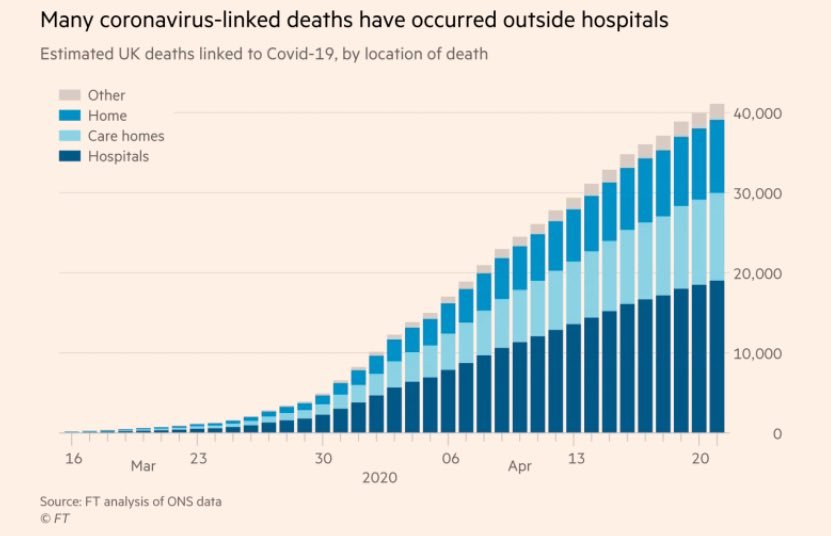
I couldn’t resist the temptation to do a short post drawing attention to an article in the Financial Times that points out that, based on an analysis of data from the Office of National Statistics, the number of Covid-19 related deaths in the UK is probably around 41,000 which is more than twice the official figure. Unusually for the FT the article is not behind a paywall so I recommend you read it.

Here you can see a couple of figures from the FT piece:
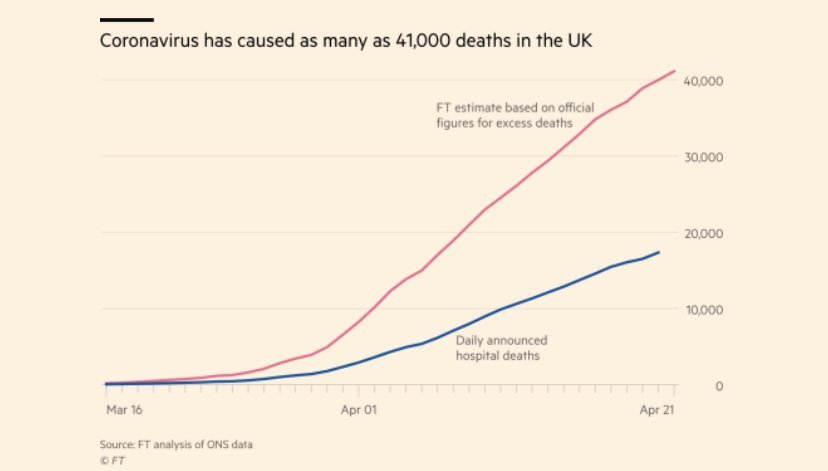
There are three main reasons why the official figures are misleading, namely that Covid-19 deaths reported each day by the UK authorities exclude:

Your reminder that the Covid-19 deaths reported each day by the UK authorities exclude:

  1. those who died of Covid-19 without ever being tested;
  2. those who died of Covid-19 who were tested but whose result was a false negative;
  3. those who died of Covid-19 outside hospitals whether they were tested or not.

Whenever I have pointed this out on Twitter (which I have done several times) I have attracted comments to the effect of “So what? Every country does the same” which is untrue. Several other countries (both large and small), including Ireland, include deaths outside hospital. Not all countries have such a shambolic policy on testing either, so not all countries leave people to die alone in their own homes without being tested. And, above all, not all countries have a Government consisting entirely of people whose incompetence is surpassed only by their dishonesty.

I’m not saying that it’s easy to communicate reliable data during a rapidly evolving pandemic. The Irish authorities are struggling to keep their figures accurate and up to date. The result is that the information available to the public is sometimes a bit confusing.

For example, a couple of days ago there was a significant upward spike in the reported deaths (red curve, about a factor two increase):
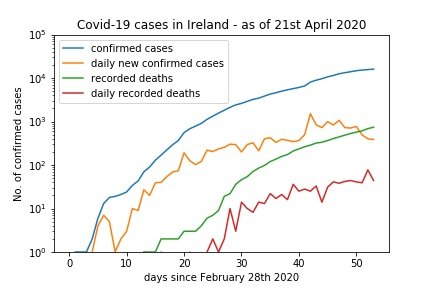
Whether this is an artefact of counting having been delayed over the weekend or a real increase, I don’t know. In any case the deaths reported each day did not necessarily occur in the previous 24 hours and may have been several days earlier. This makes the plot difficult to interpret

What I am saying is that the UK government could easily be more honest about the Covid-19 situation in the UK if it wanted to. Given that the shambles is of its own creation, and that lying is a way of life for its Ministers, it has no incentive to do anything other than obfuscate.

Lockdown Prolonged, Leaving Certificate Postponed

Posted in Education, Politics with tags , , , on April 10, 2020 by telescoper

I’ve just listened to the latest update on the Covid-19 situation in Ireland. One entirely predictable announcement made this afternoon was that the current restrictions on movement will continue until Tuesday May 5th at the earliest. Monday May 4th is a Bank Holiday in Ireland.

I would personally be surprised if the measures now in place were eased before June, actually, but it seems sensible to wait and see if the situation improves before making a decision on further extensions.

(Incidentally, I am keeping track of the Covid-19 numbers in Ireland on a page here.)

Another announcement made today is likely to be more controversial: that this year’s School Leaving Certificate examinations, due to start on June 3rd, will postponed until “late July or early August”.

Among many other things, this will cause those of us involved in University teaching quite a few problems to solve. A lot of thinking caps will be getting dusted off right now!

On the normal cycle, Leaving Certificate results are available in mid-August and successful students begin their University courses in mid-September.

Assuming that there is a delay of two months in sitting the exams and no time can be made up in the marking and moderation process, we’re looking at students not being able to start their courses until mid-November, just a few weeks before the normal end of the First Semester. I have heard suggestions that new students could start in October but these have not included any explanation of how to speed up the process enough to make this possible.

It seems possible to me that, because starting in November would create more problems than it would solve, new students might actually have to defer entry until January, which means in turn that their Second Semester would have to take place during the period June-August. That, in turn, will require staff to abandon any plans for summer research activity and, for some science disciplines, will involve labs being kept open when they are usually closed for upgrades.

Presumably the proposal will be that returning students will follow the usual academic year timetable, but there’s a problem there too if students have to repeat modules from the 1st year which are to be taught on a different calendar.

I’m sure that none of these problems are insoluble but I’m equally sure that the powers that be haven’t really thought about them. Ireland’s current Government does not give the impression of being that interested in universities or the staff who work in them. In recent weeks lecturers have worked exceptionally hard to switch to online teaching and assessment only to have these efforts conspicuously ignored in a recent statement by the Minister for Higher Education Mary Mitchell O’connor. No doubt the Government will again just take it for granted that we’ll sort things out on their behalf.

Solidarity with the UCU Strike!

Posted in Education, Politics with tags , , on February 20, 2020 by telescoper

So the latest round of strikes by members of the University and College Union (UCU) began today. There will be fourteen days of strikes spread over four weeks between now and 13th March. The cause of the long-running dispute is twofold: (1) the long-running saga of the Universities pension scheme (about which there were strikes in 2018); and (2) over pay, equality, workloads and the ever-increasing casualization of lecturing and other work.

Among the UK institutions to be involved in the industrial action are Cardiff, Sussex and Nottingham where I have worked at various times in the past. Nobody likes going on strike but the UK higher education system is a very poor state right now, and many of my former colleagues feel that they have no alternative. It will be tough out there on the picket lines in the cold weather, and losing 14 days’ pay is no fun either, but that’s what it means to go on strike.

I’m no longer involved in the UK university system so can’t do much directly to support those taking industrial action but thought the least I could do is wear my union badge* for the duration of the strike. The Irish Federation of University Teachers (IFUT) will no doubt be expressing their support for comrades on strike. It’s not as if higher education in Ireland is immune from casualisation and workload issues.

*On reflection, I should have taken the picture a different way…

A Day of Results

Posted in History, Politics with tags , , , on February 10, 2020 by telescoper

The results of Saturday’s election are not all in yet, but it is clear that Sinn Féin have come top of the popular vote, with 24.5% of first preferences. As I write this they have 36 TDs compared to 22 altogether in the last Dáil Éireann. They are unlikely to win more than 2-3 more so won’t be the biggest party in terms of seats, but the chances are they will be part of the next Government.

In my own constituency of Kildare North, Sinn Féin’s Réada Cronin won a seat, dislodging one of the Fianna Fáil incumbents, Frank O’Rourke:

As news came in yesterday evening of the strong showing by Sinn Féin, quite a few old friends from the UK emailed me to ask about my opinion. Some for some reason were under the impression that this result is something to do with Brexit. It simply isn’t. The campaign was totally dominated by domestic issues, especially housing and health, on both of which the existing coalition has clearly failed. The so-called `Irexit’ party (funded and promoted by Nigel Farage stooges) flopped in spectacular, as did sundry other far-right parties who tried to whip up anti-immigrant sentiment.

Others asked whether the success of Sinn Féin makes a United Ireland more likely in the short term. Although I would love to see that outcome achieved by democratic means, I’m not sure that this election result automatically brings it closer. For one thing, the Border Poll that would be needed to achieve unification is not in the gift of the Dublin Government, whatever its complexion. For another. a successful vote for Irish unity would require a majority in favour on both sides of the border. The hard-line unionists in the North would not vote `yes’ under any circumstances so a majority would require a significant number of more moderate or more pragmatic unionists to swing towards unity. That may well happen as the negative effects of Brexit begin to bite on Northern Ireland, but it’s also possible that Sinn Féin’s past association with violence may scare some of them off. We’ll have to wait and see. A lot will depend on what happens in the next few months.

There are also some here in the Republic who regard Sinn Féin as pretty toxic, but I see the fact that it is now a major mainstream political party as a very positive development for Ireland’s democracy. For one thing, they offer a radical alternative to the two `establishment’ centre-right parties that have run Ireland for decades. These parties, Fine Gael and Fianna Fáil, came into existence as a result of the Irish Civil War, the latter party splitting from Sinn Féin on the issue of abstentionism. After the Civil War it was not until 1997 that the first Sinn Fein TD actually took a seat in the Dáil. Way back in 1919, however, the First Dail was essentially created by Sinn Féin. It seems to me only right that this party that played such a key role in Irish history should return from the wilderness. In some sense this General Election could mark the end of the beginning of Ireland as an independent nation.

Update: here is a summary of the final results.

In for the Count

Posted in Biographical, Politics with tags , , , , , , , on February 9, 2020 by telescoper

I voted in the 2020 General Election yesterday morning before Storm Cíara arrived in Maynooth, which it did in the early afternoon.I don’t know if the weather or the switch to a Saturday polling day affected the turnout, but it looks to have been about 60% nationally*. One factor in the Dublin area was that a couple of big sporting fixtures took place in the city on Saturday, the Six Nations Rugby between Ireland and Wales at the Aviva Stadium and a Gaelic Football match between Dublin and Monaghan at Croke Park.

Whatever the effect of these things on the overall turnout I’d imagine that a larger fraction of voters turned out earlier in the day than in other elections as few people would want to interrupt their Saturday night pleasures by visiting a polling station!

The worst of Storm Cíara seems to have passed, but it’s still rather windy with the odd heavy rain shower, which is enough to keep me indoors for the count. As the meteorological storm subsides, an electoral storm seems to be brewing – last night’s exit polls the three largest parties tied on about 22% of the vote (with a margin of error around 1.5%).

Taking a look at the preceding opinion polls you will see that outcome is well within the ±3% uncertainty of the last few:

  • Sunday Times/Behaviour & Attitude: FF 32%; FG 20%; SF 19%
  • Irish Times/IPSOS-MRBI: FF 25%; FG 21%; SF 21%
  • BusinessPost/Red C: FF 26%; FG 23%; SF 19%
  • Daily Mail/Ireland Elects: FF 27%; FG 22%; SF 22%
  • Sunday Times/Panelbase: FF 23%; SF 21%; FG 19%
  • Business Post/Red C: FF 24%; SF 24%: FG 21%.
  • Irish Times/IPSOS-MRBI: FF 23%; FG 20%; SF 25%

If this pattern is borne out it will be a bitter disappointment for Fianna Fáil who have had four years in opposition to make inroads but have apparently failed to do so.

The main story however is the remarkable rise of Sinn Féin, which looks likely to shatter the two-party dominance that has held sway in Ireland more or less since its inception as an independent state. Early indications are that they will do very well and return TDs in constituencies where they have never previously won a seat.

My constituency is Kildare North which elected 1 Social democrat, 1 Fine Gael and 2 Fianna Fáil TDs last time. based on early tallies it seems that Catherine Murphy (the Social Democrat), who is a very good candidate with a strong local following, will get re-elected on the first round but the Sinn Féin candidate Réada Cronin looks likely to win a seat too. That is remarkable because she only polled 6.55% of the votes in the last General Election and also lost her County Council seat in the Local Elections last year. It’s been a remarkable turnaround for her and for Sinn Féin generally. If SF do win a seat that means at least one of the incumbents will lose theirs. But who? We’ll have to wait and see!

Counting has really only just started so I won’t comment much until the real results are available, except to say that it is very difficult to see what kind of Government will emerge from all this, which looks essentially like a three-way tie in terms of popular vote, because that will not translate directly into seats owing to the way the Single Transferable Vote works.

For example, take Dublin Central, the constituency of Sinn Féin President Mary Lou McDonald. The STV system involves a quota for automatic election which is N/(m+1) votes, where N is the number of valid ballots cast and m is the number of seats in the constituency. Dublin Central is a four-seater and it seems that Mary Lou got about 36% of the first-preference votes, which is way past the quota of 20%. This surplus (16% of the valid ballots) will be re-distributed among the 2nd preference votes of those who put her first which could make a huge difference to the fortunes of those lower-ranked candidates. But where will they go?

One might imagine that Sinn Féin voters would rank other leftish parties, but there is a fraction who don’t use the whole ballot paper, but just put a 1 next to the SF candidate. Some of the SF surplus may be wasted in this way. Moreover, during the European Elections last summer I noticed some very strange transfers that went from SF to right-wing rather than left-wing alternatives. It’s all very hard to predict, but we’ll know soon enough.

It took several days to get the full results of the European Parliament Elections last year, but in that case the constituencies were much larger (both geographically and in terms of number of voters). There were also many more candidates on each ballot paper. Hopefully there will be a clear picture of the outcome of this General Election later this evening…

*the official turnout figure is 62.9%

Polling Day Eve

Posted in Biographical, Maynooth, Politics, Rugby with tags , , , , on February 7, 2020 by telescoper

It’s Friday 7th February 2020, the day before Ireland goes to the polls in a General Election. I’m actually quite excited.

My polling card arrived a couple of days ago:

You don’t need to take this card with you when you vote, although it does speed things up a bit. The card is useful, however, because it tells you where the polling station is. In this case it’s the same place as in the European and Local Elections last summer.

A few days ago I came home from work and found this. It’s the only such card I’ve had from any individual or party during the three weeks of the campaign.

It’s a pity I wasn’t in when Bernard Durkan called around. I’m not going to vote for him, but I should like to have seen the look on his face when I told him who I’m actually going to vote for!

It remains to be seen whether the switch to a Saturday polling day will change the volume or composition of the turnout. It seems likely to me that the more important factor might be the weather: Storm Ciara is due to arrive on Saturday, bringing high winds and heavy rain. The local forecast in Maynooth for Saturday seems OK in the morning, however, so I’ll get my voting done then, but the storm seems set to hit Dublin just as the Six Nations rugby between Ireland and Wales gets under way, which might make things interesting.

Irish Election Update

Posted in Politics with tags , , , , on February 3, 2020 by telescoper

I couldn’t resist one more update before Saturday’s General Election because there has been another opinion poll (Irish Times/IPSOS-MRBI), which I’ve added to the previous ones here:

  • Sunday Times/Behaviour & Attitude: FF 32%; FG 20%; SF 19%
  • Irish Times/IPSOS-MRBI: FF 25%; FG 21%; SF 21%
  • BusinessPost/Red C: FF 26%; FG 23%; SF 19%
  • Daily Mail/Ireland Elects: FF 27%; FG 22%; SF 22%
  • Sunday Times/Panelbase: FF 23%; SF 21%; FG 19%
  • Business Post/Red C: FF 24%; SF 24%: FG 21%.
  • Irish Times/IPSOS-MRBI: FF 23%; FG 20%; SF 25%

This last one is the first to put Sinn Féin in the lead, although to be honest the margin of error is 3% again so there’s really no evidence for a significant change on the last poll by the same outfit.

I still find it very hard to predict what kind of Government Ireland will end up with, but it seems even less likely than before that Leo Varadkar will be leading it.

British friends keep asking me whether all this change is a result of Brexit. I have to say that the answer to that is ‘no’ and neither is it driven entirely by thoughts of a United Ireland. The focus of campaigning is largely on domestic political issues, chiefly housing and health. Most people tend to think Varadkar has handled Brexit pretty well, but his party had failed badly in these other areas.

UK and Ireland Trade

Posted in Politics with tags , on February 2, 2020 by telescoper

For reasons that are probably obvious I recently took a look at the latest figures relating to trade between Ireland and the United Kingdom. These were produced by the UK Government but I’ll nevertheless assume they are trustworthy. The latest complete figures are from 2018; the report was published in January this year (2020).

Here are the key points:

  • In 2018, UK exports to Ireland were worth £35.1 billion; imports from Ireland were £21.6 billion, resulting in a trade surplus of £13.5 billion with Ireland.
  • The UK had a surplus with Ireland in both goods and services.
  • Ireland accounted for 5.5% of UK exports and 3.2% of all UK imports.
  • Ireland was the UK’s 5th largest export market and the 10th largest source of imports.
  • The UK has recorded a trade surplus with Ireland every year between 1999 and 2018.

Brexiter logic states that the fact that the EU exports more to the UK than vice versa means that the EU needs the UK more than the UK needs the EU. Applying the same argument to Ireland would imply that the UK needs Ireland more than Ireland needs the UK (if it were correct). The reality is that membership of the single market has been of benefit to the economy of both countries (and the rest of the EU). Trade is not a zero-sum game. While the Single Market has allowed the UK to generate a trading surplus with Ireland, Ireland has found other opportunities elsewhere to more than make up. Contrary to popular myth, the UK now only accounts for a small fraction of goods exports from Ireland.

As the United Kingdom has left the European Union it must now try to negotiate new trading arrangements that will cover trade with remaining member states, including Ireland. No doubt the EU negotiators will be pressed by Ireland to take steps to reduce the imbalance described above. As the UK no longer wants to avail itself of the benefits of Single Market, it seems likely that other EU member states will want to seize the opportunity to boost their trade by filling the gaps.

Since the UK’s trading agreement with the EU (if there ever is one, which is doubtful) will probably not include services, I thought it would be interesting to look at goods: here is a summary of the breakdown of this category of UK exports to Ireland:

`Miscellaneous manufactured articles’, incidentally, means things made out of plastic, etc.

As a relatively recent arrival in Ireland I find these figures quite interesting in light of my own experience of shopping here. I know that consumer goods aren’t representative of all trade so this is just a comment on my own impressions and is not to be taken too seriously.

If you go into a Supermarket in Ireland you will find that fresh vegetables, meat and dairy products are generally all from local sources. There is a wide choice of these items and value for money is generally very good. The same is true for bread and bread-related products. Some fruit is imported from the EU (especially France and The Netherlands, but including some, e.g. apples, from the UK) and some from further afield (e.g. bananas from the Caribbean and Latin America). You will be shocked to learn that bendy bananas are freely available.

Moving to processed foods (including confectionery, canned items, etc) the picture changes quite a bit. There are local Irish brands but they tend to be alongside familiar British ones. There are also items from elsewhere, e.g. from Italy, that I have never seen on sale in the UK. The (smaller) Irish brands of, say, marmalade seem to be a bit dearer than their imported equivalent but are often of better quality.

As an aside I’ll also mention that supermarkets here have a noticeably smaller range of convenience foods (e.g. microwave meals and ready-made sandwiches) than in corresponding outlets in the UK.

I’ve been impressed at the quality and availability of another important staple, wine. There is a better range of French, Spanish and Italian wines in Supervalu in Ireland, especially at the quality end of the spectrum, than in stores of a similar size in the United Kingdom. There is also a good range of wines from Australia, New Zealand, South Africa and Latin America. I haven’t tried Irish wine yet…

In summary, then, it’s perfectly easy to eat and drink well in Ireland without buying any British products. For myself, I have always tried to buy local food products whenever possible to support the Irish economy as best I can.

Elsewhere in the store however you can see a much greater dominance of UK products. This is particularly true of toiletries (including toothpaste, shampoo), pharmaceutical goods, domestic cleaning products and so on. These tend to be dominated by familiar British brands, although they seem to be more expensive here in Ireland than in the UK.

None of the goods mentioned in the previous paragraph are at all perishable so they could in principle be quite easily be imported from further afield. I wonder if we’ll soon start seeing products of this sort starting to appear from elsewhere?

Irish Election Update

Posted in Biographical, Maynooth, Politics with tags , , , , on February 1, 2020 by telescoper

Well. Life goes on, and so does the Irish General Election campaign. A week today I’ll be casting my vote. Sinn Féin seem the most energized by the events of the last week, even to the extent that their posters have been going up around Maynooth. The one above, showing leader Mary Lou McDonald, is on my way into work (the North Campus of Maynooth University is on the other side of the road, beyond the trees).

Since last week’s update there have been other opinion polls (by the Sunday Times/Panel base and Red C), which I’ve added to the previous ones here:

  • Sunday Times/Behaviour & Attitude: FF 32%; FG 20%; SF 19%
  • Irish Times/IPSOS-MRBI: FF 25%; FG 21%; SF 21%
  • BusinessPost/Red C: FF 26%; FG 23%; SF 19%
  • Daily Mail/Ireland Elects: FF 27%; FG 22%; SF 22%
  • Sunday Times/Panelbase: FF 23%; SF 21%; FG 19%
  • Business Post/Red C: FF 24%; SF 24%: FG 21%.

The latest polls (like the others) are based on a small sample (1000) so has a large marging of error (around 3%) and is based on online responses and an uncertain methodology which may create a systematic bias. Those caveats aside, however, they seems to be telling the same story as the others: decline for Fine Gael and a relatively strong showing for Sinn Féin who are up 7% and 5% on the previous Panelbase and Red C numbers, respectively.

I wouldn’t be at all surprised if Sinn Féin end up with a share of the first preference votes around 25%. If that is the case they’ll probably wish they had stood more candidates, which they will probably do next time if they perform strongly in the actual election. They did poorly in the European Elections last year, which probably explains their rather defensive strategy. On the other hand if Fianna Fáil really are polling in the low twenties they may regret standing so many candidates, as their vote may end up splitting so that none reach the quota.

It will be very interesting to see how this all pans out. I find it very hard to predict what kind of Government Ireland will end up with, but I’m willing to bet that Leo Varadkar won’t be leading it.