Archive for the Politics Category

Voting Matters

Posted in Maynooth, Politics, The Universe and Stuff with tags , , , , , on October 4, 2018 by telescoper

At last I have this afternoon free of teaching and other commitments, and having fortified myself with lunch in Pugin Hall, I’m preparing to make an attempt on the summit of the Open Journal of Astrophysics now that all the outstanding administrative obstacles have been cleared. Before shutting myself away to do up the loose ends, however, I thought I’d do a quick post about a couple of electoral matters.

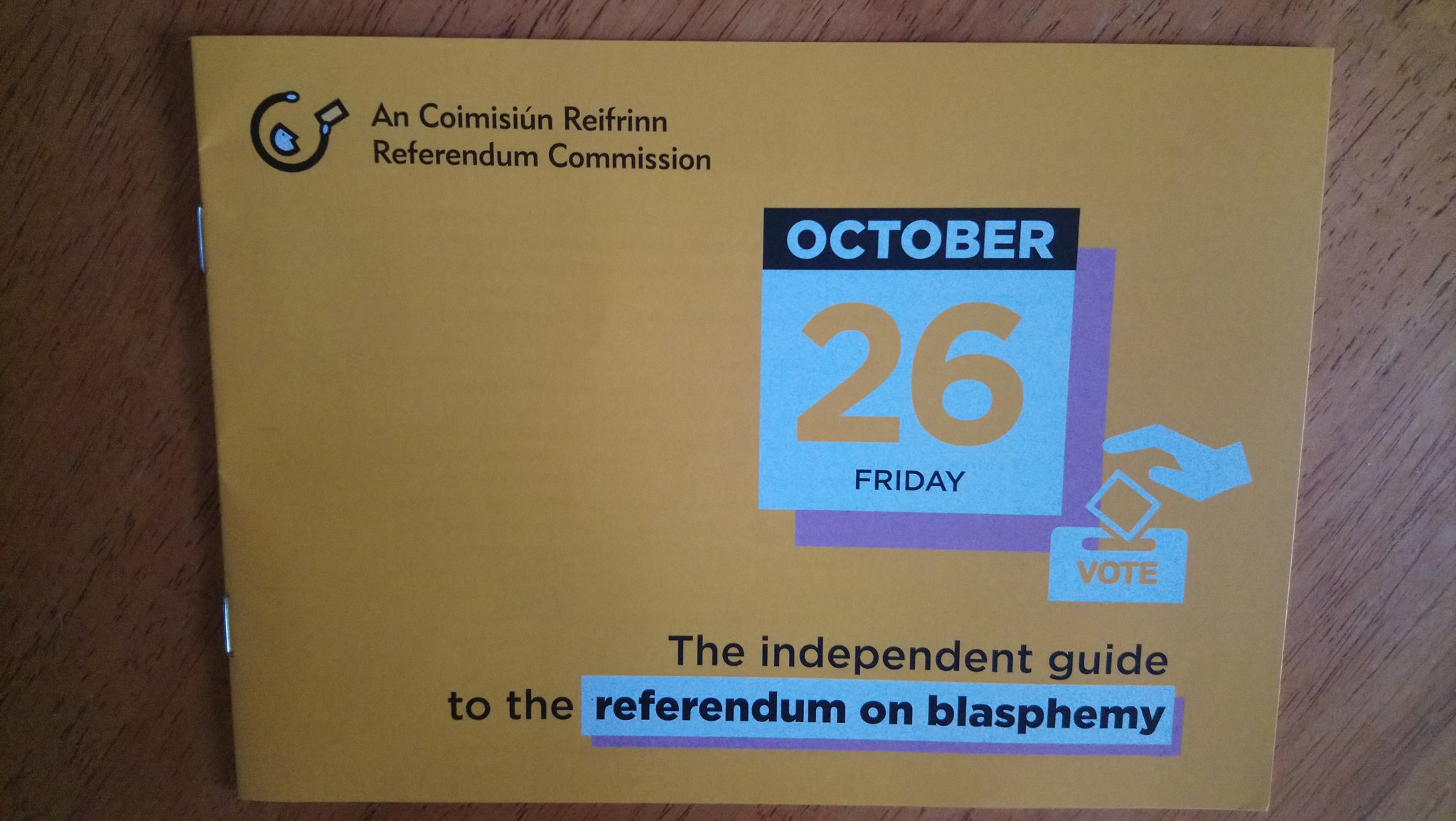
The first relates to this, which arrived at my Maynooth residence the other day:

This document reminded me that there is a referendum in Ireland on the same day as the Presidential election I mentioned at the weekend. The contents of the booklet can be found here. In brief,

At present, the Constitution says that publishing or saying something blasphemous is an offence punishable under law. Blasphemy is currently a criminal offence. The referendum will decide if the Constitution should continue to say that publishing or saying something blasphemous is a criminal offence. If the referendum is passed, the Oireachtas will be able to change the law so that blasphemy is no longer a criminal offence.

Having read the booklet thoroughly and thereby having understood all the issues, and the implications of the vote,  I have decided that I will vote in favour of making blasphemy compulsory.

The other matter being put to a vote is something I just found out about today when I got an email from the International Astronomical Union concerning an electronic vote on Resolution B4, that the Hubble Law be renamed the Hubble-Lemaître law. For background and historical references, see here. I don’t really have strong opinions on this resolution, nor do I see how it could be enforced if it is passed but, for the record, I voted in favour because I’m a fan of Georges Lemaître


The Strumia Affair

Posted in Politics, The Universe and Stuff with tags , , , , on October 3, 2018 by telescoper

I’m very late to this story as it broke over the weekend when I was preoccupied with many things, but it has triggered quite a reaction in the media (including here in Ireland). The story involves a physicist by the name of Alessandro Strumia who works at the University of Pisa in Italy. This person used the opportunity provided by a Conference on Theory and Gender to deliver a talk that contained highly inflammatory comments about gender and physics ability.

As a service to the community I’ve uploaded the slides for Strumia’s talk to Slideshare so you can read them here if you’re interested in his argument:

There are detailed discussions of Strumia’s talk by fellow bloggers Philip Moriarty here and Jon Butterworth here. Between them they cover most of what I’d say on the topic if I had time so I’ll direct you to them rather than repeat the arguments here. There are a host of other reaction pieces elsewhere, and I won’t attempt to summarize them either. Suffice to say that the old argument that `women are intrinsically not as good at physics as men’ has been refuted many times using solid empirical evidence; see the above post by Philip. It’s no wonder, though, that women get put off doing physics, when there are people like Alessandro Strumia in the field and potentially responsible for evaluating the performance of female staff.

What I will do add is that, for someone who purports to be a scientist, Strumia’s use of evidence is shockingly unscientific. His argument is riddled with non sequitur, unjustified assumptions and formulaic prejudice. Apart from everything else I think this is symptomatic of a malaise that is a widespread affliction in the field theoretical physics nowadays, which is worst among string theorists (which Strumia is not), namely a lack of basic understanding of, or even interest in, the proper application of scientific method.

The Brexit Wormhole

Posted in Politics, The Universe and Stuff with tags , , , on October 2, 2018 by telescoper

Since I have been passed over yet again for the physics Nobel Prize, I thought I’d pull out all the stops for next year and reveal my latest research which will surely satisfy the necessary criteria by conferring the “greatest benefit on mankind”.

One of the concerns facing those hoping to be involved in trade between post-Brexit Britain and the civilized world is the necessity of customs checks, especially at Dover, which will bring gridlock to the M20 and jeopardize the `just-in-time’ delivery systems used by most modern manufacturing enterprises e.g. the car industry.

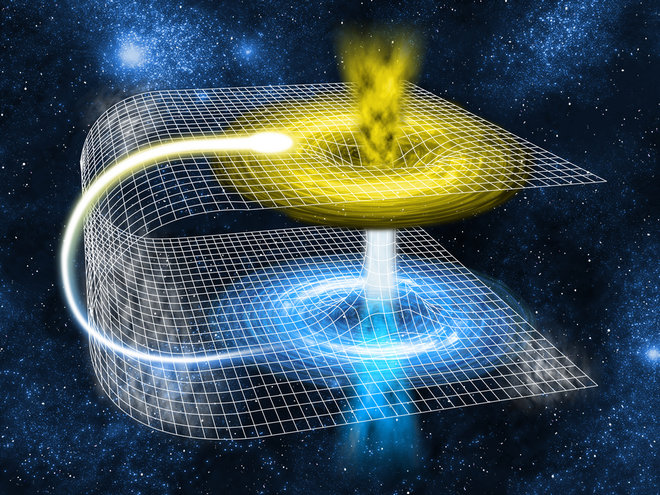
My solution to this problem is to install at Dover a series of Einstein-Rosen Bridges (as illustrated above), connecting the United Kingdom to various points in the space-time continuum. Travelling through traversible wormholes will effectively allow British lorries to reach superluminal velocity, thereby not only avoiding delays on the M20 but also allowing goods to be delivered even before they have been ordered.

I am willing to lease the Brexit Wormhole device to representatives of the UK government for the modest fee* of £350 million per week, in the hope that the extent of this generosity will put me in line for the Nobel Peace Prize in addition to the Nobel Prize for Physics.

*Payment to be made in Euros only please.

In addition to fulfilling this important geopolitical function, it will also be possible for wealthy individuals to lease smaller versions of the device for their own use, e.g. Mr Rees-Mogg may be interested in using one to travel back in time to the 18th Century.

P.S. As if the Brexit wormhole were not enough to garner these prestigious awards, I can further announce that I have found a most marvelous solution of the Irish Border Problem but this blog post is too narrow to contain it.

Presidential Election Time

Posted in Politics with tags , , , , on September 29, 2018 by telescoper

This week the deadline passed for nominations of candidates for the post of President of Ireland (Uachtarán na hÉireann). The rather peculiar nomination process has left voters with a choice of six, including the incumbent Michael D Higgins. As a relative newcomer to Ireland, even I know that the post of President doesn’t have any real power associated with it and is largely ceremonial. Surprisingly, some of the people who put themselves forward didn’t seem to understand that but, fortunately, some of the more obvious fruitcakes who put themselves forward failed to get nominated. On the other hand, three of the candidates are businessmen best known for having appeared on the Irish version of the TV show Dragon’s Den. There’s ample evidence that the products of reality TV shows do not make good presidents.

The election takes place precisely four weeks from now, on Friday 26th October 2018, and the term of the presidency is 7 years – the last such election took place in 2011.

Naturally, given the vital importance of the office of the Presidency and the need to treat the forthcoming election with the appropriate gravitas, my first thought was to look at the betting odds on Paddy Power. Here is the full SP:

  1. Michael D. Higgins (Incumbent) 1/5
  2. Sean Gallagher  5/1
  3. Gavin Duffy 14/1
  4. Joan Freeman 25/1
  5. Liadh Ni Riada  33/1
  6. Peter Casey 66/1

Obviously Michael D Higgins is a strong favourite. I think he’s carried out his duties in a very dignified and diligent way for seven years, so he will probably get my vote. Candidates 2, 3 and 6 are the Dragon’s Den people. Joan Freeman is a  journalist by trade (and an Independent member of the Seanad Éireann) and Liadh Ni Riada is the official candidate of Sinn Féin. Neither of the two biggest parties in the Dáil Éireann, Fine Gael and Fianna Fianna Fáil, nominated a candidate, preferring to back the incumbent.

It seems likely that Michael D. Higgins will win and serve another seven years, but it’s hard to be confident about anything in politics these days so we’ll just have to wait and see..


On the Plural of Referendum

Posted in Pedantry, Politics with tags , , , , on September 5, 2018 by telescoper

Quite a few people are suggesting that one way out of the current Brexit fiasco is to have another referendum when the terms of the withdrawal agreement (if any) are known. Bafflingly, Theresa May has argued that a second plebiscite would be `a betrayal of democracy’ and has categorically ruled out that possibility. Given her U-turn about last year’s General Election one might reasonably infer that a second referendum is now a racing certainty, but she called the election because she was confident she would win. All the signs are now that if given a chance to vote again the UK would vote to remain in the European Union, so the PM will need a very hard push to allow a second referendum.  A smart politician would have used the evidence of electoral misconduct by the Leave campaigns as a way out, but we’re not dealing with smart politicians on either side of the House nowadays.

Whether or not there is a second referendum an important question arises from the possibility, i.e. what is the proper plural of “referendum”?

Regular readers of this blog know that I’m never pedantic about such matters. Well, maybe a little bit, sometimes. Latin was my best subject at O-level, though, so I can’t resist making a comment.

Any dictionary will tell you that “referendum” is obtained from the Latin verb referre which is itself formed as re- (prefix meaning “back”) + ferre (to carry), thus its literal meaning is “carry back” or, more relevantly to the current discussion, “to refer”. Ferre is actually an irregular verb, which complicates the discussion a bit, so I’ll use simpler examples of regular verbs below

Latin grammar includes two related concepts derived from a verb, the gerund and the gerundive.

The gerund is a verbal noun; such things exist in English in forms that mean `the act of something’, e.g. running, eating, loving.The word formed from a verb with the ending `ing’ can also function as a present participle in English, but we wont be going there. It may easy to muddle up gerunds with participles in English, but not in Latin as they are formed in distinctly different ways.

IAs an example, in the case of `loving’ the  relevant Latin verb is the first conjugation amare (amo amas amat and all that) and the appropriate gerund is amandus. You can this sort of Latin construction surviving in such English words as “graduand”. Note, however, that a gerund has no plural form because that would make no sense in Latin. There are plural forms in English such as `doings’ and `comings and goings’ but I don’t think these are relevant here as I interpret them as jocular, and pedantry is a very serious business. Moreover

Related to the gerund is the gerundive which, as its name suggests, is an adjectival form related to the gerund, specifically expressing necessity. In Latin, an adjective takes an ending that depends on the gender of the noun it describes; the gerundive also follows this pattern.

In the loving example above, the gerundive form is amandus in a masculine case or, if referring to a female entity, amanda, hence the name Amanda, which means “deserving or requiring love”, or amandum for a neuter noun. In cases where the noun is plural the forms would be amandi, amandae, and amanda. Endings for other gerundives formed from other verbs are constructed in a similar fashion depending on their conjugation.

From this discussion you can see that in Latin amandum could mean either “loving” (gerund) or “a thing to be loved” (gerundive). Latin grammar is sufficiently precise, however, that the actual meaning will be obvious from the context.

As an aside, based on my own experiences in mathematics and physics, the abbreviation `QED’ which is often placed at the end of a proof is short for `Quod Erat Demonstrandum’, meaning `which was required to be shown’ rather than `Quite Easily Done’.  I’m surprised how many people use QED without knowing what it means!

Now, back to referendum. It seems clear to me that this is a gerundive and thus means “a thing to be referred” (the thing concerned being of no gender, as is normal in such cases in Latin). So what should be the word for more than one referendum?

Think about it and you’ll realise that referenda would imply “more than one thing to be referred”. The familiar word agenda is formed precisely this way and it means “(a list of things) to be done”. But this is not the desired meaning we want, ie “more than one example of a thing being referred”.

I would therefore argue that referenda is clearly wrong, in that it means something quite different from that needed to describe more than one of what a single referendum is.

So what should we use? This is a situation where there isn’t a precise correspondence between Latin and English grammatical forms so it seems to me that we should just treat referendum as an English noun and give it the corresponding English plural. So “referendums” it is.

Any questions?

P.S. In a forthcoming post I shall give the full conjugation of the verb brexire, as brexit must be formed from that verb  in the same way that exit is formed from exire (i.e. third person singular in the active voice; exire is an irregular verb but basically similar to fourth conjugation). On this basis the gerund of brexire would be brexeundum and the gerundive brexeundus

Charles Kingsley on the Irish

Posted in Biographical, History, Politics with tags , , , , on September 4, 2018 by telescoper

I’ve been aware since my schooldays that there has been (and still is) a significant tendency among the English (especially their governing classes) to regard the Irish as lawless barbarians, but this quote which I found in a book I’ve been reading really took my breath away. It’s from a letter written by Charles Kingsley to his wife in 1861, while he was travelling through an Ireland still reeling from the devastation of the Great Famine:

But I am haunted by the human chimpanzees I saw along that hundred miles of horrible country. I don’t believe they are our fault, I believe that there are not only more of them than of old, but that they are happier, better, more comfortably fed and lodged under our rule than they ever were. But to see white chimpanzees is dreadful; if they were black, one would not feel it so much, but their skins, except where tanned by exposure, are as white as ours.

This passage is revolting in so many ways that I don’t think it needs any further comment, but it is worth mentioning that Charles Kingsley was, by the standards of his time, regarded as something of a progressive. As well as being a Church of England priest, Professor of History and a novelist (I read The Water-Babies when I was a child), he was also a social reformer involved in such initiatives as the working men’s college and labour cooperatives. Clearly his concern for the poor and oppressed didn’t extend much beyond his own people.

P.S. In the interest of full disclosure, I should also mention that Charles Kingsley did his undergraduate studies at Magdalene College, Cambridge, as did I (thought not at the same time).

The Lunar Eclipse

Posted in Politics, The Universe and Stuff with tags , , on July 27, 2018 by telescoper

Just a reminder that there will be lunar eclipse tonight. The so-called `blood Moon’ will be visible across Ireland and the United Kingdom (as well as much of the rest of world tonight) although there is rain forecast, and its very overcast as I write this, so it’s possible that all I from Maynooth will see is clouds. That’s a shame as this will be the longest total lunar eclipse of the 21st century, lasting one hour, 42 minutes and 57 seconds.

Observers in Ireland will not be able to see the start of the eclipse as the moon will still be below the horizon when the Earth passes between the Sun and the Moon. However, in the Dublin area it will be seen (clouds permitting) from 9.30pm to 10.15pm low in the sky to the South East. Then from 10.15pm to 11.20pm, the moon will be seen coming out of Earth’s shadow. The partial eclipse will last around four hours. Oh, and you should be able to see Mars which will be very bright tonight, down a bit and to the left from the Moon.

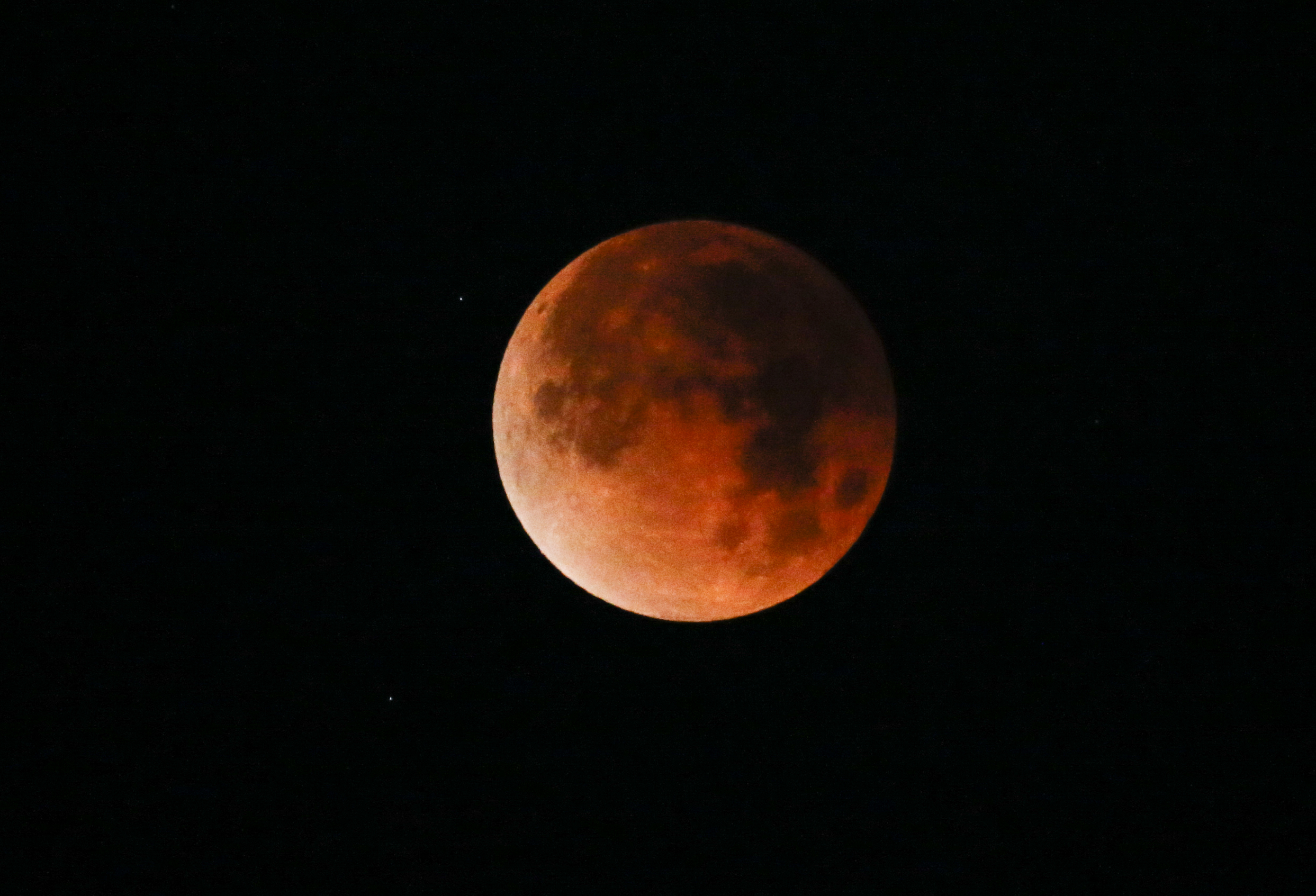
The photograph above is of a lunar eclipse taken earlier this year, on 31st January. Lunar eclipses tend to be seen in pairs, like low comedians.

Update:

P.S. It’s worth also giving advanced notice that next year, on March 29th 2019, there will be a total eclipse of the United Kingdom visible from Ireland and all the rest of the world…

Farewell to Brexit Britain

Posted in Biographical, Politics with tags , , on July 23, 2018 by telescoper

I popped into the office at Cardiff University today to finish off one piece of outstanding business I didn’t have time to complete on Friday and to collect the last of my possessions – including a number of bottles of wine! – before flying to Ireland tomorrow morning.

I couldn’t resist doing a quick post about the chaotic state of UK politics towards Brexit. For all the turmoil of the past two weeks, In a sense nothing has changed since I wrote about this almost exactly a year ago. The so-called `Chequers Plan’ was greeted with predictable disdain by the EU negotiators who must be exasperated that Theresa May seems not to have understood anything that’s said about the European Single Market for the last two years, as well as signalling that she wanted to renege on agreements already reached in December. And then we had the new Brexit Secretary, Dominic Raab, announcing that he intended that the UK would not pay its outstanding bills if a Trade Deal were not agreed, despite the UK having agreed to this months ago too.

All this is consistent with what I have always felt would be this government’s approach to the Brexit negotiations, which is not to negotiate at all. Their plan, as it has always been, is just to go through the motions until they able to find some pretext to storm out, blaming the EU for trying to bully them. The staged walkout will probably happen in October, after a summer media offensive against the EU supported by propaganda pieces in the Daily Express, Mail and Telegraph. That is, I believe, the Government’s plan. The new Foreign Secretary more or less said so today. It is why Theresa May called a snap election, hoping to build up a larger majority and a full parliamentary term to withstand the inevitable backlash. That gamble backfired, but the Conservatives are still in power and the plan remains in place.

This strategy might just allow the Tories to cling onto power while the economy suffers as we crash out of the EU in the most disorderly fashion possible. This will not only cause chaos for trade and commerce but will also be awful for for EU residents in the UK and UK residents in the EU. Above all, it will show that the UK government has not been acting in good faith at all throughout the process, and will ensure for generations to come that the United Government is entirely untrustworthy. And that’s before you even consider the fact that the 2016 referendum has now been demonstrated beyond all reasonable doubt to have been crooked, due to unlawfully excessive spending by both Leave campaigns, and other dirty tricks such as illegal use of personal data.

So why has the Government decided to adopt this position? Simple. It does not have the wherewithal even to formulate a negotiating position, let alone deliver a successful outcome., because no possible end result can deliver the economic and political benefits of remaining in the European Union. If we’re going to make people suffer, the reasoning goes, we might as well find a scapegoat to deflect criticism away from our poor choices.

And what about the EU position? Well, they hold all the cards so they won’t be worried. Their priority will be to take over all the business opportunities that we have decided we no longer want. Whatever happens with the negotiations, the UK leaves the EU in March 2019. That’s plenty of time for EU companies to relocate their operations to mainland Europe, to write British producers out of their supply chains, and to expand its portfolio of trade agreements to the further disadvantage of the UK economy, like it has recently done with Japan.

The UK government views my new home, Ireland, as the Achilles Heel of the European Union. Things could get very tough in the Republic when the UK crashes out of the EU, no doubt to the delight of the Tory party’s henchmen in the DUP. But even if that is the case I’d much rather be living in Ireland than in Brexit Britain. Just as a xenophobic backward-looking insular and authoritarian agenda grips the UK, Ireland is moving in the opposite direction, towards a modern outward-looking progressive liberal democracy.

Oh, and if you’re an academic who is as fed up with the UK as I am, take a look at Science Foundation Ireland’s Future Research Leaders scheme. Maynooth University is particularly keen to welcome applicants to the Scheme!

Thirty Years since Section 28..

Posted in History, Politics with tags , , on May 24, 2018 by telescoper

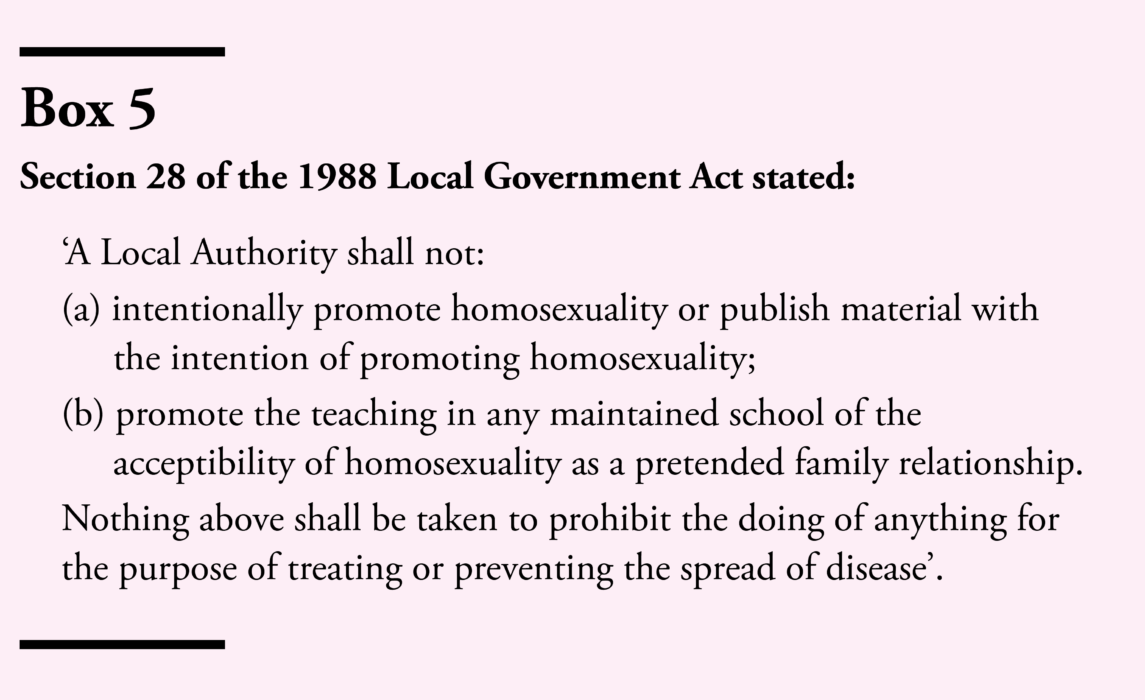
I was reminded by twitter that today is the 30th anniversary of the enactment of the Local Government Act 1988, which included the now notorious Section 28, which contained the following:

I remember very well the numerous demonstrations and other protests I went on as part of the campaign against the clause that became Section 28. Indeed, these were the first large political demonstrations in which I ever took part. But that repugnant and obviously discriminatory piece of legislation passed into law anyway. Students and younger colleagues of mine born after 1988 probably don’t have any idea how much pain and anger the introduction of this piece of legislation caused at the time, but at least it also had the effect of galvanising  many groups and individuals into action. The fightback eventually succeeded; Section 28 was repealed in 2003. I know 30 years is a long time, but it’s still amazing to me that attitudes have changed so much that now we have same-sex marriage. I would never have predicted that if someone had asked me thirty years ago!

I think there’s an important lesson in the story of Section 28, which is that rights won can easily be lost again. There are plenty of people who would not hesitate to bring back similar laws if they thought they could get away with them.  That’s why it is important for LGBT+ people not only to stand up for their rights, but to campaign for a more open, inclusive and discrimination-free environment for everyone.

Funding Basic Research in Ireland

Posted in Politics, Science Politics with tags , , on May 15, 2018 by telescoper

I received an email the other day about a scheme run by Science Foundation Ireland. Among other things, the Technology Innovation Development Award is intended (among other things)

… enables researchers to demonstrate the technical feasibility of an applied research project directed toward the development of a new or innovative technology, product, process or service that has potential for further commercial development.

The thrust of this scheme is pretty typical of funding calls in Ireland, and it spurred me to go on a mini-rant.

It’s quite clear to me since arriving in Ireland that funding for basic research – especially in the sciences – is extremely poor. This is largely because of a high-level report published in 2012. This identified 14 priority areas of research that are most likely to give demonstrable economic and societal return, and where Ireland should focus the majority of competitive funding. Four criteria were used in selecting the 14 priority areas for future, competitively-awarded investment for economic objectives:

  1. the area is associated with a large global market or markets in which Irish-based enterprises already compete or can realistically compete;
  2.  publicly performed R&D in Ireland is required to exploit the area and will complement private sector research and innovation in Ireland;
  3.  Ireland has built or is building (objectively measured) strengths in research disciplines relevant to the area; and,
  4. the area represents an appropriate approach to a recognised national challenge and/or a global challenge to which Ireland should respond.

The `vast majority’ of SFI’s funding is directed towards the 14 areas so defined, leaving virtually nothing for anything else, an outcome which has dire implications for `blue skies’ research.

I think this is a deeply misguided short-term policy, which will have a strongly negative effect on science in Ireland in the medium to long term, especially because Ireland spends so little of its GDP on research in the first place.  On top of that it will mean that Ireland will miss out on a golden opportunity to capitalise on Brexit by encouraging European scientists disaffected by the hostile environment that has been created in Britain by its government’s xenophobic policies to relocate to Ireland. There’s simply no point in trying to persuade world-leading researchers to come to Ireland if insufficient funds are available to enable them to establish here; the politicians’ welcoming platitudes will never be enough.

As the Irish economy grows, I hope the Irish government can be persuaded to reverse this situation by investing more in basic research and being more pro-active about reaping the Brexit dividend. Perhaps now that I live here I can play some sort of a role in campaigning for that?

EXPLANATORY NOTE: By `Brexit dividend’, I mean the real dividend, i.e. that which will be experienced by EU countries after Britain gives up all the collaborations, trading opportunities and inward investment that it currently enjoys by virtue of its EU membership.

In the meantime I thought I’d fire an opening salvo by re-iterating a line of thought I had some time ago in the hope that it will provoke a bit of debate.

A while ago, in response to a funding crisis in the UK, I wrote  about using taxpayer’s money to fund research in universities:

For what it’s worth I’ll repeat my own view that “commercially useful” research should not be funded by the taxpayer through research grants. If it’s going to pay off in the short term it should be funded by private investors or venture capitalists of some sort. Dragon’s Den, even. When the public purse is so heavily constrained, it should only be asked to fund those things that can’t in practice be funded any other way. That means long-term, speculative, curiosity driven research. You know, science.

A similar thing was said in in the Times Higher, in a piece about the (then) new President of the Royal Astronomical Society:

Notwithstanding the Royal Academy of Engineering’s “very unfortunate” recent submission to the government spending review – which argued that the need to rebalance the UK economy required public spending to be concentrated on applied science – Professor Davies is confident he can make a good case for spending on astrophysics to be protected.

Research with market potential can already access funding from venture capitalists, he argued, while cautioning the government against attempting to predict the economic impact of different subjects.

This is pretty much the opposite of what Irish government thinks. It wants to concentrate public funds in projects that  can demonstrate immediate commercial potential. Taxpayer’s money used in this way ends up in the pockets of entrepreneurs if the research succeeds and, if it doesn’t,  the grant has effectively been wasted.

My proposal, therefore, is to phase out research grants for groups that want to concentrate on commercially motivated research and replace them with research loans. If the claims they make to secure the advance are justified, they should have no problem repaying it  from the profits they make from patent income or other forms of exploitation. If not, then they will have to pay back the loan from their own funds (as well as being exposed as bullshit merchants). In the current economic situation the loans could be made at very low interest rates and still save a huge amount of the current research budget for higher education. Indeed after a few years – suggest the loans should be repayable in 3-5 years, it would be self-financing. I think a large fraction of research in the applied sciences and engineering should be funded in this way.

The money saved by replacing grants  to commercially driven research groups with loans could be re-invested in those areas where public investment is really needed, such as pure science and medicine. Here grants are needed because the motivation for the research is different. Much of it does, in fact, lead to commercial spin-offs, but that is accidental and likely to appear only in the very long term. The real motivation of doing this kind of research is to enrich the knowledge base of the UK and the world in general.

In other words, it’s for the public good.  Remember that?

Most of you probably think that this is a crazy idea, and if you do please feel free to tell me so via the comments box.