Archive for the Politics Category

Hands off the Good Friday Agreement!

Posted in Biographical, Politics with tags , , , , , , on February 22, 2018 by telescoper


I’ve been watching with increasing alarm the concerted attempt that certain extremist `Brexiteers’ have been trying to make a case for scrapping the Good Friday Agreement that came about in 1998 after decades of violent conflict in Northern Ireland and elsewhere.  These reckless fools think that derailing the peace process is a price worth paying for their ideological obsession with rejecting anything that involves the EU, in this case the Customs Union that allows an open border between the Republic of Ireland (whose future lies in the vibrant and outward-looking European Union) and Northern Ireland (which will remain shackled to the corpse of the United Kingdom, at least for the time being, until the creation of a united Ireland…). Not surprisingly, Irish politicians and the Irish are incensed about the reckless statements being made by some UK politicians.

Incidentally, the Good Friday Agreement was supported by simultaneous referendums in Northern Ireland (71.1% in favour) and the Republic  of Ireland  (94.4% in favour) ; a majority of the NI electorate also voted against leaving th European Union.  It’s strange how selectively some people are prepared to accept `The Will of the People’…

Anyway, just as a reminder of what is at stake, here are three examples based on my own experiences of what things were like before the GFA, when I lived in London (which I did for about eight years, between 1990 and 1998). During that time I found myself in relatively close proximity to three major bomb explosions, though fortunately I wasn’t close enough to be actually harmed. I also concluded that my proximity to these events was purely coincidental.

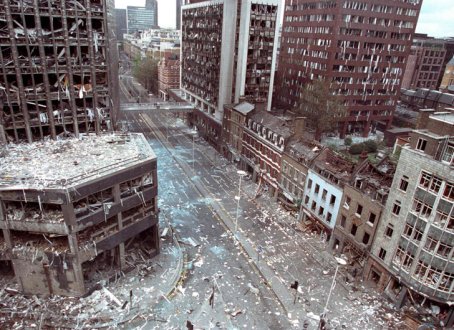
The first, in 1993, was the Bishopsgate Bombing. I happened to be looking out of the kitchen window of my flat in Bethnal Green when that bomb went off. I had a clear view across Weavers Fields towards the City of London and saw the explosion happen. I heard it too, several seconds later, loud enough to set off the car alarms in the car park beneath my window.

This picture, from the relevant Wikipedia page, shows the devastation of the area affected by the blast.

The other two came in quick succession. First, a large bomb exploded in London Docklands on Friday February 8th 1996, at around 5pm, when our regular weekly Astronomy seminar was just about to finish at Queen Mary College on the Mile End Road. We were only a couple of miles from the blast, but I don’t remember hearing anything and it was only later that I found out what had happened.

Then, on the evening of Sunday 18th February 1996, I was in a fairly long queue trying to get into a night club in Covent Garden when there was a loud bang followed by a tinkling sound caused by pieces of glass falling to the ground. It sounded very close but I was in a narrow street surrounded by tall buildings and it was hard to figure out from which direction the sound had come from. It turned out that someone had accidentally detonated a bomb on a bus in Aldwych, apparently en route to plant it somewhere else (probably King’s Cross). What I remember most about that evening was that it took me a very long time to get home. Several blocks around the site of the explosion were cordoned off. I lived in the East End, on the wrong side of sealed-off area, so I had to find a way around it before heading home. No buses or taxis were to be found so I had to walk all the way. I arrived home in the early hours of the morning.


Does anyone really  want to go back to experiencing this kind of event on a regular basis? If  the UK government is persuaded in its weakness to ditch the Good Friday Agreement then there is a real risk of that happening. And if it does, those calling for it will have blood on their hands.


Why I’m taking part in the UCU Strike Action

Posted in Education, Politics with tags , , , , , , on February 21, 2018 by telescoper

In case you weren’t aware, from tomorrow (22nd February) the University and College Union (UCU) is taking industrial action over proposed drastic cuts to staff pensions funded by the Universities Superannuation Scheme (USS). You can find some background to the pensions dispute here (and in related articles). A clear explanation of why the employers’ justification for these cuts is little more than fraudulent is given here and here you can find an example of the effect of the proposed changes on a real person’s pension (ie a cut of almost 50%). I also blogged about this a few weeks ago. There’s no doubt whose side the Financial Times is on, either.

I am not a member of UCU – I left its forerunner organisation the Association of University Teachers (AUT) as a result of its behaviour when I was at the University of Nottingham – but I will be participating in the industrial action, which takes place over four weeks as follows:

  • Week one – Thursday 22 and Friday 23 February (two days)
  • Week two – Monday 26, Tuesday 27 and Wednesday 28 February (three days)
  • Week three – Monday 5, Tuesday 6, Wednesday 7 and Thursday 8 March (four days)
  • Week four – Monday 12, Tuesday 13, Wednesday 14, Thursday 15 and Friday 16 March (five days)

This is a bit complicated for me because I only work half-time at Cardiff University (usually Mondays, Tuesdays and half of Wednesdays) and at Maynooth University the rest of the time. The USS only covers UK universities, and the dispute does not apply in the Republic of Ireland (though it does affect higher education institutions in Northern Ireland) so I won’t be on strike when I’m working for Maynooth University, which includes the first two strike days (tomorrow and Friday). I will be participating in industrial action next week, however, and have today sent an announcement to my students they hear from me that the strike has been called off there will be no lectures on 27th February, 6th March or 13th March.

All staff will be docked pay for days not worked owing to strike action, of course, but that will be far less than the amount to be lost in these pension cuts. In my case I will be docked the equivalent of three weeks’ pay as 2.5 days a week I work are all strike days in Weeks 2-4. Moreover, I shall be leaving the UK for Ireland this summer and the pension cuts will not affect my pension anyway – any changes will not be made until after I’ve left the USS scheme. Nevertheless, this is an important issue and I feel it is right to take a stand.

One final comment. Last week Cardiff University sent an email to staff including a link to a website that stated:

If staff refuse to cross a picket line and they are not a member of UCU they will be in breach of their contract of employment with the University.

In fact, any strike action (even by a union member) is a breach of contract. The law however prevents employers dismissing staff who participate in industrial action, provided that it is lawful (i.e. following a ballot, and with due notice given to the employer, etc). The government website makes it clear that non-union members have exactly the same protection as union members in this regard. The Cardiff website has now been changed, but I’m very unhappy that this extremely misleading communication was sent out in the first place.

I sincerely hope that there is a negotiated settlement to this issue. Nobody wants to go on strike, especially when it has the potential to damage students’ learning. But there comes a point where you have to draw a line in the sand, and we have reached that point. I hope I’m proved wrong, but I think this could be a very prolonged and very unpleasant dispute.

Toby Young excluded from Beard of Winter shortlist

Posted in Beards, Politics on January 4, 2018 by telescoper

The campaign against Toby Young gathers strength…..

kmflett's avatarKmflett's Blog

Beard Liberation Front

Media Release

4th January

Contact Keith Flett 07803 167266

Toby Young excluded from Beard of Winter shortlist

The Beard Liberation Front the informal network of beard wearers has said that self-styled ‘right-wing maverick’ Toby Young has been excluded from the Beard of Winter shortlist due to be unveiled on 14th January.

The campaigners say that the BLF has investigated whether Young has faced pogonophobic discrimination, after New Year criticisms of his appointment as an official Universities regulator.

The finding was that, on the contrary, Toby Young, and particularly his social media presence, has brought the hirsute into disrepute

BLF Organiser Keith Flett said, the coveted Beard of Winter Award, the first of four seasonal Awards, invariably has a diverse shortlist, for example Prince Harry is certain to feature, but Toby Young is a beard too far.

View original post

Hypocrisy Illustrated

Posted in Politics with tags , , , on January 3, 2018 by telescoper

The playwright Alan Bennett recently said that “England excels at one thing…hypocrisy”. If you needed any evidence that he was right, take a look at these results from a 2014 COMRES survey:

Passport to Nowhere

Posted in Biographical, Politics on January 1, 2018 by telescoper

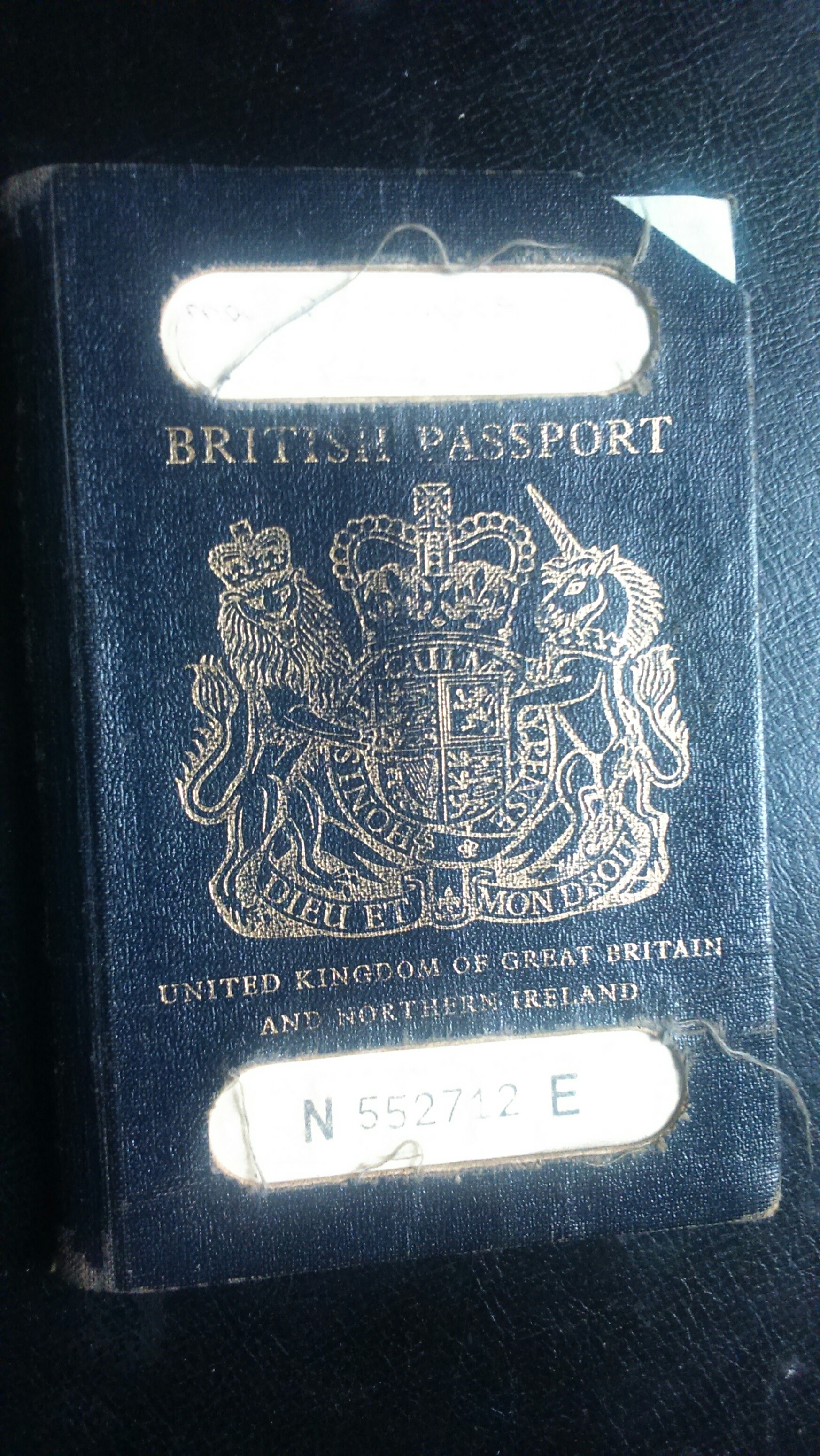
This is a picture of one of my old expired passports. It is, in fact, the first I ever had. It was issued to me in 1986, when I was 23 years old and a PhD student; I needed it to travel to a conference in France. It expired in 1996 (hence the docking of the top right corner) whereupon I had it replaced by a much better made Burgundy one.

I had never travelled abroad before 1986. I’m not from a wealthy family and we never had any holidays outside the UK. Given that,  I’m grateful that I ended up in a career that allowed me to travel quite widely,  within in the European Union and beyond.

I’m guessing that most of the people celebrating the imminent “return of the blue passport” recently announced by the Government never actually had one of these old-style passports, as they weren’t the colour of the ones UK citizens will have to carry after Brexit which will be Navy Blue, a tone much lighter than the blue of old passport, which is almost black.

This is, to me, just another example of the absurd hankering after an imagined past that never was that characterizes Brexit Britain.

Anyway, the colour of the next UK passport is of no real concern to me. Whatever its design it will not allow UK citizens to live and work freely within the European Union, so it will be of considerable less value than the existing ones.

Fortunately (for me, at least) I won’t be needing a British passport much longer and will have no need to renew mine for the downgraded version that will be mandatory after 2019. In fact when I get my Irish passport the first thing I’ll do is throw the old British one in the bin.

The Days of the Double Bind

Posted in Biographical, Literature, Politics with tags , , , , , , , on December 5, 2017 by telescoper

The last few days I’ve been trying to deal with the sort of apparently insoluble problem usually called a double bind, similar to the logical paradox which provided the central plot device of Joseph Heller’s classic novel Catch-22. I’ve seen this particular double bind happen to so many colleagues from abroad wanting to work in the United Kingdom that in a sense it’s quite reassuring that the same thing happens in much the same way in other countries too, specifically Ireland.

The problem facing me is that I need to find somewhere to rent temporarily in Maynooth until I can find longer-term accommodation (i.e. by buying a house). As convenient as St Patrick’s College is as a short-term residence, it’s not somewhere I would want to live for weeks and months. The trouble is that in order to secure private rented accommodation you need to prove that you are able to pay the rent, which generally means having a bank account. On the other hand, in order to open a bank account you need to have proof of an address. No address, no bank account and no bank account, no address.

This is not exactly the same as Heller’s Catch-22 (which is basically that an airman can’t be discharged from military service on grounds of being insane because his wanting to be discharged from military service means that he can’t actually be insane), but it belongs to the same broad class of logical quandaries where there appears to be no solution.

Although it’s quite intimidating to be put in a seemingly impossible position, Robert M. Persig’s Zen and the Art of Motorcycle Maintenance offers a way out: you just need to `unask the question’, and proceed in a way that denies the (binary) premises on which the conundrum is based. Engaging in a bit of lateral thinking, calling on the assistance of influential bodies, and employing a bit of gentle persuasion you often find that what look initially like hard rules turn out to have a surprising degree of flexibility.  Anyway, to cut a long story short, and with fingers crossed, I should have my bank account and place of residence both sorted out before I return to Cardiff on Thursday.

For me of course this isn’t anything like a life-or-death situation. I have been around long enough not to let bureaucracy get to me. Things like this seem very serious at the time, but there’s always a way to resolve the, usually because there are still some reasonable people in the world. And I am lucky. I can cope with the uncertainty and frustration of being in a double bind as I have resources to fall back on if there are problems. It would no doubt have been more difficult had I just arrived in the country as a recent graduate with no savings. I’ve seen many others at all kinds of stages in their career go through a similar impasse and, though it’s troublesome, such things invariably sort themselves out in time. Still, it’s nice to get such things settled sooner rather than later.

Thinking about this as I listened to the radio this morning, I was struck by another, much larger, more important, and slightly more complex, paradox. That is the inability of the UK government to find a solution to the Irish border problem in the Brexit negotiations. In essence, the nature of this pickle is that the EU insists (as it always said it would) that there should be no hard border between Northern Ireland and the Republic of Ireland. That is possible if the UK leaves the EU but seems to require that Northern Ireland  remains in  the Single Market and Customs Union in some form. However, the PM has insisted that the United Kingdom must leave the Single Market and Customs Union. Moreover, the Democratic Unionist Party, which is propping up the Conservative government, insists (as it always said it would) that Northern Ireland should not be treated differently from the rest of the UK. If cast in these terms, there seems to be no solution to the problem.

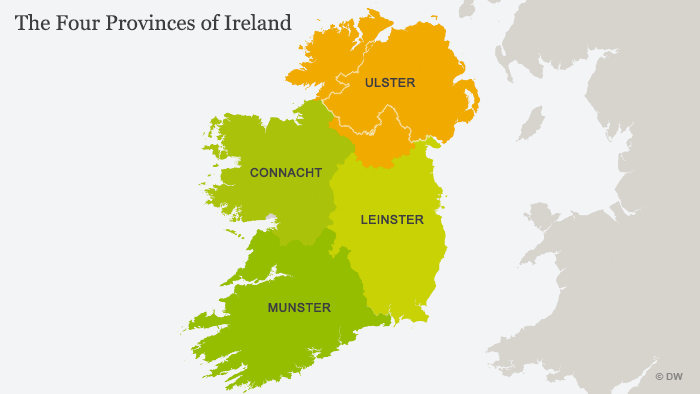
Incidentally, and I now digress, here is a map showing the Four Provinces of Ireland, together with the current border:

These are historical divisions and nowadays have no political or administrative role, but I think the map is interesting because it shows, if you didn’t know it before, that: (a) the current Irish border does not coincide with the boundary of Ulster; and (b) the most northerly point of the island of Ireland (Malin Head  on the Inishowen Peninsula, in County Donegal)  is in the Irish Republic, not in Northern Ireland. Maynooth, incidentally, is in Leinster.

Anyway, I think the current stalemate over the Irish Border is the inevitable outcome of one of Theresa May’s `red lines’ which seem to me to make a negotiated settlement impossible a priori. The only option for the Prime Minister seems to me to be to frame the problem another way. One way of making progress would be to abandon the red line on SM and CU membership. I don’t think that will happen as it would look too much like an admission of failure. Another way to do it would be to use gentle persuasion to get the DUP to shift its position. That is more likely, but will prove costly in both political and financial terms.  The best way to unask this particular question is, of course, to abandon the Brexit project altogether. I’m not going to quote odds, but the possibility of the United Kingdom remaining in the European Union is increasing by the day. That won’t affect me directly very much, as I’ll be remaining in the EU come what may.

Friends at War

Posted in History, Politics with tags , , , on November 27, 2017 by telescoper

I found this letter by accident yesterday while I was searching for something else. Apparently, it’s very famous but I had never seen it before, and it struck me as unbearably moving. It was written by Sir William Waller to his friend Sir Ralph Hopton on 16th June 1643, during the (First) English Civil War and it is the last known communication between the two men. The former was a General in the Parliamentarian army, the latter held the same rank in the Royalist army.

This one heartbreaking letter reveals the tragedy that was unfolding all over the country at the time, as friends and families were torn apart by  forces not of their making but that proved impossible to to resist. It seems that countries are doomed to do this from time to time.

To my noble friend Sir Ralph Hopton at Wells

Sir,

The experience I have of your worth and the happiness I have enjoyed in your friendship are wounding considerations when I look at this present distance between us. Certainly my affection to you is so unchangeable that hostility itself cannot violate my friendship, but I must be true wherein the cause I serve. That great God, which is the searcher of my heart, knows with what a sad sense I go about this service, and with what a perfect hatred I detest this war without an enemy; but I look upon it as an Opus Domini and that is enough to silence all passion in me. The God of peace in his good time will send us peace. In the meantime, we are upon the stage and must act those parts that are assigned to us in this tragedy. Let us do so in a way of honour and without personal animosities.

Whatever the outcome I will never willingly relinquish the title of Your most affectionated friend.

William Waller

Following the eventual defeat of the Royalist cause Sir Ralph Hopton fled to the Continent with the young Prince Charles. He died of fever in Bruges in 1651. Sir William Waller served as a Member of Parliament but became increasingly disillusioned with the new Commonwealth and subsequently worked for the Restoration of the Monarchy, which began in 1660 with Charles II. Waller died in 1668.


This is not normal: universities in the news

Posted in Education, Politics on October 30, 2017 by telescoper

A reaction to recent news coverage of UK universities, among other things.

I particularly liked “the degraded language of TEF, REF and KEF, which confuses bureaucracy with vision”. Well said.

amcrae2014's avatar[ex-] HEAD OF DEPARTMENT’S BLOG

It is not normal for universities to occupy the front pages of national newspapers. Granted, at any time there is a vital, occasionally tense, dialogue between universities and the nations in which they are situated. The line between ideals of academic freedom on the one hand, and the realities of finances and state oversight on the other hand, is notoriously fuzzy. The extent to which universities reflect or represent their nations is always a potential point of controversy.

But these are not normal times. Over the past few months, debate has swirled frenetically around questions including university funding, whether we have too many universities, what our top managers are paid, free speech on campus, how we select our students, and what we teach. We appear now to be at the point where even what academics think might be a point for national outrage.

It seems to me that much of…

View original post 767 more words

Physics of the EU – Revised Syllabus

Posted in Politics, The Universe and Stuff with tags , , on October 25, 2017 by telescoper

Yesterday, Tory MP Christopher Heaton-Harris wrote to all Vice-Chancellors of UK universities asking them to send him the names of professors teaching about “European affairs” together with links to relevant syllabuses and course materials. There has been an overwhelmingly negative response to this sinister request, which comes from an arch-Brexiteer apparently intent on thought control.

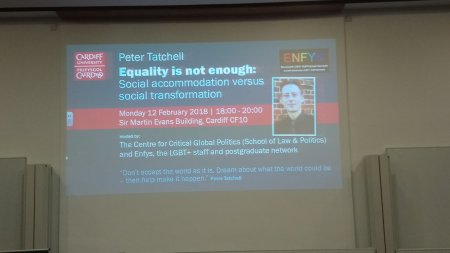
Not wishing to fall foul of the Brexit Police, I have updated my syllabus for next term and include it here so Mr McCarthy Heaton-Harris can read it:

I’m afraid that, for any further information and/or course materials relating to this module, Mr Heaton-Harris will have to register and pay the requisite fee which, thanks to his government is £9250.

P.S. I posted this slide on Twitter yesterday, and it got as close as any of my tweets have ever done to going viral (with over 800 retweets).

The State of Catalonia

Posted in Politics with tags , , on October 2, 2017 by telescoper

I’m sure I’m not the only one who was appalled by the scenes of violence yesterday as police tried to stop voting in the `referendum’ on Catalonia. Here’s some footage from the BBC which clearly shows excessive use of force inside a polling station:

This is far from the worst example: elsewhere plastic bullets were fired at unarmed protesters. In all, about 900 people have been reported injured, though this claim is contested and  thankfully none of them – as far as I know – seriously.

Whatever you think about the rights and wrongs of the independence movement – and I’ll tell you what I think in a moment – there’s no question that the Spanish government has handled this issue very badly and in so doing has conceded a propaganda victory.  There was no need to use force to prevent the voting, as the  referendum was unlawful. The national government was undoubtedly in a difficult position, but I think it would have been far better just to let the vote go ahead in full knowledge that it had no constitutional validity. The referendum result (claimed to be about 90% for independence, on a turnout of just over 40%) means nothing even if you actually believe the numbers (which are doubtful). ‘Democracy’ means nothing without the rule of law. 

Nevertheless, it just may be that history will judge Sunday 1st October to be the day that Catalonian independence became inevitable not because of the vote per  se but because of the reaction to it.

Many seem to be either casting this as a battle between democracy and fascism, raising the spectre of Franco, or, even more absurdly, blaming all this on the European Union, ignoring the blame attached to the antics of the separatists. For a counter to the simple-minded propaganda emanating from the extremes of left and right, you might read this piece

Of course I’m just an ignorant foreigner and I encourage those with different opinions to express them through the comments box below.

The EU will of course not intervene in what is essentially an internal problem for Spain, but is right to call for a dialogue to begin quickly before things get any worse, as the Commission has made clear:

Under the Spanish Constitution, yesterday’s vote in Catalonia was not legal.

For the European Commission, as President Juncker has reiterated repeatedly, this is an internal matter for Spain that has to be dealt with in line with the constitutional order of Spain.

We also reiterate the legal position held by this Commission as well as by its predecessors. If a referendum were to be organised in line with the Spanish Constitution it would mean that the territory leaving would find itself outside of the European Union.

Beyond the purely legal aspects of this matter, the Commission believes that these are times for unity and stability, not divisiveness and fragmentation.

We call on all relevant players to now move very swiftly from confrontation to dialogue. Violence can never be an instrument in politics. We trust the leadership of Prime Minister Mariano Rajoy to manage this difficult process in full respect of the Spanish Constitution and of the fundamental rights of citizens enshrined therein.

It was wrong to proceed with the referendum, but it was also wrong to use heavy-handed tactics to try to stop it going ahead. There is blame on both sides, and both sides need to get together to sort it out. I’m not optimistic that will happen immediately, but the only way to make peace is by talking to your opponents. Let’s hope that common sense prevails, if not immediately then perhaps eventually.

So what do I think about the case for Catalonian independence? Well, I’m not qualified to talk about the specific arguments, so I’ll keep to the generalities. Let me start with a bit of autobiography that might explain why I see things the way I do. I was born in Wallsend (on Tyneside) in the North East of England. My parents were both born just before World War II started, also in the area where I was born. Of my four grandparents, one was born in England, one in Northern Ireland, one in Scotland, and one in Wales. I always smile when I get to write my nationality on a form, because I put “United Kingdom”. Of course being born in England makes me English too, but I find that less defining than “UK” or “British” or even “Geordie”. To be honest, my ancestry means that  I generally find the whole concept of nationality fundamentally silly. I find nationalism silly too, except for those occasions – regrettably frequent nowadays – when nationalism takes on the guise of xenophobia. Then it is truly sinister. Nationalism is a tool by which unscrupulous individuals whip up hatred for political gain, regardless of the human consequences.

It may be apocryphal, but Albert Einstein is reported to have said “nationalism is an infantile disease”. The obvious way to cure it is to grow up and focus on fixing the real problems facing us instead of just waving flags, shouting slogans, and blaming others for our own failings. The reality is that we depend on each other too much for independence to have any meaning, let alone be desirable.