Archive for the Politics Category

That Martin Rowson Cartoon..

Posted in Art, Politics on June 22, 2017 by telescoper

I heard that the proprietors of The Sun and Daily Mail are getting very upset about this savage but brilliant cartoon by Martin Rowson of the Guardian in the wake of the recent terrorist attack on worshippers outside a mosque in Finsbury Park, so naturally I decided to post it here:

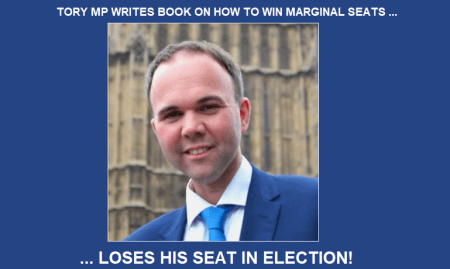
Tory MP author of ‘How To Win a Marginal Seat’ … lost his marginal seat on Thursday

Posted in Politics on June 11, 2017 by telescoper

Sometimes irony is too delicious for words…

Tom Pride's avatarPride's Purge

Gavin Barwell’s book ‘How To Win a Marginal Seat‘ was heavily praised by top Tories as a textbook on effective campaigning:

Boris Johnson wrote highly of the book:

Unfortunately for poor Gavin such hubris didn’t help him on Thursday – he lost his marginal Croydon seat to Labour’s Sarah Jones.

And even more hilariously – Gavin has just been put in charge of Theresa May’s campaigning.

Although I’m not sure May needs advice from anyone on how to f*ck up election campaigns …

View original post

The Great Election Gamble

Posted in Cardiff, Politics with tags , , on June 9, 2017 by telescoper

Well, yesterday’s general election didn’t exactly go to plan for the Tories, did it?

It turns out that, yet again, most of the opinion polls were way off the mark and the Labour Party’s share of the vote exceeded most expectations, including mine. Theresa May’s  decision on calling the election was a silly gamble to try to increase her majority in the House of Commons which, having failed spectacularly, has resulted in her losing that majority altogether. Theresa May nevertheless continues as Prime Minister courtesy of leading the largest party and doing a deal with the Democratic Unionist Party, a reactionary group of homophobes and young-earth creationists. We’ll have to wait and see how long that unholy alliance lasts. My bet would be for another election in October…

he PM was quoted last night that she had `no intention of resigning’ in the aftermath of the election she previously said she had no intention of calling. I infer that means she will soon resign. I don’t have any sympathy for her: if there’s one kind of politician I really dislike it’s the kind that takes the electorate for granted.

Although I’m personally delighted to see the Tories given a smackdown, it’s best not to get too carried away. For one thing, we’re still up Brexit Creek without a paddle and the UK’s already weak negotiating hand just got considerably weaker. The other thing worth saying is that although Jeremy Corbyn has gone up enormously in my estimation by the way he led his party, Labour still didn’t win even against a Conservative campaign that was unspeakably dire.

Anyway, regular readers of this blog (Sid and Doris Bonkers) will know that I like to place wagers on elections. My normal strategy of the compensation bet – putting money on the outcome I don’t want to happen – would have been useless in this situation as the Conservatives were odds-on to win so the return would have been poor. I therefore decided to use the occasion for my first foray into spread betting.

I took this decision when I saw that the spread being offered on the number of seats won by Labour was (205-212). In a spread bet you place a deposit (`margin’) and then wager on whether the actual total is above or below the spread by £X per seat; if it’s inside the spread you lose your deposit. In the lingo, placing a bet to win above the spread is called a `buy’; below is `sell’. The danger of spread betting is that if you bet high and the actual result is low then you lose £X per seat. Losses can therefore exceed your deposit if you’re badly wrong. This is why I’ve never bet this way before. Believe it or not, I’m actually very cautious when it comes to gambling.

The quoted spread seemed to me to be centred very low (in line with the majority of opinion poll predictions), but I felt it highly unlikely that even a bad night for Labour would have them ending up on fewer than 200 seats, because there are so many safe Labour seats. I therefore wasn’t too concerned about the possibility of a truly disastrous loss. So I paid my deposit and bought at £100 per seat.

Suffice to say that it’s my round in the pub tonight….

P.S. I forgot to mention another memorable event last night: the first seat to declare was Newcastle Central, who beat arch-rivals Sunderland to the prize for the fastest count.

P.P.S. A couple of other things worth mentioning are that Kevin Brennan won my seat (Cardiff West) with a hugely increased majority. In fact all seats in Cardiff went to Labour, including Cardiff North which had previously been held by the Conservatives. Brighton Kemptown, in which constituency I lived before coming back to Cardiff and which was also previously held by the Tories, also went to Labour.

In case you were wondering….

Posted in Biographical, Politics with tags , , on June 3, 2017 by telescoper

Captain SKA – Liar Liar

Posted in Music, Politics with tags , on June 2, 2017 by telescoper

I don’t know why, but every time I go onto Youtube these days I get a horrible Conservative Party propaganda video. Obviously some sort of algorithm has decided to inflict this crap on me because I’m deemed to be likely to be persuaded to vote for the Tories. I can promise them that this is not the case. The Tories may win next week’s election, but this campaign has revealed Theresa May as thoroughly cowardly and dishonest, despite her best efforts to hide from public scrutiny. I will be voting for Welsh Labour.

Anyway, I’ve decided to retaliate by posting this: it’s Liar Liar by Captain SKA. It’s in the top ten of the UK singles chart, but the BBC refuses to play it. I can’t compete with the Beeb, but every little helps….

R.I.P. Rhodri Morgan (1939-2017)

Posted in Politics with tags , , on May 18, 2017 by telescoper

I was very sad this morning to find the news that Rhodri Morgan passed away yesterday at the age of 77. Rhodri Morgan was the first First Minister of Wales (a post he held from 2000 to 2009) and was also Assembly Member for my constituency until 2011. Rhodri Morgan was a hugely important figure in Welsh Labour Party. As  a charismatic leader and capable administrator,  he was extremely  influential  in the campaign for Welsh devolution and  was held in very high regard across the political spectrum.

I was reminded of Rhodri Morgan earlier this week as I realised that  14th May 2009 (i.e. eight years ago on Sunday) the date on which the Planck and Herschel spacecraft were launched. Was that really so long ago?

Rhodri Morgan was still First Minister when he visited the School of Physics & Astronomy at Cardiff University on the day of the launch. He came across as very likeable, down-to-earth and funny. He’ll be missed by a great many people, but most of all by his wife Julie to whom I express my sincere condolences.

Rest in peace, Rhodri Morgan (1939-2017).


Polls Apart

Posted in Bad Statistics, Politics with tags , , , , , , , on May 9, 2017 by telescoper

Time for some random thoughts about political opinion polls, the light of Sunday’s French Presidential Election result.

We all know that Emmanuel Macron beat Marine Le Pen in the second round ballot: he won 66.1% of the votes cast to Le Pen’s 33.9%. That doesn’t count the very large number of spoilt ballots or abstentions (25.8% in total). The turnout was down on previous elections, but at 74.2% it’s still a lot higher than we can expect in the UK at the forthcoming General Election.

The French opinion polls were very accurate in predicting the first round results, getting the percentage results for the four top candidates within a percentage or two which is as good as it gets for typical survey sizes.

Nate Silver Harry Enten has written a post on Nate Silver’s FiveThirtyEight site claiming that the French opinion polls for the second round “runoff” were inaccurate. He bases this on the observation that the “average poll” in between the two rounds of voting gave Macron a lead of about 22% (61%-39%). That’s true, but it assumes that opinions did not shift in the latter stages of the campaign. In particular it ignores Marine Le Pen’s terrible performance in the one-on-one TV debate against Macron on 4th May. Polls conducted after that show (especially a big one with a sample of 5331 by IPSOS) gave a figure more like 63-37, i.e. a 26 point lead.

In any case it can be a bit misleading to focus on the difference between the two vote shares. In a two-horse race, if you’re off by +3 for one candidate you will be off by -3 for the other. In other words, underestimating Macron’s vote automatically means over-estimating Le Pen’s. A ‘normal’ sampling error looks twice as bad if you frame it in terms of differences like this.  The last polls giving Macron at 63% are only off by 3%, which is a normal sampling error…

The polls were off by more than they have been in previous years (where they have typically predicted the spread within 4%. There’s also the question of how the big gap between the two candidates may have influenced voter behaviour,  increasing the number of no-shows.

So I don’t think the French opinion polls did as badly as all that. What still worries me, though, is the different polls consistently gave results that agreed with the others to within 1% or so, when there really should be sampling fluctuations. Fishy.

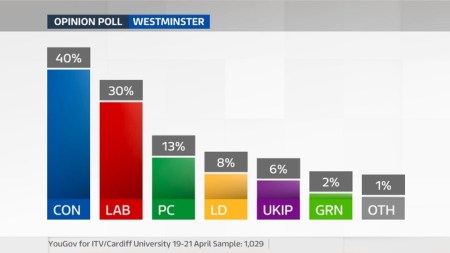
By way of a contrast, consider a couple of recent opinion polls conducted by YouGov in Wales. The first, conducted in April, gave the following breakdown of likely votes:
Poll

The apparent ten-point lead for the Conservatives over Labour (which is traditionally dominant in Wales) created a lot of noise in the media as it showed the Tories up 12% on the previous such poll taken in January (and Labour down 3%); much of the Conservative increase was due to a collapse in the UKIP share. Here’s the long-term picture from YouGov:

Wales-01

As an aside I’ll mention that ‘barometer’ surveys like this are sometimes influenced by changes in weightings and other methodological factors that can artificially produce different outcomes. I don’t know if anything changed in this regard between January 2017 and May 2017 that might have contributed to the large swing to the Tories, so let’s just assume that it’s “real”.

This “sensational” result gave various  pundits (e.g. Cardiff’s own Roger Scully) the opportunity to construct various narratives about the various implications for the forthcoming General Election.

Note, however, the sample sample size (1029), which implies an uncertainty of ±3% or so in the result. It came as no surprise to me, then, to see that the next poll by YouGov was a bit different: Conservatives on 41% (+1), but Labour on 35% (+5). That’s still grim for Labour, of course, but not quite as grim as being 10 points behind.

So what happened in the two weeks between these two polls? Well, one thing is that many places had local elections which resulted in lots of campaigning. In my ward, at least, that made a big difference: Labour increased its share of the vote compared to the 2012 elections (on a 45% turnout, which is high for local elections). Maybe then it’s true that Labour has been “fighting back” since the end of April.

Alternatively, and to my mind more probably, what we’re seeing is just the consequence of very large sampling errors. I think it’s likely that the Conservatives are in the lead, but by an extremely uncertain margin.

But why didn’t we see fluctuations of this magnitude in the French opinion polls of similar size?

Answers on a postcard, or through the comments box, please.

Local Election Issues

Posted in Biographical, Politics with tags , , , on May 4, 2017 by telescoper

Though very much overshadowed by the looming General Election, today sees important local elections in various locations across the United Kingdom including here in Cardiff where all seats on Cardiff City Council are up for grabs. This is an example of a unitary authority, unlike some areas where there are county and borough councils that operate on different levels.

Councillors are paid an `allowance’ which varies across the country but in Cardiff corresponds to a basic amount of £13,300k per annum. Not exactly a luxurious income, but it is essentially a part-time job. That doesn’t mean that it’s easy though, as many difficult choices have to be made when budgets are tight.

Since my current job at Cardiff University is part-time I did toy with the idea of putting myself forward as a Labour Party candidate, but in the end didn’t pursue it – largely because I’ve not had as much free time as I thought I would. In any case we have three very good prospective candidates in Iona Gordon, Kanaya Singh, and Caro Wild. I wish them all good luck!

When I first moved to Cardiff, in 2007, the Liberal Democrats were the largest party in the Council, a position they consolidated in the 2008 elections, where the administration that was formed consisted of a coalition between the Liberal Democrats and Plaid Cymru, the Welsh nationalist party. At the 2012 elections the Liberal Democrats crashed and burned and Labour regained the position as majority party it had lost to the LibDems in 2004. These local elections normally take place every four years, but were deferred by one year by the Welsh Government, which is why they are taking place now rather than in 2016.

Local elections return councillors for each of a number of wards within each area. Some wards return only one representative while others can have a number of councillors. My own ward, Riverside, for example, has three councillors. When I moved to my house in Pontcanna in 2008 all three councillors belonged to Plaid Cymru; at the 2012 elections all three were Labour. I think the past success of Plaid Cymru in Riverside may relate to the presence of Welsh language media organizations in the area. It’s a very mixed ward, actually, with some very posh areas in the North (towards Llandaff) and some very working-class areas to the South.

What will happen this time? I honestly have no idea. It is very difficult to predict local elections on the basis of national politics for a number of reasons. One is that turnout is very low – 30% is very high for this kind of poll. Seats in the council can be gained and lost by just a few hundred votes. There’s also the fact that those people who do vote tend to do so on the basis of very local matters, e.g. the efficiency of the refuse collection service, rather than the national and international issues that will dominate the General Election. Not that this will stop the pundits prattling on about the results.

I can see Plaid Cymru doing reasonably well, but would be surprised if either the Liberal Democrats made a substantial comeback or the Conservatives made big gains. We’ll just have to wait and see, though, as I’ve been massively wrong about such things before!

Anyway, I’m going to a concert tonight to take my mind of things and have no intention of waiting up until the early hours of the morning to hear the results come in, so I’ll update this with the results tomorrow morning.
UPDATE 8.30am, 5/5/2017: Riverside ward returned three labour councillors and Labour retained control of Cardiff City Council.

Gay Sex, Politics, Religion and the Law

Posted in LGBTQ+, Politics with tags , , on April 23, 2017 by telescoper

It seems that Liberal Democrat leader Tim Farron is under fire again for refusing to say whether he thinks gay sex is a sin.

I’m not a particular fan of Mr Farron, and won’t be voting for his party, but I think the flak being directed at him on this issue is unjustified. Much of it is pure humbug, manufactured to cause political damage.

Mr Farron (who is heterosexual) describes himself as a ‘committed Christian’. He no doubt feels that if he spells out  in public what he believes in private then it will alienate many potential voters even though he has voted progressively on this issue in the past. He’s probably right. On the other hand, by not spelling it out, he appears weak and shifty. The media are out to exploit his difficulty.

As someone who is neither heterosexual nor Christian I can help him. It seems to me very clear that the Bible does teach  that homosexuality is a sin and that if you’re a Christian you have to believe this at some level.

I say ‘at some level’ because another thing that is clear is that the Bible does not consider homosexuality a very important issue. Had it been a hot topic then perhaps Jesus might have been prepared to go on record about it, but there’s no reference in the New Testament to him personally saying anything about gay sex. ‘Thou shalt not have sex with someone of the same gender’ isn’t among the Ten Commandments, either.

I do find it strange that so many people who described themselves as Christian obsess about same-sex relationships while clearly failing to observe some of the more important biblical instructions, notably the one about loving thy neighbour…

But I digress.

I don’t care at all what Tim Farron’s (or anyone else’s) religious beliefs say about homosexuality, as long as they accept that such beliefs give nobody the right to dictate what others should do.

If you believe gay sex is sinful, fine. Don’t do it. If you don’t approve of same-sex marriage, that’s fine too. Don’t marry someone of the same sex. Just don’t try to deny other people rights and freedoms on the basis of your own personal religious beliefs.

And no, refusing you the right to impose your beliefs on others is not a form of discrimination. That goes whether you a Christian, Muslim, Buddhist, Atheist or merely confused. You are free to live by the rules you adopt. I don’t have to.

I’d go further actually. I don’t think religious beliefs should  have any place in the the laws of the land. It seems to me that’s the only way to guarantee freedom from religious prejudice. That’s why I’m a member of the National Secular Society. This does not exist to campaign against religion, but against religious privilege.

In fact the UK courts agree with me on this point. This is Lord Justice Laws, on behalf of the Court of Appeal relating to the case described here:

We do not live in a society where all the people share uniform religious beliefs. The precepts of any one religion, any belief system, cannot, by force of their religious origins, sound any louder in the general law than the precepts of any other. If they did, those out in the cold would be less than citizens and our constitution would be on the way to a theocracy, which is of necessity autocratic. The law of a theocracy is dictated without option to the people, not made by their judges and governments. The individual conscience is free to accept such dictated law, but the State, if its people are to be free, has the burdensome duty of thinking for itself.

To come back to Tim Farron, I say judge him and his party by what you see in the Liberal Democrat manifesto and on his track-record as a politician, not by what you think his interpretation might be of a few bits of scripture.

March for Science – Cardiff

Posted in Politics, Science Politics with tags , , , on April 21, 2017 by telescoper

MFS
Just a quick note to say that tomorrow I’ll be attending the Cardiff March for Science, which is one of a series of events happening around the world. I quote:

The March for Science is a celebration of science.  It’s not only about scientists and politicians; it is about the very real role that science plays in each of our lives and the need to respect and encourage research that gives us insight into the world.

The Cardiff March starts with a rally at 10am on the steps of the Senedd in Cardiff Bay and is followed by a march around the bay to Techniquest for a science event there to which families with children are particularly welcome. It should be a fun occasion  There’s a science-themed fancy dress competition. I’ll be going as a middle-aged man with a beard.

For further details see here or follow the Twitter feed: