Archive for the Politics Category

Cardiff Boundary Changes

Posted in Politics with tags , , , on September 13, 2016 by telescoper

There’s been a lot of discussion in the news about changes to electoral constituencies in the United Kingdom proposed by the Boundary Commissions for England, Wales, Scotland and Northern Ireland. These proposals are intended to achieve two goals: (a) to reduce the total number of constituencies (and hence Members of Parliament) from 650 to 600; and (b) to ensure that the resulting constituencies contain roughly the same number of votes (within 5% either way of the mean number).

In a bit more detail: each constituency in the UK should contain roughly the same number of eligible voters, the so-called “electoral quota” which is reached by dividing the total electorate of the UK by the number of required constituencies, except for the Isle of Wight and two Scottish island constituencies. The quota is then 74,769, based on the electoral register as it stood on 1 December 2015.

The purported aim of (a) is to reduce the running cost of Parliament. I’d be more convinced of that if the previous Prime Minister hadn’t appointed no fewer than 260 Members to the House of Lords, at considerably greater expense than the saving incurred by losing 50 MPs from the House of Commons. The intention of (b) is more reasonable, but it does threaten the rationale of the constituency-based system as it creates some larger and less homogeneous constituencies.

The Boundary Commisssion for Wales has proposed that the Welsh MPs be reduced from 40 to 29, which means the loss of some historically important constituencies altogether and a significant rearrangement of many others.  In fact there isn’t a seat in Wales that isn’t changed in some way. Here’s what the proposals mean for Cardiff, with the existing constituencies on the left and the proposed boundaries on the right:

slide1

I reside in Cardiff West (marked 12 on the left). You will see that the proposal involves extending this constituency on the western side of the River Taff down towards Cardiff Bay. This splits the former constituency Cardiff South and Penarth (11) into two, the western part (mainly Penarth) being absorbed into a new constituency called Vale of Glamorgan East (20 on the right). The other big change is that Cardiff Central (9 on the left) is eliminated entirely, absorbed by an enlarged Cardiff North (18 on the right, formerly 10 on the left) and a new Cardiff South and East (19) on the right. The net change is the loss of one seat in the City of Cardiff, which is currently held by Labour MP Jo Stevens.

I’m sure there’ll be quite a strong reaction to these changes, not least because they are based on the electoral register as it was on December 1st 2015 because the switch to individual electoral registration meant that 770,000 names dropped off the list before this date. The list also does not reflect those who registered to vote ahead of the EU referendum in June.

Going back to Wales for a moment, I think it’s unfair that while Scotland excluded two island constituencies from the quota formula to reflect their specific character, the same did not happen for Ynys Môn (Anglesey), a constituency which has been around since 1536, but which is now to be enlarged into a new entity called Ynys Môn and Arfon.  I’m sure someone will comment on that!

Anyway, these are proposals and there is now a period of consultation. The final boundaries will not be determined until 2018.


Rank Nonsense

Posted in Bad Statistics, Education, Politics with tags , , , , , on September 8, 2016 by telescoper

It’s that time of year when international league tables (also known as “World Rankings”)  appear. We’ve already had the QS World University Rankings and the Shanghai (ARWU) World University Rankings. These will soon be joined by the Times Higher World Rankings, due out on 21st September.

A lot of people who should know a lot better give these league tables far too much attention. As far as I’m concerned they are all constructed using extremely suspect methodologies whose main function is to amplify small statistical variations into something that looks significant enough to justify constructing  a narrative about it. The resulting press coverage usually better reflects a preconceived idea in a journalist’s head than any sensible reading of the tables themselves.

A particularly egregious example of this kind of nonsense can be found in this week’s Guardian. The offending article is entitled “UK universities tumble in world rankings amid Brexit concerns”. Now I make no secret of the fact that I voted “Remain” and that I do think BrExit (if it actually happens) will damage UK universities (as well as everything else in the UK). However, linking the changes in the QS rankings to BrExit is evidently ridiculous: all the data were collected before the referendum on 23rd June anyway! In my opinion there are enough good arguments against BrExit without trying to concoct daft ones.

In any case these tables do not come with any estimate of the likely statistical variation from year to year in the metrics used to construct them, which makes changes impossible to interpret. If only the compilers of these tables would put error bars on the results! Interestingly, my former employer, the University of Sussex, has held its place exactly in the QS rankings between 2015 and 2016: it was ranked 187th in the world in both years. However, the actual score corresponding to these two years was 55.6 in 2015 and 48.4 in 2016. Moreover, Cambridge University fell from 3rd to 4th place this year but its score only changed from 98.6 to 97.2. I very much doubt that is significant at all, but it’s mentioned prominently in the subheading of the Guardian piece:

Uncertainty over research funding and immigration rules blamed for decline, as Cambridge slips out of top three for first time.

Actually, looking closer, I find that Cambridge was joint 3rd in 2015 and is 4th this year. Over-interpretation, or what?

To end with, I can’t resist mentioning that the University of Sussex is in the top 150 in the Shanghai Rankings for Natural and Mathematical Sciences this year, having not been in the top 200 last year. This stunning improvement happened while I was Head of School for Mathematical and Physical Sciences so it clearly can not be any kind of statistical fluke but is entirely attributable to excellent leadership. Thank you for your applause.


Collector’s Item

Posted in Biographical, Politics with tags , , on August 21, 2016 by telescoper

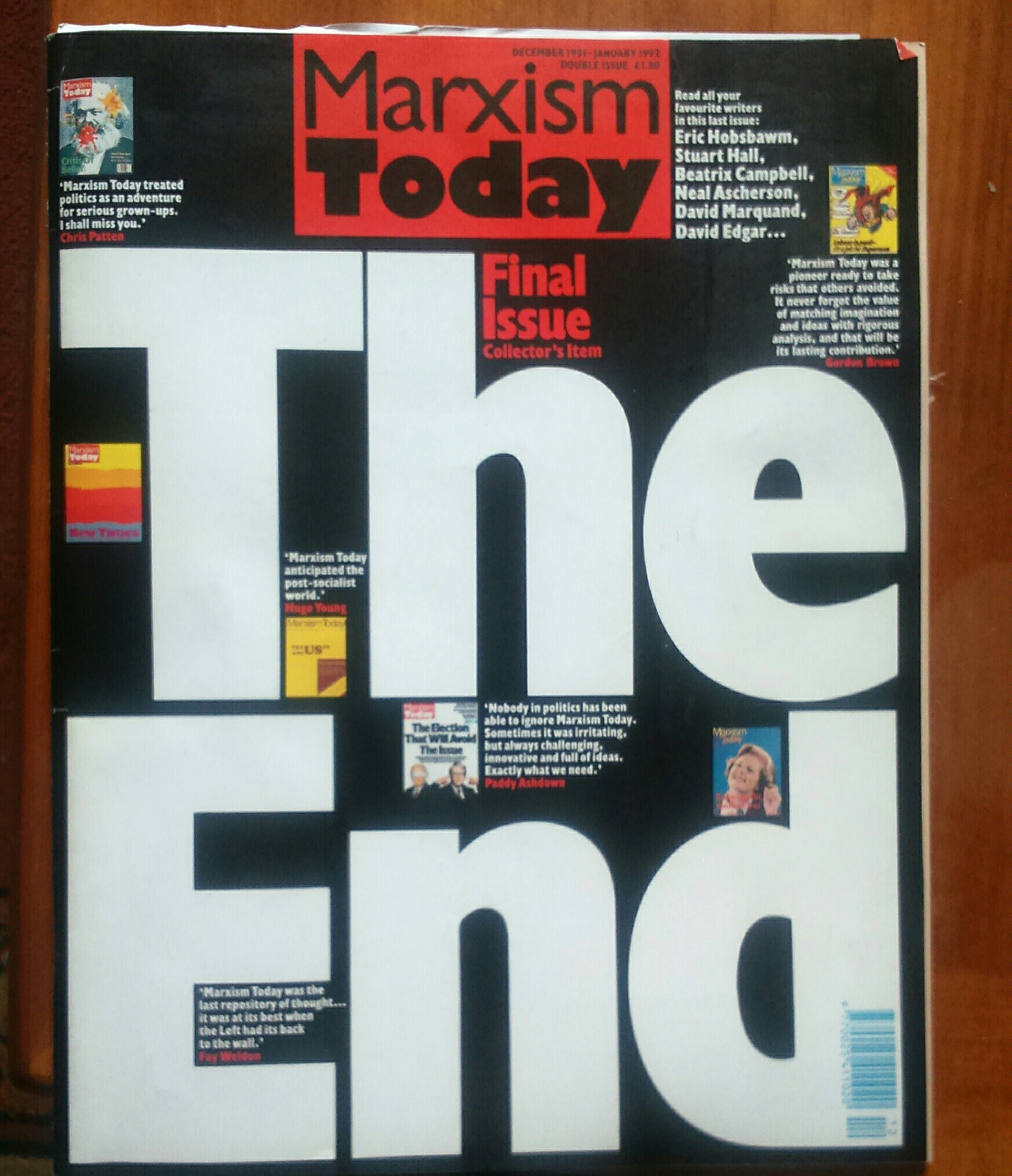
I read in today’s Observer an interesting opinion piece by Martin Jacques, who was editor of a magazine called Marxism Today until it folded at the end of 1991. I was a subscriber, in fact, and for some reason I have kept my copy of the final edition all this time. Here’s the front cover:

image

I note that it says “Collector’s Item” on the front, though I’m not at all sure it’s worth any more now than the £1.80 I paid nearly 25 years ago!

Dear Leaver, your Perfect Brexit is going to be tricky…

Posted in Politics on August 19, 2016 by telescoper

Here’s a very detailed and interesting post about the possible forms if relationship the UK might have with the EU after BrExit. If BrExit ever happens, of course. And if the UK still exist if it does…

Nog's avatarNog's Musings


Follow Nog’s Musings on WordPress.com

Hi Excited Leaver,

Note: originally this was written during a discussion with a leaver (Rod, I hope you are out there and doing well) but was then turned into a more generic post.

So, you’ve won the referendum and you’re excited about that great new deal we’re going to do with the Europeans. Let’s just recap the deal you’re after:

Access to the single market basically it’s trade more or less exactly like we have now with the EU.  BUT you want to drop some of the extras:

  • No EU contribution
  • No Freedom of Movement
  • No pooled sovereignty

Seems simple enough, just a free trade deal? And of course you’ve been told we’re in a strong position, there’s that huge Trade Deficit as we buy far more than we sell so you’re confident we can drag the EU to the table and get the deal the…

View original post 1,822 more words

Simone Manuel and the Racism of Fred Hoyle

Posted in Biographical, Politics, Sport, The Universe and Stuff with tags , , , , , , on August 14, 2016 by telescoper

Reading just now about Simone Manuel, the first black person to win an Olympic Gold medal in swimming, I suddenly remembered a bizarre event that has been lurking in the back of my mind since 1985.

In September of that year I attended a Summer School for new PhD students in Astronomy, held in Durham. I have posted about this before actually, primarily because it is interesting how many others who attended that School are still around, in senior academic positions.

Anyway, one evening during the course of this meeting there was a public lecture by non other than Sir Fred Hoyle, many of whose books on cosmology I had borrowed from the public library when I was at school and played a big part in encouraging me to study physics at university.

But Fred Hoyle’s talk that evening (to a packed lecture theatre) was not about physics but about his pet theories about the evolution of life, most of which are now generally regarded as nonsense.

At one point in his somewhat rambling discourse he digressed into the subject of the sporting abilities of different racial groups. His first assertion was that black people (by which he meant people of African origin) do not make good swimmers because their bones are too dense and the consequent lack of buoyancy is a significant disadvantage. “Have you ever seen a black swimmer in the Olympics?” he asked. None of us had, of course, but couldn’t that be because of other reasons such as lack of access to swimming pools? No. Fred was adamant. It was down to biology. I assumed he knew what he was talking about, so kept quiet.

He went on to argue that black people were also disadvantaged at tennis – not because of social factors limiting access to tennis courts – but for reasons of “poor hand-eye coordination” which he also asserted to be an inherited characteristic. This time I knew straight away he was talking drivel. The previous summer I had watched the brilliant West Indies cricketers thrash England 5-0 in a test series; their hand-eye coordination certainly wasn’t poor. And neither was that of Arthur Ashe who had  beaten Jimmy Connors in the Men’s Singles Final at Wimbledon a decade earlier,  nor the majestic Serena Williams who is probably the greatest female tennis player the world has ever seen.

These examples left me not only deeply suspicious of Hoyle’s racist attitudes but also staggered by his completely unscientific attitude to evidence. Great theoretical physicist he was – at least early in his career – but being expert about one thing doesn’t mean can’t make an utter fool of yourself if you blunder into another field. Sadly, theoretical physicists do have a greater tendency than most scientists to forget this.

Ghent for MaxEnt

Posted in Biographical, Politics with tags , , , on July 9, 2016 by telescoper

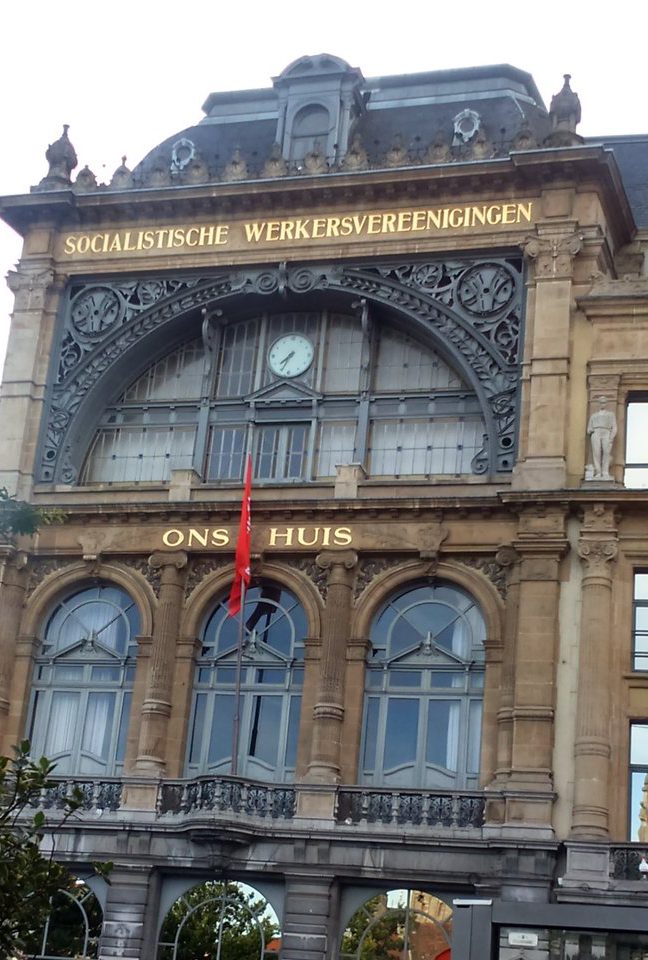
Just a quick post to mark the fact that I’ve arrived in the fine city of Ghent for the forthcoming MaxEnt 2016 (Bayesian Inference and Maximum Entropy Methods in Science and Engineering). The trip from Brighton was pleasant and disruption-free (Thameslink from Brighton to St Pancras, Eurostar t0 Brussels, and local train to Ghent, all components of which journey were on time).  In fact I travelled from London with a British contingent of the conference: John Skilling, Steve Gull and Anton Garrett (a regular commenter on this blog). We got here in time for dinner al fresco in a square near my hotel overlooked by an interesting local landmark:

Ghent


My Flemish isn’t marvellous but I translate the words at the top of the building as Socialist Workers’ Party, although it does seem a rather grandiose building for that!

Anyway, I hope to be able to do a bit of Bayesian blogging from Belgium while I’m here, during the next week. The meeting itself starts tomorrow..


Chilcot Reactions

Posted in History, Politics with tags , , , on July 6, 2016 by telescoper

At long last, the Chilcot Report on the UK’s involvement in the 2003 Iraq War has now been published. It’s a mammoth document which can obtain in full here. Even the Executive Summary is 150 pages long.

I’m going to put my cards on the table straight away. I opposed the invasion of Iraq in 2003 and have never wavered from that opposition. I would feel vindicated were I not so saddened by the agony the invasion unleashed.

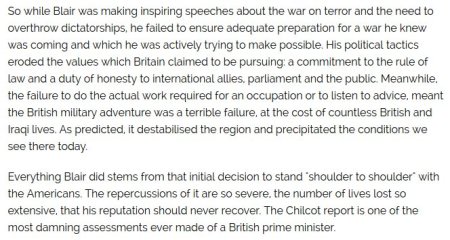
I’m not going to pretend to have read the whole document, or even all of the Executive Summary, but all the reaction I’ve seen suggest that it is unequivocal in its condemnation of the (then) Prime Minister, Tony Blair. Here is an example:

Chilcot

I sincerely hope that Blair’s reputation will not recover, and indeed hope that some form of legal redress can be sought against him. Attention in this country is focussing on the 179 service personnel who lost their lives in Iraq either during, or as a direct result of, the invasion of Iraq. However, let’s not lose sight of the fact that it was the Iraqi people who suffered most – over 150,000 are thought to have been killed, though such is the chaos of a country ruined by invasion and its aftermath that the true figure will never be known.

A few days ago we remembered the thousands who died on the Somme with the words “Lest we forget”. We shouldn’t forget Blair either…


The Habitability of the Universe

Posted in Politics, The Universe and Stuff on June 30, 2016 by telescoper

It’s important not to get carried away by the post-referendum doom and gloom. Abraham Loeb’s recent paper on the arXiv suggests the Universe will only be habitable for the next 10,000,000,000,000 years or so. This means that the current state of political chaos  won’t last for ever, though I wonder the paper doesn’t make it clear if Article 50 will have been triggered by the time the last star goes out.

Is life most likely to emerge at the present cosmic time near a star like the Sun? We consider the habitability of the Universe throughout cosmic history, and conservatively restrict our attention to the context of “life as we know it” and the standard cosmological model, LCDM. The habitable cosmic epoch started shortly after the first stars formed, about 30 Myr after the Big Bang, and will end about 10 Tyr from now, when all stars will die. We review the formation history of habitable planets and find that unless habitability around low mass stars is suppressed, life is most likely to exist near 0.1 solar mass stars ten trillion years from now. Spectroscopic searches for biosignatures in the atmospheres of transiting Earth-mass planets around low mass stars will determine whether present-day life is indeed premature or typical from a cosmic perspective.

The BrExit Threat to British Science

Posted in Politics, Science Politics with tags , , on June 29, 2016 by telescoper

After a couple of days away dealing with some personal business I’ve now time to make a few comments about the ongoing repercussions following last week’s referendum vote to Leave the European Union.

First of all on the general situation. Legally speaking the referendum decision by itself changes nothing at all. Referendums have no constitutional status in the United Kingdom and are not legally binding. The Prime Minister David Cameron has declined to activate (the now famous) Article 50 of the Lisbon Treaty which would initiate a two-year negotiated withdrawal, preferring to leave this to whomever succeeds him following his resignation. None of the likely contenders for the unenviable position of next Prime Minister seems keen to pull the trigger very quickly either. The United Kingdom therefore remains a member of the European Union and there is no clear picture of when that might change.

The rest of the European Union obviously wants the UK to leave as soon as possible, not just because we’ve indicated that we want to, but because  we have always been never been very committed or reliable partners. In the words of Jean-Claude Juncker: ‘It is not an amicable divorce, but it was not an intimate love affair anyway.’

I don’t blame the 27 remaining members for wanting us to get on with getting out, because uncertainty is bad for business. Two years is more than enough time for big European businesses to write British producers out of their supply chains and for international companies now based in the United Kingdom to relocate to continental Europe. The current gridlock at Westminster merely defers this inevitable exodus. In the meantime inward investment is falling as companies defer decisions on future plans, casting a planningblight over the UK economy.

My own view, however, is that the longer the UK waits before invoking Article 50 the greater the probability that it will never be invoked at all.  This is because the next PM – probably Boris Johnson – surely knows that he will simply not be able to deliver on any of the promises he has made.

For example, there will be no access to the single market post-BrExit without free movement of people. There won’t be £350 million per week extra for the NHS either, because our GDP is falling and we never sent £350 million anyway.  All the possible deals will be so obviously far worse than the status quo that I don’t think Parliament will ever pass legislation to accept a situation is so clearly against the national interest. I may be wrong, of course, but I think the likeliest scenario is that the referendum decision is kicked into the long grass for at least the duration of the current Parliament.

That doesn’t solve the issue of BrExit blight, however. Which brings me to British science in a possible post-BrExit era. It’s all very uncertain, of course, but it seems to me that as things stand, any deal that involves free movement within Europe would be unacceptable to the powerful  UK anti-immigration lobby. This rules out a “Norway” type deal, among others, and almost certainly means there will be no access to any science EU funding schemes post 2020. Free movement is essential to the way most of these schemes operate anyway.

It has been guaranteed that funding commitments will be honoured until the end of Horizon 2020, but that assumes that holders of such grants don’t leave the UK taking the grants with them. I know of four cases of this happening already. They won’t come back even if we’re still in the European Union then.

Another probable outcomes are that:

  1. the shrinking economy will cause the UK government to abandon its ring-fence on science funding, which will  lead to cuts in domestic provision also;
  2. a steep decline in EU students (and associated income) will halt the expansion of UK science departments, and may cause some to shrink or even close;
  3. non-UK EU scientists working in the UK decide to leave anyway because the atmosphere of this country has already been poisoned by xenophobic rhetoric.

British science may “endure” after BrExit but it definitely won’t prosper. What is the least bad solution, if we cannot remain?

Answers through the comments box please!


Britain votes to leave the EU

Posted in Politics on June 24, 2016 by telescoper

My once and future home….

euromovewales's avatareuromovewales

Today is a sad day for Britain and for Wales. The UK has voted to leave the EU.

Here in Wales we have overwhelmingly benefited from EU membership. Between 2007 and 2013 alone we received over £1.8billion in structural funding from the EU. Our universities prosper through EU co-operation and funding, a brand new campus in Swansea has just been completed – thanks to EU funding.

Those who have fought for remain, from across the political spectrum, have fought with love and wisdom. They have put aside party politics to fight for a greater, a stronger, a better UK – a better Wales. Thank you to everyone who got out and campaigned, who leafleted, who talked to friends about the benefits of the EU. Thank you.

Today we look back on what we have lost. Tomorrow we get together to help our broken and bruised country get back on its feet. This is a time to come together.

European Movement Council of…

View original post 46 more words