Archive for the Politics Category
We Will All Go Together When We Go
Posted in Politics with tags Tom Lehrer, We will all go together when we go on November 9, 2016 by telescoperAmerican Psycho
Posted in Politics with tags Donald Trump, Gore Vidal, Hillary Clinton, Nate Silver on November 8, 2016 by telescoper
Well today’s the date of the election of the next President of the United States of America. Will it be Hillary Clinton? Or will it be an unstable racist misogynist, a pathological liar, and a man who has boasted of a string of sexual assaults? It remains to be seen. The polls are alarming close. Hillary Clinton is ahead by just 3 or 4 percent nationally but only a handful of states really matter and some of those are too close to call. I’ve been following Nate Silver’s 538 election forecast for a while now. It seems to me his methodology more accurately estimates the uncertainty in the opinion polls. After narrowing considerably when the FBI decided to throw a spanner into the works last week, the probability of a Clinton win is now over a little over 70%. Uncomfortable, but the odds have been below 2-1 very recently.
At the weekend I decided that I would follow my usual betting practice and place a wager on the outcome that I don’t want to happen. Hunting around, the best odds I could find were 18-5 against Donald Trump. I put a monkey on, so will walk away with £2300 if Trump wins. I plan to use the proceeds to begin work on the construction of a fallout shelter in my garden. If an unstable psychopath like Donald Trump gets his hands on the American nuclear codes I don’t hold out much hope for the future of civilization.
I followed the same strategy on Referendum Day as I felt it in my bones that Vote Leave was going to win. I ended up depressed but compensated to the tune of £1000. I’m afraid to say I feel the same way now about the likelihood of a Trump victory. Not very scientific, I know, but there you go.
I have never paid much attention to American politics in the past. It is as incomprehensible to me as British politics must be to them. Gore Vidal summed it up for me:
There is only one party in the United States, the Property Party … and it has two right wings: Republican and Democrat. Republicans are a bit stupider, more rigid, more doctrinaire in their laissez-faire capitalism than the Democrats, who are cuter, prettier, a bit more corrupt — until recently … and more willing than the Republicans to make small adjustments when the poor, the black, the anti-imperialists get out of hand. But, essentially, there is no difference between the two parties.
Things have changed this time. Although both parties still represent the moneyed classes more than anyone else, but this time the Republican contender has overtly fascist tendencies. No wonder Nigel Farage admires him so much. Americans are free to vote for whomever they wish, of course. I don’t have a say, as I’m a foreigner. All I can say is that you should be very careful what you wish for.
Although I find it deeply depressing that this race is even close, I won’t lose any sleep over the election night. I don’t have a television, and I’ll do what I did on the day of the EU referendum. Drink some wine, listen to music and then go to sleep. There’s no point in worrying about things that are out of your hands. And if Trump does win, at least it shortens the list of countries I will have to consider emigrating to if and when the UK does leave the European Union..
Follow @telescoperJudgment Day on Article 50
Posted in Politics with tags Article 50, BrExit, EU referendum on November 3, 2016 by telescoperI couldn’t resist a quick comment on today’s ruling by the High Court that the Prime Minister cannot trigger Article 50 of the Lisbon Treaty (and thus begin the process of taking the United Kingdom out of the European Union) without the approval of Parliament. The case was brought by Gina Miller and Deir Tozetti Dos Santos (the claimants) and has important constitutional implications because it limits the use of the Royal Prerogative.
I’m not by any means a legal expert but reading the full judgment it strikes me that this unanimous decision represents a comprehensive defeat for the Government’s lawyers. The crucial paragraphs of the judgment are 92-94 if you wish to refer to them in the full judgment. Interestingly, the ruling does not really rest on the claimants’ case at all but instead is based on a complete rejection of the main point of the Government’s submission. It looks like the Government’s lawyers bungled it pretty badly. Although the Government has indicated that it will appeal the result, it’s not obvious what the grounds for such an appeal might be. The appeal will be heard some time in December.
I’ve never made any secret of the fact that I am in favour of the United Kingdom remaining inside the European Union. Events since the referendum – especially the collapse of the pound – have strengthened that opinion, in fact.
I am baffled by the extreme reaction of many “Leave” voters to this judgment, especially those who voted that way in order to “restore Parliamentary sovereignty”. Some such individuals are claiming that this ruling is somehow anti-democratic. I don’t think that view is at all rational. If you voted Leave in order to get your sovereignty back then you should be very happy with this decision. In fact whichever side of the referendum debate you were on you should welcome this decision.
We live in a parliamentary democracy. That means that sovereignty rests in Parliament, not in the Prime Minister. This ruling merely asserts that fact. It does not overturn the referendum result nor does it prevent Article 50 being triggered. It does assert that the Prime Minister’s chosen way to approach BrExit is unlawful. Democracy is nothing without the rule of law.
Incidentally, the judgment also contains the following statement which I think is worth quoting here:
The 2015 Referendum Act was passed against a background including a very clear briefing paper to Parliamentarians explaining that the referendum would have advisory effect only. Moreover, Parliament must have appreciated that the referendum was intended to be only advisory as the result of a vote in the referendum in favour of leaving the European Union would inevitably leave for future decision many important questions relating to the legal implementation of withdrawal from the European Union.
In other words the referendum in itself has no constitutional force and was specifically intended not to.
The government plans to appeal the Article 50 decision to the Supreme Court, at which point it may or may not be overturned. If the appeal fails, then there is one higher authority: the European Court of Justice. It would be a delicious irony if the UK government were forced to appeal there in order to proceed!
Supposing, though, that all appeals are exhausted and the Government is forced to debate Article 50 in Parliament. What would happen next?
Although a majority of MPs in the House of Commons were in favour of remaining in the European Union, circumstances have changed since the referendum and many would be reluctant to vote against the outcome. However, I can imagine a situation in which Parliament refuses to give approval to an Article 50 until it has sufficient knowledge of the Government’s negotiating position to be assured that the Government is not planning something reckless that would endanger the UK economically and/or politically. It is my personal belief that “something reckless” is precisely what the Government is planning, and that is why they were so keen not to have a vote in Parliament.
There was only one question on the ballot paper for the EU referendum – whether the United Kingdom should remain in the European Union or leave it. But what, if any, of the rights and benefits that currently accrue as a consequence of our membership of the EU can the UK keep if and when it leaves? Who decides what rights can be removed from UK citizens?
There has been a lot of talk about “Hard BrExit” versus “Soft BrExit”. My personal view is that “Soft BrExit” (by which we would end up in a situation something like Norway) – which a sizable number of Leave voters envisaged when they voted – is not on the agenda at all. I think the Government is headed for a “Hard BrExit”, i.e. no membership of the internal market, no freedom of movement, no free movement of people, etc. That’s partly because of the ideological beliefs of the Tory cabinet and partly because that’s what the process pretty much guarantees. Article 50 is just about the UK leaving the European Union. That process has to be completed before any trade deals with the EU or other countries can be negotiated; such deals could take years to complete and in the meantime our economy will suffer. In the interim, we’ll be out with whatever the EU decides to allow us. I don’t think that will be very much at all.
I think that the Government knows that this outcome is not what a majority voted for, that it will have serious economic consequences, and will produce a considerable political backlash. That is why the Government want to charge ahead as quickly as possible (in secret) so that nobody can stop them until it’s too late. In other words, they’re planning to use the referendum result as a pretext to further their own agenda. In order to this to work they have to avoid Parliamentary scrutiny. The High Court ruling – if it stands – effectively rules out this strategy. It is a victory for democracy.
Follow @telescoper
Lord Rees on the Threat to UK Science
Posted in Politics, Science Politics, The Universe and Stuff with tags Lord Rees, Martin Rees, Nobel Prize Physics, Science on October 6, 2016 by telescoperIn case you missed the comments by Lord Rees on Newsnight in the wake of the announcement of this year’s Nobel Prizes for Physics, here is a video.
Martin is always impeccably polite but I sense he must have been outraged by the statements made by Home Secretary Amber Rudd at the Conservative Party Conference this week, some of which seem to have been taking directly from Mein Kampf. Prior to this interview, the most extreme word I’ve ever hard Martin use was “reprehensible” – and that on an occasion when he was clearly angry. His use of the word “deplorable” here is very significant.
Quite apart the threat to science, I have to admit I’m extremely worried about the direction this country is taking. Perhaps someone should tell Prime Minister Theresa May that the referendum wasn’t about leaving the League of Nations and that this isn’t 1933. The parallels with Germany are striking. In that case it didn’t end with the identification and deportation of foreign workers. Yesterday Theresa May stated that anyone who describes themselves as a “Citizen of the World” is really a “Citizen of Nowhere”. I’ve never felt less at home in my own country than I do now.
A few days before the referendum a wrote a post that included this:
Of course I’m not saying that all those who want the UK to Leave the EU are fascists. Far from it. Many – indeed the majority – are reasonable, civilised people. But like it or not, if you vote Leave you’re voting the way the far right want you to vote. I for one will not take a single step in that direction. Fascism only needs a foot in the door. I fear that the domestic political consequences of BrExit will give it far more than that. Once they get hold of it, we’ll never get our country back.
My fear is even more real now than it was then.
Follow @telescoper
Cardiff Boundary Changes
Posted in Politics with tags Boundary Commission for Wales, Cardiff, Constituency Boundaries, Electoral Register on September 13, 2016 by telescoperThere’s been a lot of discussion in the news about changes to electoral constituencies in the United Kingdom proposed by the Boundary Commissions for England, Wales, Scotland and Northern Ireland. These proposals are intended to achieve two goals: (a) to reduce the total number of constituencies (and hence Members of Parliament) from 650 to 600; and (b) to ensure that the resulting constituencies contain roughly the same number of votes (within 5% either way of the mean number).
In a bit more detail: each constituency in the UK should contain roughly the same number of eligible voters, the so-called “electoral quota” which is reached by dividing the total electorate of the UK by the number of required constituencies, except for the Isle of Wight and two Scottish island constituencies. The quota is then 74,769, based on the electoral register as it stood on 1 December 2015.
The purported aim of (a) is to reduce the running cost of Parliament. I’d be more convinced of that if the previous Prime Minister hadn’t appointed no fewer than 260 Members to the House of Lords, at considerably greater expense than the saving incurred by losing 50 MPs from the House of Commons. The intention of (b) is more reasonable, but it does threaten the rationale of the constituency-based system as it creates some larger and less homogeneous constituencies.
The Boundary Commisssion for Wales has proposed that the Welsh MPs be reduced from 40 to 29, which means the loss of some historically important constituencies altogether and a significant rearrangement of many others. In fact there isn’t a seat in Wales that isn’t changed in some way. Here’s what the proposals mean for Cardiff, with the existing constituencies on the left and the proposed boundaries on the right:

I reside in Cardiff West (marked 12 on the left). You will see that the proposal involves extending this constituency on the western side of the River Taff down towards Cardiff Bay. This splits the former constituency Cardiff South and Penarth (11) into two, the western part (mainly Penarth) being absorbed into a new constituency called Vale of Glamorgan East (20 on the right). The other big change is that Cardiff Central (9 on the left) is eliminated entirely, absorbed by an enlarged Cardiff North (18 on the right, formerly 10 on the left) and a new Cardiff South and East (19) on the right. The net change is the loss of one seat in the City of Cardiff, which is currently held by Labour MP Jo Stevens.
I’m sure there’ll be quite a strong reaction to these changes, not least because they are based on the electoral register as it was on December 1st 2015 because the switch to individual electoral registration meant that 770,000 names dropped off the list before this date. The list also does not reflect those who registered to vote ahead of the EU referendum in June.
Going back to Wales for a moment, I think it’s unfair that while Scotland excluded two island constituencies from the quota formula to reflect their specific character, the same did not happen for Ynys Môn (Anglesey), a constituency which has been around since 1536, but which is now to be enlarged into a new entity called Ynys Môn and Arfon. I’m sure someone will comment on that!
Anyway, these are proposals and there is now a period of consultation. The final boundaries will not be determined until 2018.
Follow @telescoper
Rank Nonsense
Posted in Bad Statistics, Education, Politics with tags BrExit, Guardian, League Tables, QS World Rankings, Shanghai Rankings, University of Sussex on September 8, 2016 by telescoperIt’s that time of year when international league tables (also known as “World Rankings”) appear. We’ve already had the QS World University Rankings and the Shanghai (ARWU) World University Rankings. These will soon be joined by the Times Higher World Rankings, due out on 21st September.
A lot of people who should know a lot better give these league tables far too much attention. As far as I’m concerned they are all constructed using extremely suspect methodologies whose main function is to amplify small statistical variations into something that looks significant enough to justify constructing a narrative about it. The resulting press coverage usually better reflects a preconceived idea in a journalist’s head than any sensible reading of the tables themselves.
A particularly egregious example of this kind of nonsense can be found in this week’s Guardian. The offending article is entitled “UK universities tumble in world rankings amid Brexit concerns”. Now I make no secret of the fact that I voted “Remain” and that I do think BrExit (if it actually happens) will damage UK universities (as well as everything else in the UK). However, linking the changes in the QS rankings to BrExit is evidently ridiculous: all the data were collected before the referendum on 23rd June anyway! In my opinion there are enough good arguments against BrExit without trying to concoct daft ones.
In any case these tables do not come with any estimate of the likely statistical variation from year to year in the metrics used to construct them, which makes changes impossible to interpret. If only the compilers of these tables would put error bars on the results! Interestingly, my former employer, the University of Sussex, has held its place exactly in the QS rankings between 2015 and 2016: it was ranked 187th in the world in both years. However, the actual score corresponding to these two years was 55.6 in 2015 and 48.4 in 2016. Moreover, Cambridge University fell from 3rd to 4th place this year but its score only changed from 98.6 to 97.2. I very much doubt that is significant at all, but it’s mentioned prominently in the subheading of the Guardian piece:
Uncertainty over research funding and immigration rules blamed for decline, as Cambridge slips out of top three for first time.
Actually, looking closer, I find that Cambridge was joint 3rd in 2015 and is 4th this year. Over-interpretation, or what?
To end with, I can’t resist mentioning that the University of Sussex is in the top 150 in the Shanghai Rankings for Natural and Mathematical Sciences this year, having not been in the top 200 last year. This stunning improvement happened while I was Head of School for Mathematical and Physical Sciences so it clearly can not be any kind of statistical fluke but is entirely attributable to excellent leadership. Thank you for your applause.
Follow @telescoper
Collector’s Item
Posted in Biographical, Politics with tags Martin Jacques, Marxism Today, Observer on August 21, 2016 by telescoperI read in today’s Observer an interesting opinion piece by Martin Jacques, who was editor of a magazine called Marxism Today until it folded at the end of 1991. I was a subscriber, in fact, and for some reason I have kept my copy of the final edition all this time. Here’s the front cover:
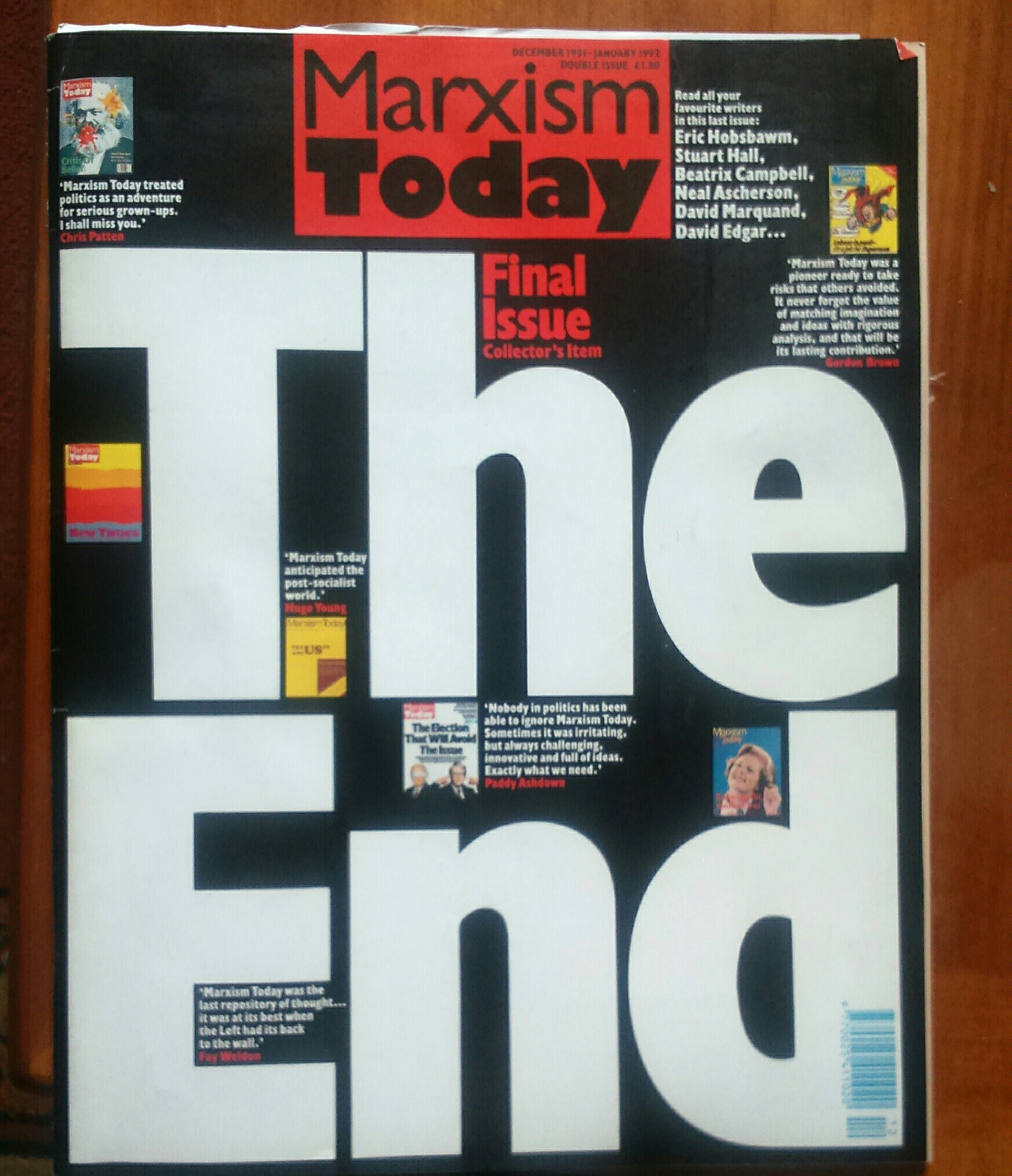
I note that it says “Collector’s Item” on the front, though I’m not at all sure it’s worth any more now than the £1.80 I paid nearly 25 years ago!
Follow @telescoperDear Leaver, your Perfect Brexit is going to be tricky…
Posted in Politics on August 19, 2016 by telescoperHere’s a very detailed and interesting post about the possible forms if relationship the UK might have with the EU after BrExit. If BrExit ever happens, of course. And if the UK still exist if it does…

Follow Nog’s Musings on WordPress.com
Hi Excited Leaver,
Note: originally this was written during a discussion with a leaver (Rod, I hope you are out there and doing well) but was then turned into a more generic post.
So, you’ve won the referendum and you’re excited about that great new deal we’re going to do with the Europeans. Let’s just recap the deal you’re after:
Access to the single market – basically it’s trade more or less exactly like we have now with the EU. BUT you want to drop some of the extras:
- No EU contribution
- No Freedom of Movement
- No pooled sovereignty
Seems simple enough, just a free trade deal? And of course you’ve been told we’re in a strong position, there’s that huge Trade Deficit as we buy far more than we sell so you’re confident we can drag the EU to the table and get the deal the…
View original post 1,822 more words
Simone Manuel and the Racism of Fred Hoyle
Posted in Biographical, Politics, Sport, The Universe and Stuff with tags 1985, Arthur Ashe, Durham. SERC, Fred Hoyle, Serena Williams, Simone Miguel, Sir Fred Hoyle on August 14, 2016 by telescoperReading just now about Simone Manuel, the first black person to win an Olympic Gold medal in swimming, I suddenly remembered a bizarre event that has been lurking in the back of my mind since 1985.
In September of that year I attended a Summer School for new PhD students in Astronomy, held in Durham. I have posted about this before actually, primarily because it is interesting how many others who attended that School are still around, in senior academic positions.
Anyway, one evening during the course of this meeting there was a public lecture by non other than Sir Fred Hoyle, many of whose books on cosmology I had borrowed from the public library when I was at school and played a big part in encouraging me to study physics at university.
But Fred Hoyle’s talk that evening (to a packed lecture theatre) was not about physics but about his pet theories about the evolution of life, most of which are now generally regarded as nonsense.
At one point in his somewhat rambling discourse he digressed into the subject of the sporting abilities of different racial groups. His first assertion was that black people (by which he meant people of African origin) do not make good swimmers because their bones are too dense and the consequent lack of buoyancy is a significant disadvantage. “Have you ever seen a black swimmer in the Olympics?” he asked. None of us had, of course, but couldn’t that be because of other reasons such as lack of access to swimming pools? No. Fred was adamant. It was down to biology. I assumed he knew what he was talking about, so kept quiet.
He went on to argue that black people were also disadvantaged at tennis – not because of social factors limiting access to tennis courts – but for reasons of “poor hand-eye coordination” which he also asserted to be an inherited characteristic. This time I knew straight away he was talking drivel. The previous summer I had watched the brilliant West Indies cricketers thrash England 5-0 in a test series; their hand-eye coordination certainly wasn’t poor. And neither was that of Arthur Ashe who had beaten Jimmy Connors in the Men’s Singles Final at Wimbledon a decade earlier, nor the majestic Serena Williams who is probably the greatest female tennis player the world has ever seen.
These examples left me not only deeply suspicious of Hoyle’s racist attitudes but also staggered by his completely unscientific attitude to evidence. Great theoretical physicist he was – at least early in his career – but being expert about one thing doesn’t mean can’t make an utter fool of yourself if you blunder into another field. Sadly, theoretical physicists do have a greater tendency than most scientists to forget this.
Follow @telescoperGhent for MaxEnt
Posted in Biographical, Politics with tags Belgium, Ghent, MaxEnt 2016, Maximum Entropy and Bayesian Methods on July 9, 2016 by telescoperJust a quick post to mark the fact that I’ve arrived in the fine city of Ghent for the forthcoming MaxEnt 2016 (Bayesian Inference and Maximum Entropy Methods in Science and Engineering). The trip from Brighton was pleasant and disruption-free (Thameslink from Brighton to St Pancras, Eurostar t0 Brussels, and local train to Ghent, all components of which journey were on time). In fact I travelled from London with a British contingent of the conference: John Skilling, Steve Gull and Anton Garrett (a regular commenter on this blog). We got here in time for dinner al fresco in a square near my hotel overlooked by an interesting local landmark:
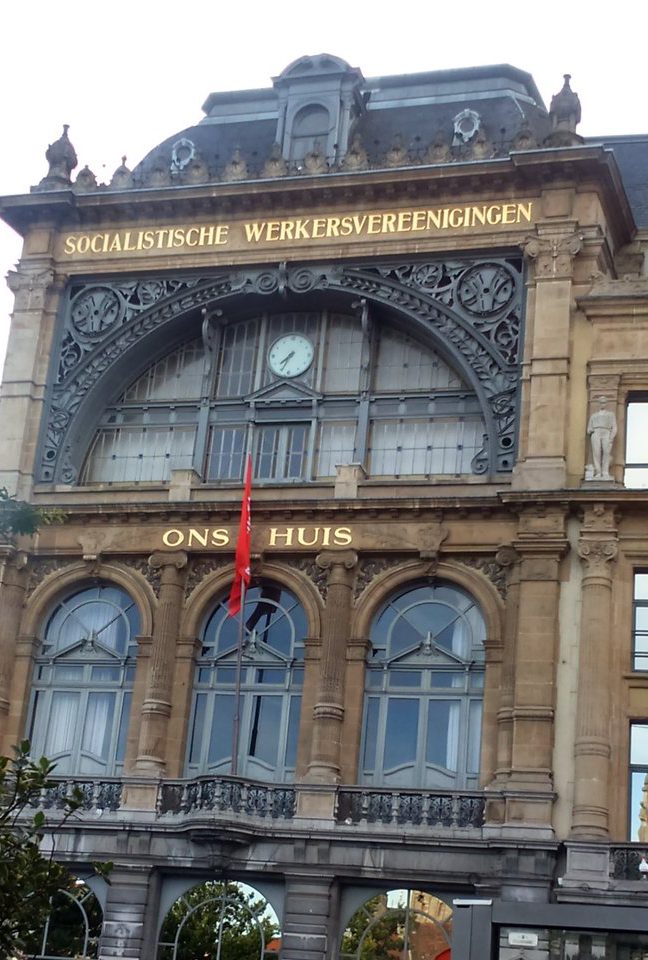
My Flemish isn’t marvellous but I translate the words at the top of the building as Socialist Workers’ Party, although it does seem a rather grandiose building for that!
Anyway, I hope to be able to do a bit of Bayesian blogging from Belgium while I’m here, during the next week. The meeting itself starts tomorrow..
Follow @telescoper

 In the Dark