This short talk, by Professor Michael Dougan of the University of Liverpool Law School, has been widely circulated but I thought I’d nevertheless share it here as it explodes many of the untruths circulating about the European Union. There’s far more useful information in this than anything produced in the official campaigns on either side, so whether you’ve made your mind up already or not, please have a look..
Follow @telescoperArchive for the Politics Category
The EU Referendum – “Dishonesty on an Industrial Scale”
Posted in Politics with tags European Union, Law, Michael Dougan, Referendum on June 22, 2016 by telescoperWhy I think the United Kingdom should remain in the European Union
Posted in Biographical, History, Politics on June 19, 2016 by telescoperThese last few weeks have been absurdly busy, and even without Thursday’s referendum, next week promises to be even busier. I will, however, definitely make time to vote and I urge you to do the same, whichever way you feel inclined to cast your ballot.
A number of my friends and colleagues have been posting on social media about why they plan to vote for one side or the other, or in some cases already have voted ( by postal ballot), so I thought I’d do the same today. I don’t suppose my ramblings will change anyone’s mind, and that’s not the reason for posting this anyway. It’s just a personal opinion, that’s all. It’s fine if yours is different. I have friends who disagree strongly with what I’m going to say, but we’re still friends. There’s no reason to think that will change whichever way the vote goes, although I am deeply worried about what damage the campaign has done to British political culture (which was deeply flawed before it started).
Let me start with a bit of biography that might explain why I see things the way I do. I was born in Wallsend on Tyneside in 1963. My parents were both born just before World War 2 started also in the area where I was born. Of my four grandparents, one was born in England, one in Northern Ireland, one in Scotland, and one in Wales. I always smile when I get to right my nationality on a form, because I put “United Kingdom”. Of course being born in England makes me English too, but I find that less defining than “UK” or even “Geordie”. To be honest, my ancestry means that I generally find the whole concept of nationality fundamentally silly. I find nationalism silly too, except for those occasions – regrettably frequent – when nationalism takes on the guise of xenophobia. Then it is much more sinister. That is happening now in the United Kingdom, a point I will return to later.
I don’t come from a wealthy background. Holidays abroad were an unaffordable luxury when I was a kid. In fact, the only members of my immediately family ever to venture abroad before I did for the first time (in 1986) were my grandfather’s brother (who died at Arnhem in 1944), his cousin (who died at the Salerno landings in 1943), and my uncle Richard who crossed the Rhine with the British Army in 1945 and was stationed in the devastated city of Hamburg for the duration of his National Service; he at least survived the War.
I had the good fortune to be born during a time of peace and relative prosperity, and have experienced immense good fortune in my life. I got a scholarship to go to a very good school and thence won a place at Cambridge University, where I did well enough to go onto a PhD here at the University of Sussex. Thirty years ago last summer, when I was 23, I went abroad for the very first time – to a cosmology conference in Cargèse, in Corsica. Since then I’ve had the opportunity to travel widely in Europe and beyond, meeting and working with some wonderful people. What little sense of nationality I started with has diminished steadily with time, and I now have no difficulty at all in adding another label to my identity: European. I’m British and I’m European. And proud to be both. That statement alone has led to me being called a “traitor”, such are the depths to which this wretched referendum campaign has sunk. Fortunately I an nowhere near sufficiently important or prominent for anyone to assassinate.
The United Kingdom joined the European Economic Community (as it was then called) in 1973, when I was ten years old. The EEC morphed into the EU in 1993, but in some form or another it has been a fact for all of my adult life. There is no question in my mind that Britain’s membership has been has been very good for Britain and for the other member states. We pay a subscription to the modern EU that amounts to around 0.5% of our public spending and for that we get preferential access to a free market that gives us around ten times as much back in trade and inward investment.
My career in science gives a perspective on this too. The UK is a member of the European Southern Observatory (ESO), the European Organization for Nuclear Research (CERN) and the European Space Agency (ESA), all of which have been stunningly successful. None of these are actually European Union organizations. ESO and CERN were founded in the 1950s and ESA in the 1970s, all before the EU formally came into existence. But they do serve as models for why the EU is such a good thing in a wider sense than the science that they do. Members of ESO, CERN and ESA pay a subscription which amounts to a pooling of resources into a pot far bigger than any individual country could manage. Each organization is run by a council that makes collective decisions on where and what to invest. The UK has a strong influence on those decisions. By being a member it has a seat at the table and a voice in the discussions. The net result is that each of these organizations is much more than the sum of its parts.

That model that works so well for ESO, CERN and ESA is basically the model for the European Union. Even when they’re not lying about the cost of membership as the official Vote Leave campaign consistently does, people tend to talk in a very short-sighted way about the amount we pay and how much we get back. That’s the wrong way to look at it. The point is that, just as with scientific organizations, the EU is more than the sum of its parts. Pooling some resources and doing things collectively does, for certain things, give a value way beyond the relatively small amount we invest. But remember that we only pool 0.5% of our public funds in this way. It’s an astonishingly good deal. And, what’s more, it’s mutually beneficial. The UK benefits and the other EU member states benefit too. It’s not “us” versus “them”, it’s “we”.
Now I know that BrExit advocates will say. “You profit from EU grants! You’ve been bought off by the EU! You’ve a vested interest!” I’ve been attacked on social media repeatedly for having the temerity to argue that EU membership is as good for science as it is for everything else. But the fact of the matter is that the accusation is completely false. My own research is wholly funded from UK sources. I don’t have any EU funding at all. Even if I had I’d still have a right to express my opinion, but I don’t. I haven’t been “bought off” by anyone. I’ve thought about the issues and come to my own conclusion. You can do that in a free country.
The EU is by no means perfect. I think it could be made more accountable, more democratic. I understand those concerns, but I do feel that they’re hard to justify coming from one of the least democratic countries in Europe. We have an entirely unelected House of Lords, and a House of Commons that has delivered an overall majority to a party with a minority share of the popular vote. Pot calling the kettle black?
I think the economic, educational, cultural and societal benefits of EU membership have been discussed widely in the referendum campaign so I won’t repeat them here. I’ll just say that I think the benefits are immense, and the risk to this country if they are lost is huge.
But there is one reason over and above all this why I shall be voting to Remain in the EU. For this I will quote note other than Boris Johnson, who wrote just two years ago in his biography of Winston Churchill:
It was his (Churchill’s) idea to bring those countries together, to bind them together so indissolubly that they could never go to war again – and who can deny, today, that this idea has been a spectacular success? Together with Nato the European Community, now Union, has helped to deliver a period of peace and prosperity for its people as long as any since the days of the Antonine emperors.
I won’t comment on why Boris Johnson has changed his mind, but I agree with that statement. It brings me back to the bit of personal family history with which I started this post. I have been lucky enough to live in the period of “peace and prosperity” described in that quote. I am sorry my grandfathers’ generation was not so lucky. I don’t have any children of my own, but I categorically refuse to take any step that would risk any future generation having to endure the same horrors.
And then there’s this.
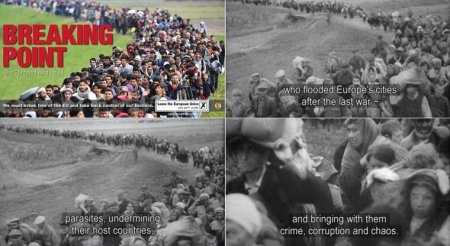
The top left image shows a poster produced by the UK Independence Party. The other three are taken from a Nazi propaganda film of the 1930s. The historical parallels are obvious and not accidental. This is indeed “Breaking Point” indeed. It’s the point the BrExit campaign descended into the gutter.
Of course I’m not saying that all those who want the UK to Leave the EU are fascists. Far from it. Many – indeed the majority – are reasonable, civilised people. But like it or not, if you vote Leave you’re voting the way the far right want you to vote. I for one will not take a single step in that direction. Fascism only needs a foot in the door. I fear that the domestic political consequences of BrExit will give it far more than that. Once they get hold of it, we’ll never get our country back.
One final point. On Thursday I will definitely vote for the United Kingdom to remain in the EU. However, Article 50 of the Lisbon Treaty allows any member state to leave the European Union, and sets a protocol for how this can be achieved. This demonstrates that the UK has sovereignty over its own affairs, thus defeating one of the central arguments of the Leave campaign.
Follow @telescoper
Migration: Time to tear up Leave’s last card
Posted in Politics, Uncategorized on June 10, 2016 by telescoperFrom the same sources as yesterday’s reblog, here’s an important post about immigration.
I’ve long felt that there is a big problem with immigration in the United Kingdom. There simply isn’t enough of it!

Nigel Farage told the TV debate audience on Tuesday that, under his proposed immigration points system, more black people would be allowed into Britain. The following morning, when grilled by Piers Morgan, he said:
What I would like is us to return to post-war normality. For about 60 years, we had net migration into Britain between 30,000 and 50,000 people a year.
Now there could be a bit of a problem with this. It depends on how you define black but I’m guessing most of the people from sub-Saharan Africa would fall into that category. Last year, net migration from that region was 21,000. Allow for people coming from the Carribean and you’d already be around half way to Nigel’s target. If he’s said that more black people are going to come in, that doesn’t leave much room for anyone else.
Meanwhile Priti Patel has been promising Asian voters that, after…
View original post 973 more words
Wakeham Review of STEM Degree Provision Graduate Employability and
Posted in Politics, Science Politics, Uncategorized with tags Employability, Sir William Wakeham, STEM on May 20, 2016 by telescoperAbout to embark on a weekend of examination marking, a desperate search for displacement activities reminded me of this important report by Sir William Wakeham (who happens to be the Chair of SEPNet, the South-East Physics Network, of which the University of Sussex is a member, so I get to call him Bill).
Apparently Bill’s report has been ready for some time but has been stuck on a shelf in Whitehall somewhere waiting to be released. Arcane rules about publishing government reports in the run-up to elections meant that it had to wait until after May 5th for publication.
Anyway, it was published this week (May 16th to be precise) and I encourage you all to read it. You can find the report and various annexes here. It has clearly been a complex task to make sense of some of the datasets used because they are incomplete and/or confusing, so inevitably some important questions remain unanswered. There are nevertheless clearly worrying signs for certain disciplines, as described in the Executive Summary:
Based on the accumulated evidence we have arrived at a list of degree disciplines where the graduate employment outcomes are sufficiently concerning for us to recommend additional targeted work. The STEM disciplines that the review has identified as being of particular concern are:•Biological Sciences•Earth, Marine and Environmental Sciences•Agriculture, Animal Sciences and Food Sciences
I’m a little surprised that Biological Sciences appears in that list, because that is usually perceived as a burgeoning area, but it’s clear that some graduates in that area do find it more difficult to find employment than in other STEM areas. However, if you read the report in more detail you will see that there are many sub-disciplines involved in Biological Sciences and the picture isn’t the same for all of them. It does seem, however, that in some of the Biological Sciences, graduates do not have sufficient training in quantitative methods to suit the demands of potential employers.
There you go. Give it a read. Any comments?
Follow @telescoperA Liar and a Cheat and the Leader of UKIP Wales
Posted in Politics with tags Cash for Questions, Neil Hamilton, Senedd, UKIP on May 11, 2016 by telescoperLast week’s elections to the Welsh Assembly saw the UK Independence Party winning seats in the Senedd for the very first time, although Welsh Labour remained the largest party by a comfortable margin despite losing a seat to Plaid Cymru. Among the 7 UK AMs elected was disgraced former Conservative MP Neil Hamilton who featured in this Guardian headline just 20 years ago.
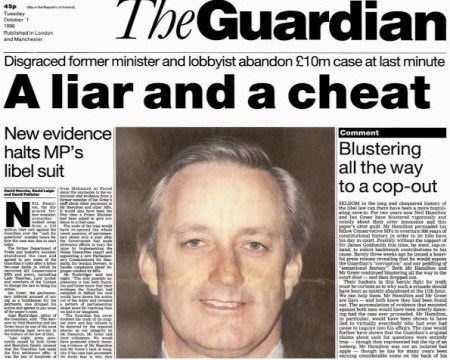
Following this “Cash for Questions” scandal, he lost his seat in the 1997 General Election, at which point he left politics and joined UKIP.
Not content with merely winning a seat in the Assembly elections, Mr Hamilton then ousted former leader Nathan Gill of UKIP Wales and is now running the show. It’s been a bizarre turn of events. There’s clearly no end to his ambition (nor any beginning to his integrity).
Questions may be asked about a person such as Neil Hamilton could have been voted into power, but it’s not year clear how much it will cost to ask them.
All I can say is I hope they keep a close eye on the cutlery in the Senedd canteen.
Follow @telescoper
Six Things We Know About EU Referendum Campaigns
Posted in Politics with tags BrExit, EU referendum on May 11, 2016 by telescoperInteresting comments on referendums authored by academics from the University of Sussex, although it seems to me that the thing that most affects the outcome of a referendum is how many people vote on each side…

Kai Oppermann and Paul Taggart
Donald Rumsfeld famously talked about ‘known knowns’ and ‘known unknowns’. Looking systematically at referendums and at the experience of these in Europe, we can learn from what has happened in other European referendums to help us in looking at what may happen in the UK’s referendum on EU membership. There may be uncertainty ahead but we can know what we don’t know from previous experience. We suggest that there are six lessons we can learn
Referendum outcomes are hard to predict
The one ‘known known’ we have is the state of the polls at the outset. But early in the campaign, opinion polls tell us very little about what the outcome of the referendum will be on 23 June. Around 20% of voters are still undecided. More than that, voting behaviour in referendums is much less settled and more fluid than in general elections. This…
View original post 1,298 more words
What has the European Convention on Human Rights ever done for us?
Posted in Politics with tags ECHR, European Convention on Human Rights, Guardian on April 27, 2016 by telescoperIn case there are some people who haven’t seen this yet, here is a short video featuring Sir Patrick Stewart the Guardian made in response to Home Secretary Theresa May’s suggestion that the United Kingdom should leave the European Convention on Human Rights. It owes more than a little to Monty Python’s Life of Brian but is none the worse for that. Make sure you watch right to the end as it exposes the hypocrisy of Home Secretary’s position on this.
Follow @telescoperThe UK Financial Contribution to the EU
Posted in Finance, Politics with tags European Union, Finance, Referendum on April 22, 2016 by telescoperThere’s so much misunderstanding and distortion flying around about the United Kingdom’s contribution to the European Budget and what it might be spent on if we left the EU that I just thought I would post this for information. It shows official figures from HMRC for 2014. Similar pie charts are available for other years, but often they include the EU contribution under “other” which is why I’ve chosen this particular one. Also, I’m very lazy and it came up first on Google…
Although it’s a lot of money in cash terms, it’s very small compared to current expenditure on, e.g. Health, Education and Welfare and even compared to the interest payments on our national debt. Saving this contribution would not make sufficient financial resources available to make a significant difference to these other big ticket items. Note also that if the UK loses its current credit rating, the expense of servicing our debt will increase by an amount that could easily on its own wipe out the saving on our EU subscription.
And of course what we get for that relatively small contribution is access to beneficial trade agreements, inward investment from EU companies and other sources, and access to the science programmes. You may disagree, of course, but I think it’s money very well spent.
Follow @telescoper
The EU Referendum and the Importance of Voting
Posted in Politics on April 18, 2016 by telescoperHere’s a post from the University of Sussex student blog site explaining why it’s important for everyone to vote in the forthcoming EU Referendum. The votes cast on June 23rd will lead to a decision that’s likely to be irrevocable so it’s especially important that younger people vote.

On Thursday 23rd June 2016, the UK will decide whether or not to remain in the European Union, and oh boy is this a big deal. This blog is designed to be accessible, to clear up some common misconceptions about the EU and to explain the methods of voting. You shouldn’t need any background in European politics to understand this. I am a firm fan of the EU and fully encourage you all to vote, and to vote to stay in.
View original post 752 more words


